
Writing a Constructed Response Grade 4 I MiniLesson




- Slides: 55
Writing a Constructed Response Grade 4
I. Mini-Lesson Statement Writers explore specific types of writing to understand how to write in that specific genre.
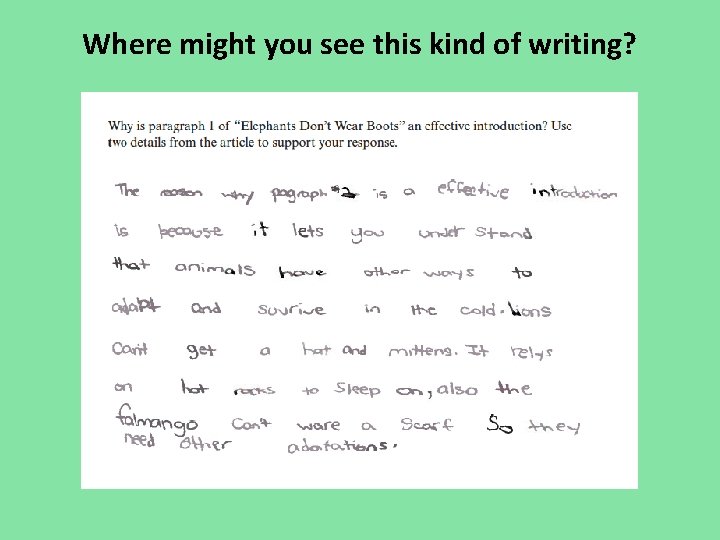
Where might you see this kind of writing?
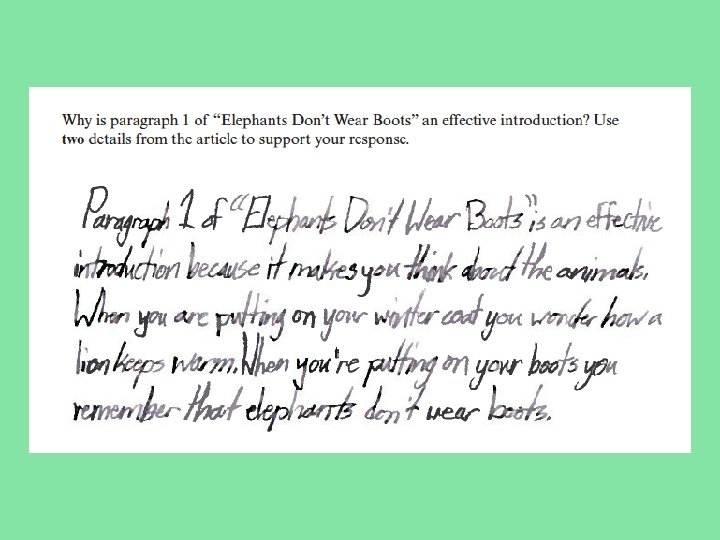
“Have A Go” Let’s quickly look at a response from “Elephants Don’t Wear Boots” • What do you notice about this kind of writing?
Application • Return to your seats to look through the writing samples with your writing partners. • Record your findings in your Writer’s Notebook, paying attention to the type of information you see in the writing.
Share • Volunteers to share the information you gathered? • Record findings on a chart.
Noticings
Remember… Writers explore specific types of writing to understand how to write in that specific genre.
Define Genre: A constructed response is…
II. Mini-Lesson Statement Writers restate a question to begin a response.
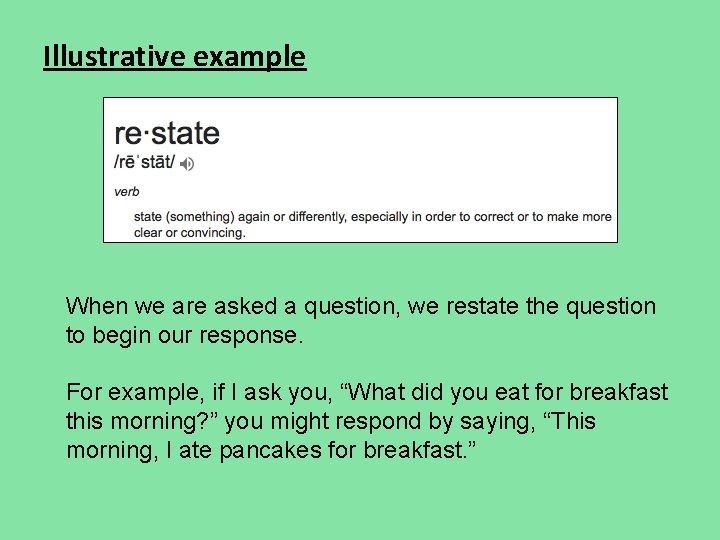
Illustrative example When we are asked a question, we restate the question to begin our response. For example, if I ask you, “What did you eat for breakfast this morning? ” you might respond by saying, “This morning, I ate pancakes for breakfast. ”
Let’s try a few together: • “How did you get to school this morning? ” • “What time did you go to bed last night? ” • “Who will you sit next to at lunch today? ”
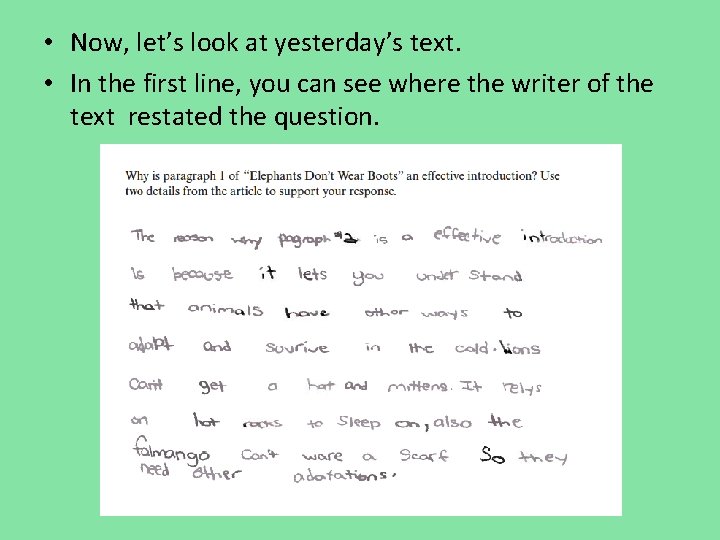
• Now, let’s look at yesterday’s text. • In the first line, you can see where the writer of the text restated the question.
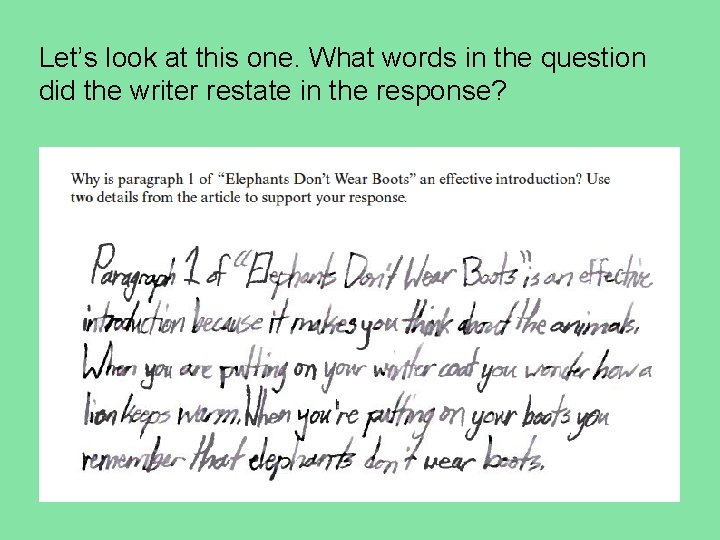
Let’s look at this one. What words in the question did the writer restate in the response?
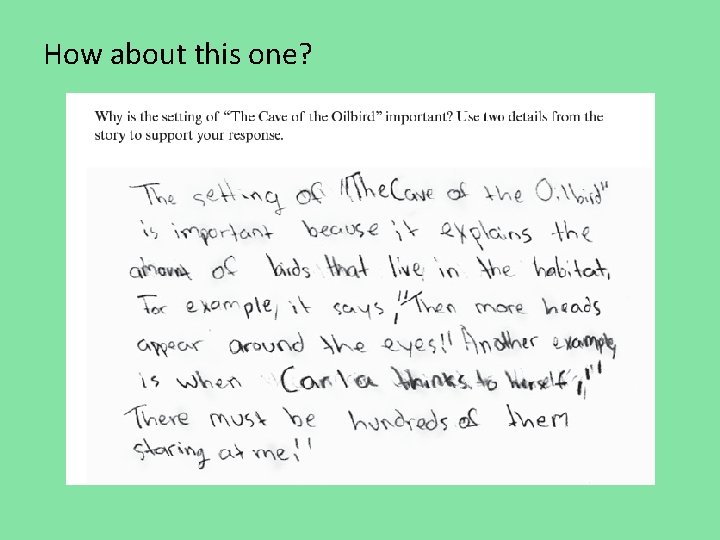
How about this one?
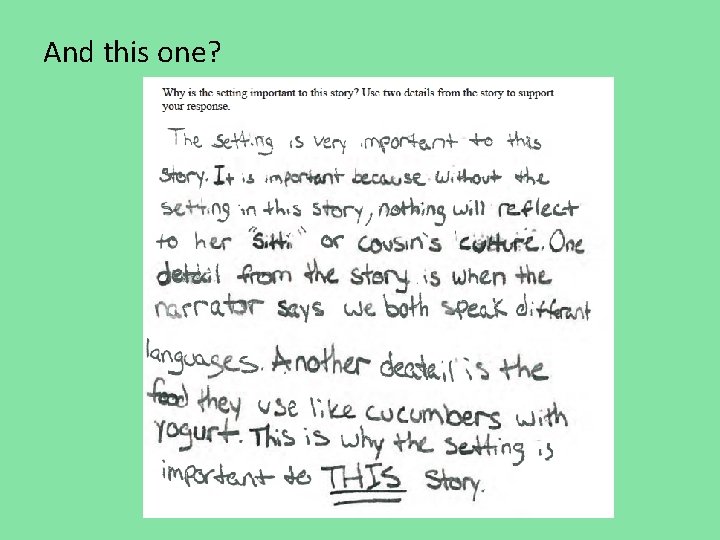
And this one?
Application • Look at the questions on the sheet that you will be given. • Using the language in the question, begin a response to each question. • Underline the language that the question and your statement have in common.
Share Volunteers to share one of your examples? What did you do last night when you got home from school?
How did you decide what to wear to school today?
When did you wake up this morning?
What do you have planned today after school?
A few questions of your own?
Remember… Writers restate a question to begin a response.
III. Mini-Lesson Statement Writers state a claim to answer the question.
What is a claim? • A statement that declares something to be true • An arguable statement
Illustrative Examples When you state a claim, it has to be one that is supported by evidence from the text. You can't just make a claim that has no evidence to back it up. Example: According to the article “I Know What Bit You Last Summer, ” why are deer flies able to easily attack humans?
Applying the skill we learned yesterday, I'm going to restate the question and then will make a claim as an introduction for my response: My claim: According to the article, deer flies are able to easily attack humans because they have a number of adaptations.
What are some other claims we can make to answer the question: Why are deer flies able to easily attack humans?
Application • In your Writer's Notebooks, make several more claims to begin a response to our question: Why are deer flies able to easily attack humans? Be sure to begin your response by first, restating the question.
Share Volunteers to share one of their claims?
Remember. . . Writers state a claim to answer a question.
IV. Mini-Lesson Statement Writers cite evidence from the text to support their claim.
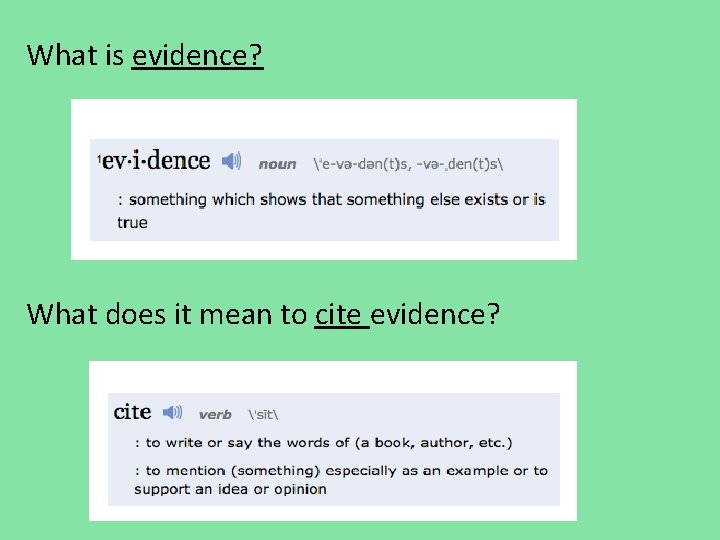
What is evidence? What does it mean to cite evidence?
Illustrative Examples Yesterday we stated a claim about why deer flies are able to easily attack humans. Question: According to the article “I Know What Bit You Last Summer, ” why are deer flies able to easily attack humans? My claim: According to the article, deer flies are able to easily attack humans because they have a number of adaptations. Today, we are going to learn how to cite evidence to support our claim.
According to the article “I Know What Bit You Last Summer, ” deer flies are able to easily attack humans, because they have a number of adaptations. One adaptation they have is two razor-sharp pincers, like scissors protruding from the front of their shiny heads.
Let's try one together: Claim: According to the article “I Know What Bit You Last Summer, ” deer flies are able to easily attack humans, because they have a number of adaptations. Evidence?
Application Use one of the charted claims from yesterday and cite at least 2 pieces of evidence to back up your claim.
Share Volunteers to share your work from today?
Remember. . . Writers cite evidence from the text to support their claim.
V. Mini-Lesson Statement Writers explain their reasoning to show the evidence supports their claim.
So far, you've learned how to: · • Restate the question when beginning your response • Answer the question by making a claim • Cite evidence to support your claim Today, I'm going to show you how to explain how your evidence supports your claim.
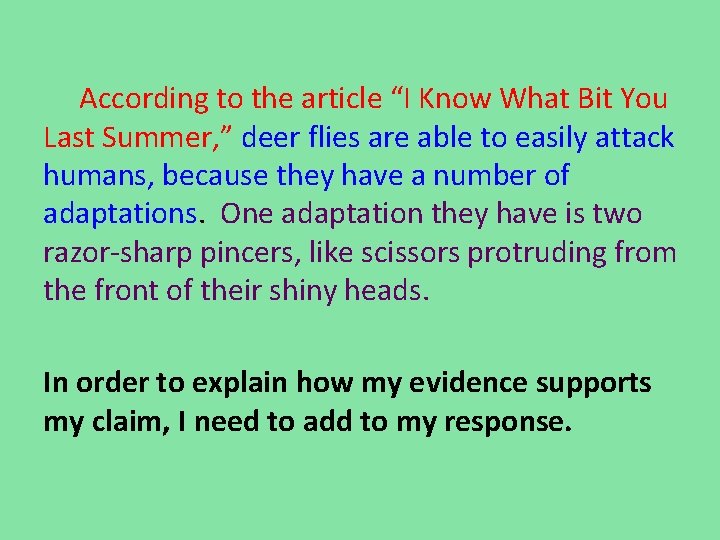
According to the article “I Know What Bit You Last Summer, ” deer flies are able to easily attack humans, because they have a number of adaptations. One adaptation they have is two razor-sharp pincers, like scissors protruding from the front of their shiny heads. In order to explain how my evidence supports my claim, I need to add to my response.
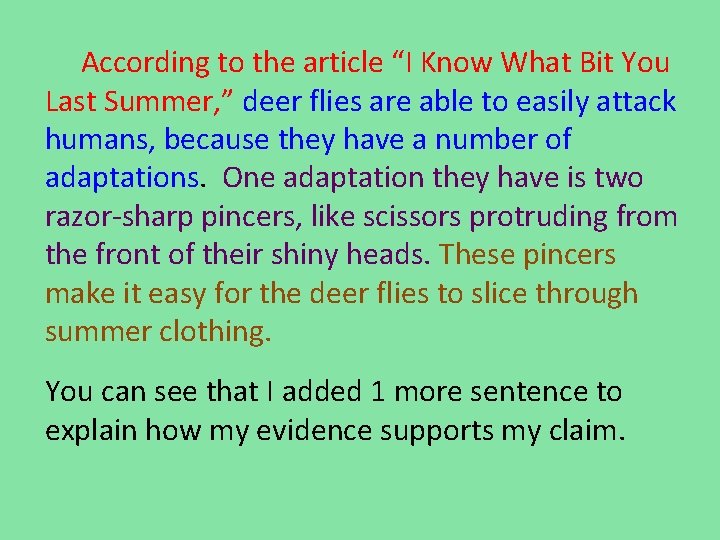
According to the article “I Know What Bit You Last Summer, ” deer flies are able to easily attack humans, because they have a number of adaptations. One adaptation they have is two razor-sharp pincers, like scissors protruding from the front of their shiny heads. These pincers make it easy for the deer flies to slice through summer clothing. You can see that I added 1 more sentence to explain how my evidence supports my claim.
Let's try one together: What can I add to my writing to explain how my evidence, “The bug eyes on deer flies are actually thousands of little lenses clumped into two larger eyes” is an adaptation that makes it easy for deer flies to attack humans?
Application • Use the piece of writing that you worked on in the last lesson. • Add at least 1 sentence per piece of evidence to show the evidence supports your claim.
Share Volunteers to share the writing they added to their work today?
Remember. . . Writers explain their reasoning to show the evidence supports their claim.
VI. Mini-Lesson Statement Writers summarize their response to provide a concluding statement.
So far, you've learned how to: • Restate the question when beginning your response • Answer the question by making a claim • Cite evidence to support your claim • Explain how your evidence supports your claim Today, I'm going to show you how to provide a concluding statement.
Illustrative Example According to the article “I Know What Bit You Last Summer, ” deer flies are able to easily attack humans, because they have a number of adaptations. One adaptation they have is two razor-sharp pincers, like scissors protruding from the front of their shiny heads. These pincers make it easy for the deer flies to slice through summer clothing. Another adaptation is the bug eyes that are actually thousands of little lenses clumped into two larger eyes. The tiny lenses show the flies many different images of the same thing giving it superb ability to detect human motion. The adaptations that deer flies have make it easy for them to prey upon humans.
Your concluding statement should be one sentence that circles back to your original claim. Let's try one together:
Application Using the piece of writing that you've been working on: • Try out several concluding statements. • Choose the best one to end your response.
Share Volunteers to share your best concluding statement?
Remember. . . Writers summarize their response to provide a concluding statement.