
Writing 15 marks There are 2 questions to

- Slides: 26
Writing: 15 marks There are 2 questions to be attempted: first question: 5 marks second question: 10 marks Questions differ in length and expectations of marker. Allow about one hour for this section
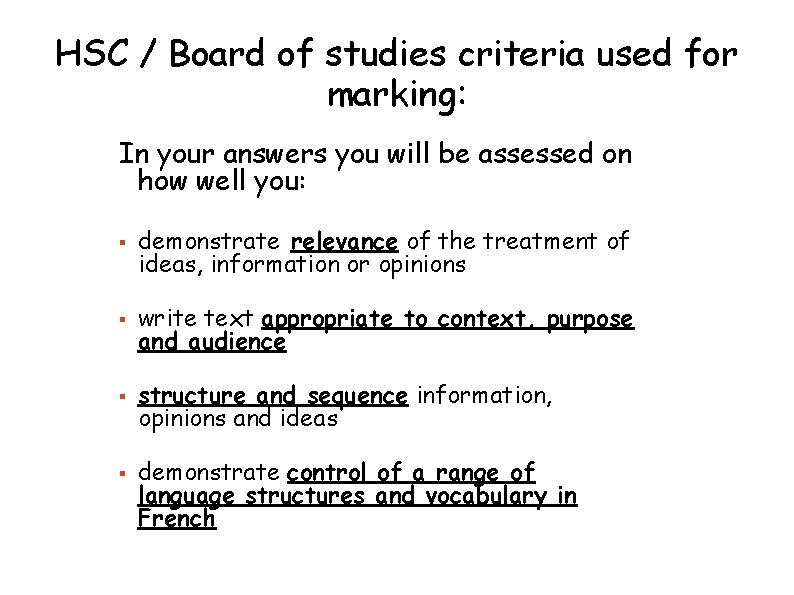
HSC / Board of studies criteria used for marking: In your answers you will be assessed on how well you: demonstrate relevance of the treatment of ideas, information or opinions write text appropriate to context, purpose and audience structure and sequence information, opinions and ideas demonstrate control of a range of language structures and vocabulary in French
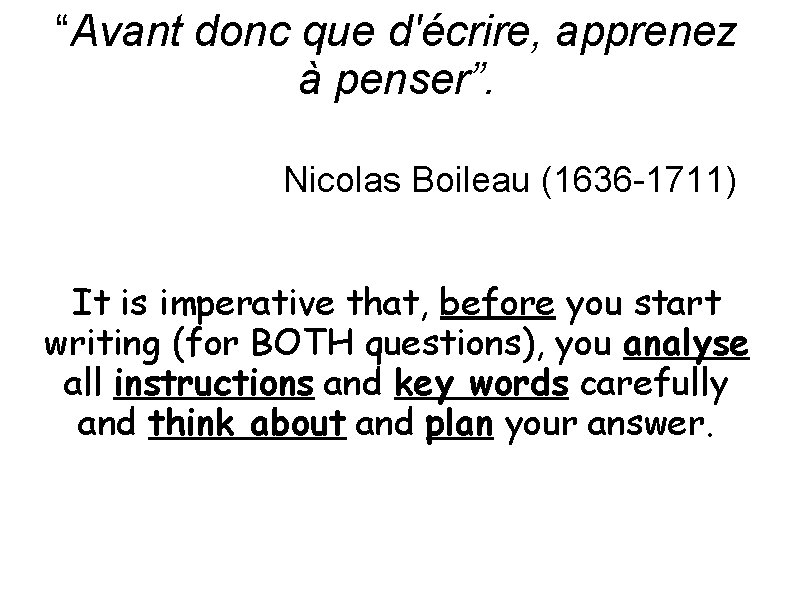
“Avant donc que d'écrire, apprenez à penser”. Nicolas Boileau (1636 -1711) It is imperative that, before you start writing (for BOTH questions), you analyse all instructions and key words carefully and think about and plan your answer.
HSC French continuers marking guidelines 2012 http: //www. boardofstudies. nsw. edu. au/hsc_exams/hsc 20 12 exams/ Notes from the marking centre 2012 http: //www. boardofstudies. nsw. edu. au/hsc_ex ams/hsc 2012 exams/notes/french. html#conti nuers
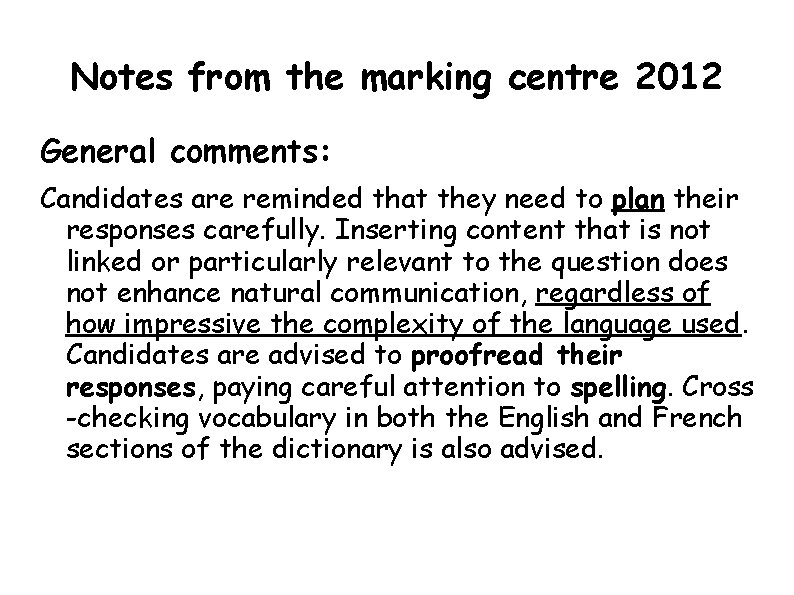
Notes from the marking centre 2012 General comments: Candidates are reminded that they need to plan their responses carefully. Inserting content that is not linked or particularly relevant to the question does not enhance natural communication, regardless of how impressive the complexity of the language used. Candidates are advised to proofread their responses, paying careful attention to spelling. Cross -checking vocabulary in both the English and French sections of the dictionary is also advised.
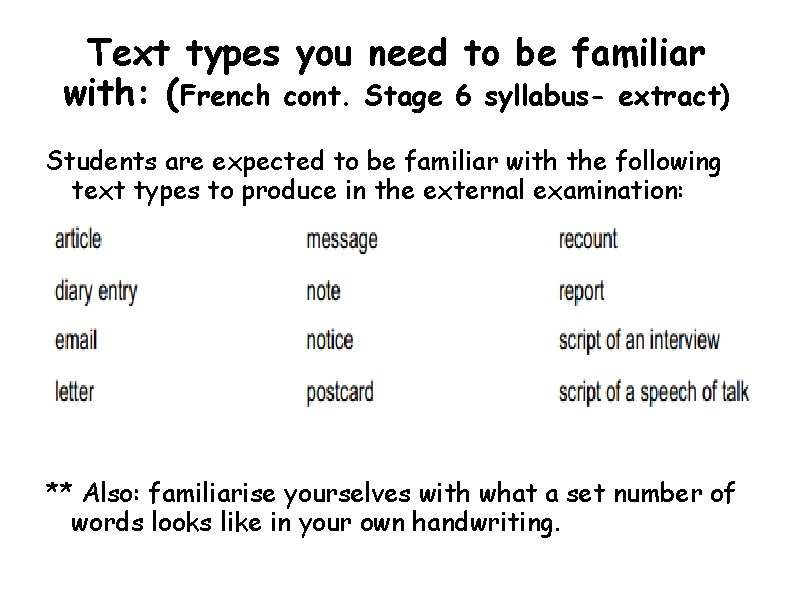
Text types you need to be familiar with: (French cont. Stage 6 syllabus- extract) Students are expected to be familiar with the following text types to produce in the external examination: ** Also: familiarise yourselves with what a set number of words looks like in your own handwriting.
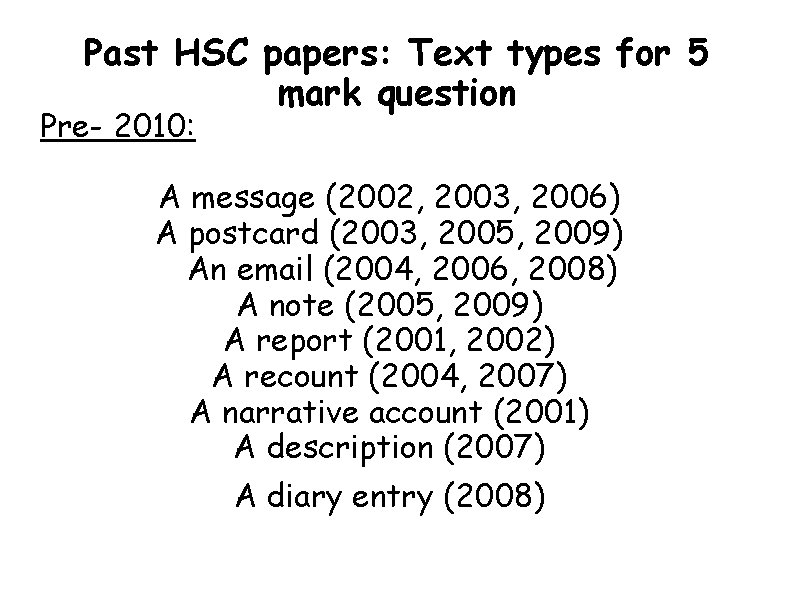
Past HSC papers: Text types for 5 mark question Pre- 2010: A message (2002, 2003, 2006) A postcard (2003, 2005, 2009) An email (2004, 2006, 2008) A note (2005, 2009) A report (2001, 2002) A recount (2004, 2007) A narrative account (2001) A description (2007) A diary entry (2008)
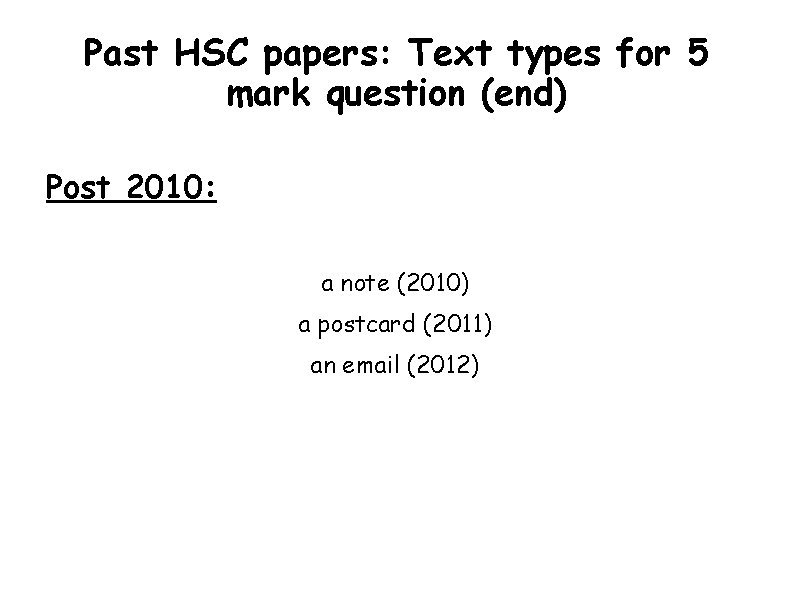
Past HSC papers: Text types for 5 mark question (end) Post 2010: a note (2010) a postcard (2011) an email (2012)
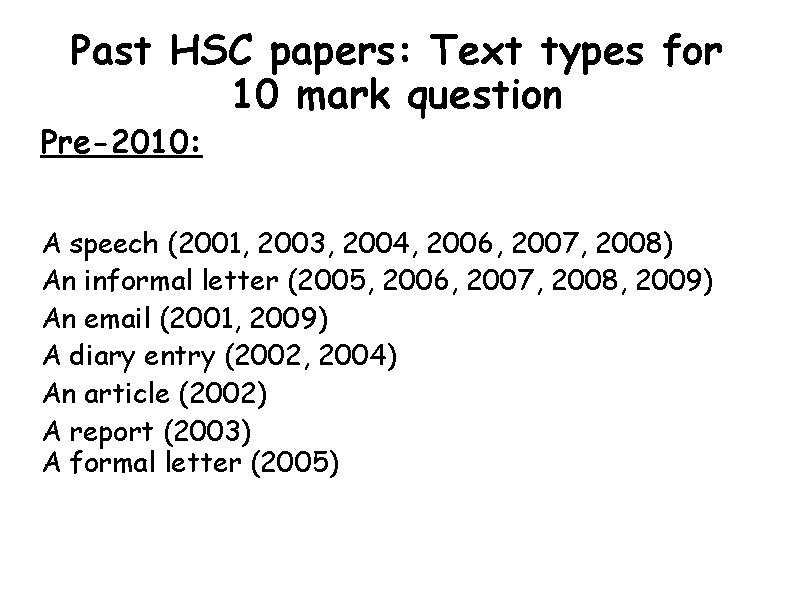
Past HSC papers: Text types for 10 mark question Pre-2010: A speech (2001, 2003, 2004, 2006, 2007, 2008) An informal letter (2005, 2006, 2007, 2008, 2009) An email (2001, 2009) A diary entry (2002, 2004) An article (2002) A report (2003) A formal letter (2005)
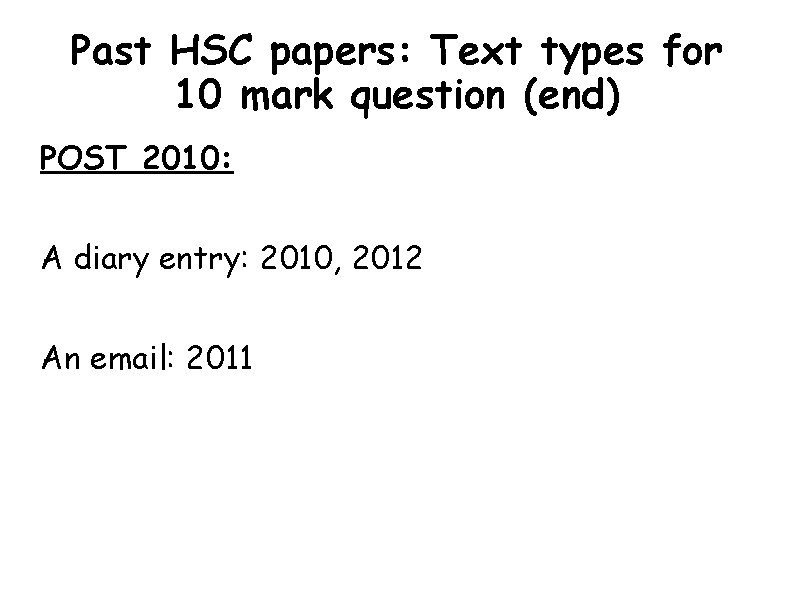
Past HSC papers: Text types for 10 mark question (end) POST 2010: A diary entry: 2010, 2012 An email: 2011
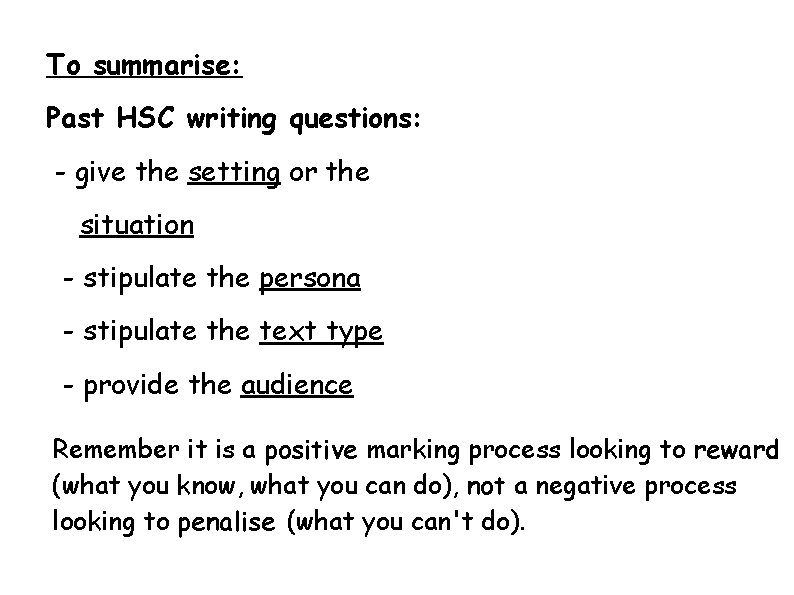
To summarise: Past HSC writing questions: - give the setting or the situation - stipulate the persona - stipulate the text type - provide the audience Remember it is a positive marking process looking to reward (what you know, what you can do), not a negative process looking to penalise (what you can't do).
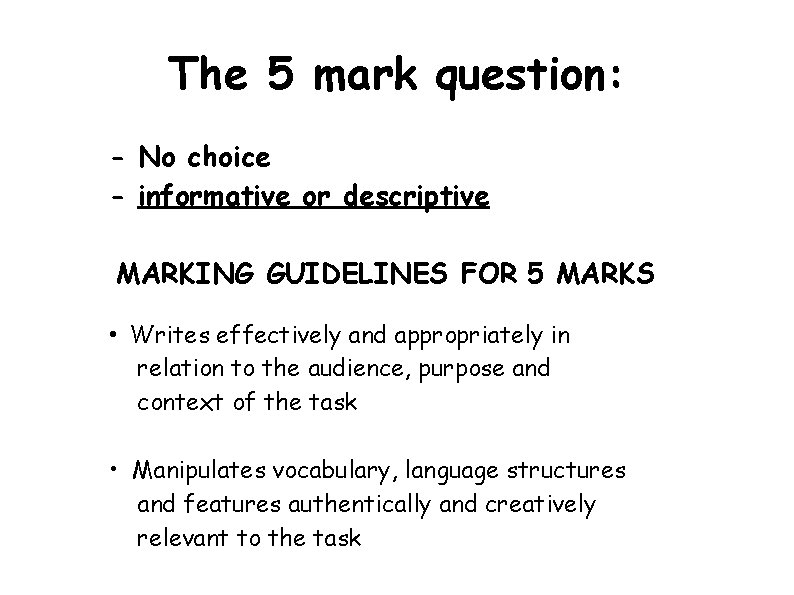
The 5 mark question: - No choice - informative or descriptive MARKING GUIDELINES FOR 5 MARKS • Writes effectively and appropriately in relation to the audience, purpose and context of the task • Manipulates vocabulary, language structures and features authentically and creatively relevant to the task
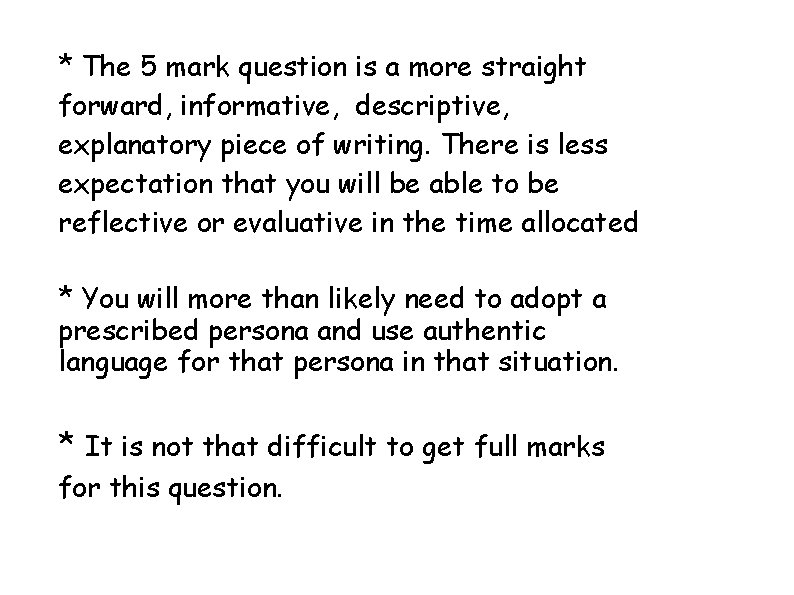
* The 5 mark question is a more straight forward, informative, descriptive, explanatory piece of writing. There is less expectation that you will be able to be reflective or evaluative in the time allocated * You will more than likely need to adopt a prescribed persona and use authentic language for that persona in that situation. * It is not that difficult to get full marks for this question.
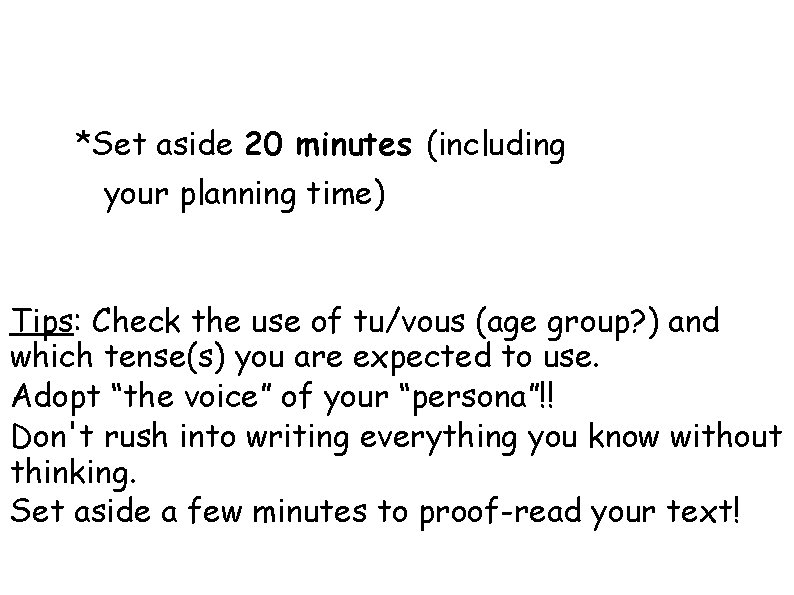
*Set aside 20 minutes (including your planning time) Tips: Check the use of tu/vous (age group? ) and which tense(s) you are expected to use. Adopt “the voice” of your “persona”!! Don't rush into writing everything you know without thinking. Set aside a few minutes to proof-read your text!
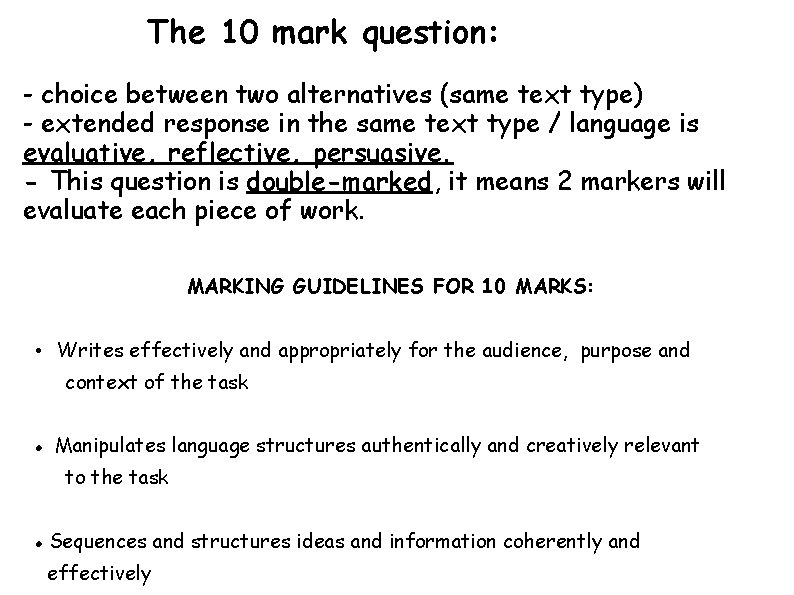
The 10 mark question: - choice between two alternatives (same text type) - extended response in the same text type / language is evaluative, reflective, persuasive. - This question is double-marked, it means 2 markers will evaluate each piece of work. MARKING GUIDELINES FOR 10 MARKS: • Writes effectively and appropriately for the audience, purpose and context of the task Manipulates language structures authentically and creatively relevant to the task Sequences and structures ideas and information coherently and effectively
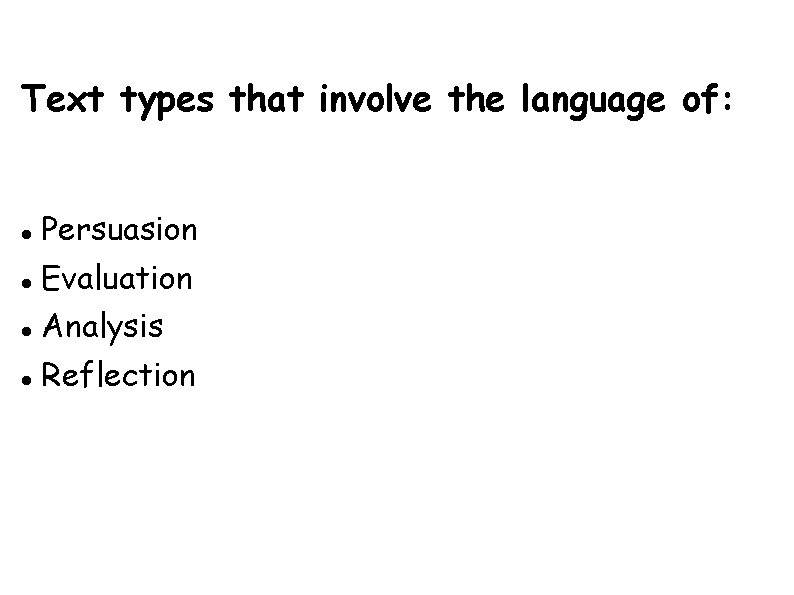
Text types that involve the language of: Persuasion Evaluation Analysis Reflection
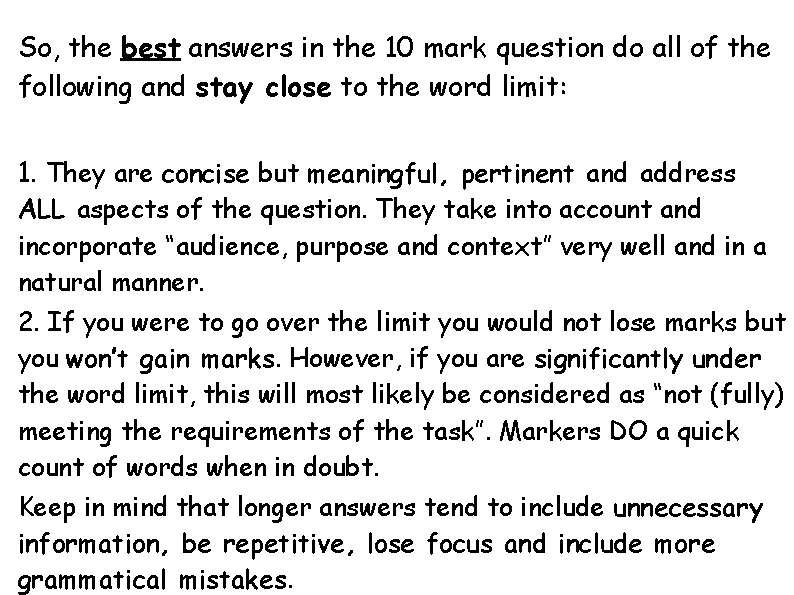
So, the best answers in the 10 mark question do all of the following and stay close to the word limit: 1. They are concise but meaningful, pertinent and address ALL aspects of the question. They take into account and incorporate “audience, purpose and context” very well and in a natural manner. 2. If you were to go over the limit you would not lose marks but you won’t gain marks. However, if you are significantly under the word limit, this will most likely be considered as “not (fully) meeting the requirements of the task”. Markers DO a quick count of words when in doubt. Keep in mind that longer answers tend to include unnecessary information, be repetitive, lose focus and include more grammatical mistakes.
3. The best answers show evidence of preplanning, and time at the end to review is time better spent than attending to the quantity. 4. The vocabulary is varied, complex and well used (e. g: no need to use and abuse the subjunctive forms out of context!) and gives an “authentic feel” to the text. There is evidence of the candidate being familiar with the various prescribed topic-specific vocabulary. The syntax is correct and precise.
5. Be mindful that ultimately your audience is HSC markers so choose your situation and vocabulary (e. g: beware of overly colloquial and/or idiomatic language if not specifically appropriate for the task – my advice: use sparingly and thoughtfully: eg: vachement”, “chiant”. . ) 6. The best answers show evidence of being familiar with text type requirements and are well structured (use of appropriate linking devices). There is a logical progression, focus is not lost and it makes sense. 7. The grammar is correct and consistent. There is a very high standard of grammatical accuracy (a few occasional errors will not stop a candidate from getting full marks if the rest is excellent). Verb conjugations and agreements of adjectives in particular are correct and consistent.
8. Evidence of cultural knowledge (e. g: details of places, postcodes, seasons. . . . ) 9. The use of humour if possible and where appropriate (but that is not a compulsory requirement! : ) Aspire to be imaginative (but stick to the topic and do not go the other extreme into very convoluted scenarii!) Be creative (this is creative writing in French after all!) but remember that creativity comes with time spent thinking and planning!
Common Areas requiring attention can be found in: Writing in French - Notes from the Marking Centre (Board of Studies website) Extracts-2012: “Many responses that demonstrated extensive knowledge of French missed out on top marks because some parts of their writing were irrelevant to the question. Answers must be carefully planned beforehand so that each paragraph contributes to fulfilling the requirements of the question. For (a) and (b), the best answers were those scripts that stayed in touch with the key words from the questions: ‘reflect’ and ‘feelings’. ” “In weaker responses, candidates did not present the information in a coherent and structured sequence. Some answers were far too long or left unfinished. Some candidates made overly long introductions instead of getting to the point. Those who did write overly long answers often did not have the time to proofread their work and eliminate careless mistakes”.
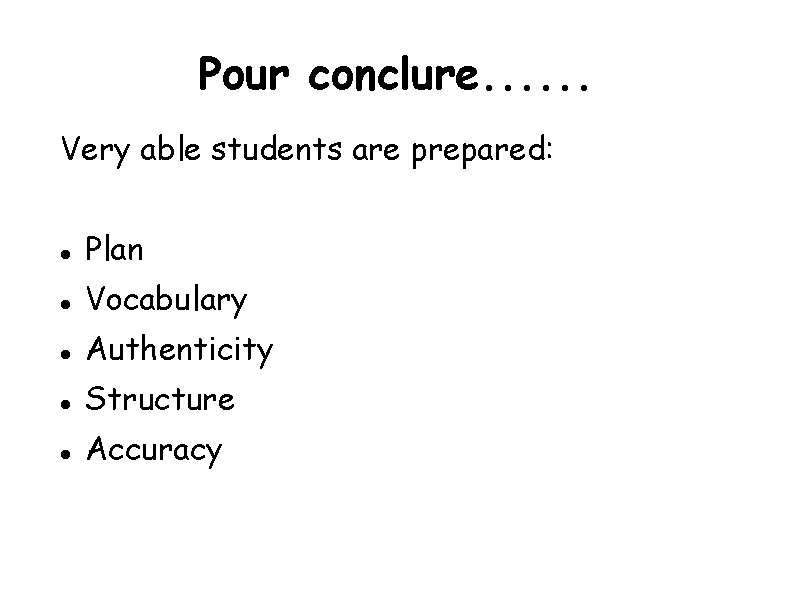
Pour conclure. . . Very able students are prepared: Plan Vocabulary Authenticity Structure Accuracy
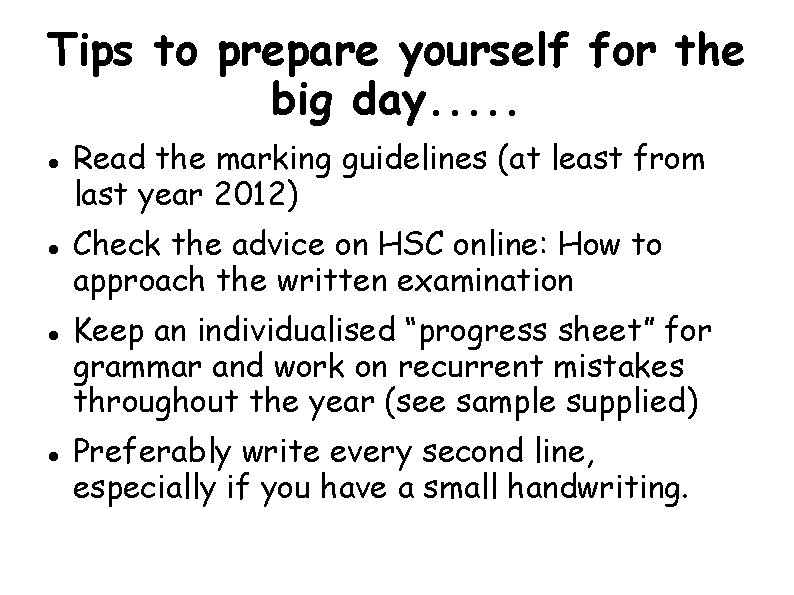
Tips to prepare yourself for the big day. . . Read the marking guidelines (at least from last year 2012) Check the advice on HSC online: How to approach the written examination Keep an individualised “progress sheet” for grammar and work on recurrent mistakes throughout the year (see sample supplied) Preferably write every second line, especially if you have a small handwriting.
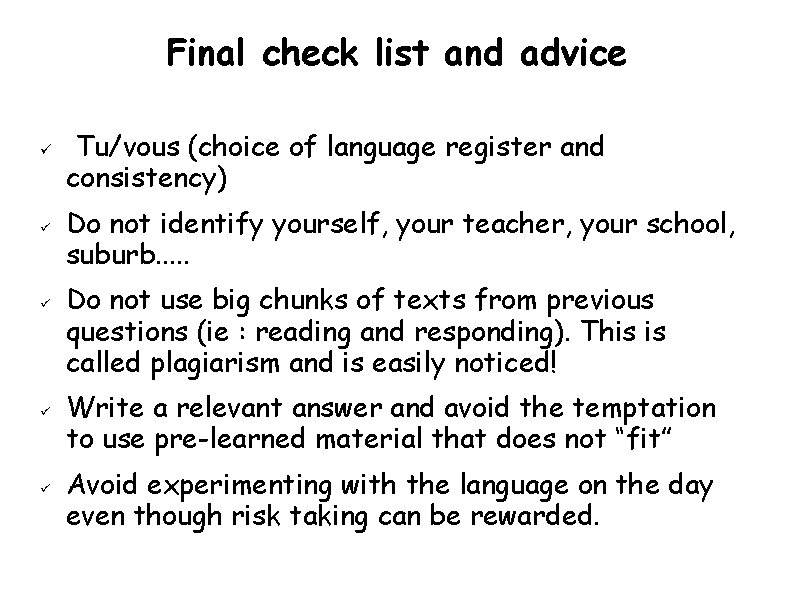
Final check list and advice Tu/vous (choice of language register and consistency) Do not identify yourself, your teacher, your school, suburb. . . Do not use big chunks of texts from previous questions (ie : reading and responding). This is called plagiarism and is easily noticed! Write a relevant answer and avoid the temptation to use pre-learned material that does not “fit” Avoid experimenting with the language on the day even though risk taking can be rewarded.
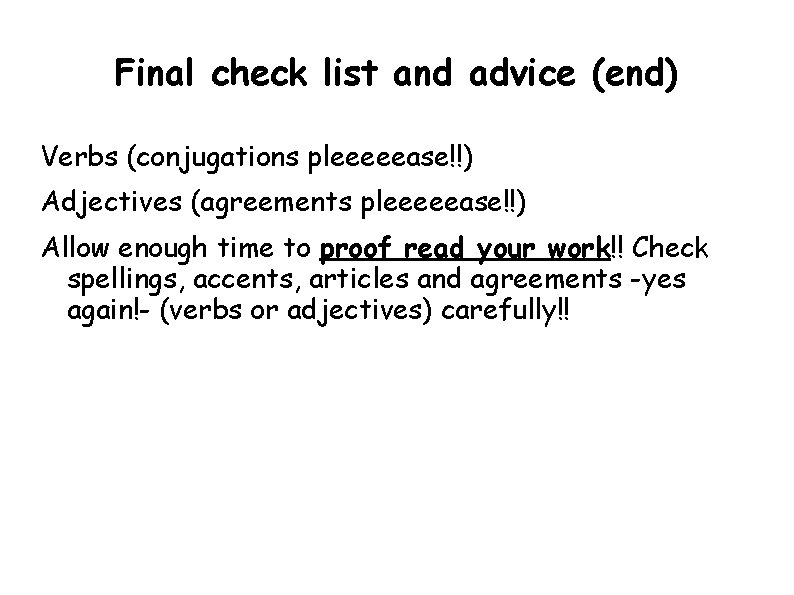
Final check list and advice (end) Verbs (conjugations pleeeeease!!) Adjectives (agreements pleeeeease!!) Allow enough time to proof read your work!! Check spellings, accents, articles and agreements -yes again!- (verbs or adjectives) carefully!!
Merci et bonne chance!!