
Write Your Way Through Grad School Dr Aubrey

Write Your Way Through Grad School Dr. Aubrey Schiavone University Writing Program

Who we are
Agenda ● Quick conversation about undergrad v. grad writing ● Habits that support graduate writing ● Four features of successful graduate writing ● Resources to support you in your writing ● Q&A
Let’s reflect on where we are now: ~5 minutes • Take 4 -5 minutes now and write a short paragraph or list for yourself: • How do you anticipate that the writing you do in graduate school will be different from the writing you did in college?

Let’s talk about it • How do you anticipate that the writing you do in graduate school will be different from the writing you did in college?

Grad school writing is a conversation Imagine that you enter a parlor. You come late. When you arrive, others have long preceded you, and they are engaged in a heated discussion, a discussion too heated for them to pause and tell you exactly what it is about. In fact, the discussion had already begun long before any of them got there, so that no one present is qualified to retrace for you all the steps that had gone before. You listen for a while, until you decide that you have caught the tenor of the argument; then you put in your oar. —Kenneth Burke, Philosophy of Literary Form , 1941
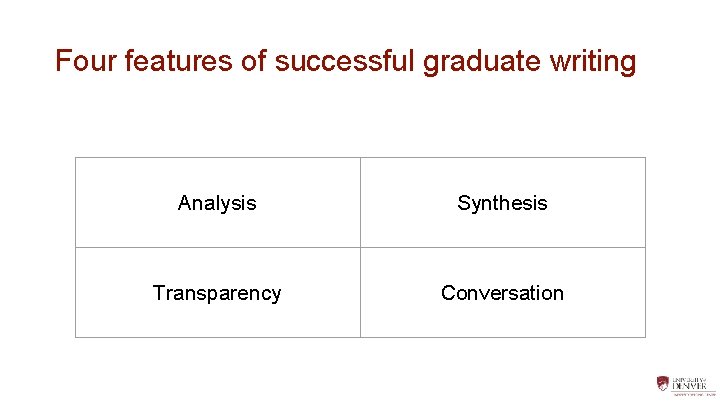
Four features of successful graduate writing Analysis Synthesis Transparency Conversation
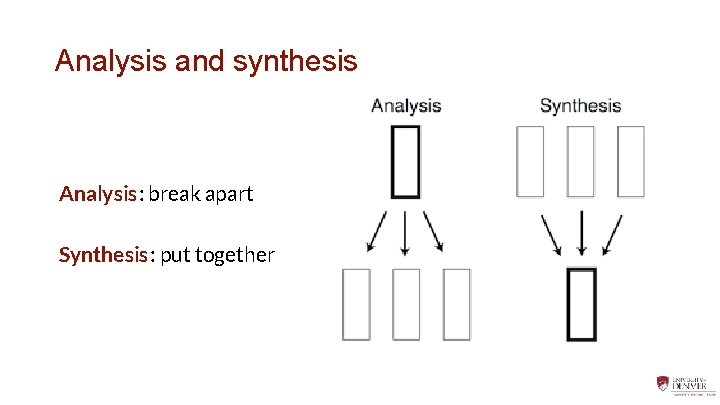
Analysis and synthesis Analysis: break apart Synthesis: put together
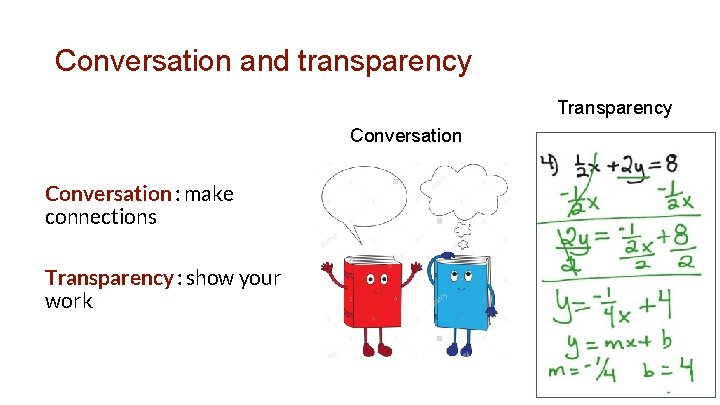
Conversation and transparency Transparency Conversation : make connections Transparency : show your work
Habits that support graduate writing ● Note taking ● Organizing your reading and research ● Use a chart or source matrix to create conversation ● Use discussion boards to practice ● Talk about your work all along, not just at the end
Use reading and note taking to begin writing When you treat reading and note-taking as part of the work of writing…. ● Texts become less abstract ● Your notes become more interactive ● You can start to find your own voice in the conversation ● The conversation you begin as an active reader gives you more to say when it’s time to write

Habit 1: Double-column note-taking
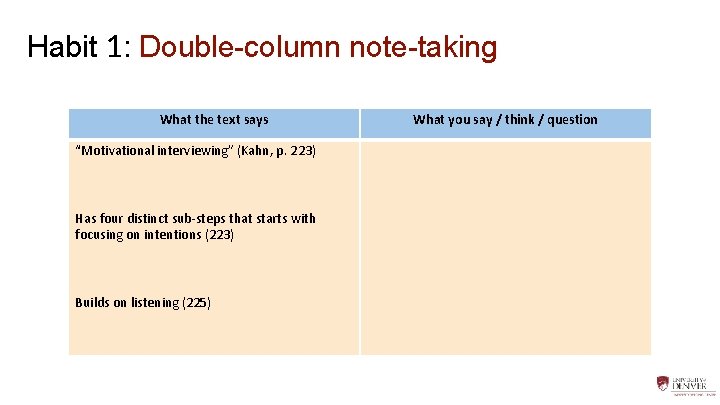
Habit 1: Double-column note-taking What the text says “Motivational interviewing” (Kahn, p. 223) Has four distinct sub-steps that starts with focusing on intentions (223) Builds on listening (225) What you say / think / question
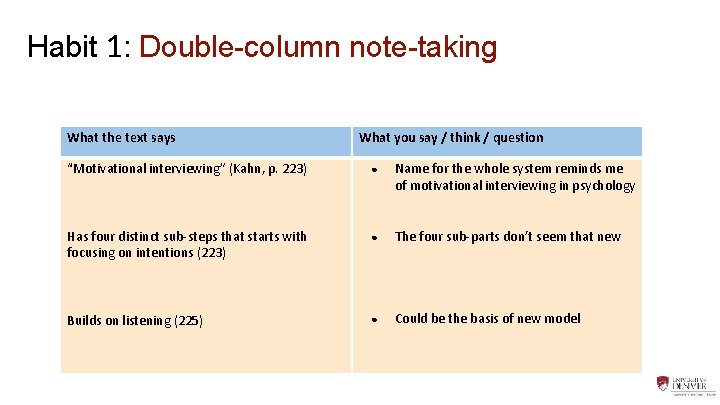
Habit 1: Double-column note-taking What the text says What you say / think / question “Motivational interviewing” (Kahn, p. 223) ● Name for the whole system reminds me of motivational interviewing in psychology Has four distinct sub-steps that starts with focusing on intentions (223) ● The four sub-parts don’t seem that new Builds on listening (225) ● Could be the basis of new model
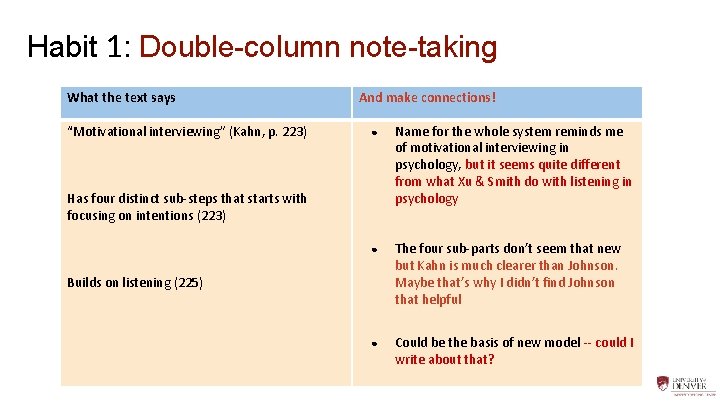
Habit 1: Double-column note-taking What the text says “Motivational interviewing” (Kahn, p. 223) And make connections! ● Name for the whole system reminds me of motivational interviewing in psychology, but it seems quite different from what Xu & Smith do with listening in psychology ● The four sub-parts don’t seem that new but Kahn is much clearer than Johnson. Maybe that’s why I didn’t find Johnson that helpful ● Could be the basis of new model -- could I write about that? Has four distinct sub-steps that starts with focusing on intentions (223) Builds on listening (225)
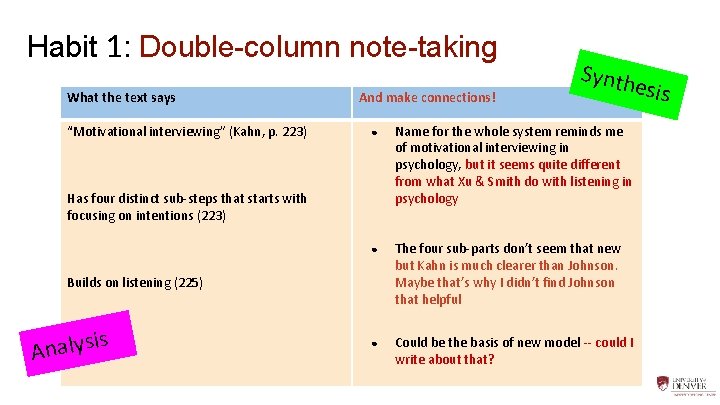
Habit 1: Double-column note-taking What the text says “Motivational interviewing” (Kahn, p. 223) And make connections! ● Name for the whole system reminds me of motivational interviewing in psychology, but it seems quite different from what Xu & Smith do with listening in psychology ● The four sub-parts don’t seem that new but Kahn is much clearer than Johnson. Maybe that’s why I didn’t find Johnson that helpful ● Could be the basis of new model -- could I write about that? Has four distinct sub-steps that starts with focusing on intentions (223) Builds on listening (225) is s y l a n A Synth esis
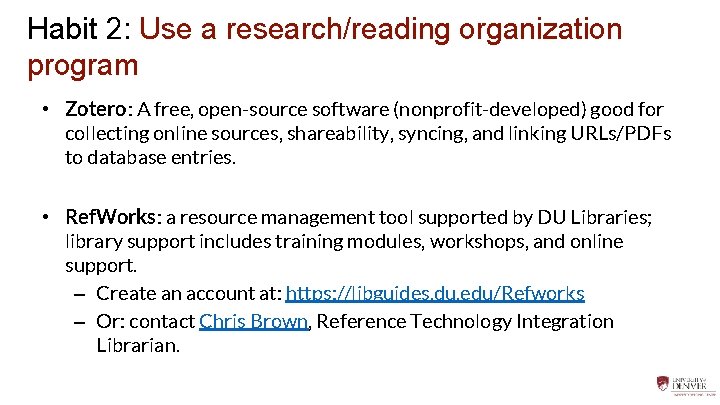
Habit 2: Use a research/reading organization program • Zotero: A free, open-source software (nonprofit-developed) good for collecting online sources, shareability, syncing, and linking URLs/PDFs to database entries. • Ref. Works: a resource management tool supported by DU Libraries; library support includes training modules, workshops, and online support. – Create an account at: https: //libguides. du. edu/Refworks – Or: contact Chris Brown, Reference Technology Integration Librarian.
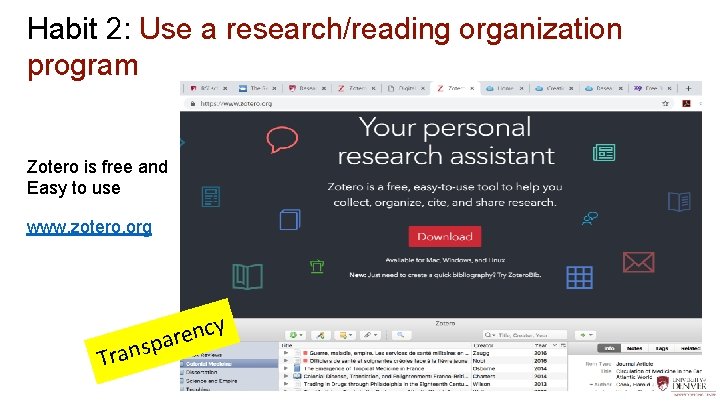
Habit 2: Use a research/reading organization program Zotero is free and Easy to use www. zotero. org y Tran c n e r spa
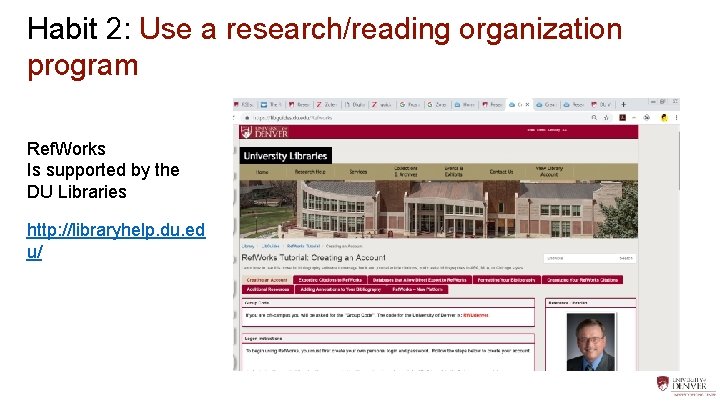
Habit 2: Use a research/reading organization program Ref. Works Is supported by the DU Libraries http: //libraryhelp. du. ed u/
Habit 2: Use a research/reading organization program The research librarians also offer individual research consultations. They can help you to figure out where to find sources and how to evaluate credibility and potential value. http: //libraryhelp. du. ed u/
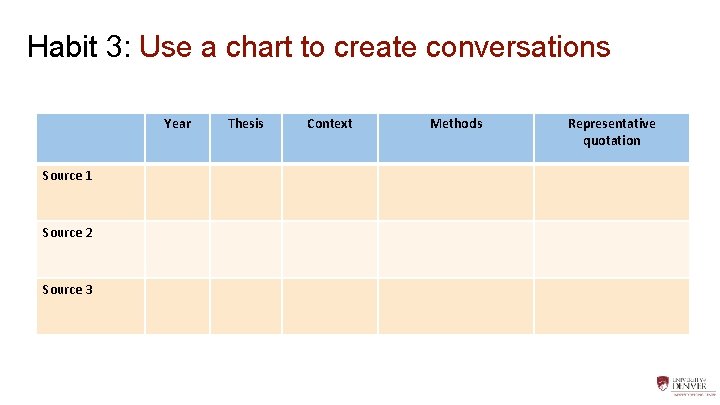
Habit 3: Use a chart to create conversations Year Source 1 Source 2 Source 3 Thesis Context Methods Representative quotation
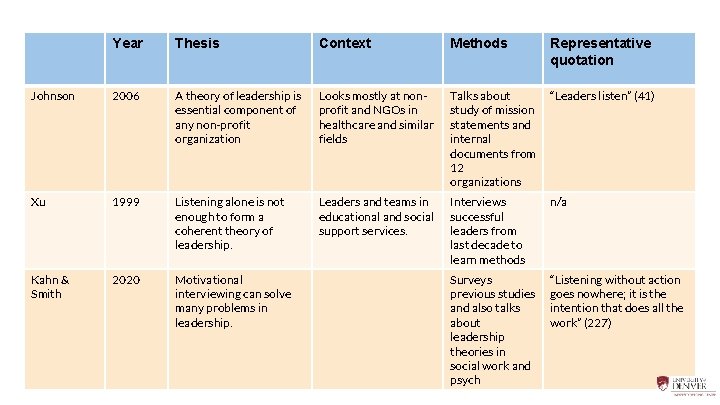
Year Thesis Context Methods Representative quotation Johnson 2006 A theory of leadership is essential component of any non-profit organization Looks mostly at nonprofit and NGOs in healthcare and similar fields Talks about study of mission statements and internal documents from 12 organizations “Leaders listen” (41) Xu 1999 Listening alone is not enough to form a coherent theory of leadership. Leaders and teams in educational and social support services. Interviews successful leaders from last decade to learn methods n/a Kahn & Smith 2020 Motivational interviewing can solve many problems in leadership. Surveys previous studies and also talks about leadership theories in social work and psych “Listening without action goes nowhere; it is the intention that does all the work” (227)
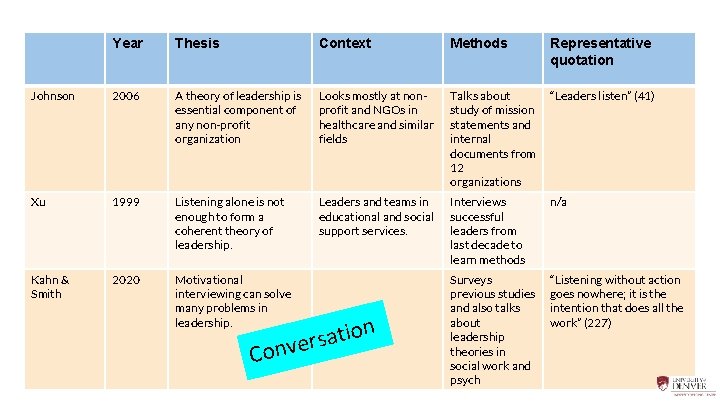
Year Thesis Context Methods Representative quotation Johnson 2006 A theory of leadership is essential component of any non-profit organization Looks mostly at nonprofit and NGOs in healthcare and similar fields Talks about study of mission statements and internal documents from 12 organizations “Leaders listen” (41) Xu 1999 Listening alone is not enough to form a coherent theory of leadership. Leaders and teams in educational and social support services. Interviews successful leaders from last decade to learn methods n/a Kahn & Smith 2020 Motivational interviewing can solve many problems in leadership. Surveys previous studies and also talks about leadership theories in social work and psych “Listening without action goes nowhere; it is the intention that does all the work” (227) Co n o i t a s nver
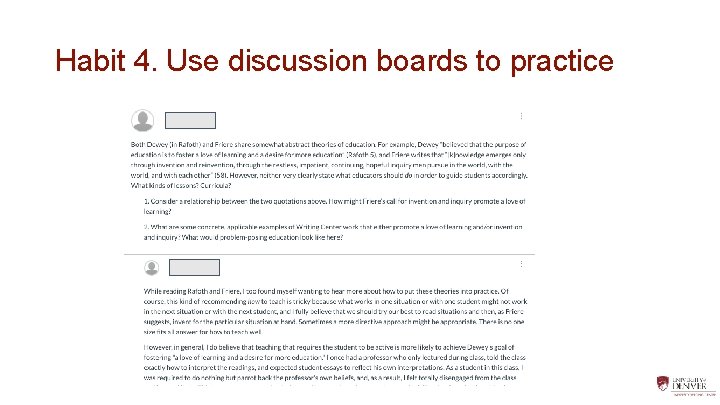
Habit 4. Use discussion boards to practice
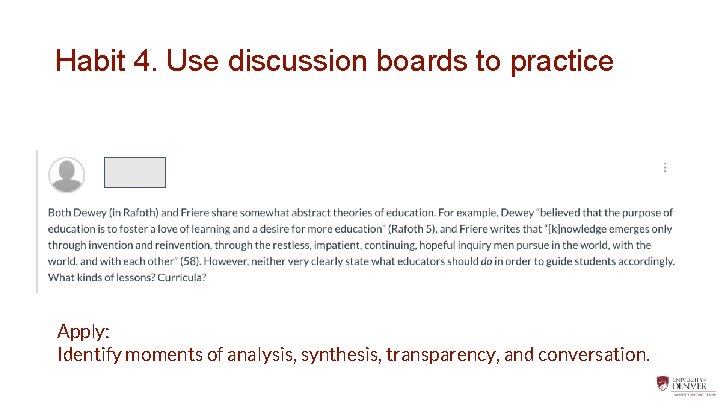
Habit 4. Use discussion boards to practice Apply: Identify moments of analysis, synthesis, transparency, and conversation.
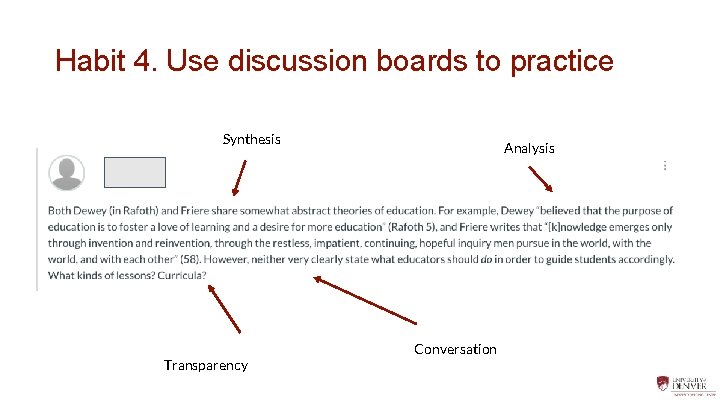
Habit 4. Use discussion boards to practice Synthesis Transparency Analysis Conversation
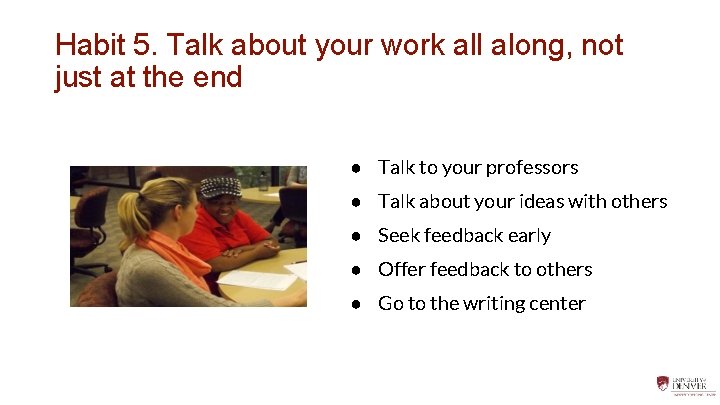
Habit 5. Talk about your work all along, not just at the end ● Talk to your professors ● Talk about your ideas with others ● Seek feedback early ● Offer feedback to others ● Go to the writing center
These 5 habits get you writing before you even begin “writing” ● Use double-column note-taking on everything you read ● Keep track of what you’ve read, maybe with a program like Zotero or Ref. Works ● For particular assignments, use a note chart to create relationships ● Use discussion board posts to practice ● Talk to people about your work!
Applying concepts to your writing • Take 4 -5 minutes now and write a short paragraph or list for yourself: • • • What seems most useful to you so far? How will you apply these concepts to your own writing? What questions about analysis, synthesis, transparency, and conversation do you still have?
Let’s talk about it • • What seems most useful to you so far? How will you apply these concepts to your own writing? What questions about analysis, synthesis, transparency, and conversation do you still have? Anything else that came up as you were writing?
Review: Four features of graduate writing
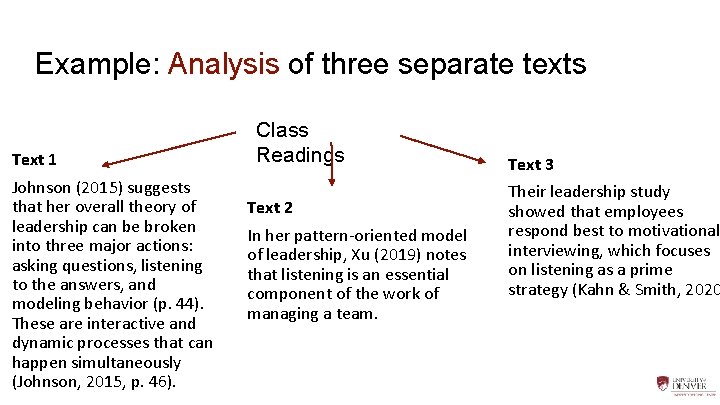
Example: Analysis of three separate texts Text 1 Johnson (2015) suggests that her overall theory of leadership can be broken into three major actions: asking questions, listening to the answers, and modeling behavior (p. 44). These are interactive and dynamic processes that can happen simultaneously (Johnson, 2015, p. 46). Class Readings Text 2 In her pattern-oriented model of leadership, Xu (2019) notes that listening is an essential component of the work of managing a team. Text 3 Their leadership study showed that employees respond best to motivational interviewing, which focuses on listening as a prime strategy (Kahn & Smith, 2020
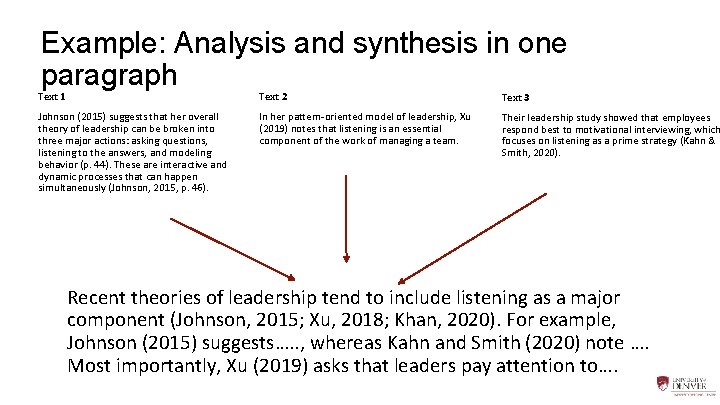
Example: Analysis and synthesis in one paragraph Text 1 Text 2 Text 3 Johnson (2015) suggests that her overall theory of leadership can be broken into three major actions: asking questions, listening to the answers, and modeling behavior (p. 44). These are interactive and dynamic processes that can happen simultaneously (Johnson, 2015, p. 46). In her pattern-oriented model of leadership, Xu (2019) notes that listening is an essential component of the work of managing a team. Their leadership study showed that employees respond best to motivational interviewing, which focuses on listening as a prime strategy (Kahn & Smith, 2020). Recent theories of leadership tend to include listening as a major component (Johnson, 2015; Xu, 2018; Khan, 2020). For example, Johnson (2015) suggests…. . , whereas Kahn and Smith (2020) note …. Most importantly, Xu (2019) asks that leaders pay attention to….
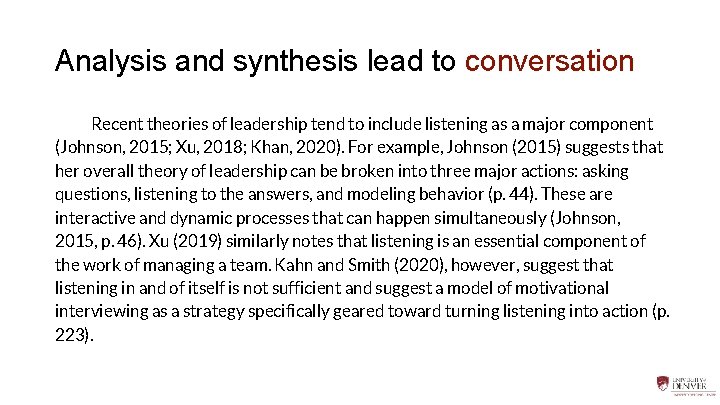
Analysis and synthesis lead to conversation Recent theories of leadership tend to include listening as a major component (Johnson, 2015; Xu, 2018; Khan, 2020). For example, Johnson (2015) suggests that her overall theory of leadership can be broken into three major actions: asking questions, listening to the answers, and modeling behavior (p. 44). These are interactive and dynamic processes that can happen simultaneously (Johnson, 2015, p. 46). Xu (2019) similarly notes that listening is an essential component of the work of managing a team. Kahn and Smith (2020), however, suggest that listening in and of itself is not sufficient and suggest a model of motivational interviewing as a strategy specifically geared toward turning listening into action (p. 223).
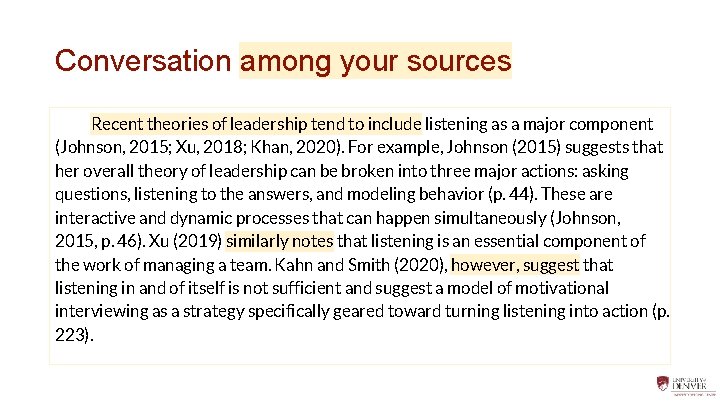
Conversation among your sources Recent theories of leadership tend to include listening as a major component (Johnson, 2015; Xu, 2018; Khan, 2020). For example, Johnson (2015) suggests that her overall theory of leadership can be broken into three major actions: asking questions, listening to the answers, and modeling behavior (p. 44). These are interactive and dynamic processes that can happen simultaneously (Johnson, 2015, p. 46). Xu (2019) similarly notes that listening is an essential component of the work of managing a team. Kahn and Smith (2020), however, suggest that listening in and of itself is not sufficient and suggest a model of motivational interviewing as a strategy specifically geared toward turning listening into action (p. 223).
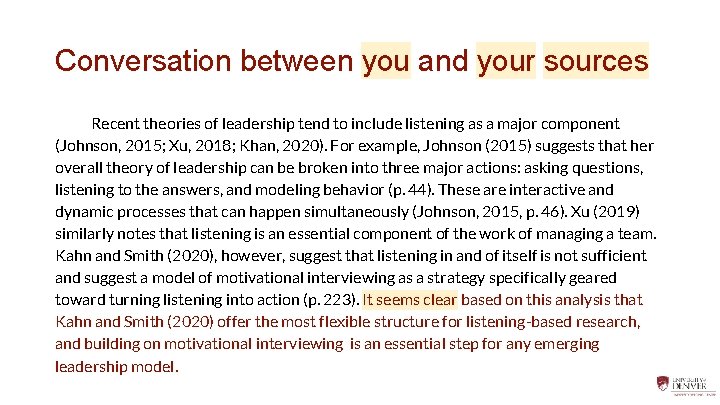
Conversation between you and your sources Recent theories of leadership tend to include listening as a major component (Johnson, 2015; Xu, 2018; Khan, 2020). For example, Johnson (2015) suggests that her overall theory of leadership can be broken into three major actions: asking questions, listening to the answers, and modeling behavior (p. 44). These are interactive and dynamic processes that can happen simultaneously (Johnson, 2015, p. 46). Xu (2019) similarly notes that listening is an essential component of the work of managing a team. Kahn and Smith (2020), however, suggest that listening in and of itself is not sufficient and suggest a model of motivational interviewing as a strategy specifically geared toward turning listening into action (p. 223). It seems clear based on this analysis that Kahn and Smith (2020) offer the most flexible structure for listening-based research, and building on motivational interviewing is an essential step for any emerging leadership model.
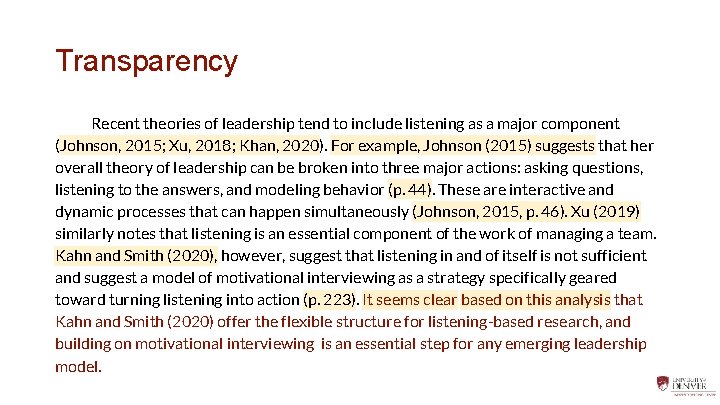
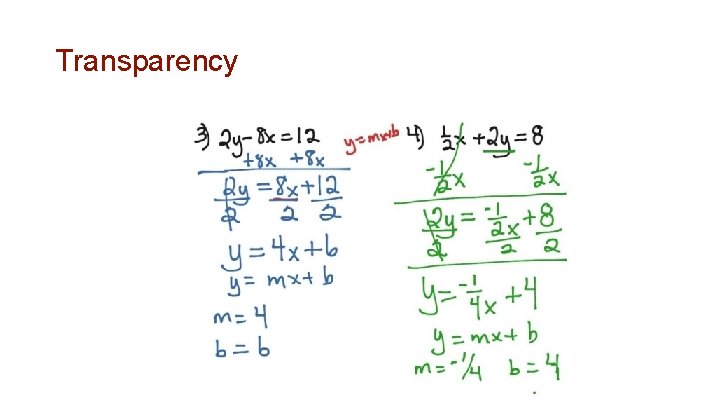
Transparency Recent theories of leadership tend to include listening as a major component (Johnson, 2015; Xu, 2018; Khan, 2020). For example, Johnson (2015) suggests that her overall theory of leadership can be broken into three major actions: asking questions, listening to the answers, and modeling behavior (p. 44). These are interactive and dynamic processes that can happen simultaneously (Johnson, 2015, p. 46). Xu (2019) similarly notes that listening is an essential component of the work of managing a team. Kahn and Smith (2020), however, suggest that listening in and of itself is not sufficient and suggest a model of motivational interviewing as a strategy specifically geared toward turning listening into action (p. 223). It seems clear based on this analysis that Kahn and Smith (2020) offer the flexible structure for listening-based research, and building on motivational interviewing is an essential step for any emerging leadership model.
Transparency
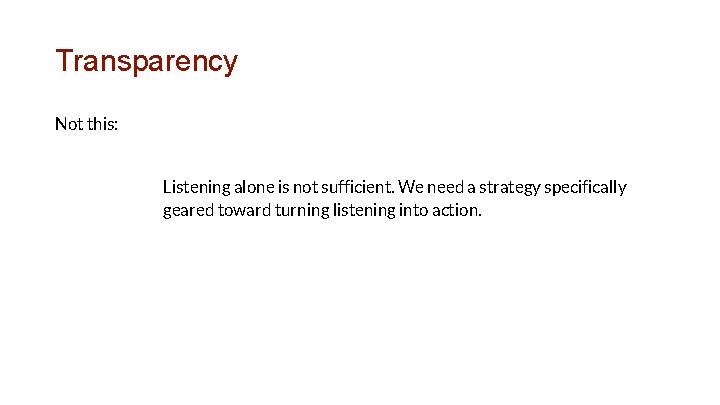
Transparency Not this: Listening alone is not sufficient. We need a strategy specifically geared toward turning listening into action.
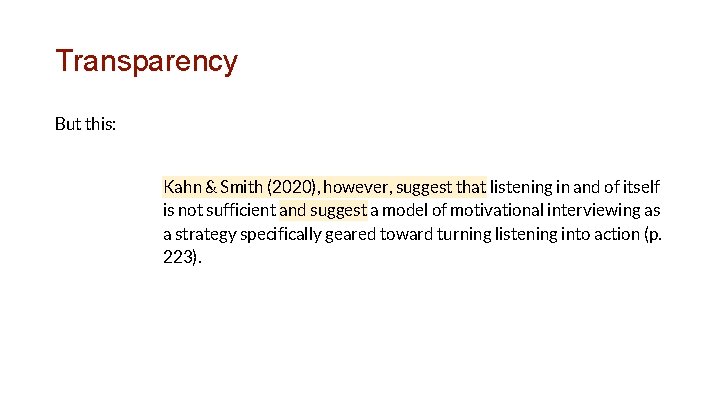
Transparency But this: Kahn & Smith (2020), however, suggest that listening in and of itself is not sufficient and suggest a model of motivational interviewing as a strategy specifically geared toward turning listening into action (p. 223).
Pause for questions ● ● What seems most useful to you so far? What questions about analysis, synthesis, transparency, and conversation do you still have?

Resources to support you in your writing
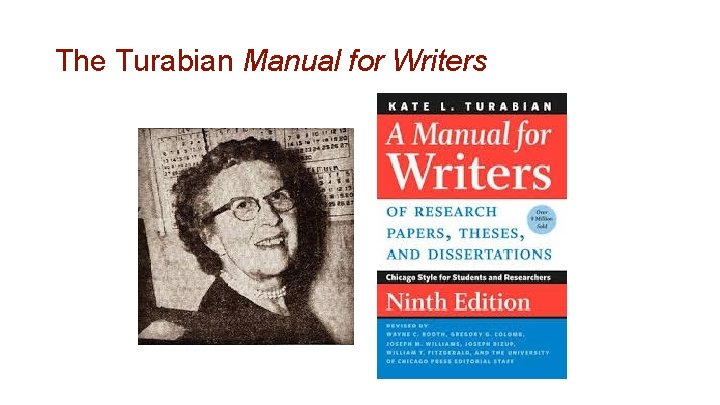
The Turabian Manual for Writers
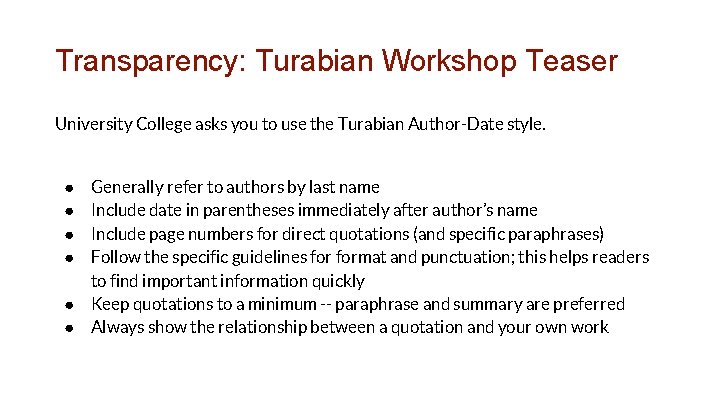
Transparency: Turabian Workshop Teaser University College asks you to use the Turabian Author-Date style. Generally refer to authors by last name Include date in parentheses immediately after author’s name Include page numbers for direct quotations (and specific paraphrases) Follow the specific guidelines format and punctuation; this helps readers to find important information quickly ● Keep quotations to a minimum -- paraphrase and summary are preferred ● Always show the relationship between a quotation and your own work ● ●
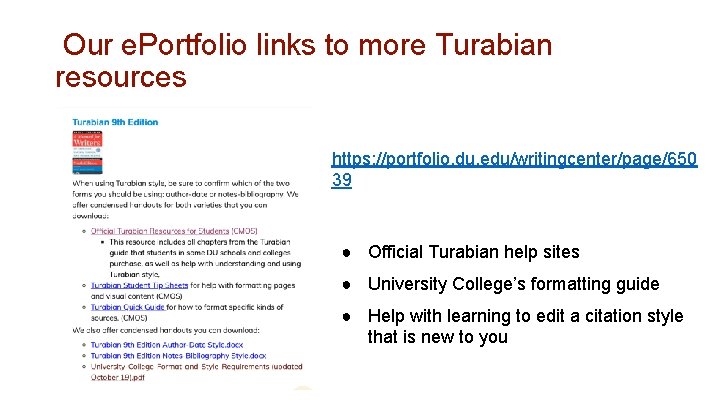
Our e. Portfolio links to more Turabian resources https: //portfolio. du. edu/writingcenter/page/650 39 ● Official Turabian help sites ● University College’s formatting guide ● Help with learning to edit a citation style that is new to you
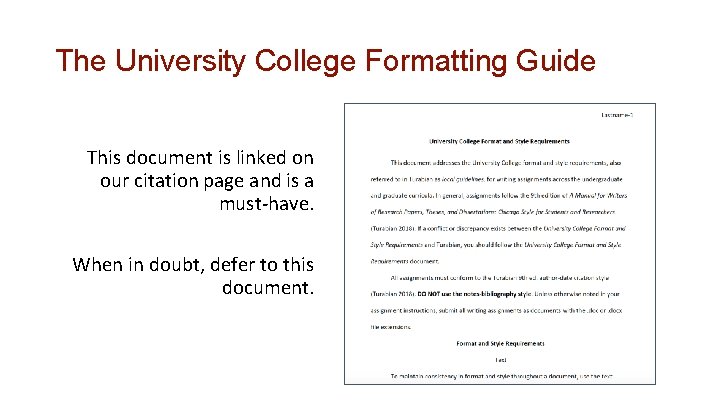
The University College Formatting Guide This document is linked on our citation page and is a must-have. When in doubt, defer to this document.
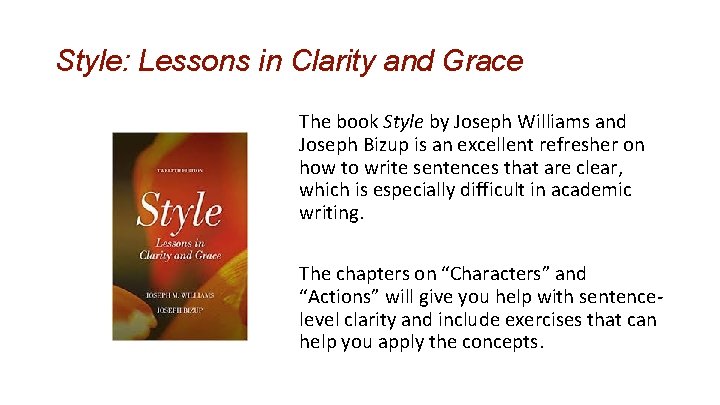
Style: Lessons in Clarity and Grace The book Style by Joseph Williams and Joseph Bizup is an excellent refresher on how to write sentences that are clear, which is especially difficult in academic writing. The chapters on “Characters” and “Actions” will give you help with sentencelevel clarity and include exercises that can help you apply the concepts.
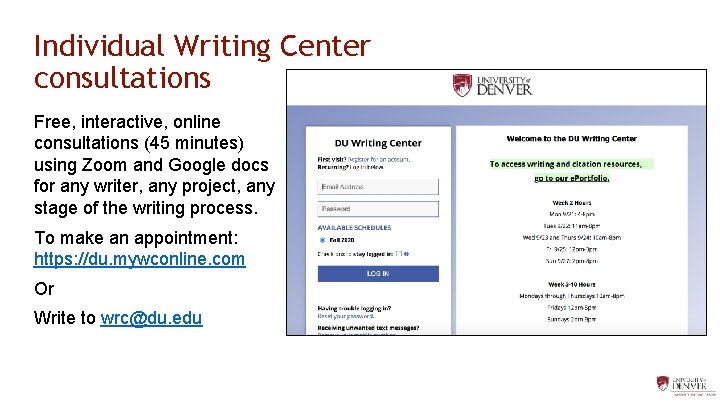
Individual Writing Center consultations Free, interactive, online consultations (45 minutes) using Zoom and Google docs for any writer, any project, any stage of the writing process. To make an appointment: https: //du. mywconline. com Or Write to wrc@du. edu
Writing Center Offerings Informal workshops for groups of 3+ writers on any topic To contact us: wrc@du. edu Examples: ● ● Learning to use Turabian style Paraphrasing, summarizing, and quoting Learning to edit your own writing Writing literature reviews or annotated bibliographies Resources including webinars and handouts for specific assignments, genres, and processes
Workshop Q & A Thank you for participating in this Writing Center workshop. We invite you to submit questions and comments through a follow-up survey: https: //udenver. qualtrics. com/jfe/form/SV_3 xjhfj. Xtpd. HH 0 Db
- Slides: 50