
Write about an obstacle you encountered on a

§ Write about an obstacle you encountered on a trip.
(Ancient and Contemporary) Unit Outline and Goals
CCSS. ELALITERACY. W. 9 -10. 3. D A. Students will learn how to use figurative language (similes). B. Students will learn how to use details to enrich text with sensory images. C. Students will use specific and descriptive words that help a reader understand how an experience feels.
CCSS. ELALITERACY. RL. 9 -10. 4 A. Students will learn how to determine the meaning of words and phrases as they are used in the text, including figurative and connotative meanings.
CCSS. ELALITERACY. RL. 9 -10. 2 A. Students will learn how to identify a texts’ theme and how it develops through details. B. Students will learn how to summarize a passage of text.
An informed assumption Inferential statements: From the text, one can infer that…
§ Write about a goal you have (for today? this week? this month? this year? )
§ Example: § A simile on steroids. § Long and ornate. In a smithy One sees a white-hot axehead or adze Plunged and wrung in a cold tub, screeching steam— The way they make soft iron hale and hard--: Just so that eyeball hissed around the spike. (Homer, Book IX lines 443) § Sometimes called ‘Homeric’ because Homer pioneered them.
§ Example: “When the young Dawn with finger tips of rose Touched the world, I roused the men…” § Makes a reference to a literary figure or event. § Often from Greek myths or from the Bible.
CCSS. ELALITERACY. RL. 9 -10. 7 A. Students will learn how to analyze thematic representation of key scenes in two artistic mediums.
In order read well, one must learn how to ask different types of open ended questions including: • Inferential • Emotional • Generalizable • Personal • Evaluative (Smagorinksy, 2008)
§ Summarizing (Marzano, 2007; Dean, Hubble, Pilter & Stone, 2012) § Distinguishing from significant and less than significant passages. § Identify word meaning § Generating Questions (Smagorinsky, 2008) § Relating textual themes to personal life (Smagorinsky, 2008) § Generating Images (Wilhelm, 1997 as cited in Smagorinsky, 2008) § Interpreting figurative language § Tracking sense imagery § Visualizing major plot movements § Identifying themes and tracking their development (CCSS 2010) § Identifying details and interpreting symbols as they relate to theme.
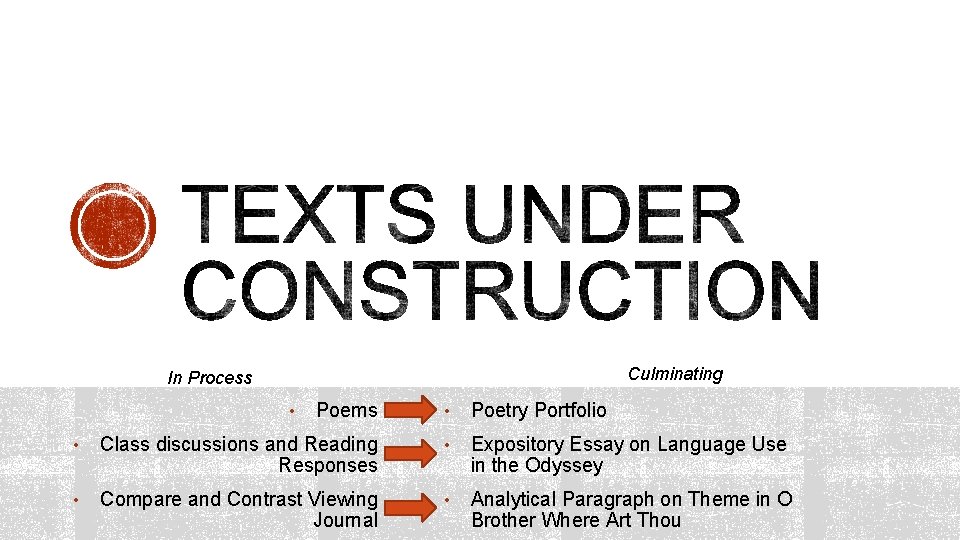
Culminating In Process Poems • Poetry Portfolio • Class discussions and Reading Responses • Expository Essay on Language Use in the Odyssey • Compare and Contrast Viewing Journal • Analytical Paragraph on Theme in O Brother Where Art Thou •
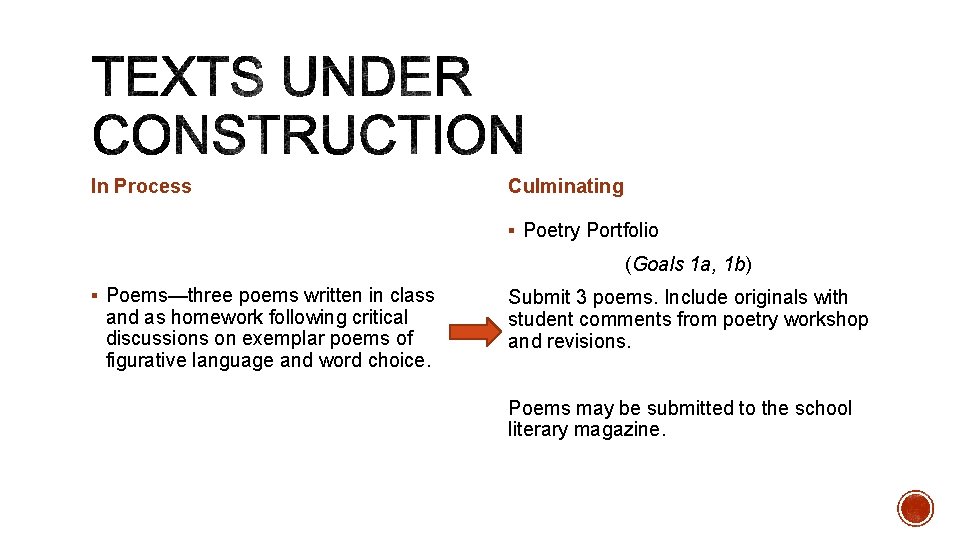
In Process Culminating § Poetry Portfolio (Goals 1 a, 1 b) § Poems—three poems written in class and as homework following critical discussions on exemplar poems of figurative language and word choice. Submit 3 poems. Include originals with student comments from poetry workshop and revisions. Poems may be submitted to the school literary magazine.
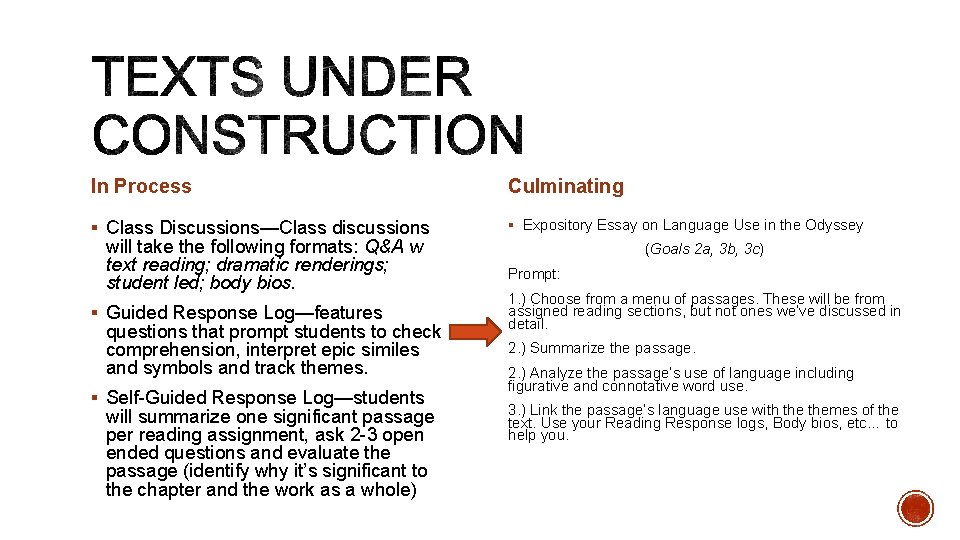
In Process Culminating § Class Discussions—Class discussions § Expository Essay on Language Use in the Odyssey will take the following formats: Q&A w text reading; dramatic renderings; student led; body bios. § Guided Response Log—features questions that prompt students to check comprehension, interpret epic similes and symbols and track themes. § Self-Guided Response Log—students will summarize one significant passage per reading assignment, ask 2 -3 open ended questions and evaluate the passage (identify why it’s significant to the chapter and the work as a whole) (Goals 2 a, 3 b, 3 c) Prompt: 1. ) Choose from a menu of passages. These will be from assigned reading sections, but not ones we’ve discussed in detail. 2. ) Summarize the passage. 2. ) Analyze the passage’s use of language including figurative and connotative word use. 3. ) Link the passage’s language use with themes of the text. Use your Reading Response logs, Body bios, etc… to help you.
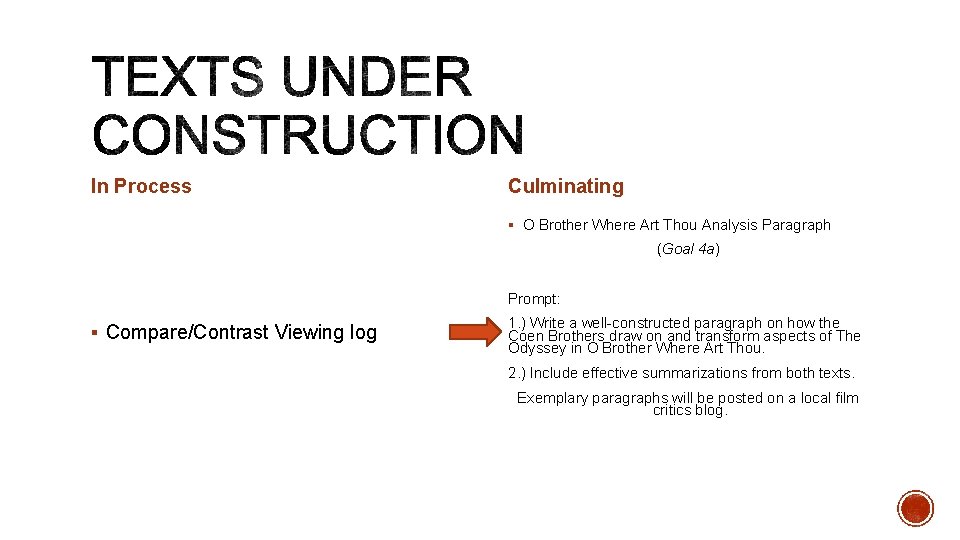
In Process Culminating § O Brother Where Art Thou Analysis Paragraph (Goal 4 a) Prompt: § Compare/Contrast Viewing log 1. ) Write a well-constructed paragraph on how the Coen Brothers draw on and transform aspects of The Odyssey in O Brother Where Art Thou. 2. ) Include effective summarizations from both texts. Exemplary paragraphs will be posted on a local film critics blog.
- Slides: 17