
WRFGC online twoway coupling of WRF and GEOSChem

- Slides: 11
WRF-GC: on-line two-way coupling of WRF and GEOS-Chem model structure and preliminary results Tzung-May Fu (tmfu@pku. edu. cn), Haipeng Lin, Xu Feng, Heng Tian, Yaping Ma, Lijuan Zhang Department of Atmospheric and Oceanic Sciences Peking University Atmospheric Chemistry & Climate @ Peking University www. phy. pku. edu. cn/atmoschem/ 1
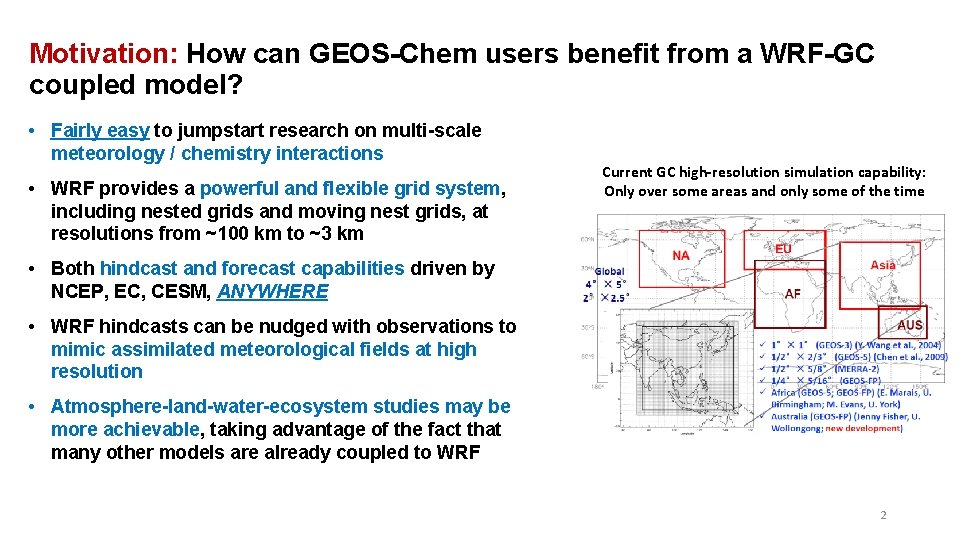
Motivation: How can GEOS-Chem users benefit from a WRF-GC coupled model? • Fairly easy to jumpstart research on multi-scale meteorology / chemistry interactions • WRF provides a powerful and flexible grid system, including nested grids and moving nest grids, at resolutions from ~100 km to ~3 km Current GC high-resolution simulation capability: Only over some areas and only some of the time • Both hindcast and forecast capabilities driven by NCEP, EC, CESM, ANYWHERE • WRF hindcasts can be nudged with observations to mimic assimilated meteorological fields at high resolution • Atmosphere-land-water-ecosystem studies may be more achievable, taking advantage of the fact that many other models are already coupled to WRF 2
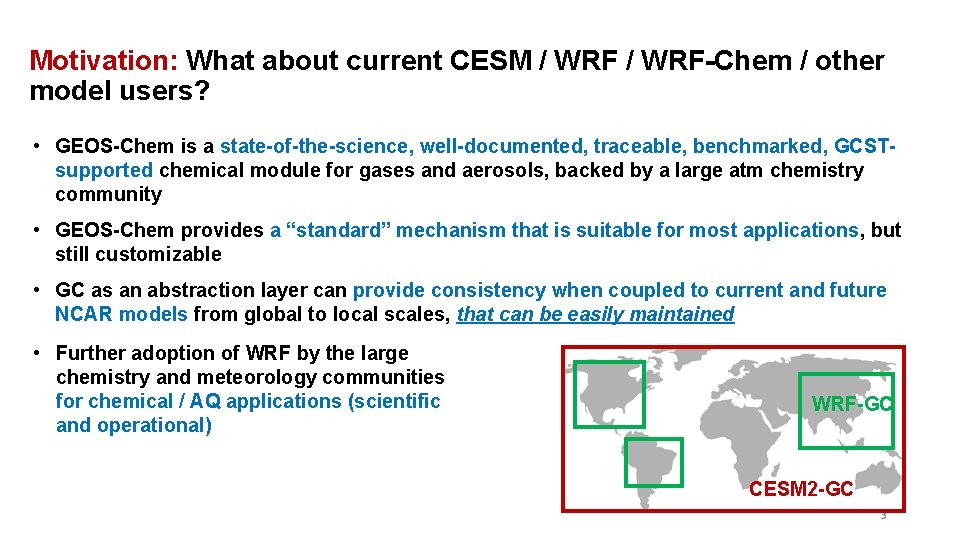
Motivation: What about current CESM / WRF-Chem / other model users? • GEOS-Chem is a state-of-the-science, well-documented, traceable, benchmarked, GCSTsupported chemical module for gases and aerosols, backed by a large atm chemistry community • GEOS-Chem provides a “standard” mechanism that is suitable for most applications, but still customizable • GC as an abstraction layer can provide consistency when coupled to current and future NCAR models from global to local scales, that can be easily maintained • Further adoption of WRF by the large chemistry and meteorology communities for chemical / AQ applications (scientific and operational) WRF-GC CESM 2 -GC 3
Development guideline: A coupling structure that is easy to use, massively parallel, and ready for the future • Very specific goal: regional GEOS-Chem simulations with online meteorology • We designed a coupling structure with minimal changes to either model, such that either parent model could be updated independently • GEOS-Chem High Performance (GCHP) technology is used, allowing WRF-GC to run in massively parallel architectures for high performance • We further “columnized” GC so that it can operate as a stateless, grid-independent column model that can be fully driven by external models, which will also ease the development of future coupling projects with GC • We plan to make the Coupler open access 4
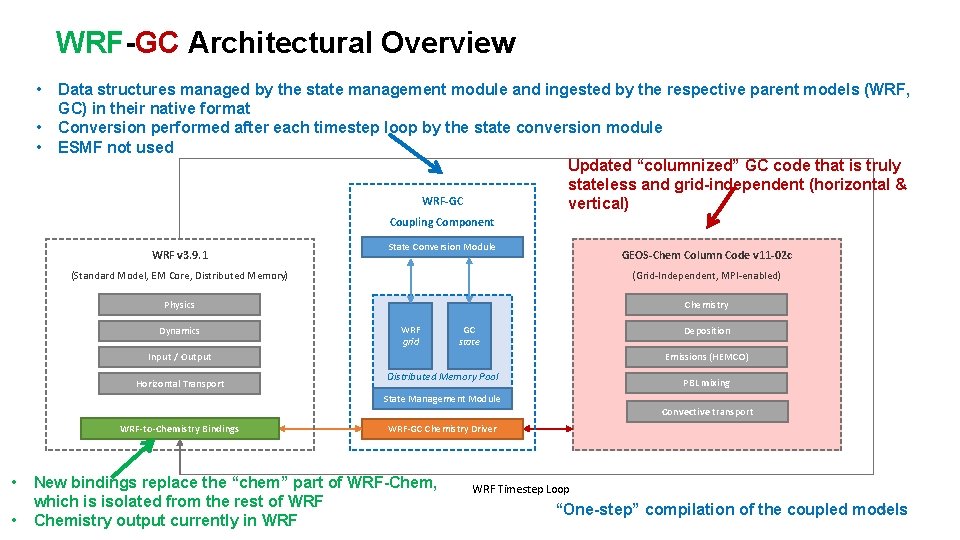
WRF-GC Architectural Overview • • • Data structures managed by the state management module and ingested by the respective parent models (WRF, GC) in their native format Conversion performed after each timestep loop by the state conversion module ESMF not used Updated “columnized” GC code that is truly stateless and grid-independent (horizontal & WRF-GC vertical) Coupling Component WRF v 3. 9. 1 State Conversion Module GEOS-Chem Column Code v 11 -02 c (Standard Model, EM Core, Distributed Memory) (Grid-Independent, MPI-enabled) Physics Chemistry Dynamics WRF grid GC state Deposition Emissions (HEMCO) Input / Output Horizontal Transport Distributed Memory Pool PBL mixing State Management Module Convective transport WRF-to-Chemistry Bindings • • WRF-GC Chemistry Driver New bindings replace the “chem” part of WRF-Chem, which is isolated from the rest of WRF Chemistry output currently in WRF Timestep Loop 5 “One-step” compilation of the coupled models
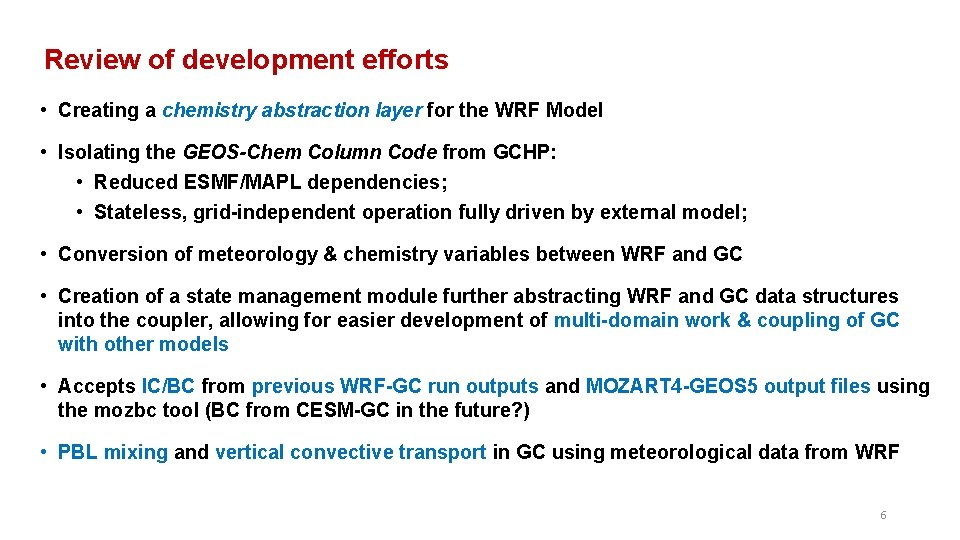
Review of development efforts • Creating a chemistry abstraction layer for the WRF Model • Isolating the GEOS-Chem Column Code from GCHP: • Reduced ESMF/MAPL dependencies; • Stateless, grid-independent operation fully driven by external model; • Conversion of meteorology & chemistry variables between WRF and GC • Creation of a state management module further abstracting WRF and GC data structures into the coupler, allowing for easier development of multi-domain work & coupling of GC with other models • Accepts IC/BC from previous WRF-GC run outputs and MOZART 4 -GEOS 5 output files using the mozbc tool (BC from CESM-GC in the future? ) • PBL mixing and vertical convective transport in GC using meteorological data from WRF 6
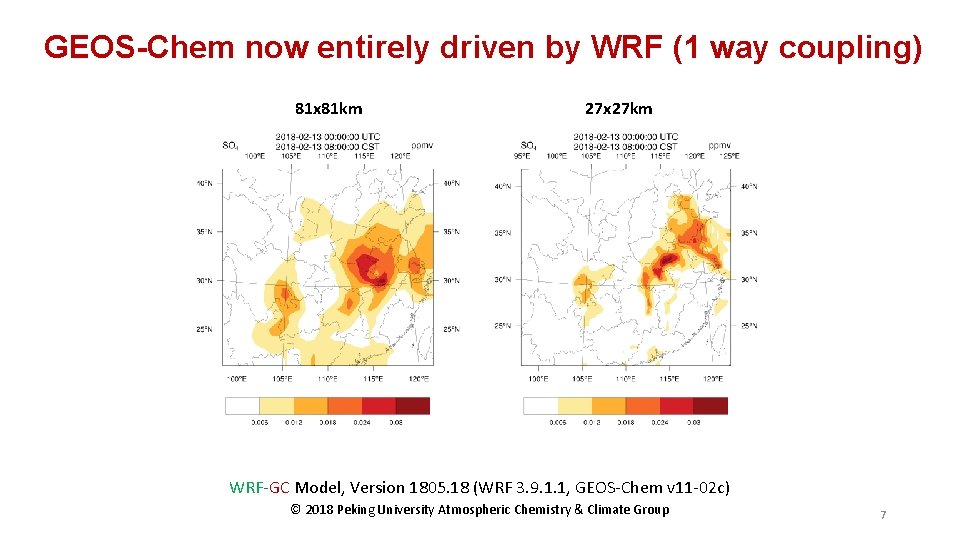
GEOS-Chem now entirely driven by WRF (1 way coupling) 81 x 81 km 27 x 27 km WRF-GC Model, Version 1805. 18 (WRF 3. 9. 1. 1, GEOS-Chem v 11 -02 c) © 2018 Peking University Atmospheric Chemistry & Climate Group 7
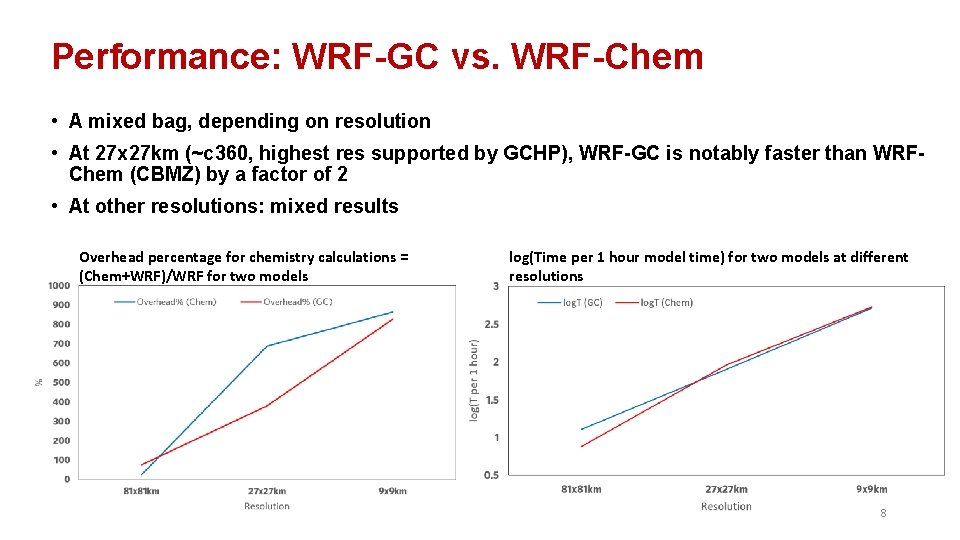
Performance: WRF-GC vs. WRF-Chem • A mixed bag, depending on resolution • At 27 x 27 km (~c 360, highest res supported by GCHP), WRF-GC is notably faster than WRFChem (CBMZ) by a factor of 2 • At other resolutions: mixed results Overhead percentage for chemistry calculations = (Chem+WRF)/WRF for two models log(Time per 1 hour model time) for two models at different resolutions 8
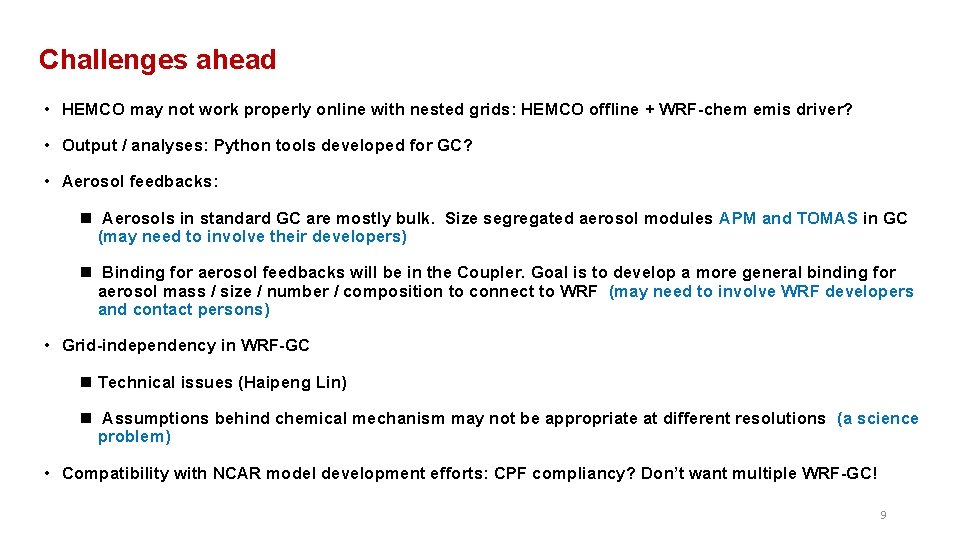
Challenges ahead • HEMCO may not work properly online with nested grids: HEMCO offline + WRF-chem emis driver? • Output / analyses: Python tools developed for GC? • Aerosol feedbacks: n Aerosols in standard GC are mostly bulk. Size segregated aerosol modules APM and TOMAS in GC (may need to involve their developers) n Binding for aerosol feedbacks will be in the Coupler. Goal is to develop a more general binding for aerosol mass / size / number / composition to connect to WRF (may need to involve WRF developers and contact persons) • Grid-independency in WRF-GC n Technical issues (Haipeng Lin) n Assumptions behind chemical mechanism may not be appropriate at different resolutions (a science problem) • Compatibility with NCAR model development efforts: CPF compliancy? Don’t want multiple WRF-GC! 9
Tentative timeline • Incorporation of updated grid-independency changes into standard GC (Haipeng Lin, this summer) • Robust one-way coupling (static nested-grids, limited physical options) by the end of 2018 / early 2019 (Xu Feng, on-going) • Basic two-way coupling (aerosol feedback based on bulk aerosol mass) by mid-2019 (Xu Feng, on-going) • Tentative beta release of the Coupler by mid- or late-2019 (static nested grids, limited physical options) • More complex two-way coupling (w/ aerosol size information from GC-APM / GC-TOMAS) by ? ? ? 10
Applications: • Air quality forecasts • Direct and indirect effects of aerosols • Interactions between air quality with small-/meso-scale/boundary layer meteorology • Nonlinearity of chemistry, parameterization of sub-grid chemistry processes • Downscaling of climate – chemistry simulations • Atmosphere-land-water-ecosystem studies may be more achievable, taking advantage of the fact that many other models are already coupled to WRF • WRF-Hydro • WRF-CFD • WRF-ROMS • WRF-Fire 11