
Wrap up Content Design Principles Information hiding Extensibility

Wrap up
Content • Design Principles • Information hiding • Extensibility • Aggregation and Composition • Recap
General Software - Design Principles 1 Information Hiding: All information about a module should be private to the module unless required externally Minimize Coupling Every module should depend on as few others as possible Coherence: Keep things together that belong together Keep behaviour together with related data Keep information about one thing in one place 3 M. R. V. Chaudron – May 2011
General Software Design Principles 2 Divide and Conquer Break a big problem into smaller ones Separation of Concerns Divide into different parts logic that addresses different issues Keep it Simple 4 M. R. V. Chaudron – May 2011

The Single Responsibility Principle (SRP) Classes should not have more than one responsibility. Anti pattern: GOD class, or Swiss Army Knife
Reducing Coupling: Information Hiding • 6 Information Hiding: – Try to localize future change – Hide system details likely to change independently – Separate parts that are likely to have a different rate of change – In interfaces expose only assumptions unlikely to change
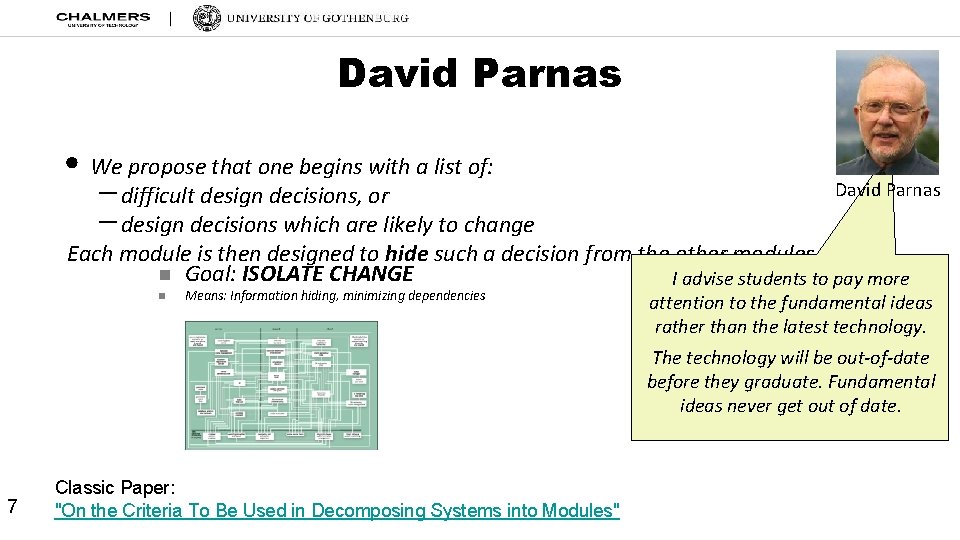
David Parnas • We propose that one begins with a list of: – difficult design decisions, or – design decisions which are likely to change David Parnas Each module is then designed to hide such a decision from the other modules. n Goal: ISOLATE CHANGE I advise students to pay more n Means: Information hiding, minimizing dependencies attention to the fundamental ideas rather than the latest technology. The technology will be out-of-date before they graduate. Fundamental ideas never get out of date. 7 Classic Paper: "On the Criteria To Be Used in Decomposing Systems into Modules"
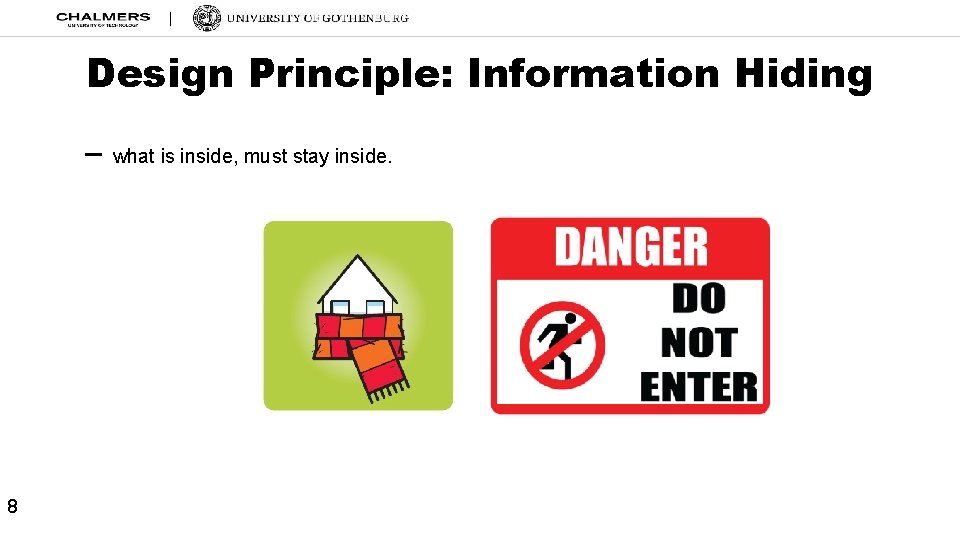
Design Principle: Information Hiding – 8 what is inside, must stay inside.
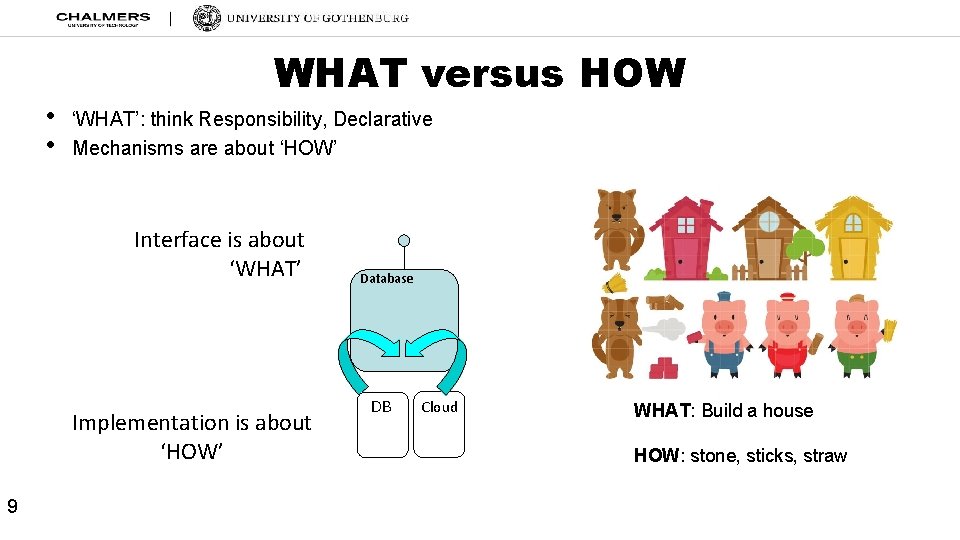
• • WHAT versus HOW ‘WHAT’: think Responsibility, Declarative Mechanisms are about ‘HOW’ Interface is about ‘WHAT’ Implementation is about ‘HOW’ 9 Database DB Cloud WHAT: Build a house HOW: stone, sticks, straw
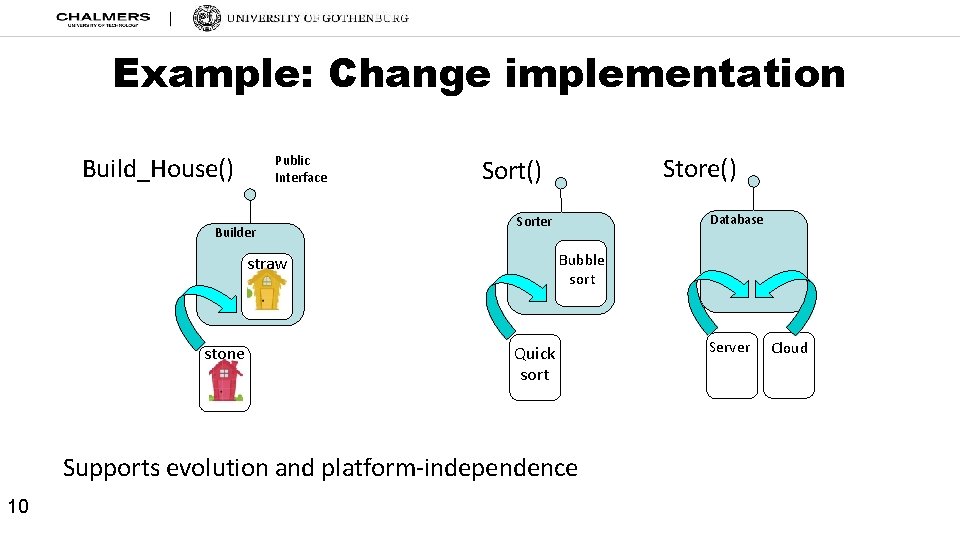
Example: Change implementation Build_House() Public Interface Builder Database Sorter Bubble sort straw stone Store() Sort() Quick sort Supports evolution and platform-independence 10 Server Cloud
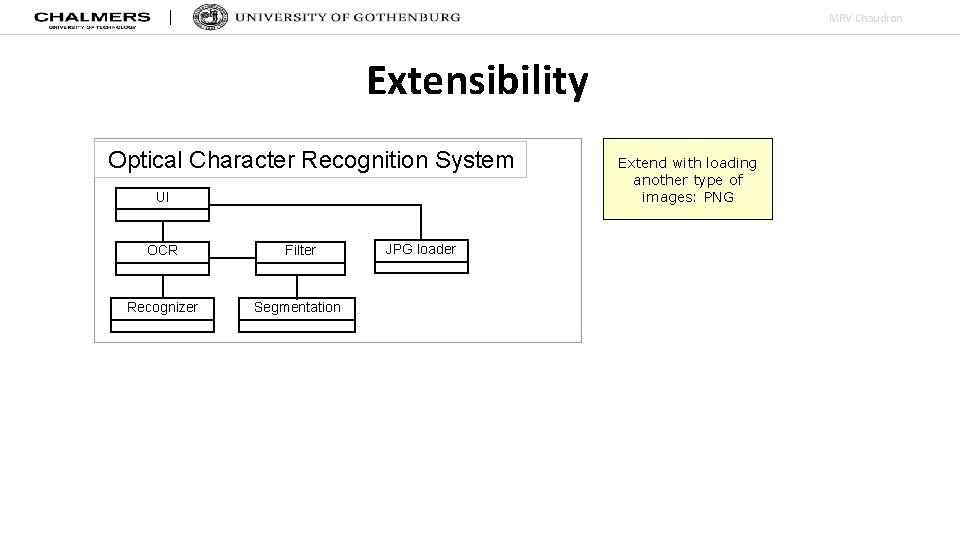
MRV Chaudron Extensibility Optical Character Recognition System UI ` OCR Filter Recognizer Segmentation M. R. V. Chaudron – May 2011 JPG loader Extend with loading another type of images: PNG
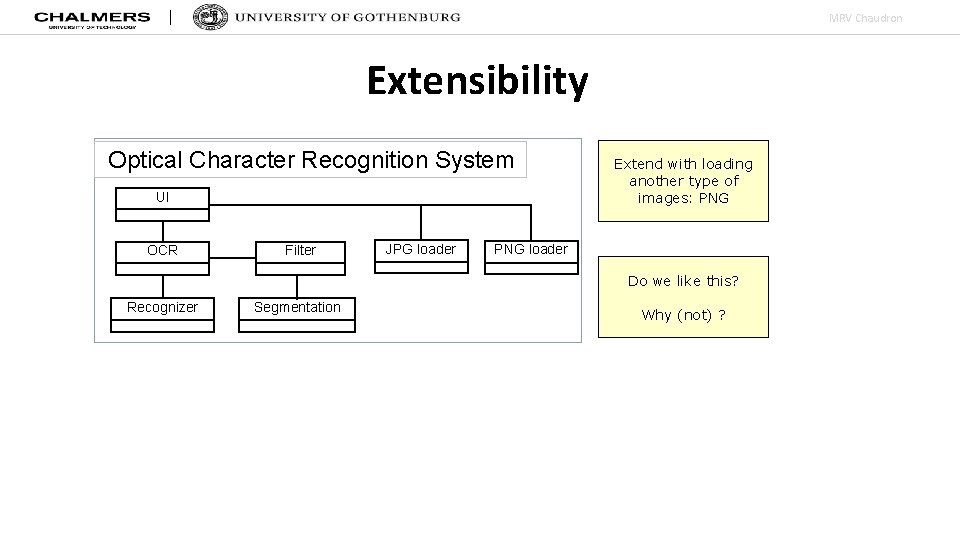
MRV Chaudron Extensibility Optical Character Recognition System UI OCR Filter ` JPG loader Extend with loading another type of images: PNG loader Do we like this? Recognizer M. R. V. Chaudron – May 2011 Segmentation Why (not) ?
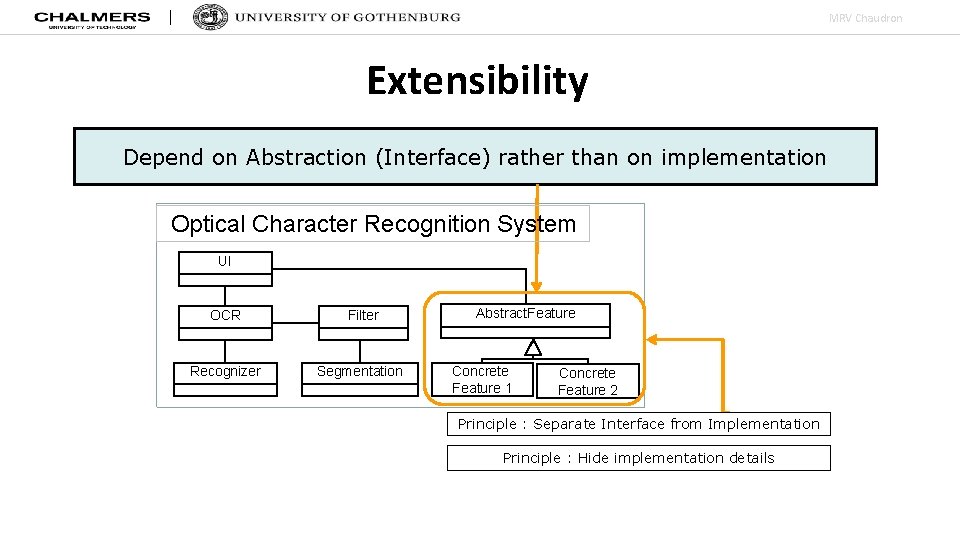
MRV Chaudron Extensibility Depend on Abstraction (Interface) rather than on implementation Optical Character Recognition System UI ` OCR Filter Recognizer Segmentation Abstract. Feature Concrete Feature 1 Concrete Feature 2 Principle : Separate Interface from Implementation Principle : Hide implementation details M. R. V. Chaudron – May 2011
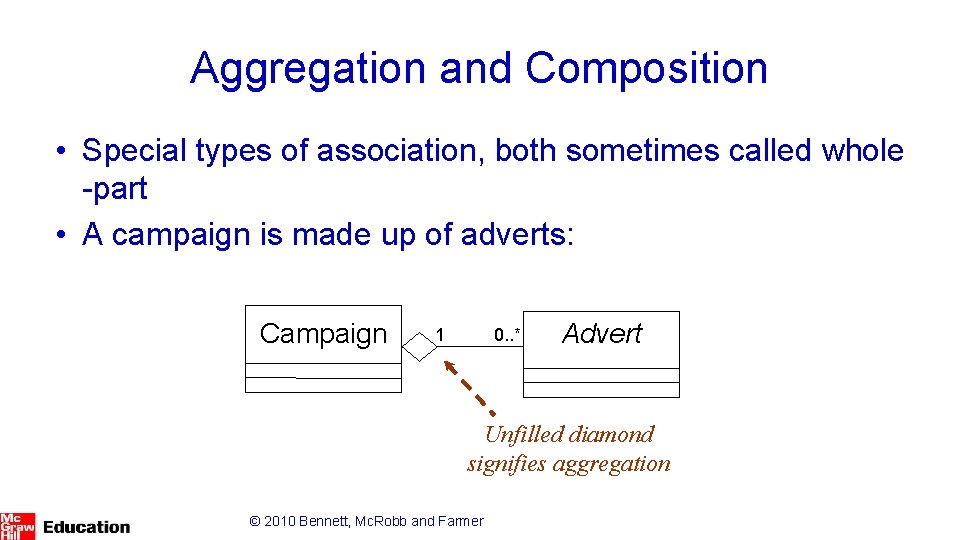
Aggregation and Composition • Special types of association, both sometimes called whole -part • A campaign is made up of adverts: Campaign 1 0. . * Advert Unfilled diamond signifies aggregation © 2010 Bennett, Mc. Robb and Farmer
Aggregation and Composition • Aggregation is essentially any whole-part relationship • Semantics can be very imprecise • Composition is ‘stronger’: – Each part may belong to only one whole at a time – When the whole is destroyed, so are all its parts © 2010 Bennett, Mc. Robb and Farmer
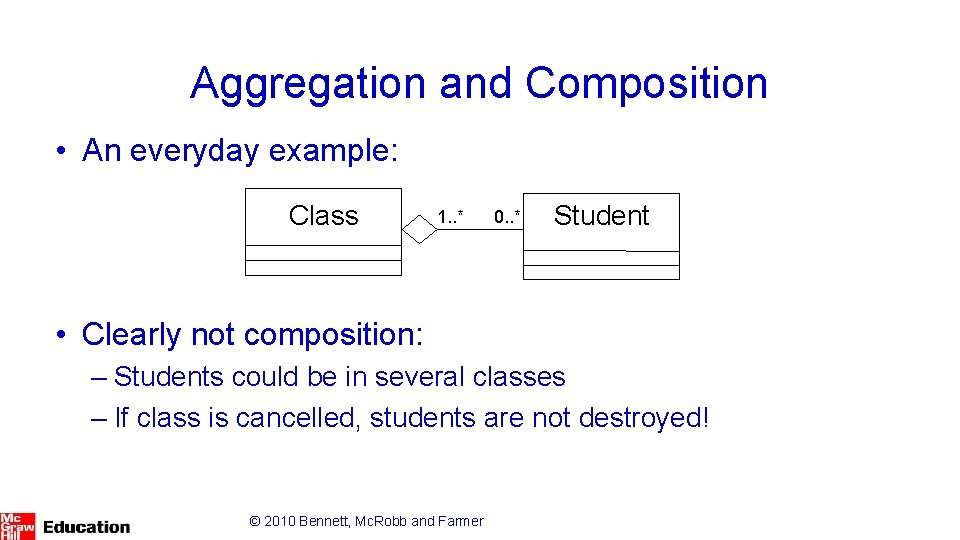
Aggregation and Composition • An everyday example: Class 1. . * 0. . * Student • Clearly not composition: – Students could be in several classes – If class is cancelled, students are not destroyed! © 2010 Bennett, Mc. Robb and Farmer
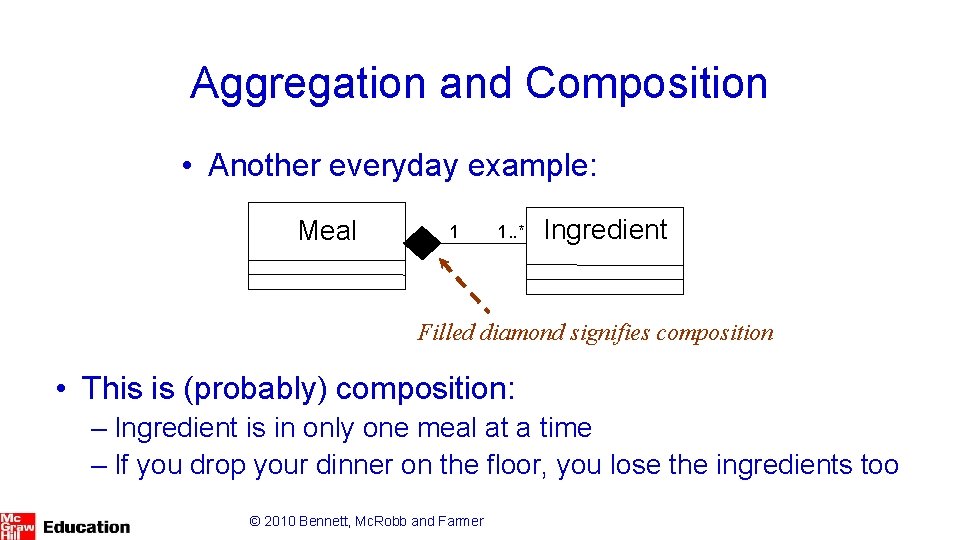
Aggregation and Composition • Another everyday example: Meal 1 1. . * Ingredient Filled diamond signifies composition • This is (probably) composition: – Ingredient is in only one meal at a time – If you drop your dinner on the floor, you lose the ingredients too © 2010 Bennett, Mc. Robb and Farmer
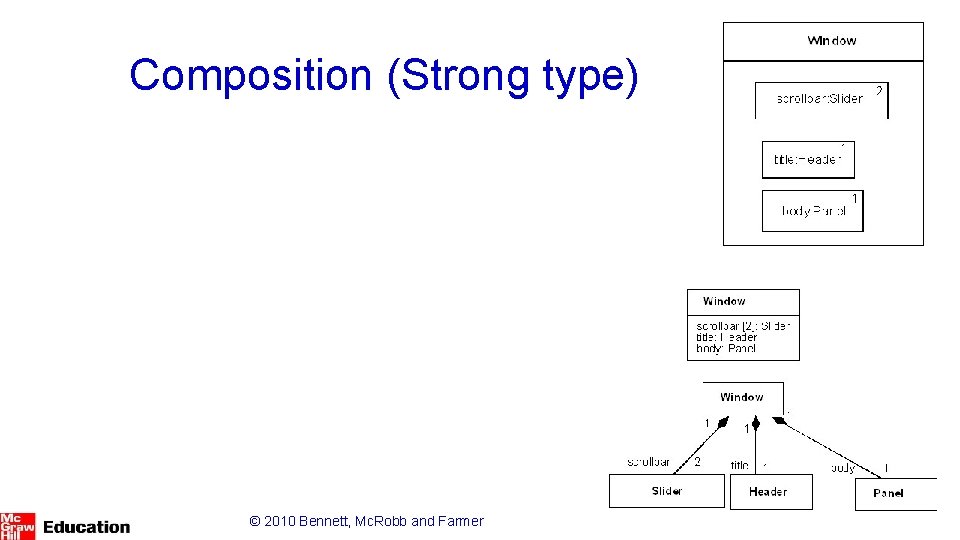
Composition (Strong type) © 2010 Bennett, Mc. Robb and Farmer
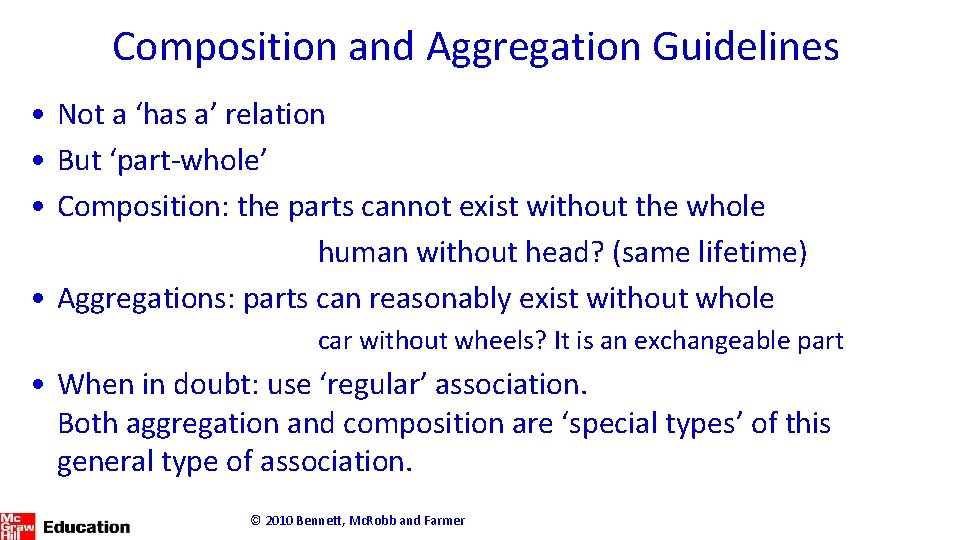
Composition and Aggregation Guidelines • Not a ‘has a’ relation • But ‘part-whole’ • Composition: the parts cannot exist without the whole human without head? (same lifetime) • Aggregations: parts can reasonably exist without whole car without wheels? It is an exchangeable part • When in doubt: use ‘regular’ association. Both aggregation and composition are ‘special types’ of this general type of association. © 2010 Bennett, Mc. Robb and Farmer
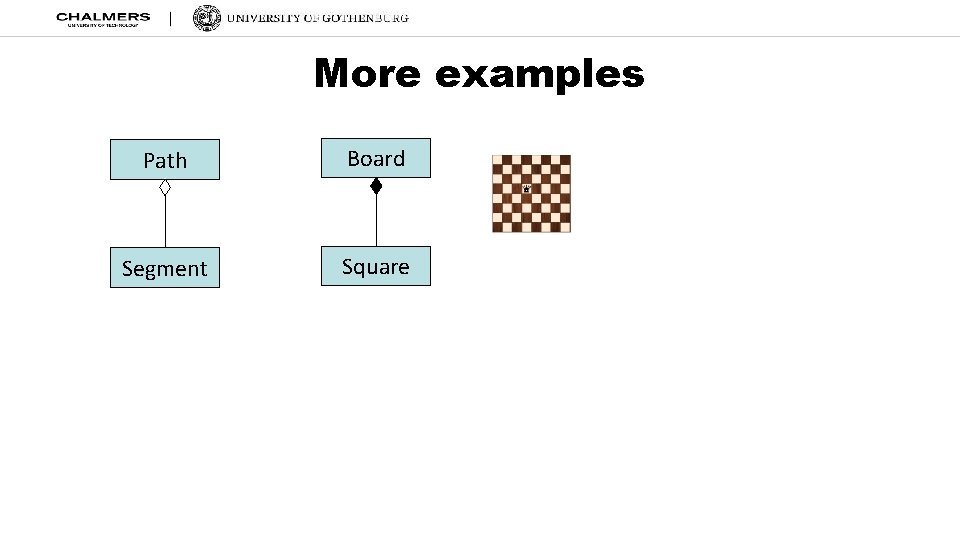
More examples Path Board Segment Square

MRV Chaudron Learning Objectives Michel’s Recap of Highlights (Dave will highlight additional topics) • Understand: • • • What models are, and are not Why we model Role of models in Software Development Relation between model(ing) and design(ing) Abstraction M. R. V. Chaudron – May 2011
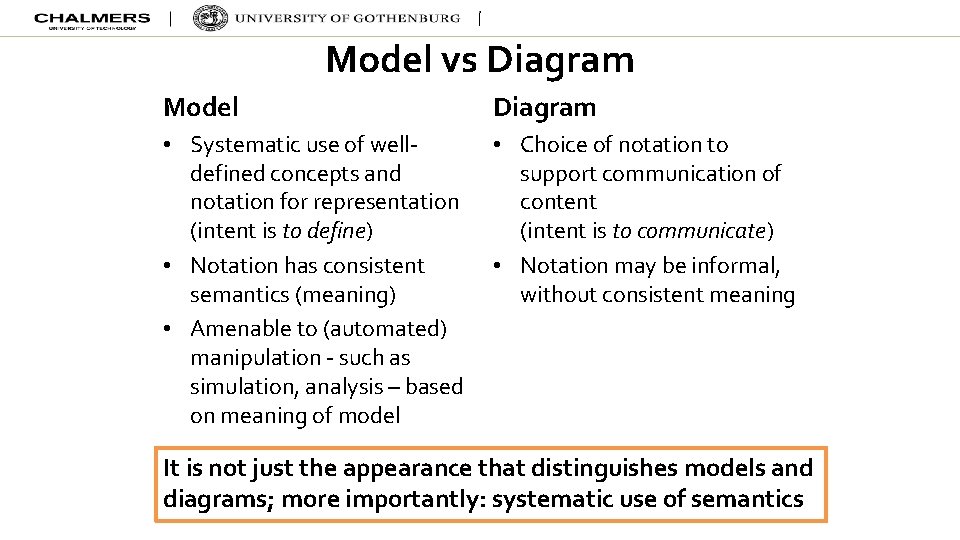
Model vs Diagram Model Diagram • Systematic use of welldefined concepts and notation for representation (intent is to define) • Notation has consistent semantics (meaning) • Amenable to (automated) manipulation - such as simulation, analysis – based on meaning of model • Choice of notation to support communication of content (intent is to communicate) • Notation may be informal, without consistent meaning It is not just the appearance that distinguishes models and diagrams; more importantly: systematic use of semantics
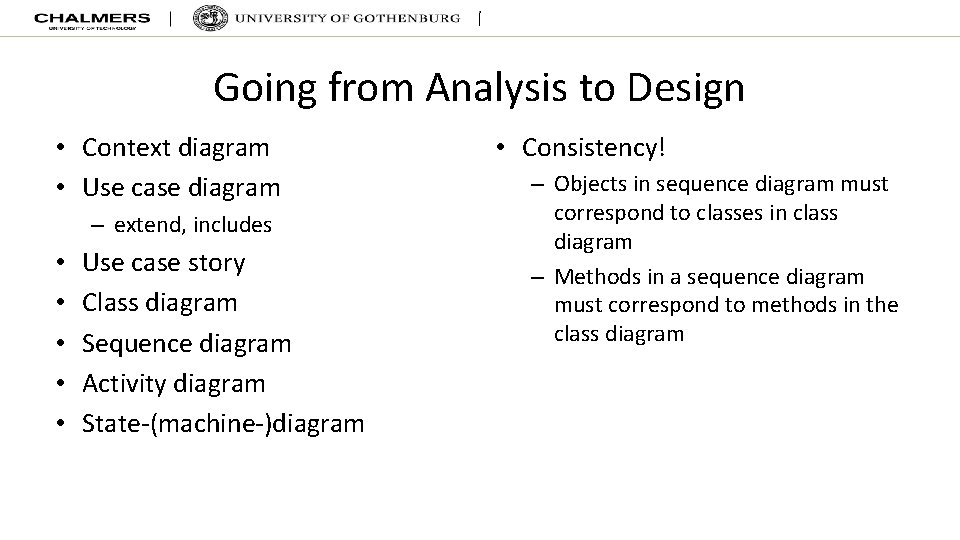
Going from Analysis to Design • Context diagram • Use case diagram – extend, includes • • • Use case story Class diagram Sequence diagram Activity diagram State-(machine-)diagram • Consistency! – Objects in sequence diagram must correspond to classes in class diagram – Methods in a sequence diagram must correspond to methods in the class diagram
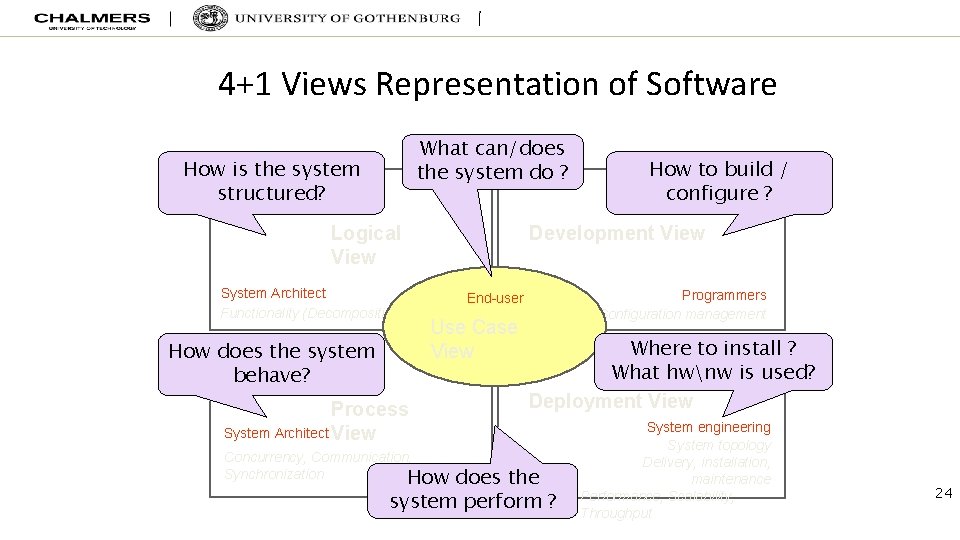
4+1 Views Representation of Software What can/does the system do ? How is the system structured? Logical View System Architect Functionality (Decomposition) How does the system behave? How to build / configure ? Development View Programmers Configuration management End-user Use Case View Process System Architect View Concurrency, Communication, Synchronization How Where to install ? What hwnw is used? Deployment View does the system perform ? System engineering System topology Delivery, installation, maintenance Performance, Scalability, Throughput 24
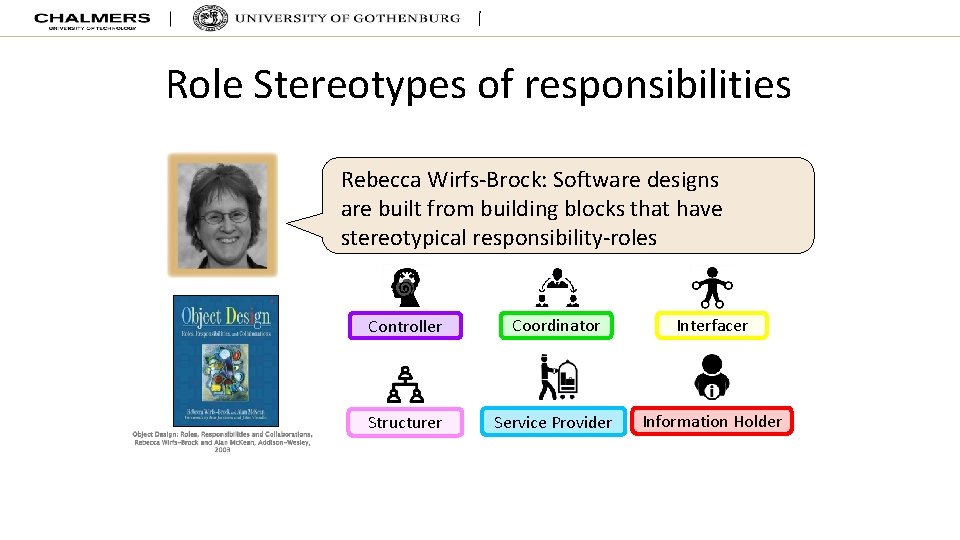
Role Stereotypes of responsibilities Rebecca Wirfs-Brock: Software designs are built from building blocks that have stereotypical responsibility-roles Controller Coordinator Interfacer Structurer Service Provider Information Holder
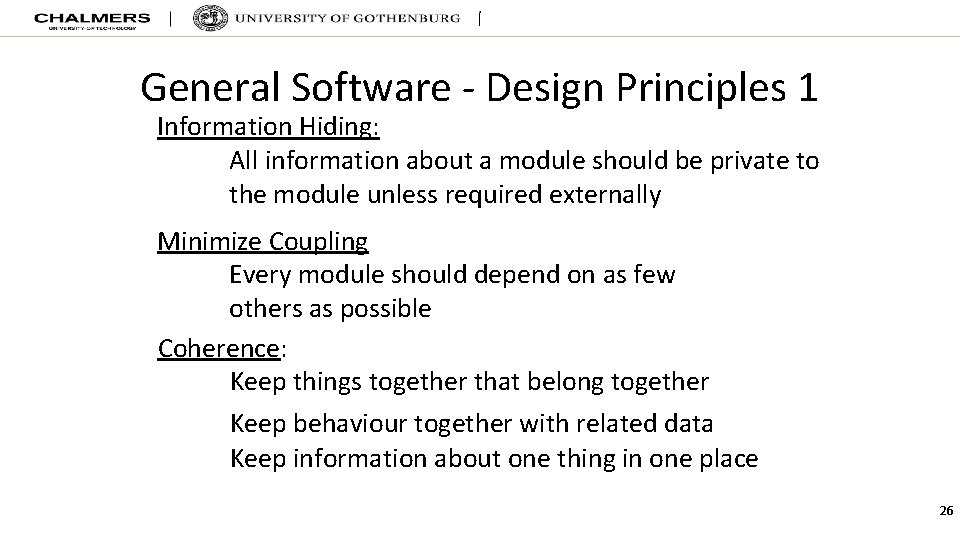
General Software - Design Principles 1 Information Hiding: All information about a module should be private to the module unless required externally Minimize Coupling Every module should depend on as few others as possible Coherence: Keep things together that belong together Keep behaviour together with related data Keep information about one thing in one place 26
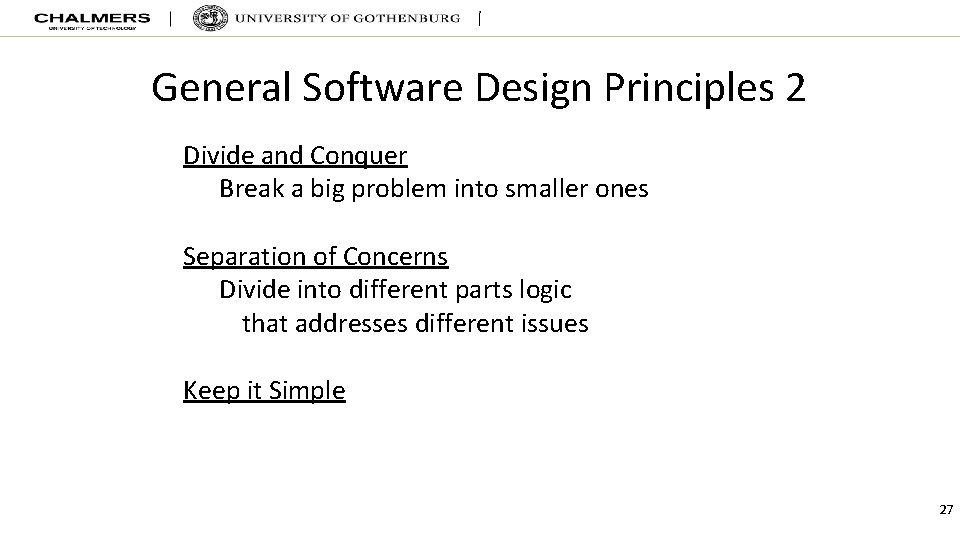
General Software Design Principles 2 Divide and Conquer Break a big problem into smaller ones Separation of Concerns Divide into different parts logic that addresses different issues Keep it Simple 27
My compliment to you as class • Positive & Constructive attitude • Appreciation
- Slides: 28