
Wrap Rate Technique Chapter 14 1 Introduction The
- Slides: 14
Wrap Rate Technique Chapter 14 1
Introduction • The Wrap Rate technique is a method used to allocate profit and other overhead costs to actual labor costs. • Total Cost equals – Direct Labor Cost – plus Overhead Cost – plus Other Costs 2
Direct Labor • Many of our cost estimating relationships use labor hours as a parameter, or predict cost in terms of labor hours. • There are two major categories of direct labor: – Engineering » Activities associated with research, design, and development or preparation of products and procedures. – Manufacturing » This is the “hands-on” effort to produce a product. 3
Wrap Rates • Once we have determined the labor hours required to produce an item, either by performing an engineering buildup or by applying a cost estimating relationship, we need a means of converting those hours to dollars. • A fully-burdened labor rate is a rate which includes all the contractor costs necessary to convert an estimate of contractor hours to contractor dollars. • The wrap rate will typically include the direct labor wage rate, overhead costs, and other costs. 4
Wage Rates • Four general factors impact the labor wage rate: – Variations in Geographical Locations » Supply and Demand of Work Available – Contractor Labor Force Variations » Supply and Demand of Workers – Variations in Skills » High skills vs. low skills – Variations with Time » Inflation » COLAs 5
Overhead Rates • Also known as Indirect Cost or Burden. • These costs are not directly identifiable with a specific cost objective. • There are two distinct types of overhead costs: – Those that are so general in nature they cannot be assigned to a specific cost objective » Plant and equipment maintenance – Those that are so inconsequential that the cost of accounting for them exceed the benefits derived from doing so. » Consumables such as washers, sandpaper, lubricants. 6
Overhead Rates • Most firms collect indirect costs in aggregate cost accounts called overhead pools such as – Manufacturing and Engineering Indirect Pools – General and Administrative Pools – Service Center Pools 7
Overhead Rates • Most common Indirect Cost Pools: – Material Overhead: Costs related to transportation, acquisition, inspection and handling of materials. – Manufacturing Overhead: Indirect labor costs including supervision, inspection and maintenance. – Engineering Overhead: Costs of directing and supporting the activities of the Engineering Department. – General and Administrative: The costs of the company’s general and executive offices. 8
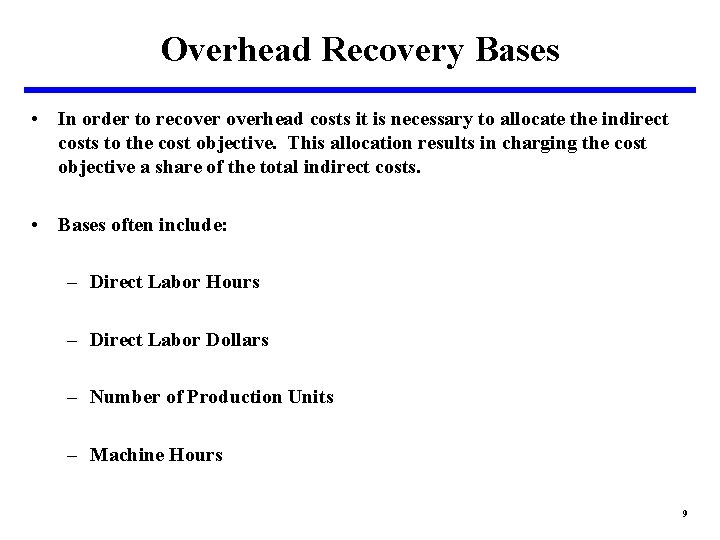
Overhead Recovery Bases • In order to recoverhead costs it is necessary to allocate the indirect costs to the cost objective. This allocation results in charging the cost objective a share of the total indirect costs. • Bases often include: – Direct Labor Hours – Direct Labor Dollars – Number of Production Units – Machine Hours 9
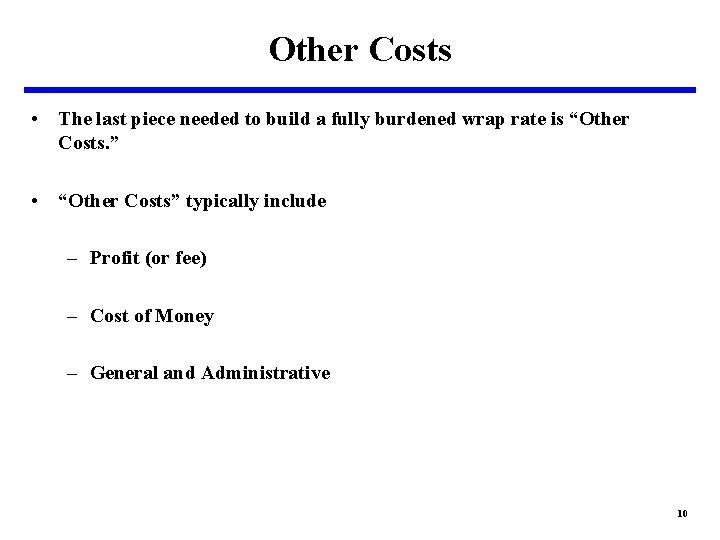
Other Costs • The last piece needed to build a fully burdened wrap rate is “Other Costs. ” • “Other Costs” typically include – Profit (or fee) – Cost of Money – General and Administrative 10
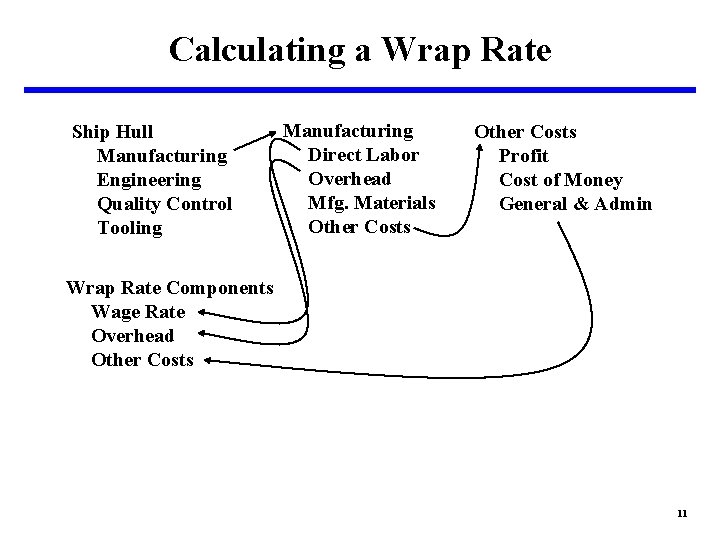
Calculating a Wrap Rate Ship Hull Manufacturing Engineering Quality Control Tooling Manufacturing Direct Labor Overhead Mfg. Materials Other Costs Profit Cost of Money General & Admin Wrap Rate Components Wage Rate Overhead Other Costs 11
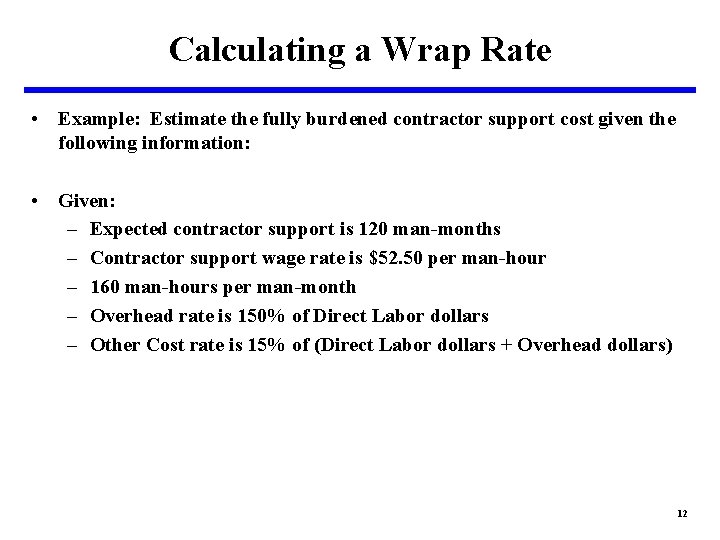
Calculating a Wrap Rate • Example: Estimate the fully burdened contractor support cost given the following information: • Given: – Expected contractor support is 120 man-months – Contractor support wage rate is $52. 50 per man-hour – 160 man-hours per man-month – Overhead rate is 150% of Direct Labor dollars – Other Cost rate is 15% of (Direct Labor dollars + Overhead dollars) 12
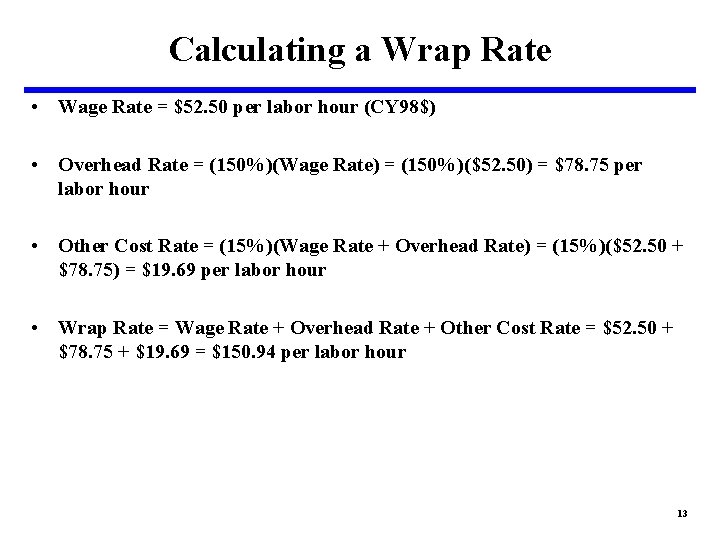
Calculating a Wrap Rate • Wage Rate = $52. 50 per labor hour (CY 98$) • Overhead Rate = (150%)(Wage Rate) = (150%)($52. 50) = $78. 75 per labor hour • Other Cost Rate = (15%)(Wage Rate + Overhead Rate) = (15%)($52. 50 + $78. 75) = $19. 69 per labor hour • Wrap Rate = Wage Rate + Overhead Rate + Other Cost Rate = $52. 50 + $78. 75 + $19. 69 = $150. 94 per labor hour 13
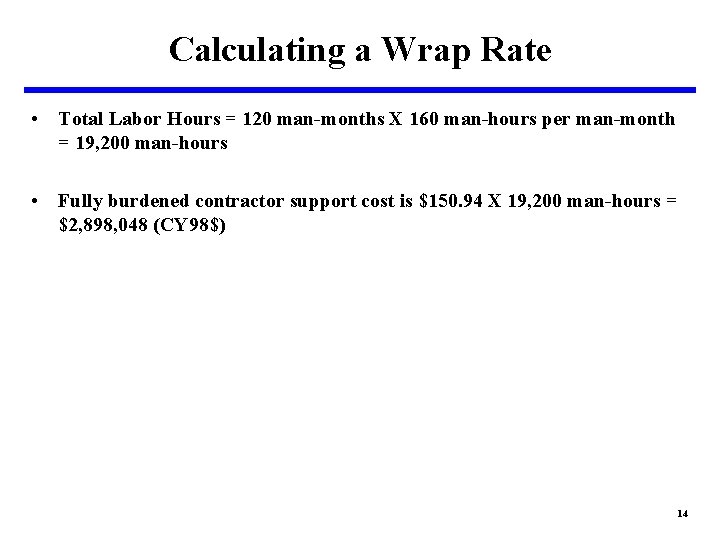
Calculating a Wrap Rate • Total Labor Hours = 120 man-months X 160 man-hours per man-month = 19, 200 man-hours • Fully burdened contractor support cost is $150. 94 X 19, 200 man-hours = $2, 898, 048 (CY 98$) 14