
WP 6 Anomalous Propagation Modelling David Bebbington Stephen
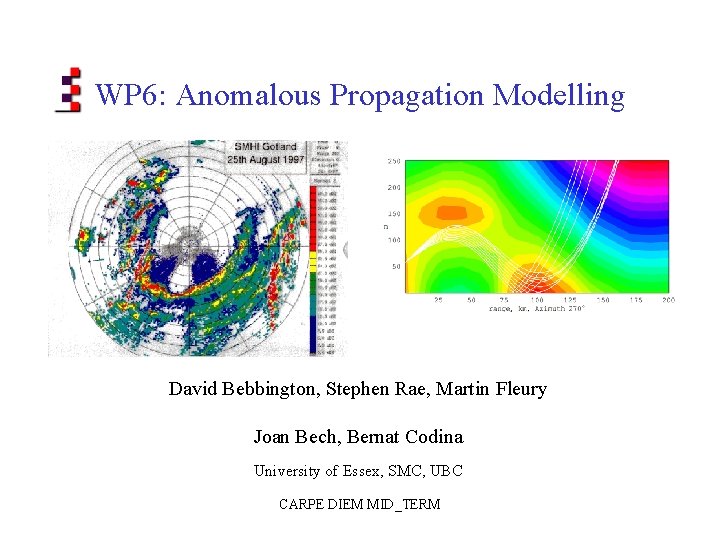
WP 6: Anomalous Propagation Modelling David Bebbington, Stephen Rae, Martin Fleury Joan Bech, Bernat Codina University of Essex, SMC, UBC CARPE DIEM MID_TERM
Overview • Part I --- Background Theory • Part II -- Terrain Interaction • Part III - Visualization 11/30/2020 CARPE DIEM MID_TERM 2

WP 6 - Anomalous Propagation Apparent elevation q z M(z) 11/30/2020 Strong surface ’reflectivity’ Our aim is to produce a PC software package capable of modelling anaprop on the basis of NWP (HIRLAM) atmospheric model, and terrain model. CARPE DIEM MID_TERM 3
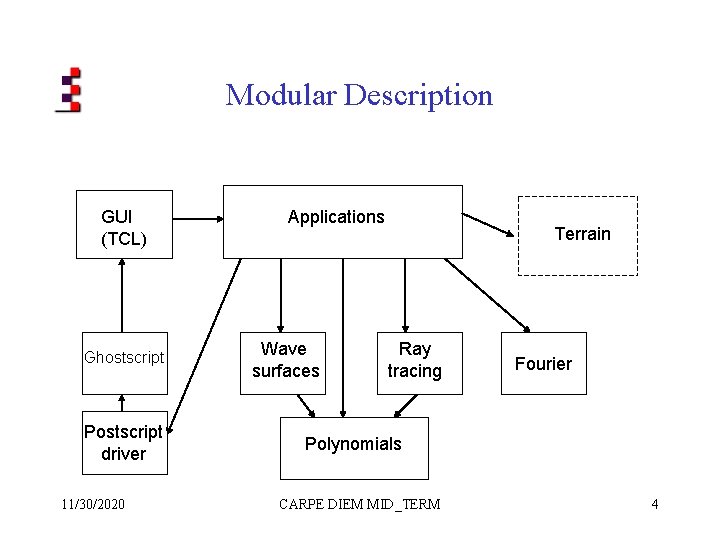
Modular Description GUI (TCL) Ghostscript Postscript driver 11/30/2020 Applications Wave surfaces Terrain Ray tracing Fourier Polynomials CARPE DIEM MID_TERM 4
Background Theory Parabolic Equation / Split-Step Method : • implements Huyghens’ principle by fast convolution (FFT) • decouples geometric and refractive effects • conventionally evaluates on planar surfaces 11/30/2020 CARPE DIEM MID_TERM 5
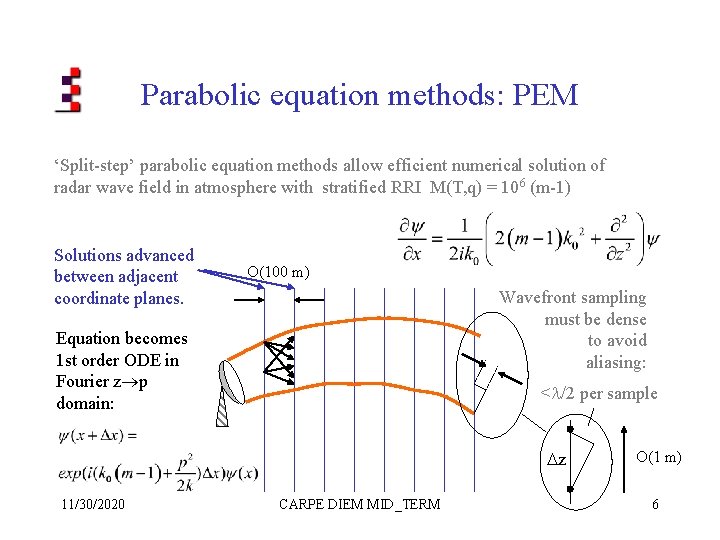
Parabolic equation methods: PEM ‘Split-step’ parabolic equation methods allow efficient numerical solution of radar wave field in atmosphere with stratified RRI M(T, q) = 106 (m-1) Solutions advanced between adjacent coordinate planes. O(100 m) Wavefront sampling must be dense to avoid aliasing: Equation becomes 1 st order ODE in Fourier z p domain: < /2 per sample z 11/30/2020 CARPE DIEM MID_TERM O(1 m) 6
PEM on curvilinear coordinates Problems can be rewritten in new coordinates - choice of coordinates frequently simplifies Formally, the wave equation acquires new terms - metric connection coefficients - this is the basis of the modified refractive index approach. Computationally, considerable advantage from adapting coordinate system close to wave surface. 11/30/2020 CARPE DIEM MID_TERM 7
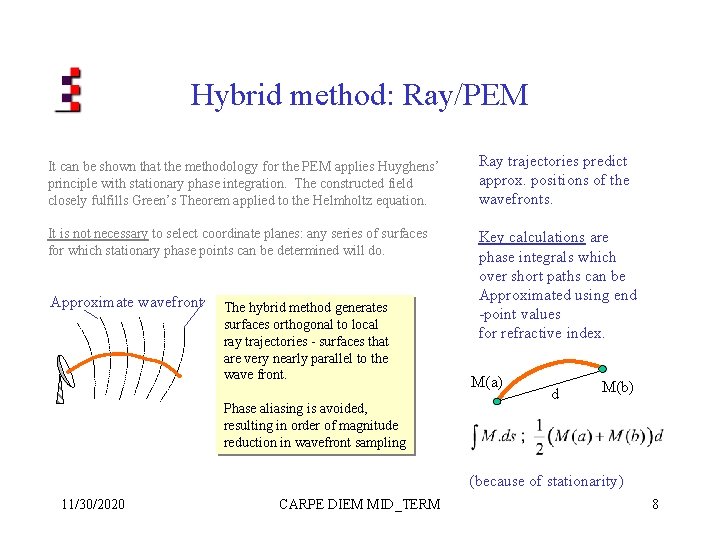
Hybrid method: Ray/PEM It can be shown that the methodology for the PEM applies Huyghens’ principle with stationary phase integration. The constructed field closely fulfills Green’s Theorem applied to the Helmholtz equation. It is not necessary to select coordinate planes: any series of surfaces for which stationary phase points can be determined will do. Approximate wavefront The hybrid method generates surfaces orthogonal to local ray trajectories - surfaces that are very nearly parallel to the wave front. Phase aliasing is avoided, resulting in order of magnitude reduction in wavefront sampling Ray trajectories predict approx. positions of the wavefronts. Key calculations are phase integrals which over short paths can be Approximated using end -point values for refractive index. M(a) d M(b) (because of stationarity) 11/30/2020 CARPE DIEM MID_TERM 8

Evaluations on wave surfaces Solutions advanced between adjacent coordinate surfaces Phase variation with respect to smooth surface with adjusted tilt and curvature is reduced Wavefront sampling can be sparse and avoid aliasing: FFT order is strongly reduced 11/30/2020 CARPE DIEM MID_TERM 9
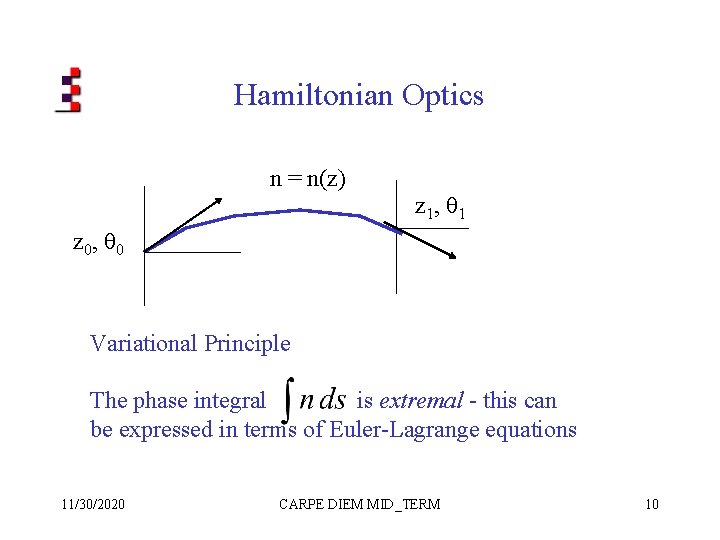
Hamiltonian Optics n = n(z) z 1, q 1 z 0, q 0 Variational Principle The phase integral is extremal - this can be expressed in terms of Euler-Lagrange equations 11/30/2020 CARPE DIEM MID_TERM 10
Parametric representation The smooth ray trajectory z(s) can be expanded as a truncated Taylor series for a small increment s If refractive index n(z) expressed as a function, approximate solution of ODE for ray reduces to algebraic equation. Cubic parametrization of n(z) gives unique cubic trajectory minimizing mean square error in Lagrangian. 11/30/2020 CARPE DIEM MID_TERM 11
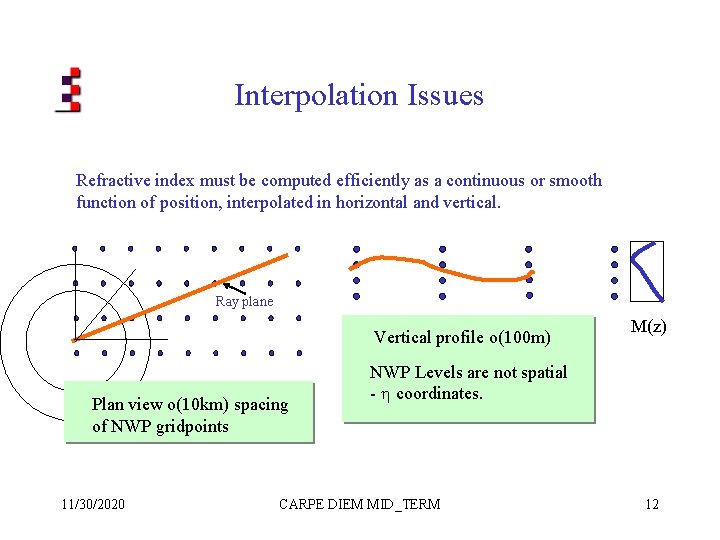
Interpolation Issues Refractive index must be computed efficiently as a continuous or smooth function of position, interpolated in horizontal and vertical. Ray plane Vertical profile o(100 m) Plan view o(10 km) spacing of NWP gridpoints 11/30/2020 M(z) NWP Levels are not spatial - h coordinates. CARPE DIEM MID_TERM 12
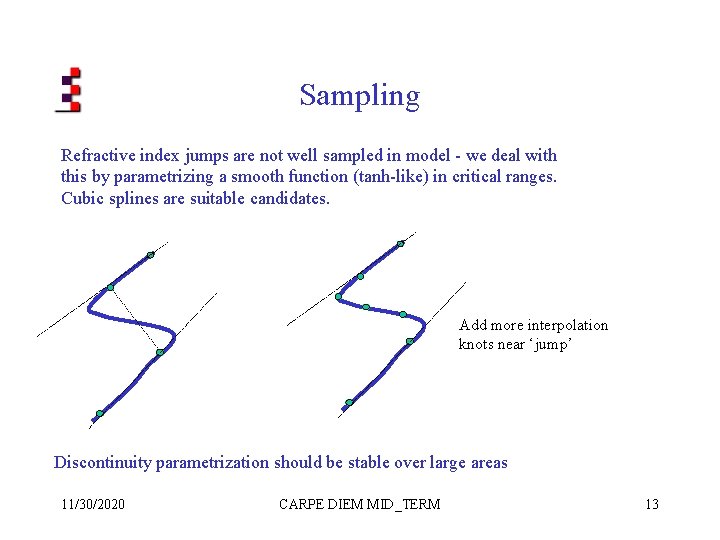
Sampling Refractive index jumps are not well sampled in model - we deal with this by parametrizing a smooth function (tanh-like) in critical ranges. Cubic splines are suitable candidates. Add more interpolation knots near ‘jump’ Discontinuity parametrization should be stable over large areas 11/30/2020 CARPE DIEM MID_TERM 13

Application and Implementation Approximate wave surface propagated by calculating end points for small number of test rays: Small deviation between ray tangent and surface normal NOTE: form of surface is immaterial to end result. Best fit circular arc 11/30/2020 CARPE DIEM MID_TERM 14
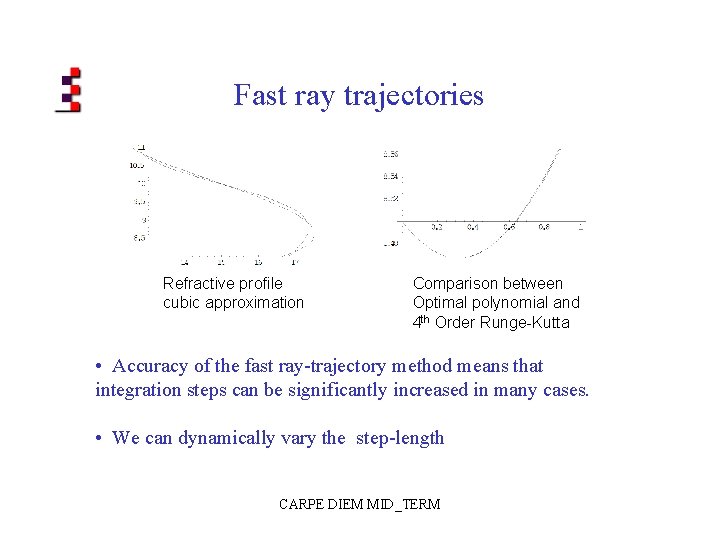
Fast ray trajectories Refractive profile cubic approximation Comparison between Optimal polynomial and 4 th Order Runge-Kutta • Accuracy of the fast ray-trajectory method means that integration steps can be significantly increased in many cases. • We can dynamically vary the step-length CARPE DIEM MID_TERM
Phase Integration In principle, we have to evaluate total phase between pairs of corresponding points - implying knowledge of each trajectory. To simplify, decompose the sum: • S 1: contribution due to refraction as if on a straight path • S 2: (negative) due to difference in n on actual path • S 3: (positive) due to geometric ray curvature Useful result: S 2 = -2 S 3. If trajectory is known, the net phase can be determined geometrically Further: a cubic is determined by endpoints and slopes - so curve is determined implicitly by end conditions. 11/30/2020 CARPE DIEM MID_TERM 16
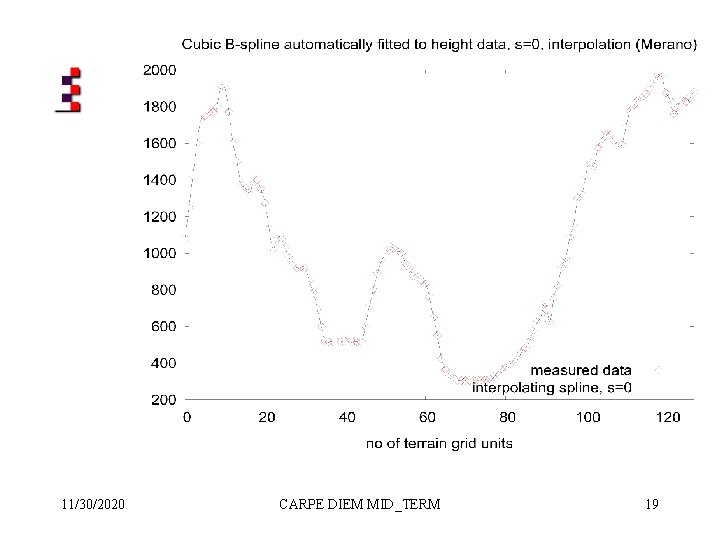
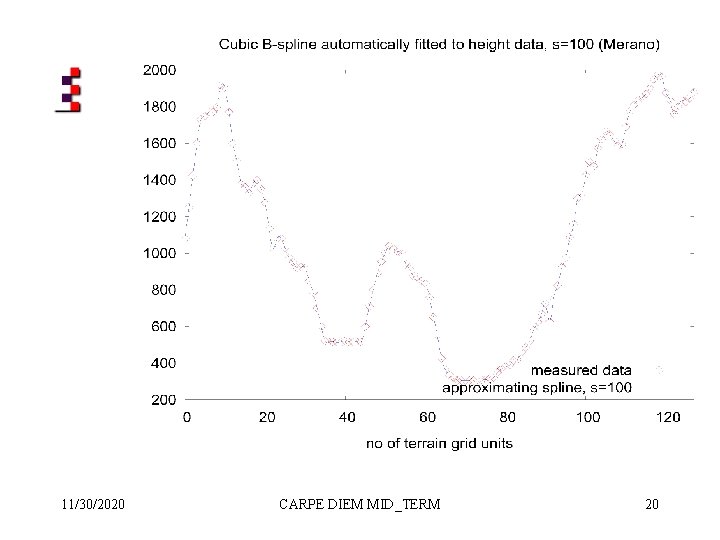
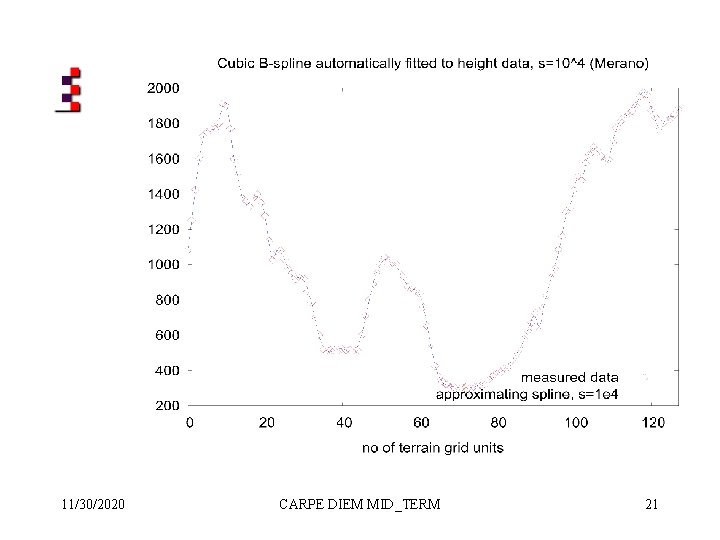
Part II - Terrain Interaction Simulation of anaprop requires a good model of terrain profile for each radar azimuth. - need to determine where beam interacts with terrain -where terrain sufficiently smooth, evaluate coherent forward reflection propagating to further targets Tasks in hand/completed • Interpolation from cartesian to polar grid. • B-spline interpolation/approximation of terrain profiles 11/30/2020 CARPE DIEM MID_TERM 17
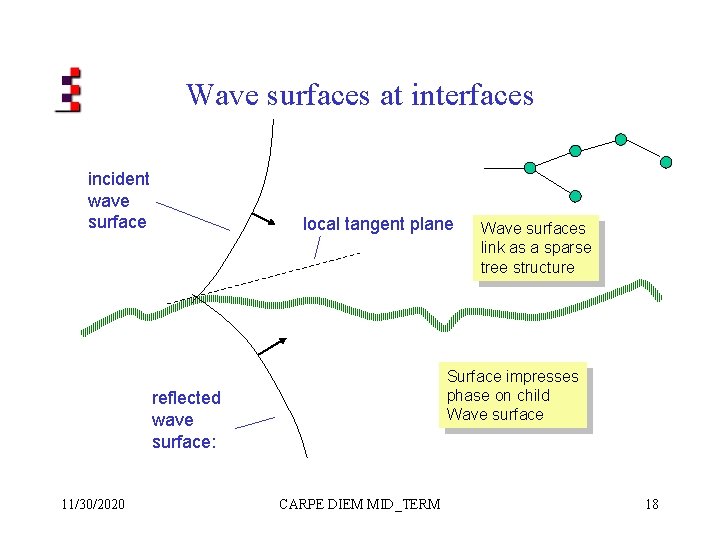
Wave surfaces at interfaces incident wave surface local tangent plane Surface impresses phase on child Wave surface reflected wave surface: 11/30/2020 Wave surfaces link as a sparse tree structure CARPE DIEM MID_TERM 18
11/30/2020 CARPE DIEM MID_TERM 19
11/30/2020 CARPE DIEM MID_TERM 20
11/30/2020 CARPE DIEM MID_TERM 21
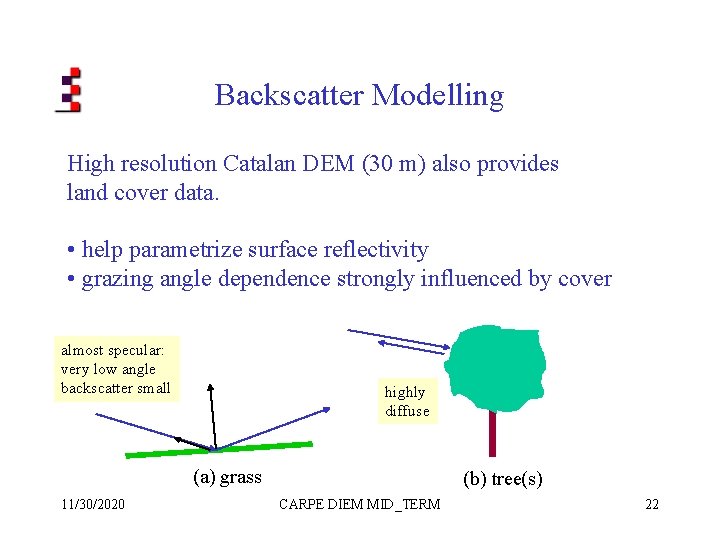
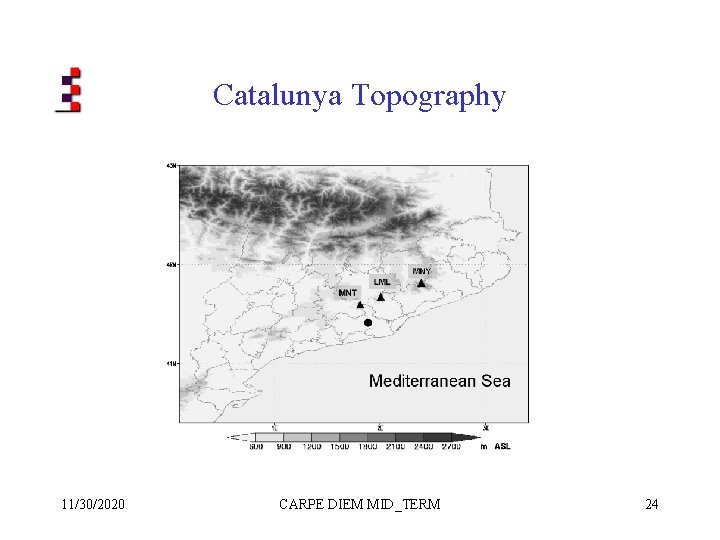
Backscatter Modelling High resolution Catalan DEM (30 m) also provides land cover data. • help parametrize surface reflectivity • grazing angle dependence strongly influenced by cover almost specular: very low angle backscatter small highly diffuse (a) grass 11/30/2020 (b) tree(s) CARPE DIEM MID_TERM 22
Part III - Visualization Gauging effectiveness of anaprop modelling depends on visualization of results. Anaprop is strongly linked to terrain, so it is desirable to have simultaneous display of terrain and radar. • developed Post. Script transparent radar overlay • show terrain in ‘brownscale’ • developed polar contour module for 3 rd variable, e. g - anaprop reflectivity • developed image warping transformations to display lat-lon terrain data in radar tangent-plane coordinates 11/30/2020 CARPE DIEM MID_TERM 23
Catalunya Topography 11/30/2020 CARPE DIEM MID_TERM 24
Summary Ongoing development of a software tool to simulate and visualize anaprop predicted on the basis of NWP data. Design concepts geared to: (a) highly efficient evaluation of the beam propagation - wave surface data structure - polynomial reps of n, h, rays. (b) parametric variation Further developments will be aimed at optimization of match between observation and NWP, with possible refinements of NWP data 11/30/2020 CARPE DIEM MID_TERM 25
- Slides: 25