
WP 1 Building up a National Database Prof
WP 1: Building up a National Database Prof Barbara Dooley, Mr. Chuck Rashleigh, Dr Emma Howard and Dr Zahra Farahani
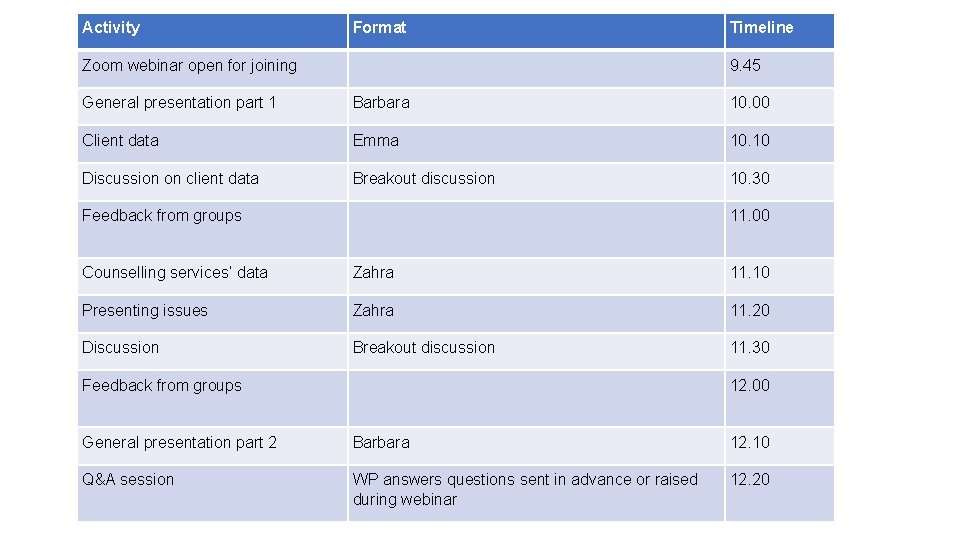
Activity Format Zoom webinar open for joining Timeline 9. 45 General presentation part 1 Barbara 10. 00 Client data Emma 10. 10 Discussion on client data Breakout discussion 10. 30 Feedback from groups 11. 00 Counselling services’ data Zahra 11. 10 Presenting issues Zahra 11. 20 Discussion Breakout discussion 11. 30 Feedback from groups 12. 00 General presentation part 2 Barbara 12. 10 Q&A session WP answers questions sent in advance or raised during webinar 12. 20
House Rules: • Please keep your microphone muted when you are not talking. This is to minimise the background noise. • Please use the chat box for asking questions or making comments during the presentation. • Please turn off the video feed if occurrences happen in the background.
Overview of Project
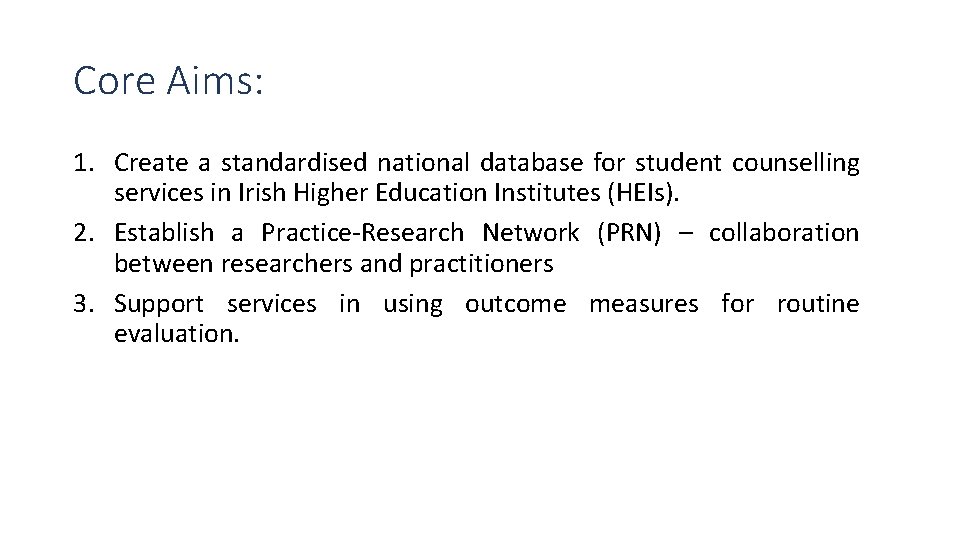
Core Aims: 1. Create a standardised national database for student counselling services in Irish Higher Education Institutes (HEIs). 2. Establish a Practice-Research Network (PRN) – collaboration between researchers and practitioners 3. Support services in using outcome measures for routine evaluation.
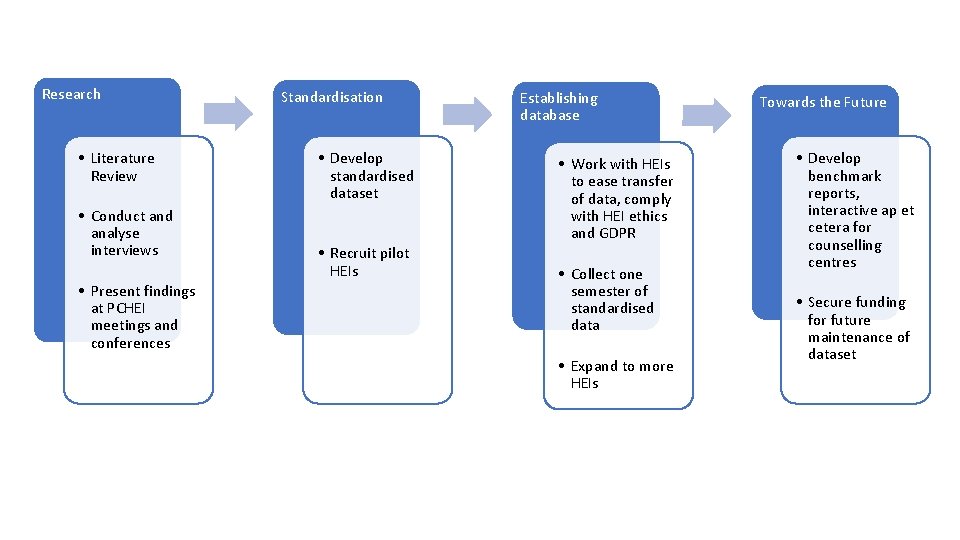
Research • Literature Review • Conduct and analyse interviews • Present findings at PCHEI meetings and conferences Standardisation • Develop standardised dataset • Recruit pilot HEIs Establishing database • Work with HEIs to ease transfer of data, comply with HEI ethics and GDPR • Collect one semester of standardised data • Expand to more HEIs Towards the Future • Develop benchmark reports, interactive ap et cetera for counselling centres • Secure funding for future maintenance of dataset
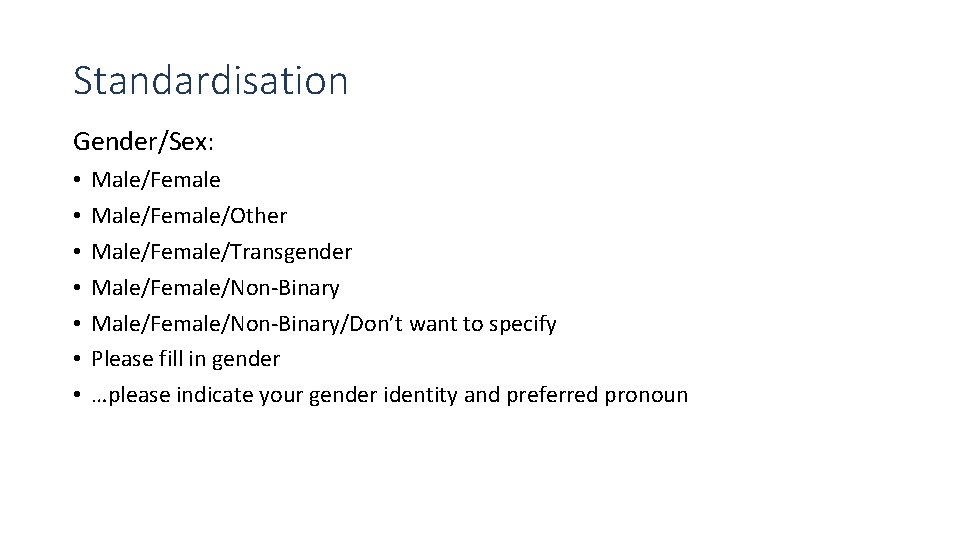
Standardisation Gender/Sex: • • Male/Female/Other Male/Female/Transgender Male/Female/Non-Binary/Don’t want to specify Please fill in gender …please indicate your gender identity and preferred pronoun
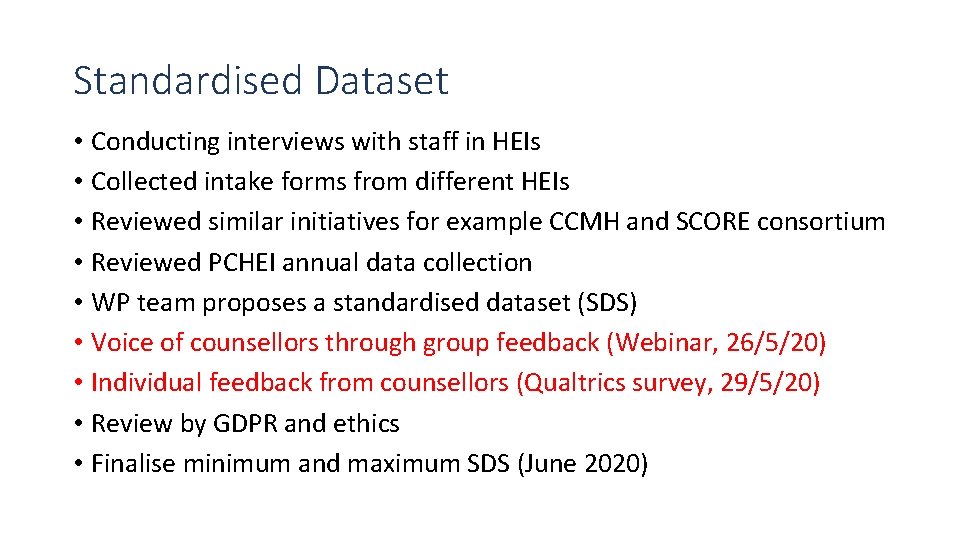
Standardised Dataset • Conducting interviews with staff in HEIs • Collected intake forms from different HEIs • Reviewed similar initiatives for example CCMH and SCORE consortium • Reviewed PCHEI annual data collection • WP team proposes a standardised dataset (SDS) • Voice of counsellors through group feedback (Webinar, 26/5/20) • Individual feedback from counsellors (Qualtrics survey, 29/5/20) • Review by GDPR and ethics • Finalise minimum and maximum SDS (June 2020)
Section A: Client Data
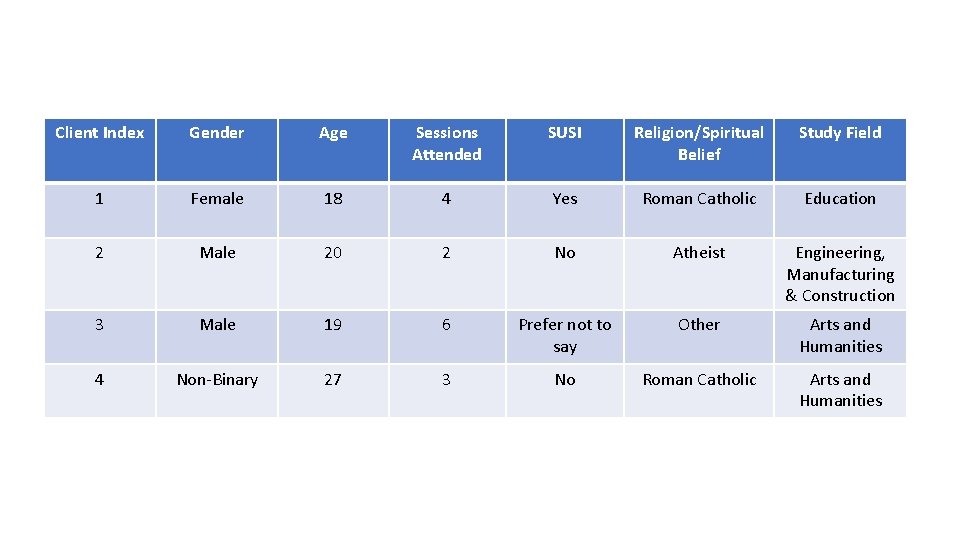
Client Index Gender Age Sessions Attended SUSI Religion/Spiritual Belief Study Field 1 Female 18 4 Yes Roman Catholic Education 2 Male 20 2 No Atheist Engineering, Manufacturing & Construction 3 Male 19 6 Prefer not to say Other Arts and Humanities 4 Non-Binary 27 3 No Roman Catholic Arts and Humanities
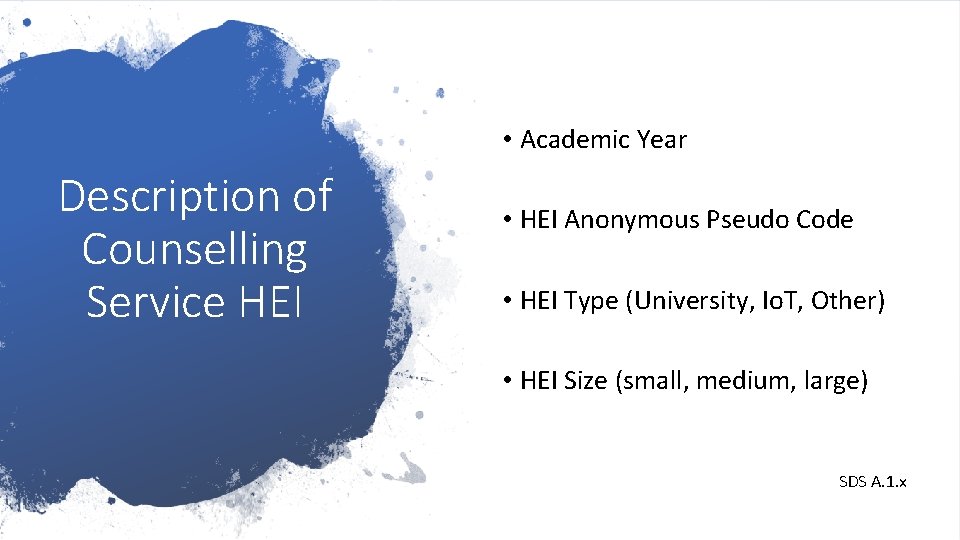
• Academic Year Description of Counselling Service HEI • HEI Anonymous Pseudo Code • HEI Type (University, Io. T, Other) • HEI Size (small, medium, large) SDS A. 1. x
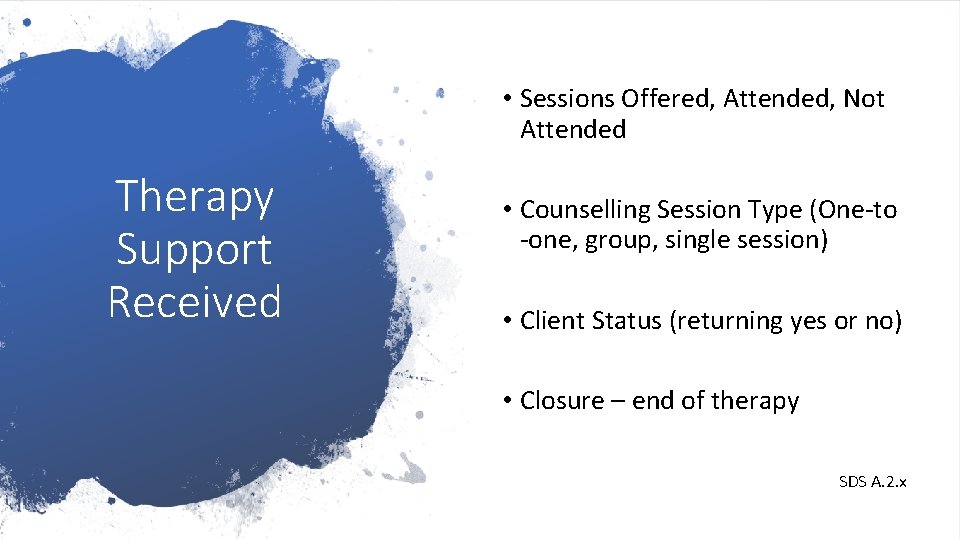
• Sessions Offered, Attended, Not Attended Therapy Support Received • Counselling Session Type (One-to -one, group, single session) • Client Status (returning yes or no) • Closure – end of therapy SDS A. 2. x

• Option 1: Male, Female, Transgender Male, Transgender Female, Non-binary Gender • Option 2: Male, Female, Non-binary, Other • Option 3: Gender. Queer, Gender. Fluid, Male, Female, Gender. Variant, Nonbinary, Self-Assign Gender SDS A. 3. 2
• This variable is proposed instead of country of origin or nationality. Country of Domicile • Response: Europe EU; Europe Non-EU; Asia; Oceania; Africa; America North; America South; Other SDS A. 3. 4
• Q. What is your ethnic or cultural background? Ethnicity • Option 1: White Irish, White (not Irish), Asian/Asian Irish, Black, Mixed • Option 2: White Irish, Irish Traveller, Any other White background, Black or Black Irish, Asian or Asian Irish, Prefer not to say, Other including Mixed Background • Option 3: White Irish, Irish Traveller, Any other White background, African, Any other Black Background, Chinese, Any other Asian background, Prefer not to say, Other including Mixed Background SDS A. 3. 6
• Arts and Humanities • Natural Sciences, Mathematics & Statistics • Engineering, Manufacturing & Construction Study Level, Field, & Year • Business, Administration & Law • Agriculture, Forestry, Fisheries & Veterinary • Social Science, Journalism & Information • Education • Services • Information & Communication Technologies (ICTs) • Generic Programmes and Qualifications • Health & Welfare SDS A. 3. 8/. 9/. 10
• Q. Are you registered as any of the following. . . Mature, HEAR, Placement • Response: Yes, No SDS A. 3. 12/13/15
Living Arrangements • Option 1: With who do you live? • Response: Alone, Spouse, Partner or significant other, Roommate(s), Children, Parent(s) or guardian(s), Family other, Other (please specify) • Option 2: Type of accommodation during term time: • Response: Family home, Campus Residence, Private Rented accommodation, Digs, Other SDS A. 3. 16
Extracurricular Activities, Paid Work • Please estimate the number of hours per week you are actively involved in organised extracurricular activities (e. g. , sports, clubs, student union, etc. ): • Q. What is the average number of hours you work per week during the academic year (paid employment only)? SDS A. 3. 14/18
• Q. How many hours of sleep do you get on average? Sleep, Alcohol/Drugs, Medication • Q. Have you ever used alcohol or drugs to cope with your issues? • Q. Are you on medication for a mental health issue? SDS A. 3. 17/. 19/. 22
Mental Health • Q. Please tick any mental health professionals outside the student counselling service whom you currently consult? • Response: Family GP, Primary care setting, Hospital, On-campus mental health support, Psychotherapist, Jigsaw or similar, Other • To what extent are your current issues affecting your mental health? SDS A. 3. 20/21
Disability • DARE • Client registered with disability • Client registered with mental health disability • Client registered with disability but not meeting the criteria for mental health disability • Client not registered other health issue although fulfilling criteria for registration SDS A. 4. x
Risk (self-harm, harm to others, suicide) • Option 1: Yes, No • Option 2: How many times it has occurred • Option 3: The last time it occurred • Option 4: Level of risk for each category (self-harm, harm to others, suicide) • Option 5: Report how many students assessed as severe suicide risk and how many as moderate risk of suicide SDS A. 5. 1
Counselling Impact on Academic Outcomes (CIAO) • Q 1. To what extent are you considering leaving your course because of your problems? • Q 2. To what extent would you say your problems are affecting your study? • . . . • Q 9. To what extent would say that counselling has helped you feel more positive about the future? SDS A. 6. 1
Discussion on Client Data
Counselling Services’ Data
Counselling Services’ Data • This data would be collected on a per counselling service basis • Similar to PCHEI annual data collection • The data could be used to provide a sector overview for an annual report, for funding statistics and benchmarking if services wish
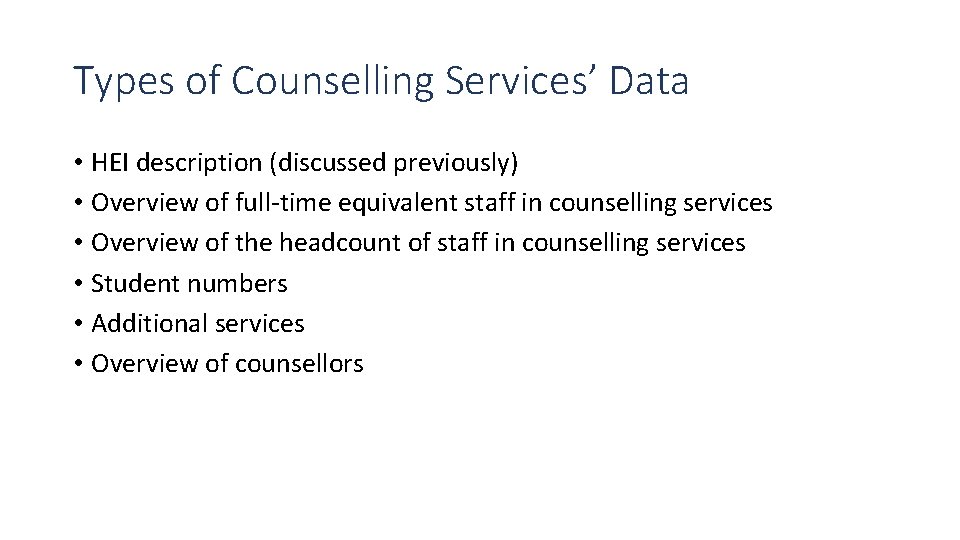
Types of Counselling Services’ Data • HEI description (discussed previously) • Overview of full-time equivalent staff in counselling services • Overview of the headcount of staff in counselling services • Student numbers • Additional services • Overview of counsellors
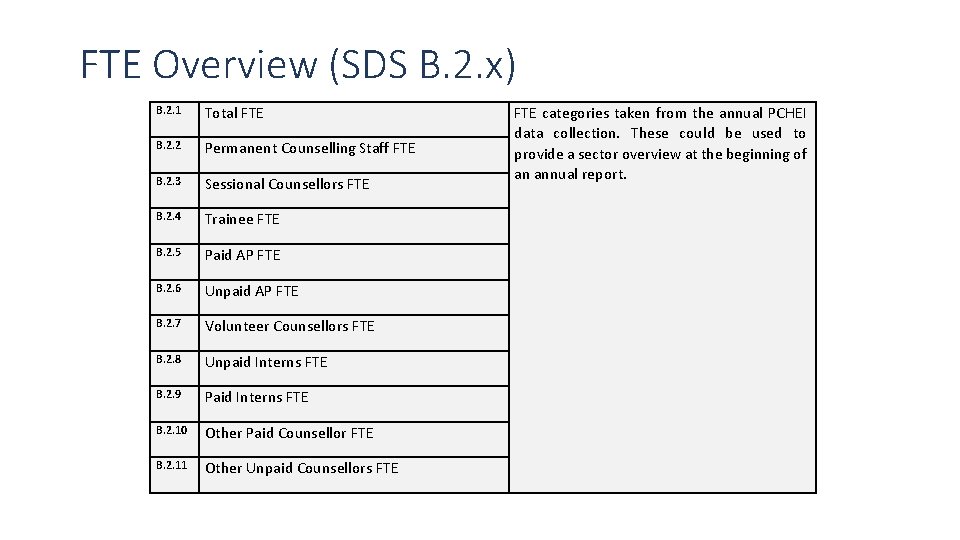
FTE Overview (SDS B. 2. x) B. 2. 1 Total FTE B. 2. 2 Permanent Counselling Staff FTE B. 2. 3 Sessional Counsellors FTE B. 2. 4 Trainee FTE B. 2. 5 Paid AP FTE B. 2. 6 Unpaid AP FTE B. 2. 7 Volunteer Counsellors FTE B. 2. 8 Unpaid Interns FTE B. 2. 9 Paid Interns FTE B. 2. 10 Other Paid Counsellor FTE B. 2. 11 Other Unpaid Counsellors FTE categories taken from the annual PCHEI data collection. These could be used to provide a sector overview at the beginning of an annual report.
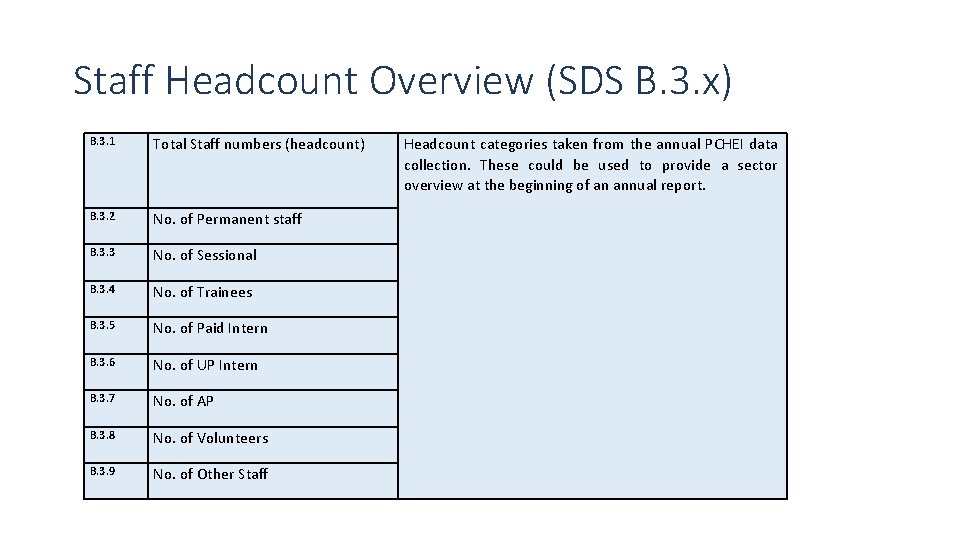
Staff Headcount Overview (SDS B. 3. x) B. 3. 1 Total Staff numbers (headcount) B. 3. 2 No. of Permanent staff B. 3. 3 No. of Sessional B. 3. 4 No. of Trainees B. 3. 5 No. of Paid Intern B. 3. 6 No. of UP Intern B. 3. 7 No. of AP B. 3. 8 No. of Volunteers B. 3. 9 No. of Other Staff Headcount categories taken from the annual PCHEI data collection. These could be used to provide a sector overview at the beginning of an annual report.
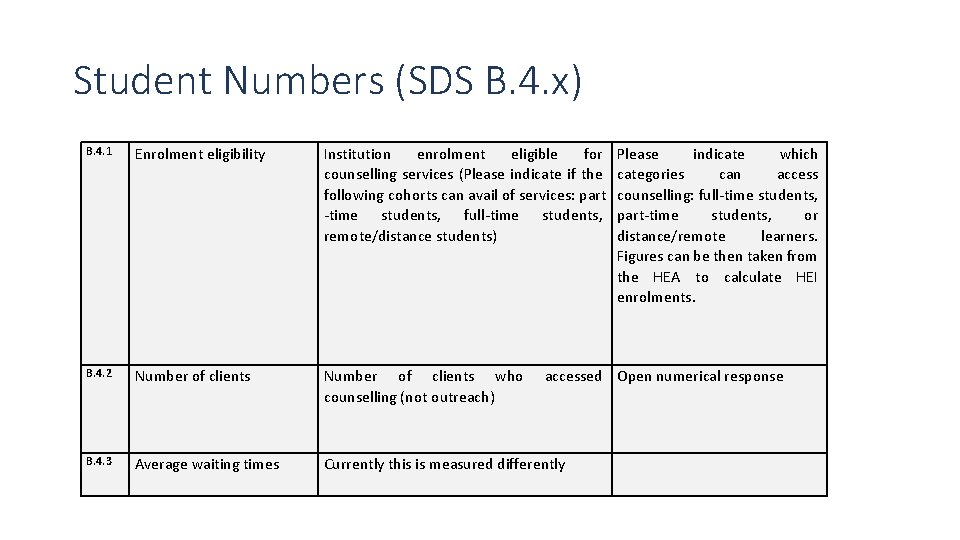
Student Numbers (SDS B. 4. x) B. 4. 1 Enrolment eligibility Institution enrolment eligible for counselling services (Please indicate if the following cohorts can avail of services: part -time students, full-time students, remote/distance students) B. 4. 2 Number of clients who counselling (not outreach) B. 4. 3 Average waiting times Currently this is measured differently Please indicate which categories can access counselling: full-time students, part-time students, or distance/remote learners. Figures can be then taken from the HEA to calculate HEI enrolments. accessed Open numerical response
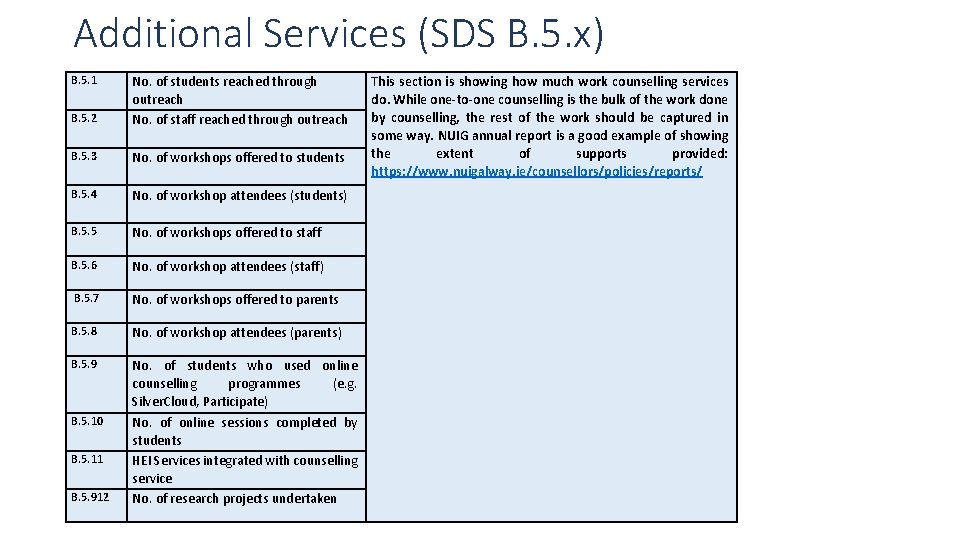
Additional Services (SDS B. 5. x) B. 5. 1 B. 5. 2 No. of students reached through outreach No. of staff reached through outreach B. 5. 3 No. of workshops offered to students B. 5. 4 No. of workshop attendees (students) B. 5. 5 No. of workshops offered to staff B. 5. 6 No. of workshop attendees (staff) B. 5. 7 No. of workshops offered to parents B. 5. 8 No. of workshop attendees (parents) B. 5. 9 No. of students who used online counselling programmes (e. g. Silver. Cloud, Participate) B. 5. 10 No. of online sessions completed by students HEI Services integrated with counselling service No. of research projects undertaken B. 5. 11 B. 5. 912 This section is showing how much work counselling services do. While one-to-one counselling is the bulk of the work done by counselling, the rest of the work should be captured in some way. NUIG annual report is a good example of showing the extent of supports provided: https: //www. nuigalway. ie/counsellors/policies/reports/
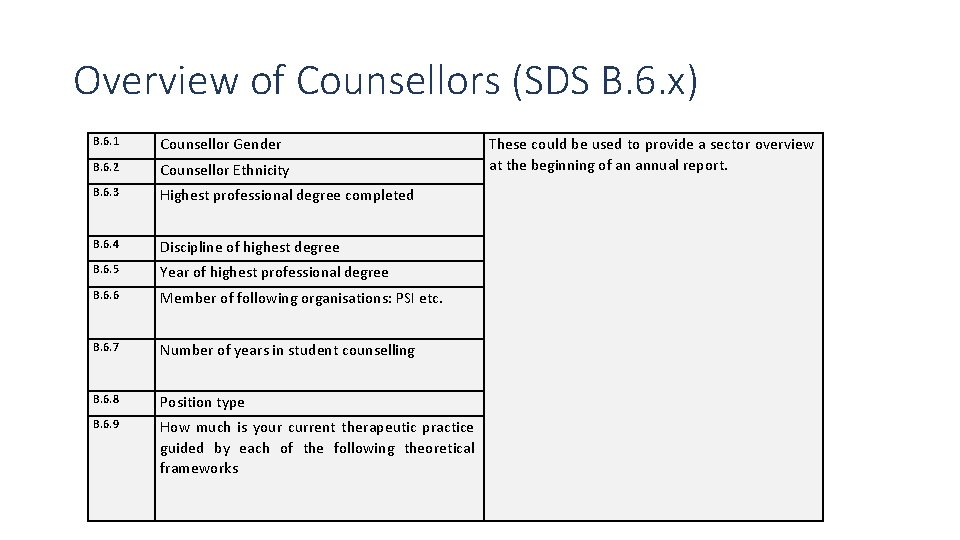
Overview of Counsellors (SDS B. 6. x) B. 6. 1 Counsellor Gender B. 6. 2 Counsellor Ethnicity B. 6. 3 Highest professional degree completed B. 6. 4 Discipline of highest degree B. 6. 5 Year of highest professional degree B. 6. 6 Member of following organisations: PSI etc. B. 6. 7 Number of years in student counselling B. 6. 8 Position type B. 6. 9 How much is your current therapeutic practice guided by each of the following theoretical frameworks These could be used to provide a sector overview at the beginning of an annual report.

Presenting Issues
Presenting issues: • Capturing the presenting issues helps us to understand why the client is seeking help. • AUCC/PCHEI categories are the most common categories across the sector. • AUCC/PCHEI categories include 15 main categories and more than 200 subcategories. • Some services use different categories while others have added extra categories to AUCC/PCHEI.
Proposed plan for the SDS: • Include the AUCC main categories. • Add sexual assault as a main category. • Receive feedback from counsellors through group discussions on the description of each main category. • Work with services using different categories to map their categories to the AUCC/PCHEI categories.

Discussion part 2
General Presentation part 2
Use of the Database • Annual national report (could be benchmarked internationally) • Annual benchmarking report for each HEI • Access to statistics for funding applications and Freedom of Information requests • Dataset for Practice-Research Network • Identification of trends
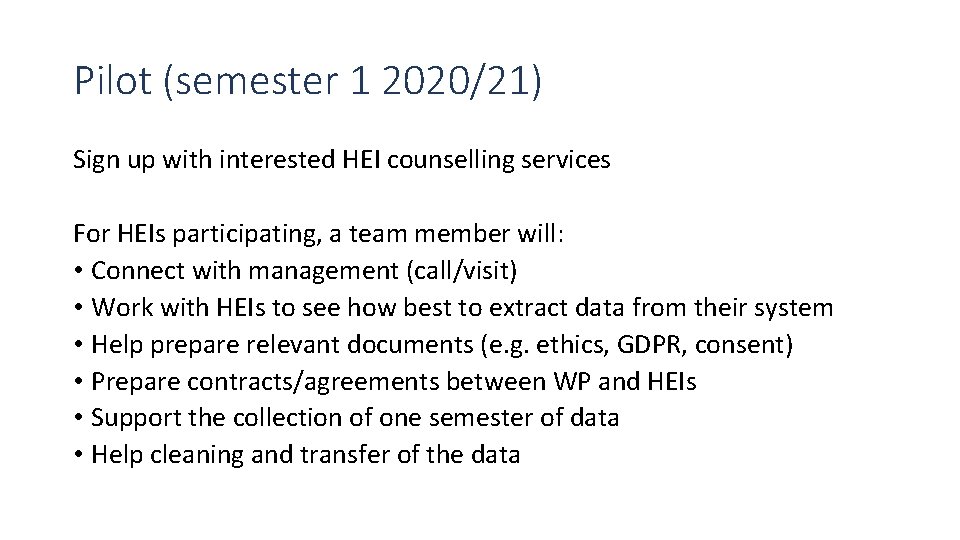
Pilot (semester 1 2020/21) Sign up with interested HEI counselling services For HEIs participating, a team member will: • Connect with management (call/visit) • Work with HEIs to see how best to extract data from their system • Help prepare relevant documents (e. g. ethics, GDPR, consent) • Prepare contracts/agreements between WP and HEIs • Support the collection of one semester of data • Help cleaning and transfer of the data
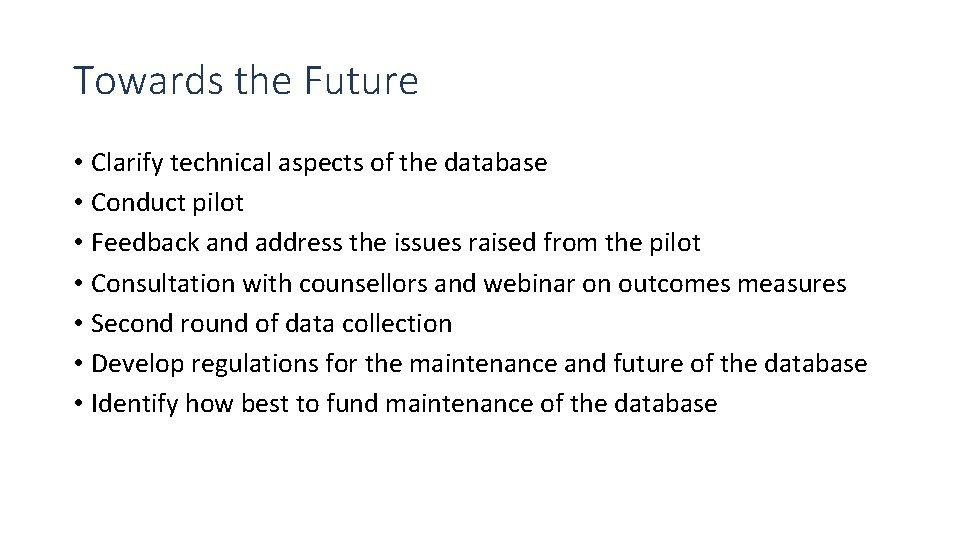
Towards the Future • Clarify technical aspects of the database • Conduct pilot • Feedback and address the issues raised from the pilot • Consultation with counsellors and webinar on outcomes measures • Second round of data collection • Develop regulations for the maintenance and future of the database • Identify how best to fund maintenance of the database

Q&A session
- Slides: 42