
WOW Crab cavity Alexej Grudiev Kai Papke Impedance

WOW Crab cavity Alexej Grudiev, Kai Papke Impedance Working Group meeting #10 23. 05. 2017
Outline • Introduction and Motivation • Cavity design and parameters • Impedance and HOMs of the bare cavity • Input coupler designs • Impedance of cavity with input coupler • Summary 2
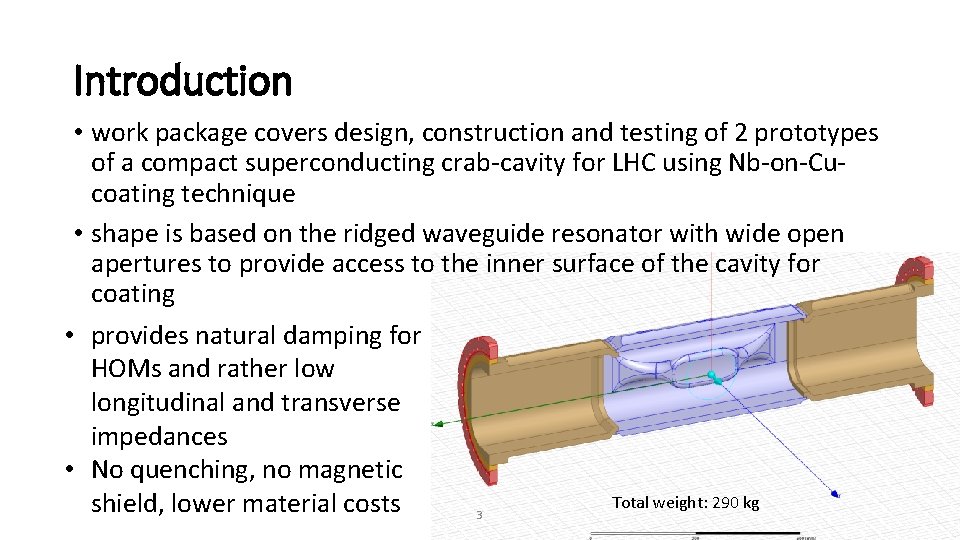
Introduction • work package covers design, construction and testing of 2 prototypes of a compact superconducting crab-cavity for LHC using Nb-on-Cucoating technique • shape is based on the ridged waveguide resonator with wide open apertures to provide access to the inner surface of the cavity for coating • provides natural damping for HOMs and rather low longitudinal and transverse impedances • No quenching, no magnetic Total weight: 290 kg shield, lower material costs 3
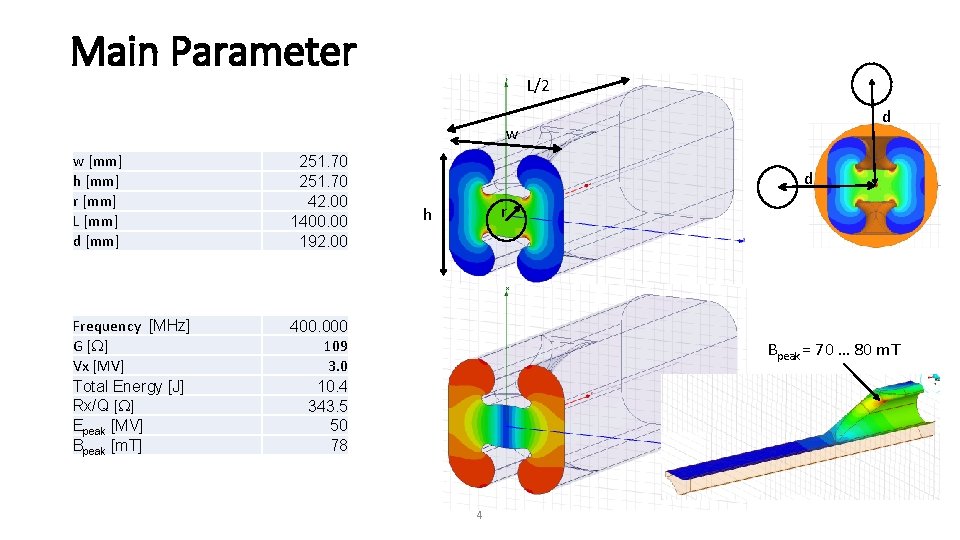
Main Parameter L/2 d w w [mm] h [mm] r [mm] L [mm] d [mm] 251. 70 42. 00 1400. 00 192. 00 Frequency [MHz] G [ ] Vx [MV] Total Energy [J] Rx/Q [ ] Epeak [MV] Bpeak [m. T] 400. 000 109 3. 0 10. 4 343. 5 50 78 d r h Bpeak = 70 … 80 m. T 4
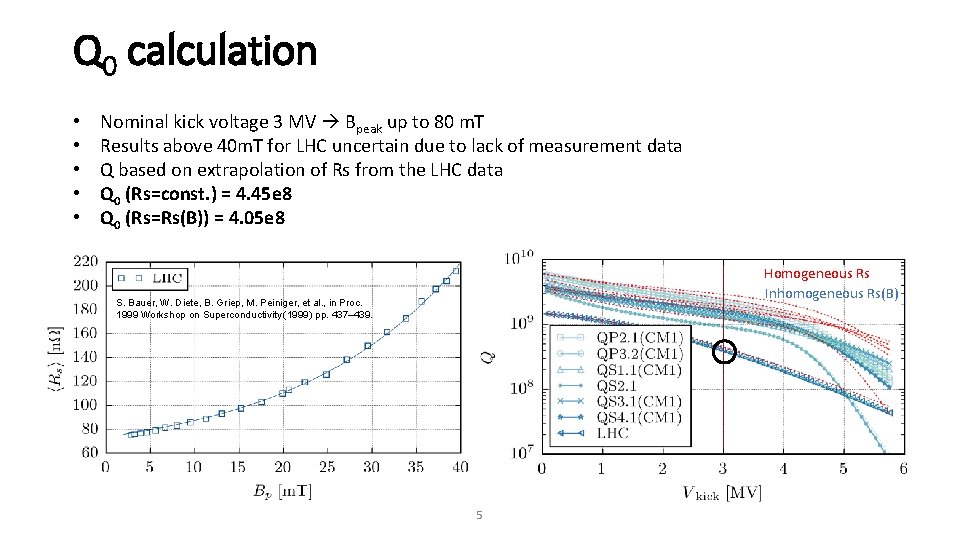
Q 0 calculation • • • Nominal kick voltage 3 MV Bpeak up to 80 m. T Results above 40 m. T for LHC uncertain due to lack of measurement data Q based on extrapolation of Rs from the LHC data Q 0 (Rs=const. ) = 4. 45 e 8 Q 0 (Rs=Rs(B)) = 4. 05 e 8 Homogeneous Rs Inhomogeneous Rs(B) S. Bauer, W. Diete, B. Griep, M. Peiniger, et al. , in Proc. 1999 Workshop on Superconductivity (1999) pp. 437– 439. 5
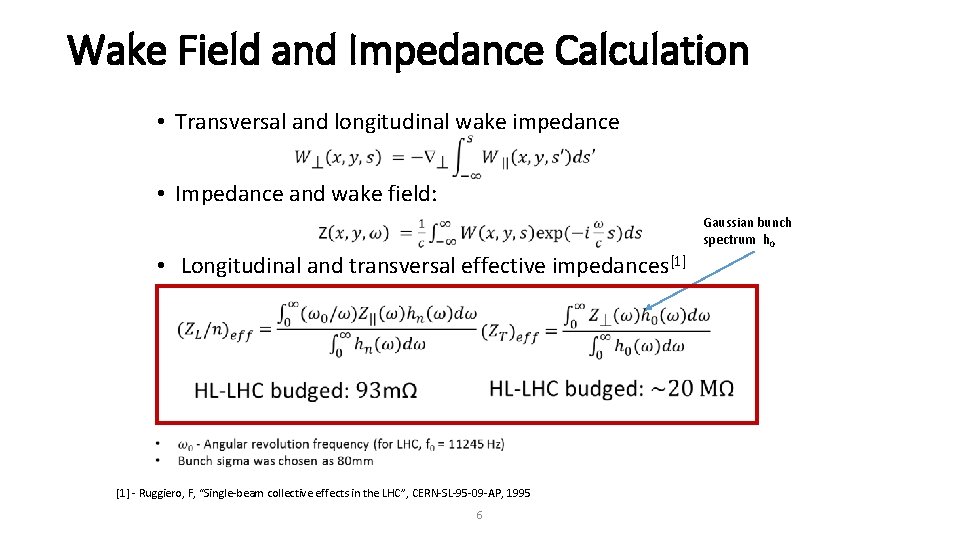
Wake Field and Impedance Calculation • Transversal and longitudinal wake impedance • Impedance and wake field: Gaussian bunch spectrum h 0 • Longitudinal and transversal effective impedances[1] - Ruggiero, F, “Single-beam collective effects in the LHC”, CERN-SL-95 -09 -AP, 1995 6
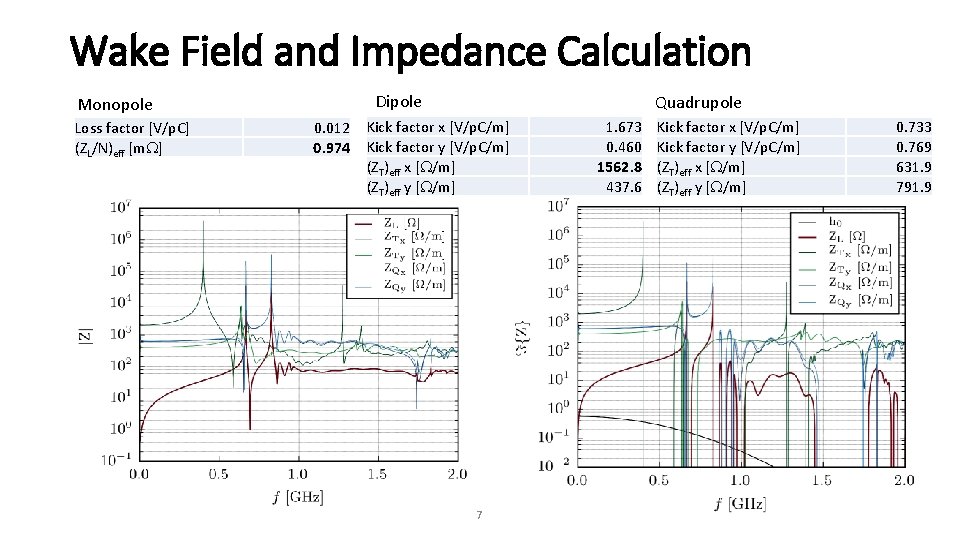
Wake Field and Impedance Calculation Dipole Monopole Loss factor [V/p. C] (ZL/N)eff [m ] 0. 012 0. 974 Quadrupole Kick factor x [V/p. C/m] Kick factor y [V/p. C/m] (ZT)eff x [ /m] (ZT)eff y [ /m] 7 1. 673 0. 460 1562. 8 437. 6 Kick factor x [V/p. C/m] Kick factor y [V/p. C/m] (ZT)eff x [ /m] (ZT)eff y [ /m] 0. 733 0. 769 631. 9 791. 9
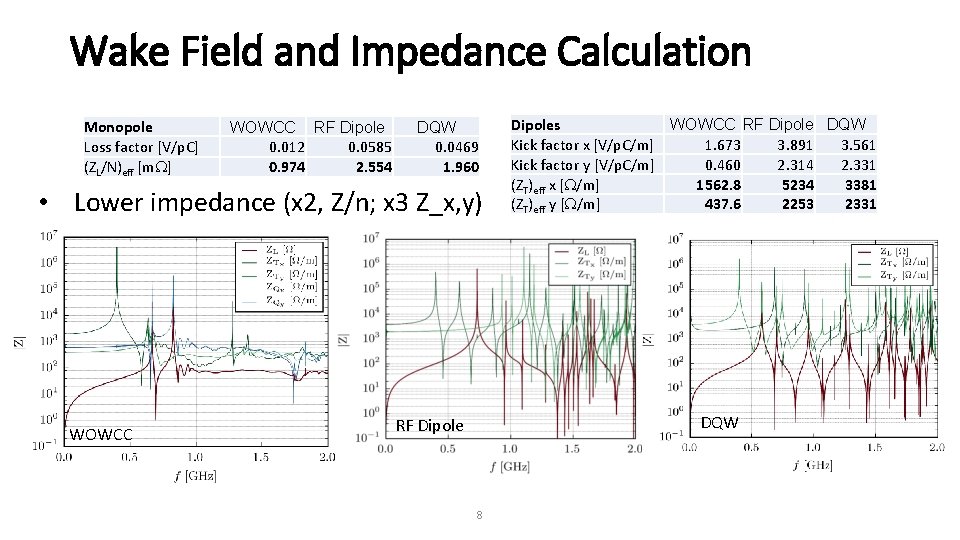
Wake Field and Impedance Calculation Monopole Loss factor [V/p. C] (ZL/N)eff [m ] WOWCC RF Dipole 0. 012 0. 0585 0. 974 2. 554 DQW 0. 0469 1. 960 • Lower impedance (x 2, Z/n; x 3 Z_x, y) WOWCC Dipoles WOWCC RF Dipole DQW Kick factor x [V/p. C/m] 1. 673 3. 891 3. 561 Kick factor y [V/p. C/m] 0. 460 2. 314 2. 331 (ZT)eff x [ /m] 1562. 8 5234 3381 (ZT)eff y [ /m] 437. 6 2253 2331 DQW RF Dipole 8
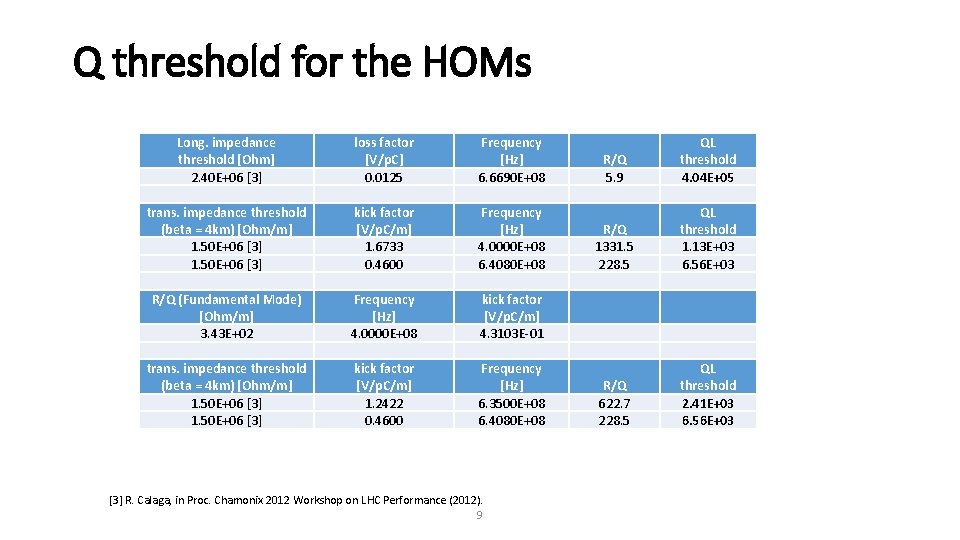
Q threshold for the HOMs Long. impedance threshold [Ohm] 2. 40 E+06 [3] loss factor [V/p. C] 0. 0125 Frequency [Hz] 6. 6690 E+08 trans. impedance threshold (beta = 4 km) [Ohm/m] 1. 50 E+06 [3] kick factor [V/p. C/m] 1. 6733 0. 4600 Frequency [Hz] 4. 0000 E+08 6. 4080 E+08 R/Q (Fundamental Mode) [Ohm/m] 3. 43 E+02 Frequency [Hz] 4. 0000 E+08 kick factor [V/p. C/m] 4. 3103 E-01 trans. impedance threshold (beta = 4 km) [Ohm/m] 1. 50 E+06 [3] kick factor [V/p. C/m] 1. 2422 0. 4600 Frequency [Hz] 6. 3500 E+08 6. 4080 E+08 [3] R. Calaga, in Proc. Chamonix 2012 Workshop on LHC Performance (2012). 9 R/Q 5. 9 QL threshold 4. 04 E+05 R/Q 1331. 5 228. 5 QL threshold 1. 13 E+03 6. 56 E+03 R/Q 622. 7 228. 5 QL threshold 2. 41 E+03 6. 56 E+03
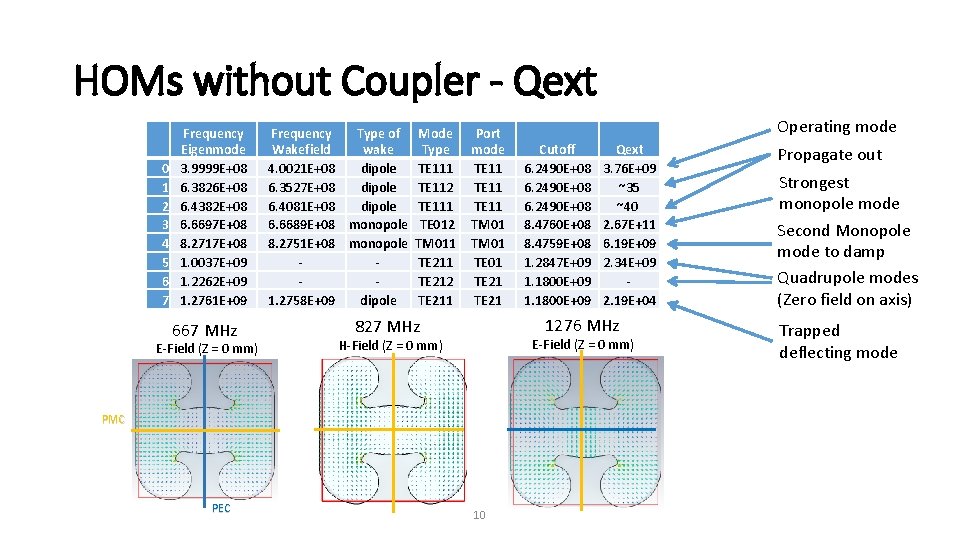
HOMs without Coupler - Qext 0 1 2 3 4 5 6 7 Frequency Eigenmode 3. 9999 E+08 6. 3826 E+08 6. 4382 E+08 6. 6697 E+08 8. 2717 E+08 1. 0037 E+09 1. 2262 E+09 1. 2761 E+09 667 MHz E-Field (Z = 0 mm) Frequency Type of Mode Wakefield wake Type 4. 0021 E+08 dipole TE 111 6. 3527 E+08 dipole TE 112 6. 4081 E+08 dipole TE 111 6. 6689 E+08 monopole TE 012 8. 2751 E+08 monopole TM 011 TE 212 1. 2758 E+09 dipole TE 211 Port mode TE 11 TM 01 TE 21 Cutoff 6. 2490 E+08 8. 4760 E+08 8. 4759 E+08 1. 2847 E+09 1. 1800 E+09 Qext 3. 76 E+09 ~35 ~40 2. 67 E+11 6. 19 E+09 2. 34 E+09 2. 19 E+04 1276 MHz 827 MHz E-Field (Z = 0 mm) H-Field (Z = 0 mm) PMC PEC Operating mode 10 Propagate out Strongest monopole mode Second Monopole mode to damp Quadrupole modes (Zero field on axis) Trapped deflecting mode
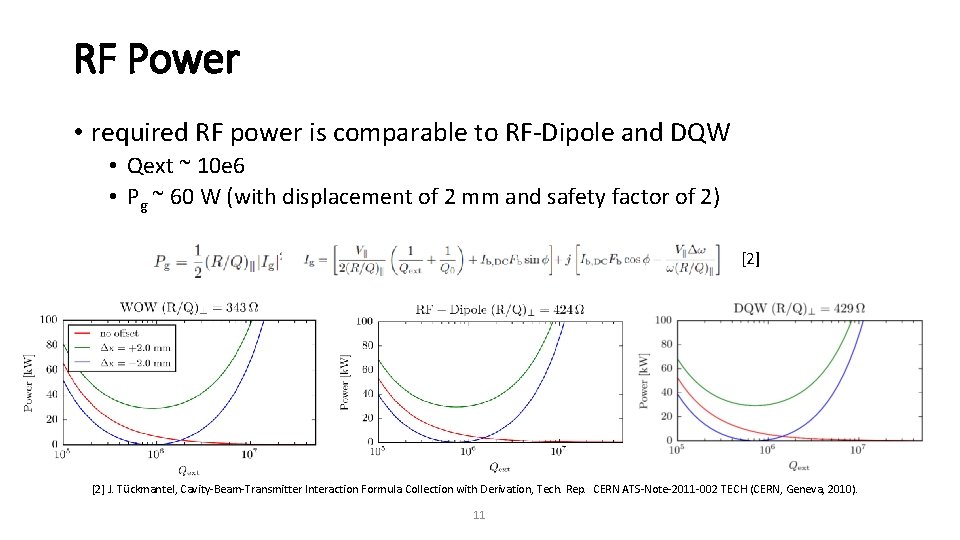
RF Power • required RF power is comparable to RF-Dipole and DQW • Qext ~ 10 e 6 • Pg ~ 60 W (with displacement of 2 mm and safety factor of 2) [2] J. Tückmantel, Cavity-Beam-Transmitter Interaction Formula Collection with Derivation, Tech. Rep. CERN ATS-Note-2011 -002 TECH (CERN, Geneva, 2010). 11
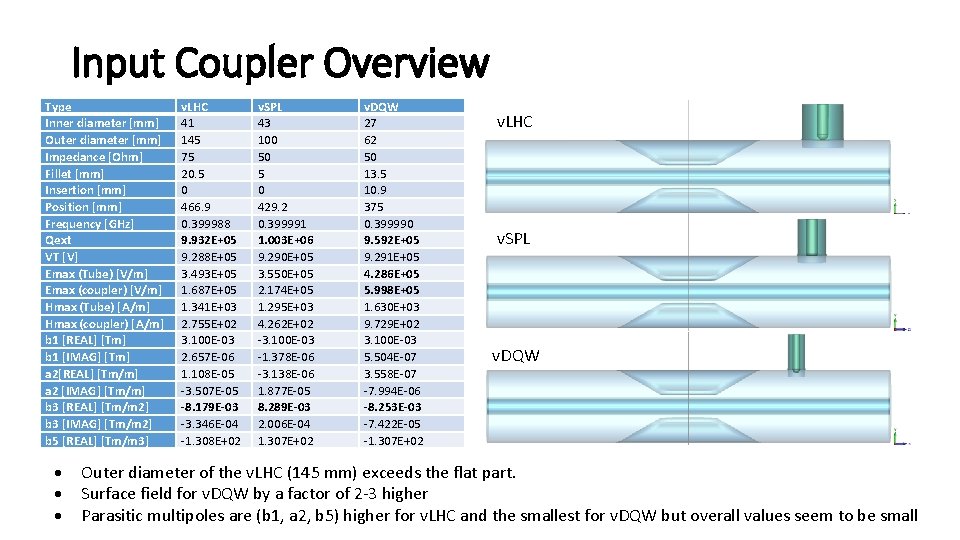
Input Coupler Overview Type Inner diameter [mm] Outer diameter [mm] Impedance [Ohm] Fillet [mm] Insertion [mm] Position [mm] Frequency [GHz] Qext VT [V] Emax (Tube) [V/m] Emax (coupler) [V/m] Hmax (Tube) [A/m] Hmax (coupler) [A/m] b 1 [REAL] [Tm] b 1 [IMAG] [Tm] a 2[REAL] [Tm/m] a 2 [IMAG] [Tm/m] b 3 [REAL] [Tm/m 2] b 3 [IMAG] [Tm/m 2] b 5 [REAL] [Tm/m 3] v. LHC 41 145 75 20. 5 0 466. 9 0. 399988 9. 932 E+05 9. 288 E+05 3. 493 E+05 1. 687 E+05 1. 341 E+03 2. 755 E+02 3. 100 E-03 2. 657 E-06 1. 108 E-05 -3. 507 E-05 -8. 179 E-03 -3. 346 E-04 -1. 308 E+02 v. SPL 43 100 50 5 0 429. 2 0. 399991 1. 003 E+06 9. 290 E+05 3. 550 E+05 2. 174 E+05 1. 295 E+03 4. 262 E+02 -3. 100 E-03 -1. 378 E-06 -3. 138 E-06 1. 877 E-05 8. 289 E-03 2. 006 E-04 1. 307 E+02 v. DQW 27 62 50 13. 5 10. 9 375 0. 399990 9. 592 E+05 9. 291 E+05 4. 286 E+05 5. 998 E+05 1. 630 E+03 9. 729 E+02 3. 100 E-03 5. 504 E-07 3. 558 E-07 -7. 994 E-06 -8. 253 E-03 -7. 422 E-05 -1. 307 E+02 v. LHC v. SPL v. DQW Outer diameter of the v. LHC (145 mm) exceeds the flat part. Surface field for v. DQW by a factor of 2 -3 higher Parasitic multipoles are (b 1, a 2, b 5) higher for v. LHC and the smallest for v. DQW but overall values seem to be small
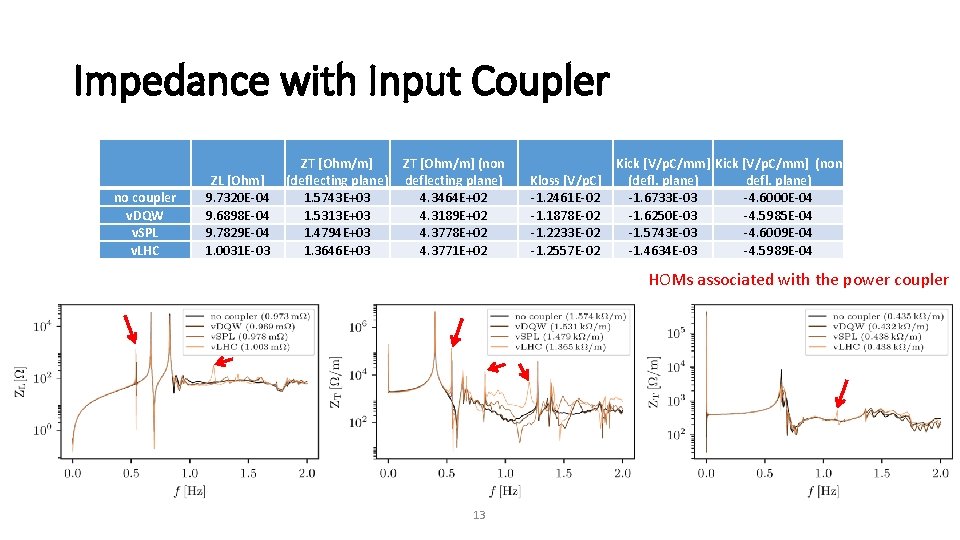
Impedance with Input Coupler no coupler v. DQW v. SPL v. LHC ZL [Ohm] 9. 7320 E-04 9. 6898 E-04 9. 7829 E-04 1. 0031 E-03 ZT [Ohm/m] (deflecting plane) 1. 5743 E+03 1. 5313 E+03 1. 4794 E+03 1. 3646 E+03 ZT [Ohm/m] (non deflecting plane) 4. 3464 E+02 4. 3189 E+02 4. 3778 E+02 4. 3771 E+02 Kloss [V/p. C] -1. 2461 E-02 -1. 1878 E-02 -1. 2233 E-02 -1. 2557 E-02 Kick [V/p. C/mm] (non (defl. plane) -1. 6733 E-03 -4. 6000 E-04 -1. 6250 E-03 -4. 5985 E-04 -1. 5743 E-03 -4. 6009 E-04 -1. 4634 E-03 -4. 5989 E-04 HOMs associated with the power coupler 13
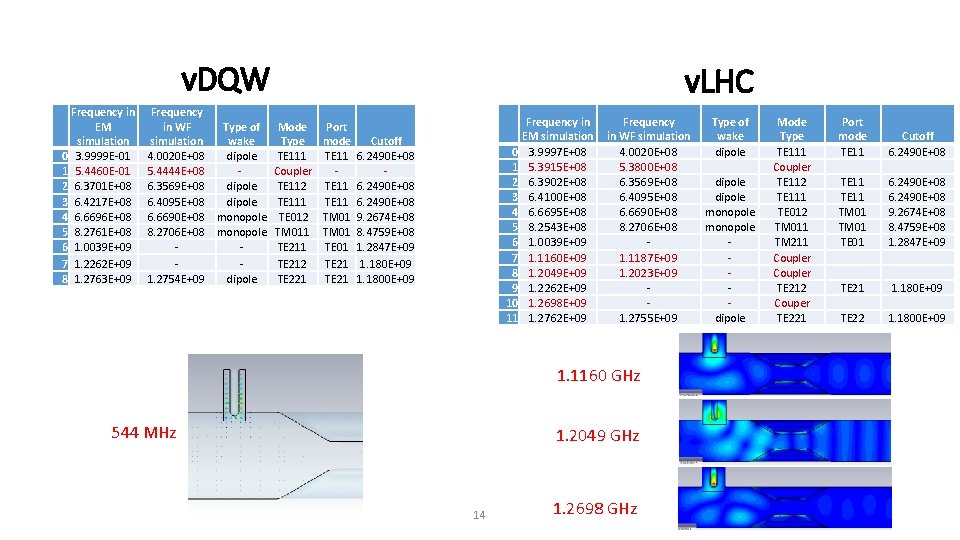
v. DQW Frequency in EM simulation 0 3. 9999 E-01 1 5. 4460 E-01 2 6. 3701 E+08 3 6. 4217 E+08 4 6. 6696 E+08 5 8. 2761 E+08 6 1. 0039 E+09 7 1. 2262 E+09 8 1. 2763 E+09 v. LHC Frequency Type of Mode Port in WF simulation wake Type mode Cutoff 4. 0020 E+08 dipole TE 111 TE 11 6. 2490 E+08 5. 4444 E+08 Coupler 6. 3569 E+08 dipole TE 112 TE 11 6. 2490 E+08 6. 4095 E+08 dipole TE 111 TE 11 6. 2490 E+08 6. 6690 E+08 monopole TE 012 TM 01 9. 2674 E+08 8. 2706 E+08 monopole TM 011 TM 01 8. 4759 E+08 TE 211 TE 01 1. 2847 E+09 TE 212 TE 21 1. 180 E+09 1. 2754 E+09 dipole TE 221 TE 21 1. 1800 E+09 0 1 2 3 4 5 6 7 8 9 10 11 Frequency in EM simulation 3. 9997 E+08 5. 3915 E+08 6. 3902 E+08 6. 4100 E+08 6. 6695 E+08 8. 2543 E+08 1. 0039 E+09 1. 1160 E+09 1. 2049 E+09 1. 2262 E+09 1. 2698 E+09 1. 2762 E+09 Frequency in WF simulation 4. 0020 E+08 5. 3800 E+08 6. 3569 E+08 6. 4095 E+08 6. 6690 E+08 8. 2706 E+08 1. 1187 E+09 1. 2023 E+09 1. 2755 E+09 1. 1160 GHz 544 MHz 1. 2049 GHz 14 1. 2698 GHz Type of wake dipole monopole dipole Mode Type TE 111 Coupler TE 112 TE 111 TE 012 TM 011 TM 211 Coupler TE 212 Couper TE 221 Port mode TE 11 Cutoff 6. 2490 E+08 TE 11 TM 01 TE 01 6. 2490 E+08 9. 2674 E+08 8. 4759 E+08 1. 2847 E+09 TE 21 1. 180 E+09 TE 22 1. 1800 E+09

Summary • Lower impedance (x 2, Z/n; x 3 Z_x, y) • Qext ~ 1 e 6 (slightly higher than for DQW), Pg = 60 W • Limit for the HOM Q values: • Monopole modes: 4 e 5 • Dipole modes: 2 e 3 • Input coupler reduces Z_x by 0 – 10 % the larger it is • Smaller coupler favored because of lower number of asymmetric HOMs • Studies about HOM damping ongoing
- Slides: 15