
Wound Stabilizing Function The membrane may also serve
Wound Stabilizing Function The membrane may also serve to relieve functional stress on the gingival flap which might otherwise disrupt the fragile adhesion of the maturing fibrin clot to the root surface during the early and most critical phase of healing Selvig K. A. (JP, 1990) KHU Perio HYS
Coronal Migration of Periodontal Ligament Cells Periodontal ligament cells have been shown to migrate onto root surface 0. 5 mm in cell culture. Preisig et al. (1988, JPR) The source of periodontal ligament cells which migrate coronally is limited to 200 ~400 um of adjacent periodontal ligament apical to the wounds Iglhaut et al. (1988, JPR), Aukhil et al. (1988, JCP) KHU Perio HYS
Roles of Barrier Membrane in GBR 1. Wound stabilization 2. Exclusion of competing tissues : gingival epithelium, gingival connective tissue 3. Space-making & space-maintaining KHU Perio HYS
How long the physical barriers need to be left? 4 ~ 6 weeks : W. L. Gore & Associates Recommendation Although it has been suggested that the division of PDL cells is complete at 21 days ( Iglhaut et al. 1998, JPR ) , it is not known how long these cells need an undisturbed healing phase to allow for complete regeneration. KHU Perio HYS
Non-bioresorbable barrier (e. PTFE) reported no differences in amount of regeneration obtained in areas where the barrier was removed at 1 months and those in which it was left for longer periods of time. - beagle dog study Caffesse et al. (1988, JP) KHU Perio HYS
Periodontal Ligament Cell Kinetics The activity of the PDL cells peaks around day 2, decreases around day 7 and is almost down to normal levels by day 21. Iglhaut et al. (1988, JPR) The eventual healing depends on the timing and magnitude of amplifying divisions these first generation of progenitor cells will undergo. Iglhaut et al. (1988, JPR), Aukhil et al. (1988, JCP) KHU Perio HYS
Subdivided New Term of GTR GPTR (Guided Periodontal Tissue Regeneration ) Procedures aiming the regeneration of lost periodontal structures (I. e. , cementum, periodontal ligament, alveolar bone) GBR ( Guided Bone Regeneration ) Procedures aiming the regeneration of alveolar bone only, such as in bone augmentation Quiñones and Caffesse (1995) KHU Perio HYS
Factors Influencing Periodontal Regeneration 1. Depth and width of the defect and attachment level prior to treatment 2. Gingival thickness 3. Membrane exposure with accompanying plaque accumulation 4. Coverage of the newly regenerated tissues KHU Perio HYS
5. Tooth anatomy 6. Smoking and eating habits 7. Quality of recall maintenance program 8. Periodontal history of the affected tooth 9. Healing response of the patient 10. Clinician’s surgical skill KHU Perio HYS
Schallhorn & Mc. Clain (1993) The term GTR is a misnomer, because new cementum and a functional periodontal ligament are quite often obtained , but not new bone growth. Bower et al. (1989, JP) The combination of highly osteogenic materials and epithelial exclusion techniques offer promise for enhancing the amount, frequently, and predictability of periodontal regeneration. KHU Perio HYS
Double Layer Construction of Guidor ® • Large perforations on outer side To facilitate connective tissue integration and to avoid an epithelial downgrowth • Small perforations on inner side To allow passage of nutrients and delay ingrowth of connective tissue • Spacers on the inner side of the membrane and between the two layers. KHU Perio HYS
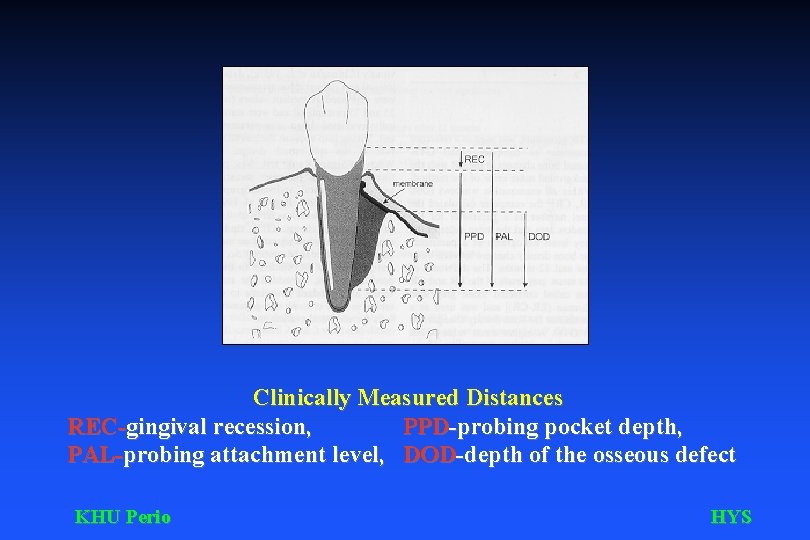
Clinically Measured Distances REC-gingival recession, PPD-probing pocket depth, PAL-probing attachment level, DOD-depth of the osseous defect KHU Perio HYS
- Slides: 12