
Would it be Enough to Balance Ohios System

Would it be Enough to Balance Ohio’s System of Long-term Services and Supports (LTCSS)? 35 th Annual Ohio Professional & Student Conference on Aging April 15, 2011 Shahla Mehdizadeh, Ph. D. Robert Applebaum, Ph. D.
Outline • 1) Ohio’s system of LTCSS, how out of balance is it? • 2) How does balancing impact needs for care, and state’s budget? • 3) Are there other efforts that policy makers need to consider?
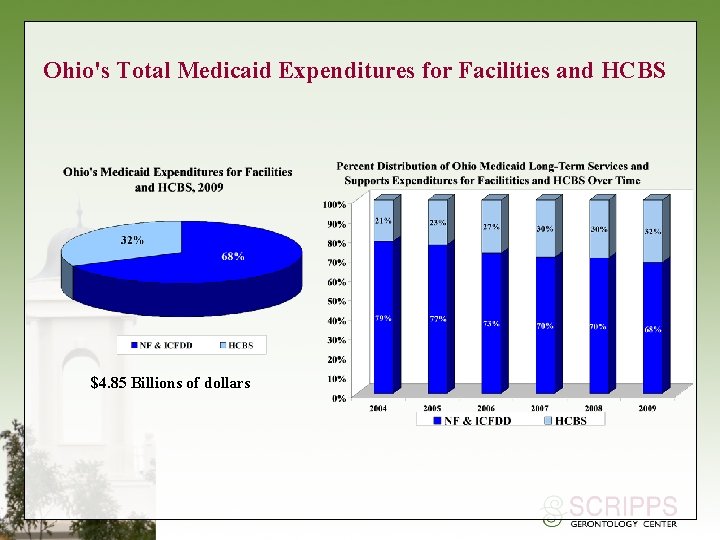
Ohio's Total Medicaid Expenditures for Facilities and HCBS $4. 85 Billions of dollars
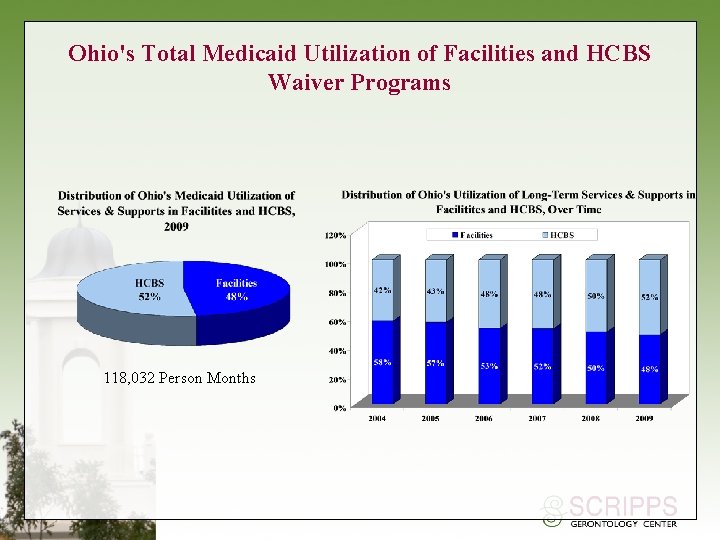
Ohio's Total Medicaid Utilization of Facilities and HCBS Waiver Programs 118, 032 Person Months
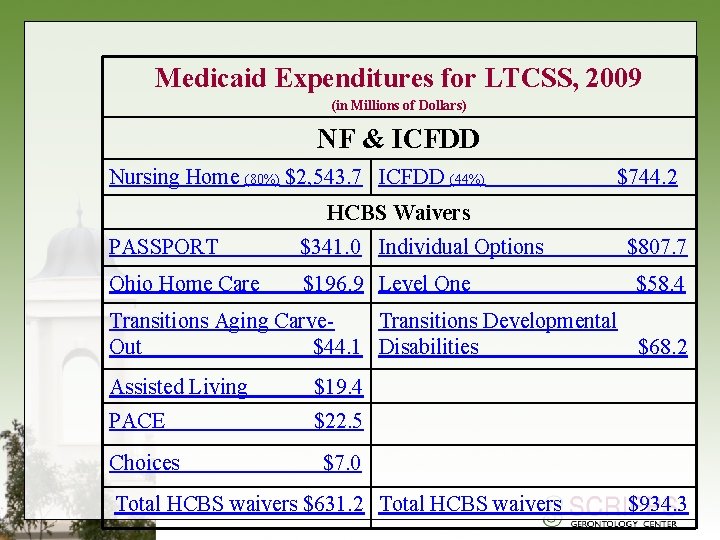
Medicaid Expenditures for LTCSS, 2009 (in Millions of Dollars) NF & ICFDD Nursing Home (80%) $2, 543. 7 ICFDD (44%) $744. 2 HCBS Waivers PASSPORT $341. 0 Individual Options Ohio Home Care $196. 9 Level One $807. 7 $58. 4 Transitions Aging Carve. Transitions Developmental Out $44. 1 Disabilities $68. 2 Assisted Living $19. 4 PACE $22. 5 Choices $7. 0 Total HCBS waivers $631. 2 Total HCBS waivers $934. 3
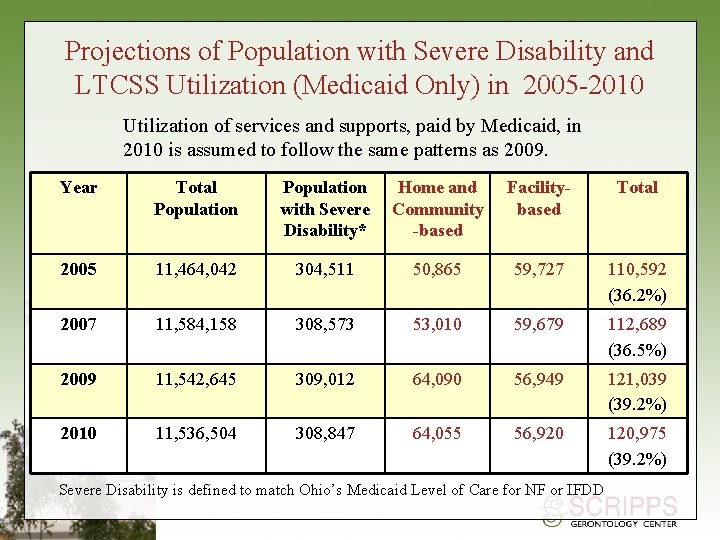
Projections of Population with Severe Disability and LTCSS Utilization (Medicaid Only) in 2005 -2010 Utilization of services and supports, paid by Medicaid, in 2010 is assumed to follow the same patterns as 2009. Year Total Population with Severe Disability* Home and Community -based Facilitybased Total 2005 11, 464, 042 304, 511 50, 865 59, 727 110, 592 (36. 2%) 2007 11, 584, 158 308, 573 53, 010 59, 679 112, 689 (36. 5%) 2009 11, 542, 645 309, 012 64, 090 56, 949 121, 039 (39. 2%) 2010 11, 536, 504 308, 847 64, 055 56, 920 120, 975 (39. 2%) Severe Disability is defined to match Ohio’s Medicaid Level of Care for NF or IFDD
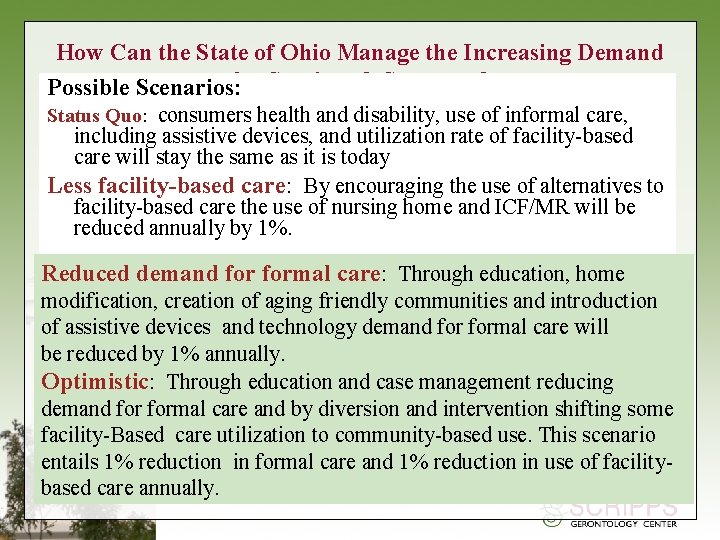
How Can the State of Ohio Manage the Increasing Demand Possible Scenarios: for Services & Supports? Status Quo: consumers health and disability, use of informal care, including assistive devices, and utilization rate of facility-based care will stay the same as it is today Less facility-based care: By encouraging the use of alternatives to facility-based care the use of nursing home and ICF/MR will be reduced annually by 1%. Reduced demand formal care: Through education, home modification, creation of aging friendly communities and introduction of assistive devices and technology demand formal care will be reduced by 1% annually. Optimistic: Through education and case management reducing demand formal care and by diversion and intervention shifting some facility-Based care utilization to community-based use. This scenario entails 1% reduction in formal care and 1% reduction in use of facilitybased care annually.
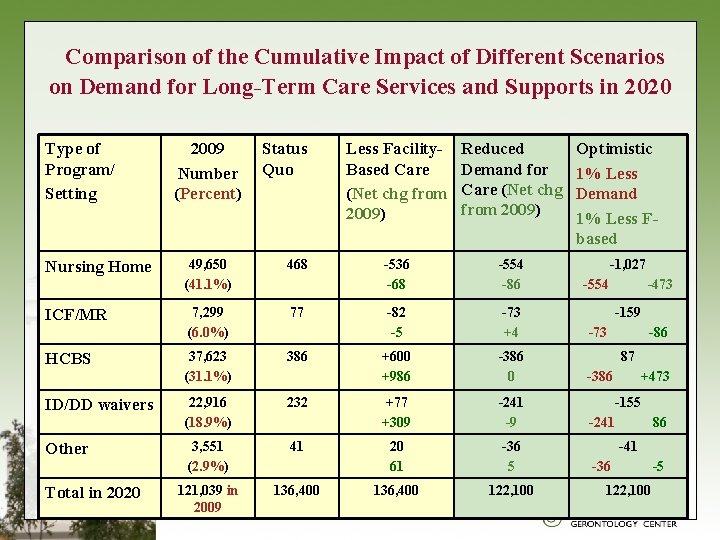
Comparison of the Cumulative Impact of Different Scenarios on Demand for Long-Term Care Services and Supports in 2020 Type of Program/ Setting Nursing Home ICF/MR HCBS ID/DD waivers Other Total in 2020 2009 Number (Percent) Status Quo 49, 650 (41. 1%) 468 7, 299 (6. 0%) 77 37, 623 (31. 1%) 386 22, 916 (18. 9%) 232 3, 551 (2. 9%) 41 121, 039 in 2009 136, 400 Less Facility. Based Care (Net chg from 2009) Reduced Demand for Care (Net chg from 2009) -536 -68 -554 -86 -82 -5 -73 +4 +600 +986 -386 0 +77 +309 -241 -9 20 61 -36 5 136, 400 122, 100 Optimistic 1% Less Demand 1% Less Fbased -1, 027 -554 -473 -159 -73 -86 87 -386 +473 -155 -241 86 -41 -36 122, 100 -5
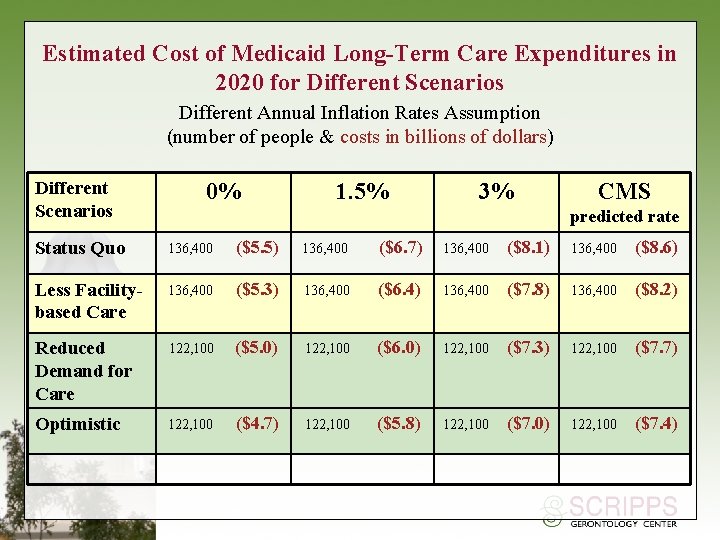
Estimated Cost of Medicaid Long-Term Care Expenditures in 2020 for Different Scenarios Different Annual Inflation Rates Assumption (number of people & costs in billions of dollars) Different Scenarios 0% 1. 5% 3% CMS predicted rate Status Quo 136, 400 ($5. 5) 136, 400 ($6. 7) 136, 400 ($8. 1) 136, 400 ($8. 6) Less Facilitybased Care 136, 400 ($5. 3) 136, 400 ($6. 4) 136, 400 ($7. 8) 136, 400 ($8. 2) Reduced Demand for Care 122, 100 ($5. 0) 122, 100 ($6. 0) 122, 100 ($7. 3) 122, 100 ($7. 7) Optimistic 122, 100 ($4. 7) 122, 100 ($5. 8) 122, 100 ($7. 0) 122, 100 ($7. 4)
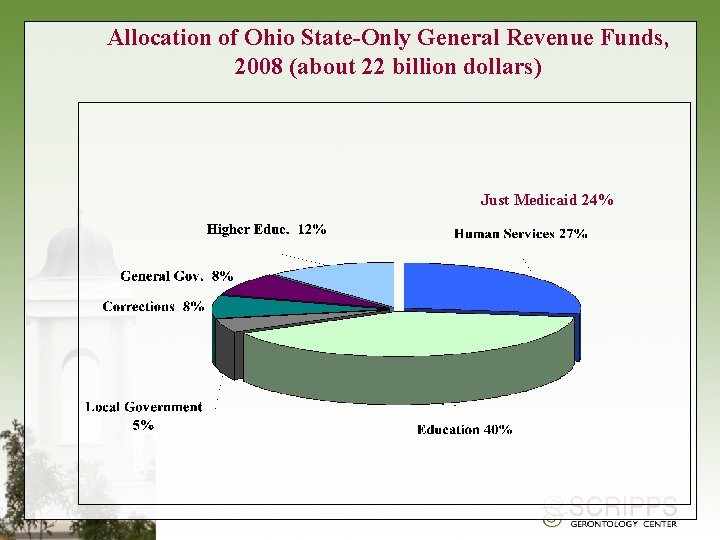
Allocation of Ohio State-Only General Revenue Funds, 2008 (about 22 billion dollars) Just Medicaid 24%
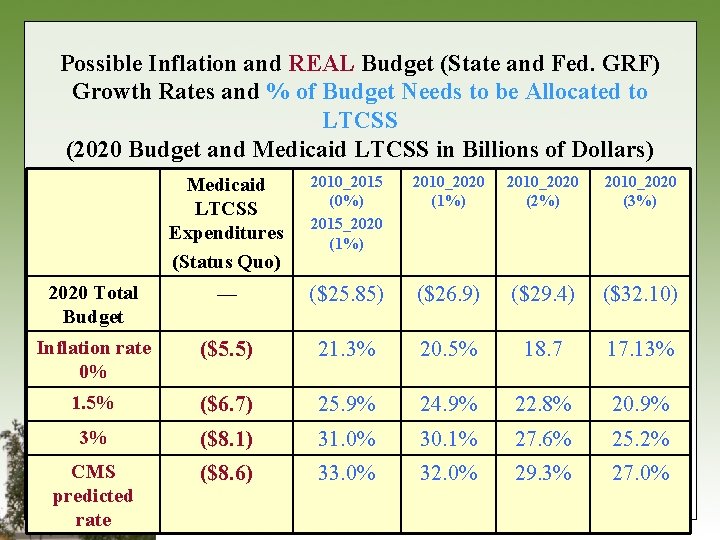
Possible Inflation and REAL Budget (State and Fed. GRF) Growth Rates and % of Budget Needs to be Allocated to LTCSS (2020 Budget and Medicaid LTCSS in Billions of Dollars) Medicaid LTCSS Expenditures (Status Quo) 2010_2015 (0%) 2015_2020 (1%) 2010_2020 (2%) 2010_2020 (3%) 2020 Total Budget ― ($25. 85) ($26. 9) ($29. 4) ($32. 10) Inflation rate 0% ($5. 5) 21. 3% 20. 5% 18. 7 17. 13% 1. 5% ($6. 7) 25. 9% 24. 9% 22. 8% 20. 9% 3% ($8. 1) 31. 0% 30. 1% 27. 6% 25. 2% CMS predicted rate ($8. 6) 33. 0% 32. 0% 29. 3% 27. 0%
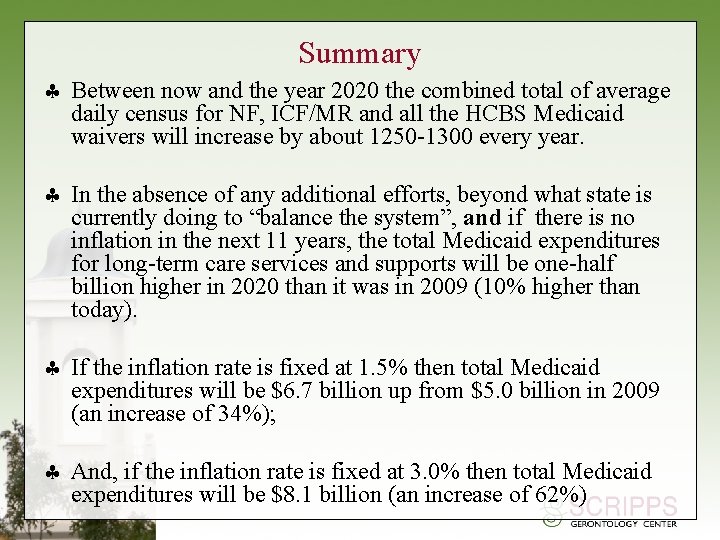
Summary § Between now and the year 2020 the combined total of average daily census for NF, ICF/MR and all the HCBS Medicaid waivers will increase by about 1250 -1300 every year. § In the absence of any additional efforts, beyond what state is currently doing to “balance the system”, and if there is no inflation in the next 11 years, the total Medicaid expenditures for long-term care services and supports will be one-half billion higher in 2020 than it was in 2009 (10% higher than today). § If the inflation rate is fixed at 1. 5% then total Medicaid expenditures will be $6. 7 billion up from $5. 0 billion in 2009 (an increase of 34%); § And, if the inflation rate is fixed at 3. 0% then total Medicaid expenditures will be $8. 1 billion (an increase of 62%)
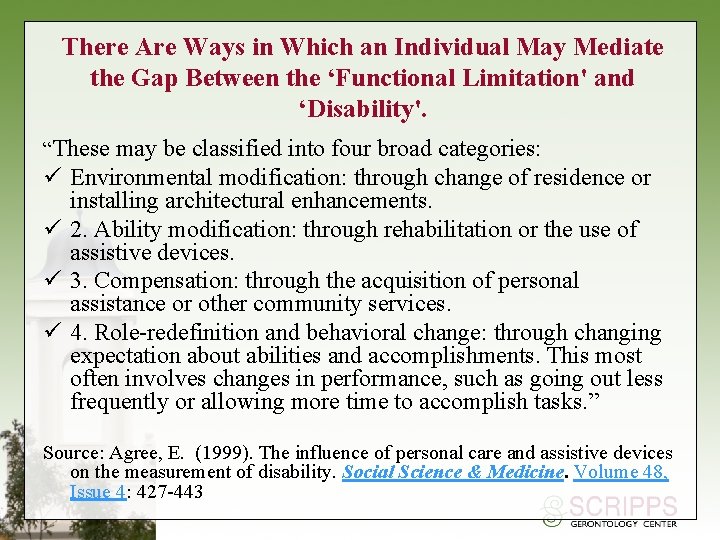
There Are Ways in Which an Individual May Mediate the Gap Between the ‘Functional Limitation' and ‘Disability'. “These may be classified into four broad categories: ü Environmental modification: through change of residence or installing architectural enhancements. ü 2. Ability modification: through rehabilitation or the use of assistive devices. ü 3. Compensation: through the acquisition of personal assistance or other community services. ü 4. Role-redefinition and behavioral change: through changing expectation about abilities and accomplishments. This most often involves changes in performance, such as going out less frequently or allowing more time to accomplish tasks. ” Source: Agree, E. (1999). The influence of personal care and assistive devices on the measurement of disability. Social Science & Medicine. Volume 48, Issue 4: 427 -443
- Slides: 13