
Worldviews and RE Aims To unpack elements of


- Slides: 42
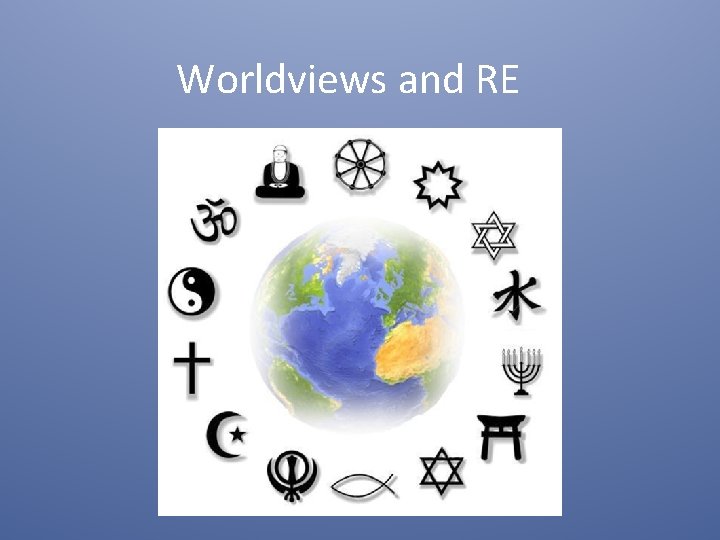
Worldviews and RE
Aims • To unpack elements of worldviews • To identify aspects of own worldviews • To examine the process of construction and reconstruction of worldviews • To analyse how worldviews influence the teaching of RE • To consider how reflexivity can be developed in RE teaching • (to use this session to evaluate and inform the design of my future research)
Challenges of RE – teachers’ voices “engaging the pupils” “lack of subject knowledge” “answering children’s questions honestly (without offending parents)” “It is sometimes hard to answer questions about religion/God. ” “Children can come into school with a negative view of RE. ” “To ensure I don’t influence children in their personal spiritual choices” “Time”
A key for RE Examine worldviews • Develop understanding and empathy • How to approach new subject knowledge • Increasing confidence
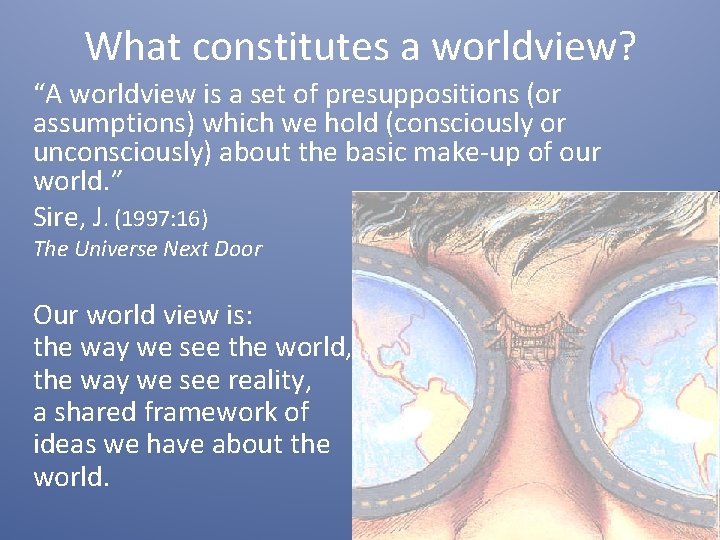
What constitutes a worldview? “A worldview is a set of presuppositions (or assumptions) which we hold (consciously or unconsciously) about the basic make-up of our world. ” Sire, J. (1997: 16) The Universe Next Door Our world view is: the way we see the world, the way we see reality, a shared framework of ideas we have about the world.
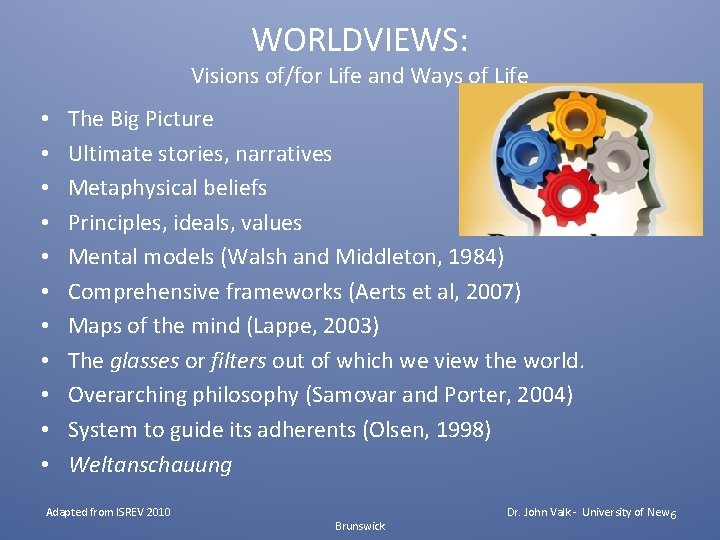
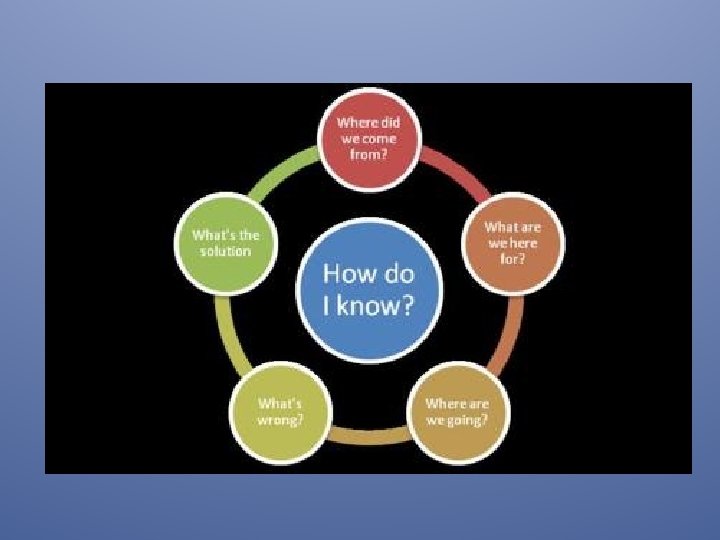
WORLDVIEWS: Visions of/for Life and Ways of Life • • • The Big Picture Ultimate stories, narratives Metaphysical beliefs Principles, ideals, values Mental models (Walsh and Middleton, 1984) Comprehensive frameworks (Aerts et al, 2007) Maps of the mind (Lappe, 2003) The glasses or filters out of which we view the world. Overarching philosophy (Samovar and Porter, 2004) System to guide its adherents (Olsen, 1998) Weltanschauung Adapted from ISREV 2010 Dr. John Valk - University of New 6 Brunswick
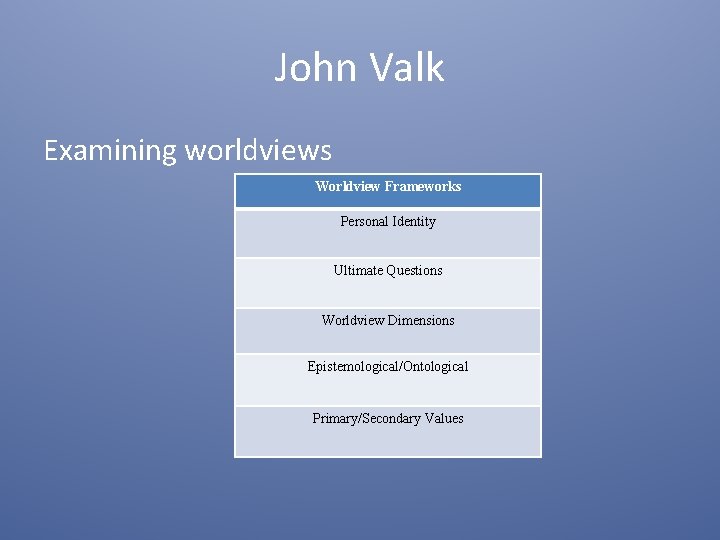
John Valk Examining worldviews Worldview Frameworks Personal Identity Ultimate Questions Worldview Dimensions Epistemological/Ontological Primary/Secondary Values
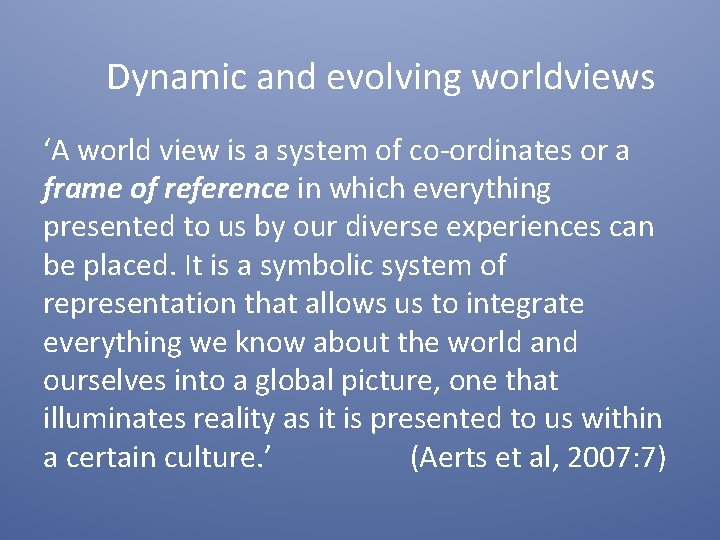
Dynamic and evolving worldviews ‘A world view is a system of co-ordinates or a frame of reference in which everything presented to us by our diverse experiences can be placed. It is a symbolic system of representation that allows us to integrate everything we know about the world and ourselves into a global picture, one that illuminates reality as it is presented to us within a certain culture. ’ (Aerts et al, 2007: 7)
Frames of reference • Examine this selection of pictures • Choose one that you think portrays different perspectives in a way that appeals to you • Discuss in your groups
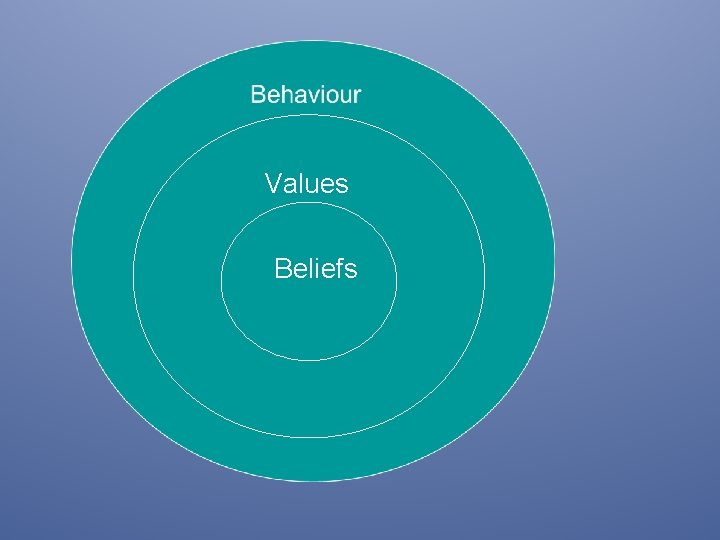
Values Beliefs
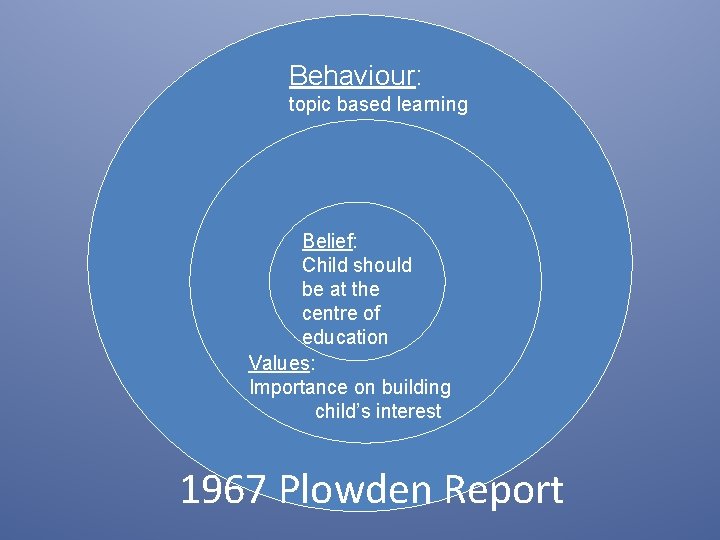
Behaviour: topic based learning Belief: Child should be at the centre of education Values: Importance on building child’s interest 1967 Plowden Report
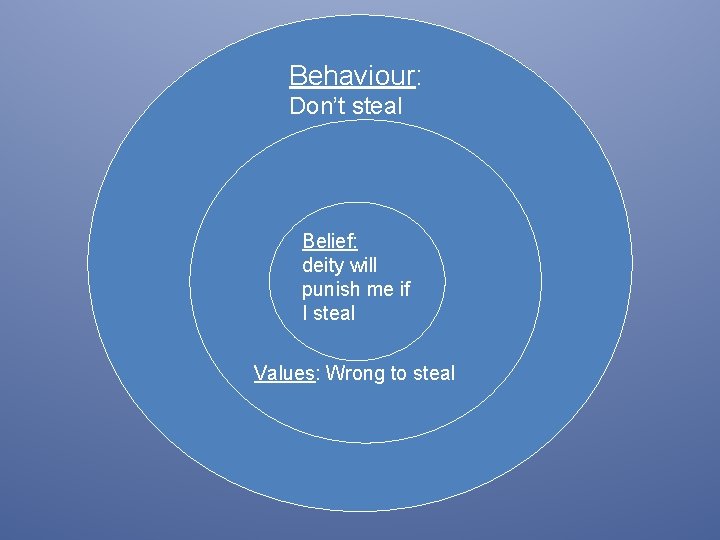
Behaviour: Don’t steal Belief: deity will punish me if I steal Values: Wrong to steal
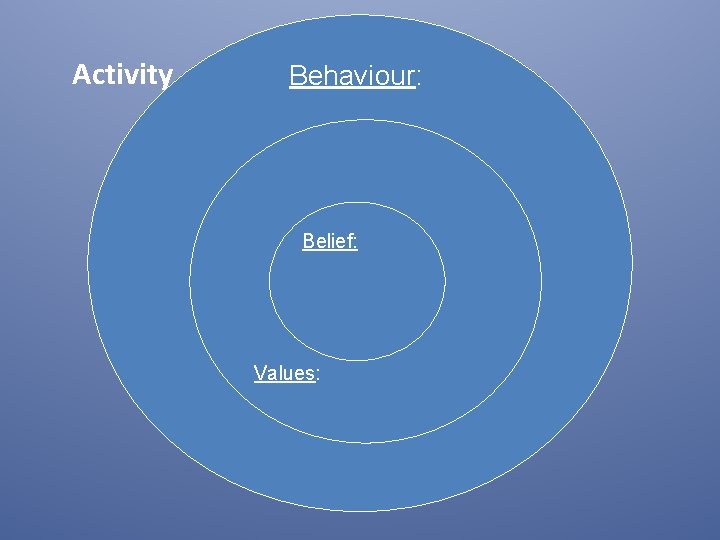
Activity Behaviour: Belief: Values:
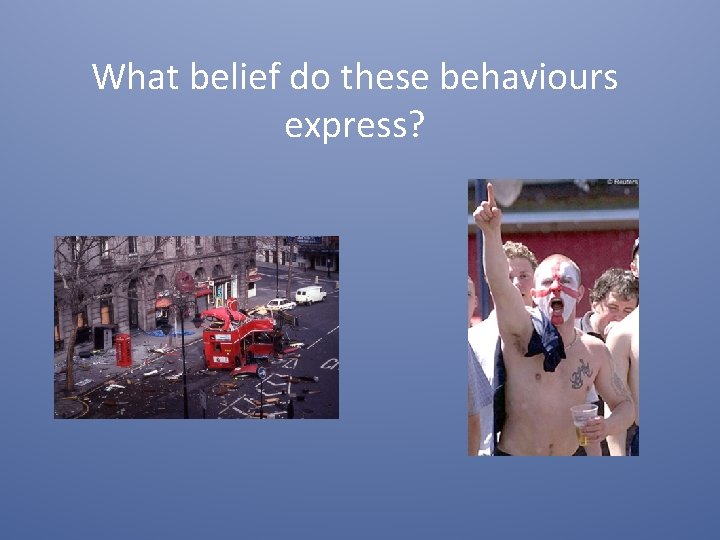
What belief do these behaviours express?
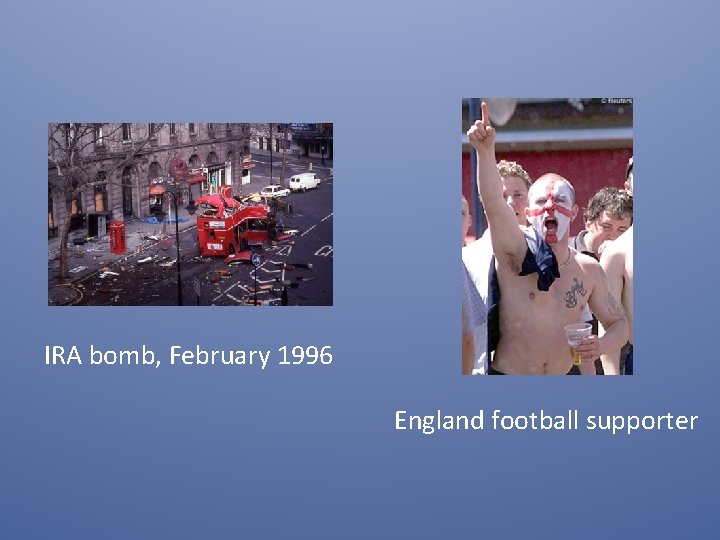
IRA bomb, February 1996 England football supporter
Worldview norms https: //www. youtube. com/watch? v=6_WAmt 3 c. Mdk
How are worldviews formed? Paul Ricoeur: Identifications are associated ‘with values, norms, ideals, models and heroes, in which the person or community recognises itself’ (1992: 122) To understand self Ricoeur suggests an examination of narrative: ‘Self-understanding is an interpretation; interpretation of the self in turn , finds in narrative…. a privileged form of mediation; the latter borrows from history as well as from fiction, making a life story a fictional history or, if one prefers, a historical fiction’ (1992: 114)
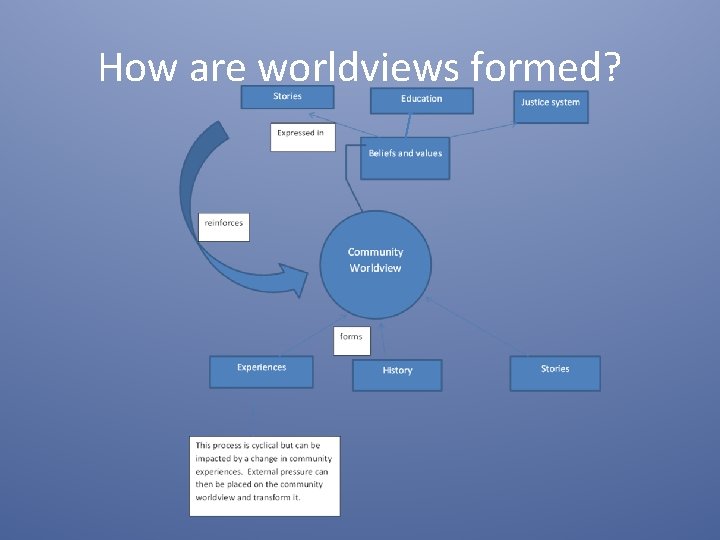
How are worldviews formed?
Bricolage nature of worldviews Van der Kooij et al (2013) • Draws key distinctions between ‘personal’ worldviews, with norms, values, ideals and practices, and ‘organised’ worldviews. • Personal worldviews can be based on an organised religious worldview but can be eclectic and idiosyncratic. • ‘Bricolage’ (Hervieu-Leger, 2006) - a ‘mishmash’ of ideas, symbols and practises from different traditions which moulded together to construct a personal religious profile (2013: 213 -214). • Whilst not rejecting Valk’s model Van der Kooij et al claim that this distinction needs to be made explicit.
How are worldviews formed? Take a look at the answers from the circles activity task. • Choose one answer • Can you identify the origins of any of your views? (such as education, parent, teacher, peer influence, life experience? )
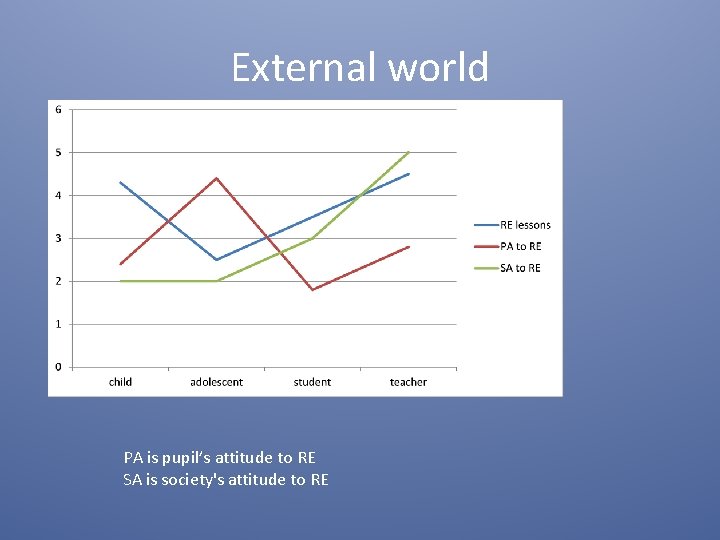
External world PA is pupil’s attitude to RE SA is society's attitude to RE
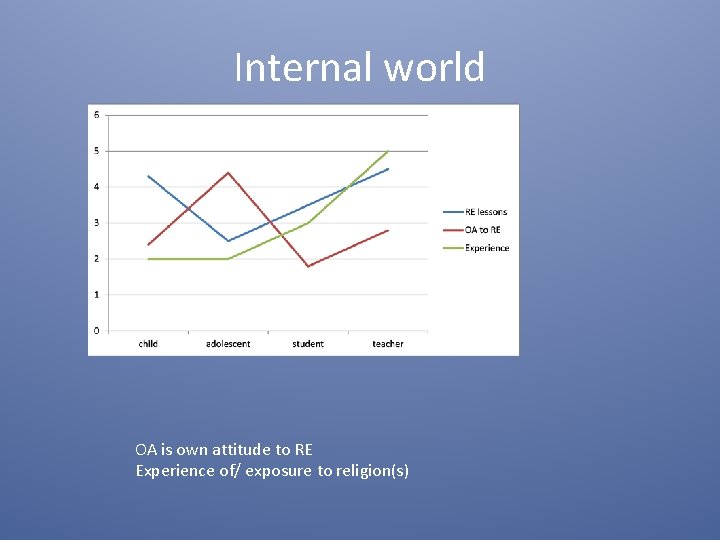
Internal world OA is own attitude to RE Experience of/ exposure to religion(s)
Why are worldviews important? 1. Assists Communication 2. Helps overcome fears 3. Promotes diversity 4. Helps pupils/teachers relate to RE
‘By seeing worldview as a concept that makes sense of the world, which can be different due to different life experiences, may assist understanding that what one perceives as the ‘norms’ of life are merely a product of our own life narrative and worldviews. To recognise this prevents the views of others as being negatively perceived as ‘other’, ‘exotic’ or even ‘wrong’, as they deviate from individuals’ accepted norms, but rather view these as shared responses to life experience. ’ (Flanagan, 2018)
Perhaps the main question for a teacher is not is there an objective truth but is it possible to be neutral? An individual is a product of socio cultural and personal history but this does not negate truth rather it negates neutrality and acknowledges that all individuals are engaged in ‘informed’ interpretation: as ‘active participants in the process of interpretation …we must abandon any strict claim to neutrality and objectivity’ (West, 2012: 399). (Flanagan, 2018. )
The impact of teacher beliefs • ‘The beliefs teachers hold with regard to learning and teaching determine their actions’ Korthagen (2004: 81). • ‘few would argue that the beliefs the teachers hold influence their perceptions and judgments which in turn, affect their behaviour in the classroom, or that understanding the belief structures of teachers and teacher candidates is essential to improving their professional preparation and teaching practice’ Pajares (1992: 207)
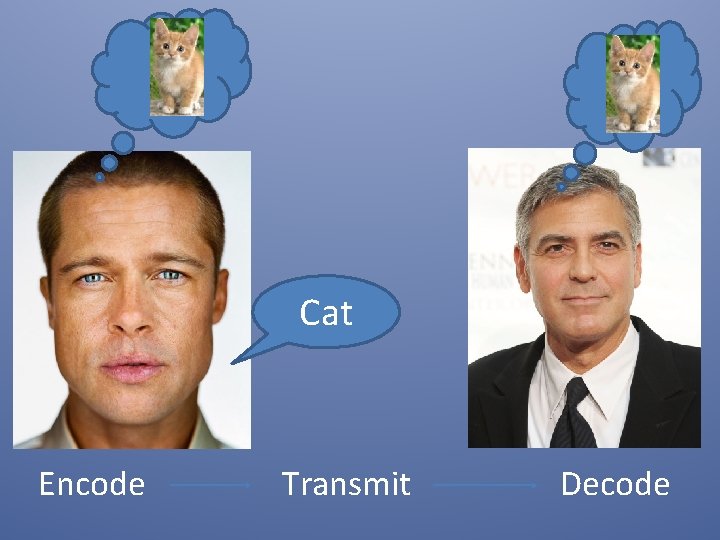
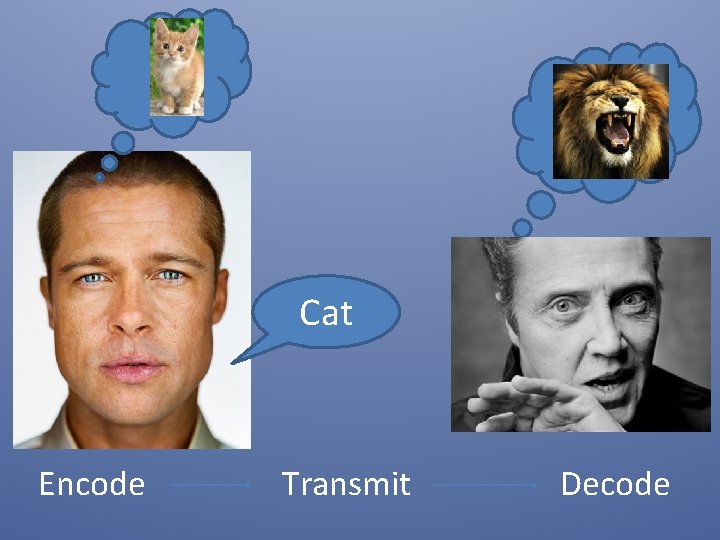
Cat Encode Transmit Decode
Cat Encode Transmit Decode
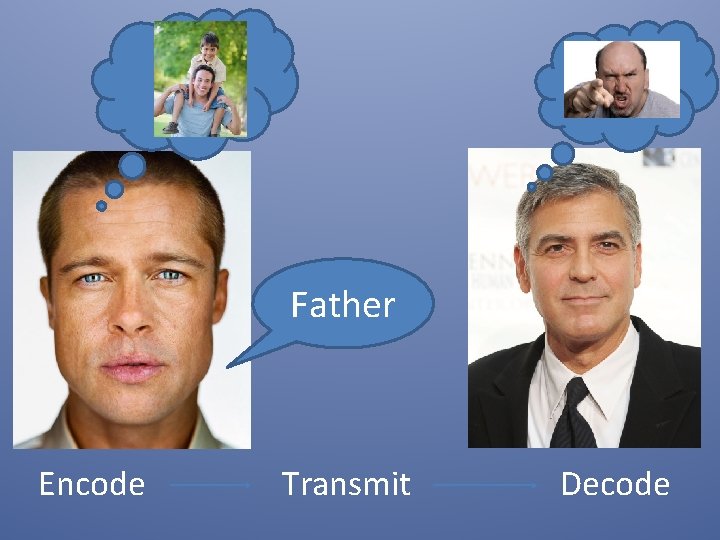
Father Encode Transmit Decode
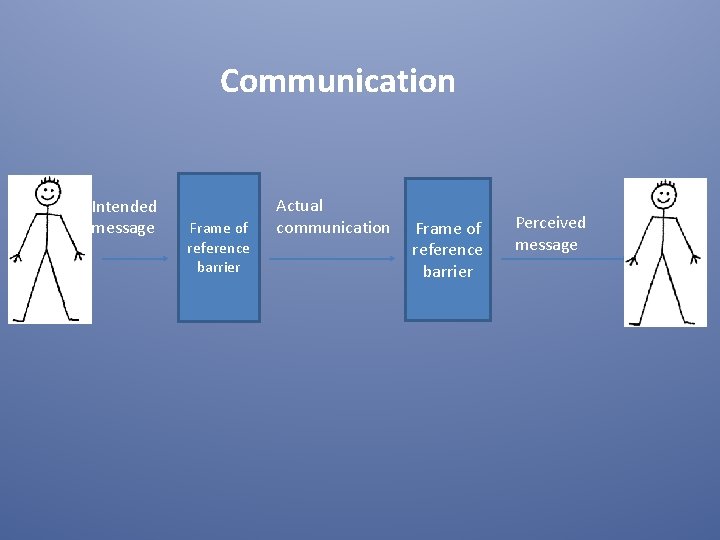
Communication Intended message Frame of reference barrier Actual communication Frame of reference barrier Perceived message
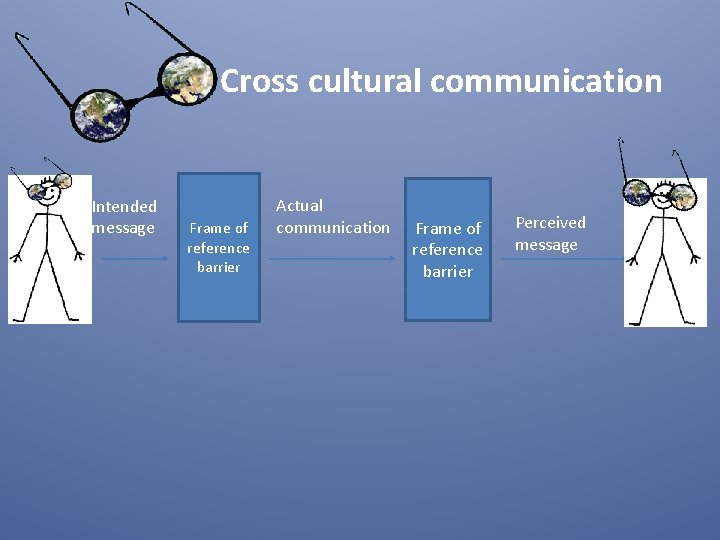
Cross cultural communication Intended message Frame of reference barrier Actual communication Frame of reference barrier Perceived message
Watch this clip from an advert for the Guardian. https: //www. youtube. com/watch? v=M 3 bf. O 1 r. E 7 Yg
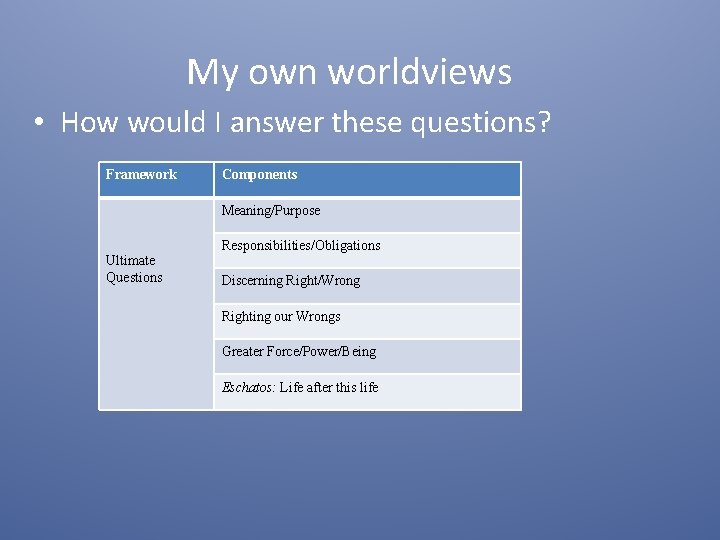
My own worldviews • How would I answer these questions? Framework Components Meaning/Purpose Ultimate Questions Responsibilities/Obligations Discerning Right/Wrong Righting our Wrongs Greater Force/Power/Being Eschatos: Life after this life
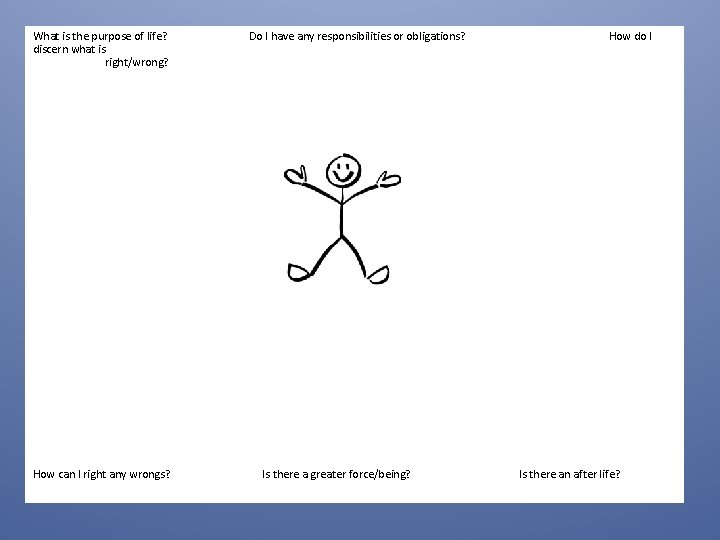
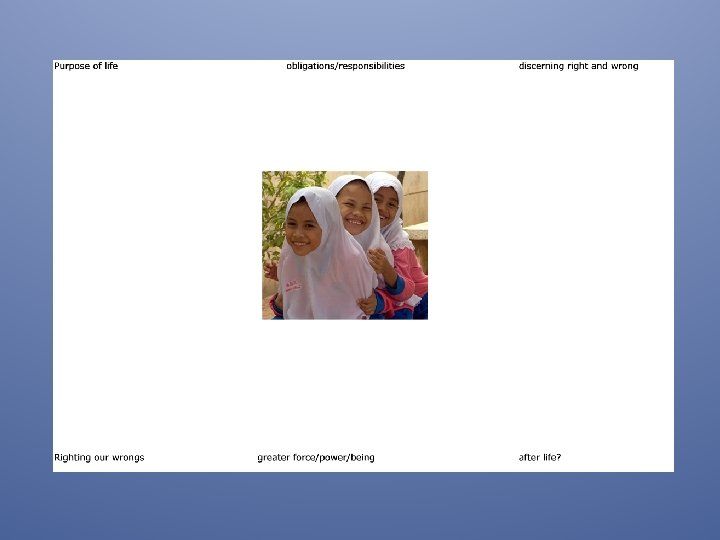
What is the purpose of life? discern what is right/wrong? Do I have any responsibilities or obligations? How do I How can I right any wrongs? Is there a greater force/being? Is there an after life?
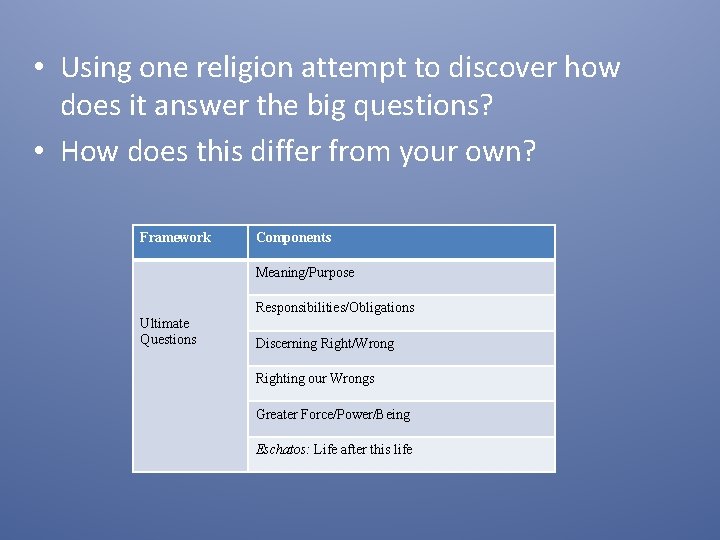
• Using one religion attempt to discover how does it answer the big questions? • How does this differ from your own? Framework Components Meaning/Purpose Ultimate Questions Responsibilities/Obligations Discerning Right/Wrong Righting our Wrongs Greater Force/Power/Being Eschatos: Life after this life
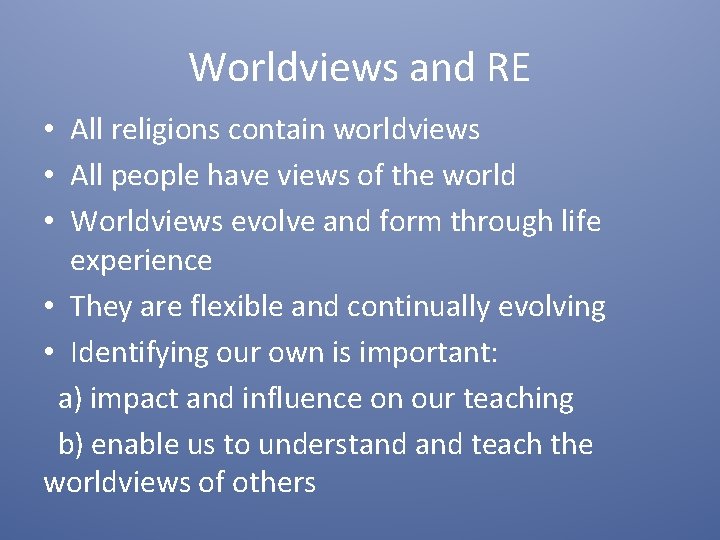
Worldviews and RE • All religions contain worldviews • All people have views of the world • Worldviews evolve and form through life experience • They are flexible and continually evolving • Identifying our own is important: a) impact and influence on our teaching b) enable us to understand teach the worldviews of others
Any questions? Please let me know if you would be happy to take part in a short interview later this term or at the start of next term. Thank you for your help with this research. r. flanagan@exeter. ac. uk
Some key references Aerts et al. (1994) Worldviews: from fragmentation to Integration. VUB press Brussels. Internet edition. 2007. Available at http: //www. vub. ac. be/CLEA/pub/books/worldviews. pdf accessed on 7/3/18. Korthagen, F. (2004) In search of the essence of a good teacher: towards a more holistic approach in teacher education. Teaching and Teacher Education. Vol 20: 1, p 77 – 97. Pajares, M. F. (1992) Teachers' Beliefs and Educational Research: Cleaning Up a Messy construct. Review of Educational Research. Vol 62: 3, p 307 - 332. Ricoeur, P. (1992) Oneself as another. Translated by Blamey, K. University of Chicago Press, Chicago. Valk, J. (2010 a) Worldview education in a changing world. Lecture at New Brunswick University, ISREV Ottawa. Van der Kooij, J. , de Ruyter, D. Midema, S. (2013) ‘Worldview’: the meaning of the concept and the Impact on Religious Education’. Religious Education, 108: 2, p 201 -228.