
Worlds oldest regional salt seal in the Amadeus

- Slides: 21
World’s oldest regional salt seal in the Amadeus and Officer Basins: implications for subsalt helium and hydrocarbons Presented by Peter Haines
Talk outline Ø Helium introduction Ø Helium in hydrocarbon reservoirs Ø Geological requirements for commercial helium accumulations Ø Why Western Australia may a good place to explore Ø Amadeus Basin Ø Officer Basin Ø Conclusions
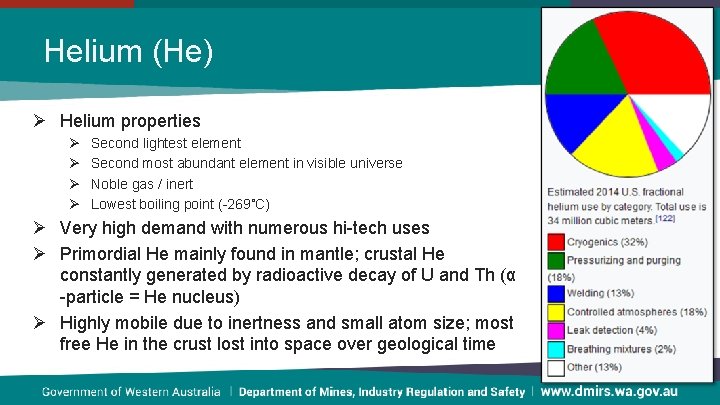
Helium (He) Ø Helium properties Ø Ø Second lightest element Second most abundant element in visible universe Noble gas / inert Lowest boiling point (-269˚C) Ø Very high demand with numerous hi-tech uses Ø Primordial He mainly found in mantle; crustal He constantly generated by radioactive decay of U and Th (α -particle = He nucleus) Ø Highly mobile due to inertness and small atom size; most free He in the crust lost into space over geological time
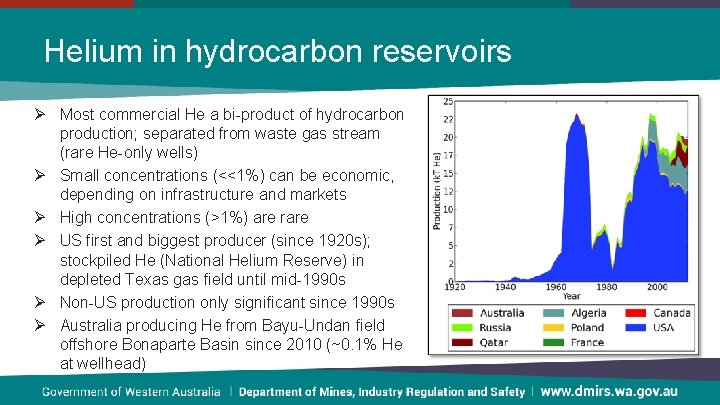
Helium in hydrocarbon reservoirs Ø Most commercial He a bi-product of hydrocarbon production; separated from waste gas stream (rare He-only wells) Ø Small concentrations (<<1%) can be economic, depending on infrastructure and markets Ø High concentrations (>1%) are rare Ø US first and biggest producer (since 1920 s); stockpiled He (National Helium Reserve) in depleted Texas gas field until mid-1990 s Ø Non-US production only significant since 1990 s Ø Australia producing He from Bayu-Undan field offshore Bonaparte Basin since 2010 (~0. 1% He at wellhead)
Geological requirements for commercial helium accumulations Ø A He source: radiogenic U-Th bearing rocks in basement or within a basin Ø A migration pathway (access to gas phase in pore fluid) Ø A porous reservoir and trap (same as conventional hydrocarbons) Ø Excellent seal due to high mobility; best seals are salt (halite, anhydrite) Ø Lots of time because He generation/accumulation is very slow Ø Coexisting hydrocarbon source; but a prolific source may reduce He concentration Ø Therefore for highest He concentration (>1%) look in old basins with marginal hydrocarbon source rocks and intact salt seals over early formed traps (in US most production from Paleozoic fields with late Paleozoic salt seal)
Relevance to WA? Ø Extensive old basins (Paleozoic, Neoproterozoic, and older) Ø Radiogenic basement common Ø Multiple old salt deposits including world’s oldest basin-scale salt deposits (~800 Ma) in Officer and Amadeus basins; possibly extending elsewhere in the Centralian Superbasin Ø Due to long periods of stability since the Paleozoic the salt has potential to seals traps dating from the Paleozoic or even Neoproterozoic
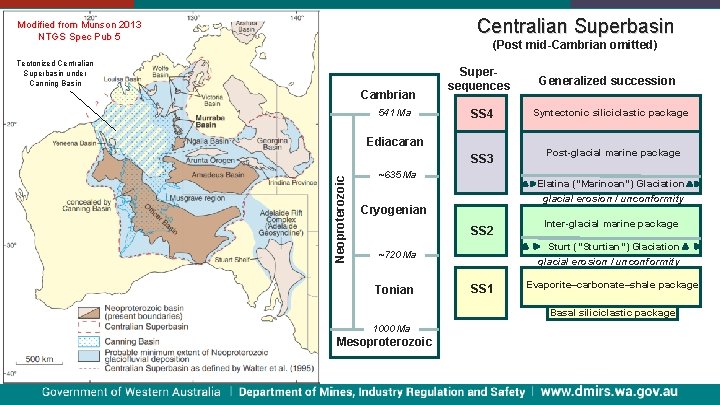
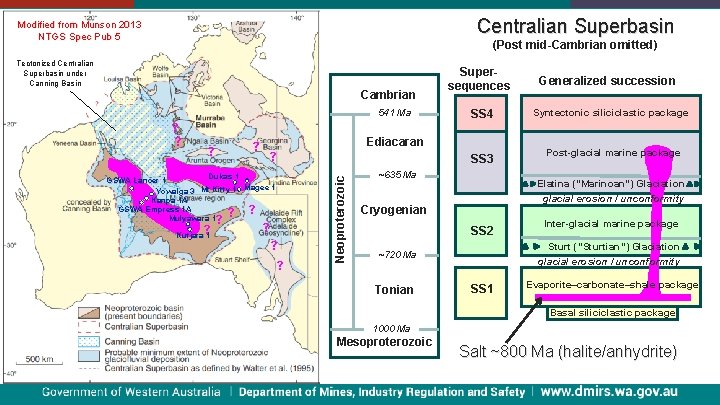
Centralian Superbasin Modified from Munson 2013 NTGS Spec Pub 5 Centralian Superbasin (Post mid-Cambrian omitted) Tectonized Centralian Superbasin under Canning Basin Cambrian 541 Ma Supersequences SS 4 Ediacaran Neoproterozoic SS 3 ~635 Ma Syntectonic siliciclastic package Post-glacial marine package Elatina (“Marinoan”) Glaciation glacial erosion / unconformity Cryogenian SS 2 Inter-glacial marine package Sturt (“Sturtian”) Glaciation ~720 Ma Tonian Generalized succession glacial erosion / unconformity SS 1 Evaporite–carbonate–shale package Basal siliciclastic package 1000 Ma Mesoproterozoic
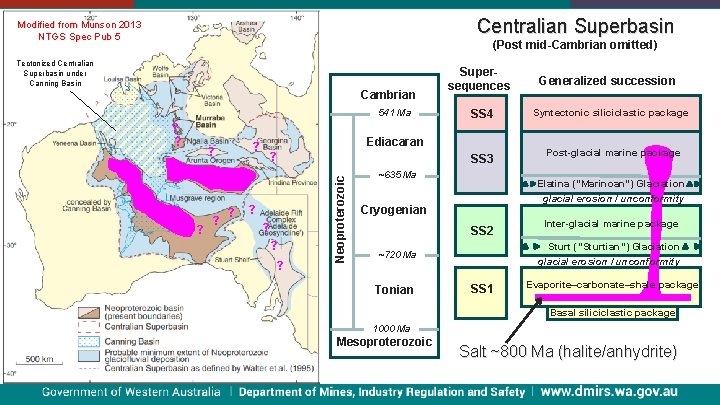
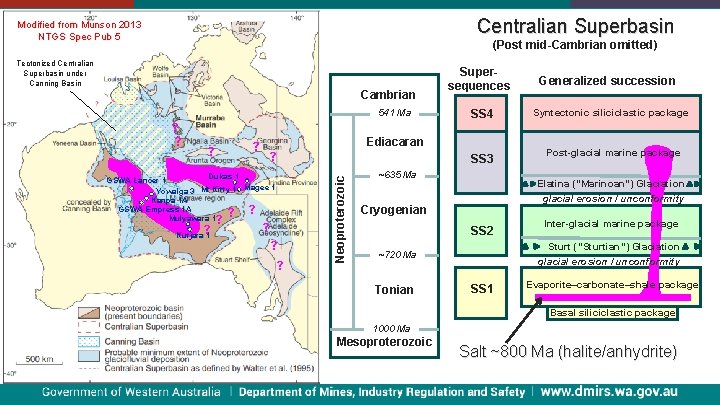
Centralian Superbasin Modified from Munson 2013 NTGS Spec Pub 5 Centralian Superbasin (Post mid-Cambrian omitted) Tectonized Centralian Superbasin under Canning Basin Cambrian 541 Ma ? ? ? SS 4 Ediacaran ? SS 3 ? ? Neoproterozoic ? ? Supersequences ~635 Ma Syntectonic siliciclastic package Post-glacial marine package Elatina (“Marinoan”) Glaciation glacial erosion / unconformity Cryogenian SS 2 Inter-glacial marine package Sturt (“Sturtian”) Glaciation ~720 Ma Tonian Generalized succession glacial erosion / unconformity SS 1 Evaporite–carbonate–shale package Basal siliciclastic package 1000 Ma Mesoproterozoic Salt ~800 Ma (halite/anhydrite)
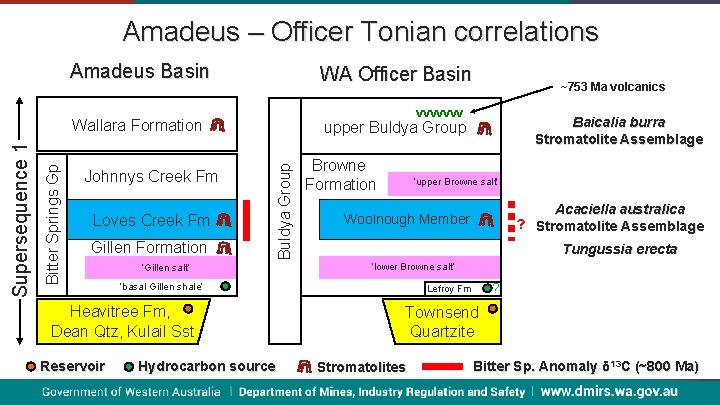
Amadeus – Officer Tonian correlations Amadeus Basin WA Officer Basin vvvvvvv Loves Creek Fm Gillen Formation ‘Gillen salt’ Browne Formation ‘upper Browne salt’ Hydrocarbon source Acaciella australica ? Stromatolite Assemblage Woolnough Member Tungussia erecta ‘lower Browne salt’ ‘basal Gillen shale’ Heavitree Fm, Dean Qtz, Kulail Sst Reservoir Baicalia burra Stromatolite Assemblage upper Buldya Group Bitter Springs Gp Supersequence 1 Wallara Formation Johnnys Creek Fm ~753 Ma volcanics ? Lefroy Fm Townsend Quartzite Stromatolites Bitter Sp. Anomaly δ 13 C (~800 Ma)
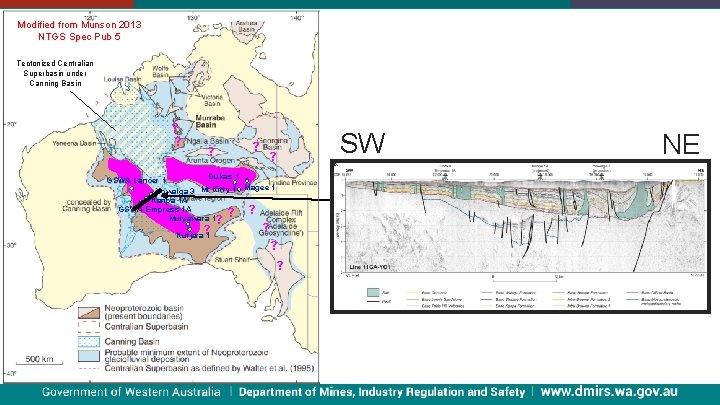
Centralian Superbasin Modified from Munson 2013 NTGS Spec Pub 5 Centralian Superbasin (Post mid-Cambrian omitted) Tectonized Centralian Superbasin under Canning Basin Cambrian 541 Ma ? ? ? SS 3 Dukas 1 GSWA Lancer 1 Mt Kitty 1 Magee 1 Yowalga 3 Kanpa 1 A GSWA Empress 1 A ? ? Mulyawara 1? Kutjara? 1 SS 4 Ediacaran ? ? ? Neoproterozoic ? ? Supersequences ~635 Ma Syntectonic siliciclastic package Post-glacial marine package Elatina (“Marinoan”) Glaciation glacial erosion / unconformity Cryogenian SS 2 Inter-glacial marine package Sturt (“Sturtian”) Glaciation ~720 Ma Tonian Generalized succession glacial erosion / unconformity SS 1 Evaporite–carbonate–shale package Basal siliciclastic package 1000 Ma Mesoproterozoic Salt ~800 Ma (halite/anhydrite)
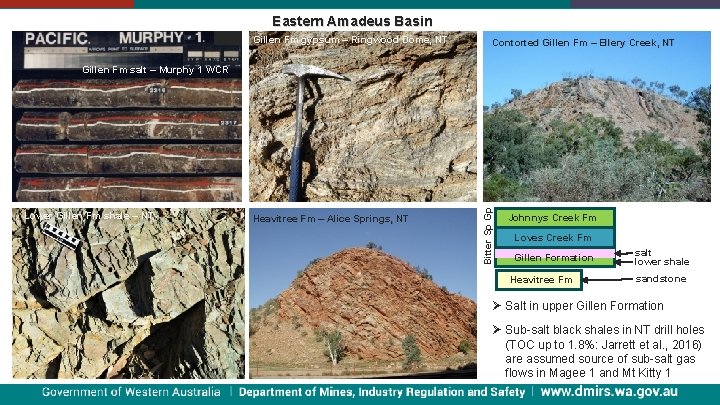
Eastern Amadeus Basin Centralian Superbasin Gillen Fm gypsum – Ringwood Dome, NT Contorted Gillen Fm – Ellery Creek, NT Lower Gillen Fm shale – NT Heavitree Fm – Alice Springs, NT Bitter Sp Gp Gillen Fm salt – Murphy 1 WCR Johnnys Creek Fm Loves Creek Fm Gillen Formation Heavitree Fm salt lower shale sandstone Ø Salt in upper Gillen Formation Ø Sub-salt black shales in NT drill holes (TOC up to 1. 8%: Jarrett et al. , 2016) are assumed source of sub-salt gas flows in Magee 1 and Mt Kitty 1
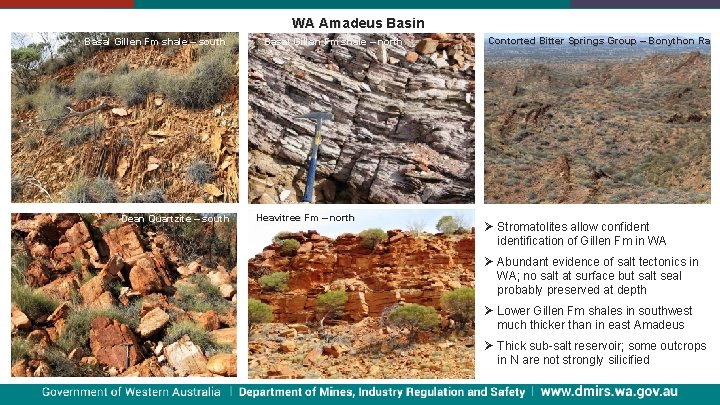
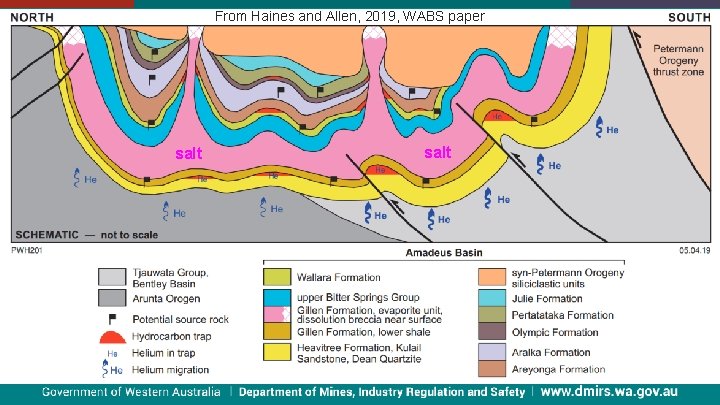
WA Amadeus Basin Centralian Superbasin Basal Gillen Fm shale – south Dean Quartzite – south Basal Gillen Fm shale – north Heavitree Fm – north Contorted Bitter Springs Group – Bonython Ra Ø Stromatolites allow confidentification of Gillen Fm in WA Ø Abundant evidence of salt tectonics in WA; no salt at surface but salt seal probably preserved at depth Ø Lower Gillen Fm shales in southwest much thicker than in east Amadeus Ø Thick sub-salt reservoir; some outcrops in N are not strongly silicified
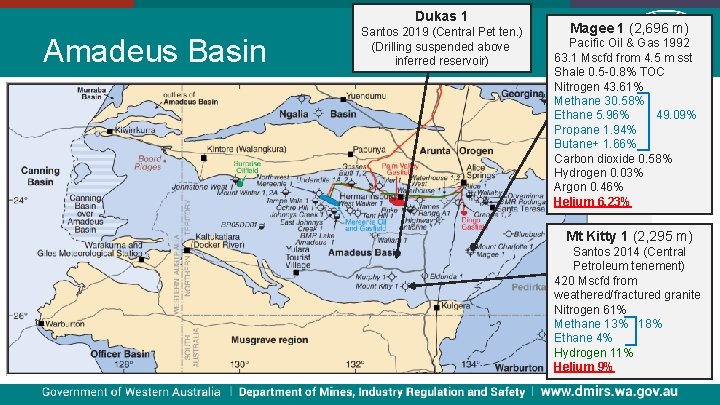
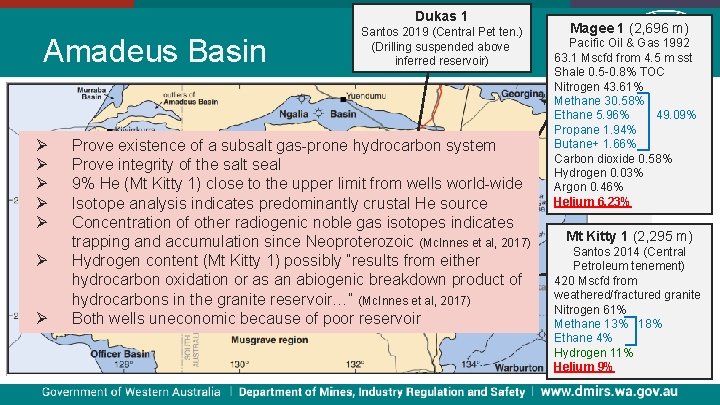
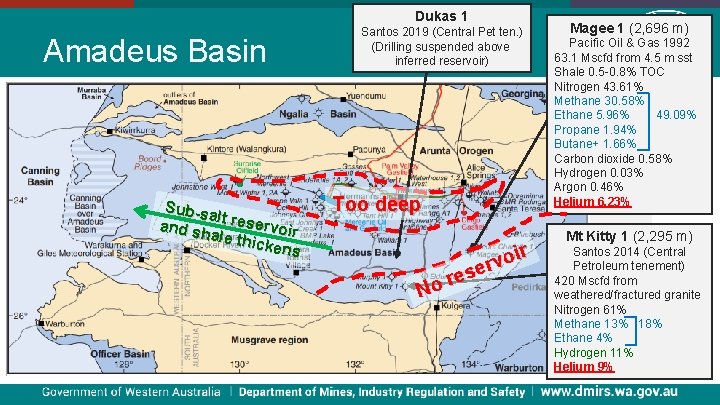
Dukas 1 Amadeus Basin Santos 2019 (Central Pet ten. ) (Drilling suspended above inferred reservoir) Magee 1 (2, 696 m) Pacific Oil & Gas 1992 63. 1 Mscfd from 4. 5 m sst Shale 0. 5 -0. 8% TOC Nitrogen 43. 61% Methane 30. 58% Ethane 5. 96% 49. 09% Propane 1. 94% Butane+ 1. 66% Carbon dioxide 0. 58% Hydrogen 0. 03% Argon 0. 46% Helium 6. 23% Mt Kitty 1 (2, 295 m) Santos 2014 (Central Petroleum tenement) 420 Mscfd from weathered/fractured granite Nitrogen 61% Methane 13% 18% Ethane 4% Hydrogen 11% Helium 9%
Dukas 1 Amadeus Basin Ø Ø Ø Ø Santos 2019 (Central Pet ten. ) (Drilling suspended above inferred reservoir) Prove existence of a subsalt gas-prone hydrocarbon system Prove integrity of the salt seal 9% He (Mt Kitty 1) close to the upper limit from wells world-wide Isotope analysis indicates predominantly crustal He source Concentration of other radiogenic noble gas isotopes indicates trapping and accumulation since Neoproterozoic (Mc. Innes et al, 2017) Hydrogen content (Mt Kitty 1) possibly “results from either hydrocarbon oxidation or as an abiogenic breakdown product of hydrocarbons in the granite reservoir…” (Mc. Innes et al, 2017) Both wells uneconomic because of poor reservoir Magee 1 (2, 696 m) Pacific Oil & Gas 1992 63. 1 Mscfd from 4. 5 m sst Shale 0. 5 -0. 8% TOC Nitrogen 43. 61% Methane 30. 58% Ethane 5. 96% 49. 09% Propane 1. 94% Butane+ 1. 66% Carbon dioxide 0. 58% Hydrogen 0. 03% Argon 0. 46% Helium 6. 23% Mt Kitty 1 (2, 295 m) Santos 2014 (Central Petroleum tenement) 420 Mscfd from weathered/fractured granite Nitrogen 61% Methane 13% 18% Ethane 4% Hydrogen 11% Helium 9%
Dukas 1 Amadeus Basin Sub-s al and sh t reservoir ale thi ckens Santos 2019 (Central Pet ten. ) (Drilling suspended above inferred reservoir) Too deep oir v r se e r No Magee 1 (2, 696 m) Pacific Oil & Gas 1992 63. 1 Mscfd from 4. 5 m sst Shale 0. 5 -0. 8% TOC Nitrogen 43. 61% Methane 30. 58% Ethane 5. 96% 49. 09% Propane 1. 94% Butane+ 1. 66% Carbon dioxide 0. 58% Hydrogen 0. 03% Argon 0. 46% Helium 6. 23% Mt Kitty 1 (2, 295 m) Santos 2014 (Central Petroleum tenement) 420 Mscfd from weathered/fractured granite Nitrogen 61% Methane 13% 18% Ethane 4% Hydrogen 11% Helium 9%
From Haines and Allen, 2019, WABS paper salt
Centralian Superbasin Modified from Munson 2013 NTGS Spec Pub 5 Centralian Superbasin (Post mid-Cambrian omitted) Tectonized Centralian Superbasin under Canning Basin Cambrian 541 Ma ? ? ? SS 3 Dukas 1 GSWA Lancer 1 Mt Kitty 1 Magee 1 Yowalga 3 Kanpa 1 A GSWA Empress 1 A ? ? Mulyawara 1? Kutjara? 1 SS 4 Ediacaran ? ? ? Neoproterozoic ? ? Supersequences ~635 Ma Syntectonic siliciclastic package Post-glacial marine package Elatina (“Marinoan”) Glaciation glacial erosion / unconformity Cryogenian SS 2 Inter-glacial marine package Sturt (“Sturtian”) Glaciation ~720 Ma Tonian Generalized succession glacial erosion / unconformity SS 1 Evaporite–carbonate–shale package Basal siliciclastic package 1000 Ma Mesoproterozoic Salt ~800 Ma (halite/anhydrite)
Modified from Munson 2013 NTGS Spec Pub 5 Centralian Superbasin Tectonized Centralian Superbasin under Canning Basin ? ? ? ? SW ? Dukas 1 GSWA Lancer 1 Mt Kitty 1 Magee 1 Yowalga 3 Kanpa 1 A GSWA Empress 1 A ? ? Mulyawara 1? Kutjara? 1 ? ? ? NE
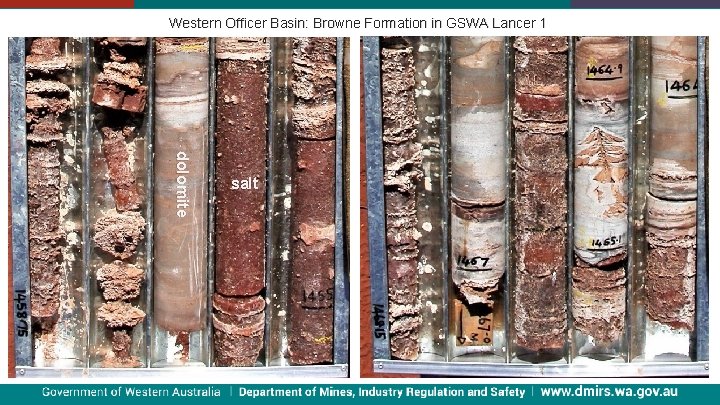
Western Officer Basin: Browne Formation in GSWA Lancer 1 Centralian Superbasin dolomite salt
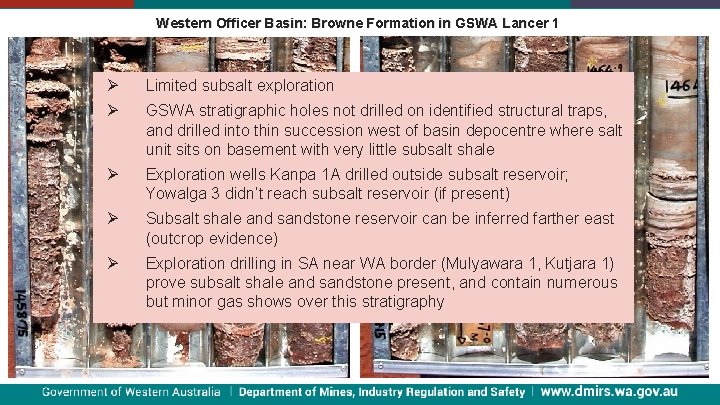
Western Officer Basin: Browne Formation in GSWA Lancer 1 Centralian Superbasin Ø Limited subsalt exploration Ø GSWA stratigraphic holes not drilled on identified structural traps, and drilled into thin succession west of basin depocentre where salt unit sits on basement with very little subsalt shale Ø Exploration wells Kanpa 1 A drilled outside subsalt reservoir; Yowalga 3 didn’t reach subsalt reservoir (if present) Ø Subsalt shale and sandstone reservoir can be inferred farther east (outcrop evidence) Ø Exploration drilling in SA near WA border (Mulyawara 1, Kutjara 1) prove subsalt shale and sandstone present, and contain numerous but minor gas shows over this stratigraphy
Conclusions Ø World’s oldest regional salt seal widespread in Amadeus and Officer Basins Ø Basins overlie radiogenic basement He source Ø Salt locally overlies thick sandstone reservoir and marginal gas-prone hydrocarbon source rocks Ø Salt-sealed traps likely formed early (Neoproterozoic & Paleozoic tectonics) Ø Ingredients thus in place for a world-class He province (challenges are remoteness, and lack of subsurface data) Ø Trapping of very high He concentration in gas proven in two eastern Amadeus Basin wells (though uncommercial due to poor reservoir) Ø Considerable opportunities in WA parts of Amadeus and Officer Basins