
World War II The European Theater Germany Attacks
- Slides: 24
World War II: The European Theater
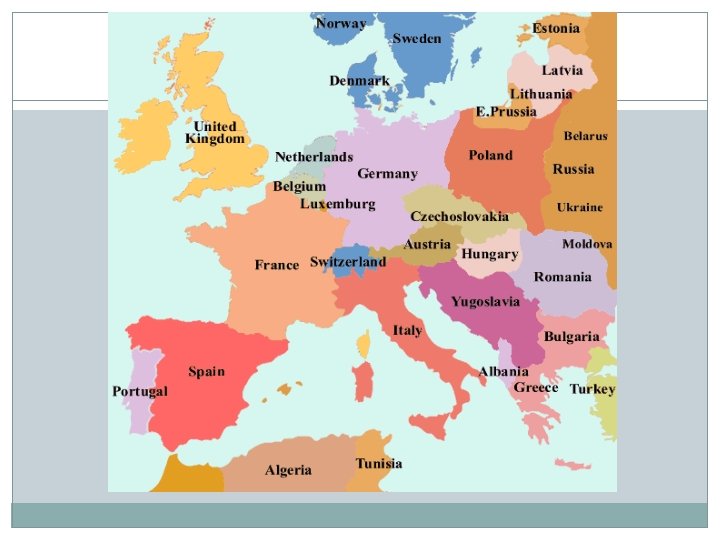
Germany Attacks Poland �The Polish army carried lances and rode horses �The German army had tanks, called Panzers �The Germans used a new type of warfare called blitzkrieg, or “lightning war” �Warsaw fell to the Germans on September 27, 1939 �The Polish military was defeated by the Germans by October 5, 1939
The Fall of France �Often referred to as the “Bore War, ” the “sitting war, ” or the “Phony War” �The French waited for the Germans behind concrete bunkers and fortifications they had build after WWI, called the Maginot Line �Germany went around the Maginot Line and attacked from the north �On May 10, 1939, Germany launched a new blitzkrieg �French and British forces get trapped in Belgium, France surrenders
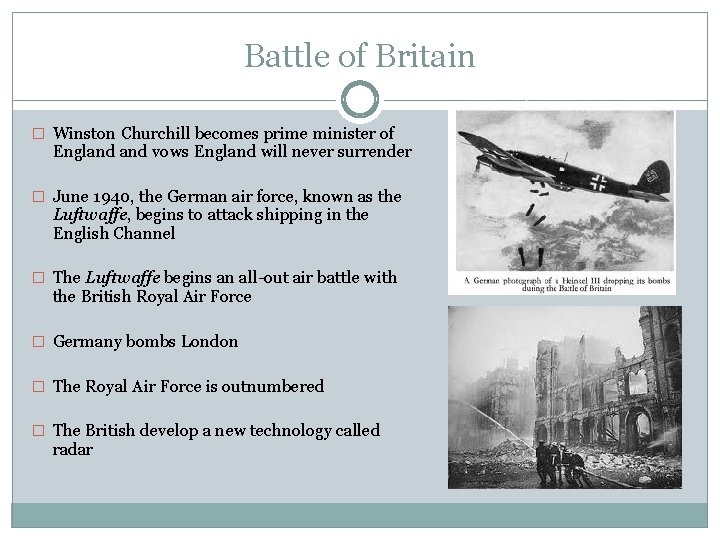
Battle of Britain � Winston Churchill becomes prime minister of England vows England will never surrender � June 1940, the German air force, known as the Luftwaffe, begins to attack shipping in the English Channel � The Luftwaffe begins an all-out air battle with the British Royal Air Force � Germany bombs London � The Royal Air Force is outnumbered � The British develop a new technology called radar
The Isolationist Debate � FDR asks Congress to eliminate the ban on the sale of arms to nations at war. � In spring of 1940, Churchill asks FDR for destroyers -FDR finds a loophole in the Neutrality Acts -The U. S. provides destroyers to the British in exchange for the right to build U. S. bases on British controlled Newfoundland, Bermuda, and islands in the Caribbean � The America First Committee, and group of isolationists, was strongly opposed to American intervention or aid to the Allies. � The Fight For Freedom Committee urged for stronger action against Germany and the repeal of the neutrality laws.
Lend-Lease Act � FDR is elected for a third term in 1941. � He proposed a Lend-Lease Act, which allowed the United States to lend or lease arms to any country considered “vital to the defense of the United States. ” � This act allowed the United States to provide weapons to Britain and the Soviet Union as long as they promised to return or pay rent on them after the war. � The U. S. lent more than $40 billion in weapons, vehicles, and supplies to the Allied war effort.
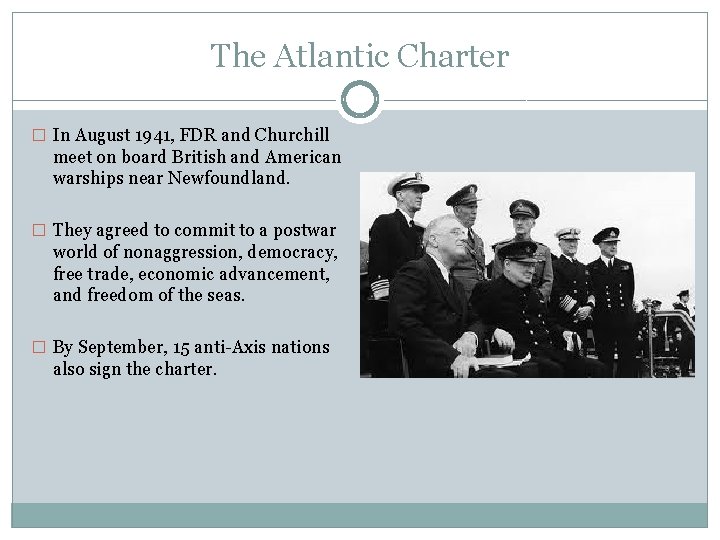
The Atlantic Charter � In August 1941, FDR and Churchill meet on board British and American warships near Newfoundland. � They agreed to commit to a postwar world of nonaggression, democracy, free trade, economic advancement, and freedom of the seas. � By September, 15 anti-Axis nations also sign the charter.
Germany First Strategy � FDR pledged to “force an ‘incident’… which would justify him in opening hostilities” with Germany. � A German U-boat fired on an American destroyer that has been sending the Uboat’s position to the British. -Roosevelt responded by ordering a “shoot-on-sight” policy toward Germany submarines. � The following month, the Germans attacked two American destroyers. -The Rueben James, which sank after being hit with torpedoes. -115 sailors died � Germany and the United States continued a tense stand-off. � The United States and Britain agreed Nazi Germany needed to be taken down first. � The Germany First strategy was formally called, “Plan D”. � Germany First was part of the Rainbow -5 war strategy.
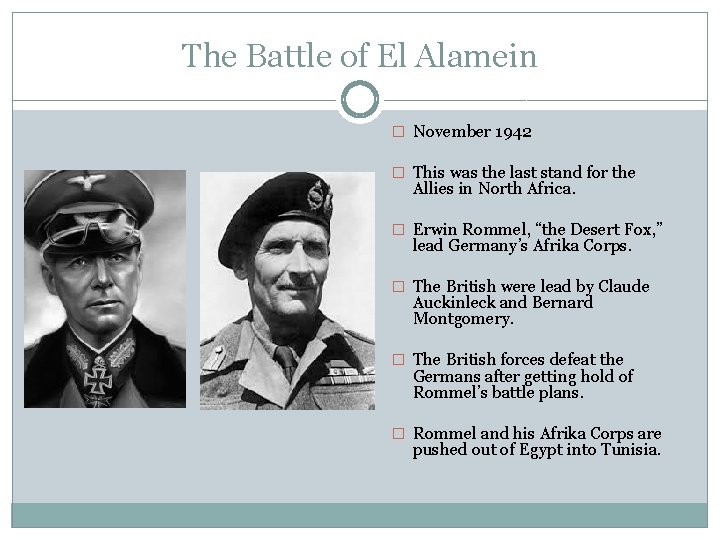
The Battle of El Alamein � November 1942 � This was the last stand for the Allies in North Africa. � Erwin Rommel, “the Desert Fox, ” lead Germany’s Afrika Corps. � The British were lead by Claude Auckinleck and Bernard Montgomery. � The British forces defeat the Germans after getting hold of Rommel’s battle plans. � Rommel and his Afrika Corps are pushed out of Egypt into Tunisia.
The Battle of Stalingrad � German commanders were ordered to secure the oil-fields in Caucasus. -Hitler orders troops to take Stalingrad � Stalin orders Soviet troops to take “not a step backwards”. � This was one of the most brutal battles of WWII. -Hand-to-hand combat -Germans are trapped in Stalingrad over the winter in below zero temperatures and limited supplies. � The battle of Stalingrad holds the highest number of casualties in a single battle in human history. -The Germans suffered close to 850, 000 casualties -The Russians suffered close to 1, 128, 000 casualties � All German troops surrendered on February 2, 1943 � This is a major turning point in the war.
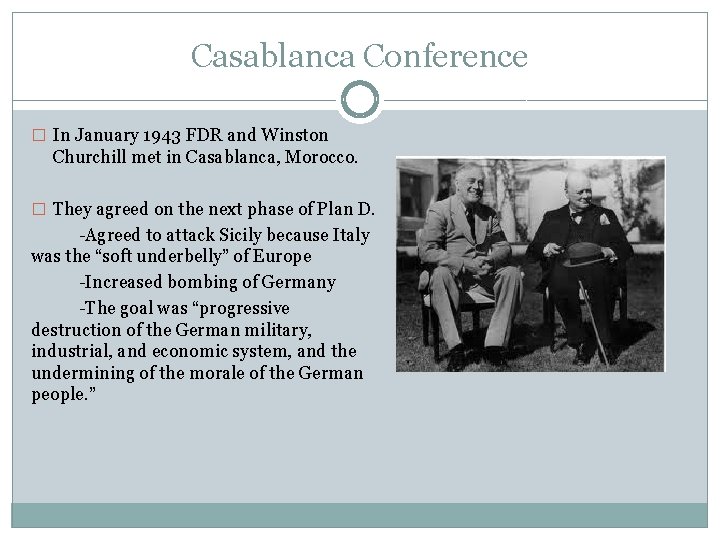
Casablanca Conference � In January 1943 FDR and Winston Churchill met in Casablanca, Morocco. � They agreed on the next phase of Plan D. -Agreed to attack Sicily because Italy was the “soft underbelly” of Europe -Increased bombing of Germany -The goal was “progressive destruction of the German military, industrial, and economic system, and the undermining of the morale of the German people. ”
Kasserine Pass �February – May 1943 �General Rommel and his Afrika Corps defeat American troops for the first time. �Over 1, 000 Americans die, hundreds more are taken prisoner.
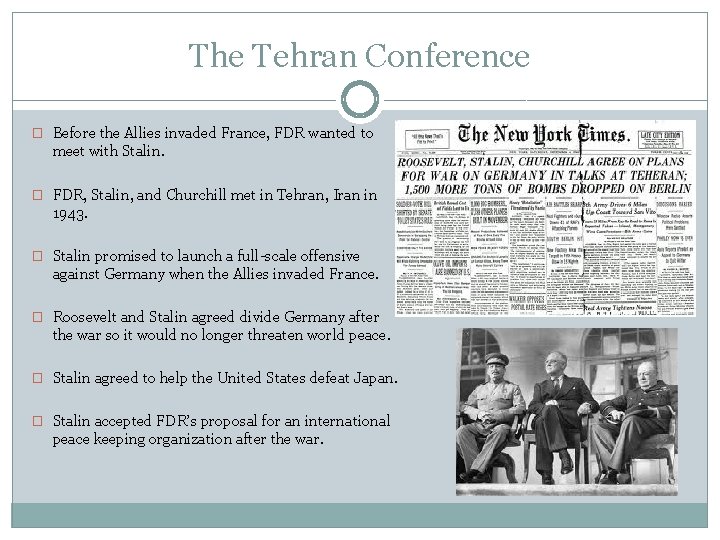
The Tehran Conference � Before the Allies invaded France, FDR wanted to meet with Stalin. � FDR, Stalin, and Churchill met in Tehran, Iran in 1943. � Stalin promised to launch a full-scale offensive against Germany when the Allies invaded France. � Roosevelt and Stalin agreed divide Germany after the war so it would no longer threaten world peace. � Stalin agreed to help the United States defeat Japan. � Stalin accepted FDR’s proposal for an international peace keeping organization after the war.
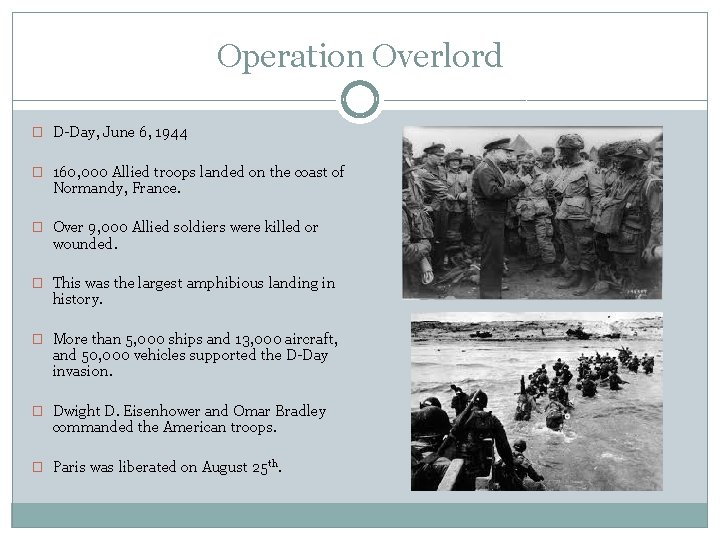
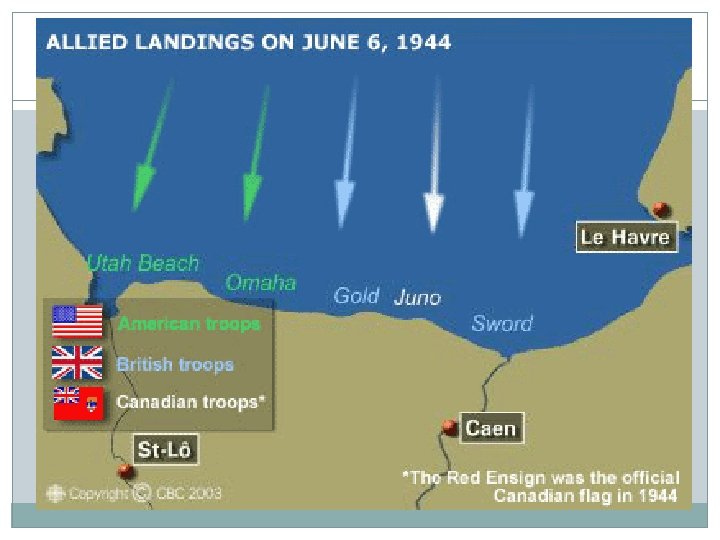
Operation Overlord � D-Day, June 6, 1944 � 160, 000 Allied troops landed on the coast of Normandy, France. � Over 9, 000 Allied soldiers were killed or wounded. � This was the largest amphibious landing in history. � More than 5, 000 ships and 13, 000 aircraft, and 50, 000 vehicles supported the D-Day invasion. � Dwight D. Eisenhower and Omar Bradley commanded the American troops. � Paris was liberated on August 25 th.
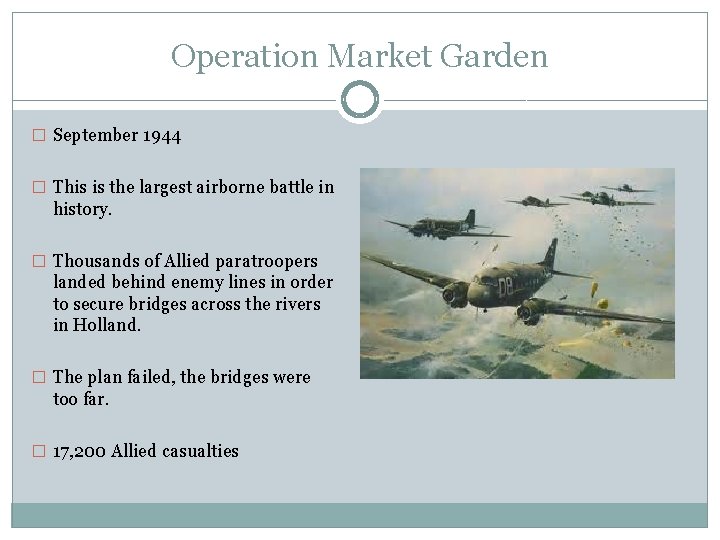
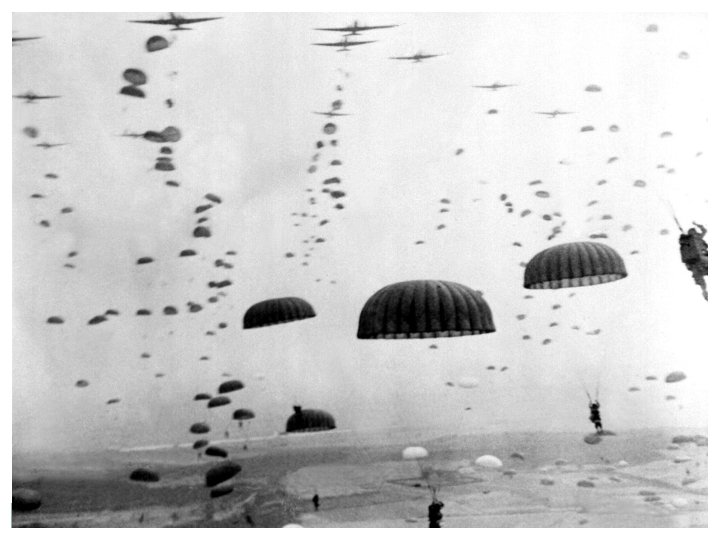
Operation Market Garden � September 1944 � This is the largest airborne battle in history. � Thousands of Allied paratroopers landed behind enemy lines in order to secure bridges across the rivers in Holland. � The plan failed, the bridges were too far. � 17, 200 Allied casualties
Battle of the Bulge �FDR elected for fourth term �December 1944 �German troops caught Americans by surprise. �Eisenhower ordered General Patton to rescue them. � 3 days later, Patton’s troops attacked the Germans, and began attacking German fuel storage. �German troops were forced to a halt and Patton’s troops broke through to the German line. �The Germans begin to withdraw.
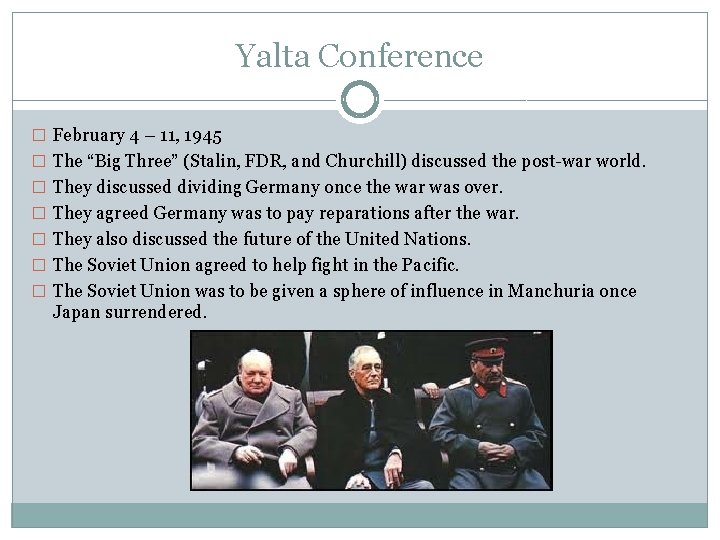
Yalta Conference � February 4 – 11, 1945 � The “Big Three” (Stalin, FDR, and Churchill) discussed the post-war world. � They discussed dividing Germany once the war was over. � They agreed Germany was to pay reparations after the war. � They also discussed the future of the United Nations. � The Soviet Union agreed to help fight in the Pacific. � The Soviet Union was to be given a sphere of influence in Manchuria once Japan surrendered.
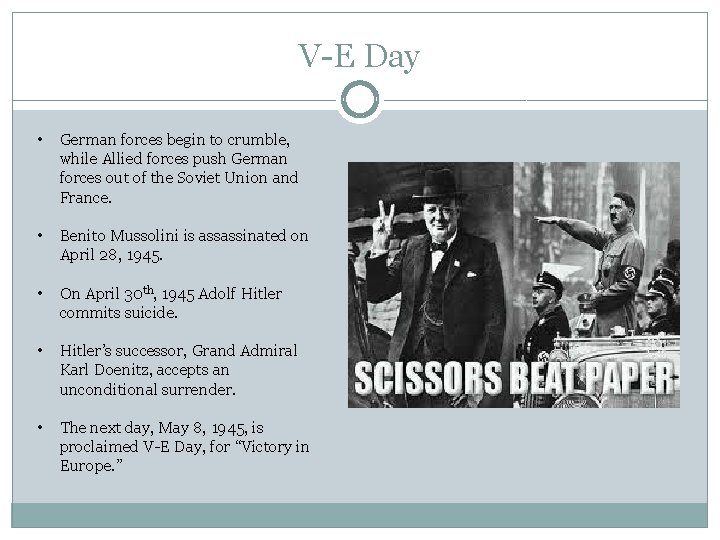
V-E Day • German forces begin to crumble, while Allied forces push German forces out of the Soviet Union and France. • Benito Mussolini is assassinated on April 28, 1945. • On April 30 th, 1945 Adolf Hitler commits suicide. • Hitler’s successor, Grand Admiral Karl Doenitz, accepts an unconditional surrender. • The next day, May 8, 1945, is proclaimed V-E Day, for “Victory in Europe. ”
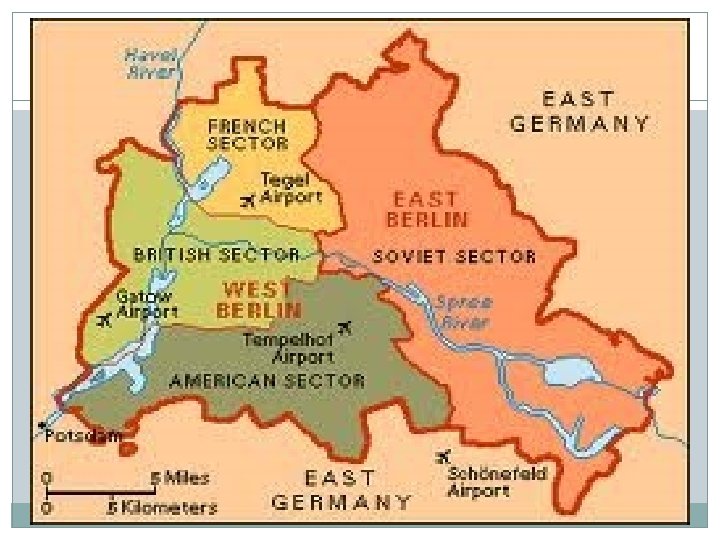
Potsdam Conference � Truman, Stalin, and Churchill met in Potsdam, Germany, from July 17 – August 2, 1945. � They agreed on a demilitarized and disarmed Germany. � Germany was divided into four separate zones. � Poland received a large portion of German territory. � The United States, Great Britain, and China released the "Potsdam Declaration, " which threatened Japan with "prompt and utter destruction" if it did not immediately surrender.