
World War II Objective Analyze the causes and
World War II Objective Analyze the causes and results of World War II
Chapters in Brief In 1939, having conquered Austria and Czechoslovakia, Adolf Hitler decided to move on Poland. He had signed an agreement with Stalin of the Soviet Union. In it, they agreed to split Poland between them. This deal removed the threat of the Soviets attacking Germany from the east. So, on September 1, 1939, the German army invaded Poland. Using planes, tanks, and troops, it move 3 d suddenly in a technique called blitzkrieg – “lightning war. ” Britain and France declared war, but Poland fell before they could help. On September 17, Stalin invaded Finland eastern Poland. In April 1940, Hitler’s armies conquered Denmark and Norway. Within two months, they also captured Belgium, the Netherlands, Luxembourg, and France. Some French, led by Charles de Gaulle, escaped to Britain to continue fighting. By then, Italy’s Benito Mussolini had joined Hitler’s side.
Chapters in Brief Great Britain – now led by Winston Churchill – stood alone. To prepare for an invasion of Britain, the German air force launched bombing attacks to weaken the country. The British air force fought back. It was helped by the newly developed radar that warned of coming attacks. Also, the British had broken the German army’s secret code. The air war over Britain lasted many months. Unable to break British defenses, Hitler called off the attacks. He next turned to the Mediterranean and the east. Germany sent troops to North Africa, where its ally, Italy, was losing to British forces. German troops joined the battle and fought a seesaw struggle with the British. Hitler forced Bulgaria, Romania, and Hungary to join Germany in the war. In April 1941, German armies quickly took control of Yugoslavia and Greece. In June, Hitler turned on his one-time ally and launched a surprise invasion of the Soviet Union. The Red Army, though the largest in the world, was not well-equipped or welltrained. The Germans quickly pushed deep into Soviet land. As the Red Army was forced to retreat, it destroyed everything left behind to keep supplies out of German hands. Stopped from taking Leningrad in the north, the Germans turned on Moscow, the Soviet capital. A strong Soviet counterattack, combined with fierce Russian winter weather, forced the Germans back.
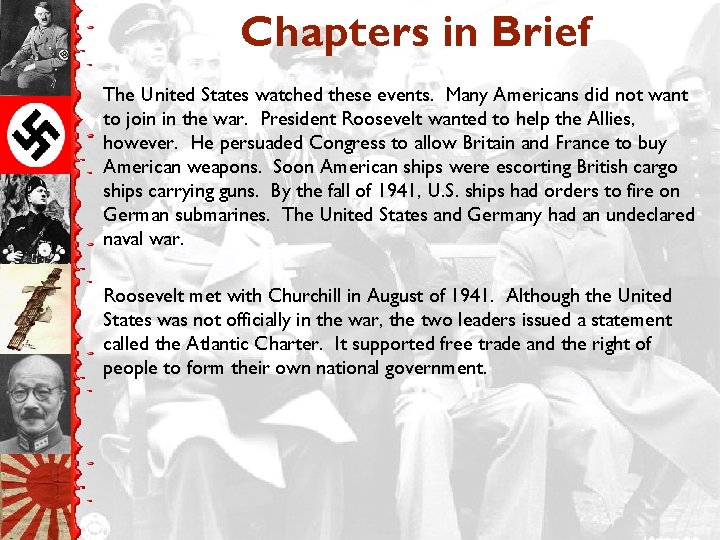
Chapters in Brief The United States watched these events. Many Americans did not want to join in the war. President Roosevelt wanted to help the Allies, however. He persuaded Congress to allow Britain and France to buy American weapons. Soon American ships were escorting British cargo ships carrying guns. By the fall of 1941, U. S. ships had orders to fire on German submarines. The United States and Germany had an undeclared naval war. Roosevelt met with Churchill in August of 1941. Although the United States was not officially in the war, the two leaders issued a statement called the Atlantic Charter. It supported free trade and the right of people to form their own national government.
Weimer Republic Review (2: 30) https: //www. youtube. com/watch? v=v. O-_HXO 7 Hw. Y&t=177 s
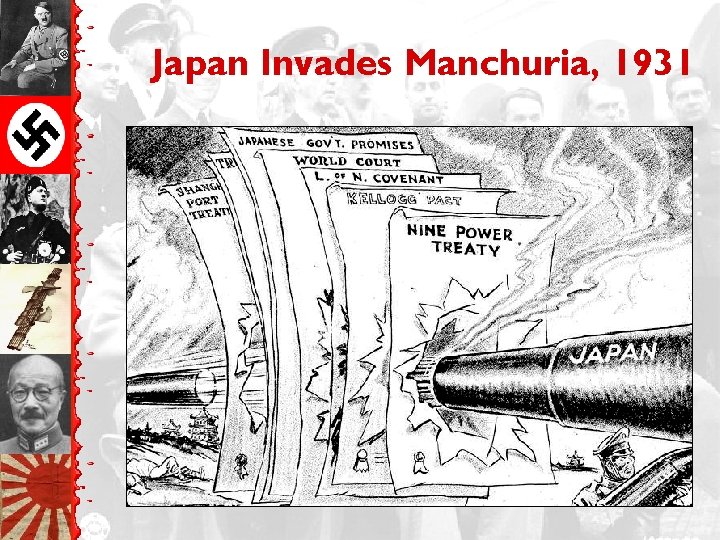
Japan Invades Manchuria, 1931
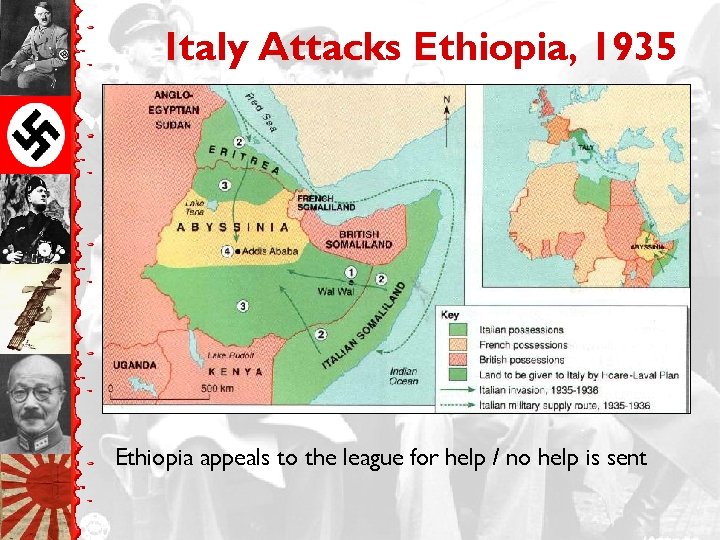
Italy Attacks Ethiopia, 1935 Ethiopia appeals to the league for help / no help is sent
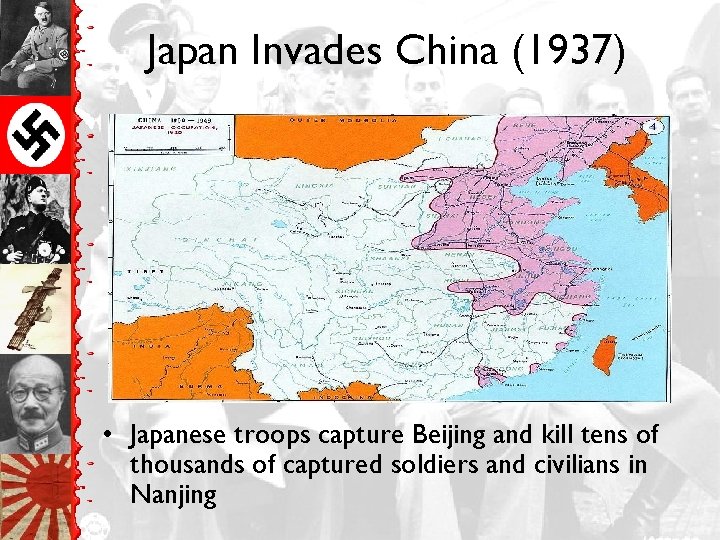
Japan Invades China (1937) • Japanese troops capture Beijing and kill tens of thousands of captured soldiers and civilians in Nanjing
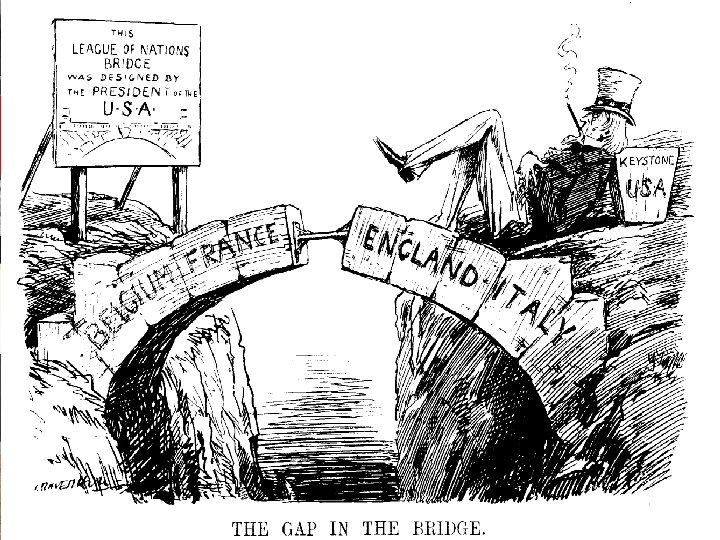
What has been the League of Nation’s reaction so far?
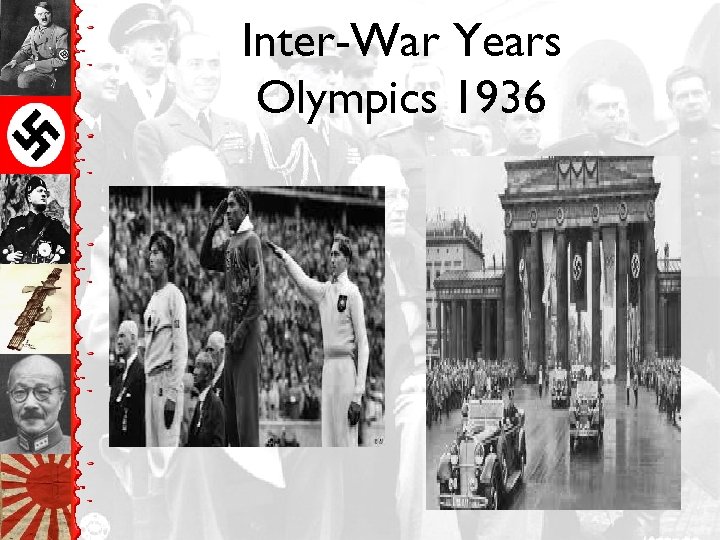
Inter-War Years Olympics 1936
![Fascist Aggression Timeline 1935: Hitler denounced the Versailles Treaty the League of Nations [re-arming!]](http://slidetodoc.com/presentation_image_h/dcc1a8480b15eab79e83a5d5c4588c23/image-15.jpg "Fascist Aggression Timeline 1935: Hitler denounced the Versailles Treaty the League of Nations [re-arming!]")
Fascist Aggression Timeline 1935: Hitler denounced the Versailles Treaty the League of Nations [re-arming!] 1935: Mussolini attacks Ethiopia 1935: Hitler announces he will not obey the Treaty of Versailles 1936: March 7 th - German troops sent into the Rhineland 1936: Fascist forces sent to fight with Franco in Spain
![Fascist Aggression 1938: Austrian Anschluss (union) 1938: Rome-Berlin Tokyo Pact [AXIS] 1938: Munich Agreement](http://slidetodoc.com/presentation_image_h/dcc1a8480b15eab79e83a5d5c4588c23/image-16.jpg "Fascist Aggression 1938: Austrian Anschluss (union) 1938: Rome-Berlin Tokyo Pact [AXIS] 1938: Munich Agreement")
Fascist Aggression 1938: Austrian Anschluss (union) 1938: Rome-Berlin Tokyo Pact [AXIS] 1938: Munich Agreement APPEASEMENT! 1939: German troops march into the rest of Czechoslovakia the Sudetenland (German speaking) 1939: Hitler-Stalin Non-Aggression Pact 1939: September 1 st German troops march into Poland blitzkrieg WWII begins!!!
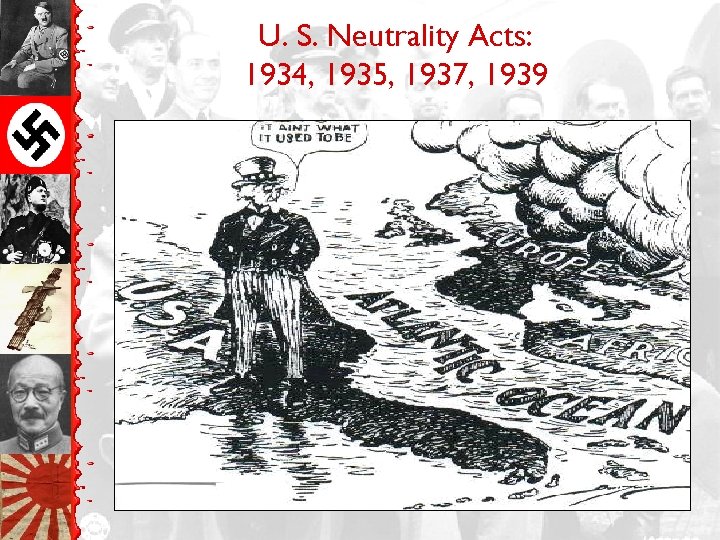
U. S. Neutrality Acts: 1934, 1935, 1937, 1939
U. S. Neutrality Acts: 1935, 1936, 1937 • when the President proclaimed the existence of a foreign war, certain restrictions would automatically go into effect: • prohibited sales of arms to belligerent nations • prohibited loans and credits to belligerent nations • forbade Americans to travel on vessels of nations at war [in contrast to WW I] • non-military goods must be purchased on a “cash-and-carry” basis pay when goods are picked up • banned involvement in the Spanish Civil War • this limited the options of the President in a crisis • America in the 1930 s declined to build up its forces
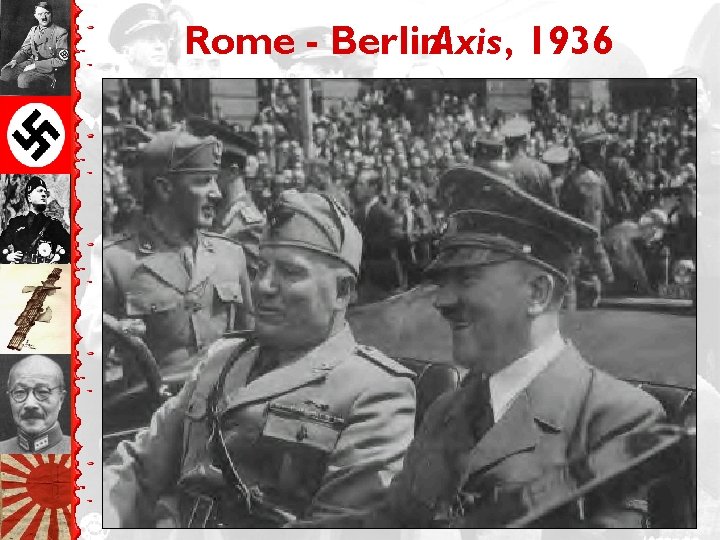
Rome - Berlin. Axis, 1936
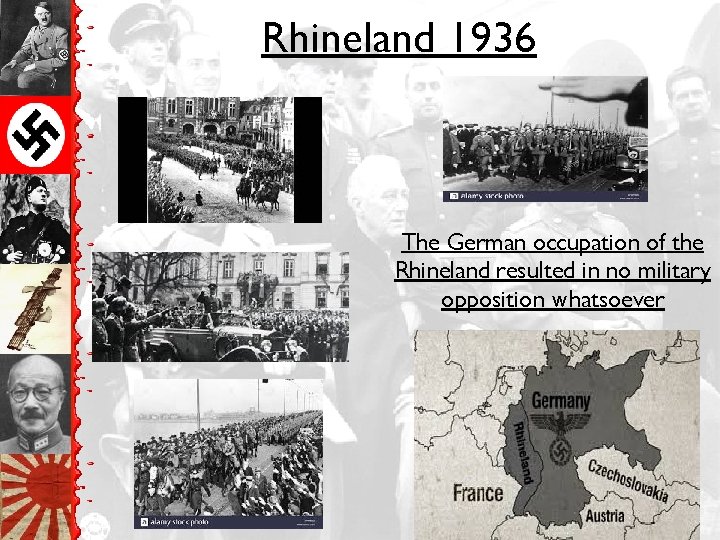
Rhineland 1936 The German occupation of the Rhineland resulted in no military opposition whatsoever
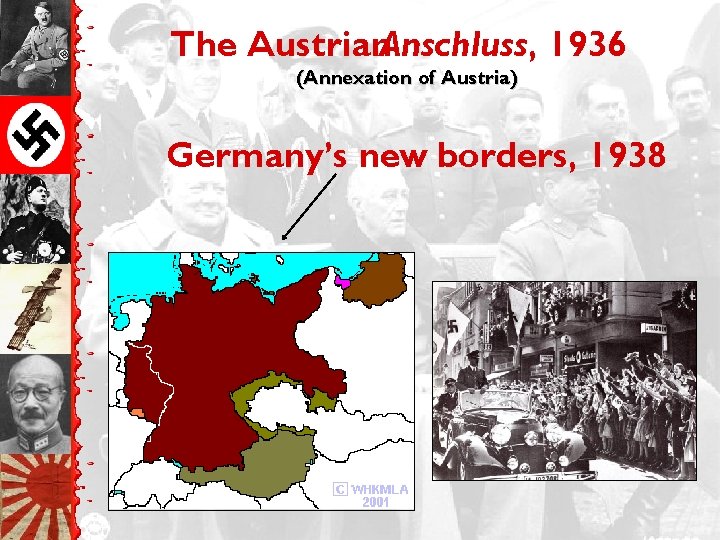
The Austrian. Anschluss, 1936 (Annexation of Austria) Germany’s new borders, 1938
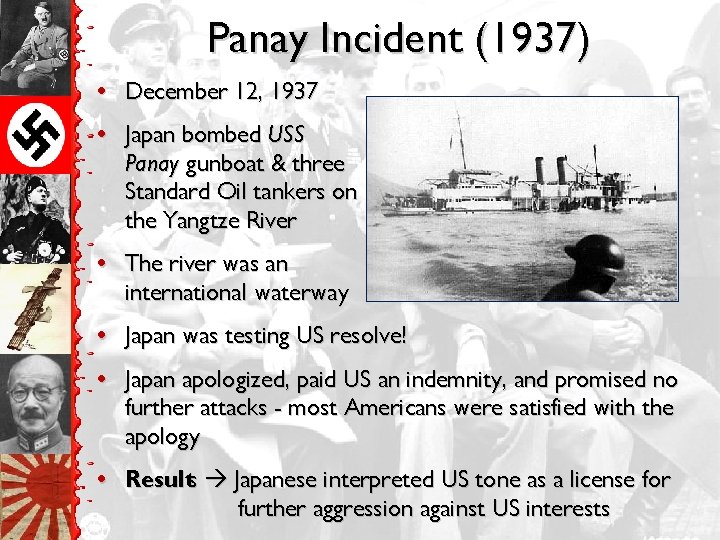
Panay Incident (1937) • December 12, 1937 • Japan bombed USS Panay gunboat & three Standard Oil tankers on the Yangtze River • The river was an international waterway • Japan was testing US resolve! • Japan apologized, paid US an indemnity, and promised no further attacks - most Americans were satisfied with the apology • Results Japanese interpreted US tone as a license for further aggression against US interests
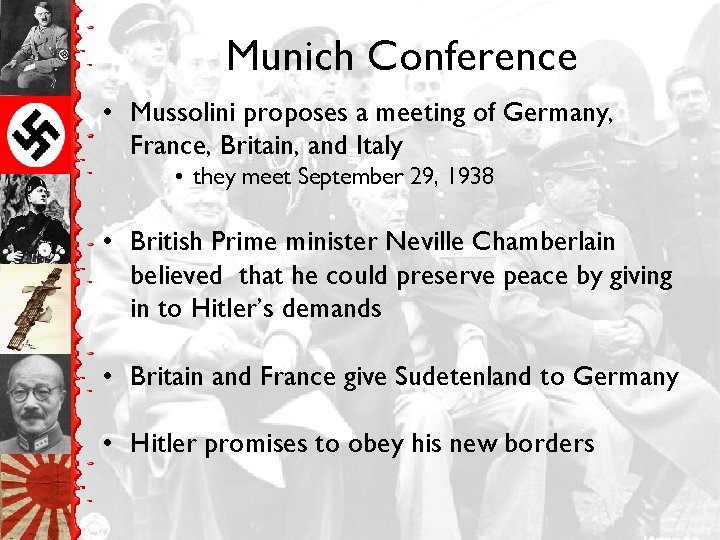
Munich Conference • Mussolini proposes a meeting of Germany, France, Britain, and Italy • they meet September 29, 1938 • British Prime minister Neville Chamberlain believed that he could preserve peace by giving in to Hitler’s demands • Britain and France give Sudetenland to Germany • Hitler promises to obey his new borders
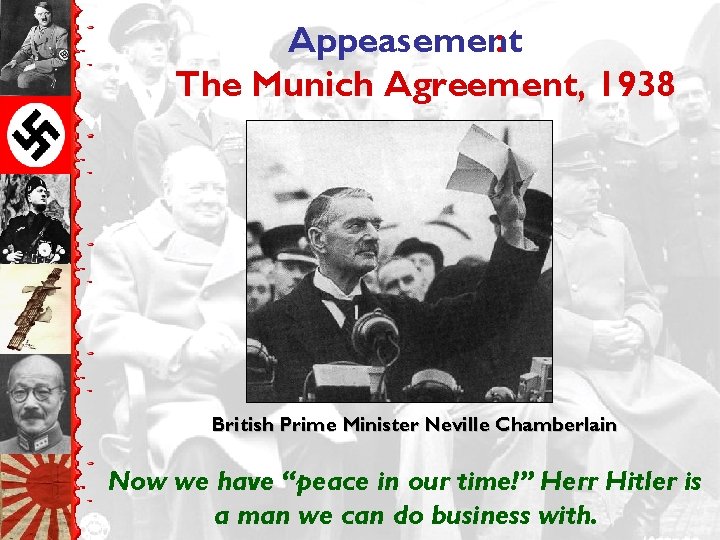
Appeasement : The Munich Agreement, 1938 British Prime Minister Neville Chamberlain Now we have “peace in our time!” Herr Hitler is a man we can do business with.
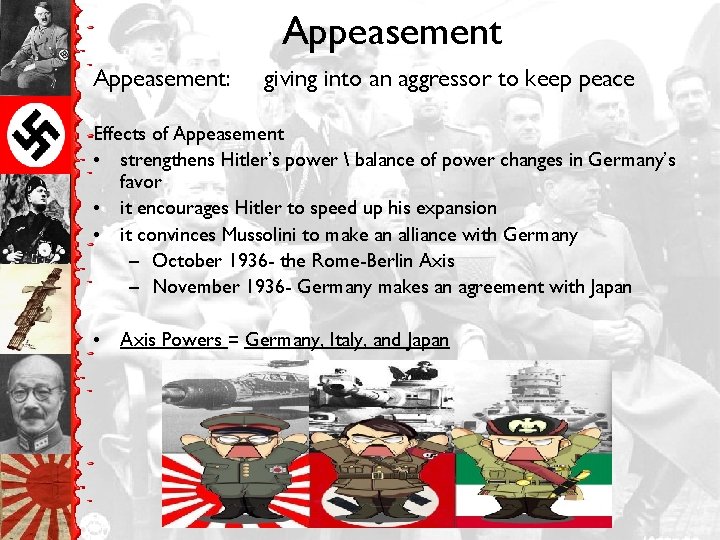
Appeasement: giving into an aggressor to keep peace Effects of Appeasement • strengthens Hitler’s power balance of power changes in Germany’s favor • it encourages Hitler to speed up his expansion • it convinces Mussolini to make an alliance with Germany – October 1936 - the Rome-Berlin Axis – November 1936 - Germany makes an agreement with Japan • Axis Powers = Germany, Italy, and Japan
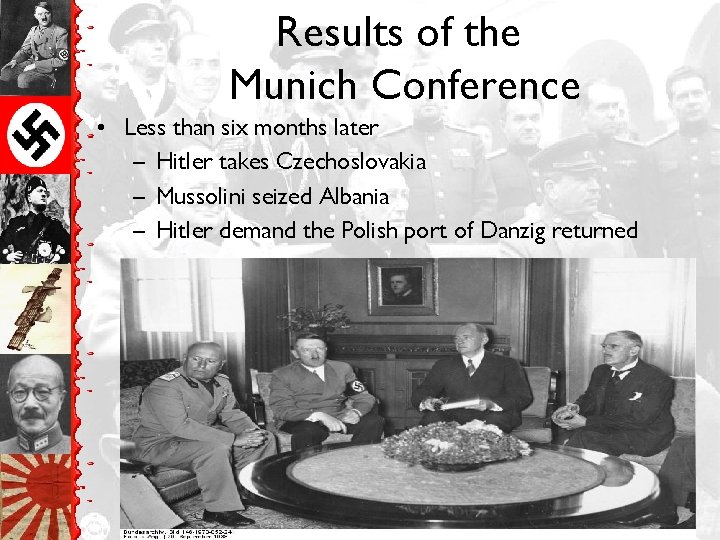
Results of the Munich Conference • Less than six months later – Hitler takes Czechoslovakia – Mussolini seized Albania – Hitler demand the Polish port of Danzig returned
1939 U. S. Neutrality Act In response to Germany’s invasion of Poland: • FDR persuades Congress in special session to allow the US to aid European democracies in a limited way: • the US could sell weapons to the European democracies on a “cash-and-carry” basis • FDR was authorized to proclaim danger zones which US ships and citizens could not enter • • Results of the 1939 Neutrality Act: • aggressors could not send ships to buy US munitions • the US economy improved as European demands for war goods helped bring the country out of the 1937 -38 recession America becomes the “Arsenal of Democracy. ”
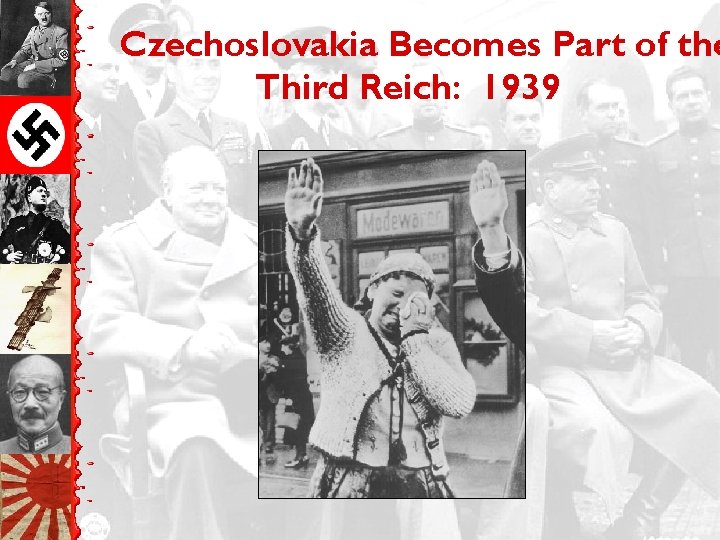
Czechoslovakia Becomes Part of the Third Reich: 1939
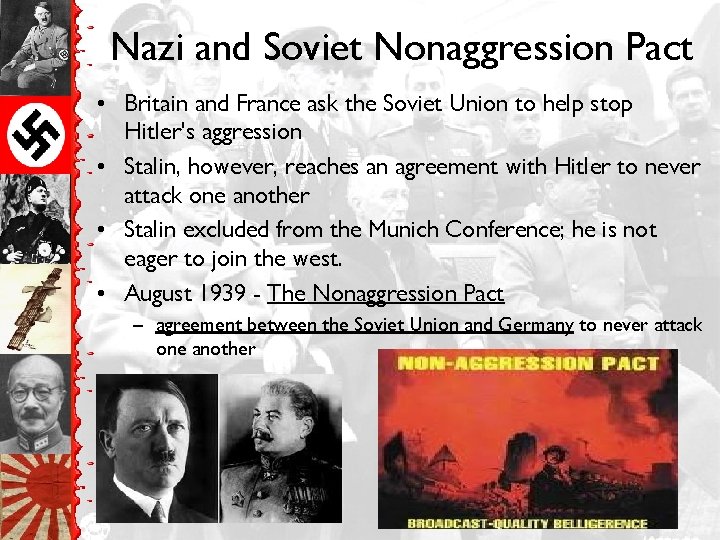
Nazi and Soviet Nonaggression Pact • Britain and France ask the Soviet Union to help stop Hitler's aggression • Stalin, however, reaches an agreement with Hitler to never attack one another • Stalin excluded from the Munich Conference; he is not eager to join the west. • August 1939 - The Nonaggression Pact – agreement between the Soviet Union and Germany to never attack one another
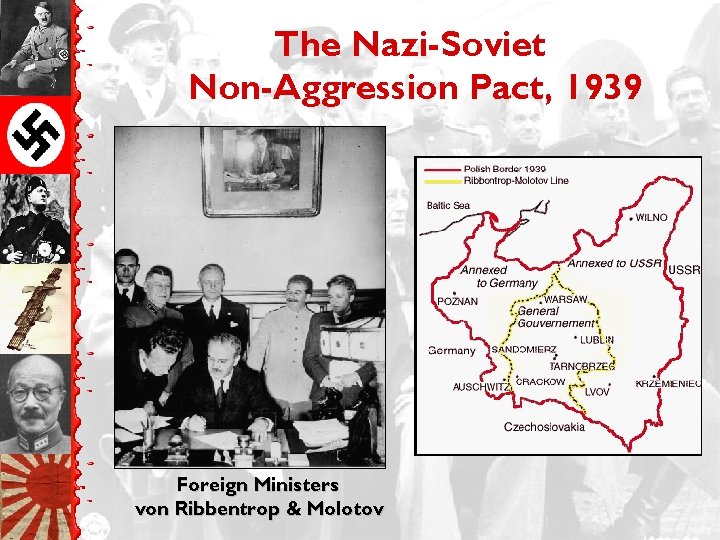
The Nazi-Soviet Non-Aggression Pact, 1939 Foreign Ministers von Ribbentrop & Molotov
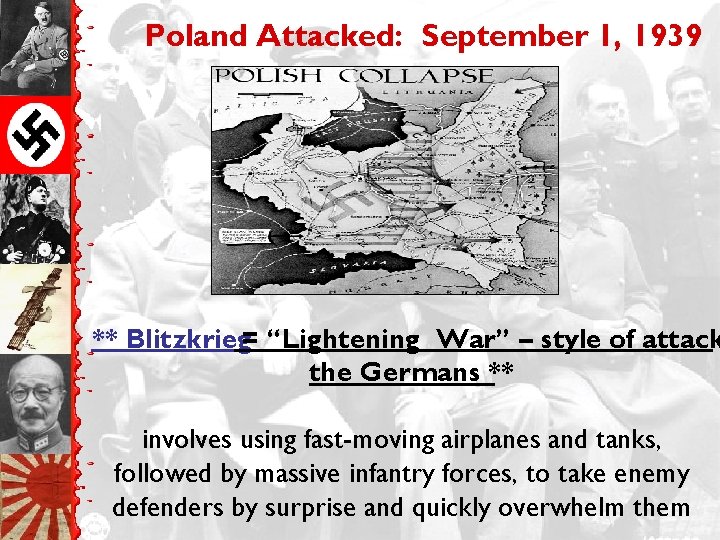
Poland Attacked: September 1, 1939 ** Blitzkrieg= “Lightening War” – style of attack the Germans ** involves using fast-moving airplanes and tanks, followed by massive infantry forces, to take enemy defenders by surprise and quickly overwhelm them
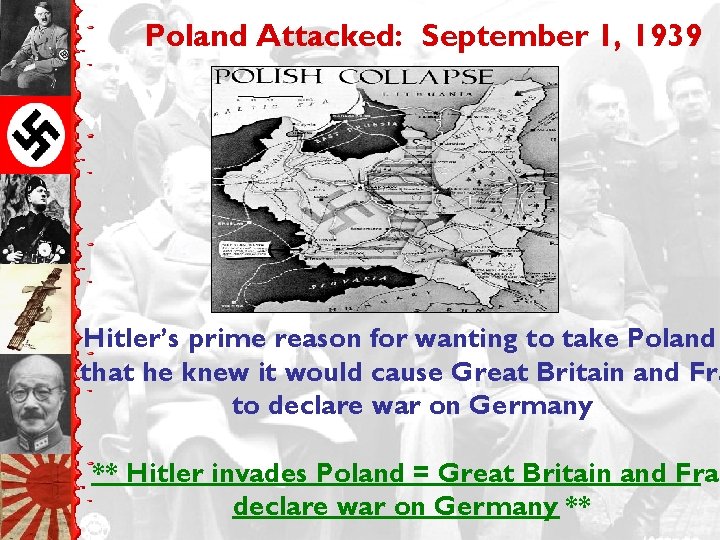
Poland Attacked: September 1, 1939 Hitler’s prime reason for wanting to take Poland that he knew it would cause Great Britain and Fra to declare war on Germany ** Hitler invades Poland = Great Britain and Fran declare war on Germany **
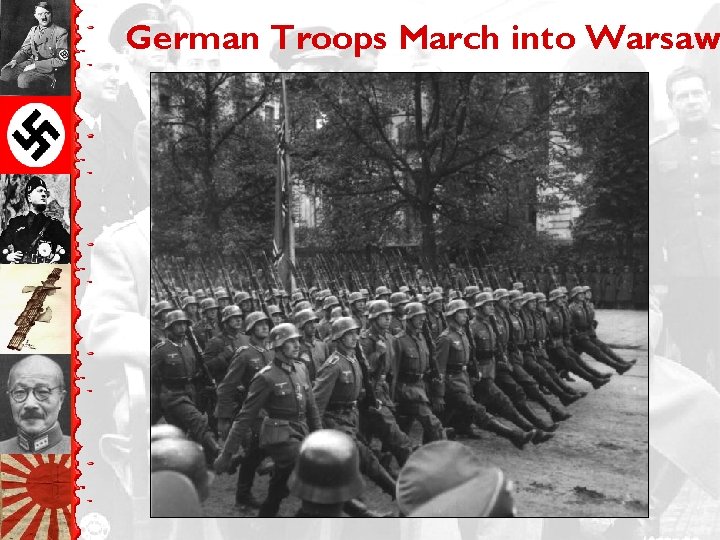
German Troops March into Warsaw
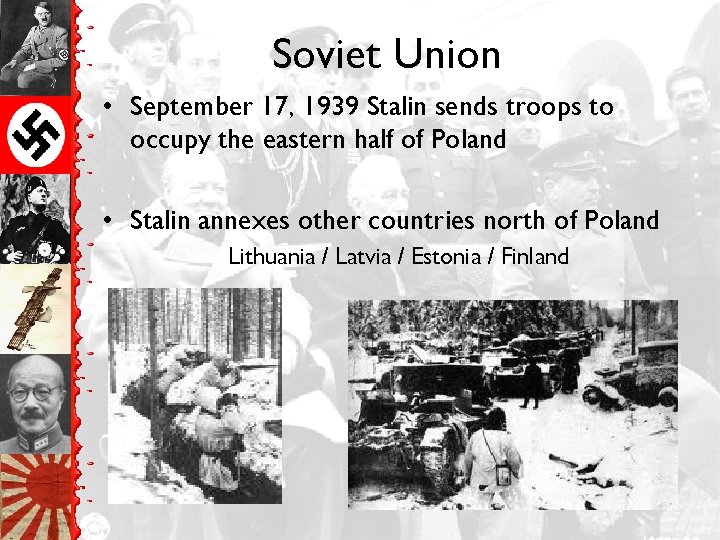
Soviet Union • September 17, 1939 Stalin sends troops to occupy the eastern half of Poland • Stalin annexes other countries north of Poland Lithuania / Latvia / Estonia / Finland
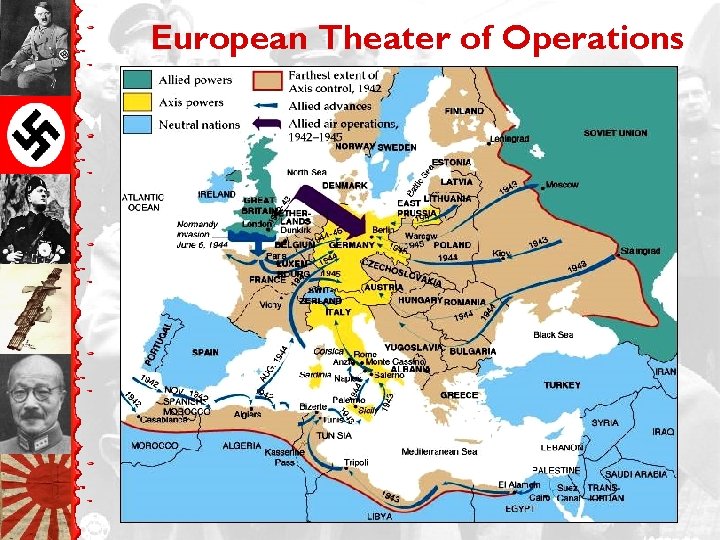
European Theater of Operations
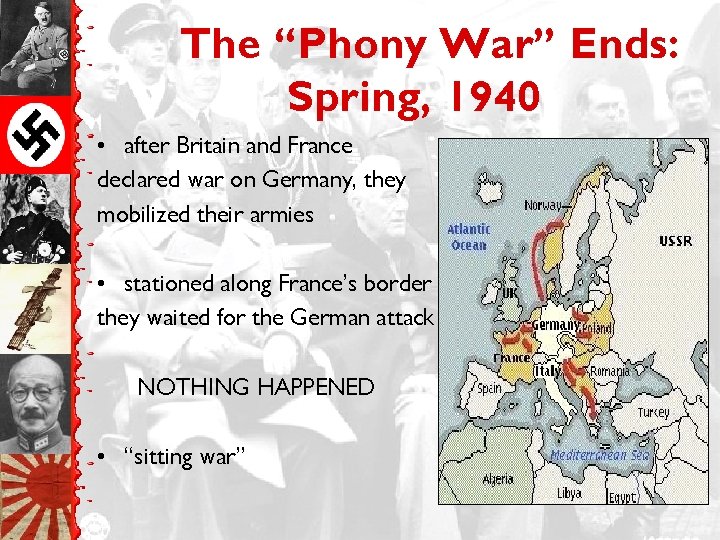
The “Phony War” Ends: Spring, 1940 • after Britain and France declared war on Germany, they mobilized their armies • stationed along France’s border they waited for the German attack NOTHING HAPPENED • “sitting war”
Fall of France • May 1940 – Hitler sweeps through the Netherlands, Belgium, and Luxembourg • Allies kept attention on these attacks so Hitler was able to strike at France • at Dunkirk, the allies were trapped with their backs to the sea • Great Britain set out to rescue the army – 338, 000 battle-weary soldiers were saved
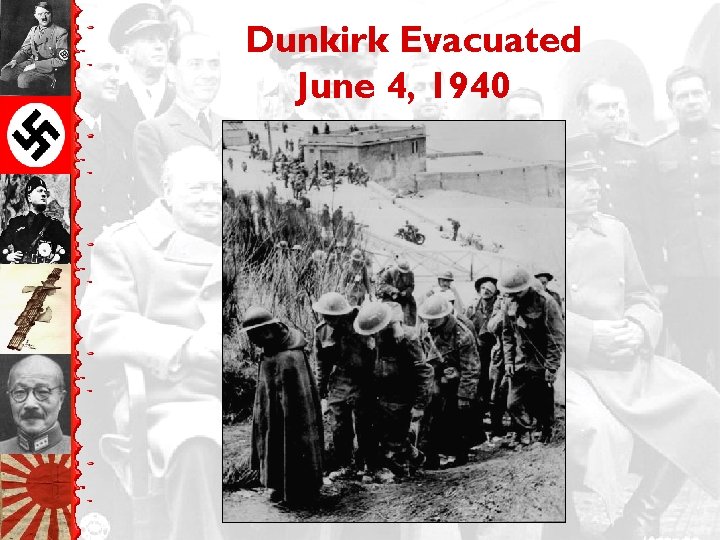
Dunkirk Evacuated June 4, 1940
Fall of France • resistance in France began to crumble • June 14, 1940 – Germans had taken Paris • June 22, 1940 – French leaders surrendered • Germans took control of the northern part of France and left the southern part a “puppetcontrolled” government
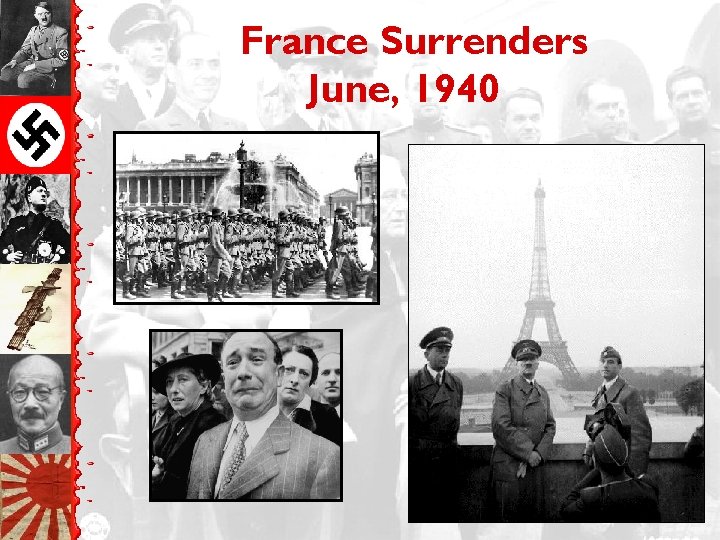
France Surrenders June, 1940
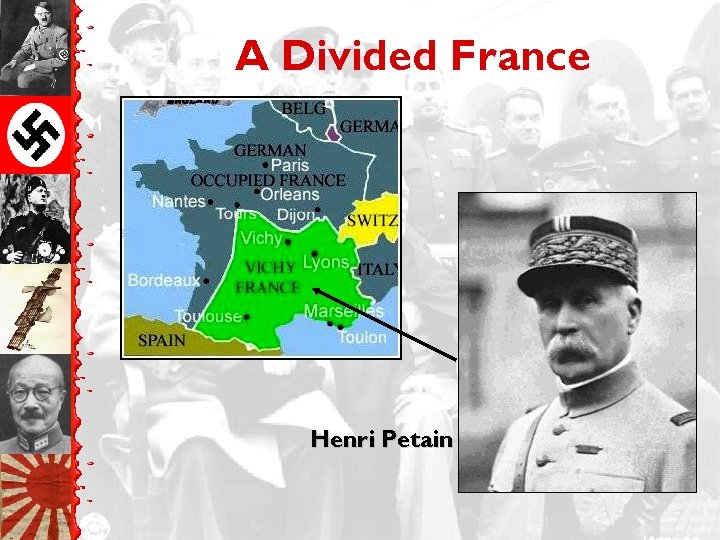
A Divided France Henri Petain
A Divided France - Petain • May 1940 - France under attack from Germany • Pétain was appointed vice premier • June 1940 - asked for an armistice (truce) • upon which he was appointed 'chief of state‘ and enjoyed almost absolute power • armistice gave the Germans control over the north and west of France, including Paris • the remainder was left as a separate regime under Pétain, with its capital at Vichy • officially neutral, in practice the regime • collaborated closely with Germany • brought in its own anti-Semitic legislation
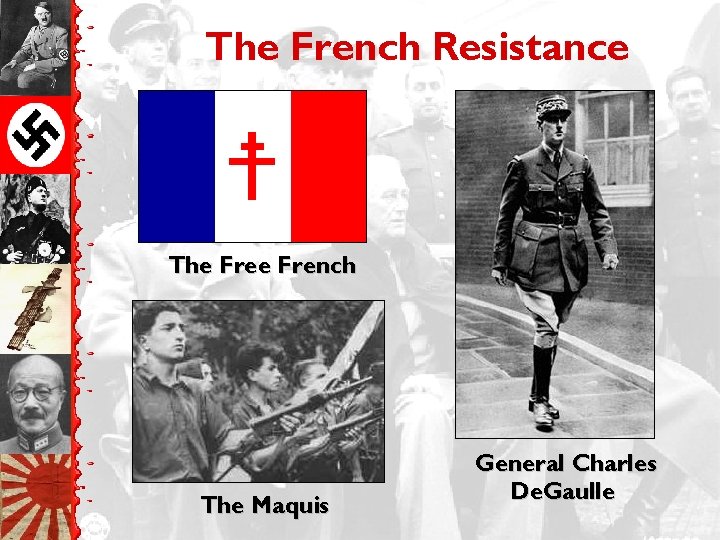
The French Resistance The French The Maquis General Charles De. Gaulle
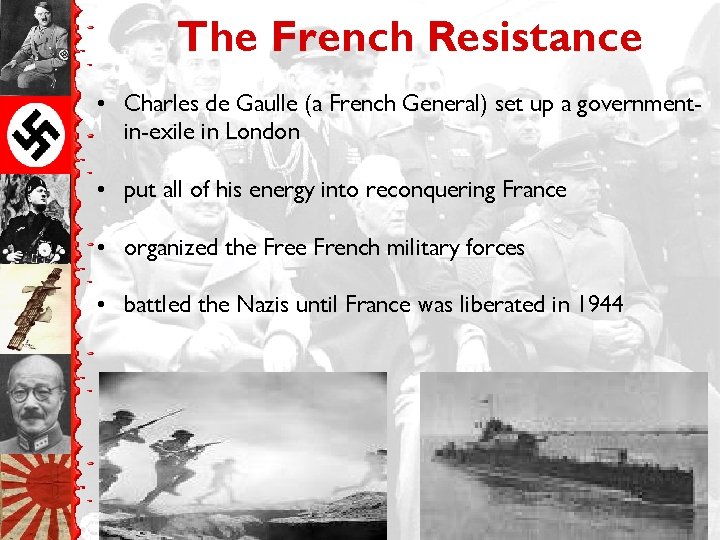
The French Resistance • Charles de Gaulle (a French General) set up a governmentin-exile in London • put all of his energy into reconquering France • organized the French military forces • battled the Nazis until France was liberated in 1944
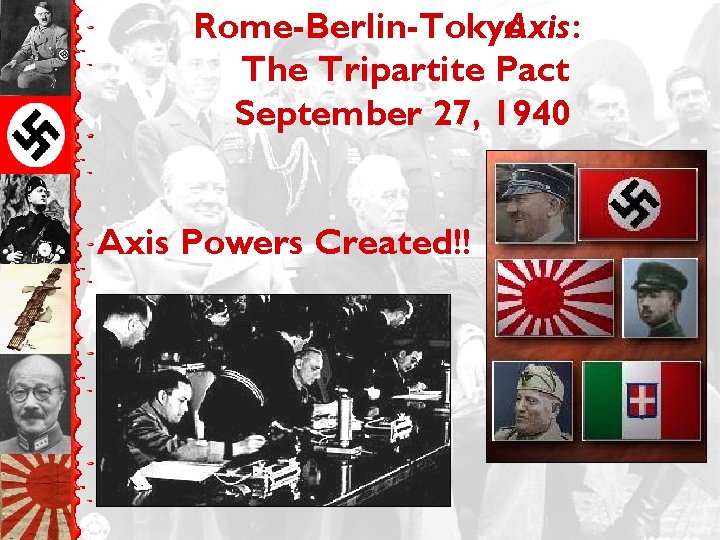
Rome-Berlin-Tokyo Axis: The Tripartite Pact September 27, 1940 Axis Powers Created!!
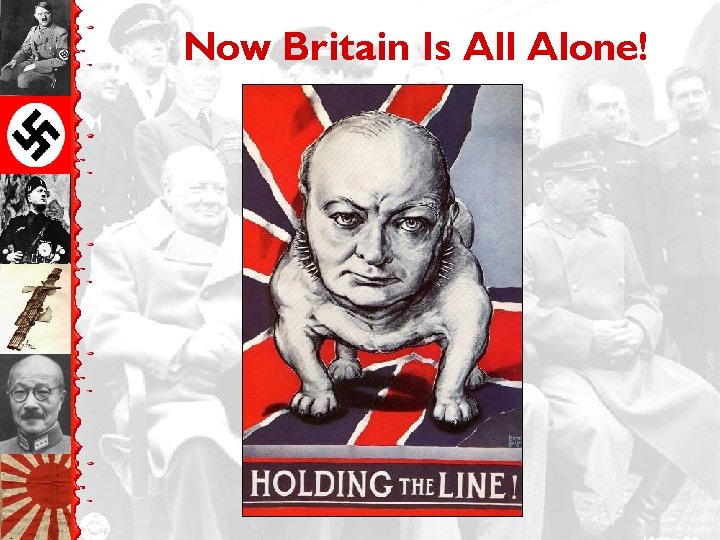
Now Britain Is All Alone!
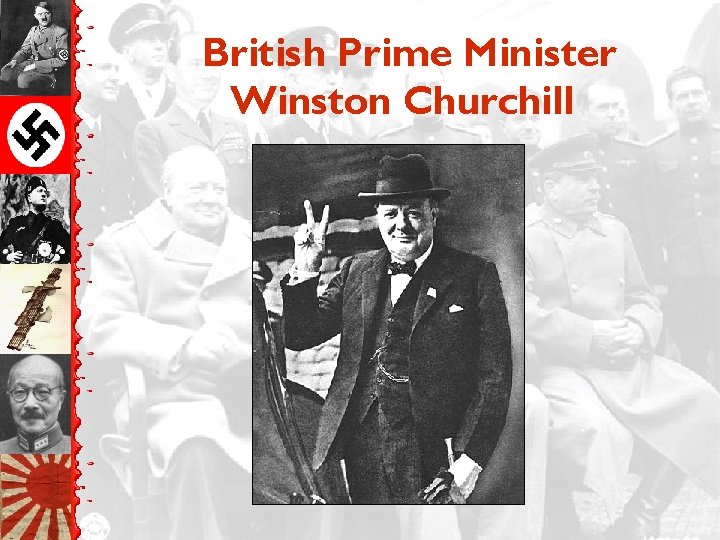
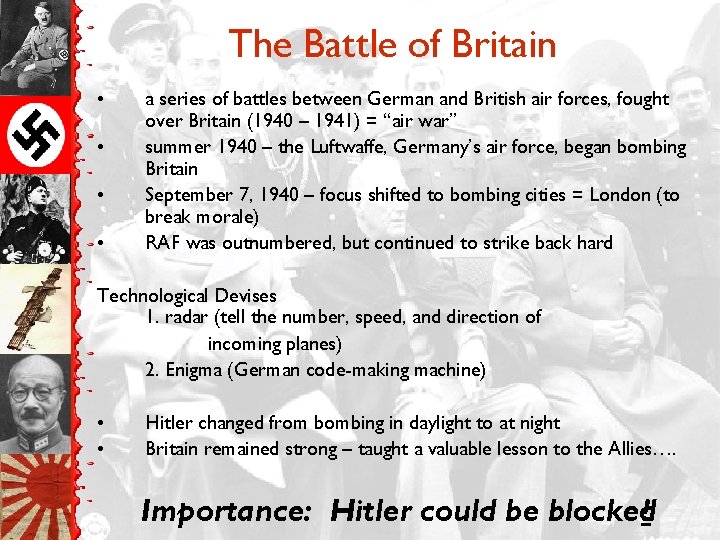
British Prime Minister Winston Churchill
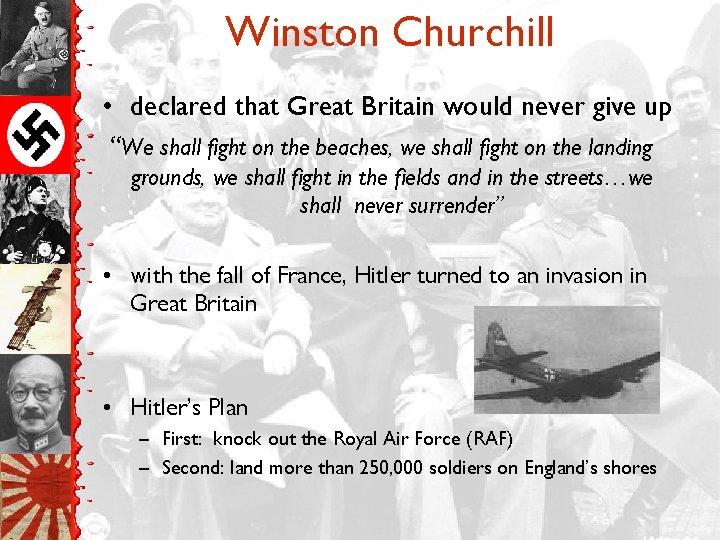
Winston Churchill • declared that Great Britain would never give up “We shall fight on the beaches, we shall fight on the landing grounds, we shall fight in the fields and in the streets…we shall never surrender” • with the fall of France, Hitler turned to an invasion in Great Britain • Hitler’s Plan – First: knock out the Royal Air Force (RAF) – Second: land more than 250, 000 soldiers on England’s shores
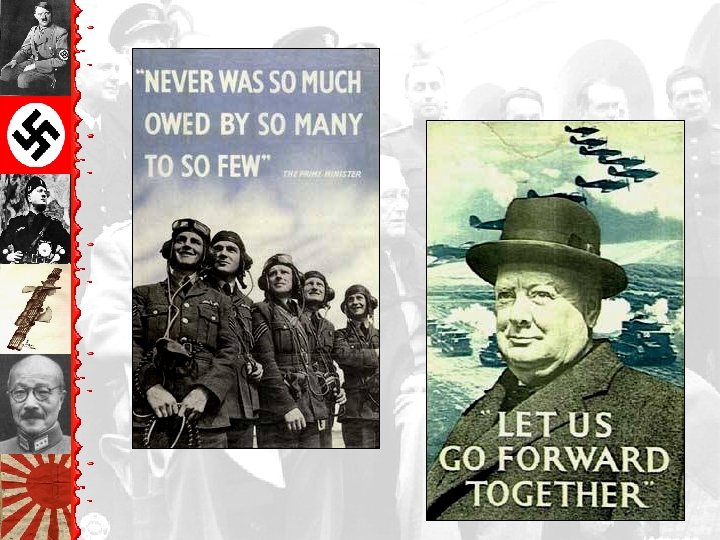
The Battle of Britain • • a series of battles between German and British air forces, fought over Britain (1940 – 1941) = “air war” summer 1940 – the Luftwaffe, Germany’s air force, began bombing Britain September 7, 1940 – focus shifted to bombing cities = London (to break morale) RAF was outnumbered, but continued to strike back hard Technological Devises 1. radar (tell the number, speed, and direction of incoming planes) 2. Enigma (German code-making machine) • • Hitler changed from bombing in daylight to at night Britain remained strong – taught a valuable lesson to the Allies…. Importance: Hitler could be blocked!
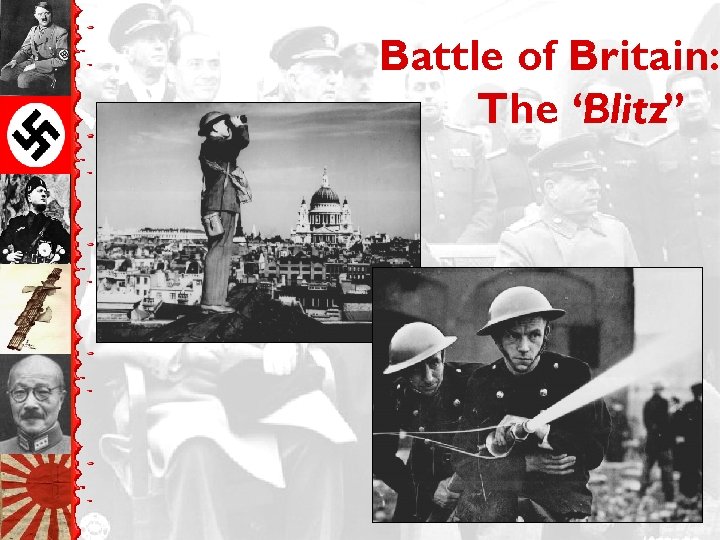
Battle of Britain: The “Blitz”
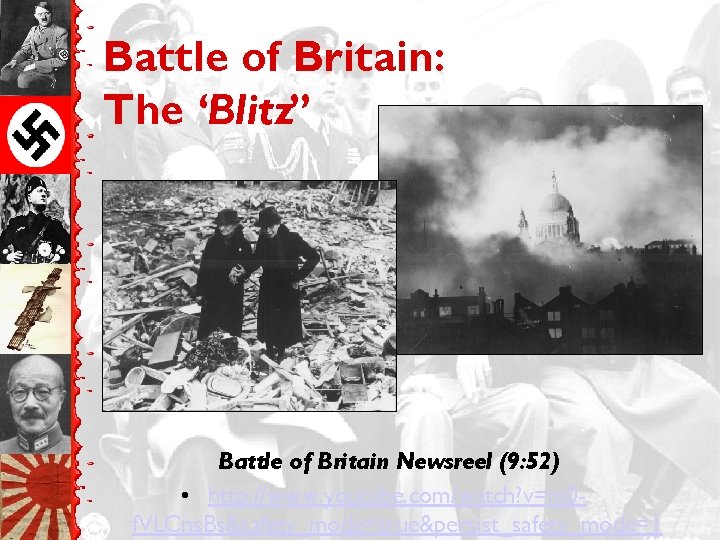
Battle of Britain: The “Blitz” Battle of Britain Newsreel (9: 52) • http: //www. youtube. com/watch? v=m 0 f. VLCns. Bs&safety_mode=true&persist_safety_mode=1
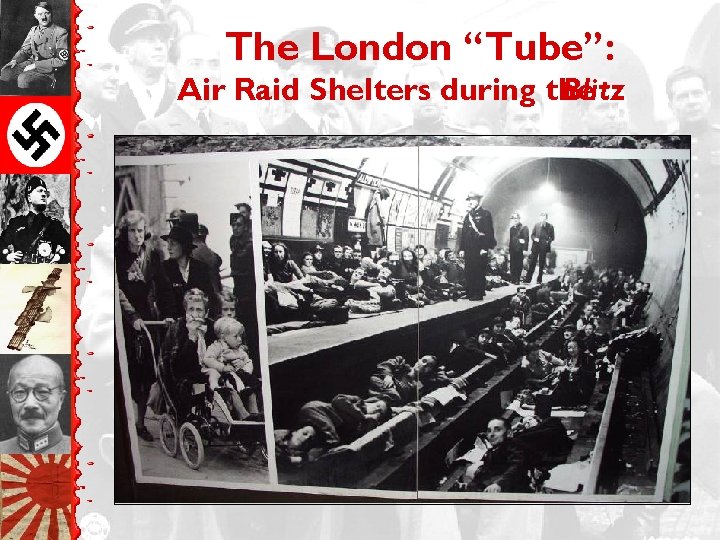
The London “Tube”: Air Raid Shelters during the Blitz
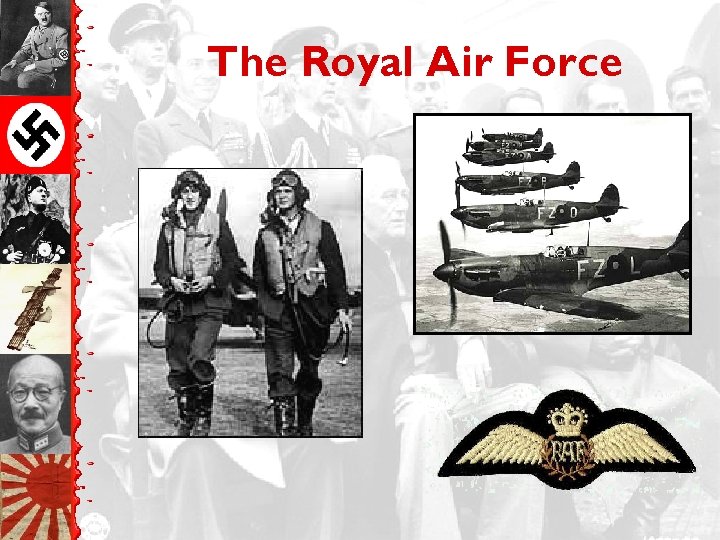
The Royal Air Force
The Mediterranean and the Eastern Front • the resistance of the Battle of Britain caused a shift in Hitler’s strategy in Europe • Hitler turns his attention east to: - Mediterranean area - Balkans - Soviet Union (ultimate prize)
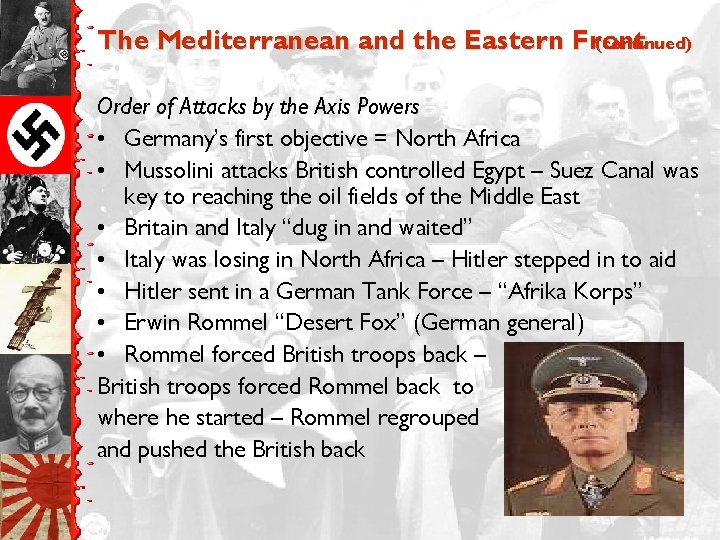
The Mediterranean and the Eastern Front (continued) Order of Attacks by the Axis Powers • Germany’s first objective = North Africa • Mussolini attacks British controlled Egypt – Suez Canal was key to reaching the oil fields of the Middle East • Britain and Italy “dug in and waited” • Italy was losing in North Africa – Hitler stepped in to aid • Hitler sent in a German Tank Force – “Afrika Korps” • Erwin Rommel “Desert Fox” (German general) • Rommel forced British troops back – British troops forced Rommel back to where he started – Rommel regrouped and pushed the British back
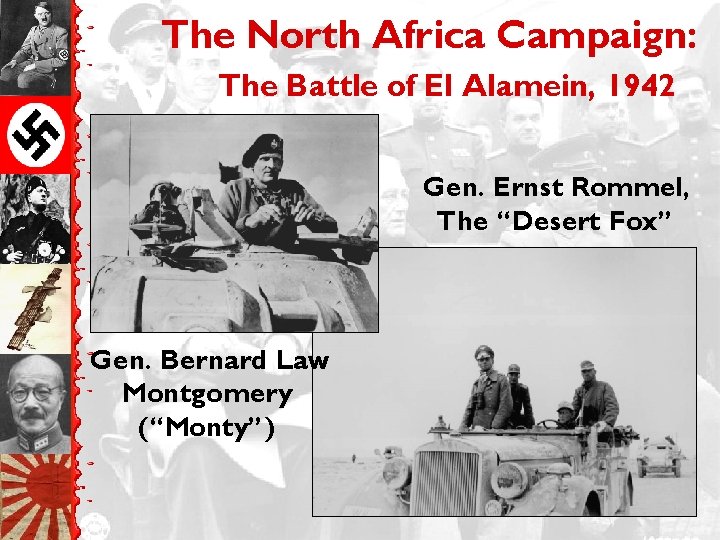
The North Africa Campaign: The Battle of El Alamein, 1942 Gen. Ernst Rommel, The “Desert Fox” Gen. Bernard Law Montgomery (“Monty”)
The Mediterranean and the Eastern Front (continued) Order of Attacks by the Axis Powers • Rommel is in North Africa, other German generals were active in the Balkans • summer 1940 -Hitler had begun planning to attack his ally………. the USSR • 1941 Hitler convinces Bulgaria, Romania, and Hungary to join the Axis powers • Yugoslavia and Greece = pro-British governments • April 1941 – Hitler invades both countries • with the Balkans firmly in control, Hitler moved ahead with Operation Barbarossa
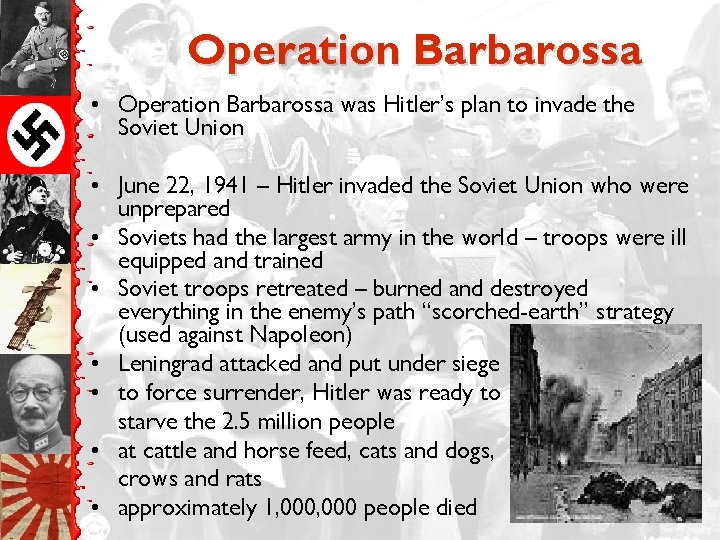
Operation Barbarossa • Operation Barbarossa was Hitler’s plan to invade the Soviet Union • June 22, 1941 – Hitler invaded the Soviet Union who were unprepared • Soviets had the largest army in the world – troops were ill equipped and trained • Soviet troops retreated – burned and destroyed everything in the enemy’s path “scorched-earth” strategy (used against Napoleon) • Leningrad attacked and put under siege • to force surrender, Hitler was ready to starve the 2. 5 million people • at cattle and horse feed, cats and dogs, crows and rats • approximately 1, 000 people died
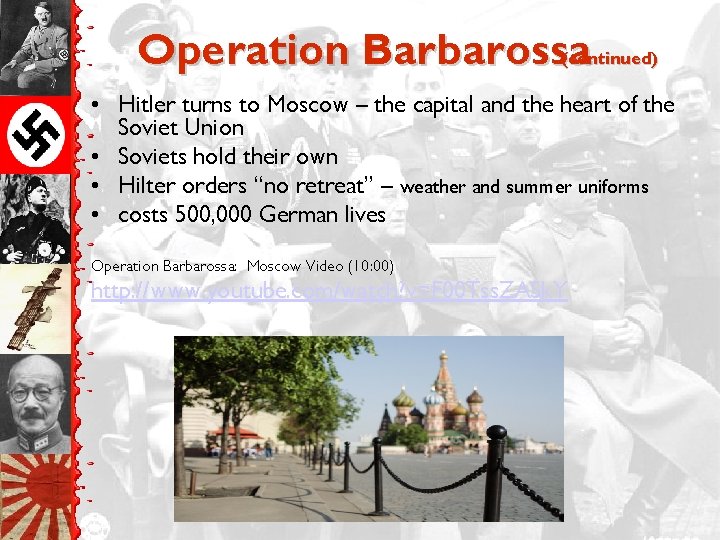
Operation Barbarossa (continued) • Hitler turns to Moscow – the capital and the heart of the Soviet Union • Soviets hold their own • Hilter orders “no retreat” – weather and summer uniforms • costs 500, 000 German lives Operation Barbarossa: Moscow Video (10: 00) http: //www. youtube. com/watch? v=F 00 Tss. ZASk. Y
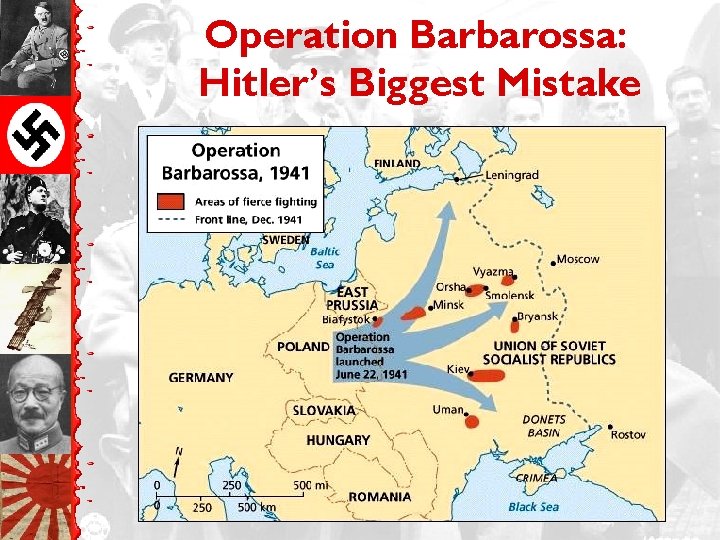
Operation Barbarossa: Hitler’s Biggest Mistake
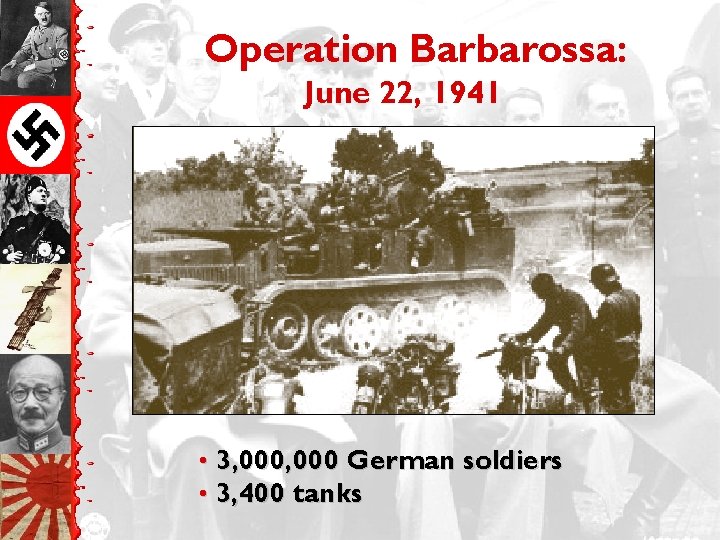
Operation Barbarossa: June 22, 1941 • 3, 000 German soldiers • 3, 400 tanks
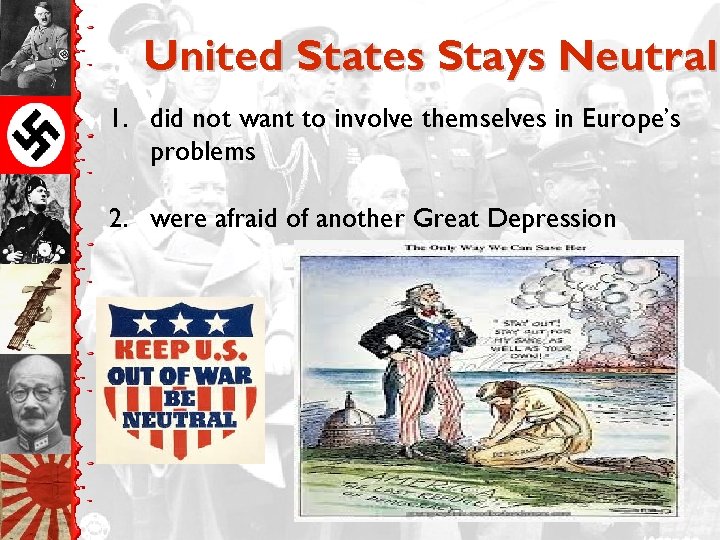
United States Stays Neutral 1. did not want to involve themselves in Europe’s problems 2. were afraid of another Great Depression
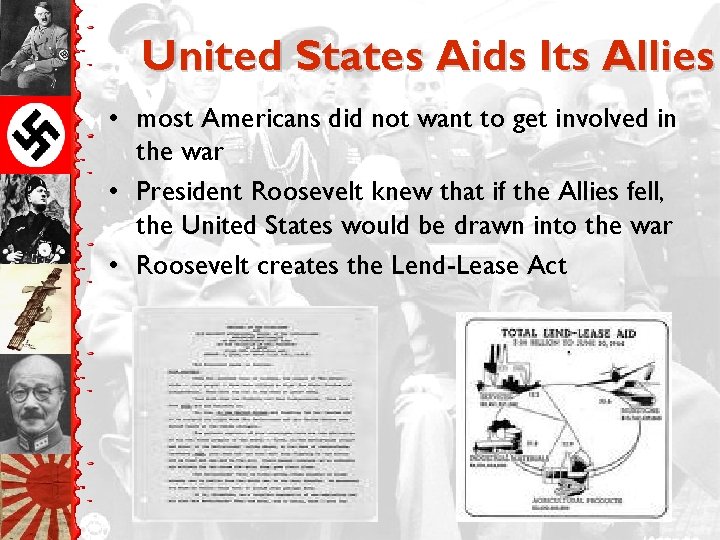
United States Aids Its Allies • most Americans did not want to get involved in the war • President Roosevelt knew that if the Allies fell, the United States would be drawn into the war • Roosevelt creates the Lend-Lease Act

Lend-Lease Act • Lend-Lease Policy the U. S. president would lend or lease arms and other supplies to “any country whose defense was vital to the United States”

Lend-Lease Act Benefits to the United States 1. enriched the U. S. economy = arms 2. lent troops in exchange for European goods 3. allowed Allies to purchase food and medicine
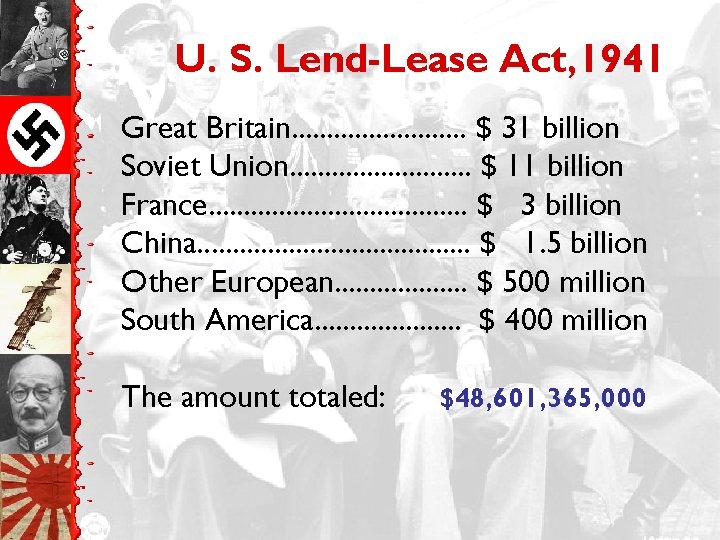
U. S. Lend-Lease Act, 1941 Great Britain. . . $ 31 billion Soviet Union. . . $ 11 billion France. . . . . $ 3 billion China. . . . . $ 1. 5 billion Other European. . . . . $ 500 million South America. . . . . $ 400 million The amount totaled: $48, 601, 365, 000
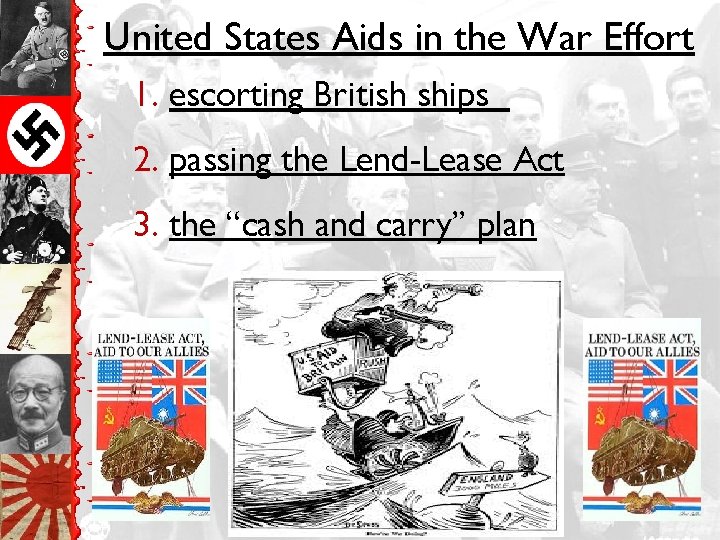
United States Aids in the War Effort 1. escorting British ships 2. passing the Lend-Lease Act 3. the “cash and carry” plan
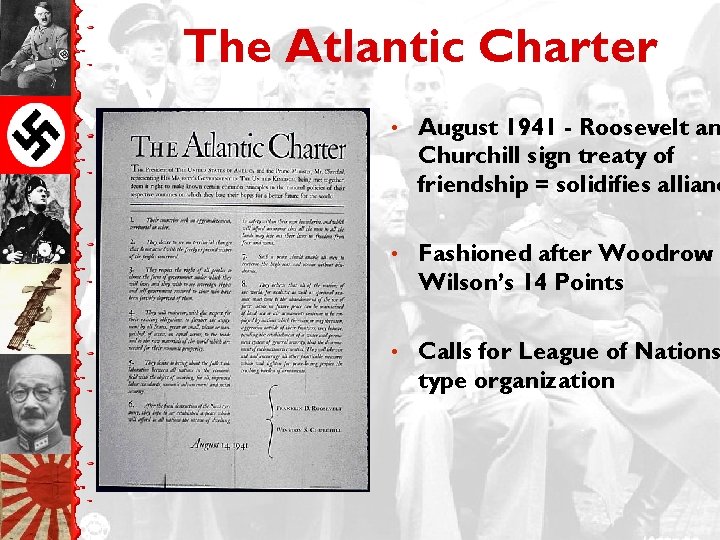
The Atlantic Charter • August 1941 - Roosevelt an Churchill sign treaty of friendship = solidifies allianc • Fashioned after Woodrow Wilson’s 14 Points • Calls for League of Nations type organization
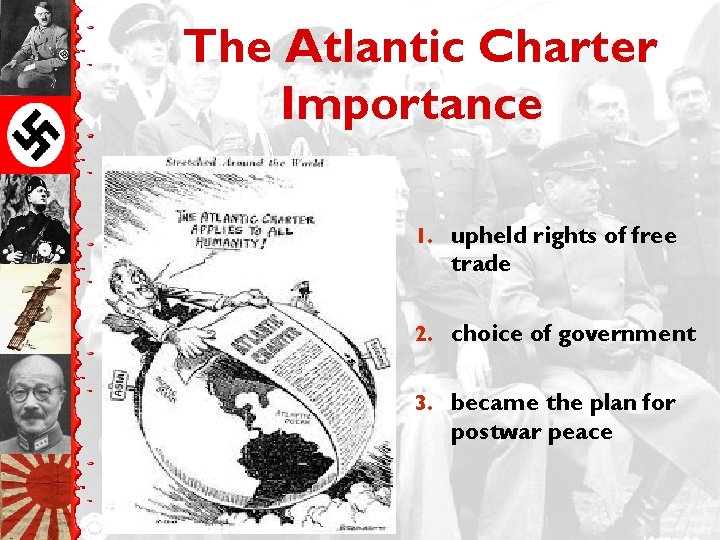
The Atlantic Charter Importance 1. upheld rights of free trade 2. choice of government 3. became the plan for postwar peace
Essential Question What factors do you think a country’s leaders consider when deciding whether to surrender or fight? Write three complete sentences in the summary location on your note sheet
World War II Objective Analyze the causes and results of World War II
- Slides: 75