
World War II Cause Course I First Steps
- Slides: 38
World War II Cause & Course
I. First Steps of Nazi Aggression Hitler & most Germans believed the Treaty of Versailles to be humiliating & the cause of Germany’s economic problems Hitler slyly convinced Germans with his rage and rants, arousing fear & nationalism In 1935, Hitler openly rearmed: Air force & military France, Great Britain, & Italy condemned Germany, but no action by League of Nations Warnings were made but Great Depression caused internal problems
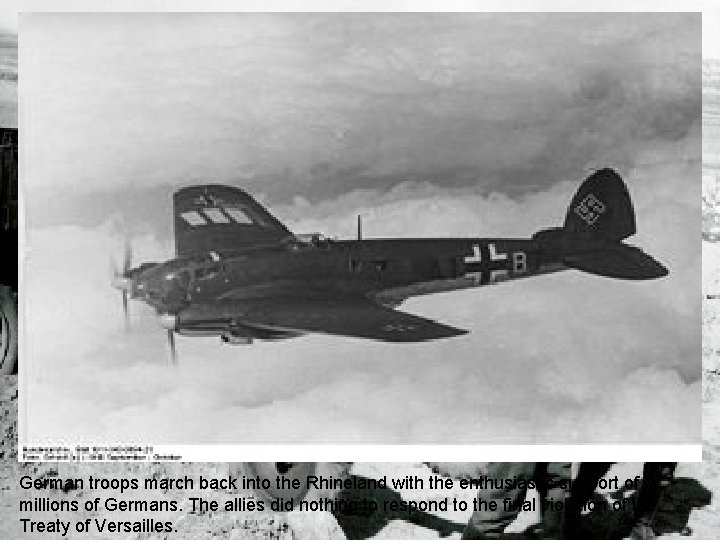
The Heinkel He 111, one of the technologically-advanced aircraft that were designed and produced illegally in the early 1930 s as part of the clandestine German re-armament
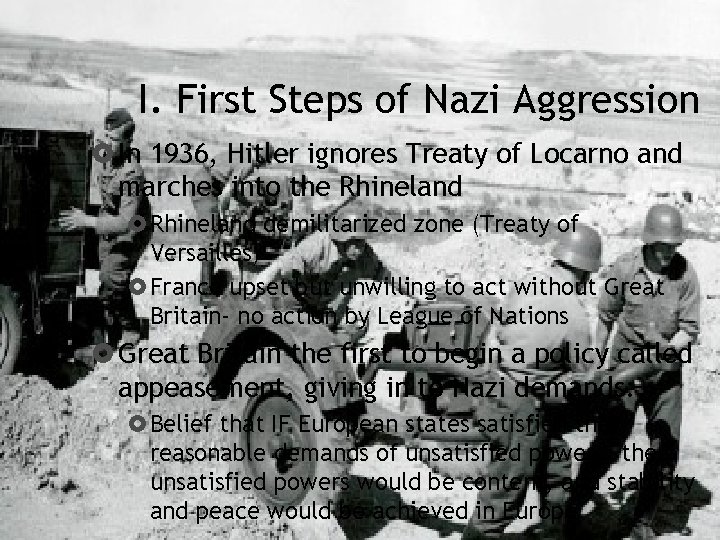
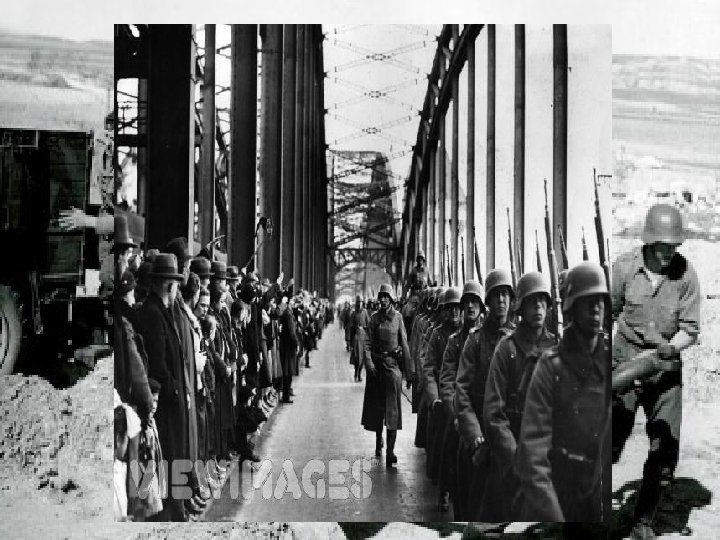
I. First Steps of Nazi Aggression In 1936, Hitler ignores Treaty of Locarno and marches into the Rhineland demilitarized zone (Treaty of Versailles) France upset but unwilling to act without Great Britain- no action by League of Nations Great Britain the first to begin a policy called appeasement, giving in to Nazi demands: Belief that IF European states satisfied the reasonable demands of unsatisfied powers, the unsatisfied powers would be content, and stability and peace would be achieved in Europe
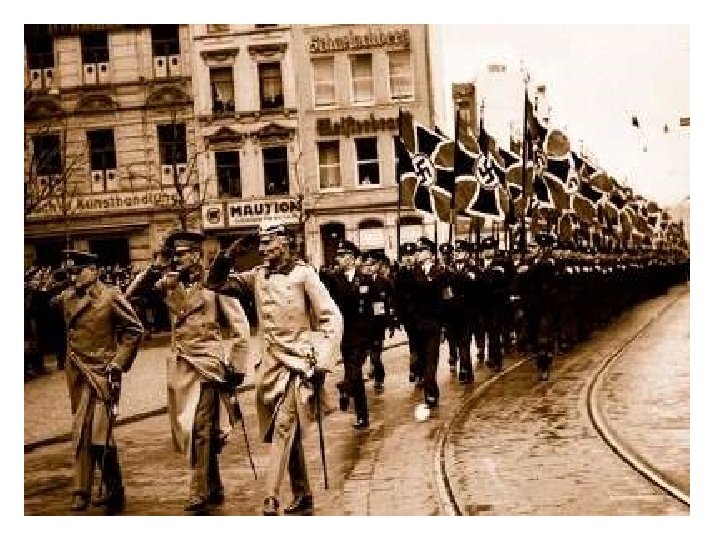
German troops march back into the Rhineland with the enthusiastic support of millions of Germans. The allies did nothing to respond to the final violation of the Treaty of Versailles.
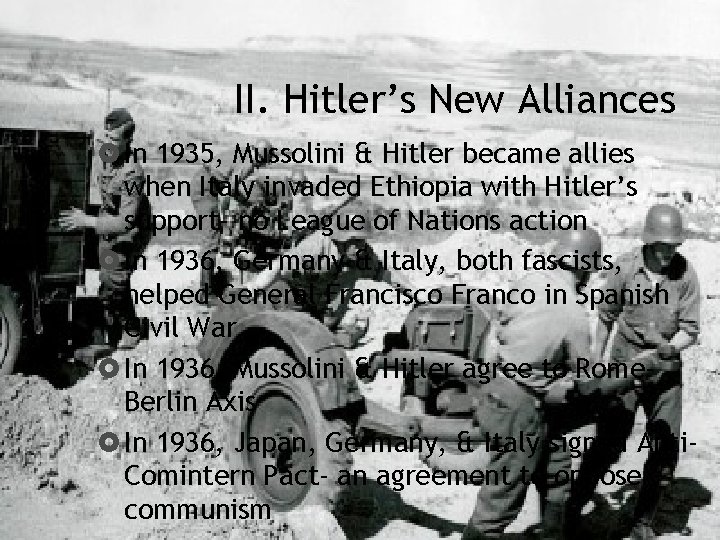
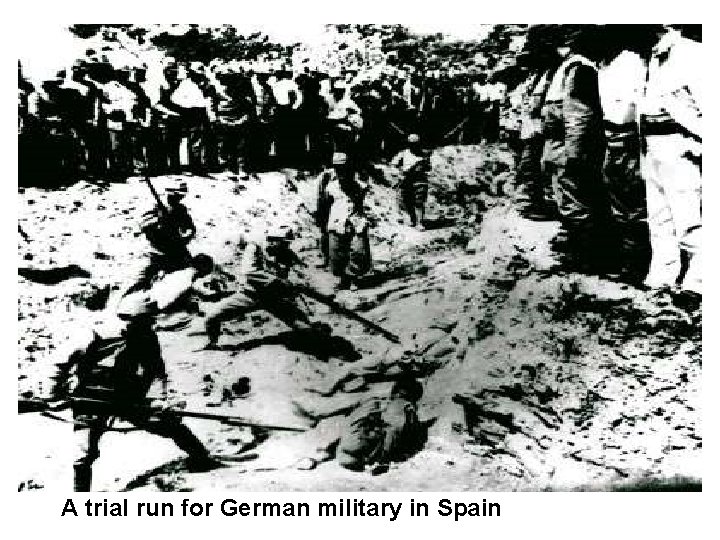
II. Hitler’s New Alliances In 1935, Mussolini & Hitler became allies when Italy invaded Ethiopia with Hitler’s support- no League of Nations action In 1936, Germany & Italy, both fascists, helped General Francisco Franco in Spanish Civil War In 1936, Mussolini & Hitler agree to Rome. Berlin Axis In 1936, Japan, Germany, & Italy signed Anti. Comintern Pact- an agreement to oppose communism
A trial run for German military in Spain
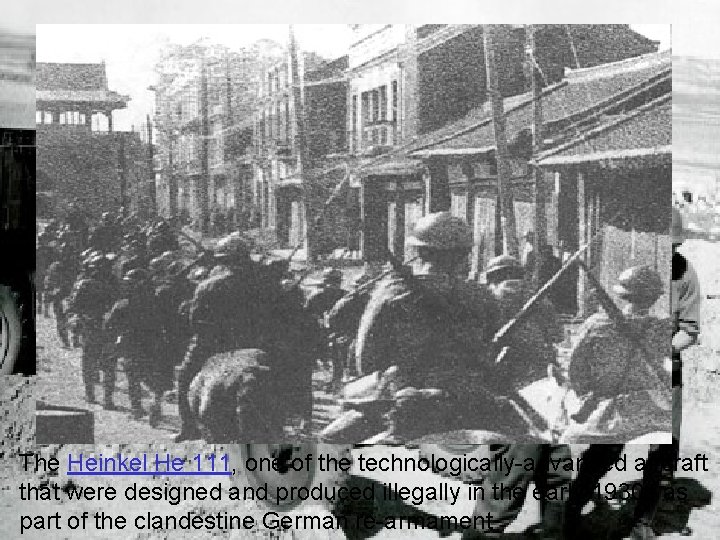
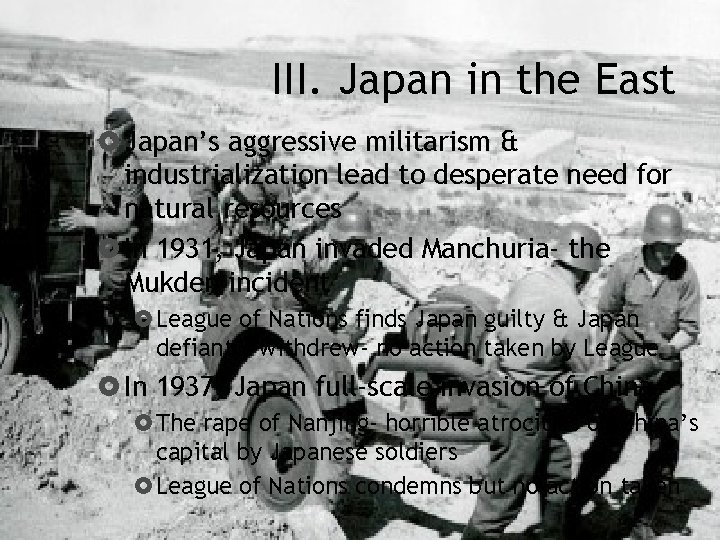
III. Japan in the East Japan’s aggressive militarism & industrialization lead to desperate need for natural resources In 1931, Japan invaded Manchuria- the Mukden incident League of Nations finds Japan guilty & Japan defiantly withdrew- no action taken by League In 1937, Japan full-scale invasion of China The rape of Nanjing- horrible atrocities on China’s capital by Japanese soldiers League of Nations condemns but no action taken
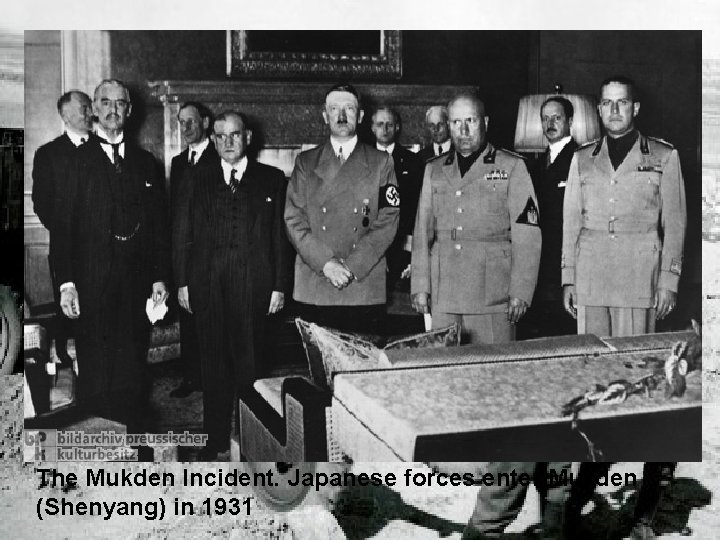
The Mukden Incident. Japanese forces enter Mukden (Shenyang) in 1931
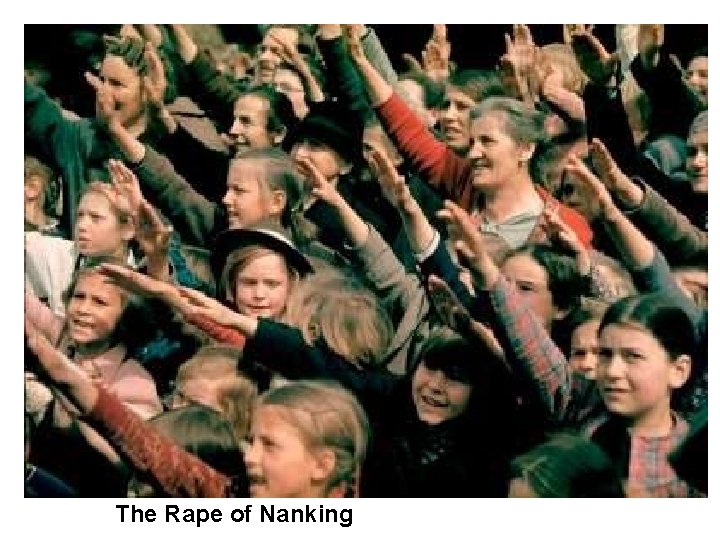
The Rape of Nanking
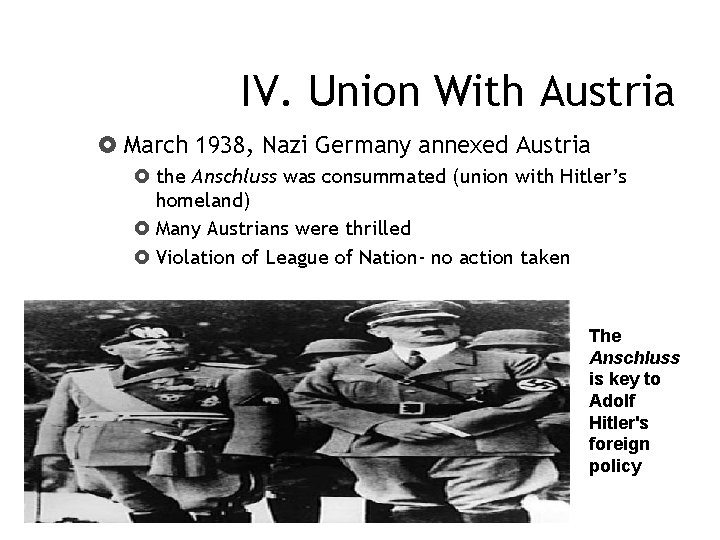
IV. Union With Austria March 1938, Nazi Germany annexed Austria the Anschluss was consummated (union with Hitler’s homeland) Many Austrians were thrilled Violation of League of Nation- no action taken The Anschluss is key to Adolf Hitler's foreign policy
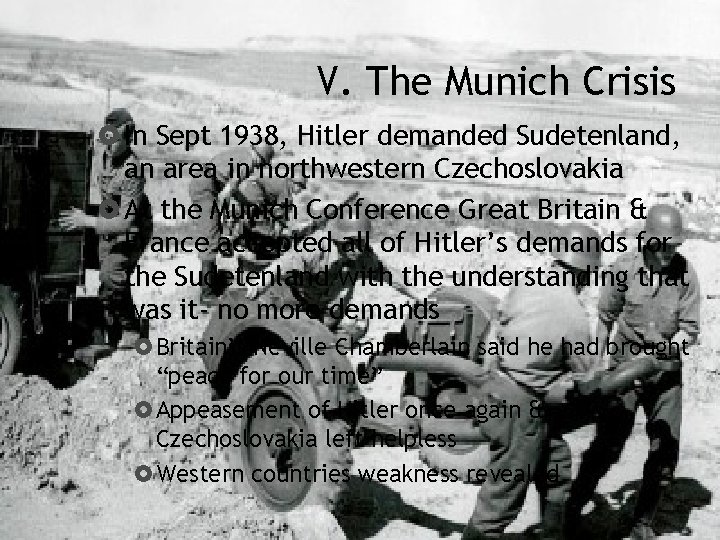
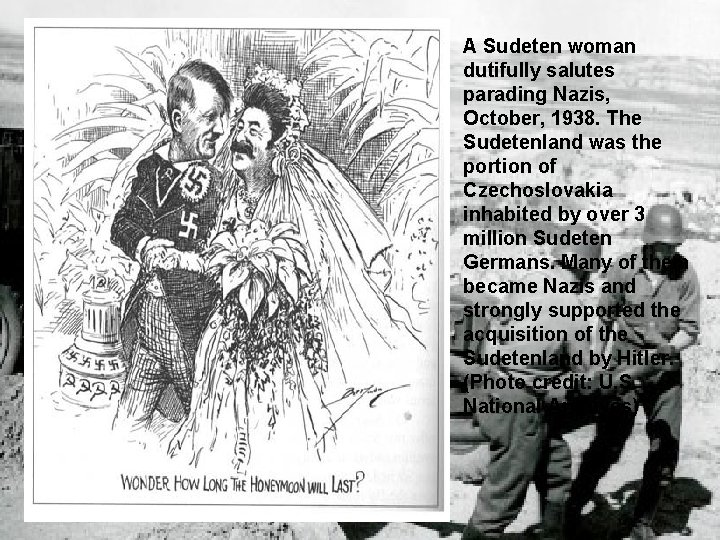
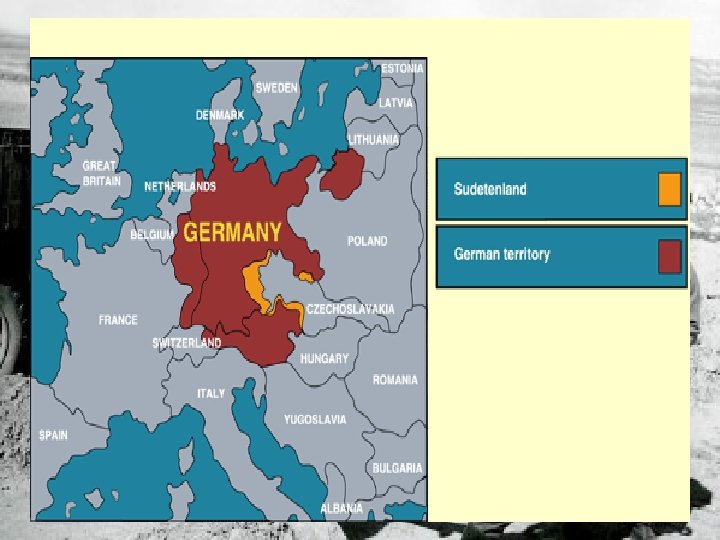
V. The Munich Crisis In Sept 1938, Hitler demanded Sudetenland, an area in northwestern Czechoslovakia At the Munich Conference Great Britain & France accepted all of Hitler’s demands for the Sudetenland with the understanding that was it- no more demands Britain’s Neville Chamberlain said he had brought “peace for our time” Appeasement of Hitler once again & Czechoslovakia left helpless Western countries weakness revealed
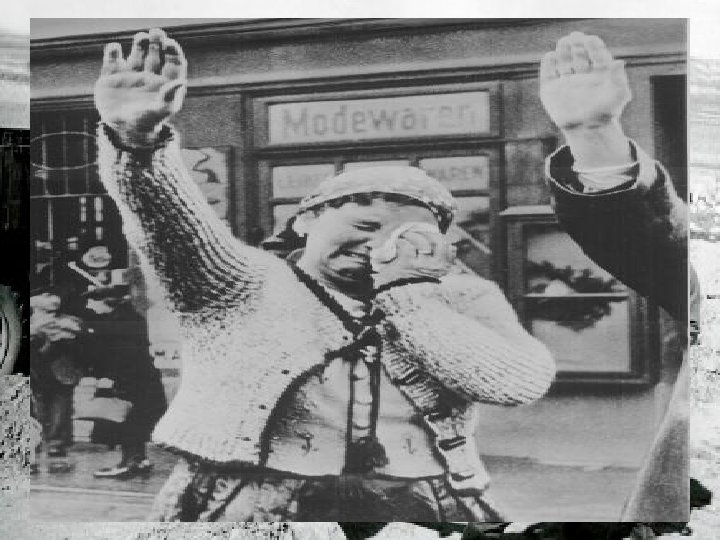
A Sudeten woman dutifully salutes parading Nazis, October, 1938. The Sudetenland was the portion of Czechoslovakia inhabited by over 3 million Sudeten Germans. Many of them became Nazis and strongly supported the acquisition of the Sudetenland by Hitler. (Photo credit: U. S. National Archives)
VI. The End of Appeasement In March 1939, Hitler invaded western Czechoslovakia Western states began to understand Hitler could not be appeased They began to prepare for war & vowed to protect Poland Britain tried to form an anti-German alliance with the USSR
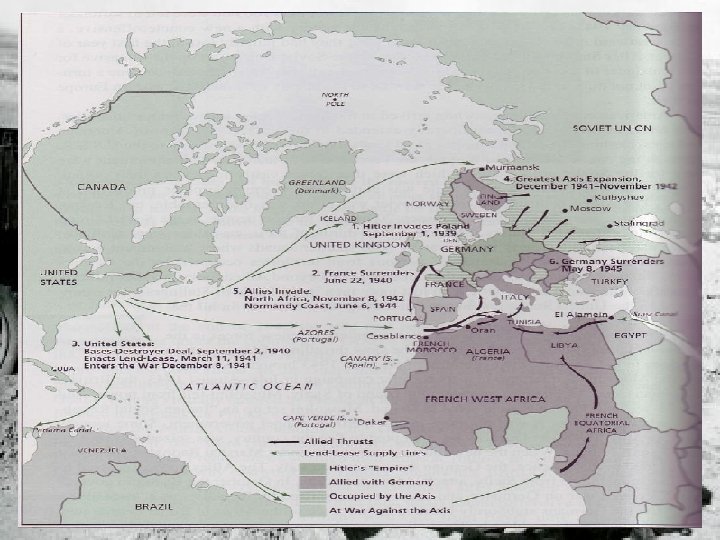
VII. The Nazi-Soviet Pact Stalin unhappy with intentions of Western Powers signed the Nazi-Soviet Nonaggression Pact with Hitler (Aug 1939) Promised not to attack each other… : ) Split Poland Germans invaded Poland Sept 1, 1939 Great Britain & France declared war on Germany Sept 3 and World War II officially began Soviets invaded eastern half of Poland fell in 4 weeks
VIII. The German Blitzkreig New style “lightening war” different from trench warfare of WWI 1 million men 300 tanks Supported by Luftwaffe or air force Fast moving
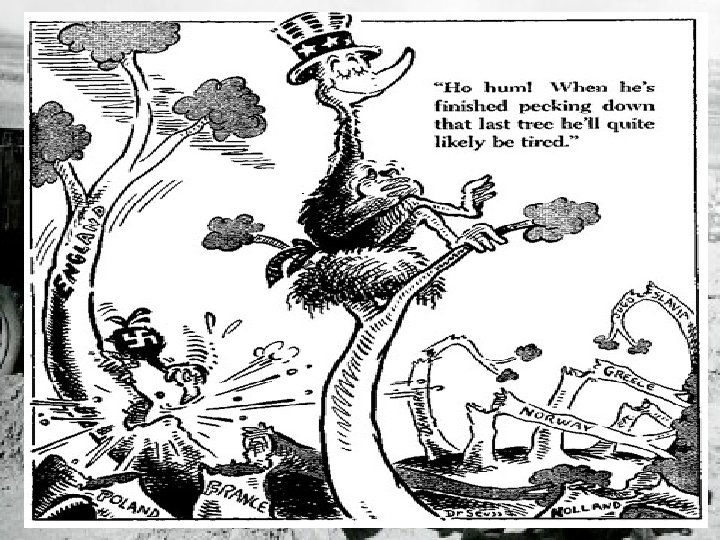
VIII. The German Blitzkreig Germany continued: In April 1940 attacked Norway & Denmark In May 1940 attacked Netherlands, Belgium, Luxembourg, & France British & French troops were almost trapped on the beaches of Dunkirk but evacuated 330, 000 troops just in time By late June, France signed armistice with Germany http: //news. bbc. co. uk/1/shared/spl/hi /europe/02/euro_borders/html/5. stm
IX. American Aid Winston Churchill elected Prime Minister in 1940 & asked for America’s help America had a policy of neutrality from WWI (isolationist), but interventionists like President Roosevelt convinced Congress & America to help supply the democratic Allies Ships Arms Food Natural resources Debt
X. The Battle of Britain Hitler’s plan: 1 st by air then sea & land German’s Luftwaffe bombed British military targets, but British radar improved & civilians never gave up Hitler retaliated to a British attack on Berlin by shifting attacks from military targets to British cities- costly decision End of 1940 -1941, Hitler postponed the invasion of Britain to focus on USSR
XI. The Nazi Invasion of Russia Nazi-Soviet Pact of 1939 was only meant to buy time- never BFF Hitler believed Soviets easily defeated Invaded the Soviet Union in June 1941 surprised Stalin Initial success ended with early winter Germans had no winter uniforms Russians began “scorched earth” policy from war with Napoleon Hitler’s forces began to falter
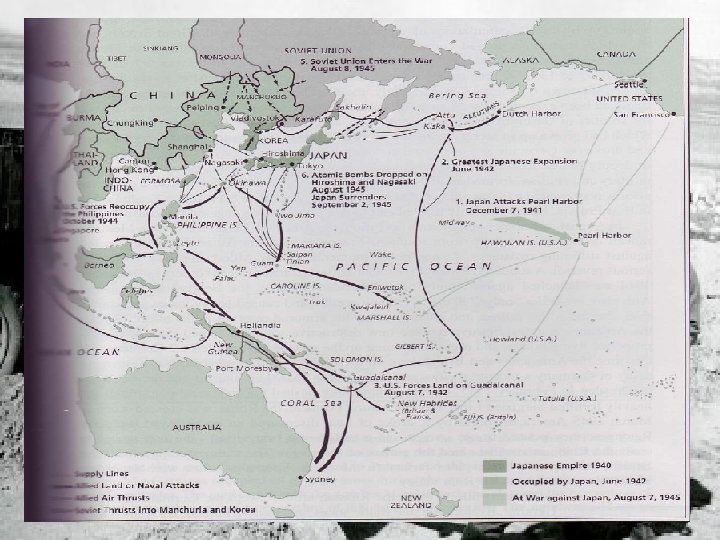
XII. Japanese Path to War Japanese Plan A- to seize Soviet Siberia for natural resources Nazi-Soviet Nonaggression Pact forced Japanese to rethink plan Plan B- expand into Southeast Asia Region already colonized by European Powers & the U. S. tried to stop Japanese expansion with economic sanctions Japanese desperately needed American oil & metal
XII. Japanese Path to War New Japanese prime minister, General Hideki Tojo publicly proclaimed that British & U. S. influence in Asia should be eliminated December 7, 1941, without warning, Japan bombed Pearl Harbor Hawaii & invaded the Philippines “A day that will live in infamy…” U. S. & Britain declared war on Japan Dec 8 3 days later the other major Axis Powers (Germany & Italy) declared war on the U. S. Japan hoped the U. S. would give up
XIII. Alliances 1942 -1943 Grand Alliance- 26 nations- Great powers were Great Britain, U. S. , & the USSR- allied together against the Axis Powers until unconditional surrender- they agreed to form the United Nations The Axis Powers- Germany, Italy, & Japan, etc.
XIV. Battle of Stalingrad Major industrial center Hitler made all-out attack of quarter million Nazis Russians rallied and encircled the Nazis who were forced to surrender- turning point of war German Sixth Army (Hitler’s best) was lost By end of 1943 even Hitler knew there would be no defeat of the Soviet Union Huge casualties both military & civilianlargest of war German’s murdered “undesirable” people or non. Germans
XV. The Battle of Midway & the Pacific Midway Island, June 1942 was the turning point in Asia U. S. destroyed Japanese aircraft carriers & navy Fall 1942, U. S. general Douglas Mac. Arthur began “island hopping” up to Japan
XVI. The Invasion of Europe Summer 1943, America, Britain, & Canada conquered Mussolini from the south He shortly ruled northern Italy April 1945 Mussolini was captured & murdered by anti-Facist Italians while trying to flee June 6, 1944 - D-Day- led by general Dwight Eisenhower landed on the beaches of Normandy By Jan 1945 Hitler moved into underground bunker in Berlin- war was lost- he continued to blame Jews & he committed suicide on April 30, 1945 Germany officially surrendered May 7, 1945
XVII. The Atomic Bomb Roosevelt died in April 1945 & VP Harry Truman took office as president Tough decision, but he decided to use newly developed atomic weapons Why? He knew an invasion of Japan would be costly & extremely deadly for America Two bombs Hiroshima- Aug 6, 1945 Nagasaki- Aug 9, 1945 Thousands died instantly & thousands more from radiation Emperor Hirohito forced military to surrender on Aug 14, 1945 & WWII was finally over
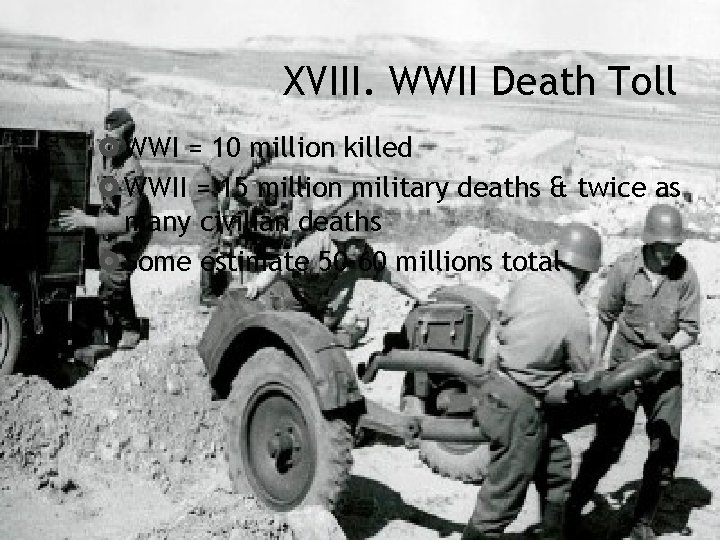
XVIII. WWII Death Toll WWI = 10 million killed WWII = 15 million military deaths & twice as many civilian deaths Some estimate 50 -60 millions total
X