
WORLD WAR II By Ethan Lynex INTRODUCTION TO
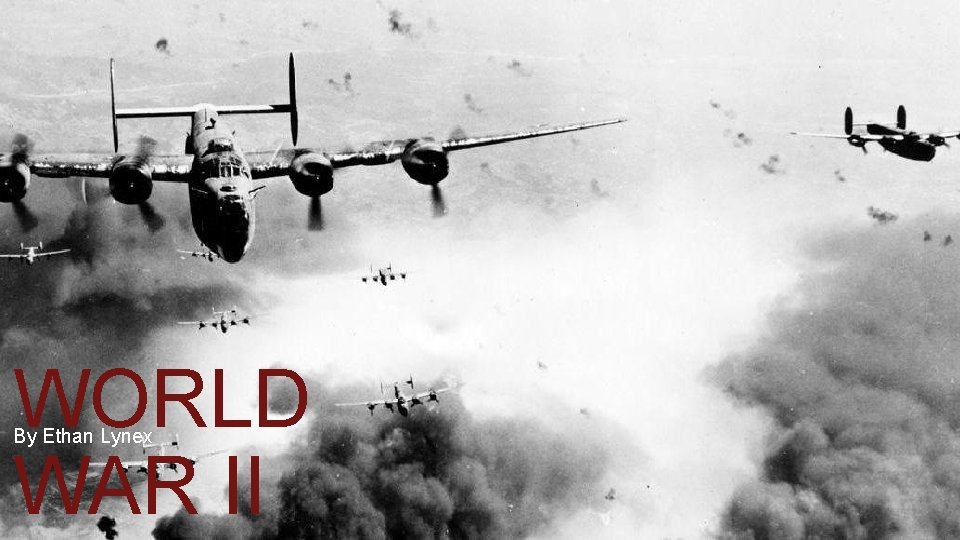
WORLD WAR II By Ethan Lynex
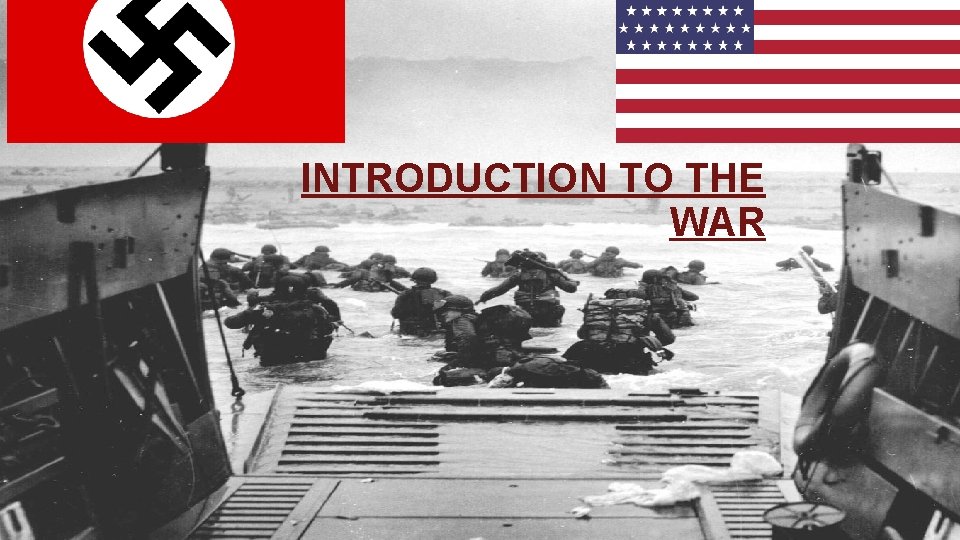
INTRODUCTION TO THE WAR
INTRODUCTION For almost six years from 1939 to 1945 Britain fought the toughest war it had ever experienced. World War II was total war - every person, every business, every service was involved. Britain did not fight alone, the war also involved many countries. World War II involved 61 countries with 1. 7 billion people (three quarters of the world's population). Fifty million people lost their lives and hundreds of millions people were injured.
TIMELINE OF WW 2 1939 September 1 - Germany invades Poland. World War II begins. 1939 September 3 - France and Great Britain declare war on Germany. 1940 April 9 to June 9 - Germany invades and takes control of Denmark and Norway. 1940 May 10 to June 22 - Germany uses quick strikes called blitzkrieg, meaning lightning war, to take over much of western Europe including the Netherlands, Belgium, and northern France. 1940 May 30 - Winston Churchill becomes leader of the British government. • 1940 June 10 - Italy enters the war as a member of the Axis powers. 1940 July 10 - Germany launches an air attack on Great Britain. These attacks last until the end of October and are known as the Battle of Britain. 1940 September 22 - Germany, Italy, and Japan sign the Tripartite Pact creating the Axis Alliance. 1941 June 22 - Germany and the Axis Powers attack Russia with a huge force of over four million troops. 1941 December 7 - The Japanese attack the US Navy in Pearl Harbor. The next day the US enters World War II on the side of the Allies. 1942 June 4 - The US Navy defeats the Japanese navy at the Battle of Midway. 1942 July 10 - The Allies invade and take the island of Sicily. 1943 September 3 - Italy surrenders to the Allies, however Germany helps Mussolini to escape and set up a government in Northern Italy. 1944 June 6 - D-day and the Normandy invasion. Allied forces invade France and push back the Germans. 1944 August 25 - Paris is liberated from German control.

• 1944 December 16 - The Germans launch a large attack in the Battle of the Bulge. They lose to the Allies sealing the fate of the German army. 1945 February 19 - US Marines invade the island of Iwo Jima. After a fierce battle they capture the island. 1945 April 12 - US President Franklin Roosevelt dies. He is succeeded by President Harry Truman. 1945 March 22 - The US Third Army under General Patton crosses the Rhine River. 1945 April 30 - Adolf Hitler commits suicide as he knows Germany has lost the war. 1945 May 7 - Germany surrenders to the Allies. 1945 August 6 - The United States drops the Atomic Bomb on Hiroshima, Japan. The city is devastated. 1945 August 9 - Another atomic bomb is dropped on Nagasaki, Japan. 1945 September 2 - Japan surrenders to US General Douglass Mac. Arthur and the Allies.
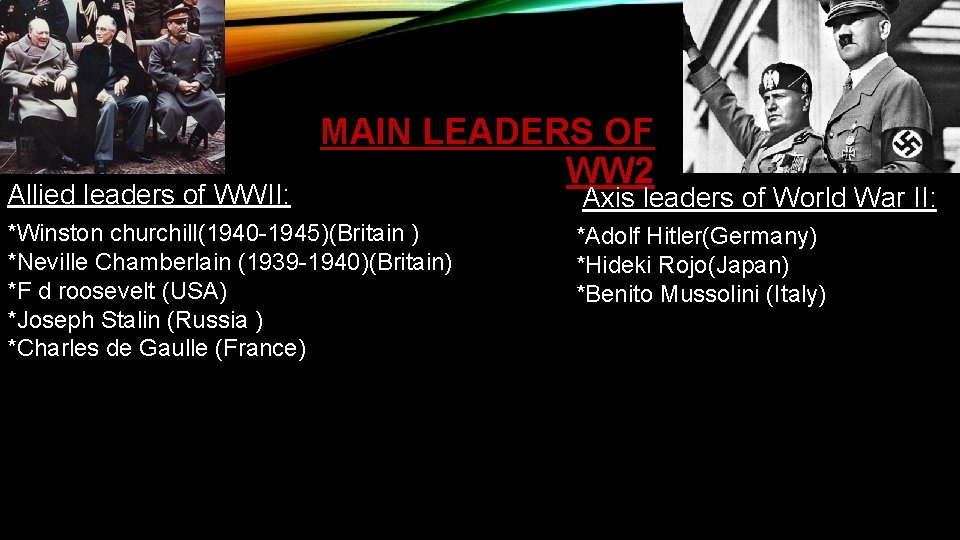
Allied leaders of WWII: MAIN LEADERS OF WW 2 *Winston churchill(1940 -1945)(Britain ) *Neville Chamberlain (1939 -1940)(Britain) *F d roosevelt (USA) *Joseph Stalin (Russia ) *Charles de Gaulle (France) Axis leaders of World War II: *Adolf Hitler(Germany) *Hideki Rojo(Japan) *Benito Mussolini (Italy)
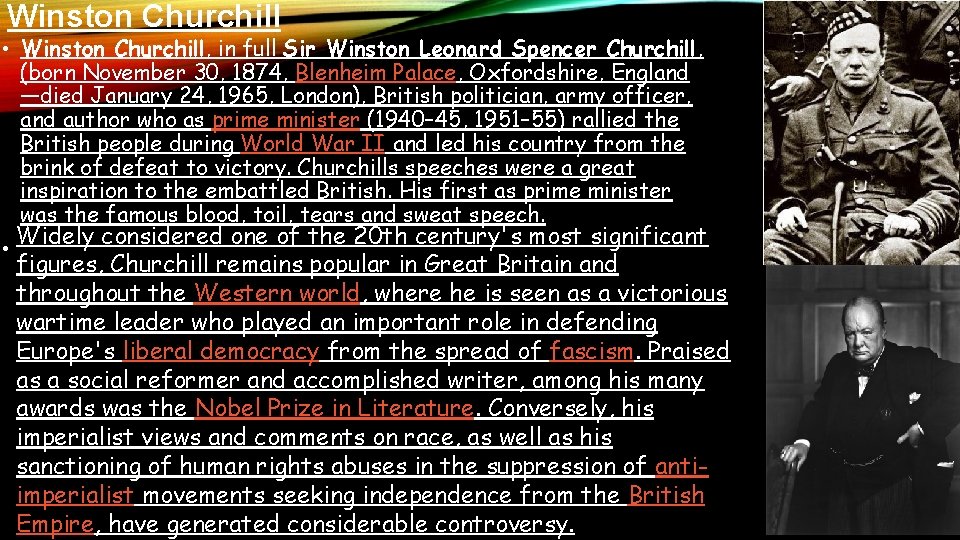
Winston Churchill • Winston Churchill, in full Sir Winston Leonard Spencer Churchill, (born November 30, 1874, Blenheim Palace, Oxfordshire, England —died January 24, 1965, London), British politician, army officer, and author who as prime minister (1940– 45, 1951– 55) rallied the British people during World War II and led his country from the brink of defeat to victory. Churchills speeches were a great inspiration to the embattled British. His first as prime minister was the famous blood, toil, tears and sweat speech. • Widely considered one of the 20 th century's most significant figures, Churchill remains popular in Great Britain and throughout the Western world, where he is seen as a victorious wartime leader who played an important role in defending Europe's liberal democracy from the spread of fascism. Praised as a social reformer and accomplished writer, among his many awards was the Nobel Prize in Literature. Conversely, his imperialist views and comments on race, as well as his sanctioning of human rights abuses in the suppression of antiimperialist movements seeking independence from the British Empire, have generated considerable controversy.
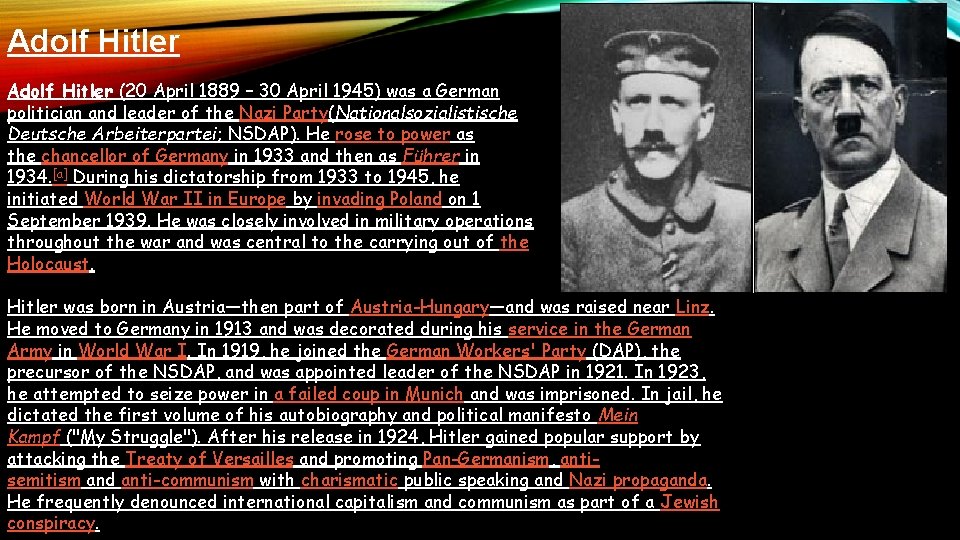
Adolf Hitler (20 April 1889 – 30 April 1945) was a German politician and leader of the Nazi Party(Nationalsozialistische Deutsche Arbeiterpartei; NSDAP). He rose to power as the chancellor of Germany in 1933 and then as Führer in 1934. [a] During his dictatorship from 1933 to 1945, he initiated World War II in Europe by invading Poland on 1 September 1939. He was closely involved in military operations throughout the war and was central to the carrying out of the Holocaust. Hitler was born in Austria—then part of Austria-Hungary—and was raised near Linz. He moved to Germany in 1913 and was decorated during his service in the German Army in World War I. In 1919, he joined the German Workers' Party (DAP), the precursor of the NSDAP, and was appointed leader of the NSDAP in 1921. In 1923, he attempted to seize power in a failed coup in Munich and was imprisoned. In jail, he dictated the first volume of his autobiography and political manifesto Mein Kampf ("My Struggle"). After his release in 1924, Hitler gained popular support by attacking the Treaty of Versailles and promoting Pan-Germanism, antisemitism and anti-communism with charismatic public speaking and Nazi propaganda. He frequently denounced international capitalism and communism as part of a Jewish conspiracy.
GROUND WARFARE • Ground warfare or land warfare is the process of military operation resulting in combat that take place predominantly on the battlespace land surface of the planet. • Land warfare is categorized by the use of large numbers of combat personnel employing a diverse set of combat skills, methods and a wide variety of weapon systems and equipment, conducted in diverse terrains and weather environments. Land warfare, by the virtue of being conducted in defence of urban and rural population areas, dominates the study of war, and is a focus for most national defence policyplanning and financial considerations. • Land warfare in history has undergone several distinct transitions in conduct from large concentration of largely untrained and irregularly armed populace used in frontal assaults to current employment of combined arms concepts with highly trained regular troops using a wide variety of organisational, weapon and information systems, and employing a variety of strategic, operational and tactical doctrines. • Although the land combat in the past was conducted by the Combat Arms of the armed forces, since the Second World War it has largely involved three distinct types of combat units: Infantry, Armour and Artillery. These arms, since the Age of Sail, have used amphibious warfare concepts and methods to project power from the seas and oceans, and since the wide introduction of military transport aircraft and helicopters have used airborne forces and vertical envelopment to the variety of doctrines used to prosecute warfare on land.
AERIAL WARFARE • Aerial warfare is the battlespace use of military aircraft and other flying machines in warfare. Aerial warfare includes bombers attacking enemy installations or a concentration of enemy troops or strategic targets; fighter aircraft battling for control of airspace; attack aircraftengaging in close air support against ground targets; naval aviation flying against sea and nearby land targets; gliders, helicopters and other aircraft to carry airborne forces such as paratroopers; aerial refueling tankers to extend operation time or range; and military transport aircraft to move cargo and personnel. [1] Historically, military aircraft have included lighter-than-air balloons carrying artillery observers; lighterthan-air airships for bombing cities; various sorts of reconnaissance, surveillance and early warning aircraft carrying observers, cameras and radar equipment; torpedo bombers to attack enemy shipping; and military air-sea rescue aircraft for saving downed airmen. Modern aerial warfare includes missiles and unmanned aerial vehicles. Surface forces are likely to respond to enemy air activity with anti-aircraft warfare.
AMPHIBIOUS WARFARE • Amphibious warfare is a type of offensive military operation that today uses naval ships to project ground air power onto a hostile or potentially hostile shore at a designated landing beach. [1] Through history the operations were conducted using ship's boats as the primary method of delivering troops to shore. Since the Gallipoli Campaign, specialised watercraft were increasingly designed for landing troops, materiel and vehicles, including by landing craft and for insertion of commandos, by fast patrol boats, zodiacs (rigid inflatable boats) and from mini-submersibles. The term amphibious first emerged in the United Kingdom and the United States during the 1930 s with introduction of vehicles such as Vickers-Carden-Loyd Amphibious Tank ordefined the Landing Vehicle Amphibious warfare Light includes operations by their type, purpose, scale and Tracked. means of execution. In the British Empire at the time these were called combined operations which were defined as ". . . operations where naval, military or air forces in any combination are co-operating with each other, working independently under their respective commanders, but with a common strategic object. "[2] All armed forces that employ troops with special training and equipment for conducting landings from naval vessels to shore agree to this definition.
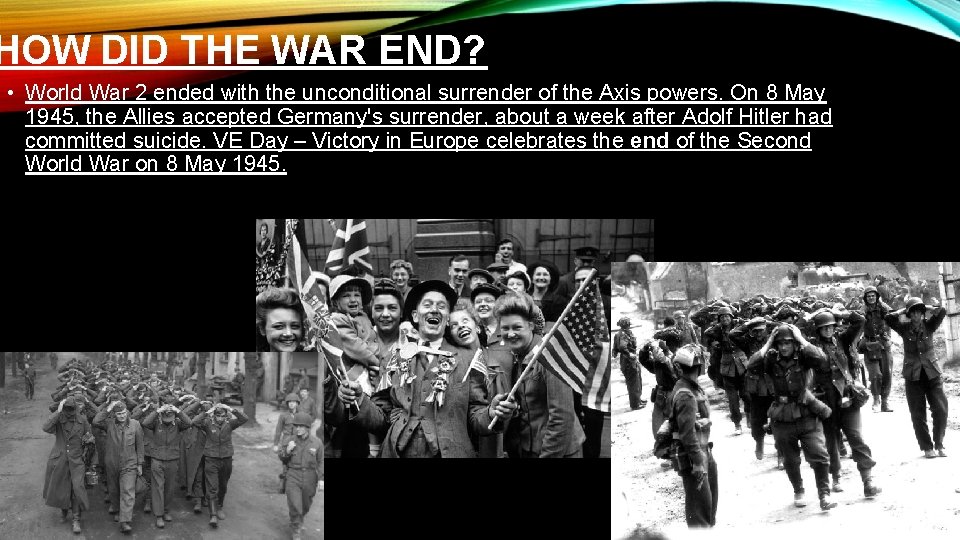
HOW DID THE WAR END? • World War 2 ended with the unconditional surrender of the Axis powers. On 8 May 1945, the Allies accepted Germany's surrender, about a week after Adolf Hitler had committed suicide. VE Day – Victory in Europe celebrates the end of the Second World War on 8 May 1945.

- Slides: 13