
World War II and the Grand Alliance World
- Slides: 9
World War II and the Grand Alliance
World War II: UK, US, and USSR • Britain declared war on Germany Sept. 3 1939 • Operation Barbarossa June 22 1941 • US declared war on Japan Dec. 8 1941 • As the three main countries fighting the Axis powers, what do they have in common? • Despite being on the same side of the war, where did disagreement/tension start to show in relation to the war?
Things to consider. . . • Through Lend-Lease, the US provided $31 billion in aid to Britain and $11 billion to the Soviet Union. – 2015 equivalent: $450 billion and $160 billion • US and UK launched propaganda campaigns to help improve public opinion of the Soviet Union – Uncle Joe • Although all three were at war in 1942, the Soviet Union was holding down the only front in continental Europe.
Atlantic Charter—August 1941 • Roosevelt and Churchill meet at sea of the coast of Newfoundland. • Agree to – oppose all postwar territorial changes that violated the wishes of the population concerned – support democratically elected governments in regions emancipated from German rule – Favor creating international peacekeeping organization to supplant League of Nations • What would USSR think?
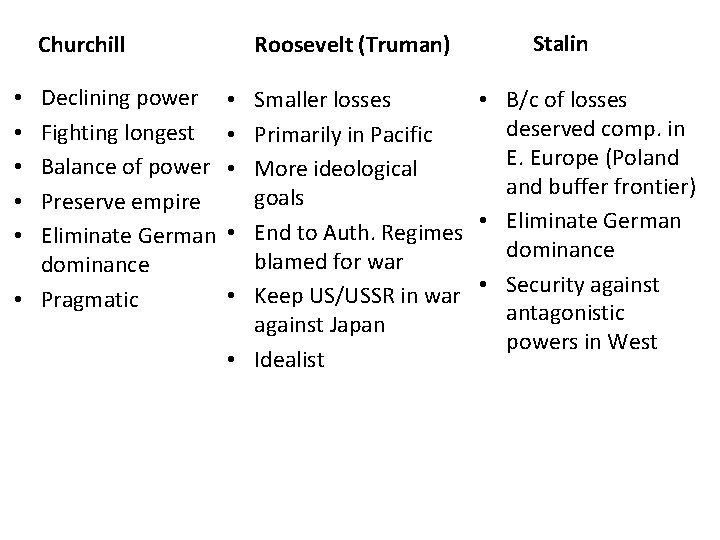
Churchill Declining power Fighting longest Balance of power Preserve empire Eliminate German dominance • Pragmatic • • • Roosevelt (Truman) Stalin • Smaller losses • B/c of losses deserved comp. in • Primarily in Pacific E. Europe (Poland • More ideological and buffer frontier) goals • End to Auth. Regimes • Eliminate German dominance blamed for war • Keep US/USSR in war • Security against antagonistic against Japan powers in West • Idealist
Conferences • • Casablanca—January 1943 Cairo and Teheran—November 1943 Yalta—February 1945 Potsdam—August 1945
Casablanca—January 1943 • Roosevelt and Churchill – Stalin declined b/c Stalingrad, Free French present but minimal role and not in military planning • Objective: coordinate their policies – Tactical procedure, allocation of resources, diplomacy • Advancement of the idea of unconditional surrender to bring about the “destruction of the philosophies in those countries which are based on conquest and subjugation of other people. ” –Roosevelt • Logical progression of Atlantic Charter • Why meet in Casablanca?
Cairo—November 22 -26 1943 • Churchill, Roosevelt, Jiang Jieshi (Chiang Kai-shek) • Objective: boost sagging Chinese morale with continued financial and military support for the nationalists. Discuss war with Japan and future of Asia. • Four Policemen—idea that there would be a dominant power in each main region that would be responsible for keeping the peace in that area. – China would fill the vacuum after defeat of Japan.
• Roosevelt and Jiang shared ideas about China overseeing decolonization and facilitate the onset of a trusteeship system in Asia. – Roosevelt did not want Indo-China to go back to France. – Not supported by UK and eventually dropped. • Cairo Declaration – Continue the war against Japan – Insist upon unconditional surrender – Remove Japan from lands it conquered – Restore Japan to its 1894 frontiers (pre Sino-Japanese war) – Agree to no Allied acquisition of land on mainland Asia or in Pacific Islands