
WORLD WAR II 1939 1945 REVIEW Go through
- Slides: 38
WORLD WAR II 1939 - 1945 REVIEW Go through the Power. Point and answer the questions on the sheet
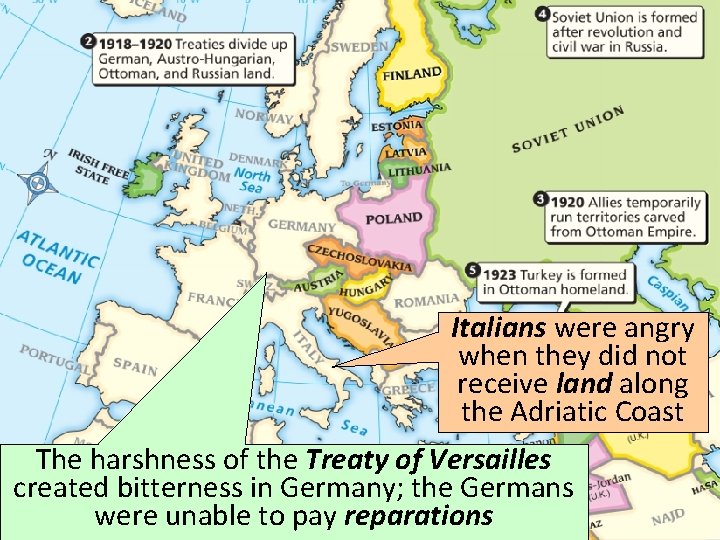
■ Text Italians were angry when they did not receive land along the Adriatic Coast The harshness of the Treaty of Versailles created bitterness in Germany; the Germans were unable to pay reparations
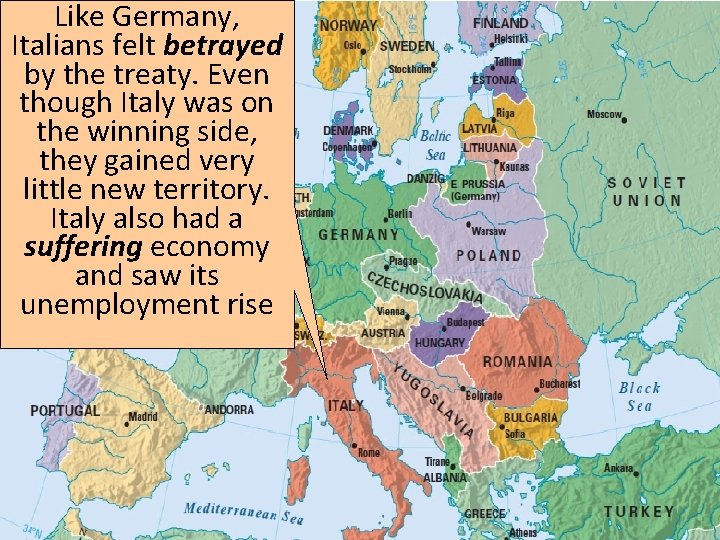
Like Germany, Italians felt betrayed by the treaty. Even though Italy was on the winning side, they gained very little new territory. Italy also had a suffering economy and saw its unemployment rise
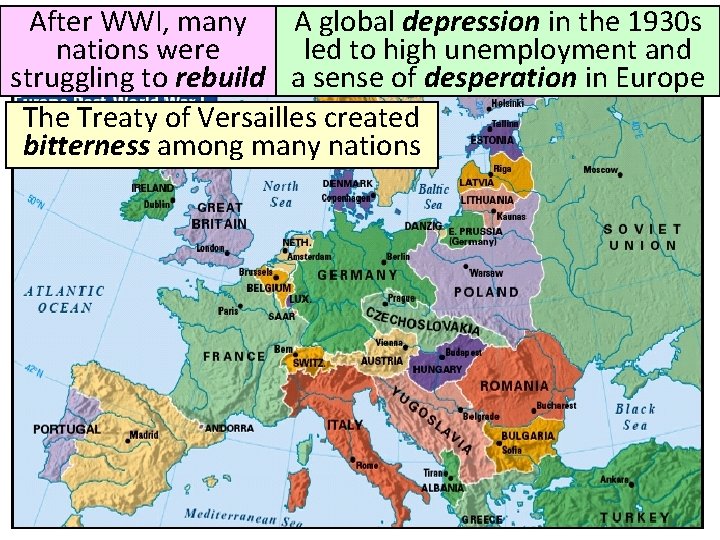
After WWI, many A global depression in the 1930 s nations were led to high unemployment and struggling to rebuild a sense of desperation in Europe The Treaty of Versailles created bitterness among many nations
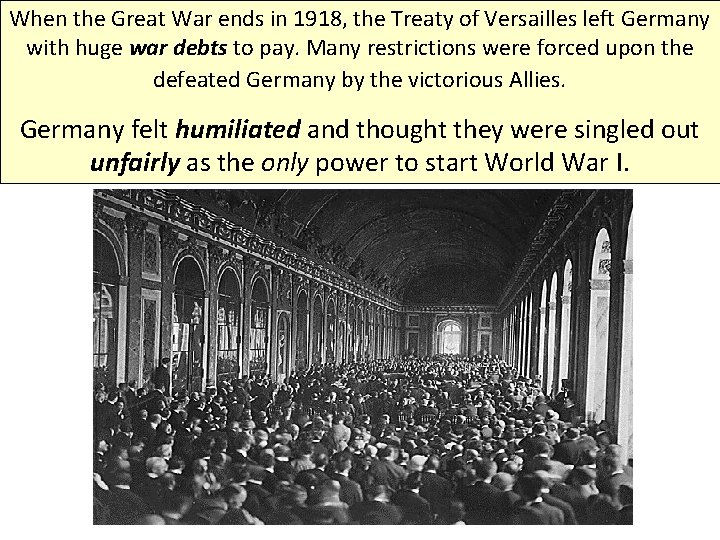
When the Great War ends in 1918, the Treaty of Versailles left Germany with huge war debts to pay. Many restrictions were forced upon the defeated Germany by the victorious Allies. Germany felt humiliated and thought they were singled out unfairly as the only power to start World War I.
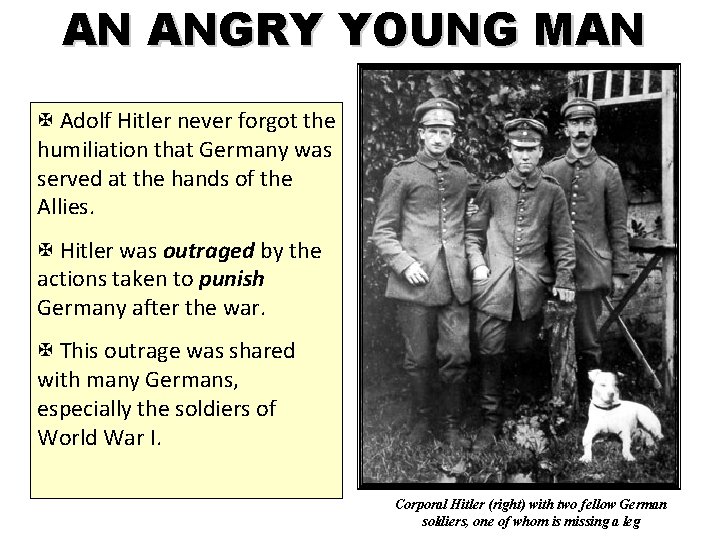
AN ANGRY YOUNG MAN X Adolf Hitler never forgot the humiliation that Germany was served at the hands of the Allies. X Hitler was outraged by the actions taken to punish Germany after the war. X This outrage was shared with many Germans, especially the soldiers of World War I. Corporal Hitler (right) with two fellow German soldiers, one of whom is missing a leg
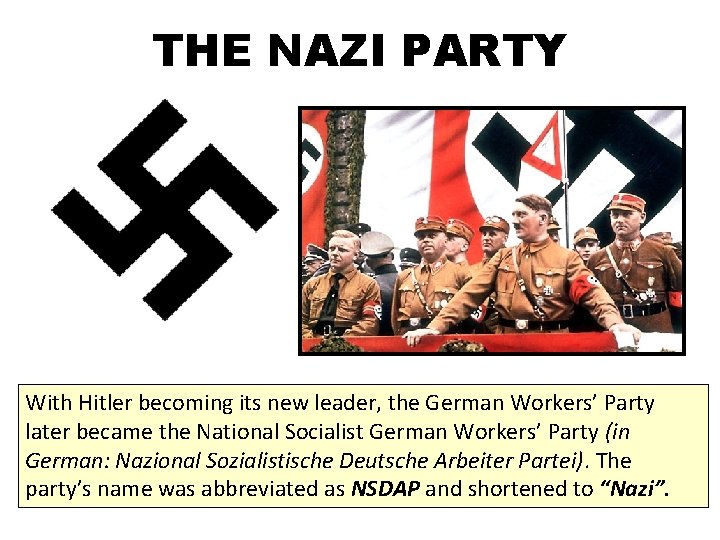
THE NAZI PARTY With Hitler becoming its new leader, the German Workers’ Party later became the National Socialist German Workers’ Party (in German: Nazional Sozialistische Deutsche Arbeiter Partei). The party’s name was abbreviated as NSDAP and shortened to “Nazi”.
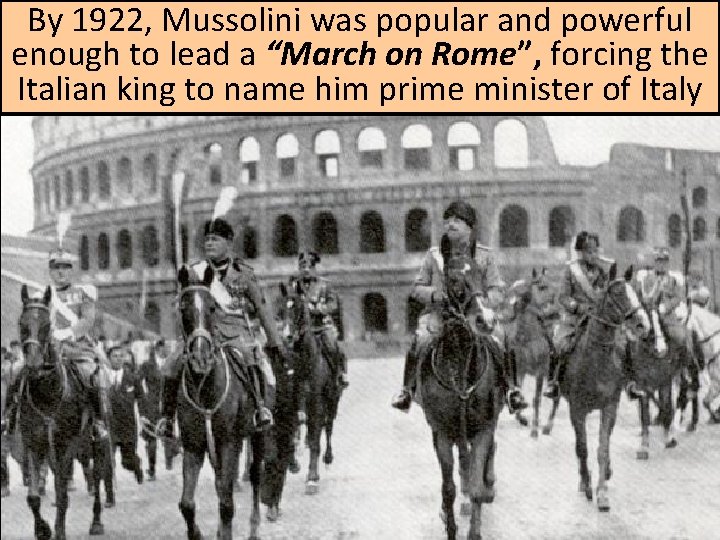
By 1922, Mussolini was popular and powerful enough to lead a “March on Rome”, forcing the Italian king to name him prime minister of Italy
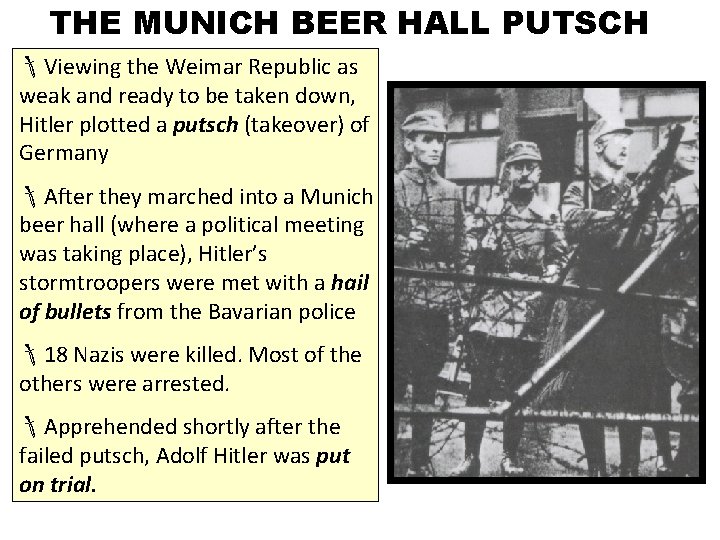
THE MUNICH BEER HALL PUTSCH Viewing the Weimar Republic as weak and ready to be taken down, Hitler plotted a putsch (takeover) of Germany After they marched into a Munich beer hall (where a political meeting was taking place), Hitler’s stormtroopers were met with a hail of bullets from the Bavarian police 18 Nazis were killed. Most of the others were arrested. Apprehended shortly after the failed putsch, Adolf Hitler was put on trial.
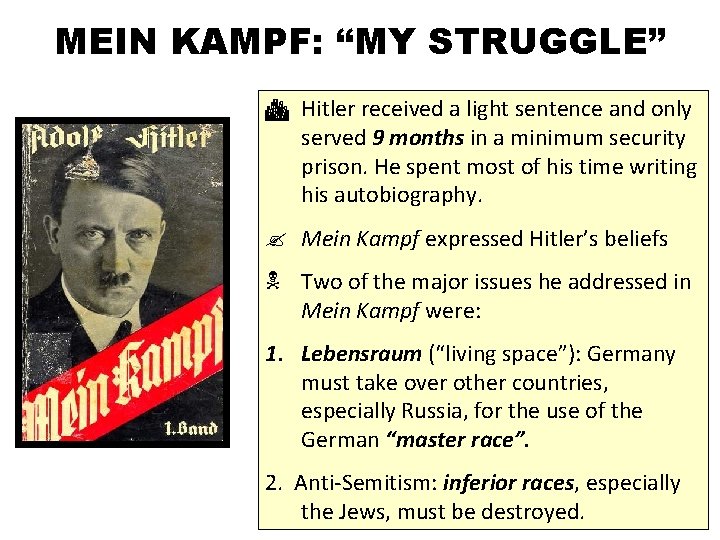
MEIN KAMPF: “MY STRUGGLE” C Hitler received a light sentence and only served 9 months in a minimum security prison. He spent most of his time writing his autobiography. ? Mein Kampf expressed Hitler’s beliefs N Two of the major issues he addressed in Mein Kampf were: 1. Lebensraum (“living space”): Germany must take over other countries, especially Russia, for the use of the German “master race”. 2. Anti-Semitism: inferior races, especially the Jews, must be destroyed.
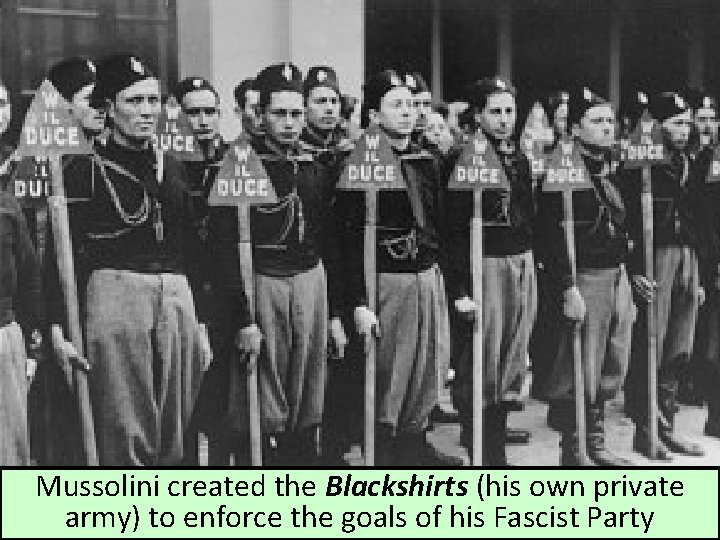
Mussolini created the Blackshirts (his own private army) to enforce the goals of his Fascist Party
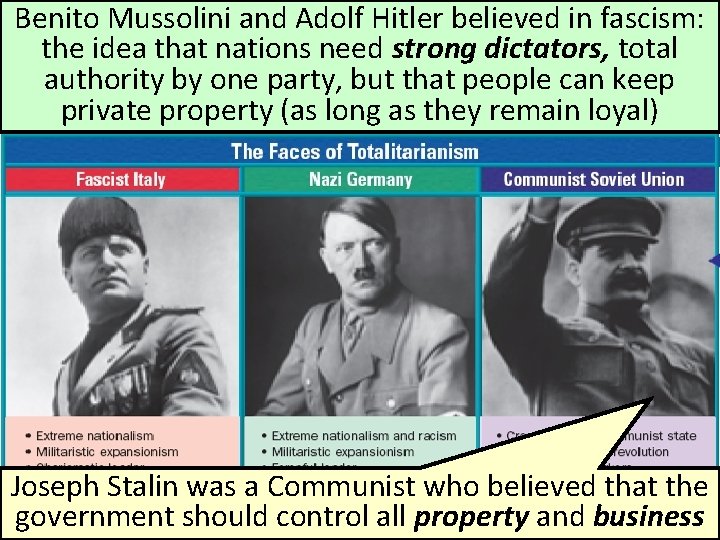
Benito Mussolini and Adolf Hitler believed in fascism: the idea that nations need strong dictators, total authority by one party, but that people can keep private property (as long as they remain loyal) Joseph Stalin was a Communist who believed that the government should control all property and business
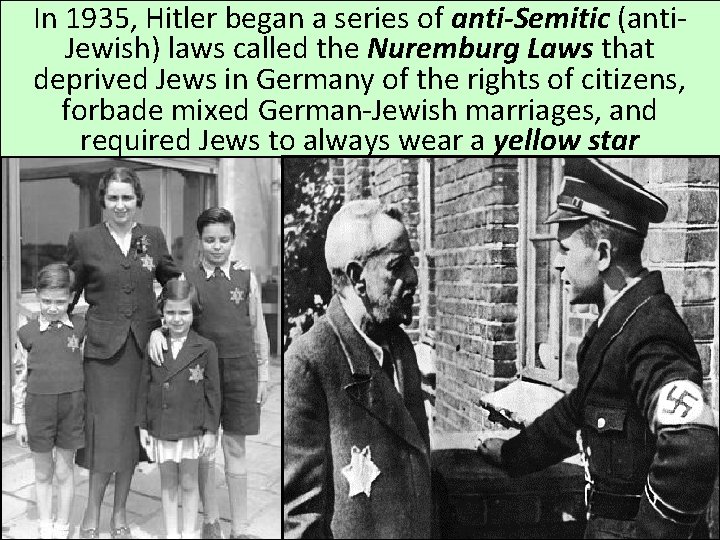
In 1935, Hitler began a series of anti-Semitic (anti. Jewish) laws called the Nuremburg Laws that deprived Jews in Germany of the rights of citizens, forbade mixed German-Jewish marriages, and required Jews to always wear a yellow star
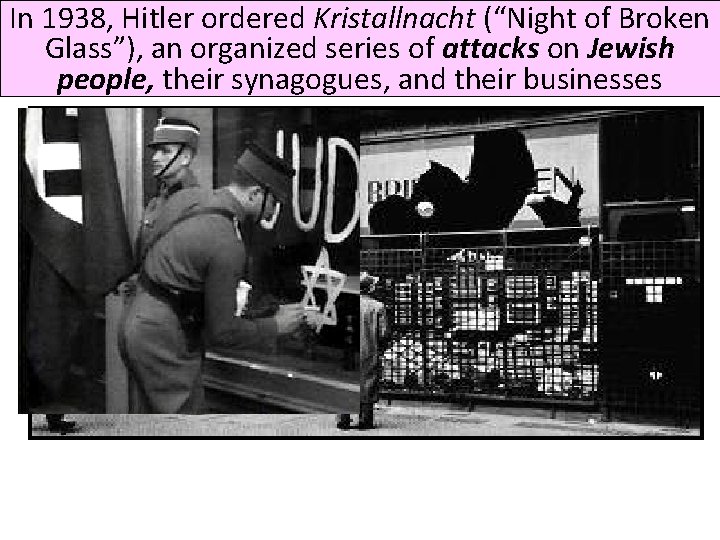
In 1938, Hitler ordered Kristallnacht (“Night of Broken Glass”), an organized series of attacks on Jewish people, their synagogues, and their businesses
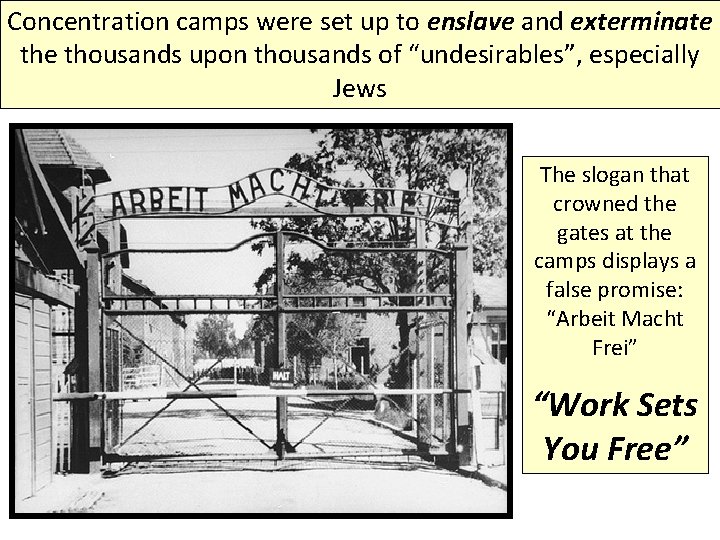
Concentration camps were set up to enslave and exterminate thousands upon thousands of “undesirables”, especially Jews The slogan that crowned the gates at the camps displays a false promise: “Arbeit Macht Frei” “Work Sets You Free”
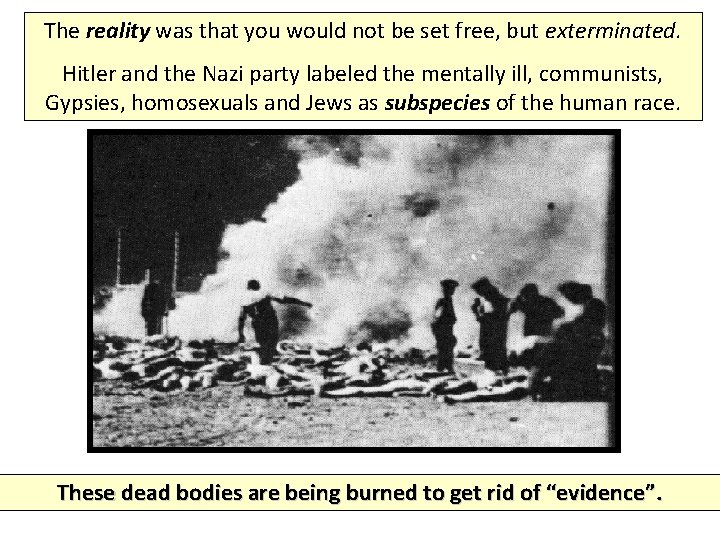
The reality was that you would not be set free, but exterminated. Hitler and the Nazi party labeled the mentally ill, communists, Gypsies, homosexuals and Jews as subspecies of the human race. These dead bodies are being burned to get rid of “evidence”.
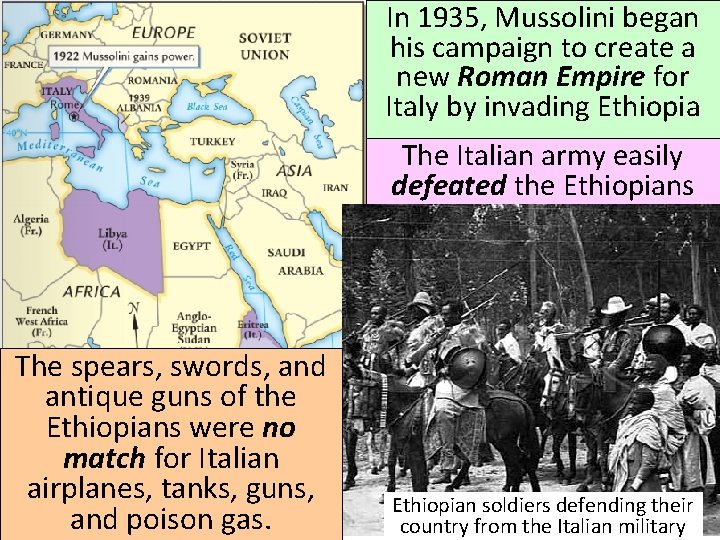
In 1935, Mussolini began his campaign to create a new Roman Empire for Italy by invading Ethiopia The Italian army easily defeated the Ethiopians The spears, swords, and antique guns of the Ethiopians were no match for Italian airplanes, tanks, guns, and poison gas. Ethiopian soldiers defending their country from the Italian military
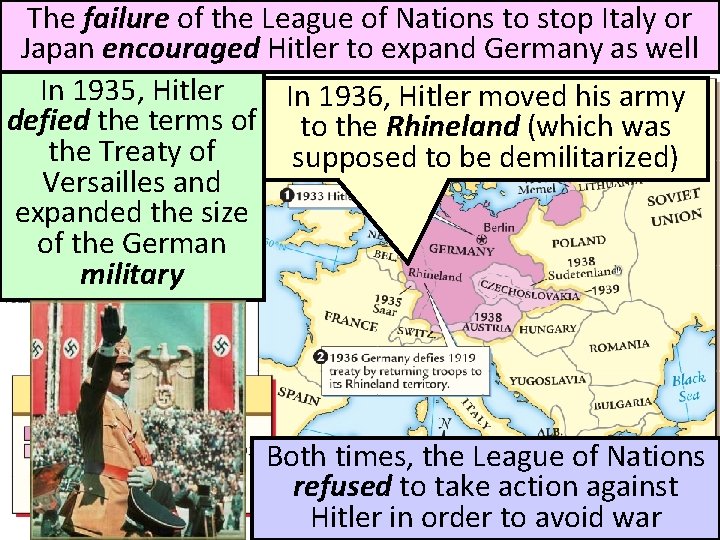
The failure of the League of Nations to stop Italy or Japan encouraged Hitler to expand Germany as well In 1935, Hitler In 1936, Hitler moved his army defied the terms of to the Rhineland (which was the Treaty of supposed to be demilitarized) Versailles and expanded the size of the German military Both times, the League of Nations refused to take action against Hitler in order to avoid war
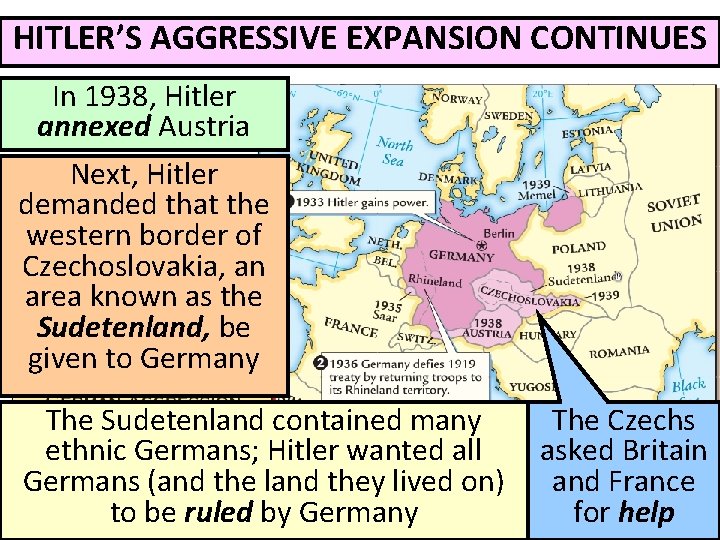
HITLER’S AGGRESSIVE EXPANSION CONTINUES In 1938, Hitler annexed Austria Next, Hitler demanded that the western border of Czechoslovakia, an area known as the Sudetenland, be given to Germany The Sudetenland contained many ethnic Germans; Hitler wanted all Germans (and the land they lived on) to be ruled by Germany The Czechs asked Britain and France for help
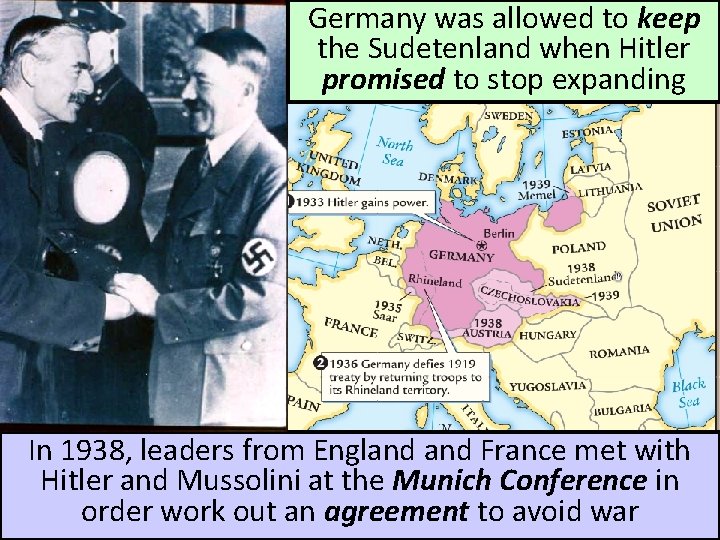
Germany was allowed to keep the Sudetenland when Hitler promised to stop expanding In 1938, leaders from England France met with Hitler and Mussolini at the Munich Conference in order work out an agreement to avoid war
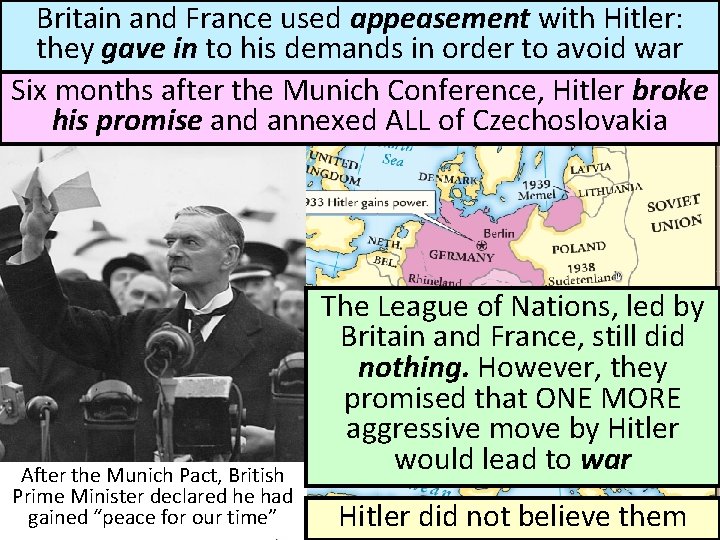
Britain and France used appeasement with Hitler: they gave in to his demands in order to avoid war Six months after the Munich Conference, Hitler broke his promise and annexed ALL of Czechoslovakia After the Munich Pact, British Prime Minister declared he had gained “peace for our time” The League of Nations, led by Britain and France, still did nothing. However, they promised that ONE MORE aggressive move by Hitler would lead to war Hitler did not believe them
WHAT WERE THE CAUSES OF WORLD WAR II? Many factors played a part in the outbreak of World War II, but it can be broken down to FOUR MAIN CAUSES: 1. 2. 3. 4. The conditions of the Treaty of Versailles The aggression of totalitarian dictators The failure of the League of Nations The failure of appeasement
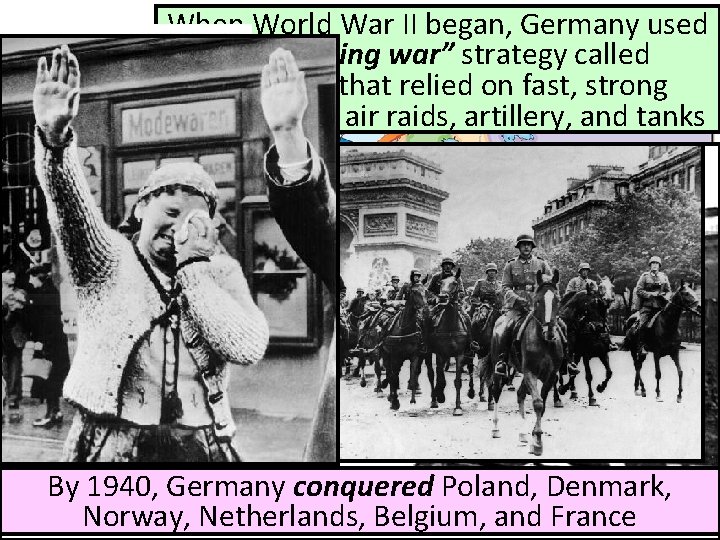
When World War II began, Germany used a “lightning war” strategy called blitzkrieg that relied on fast, strong attacks using air raids, artillery, and tanks By 1940, Germany conquered Poland, Denmark, Norway, Netherlands, Belgium, and France
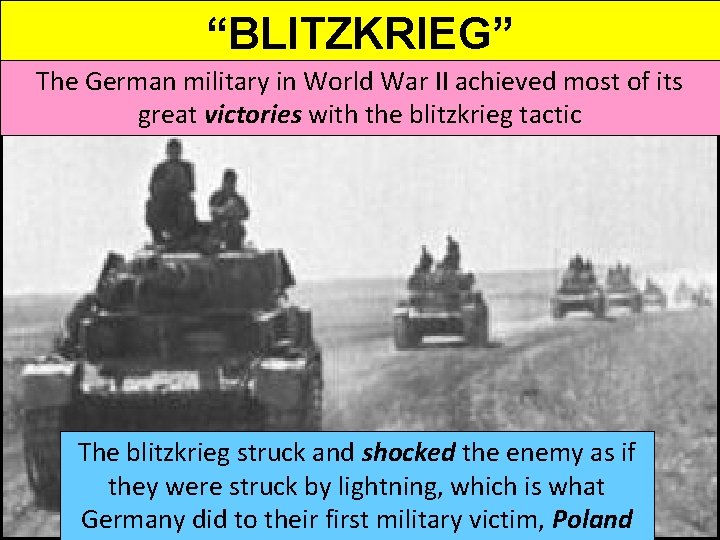
“BLITZKRIEG” The German military in World War II achieved most of its great victories with the blitzkrieg tactic The blitzkrieg struck and shocked the enemy as if they were struck by lightning, which is what Germany did to their first military victim, Poland
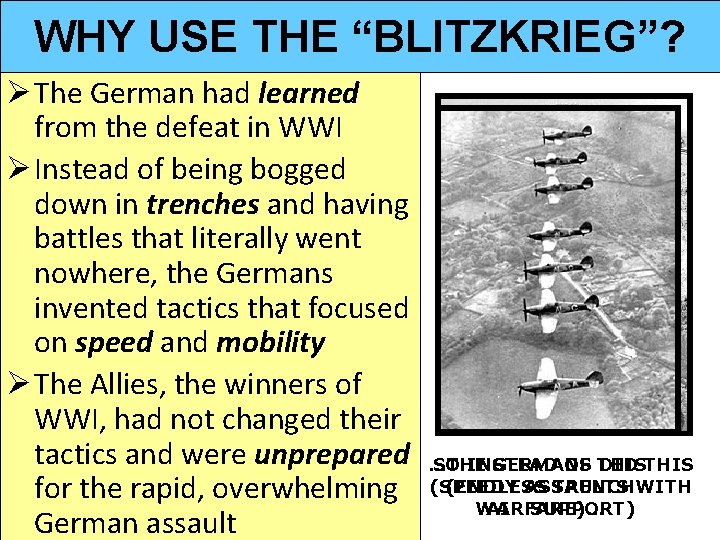
WHY USE THE “BLITZKRIEG”? Ø The German had learned from the defeat in WWI Ø Instead of being bogged down in trenches and having battles that literally went nowhere, the Germans invented tactics that focused on speed and mobility Ø The Allies, the winners of WWI, had not changed their tactics and were unprepared for the rapid, overwhelming German assault …THE SO INSTEAD GERMANS OF THIS DID THIS (SPEEDY (ENDLESS ASSAULTS TRENCHWITH WARFARE)… AIR SUPPORT)
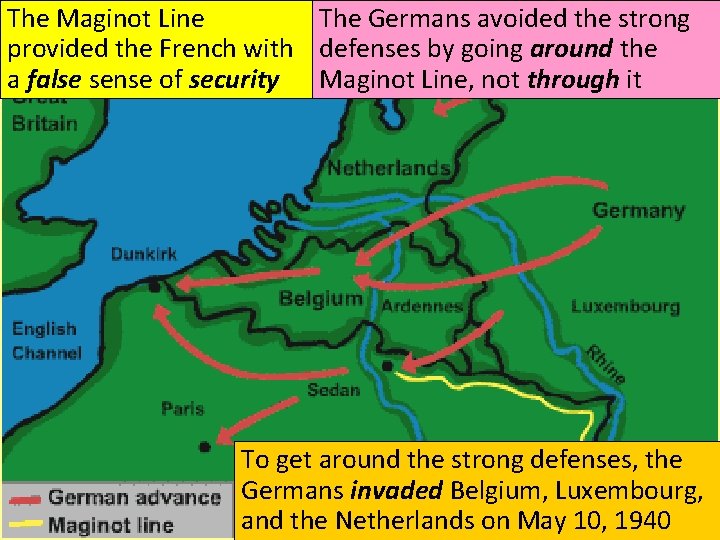
The Maginot Line The Germans avoided the strong provided the French with defenses by going around the a false sense of security Maginot Line, not through it To get around the strong defenses, the Germans invaded Belgium, Luxembourg, and the Netherlands on May 10, 1940
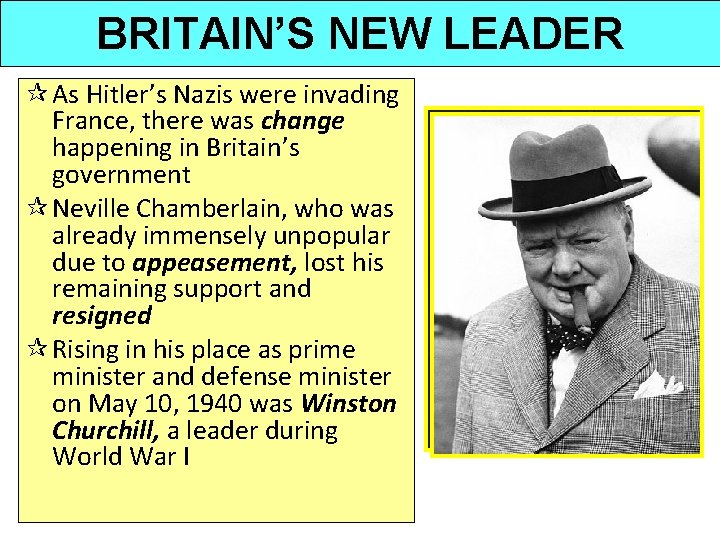
BRITAIN’S NEW LEADER ¶ As Hitler’s Nazis were invading France, there was change happening in Britain’s government ¶ Neville Chamberlain, who was already immensely unpopular due to appeasement, lost his remaining support and resigned ¶ Rising in his place as prime minister and defense minister on May 10, 1940 was Winston Churchill, a leader during World War I
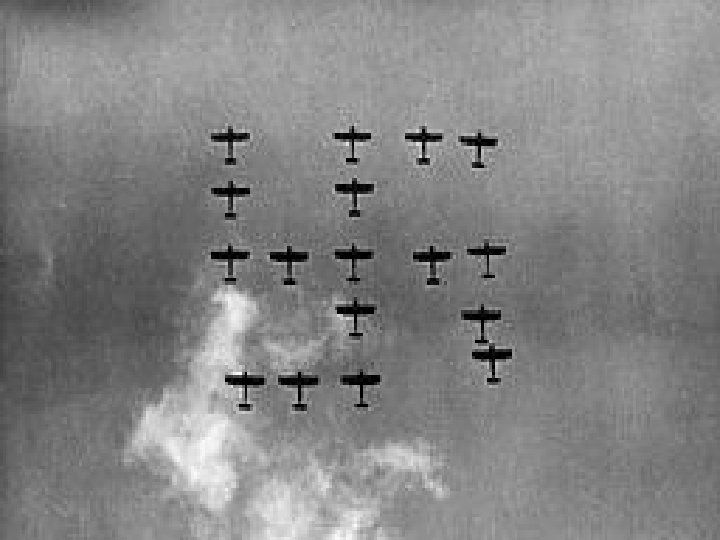
THE BATTLE OF BRITAIN GERMANY’S LUFTWAFFE VERSUS BRITAIN’S ROYAL AIR FORCE
THE BATTLE OF BRITAIN “My Luftwaffe is invincible. And so now we turn to England. How long will this one last? Two, three weeks? ” German Reichsmarshall (and chief of the Luftwaffe) Hermann Goring, speaking after the Fall of France
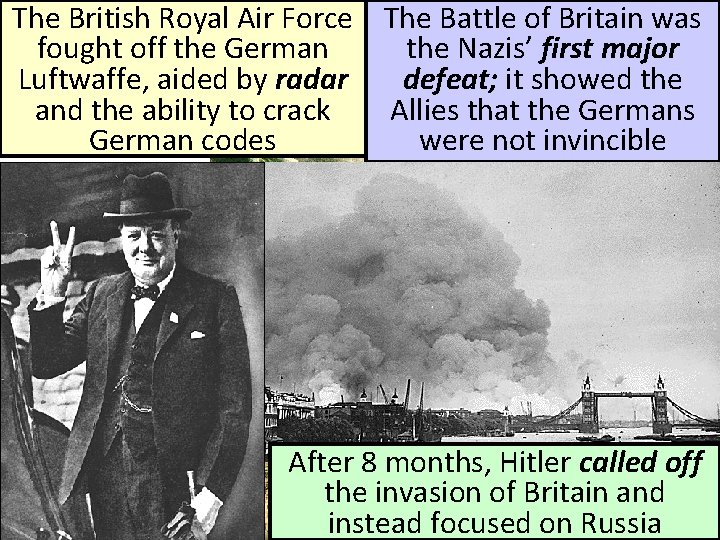
The British Royal Air Force The Battle of Britain was fought off the German the Nazis’ first major Luftwaffe, aided by radar defeat; it showed the and the ability to crack Allies that the Germans German codes were not invincible After 8 months, Hitler called off the invasion of Britain and instead focused on Russia
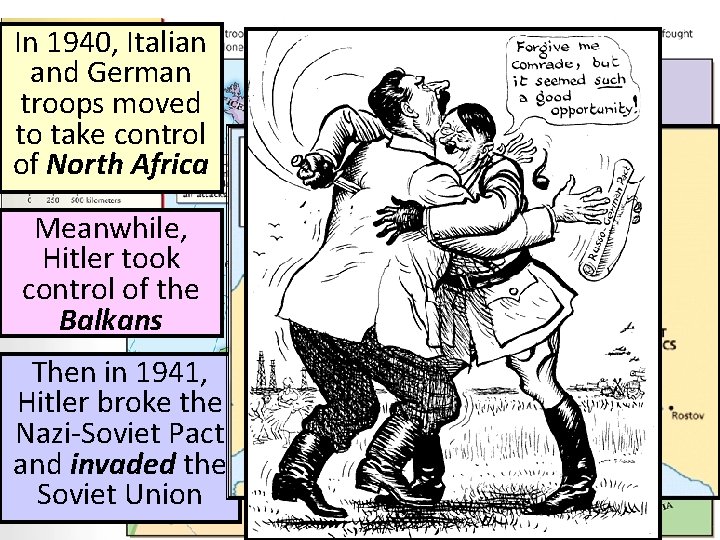
In 1940, Italian and German troops moved to take control of North Africa Meanwhile, Hitler took control of the Balkans Then in 1941, Hitler broke the Nazi-Soviet Pact and invaded the Soviet Union
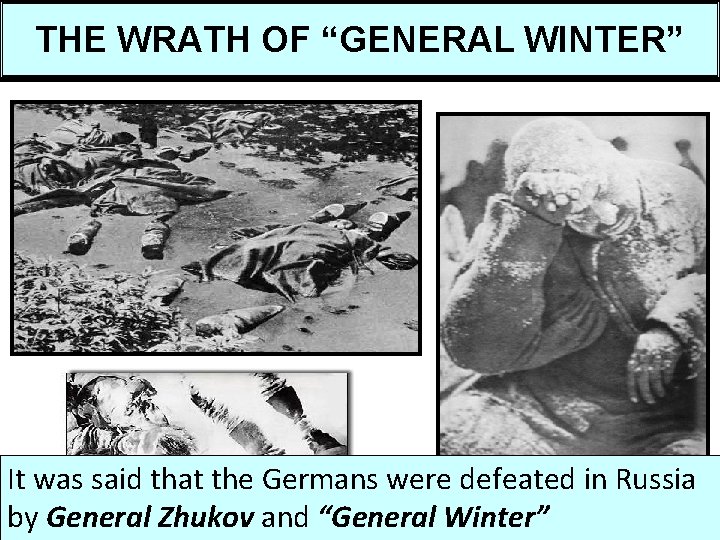
THE WRATH OF “GENERAL WINTER” It was said that the Germans were defeated in Russia by General Zhukov and “General Winter”
HISTORY REPEATS ITSELF v. Just like in World War I, Germany now found itself in a TWO-FRONT WAR v. Hitler vowed not to repeat the mistakes of The Great War, but he most certainly did v. Rashness, impatience, and overconfidence led Hitler to over-commit his forces, fighting too many enemies at the same time v. Like they had in WWI, Germany now had struggles with Britain in the West and now a prolonged battle of attrition in the East with Russia
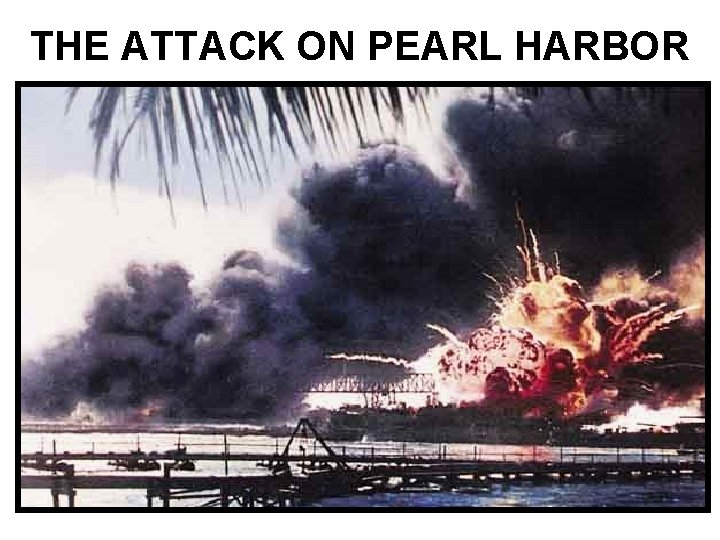
THE ATTACK ON PEARL HARBOR
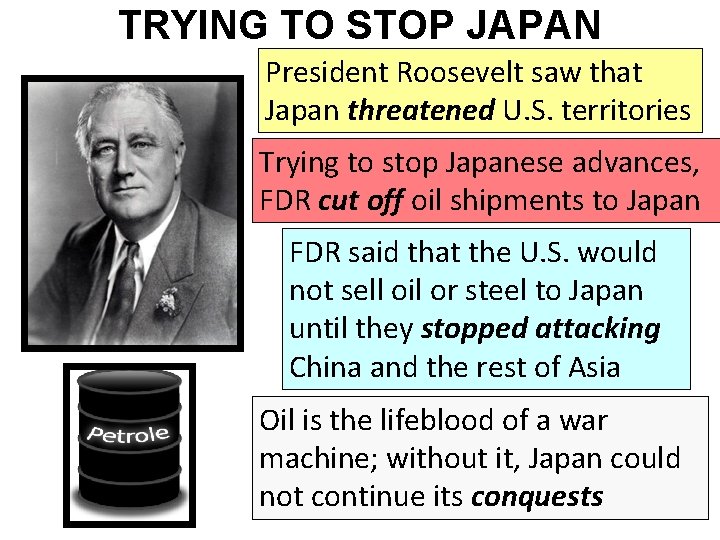
TRYING TO STOP JAPAN President Roosevelt saw that Japan threatened U. S. territories Trying to stop Japanese advances, FDR cut off oil shipments to Japan FDR said that the U. S. would not sell oil or steel to Japan until they stopped attacking China and the rest of Asia Oil is the lifeblood of a war machine; without it, Japan could not continue its conquests
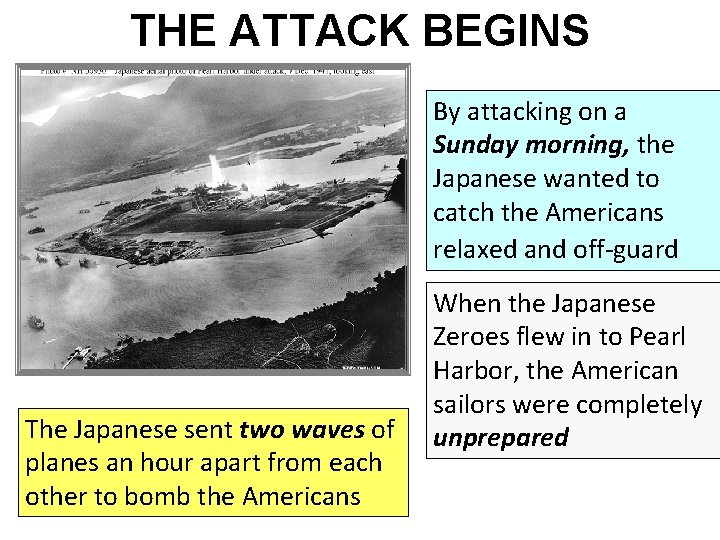
THE ATTACK BEGINS By attacking on a Sunday morning, the Japanese wanted to catch the Americans relaxed and off-guard The Japanese sent two waves of planes an hour apart from each other to bomb the Americans When the Japanese Zeroes flew in to Pearl Harbor, the American sailors were completely unprepared
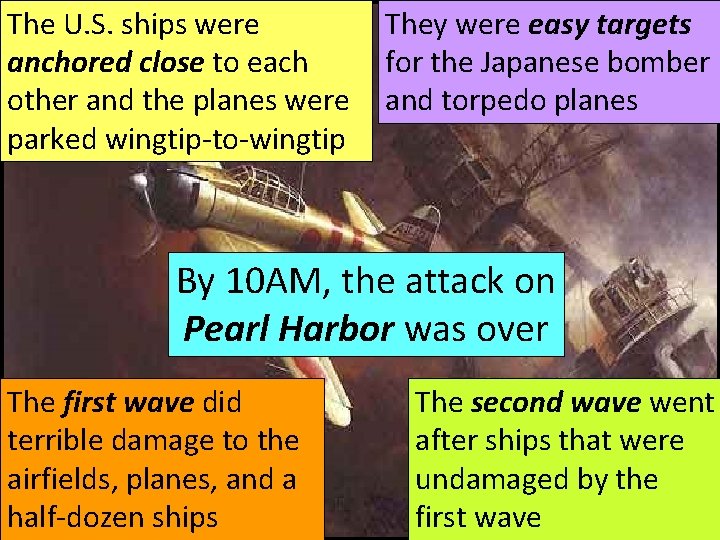
The U. S. ships were anchored close to each other and the planes were parked wingtip-to-wingtip They were easy targets for the Japanese bomber and torpedo planes By 10 AM, the attack on Pearl Harbor was over The first wave did terrible damage to the airfields, planes, and a half-dozen ships The second wave went after ships that were undamaged by the first wave
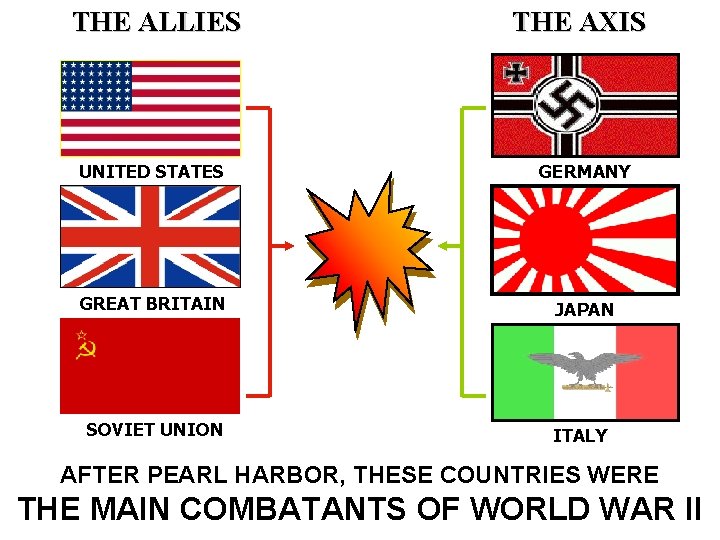
THE ALLIES THE AXIS UNITED STATES GERMANY GREAT BRITAIN JAPAN SOVIET UNION ITALY AFTER PEARL HARBOR, THESE COUNTRIES WERE THE MAIN COMBATANTS OF WORLD WAR II