
World War II 1939 1945 Georgia Standards SSUSH


- Slides: 32
World War II 1939 -1945
Georgia Standards SSUSH 19 The student will identify the origins, major developments, and the domestic impact of World War II, especially the growth of the federal government. a. Explain A. Philip Randolph’s proposed march on Washington, D. C. , and President Franklin D. Roosevelt’s response. b. Explain the Japanese attack on Pearl Harbor and the internment of Japanese- Americans, German-Americans, and Italian-Americans. c. Explain major events; include the lend-lease program, the Battle of Midway, D-Day, and the fall of Berlin. d. Describe war mobilization, as indicated by rationing, war-time conversion, and the role of women in war industries. e. Describe the Manhattan Project at Los Alamos and the scientific, economic, and military implications of developing the atomic bomb. f. Compare the geographic locations of the European Theater and the Pacific Theater and the difficulties the U. S. faced in delivering weapons, food, and medical supplies to troops.
The Domestic Front in World War II
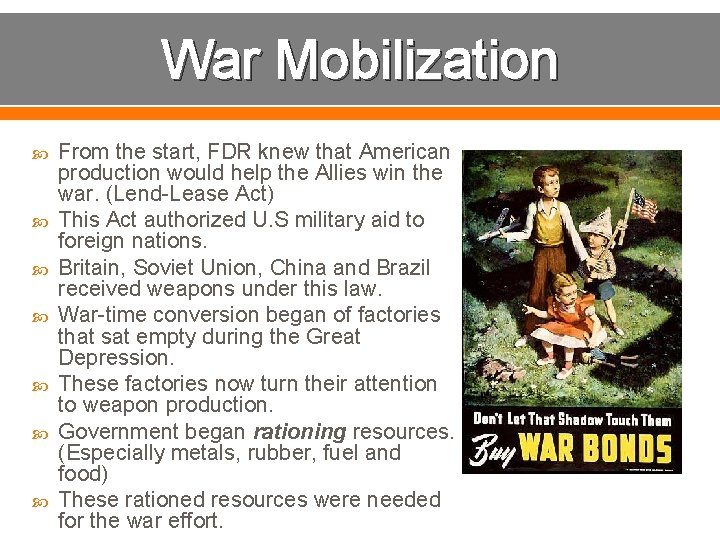
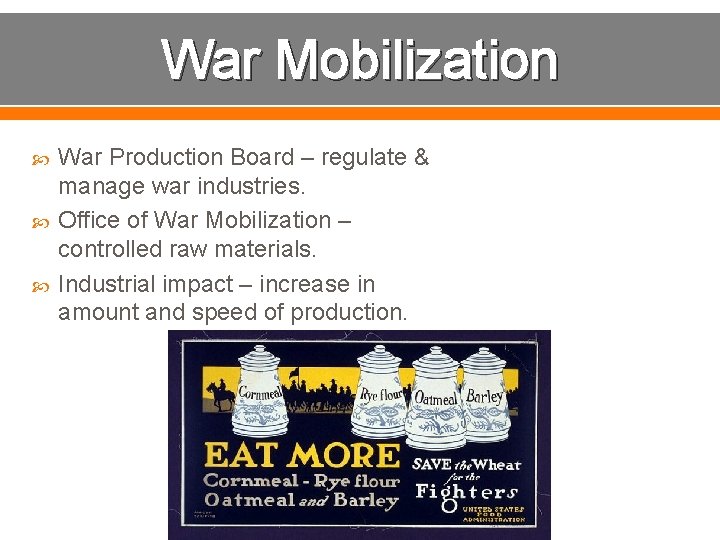
War Mobilization From the start, FDR knew that American production would help the Allies win the war. (Lend-Lease Act) This Act authorized U. S military aid to foreign nations. Britain, Soviet Union, China and Brazil received weapons under this law. War-time conversion began of factories that sat empty during the Great Depression. These factories now turn their attention to weapon production. Government began rationing resources. (Especially metals, rubber, fuel and food) These rationed resources were needed for the war effort.
War Mobilization War Production Board – regulate & manage war industries. Office of War Mobilization – controlled raw materials. Industrial impact – increase in amount and speed of production.
Women
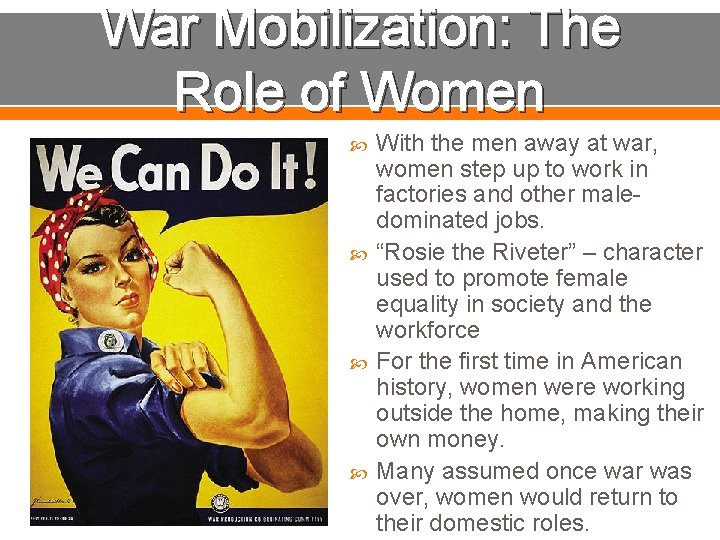
War Mobilization: The Role of Women With the men away at war, women step up to work in factories and other maledominated jobs. “Rosie the Riveter” – character used to promote female equality in society and the workforce For the first time in American history, women were working outside the home, making their own money. Many assumed once war was over, women would return to their domestic roles.
African-Americans
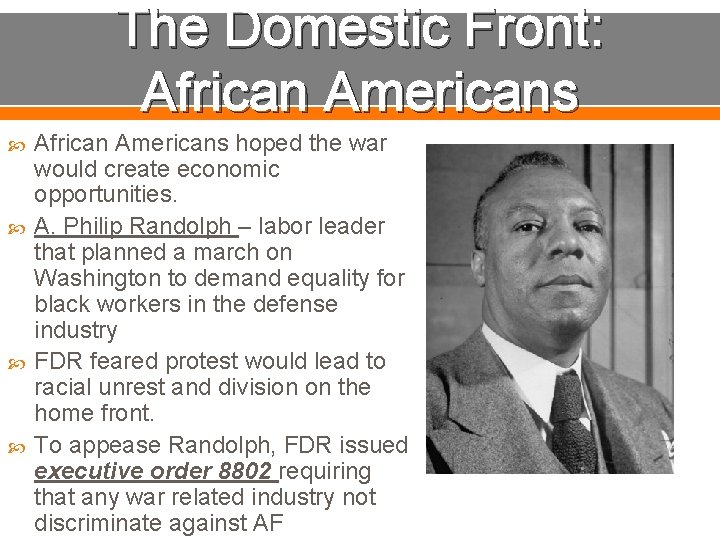
The Domestic Front: African Americans hoped the war would create economic opportunities. A. Philip Randolph – labor leader that planned a march on Washington to demand equality for black workers in the defense industry FDR feared protest would lead to racial unrest and division on the home front. To appease Randolph, FDR issued executive order 8802 requiring that any war related industry not discriminate against AF
Mexican-Americans
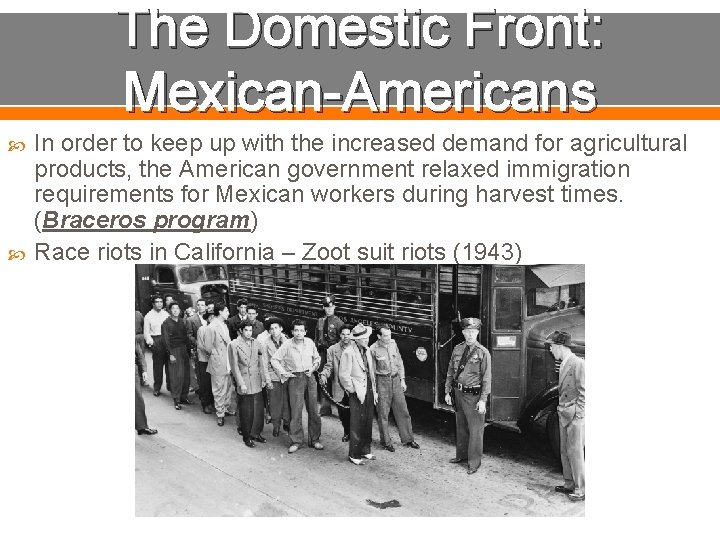
The Domestic Front: Mexican-Americans In order to keep up with the increased demand for agricultural products, the American government relaxed immigration requirements for Mexican workers during harvest times. (Braceros program) Race riots in California – Zoot suit riots (1943)
Japanese-Americans
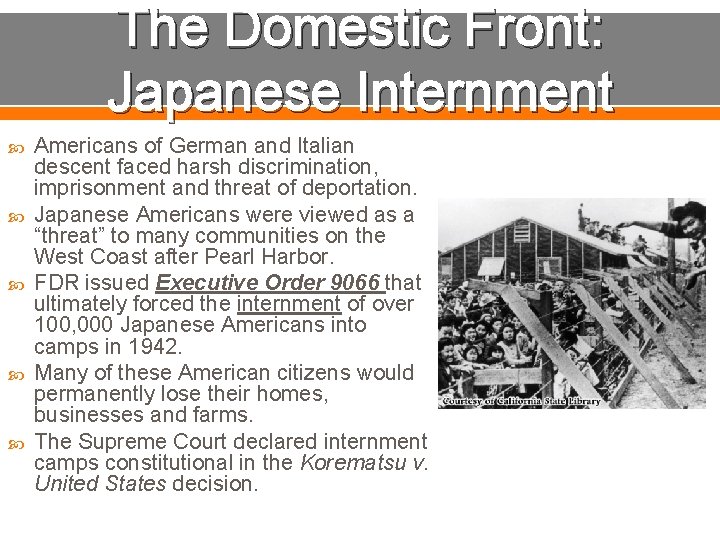
The Domestic Front: Japanese Internment Americans of German and Italian descent faced harsh discrimination, imprisonment and threat of deportation. Japanese Americans were viewed as a “threat” to many communities on the West Coast after Pearl Harbor. FDR issued Executive Order 9066 that ultimately forced the internment of over 100, 000 Japanese Americans into camps in 1942. Many of these American citizens would permanently lose their homes, businesses and farms. The Supreme Court declared internment camps constitutional in the Korematsu v. United States decision.
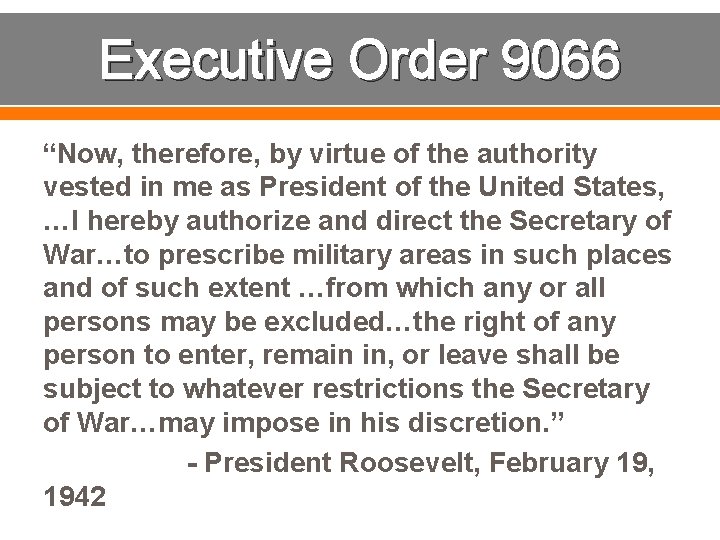
Executive Order 9066 “Now, therefore, by virtue of the authority vested in me as President of the United States, …I hereby authorize and direct the Secretary of War…to prescribe military areas in such places and of such extent …from which any or all persons may be excluded…the right of any person to enter, remain in, or leave shall be subject to whatever restrictions the Secretary of War…may impose in his discretion. ” - President Roosevelt, February 19, 1942
Two Theaters of War Comparing the geography of Europe and the Pacific
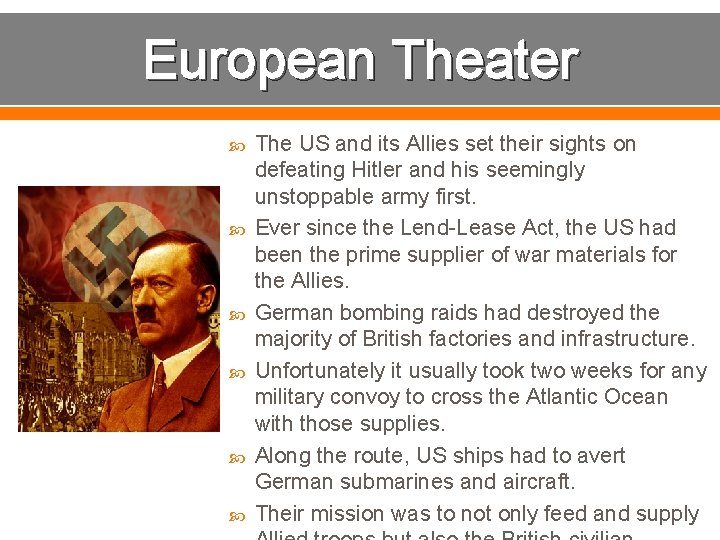
European Theater The US and its Allies set their sights on defeating Hitler and his seemingly unstoppable army first. Ever since the Lend-Lease Act, the US had been the prime supplier of war materials for the Allies. German bombing raids had destroyed the majority of British factories and infrastructure. Unfortunately it usually took two weeks for any military convoy to cross the Atlantic Ocean with those supplies. Along the route, US ships had to avert German submarines and aircraft. Their mission was to not only feed and supply
Pacific Theater The distance across the Pacific was three times that of the distance from New York to Great Britain. It sometimes took up to five months for supplies to reach Allied ports in Australia. Since the first priority was the defeat of Hitler, troops in the Pacific were stuck with outdated equipment and food and medical supply shortages. The climate of the South Pacific caused massive food spoilage. All of these circumstances led to the Allied policy of “islandhopping”. The goal of the “island-hopping” campaigns was to conquer various small islands in the Pacific and set up bases to better organize and operate military operations.
Fast 5 -11/3/16 1. What does internment mean? 2. What is an executive order? 3. Why were Japanese Americans interned? 4. What similarities did Lincoln’s suspension of habeas corpus and Roosevelt’s Japanese internment have? 5. What similarities exist between Japanese interment and modern treatment of Muslim. Americans?
The Battle of Midway The Turning Point of the Pacific Theater
The Battle of Midway Throughout much of early 1942, the Japanese navy had won control of many British, Dutch and American possessions in the Pacific (including the Philippines). Japan now turned their attention to the American naval base on the island of Midway. Seizing Midway would allow the Japanese to easily conquer the Hawaii islands and the Aleutian islands of Alaska. Unbeknownst to the Japanese, US code breakers had intercepted the attack plan at Midway. Resultantly the US dealt the Japanese navy a decisive defeat destroying numerous Japanese aircraft carriers in June 1942. The US victory at Midway is seen as the turning point in the Pacific theater and a huge morale boost for US troops. From Midway, the US navy was enabled to regain and subsequently control other strategic Pacific islands putting Japan on the defensive.
D-Day: Allied Invasion of Europe
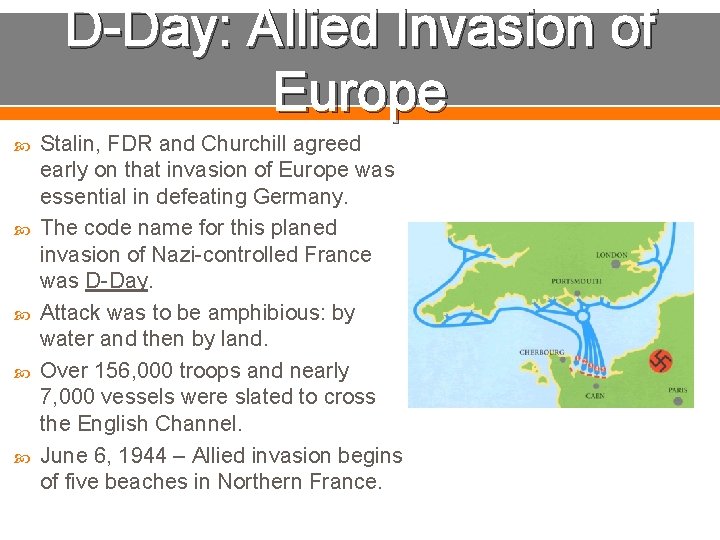
D-Day: Allied Invasion of Europe Stalin, FDR and Churchill agreed early on that invasion of Europe was essential in defeating Germany. The code name for this planed invasion of Nazi-controlled France was D-Day. Attack was to be amphibious: by water and then by land. Over 156, 000 troops and nearly 7, 000 vessels were slated to cross the English Channel. June 6, 1944 – Allied invasion begins of five beaches in Northern France.
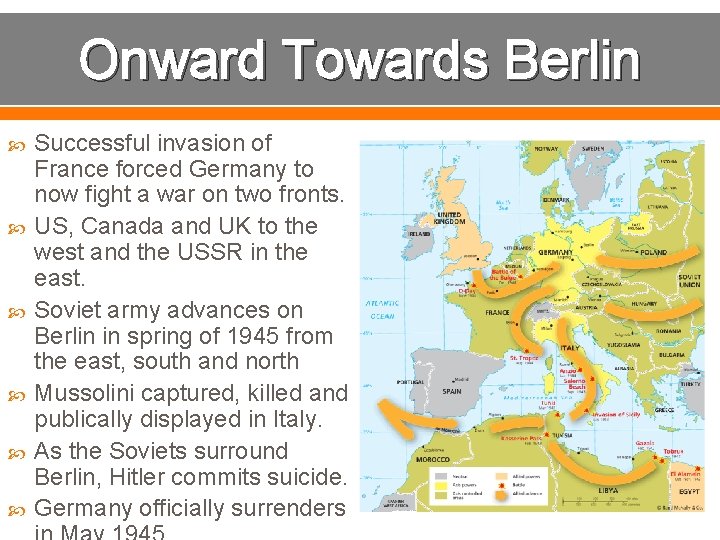
Onward Towards Berlin Successful invasion of France forced Germany to now fight a war on two fronts. US, Canada and UK to the west and the USSR in the east. Soviet army advances on Berlin in spring of 1945 from the east, south and north Mussolini captured, killed and publically displayed in Italy. As the Soviets surround Berlin, Hitler commits suicide. Germany officially surrenders
Truman and the Atomic Bomb The Manhattan Project and its Consequences
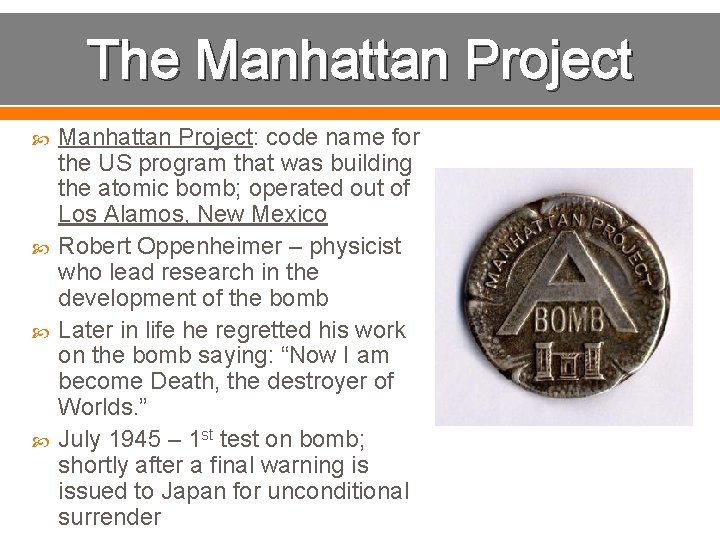
The Manhattan Project Manhattan Project: code name for the US program that was building the atomic bomb; operated out of Los Alamos, New Mexico Robert Oppenheimer – physicist who lead research in the development of the bomb Later in life he regretted his work on the bomb saying: “Now I am become Death, the destroyer of Worlds. ” July 1945 – 1 st test on bomb; shortly after a final warning is issued to Japan for unconditional surrender
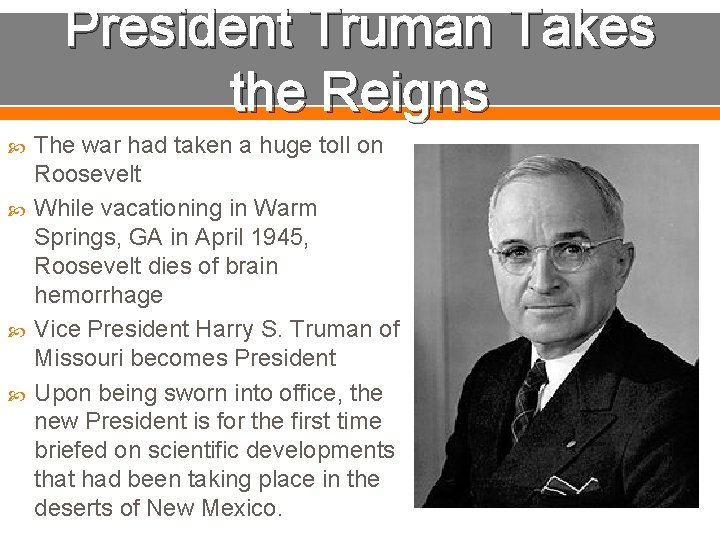
President Truman Takes the Reigns The war had taken a huge toll on Roosevelt While vacationing in Warm Springs, GA in April 1945, Roosevelt dies of brain hemorrhage Vice President Harry S. Truman of Missouri becomes President Upon being sworn into office, the new President is for the first time briefed on scientific developments that had been taking place in the deserts of New Mexico.
Truman Decides to Drop the Bomb Military strategists believed that a D-Day type invasion of Japan would result in the loss of an estimated 1 million US soldiers. After further contemplation, Truman authorizes the use of the atomic bomb. 1 st bomb dropped at Hiroshima on August 6, 1945 On August 8 th Soviets declares war on Japan; invade Manchuria. 2 nd atomic bomb dropped August 9 th at Nagasaki An estimated 120, 000 Japanese citizens were killed instantly 80, 000 more would die from radiation in the weeks and months to come Japan formally surrenders in September 1945.
Sixteen hours ago an American airplane dropped one bomb on Hiroshima and destroyed its usefulness to the enemy…The Japanese began the war from the air at Pearl Harbor. They have been repaid many fold. And the end is not yet. It is an atomic bomb. It is a harnessing of the basic power of the universe. The force from which the sun draws its power has been loosed against those who brought war to the Far East. The battle of the laboratories held fateful risks for us as well as the battles of the air, land, and sea, and we have now won the battle of the laboratories as we have won the other battles. We are now prepared to obliterate more rapidly and completely every productive enterprise the Japanese have above ground in any city. We shall destroy their docks, their factories, and their communications. Let there be no mistake; we shall completely destroy Japan's power to make war. If they [Japan] do not now accept our terms they may expect a rain of ruin from the air, the like of which has never been seen on this earth. Behind this air attack will follow sea and land forces in such number that and power as they have not yet seen and with the fighting skill of which they are already well aware. - Statement from President Truman, August
America Becomes a Superpower
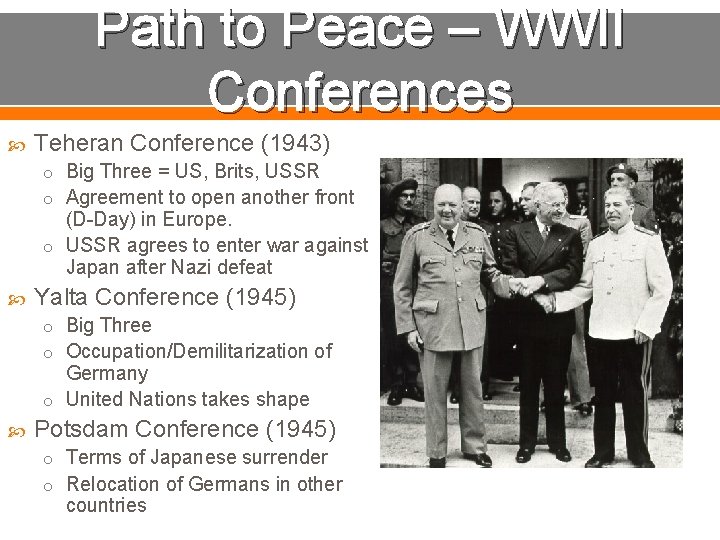
Path to Peace – WWII Conferences Teheran Conference (1943) o Big Three = US, Brits, USSR o Agreement to open another front (D-Day) in Europe. o USSR agrees to enter war against Japan after Nazi defeat Yalta Conference (1945) o Big Three o Occupation/Demilitarization of Germany o United Nations takes shape Potsdam Conference (1945) o Terms of Japanese surrender o Relocation of Germans in other countries
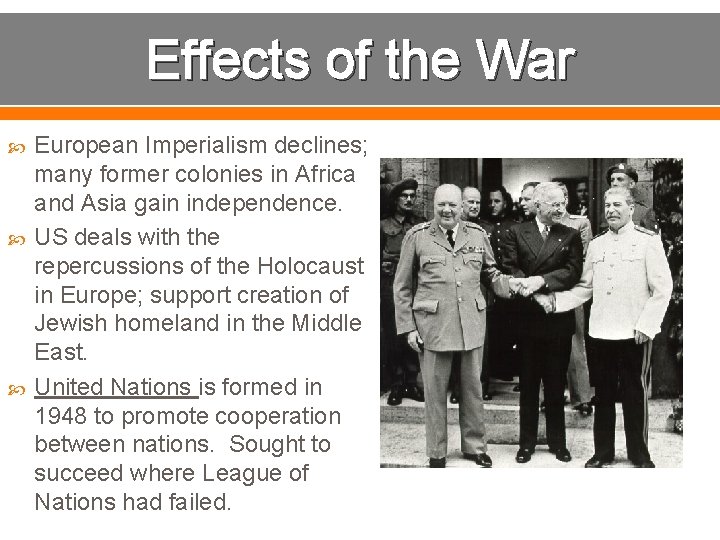
Effects of the War European Imperialism declines; many former colonies in Africa and Asia gain independence. US deals with the repercussions of the Holocaust in Europe; support creation of Jewish homeland in the Middle East. United Nations is formed in 1948 to promote cooperation between nations. Sought to succeed where League of Nations had failed.
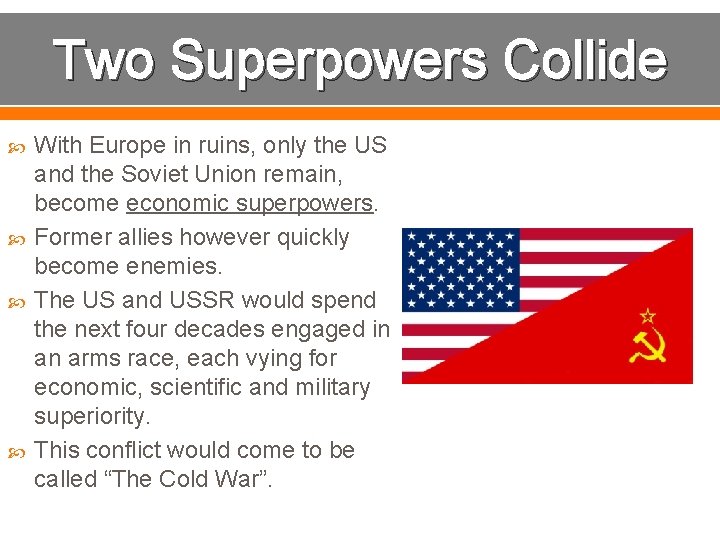
Two Superpowers Collide With Europe in ruins, only the US and the Soviet Union remain, become economic superpowers. Former allies however quickly become enemies. The US and USSR would spend the next four decades engaged in an arms race, each vying for economic, scientific and military superiority. This conflict would come to be called “The Cold War”.