
World War II 1931 1945 THE INTERWAR PERIOD
- Slides: 26
World War II (1931– 1945)
THE INTERWAR PERIOD Economic depression ØWar debt & poverty Crisis & resentment led to nationalist regimes ØTotalitarianism under Stalin – Soviet Union ØFascism under Mussolini – Italy ØNazism under Hitler – Germany ØMilitarism in Japan
FAILURE OF THE LEAGUE OF NATIONS League of Nations ineffectual ØManchuria invaded by Japan in 1931 ØRhineland invaded by Germany in 1936 ØEthiopia invaded by Italy in 1935 ØSpanish Civil War – Fascist rebels v. Spanish republic
UNITED STATES ISOLATIONISM Isolationism in post-World War I America ØKellogg-Briand Pact (1928) ØNye Committee (1934 -36) blamed war on “merchants of death” ØGood Neighbor Policy reversed actions taken by Mc. Kinley & Roosevelt FDR expands U. S. diplomacy ØRecognized USSR in 1933 ØReciprocal Trade Agreement (1934) lowered tariffs
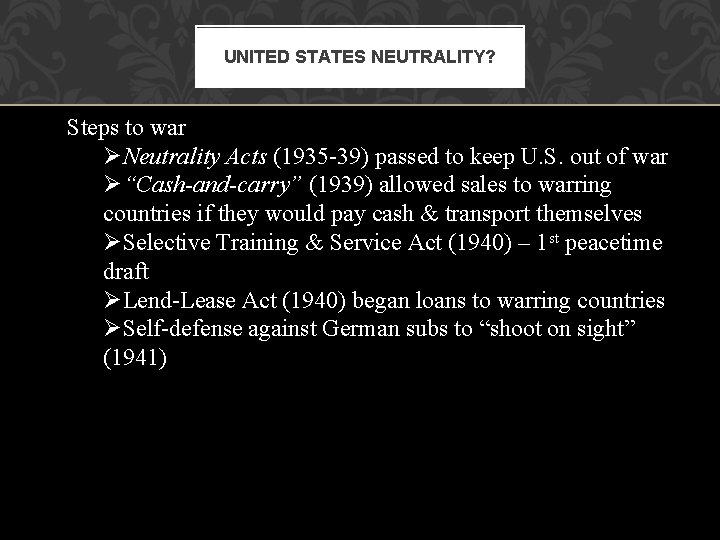
UNITED STATES NEUTRALITY? Steps to war ØNeutrality Acts (1935 -39) passed to keep U. S. out of war Ø“Cash-and-carry” (1939) allowed sales to warring countries if they would pay cash & transport themselves ØSelective Training & Service Act (1940) – 1 st peacetime draft ØLend-Lease Act (1940) began loans to warring countries ØSelf-defense against German subs to “shoot on sight” (1941)
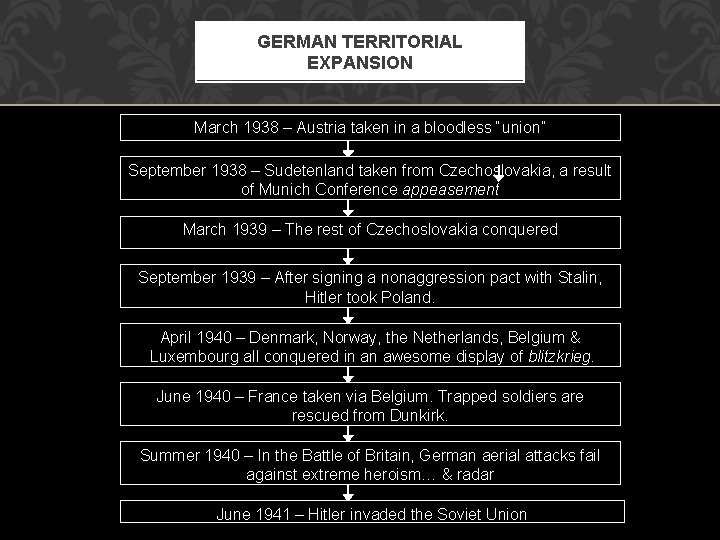
GERMAN TERRITORIAL EXPANSION March 1938 – Austria taken in a bloodless “union” September 1938 – Sudetenland taken from Czechoslovakia, a result of Munich Conference appeasement March 1939 – The rest of Czechoslovakia conquered September 1939 – After signing a nonaggression pact with Stalin, Hitler took Poland. April 1940 – Denmark, Norway, the Netherlands, Belgium & Luxembourg all conquered in an awesome display of blitzkrieg. June 1940 – France taken via Belgium. Trapped soldiers are rescued from Dunkirk. Summer 1940 – In the Battle of Britain, German aerial attacks fail against extreme heroism… & radar June 1941 – Hitler invaded the Soviet Union
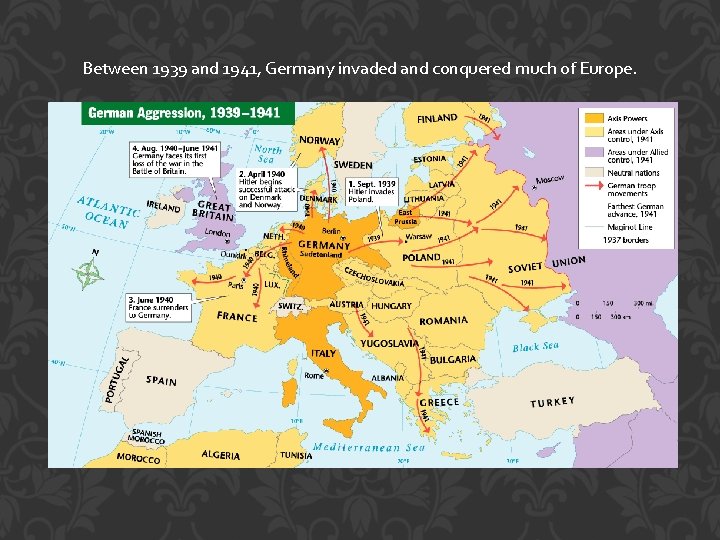
Between 1939 and 1941, Germany invaded and conquered much of Europe.
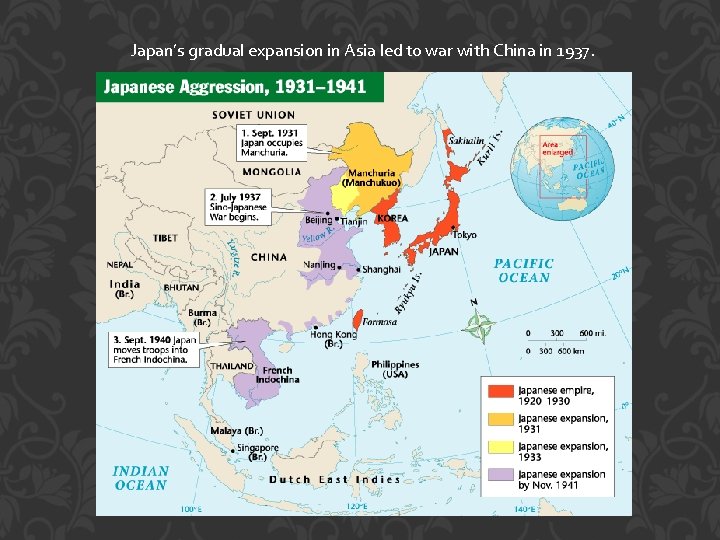
Japan’s gradual expansion in Asia led to war with China in 1937.
- Axis Germany, Italy & Japan sign Tripartite Pact in September 1940 versus - Allies Great Britain & France declared war after invasion of Poland in 1939 Soviet Union became an ally after Germany invaded in 1941 Before officially declaring war, U. S. made the Atlantic Charter Allies eventually included 26 nations
DECEMBER 7, 1941 ØJapanese surprise attack at Pearl Harbor decimated the Pacific fleet ØCongress (470 -1) declared war on Japan on December 8 ØGermany & Italy declared war on U. S. to support their ally Japan ØRacism & distrust resulted in internment of Japanese Americas
THE HOLOCAUST ØProduct of Hitler’s anti-Semitic ideas ØAfter Kristallnacht, Nazis begin removing Jews from society ØJews relocated into ghettos, later moved to concentration camps Ø“Final solution” (genocide) – many camps converted to death camps Ø 6 million Jews, 5 million others are killed
TWO-FRONT WAR: EUROPEAN THEATER ØNorth African Campaign – “Desert Fox” Rommel pushed back by a joint British/U. S. offensive ØBattle of Stalingrad – Hitler defeated by Russian winter & fighting on two fronts ØGen. George S. Patton’s invasion of Sicily led to the removal from office & arrest of Mussolini
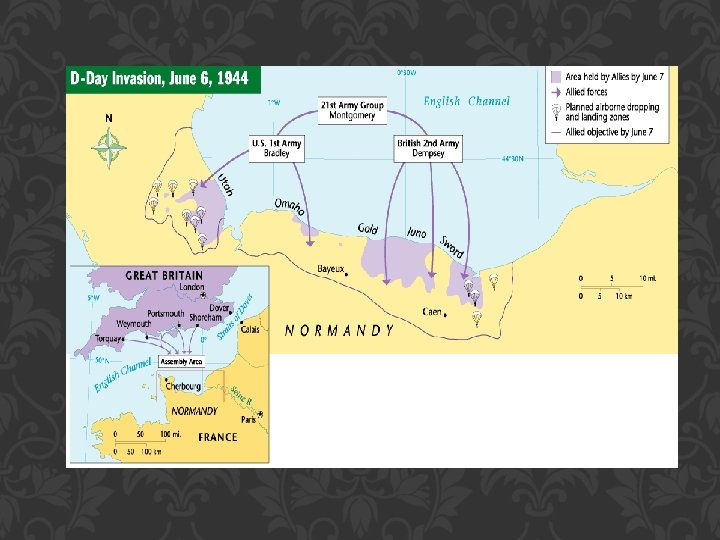
D-DAY INVASION (JUNE 6, 1944) FDR’s Chief of Staff George Marshall suggested an invasion of Western Europe Ø General Eisenhower was supreme commander for the invasion, Operation Overlord Ø Heavy casualties were suffered, but by late July, nearly 2 million Allied troops were in France Ø On August 25, 1944, Paris was liberated from German occupation. Ø
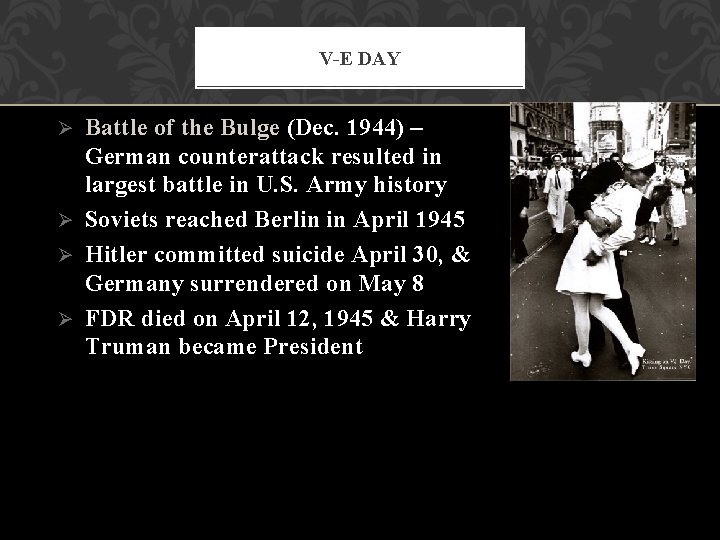
V-E DAY Battle of the Bulge (Dec. 1944) – German counterattack resulted in largest battle in U. S. Army history Ø Soviets reached Berlin in April 1945 Ø Hitler committed suicide April 30, & Germany surrendered on May 8 Ø FDR died on April 12, 1945 & Harry Truman became President Ø
YALTA CONFERENCE The Yalta Conference (February 1945) – Roosevelt, Churchill, and Stalin met to discuss the shape of the postwar world. The leaders agreed: 1. To split Germany into four zones, each under the control of a major Ally, including France. 2. To split Berlin similarly. 3. That Stalin would allow free elections in the nations of Eastern Europe that Soviets had liberated. 4. That Stalin would enter the war against Japan. Stalin didn’t keep either promise.
TWO-FRONT WAR: PACIFIC THEATER “Island hopping” strategy Ø May 1942 – 76 K POWs take Bataan Death March. 10 K died on the march & at least 15 K more died in the prison camps. Ø Battle of Midway (June 1942) – Americans sank 4 Japanese carriers & 250 planes, ending the Japanese offensive in the Pacific. Ø
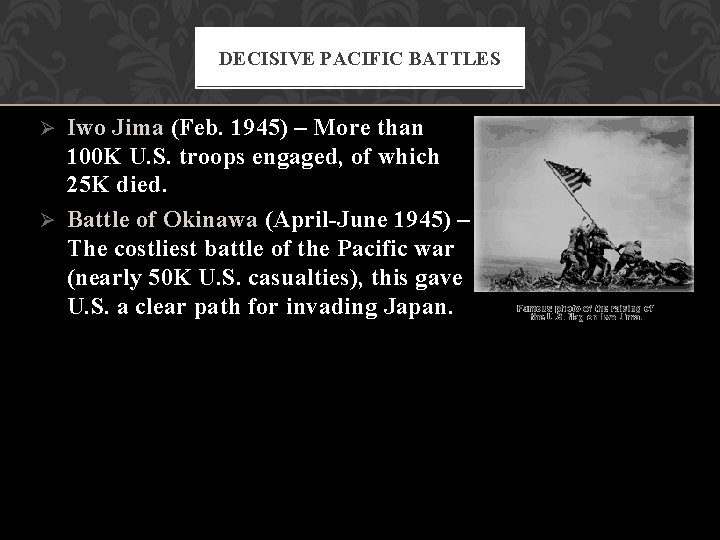
DECISIVE PACIFIC BATTLES Iwo Jima (Feb. 1945) – More than 100 K U. S. troops engaged, of which 25 K died. Ø Battle of Okinawa (April-June 1945) – The costliest battle of the Pacific war (nearly 50 K U. S. casualties), this gave U. S. a clear path for invading Japan. Ø
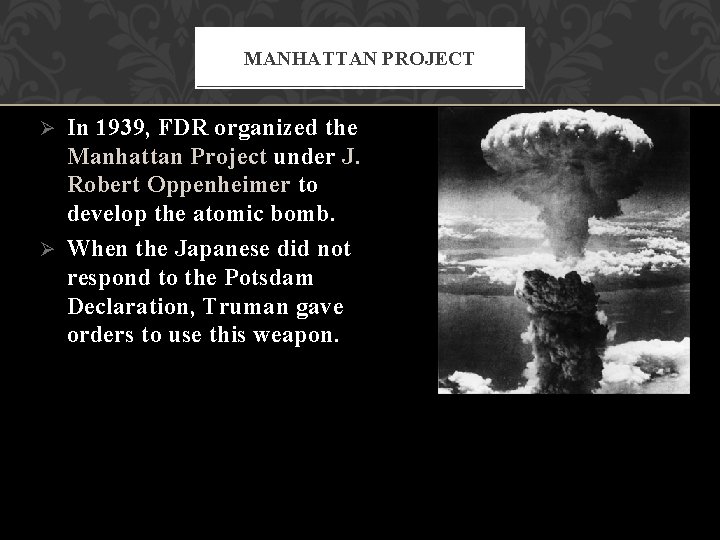
MANHATTAN PROJECT In 1939, FDR organized the Manhattan Project under J. Robert Oppenheimer to develop the atomic bomb. Ø When the Japanese did not respond to the Potsdam Declaration, Truman gave orders to use this weapon. Ø
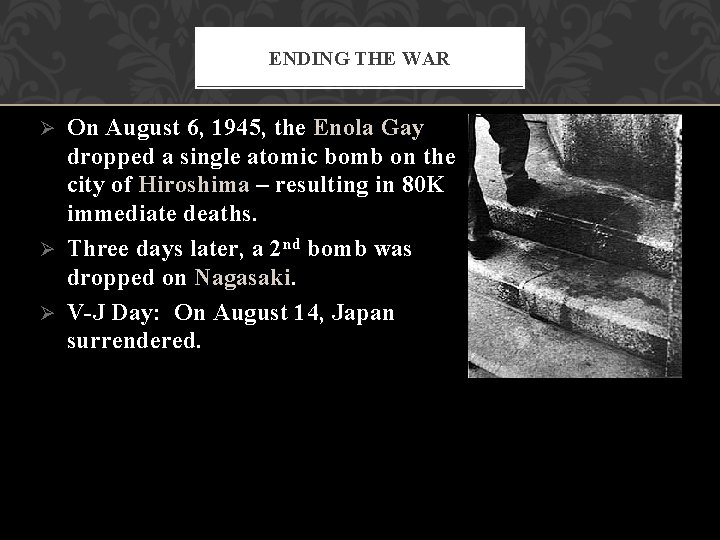
ENDING THE WAR On August 6, 1945, the Enola Gay dropped a single atomic bomb on the city of Hiroshima – resulting in 80 K immediate deaths. Ø Three days later, a 2 nd bomb was dropped on Nagasaki. Ø V-J Day: On August 14, Japan surrendered. Ø
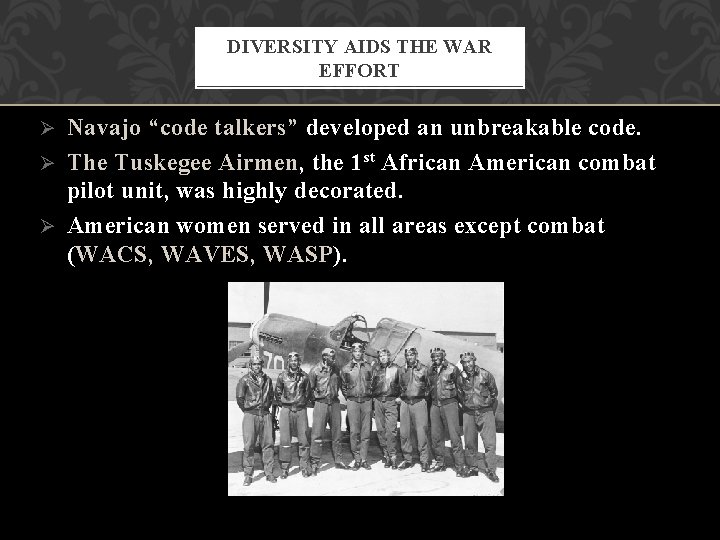
DIVERSITY AIDS THE WAR EFFORT Navajo “code talkers” developed an unbreakable code. Ø The Tuskegee Airmen, the 1 st African American combat pilot unit, was highly decorated. Ø American women served in all areas except combat (WACS, WAVES, WASP). Ø
THE WAR AT HOME Ø Factories converted to war production: o Ford Motor Company built B-24 bombers. o Mass-production techniques were applied to ship building. Liberty ships were large, sturdy merchant ships that carried supplies or troops. Many goods were rationed, and citizens were involved in the war effort. Ø Victory gardens produced about 1/3 of the country’s fresh vegetables. Ø
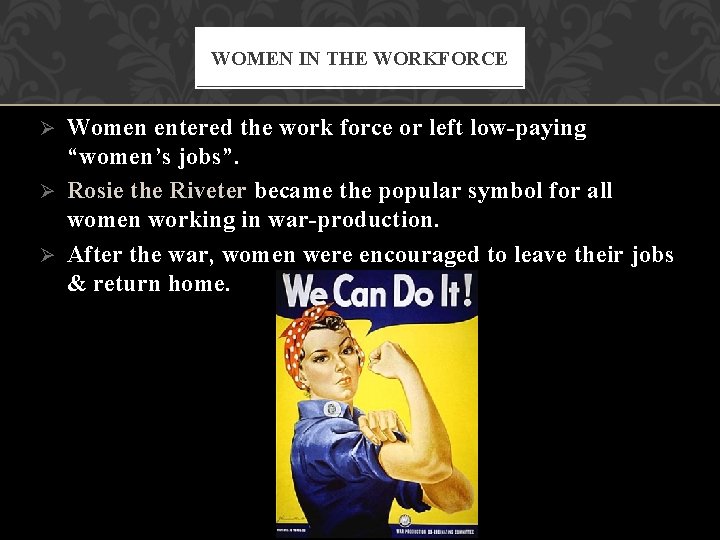
WOMEN IN THE WORKFORCE Women entered the work force or left low-paying “women’s jobs”. Ø Rosie the Riveter became the popular symbol for all women working in war-production. Ø After the war, women were encouraged to leave their jobs & return home. Ø
NEW TECHNOLOGIES Dr. Charles Drew developed methods that geared blood plasma collection to mass production. Ø New weaponry included the atomic bomb & V-1 rockets Ø Radar & sonar made detecting enemy crafts possible Ø
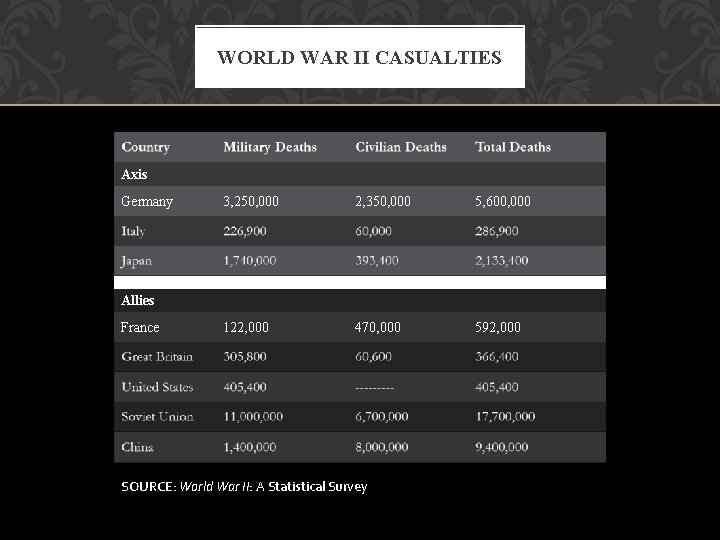
WORLD WAR II CASUALTIES Axis Germany 3, 250, 000 2, 350, 000 5, 600, 000 122, 000 470, 000 592, 000 Allies France SOURCE: World War II: A Statistical Survey
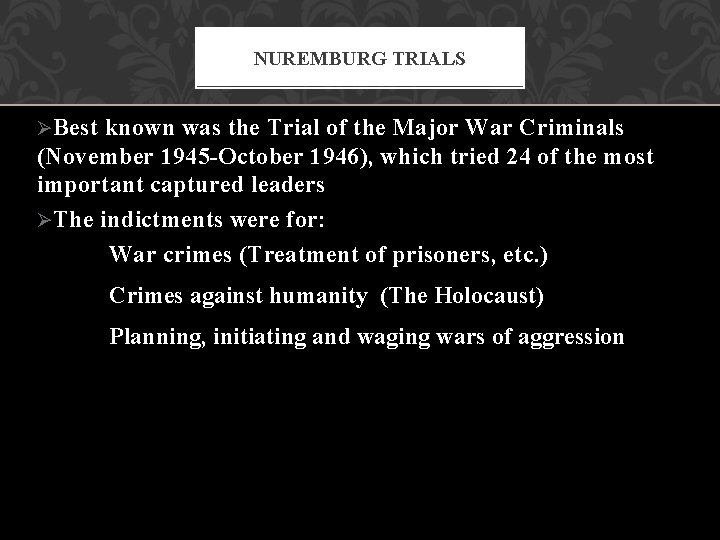
NUREMBURG TRIALS ØBest known was the Trial of the Major War Criminals (November 1945 -October 1946), which tried 24 of the most important captured leaders ØThe indictments were for: War crimes (Treatment of prisoners, etc. ) Crimes against humanity (The Holocaust) Planning, initiating and waging wars of aggression