
World War I Year by Year World War
World War I: Year by Year

World War I: Year by Year �When the First World War broke out in 1914, the mood was almost festive. Most people believed it would be a short war that would solve many of the problems of the competing nations. As the war dragged on, it became a battle of attrition. Victory came down to a simple question: which nation could continue to supply soldiers and weapons in order to outlast the others? �In this seminar, students will study the events occurring in four periods of time: 1914; 1915 -16; 1917; 1918. Using primary and secondary sources, students will attempt to answer the following question: “How was [year] significant in the course of the war in terms of the front lines and the home front? ”
The following are some questions/options to consider as you prepare to participate in your seminar: �To what extent did the home front change or reflect the reality of the front lines? Determine and describe the key events or turning points that help exemplify this interplay. �What strategies or tactics were used in an effort to end the war? How successful were they and how were they evolving? �Using specific artists or poets, examine the role imagination played in trying to bring the realities of the front to people at home. �How does [insert year] reflect total war?
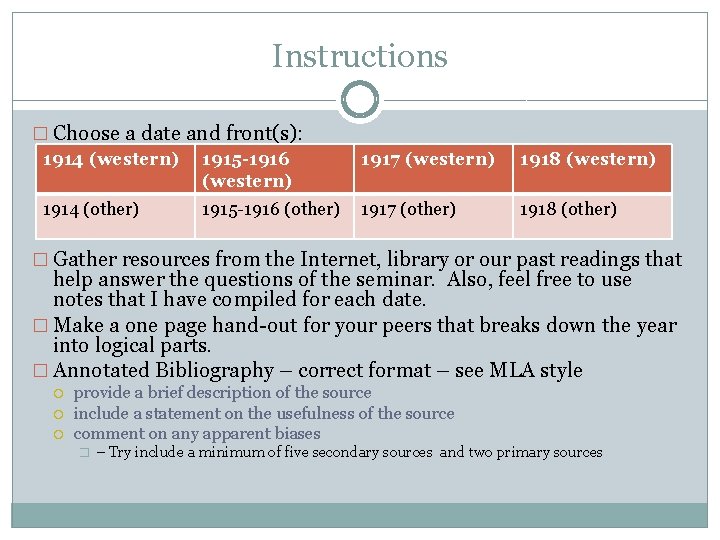
Instructions � Choose a date and front(s): 1914 (western) 1915 -1916 (western) 1914 (other) 1915 -1916 (other) 1917 (western) 1918 (western) 1917 (other) 1918 (other) � Gather resources from the Internet, library or our past readings that help answer the questions of the seminar. Also, feel free to use notes that I have compiled for each date. � Make a one page hand-out for your peers that breaks down the year into logical parts. � Annotated Bibliography – correct format – see MLA style provide a brief description of the source include a statement on the usefulness of the source comment on any apparent biases � – Try include a minimum of five secondary sources and two primary sources
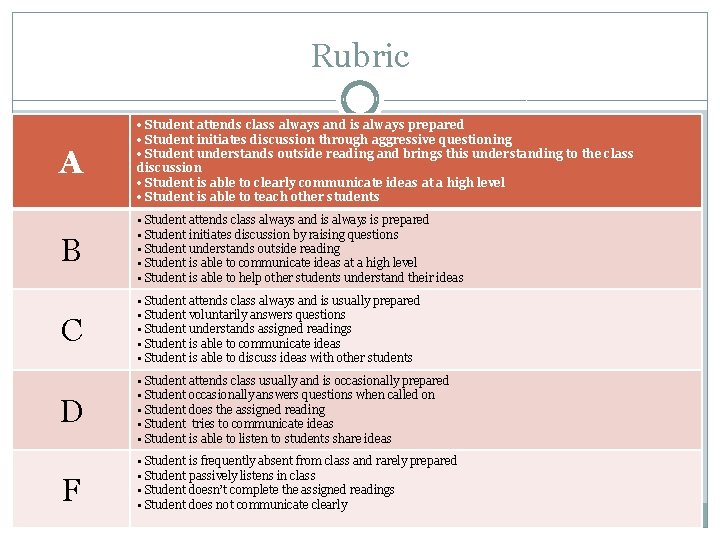
Rubric A • Student attends class always and is always prepared • Student initiates discussion through aggressive questioning • Student understands outside reading and brings this understanding to the class discussion • Student is able to clearly communicate ideas at a high level • Student is able to teach other students B • Student attends class always and is always is prepared • Student initiates discussion by raising questions • Student understands outside reading • Student is able to communicate ideas at a high level • Student is able to help other students understand their ideas C • Student attends class always and is usually prepared • Student voluntarily answers questions • Student understands assigned readings • Student is able to communicate ideas • Student is able to discuss ideas with other students D • Student attends class usually and is occasionally prepared • Student occasionally answers questions when called on • Student does the assigned reading • Student tries to communicate ideas • Student is able to listen to students share ideas F • Student is frequently absent from class and rarely prepared • Student passively listens in class • Student doesn’t complete the assigned readings • Student does not communicate clearly
- Slides: 5