
World War I World War I The Aftermath
- Slides: 17
World War I •
World War I The Aftermath
SSWH 17 - Demonstrate an understanding of longterm causes of World War I and its global impact. • c. Explain the major decisions made in the Versailles Treaty, include: German reparations & the mandate system that replaced Ottoman control
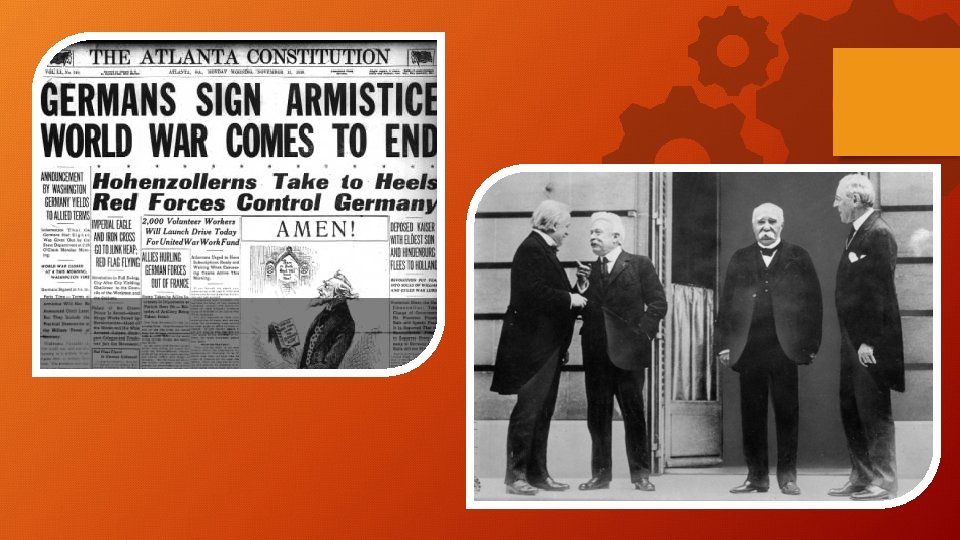
World War I: The Aftermath • 1919 – The war ends with the Allies defeating the Central Powers • November 11 th, 1918 – Germany surrenders to Allies • Central Powers felt that all the countries of Europe involved were equally responsible for the war • Expected this to be reflected in the peace treaty • This did not happen • Paris Peace conference begins in 1919 • Dominated by the United States, Britain, France and Italy • Felt that Central Powers should be punished harshly, Germany in particular
World War I: Paris Peace Conference • Group of leaders known as the Big Four • U. S. president Woodrow Wilson • French ruler Georges Clemenceau • David Lloyd George of Great Britain • Vittorio Orlando of Italy
World War I: Paris Peace Conference • U. S. President Woodrow Wilson • 14 Points – Plan to make this “War to End All Wars” • Britain, France, and Italy leaders were less concerned with this idealistic goal and more concerned with punishing the Central Powers for causing the war • In the end the treaties that emerged from the conference included some of the idealism of Wilson’s 14 Points & a great deal of the punishment planned by the European representatives • While 5 treaties were actually negotiated & executed (one for each of the defeated nations), the treaty imposed on Germany, the Versailles Treaty, proved the most consequential
World War I: Treaty of Versailles • Included ideas from Wilson’s 14 Points • League of Nations - international body designed to prevent war by creating a forum for conflict resolution • Wilson’s beliefs about national self-determination were largely realized with the creation of new countries: • Poland, Yugoslavia, Czechoslovakia, Finland, Latvia, Lithuania, Estonia, Austria, & Hungary out of lands once controlled by the German, Russian, and Austro. Hungarian Empires • Wilson’s calls for decolonization were heard with the creation of the mandate system
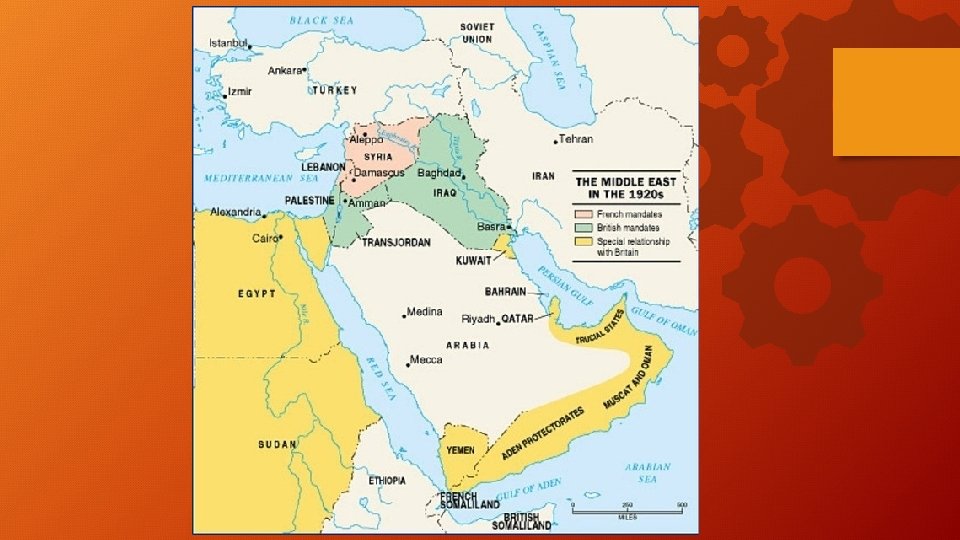
World War I: Treaty of Versailles • Included ideas from Wilson’s 14 Points • According to the treaty, the overseas colonies of Germany & non-Turkish speaking lands of the Ottoman Empire were to become temporary mandates of the League of Nations • As a mandate, each of these territories would be temporarily assigned to one of the Allied powers, mostly Britain & France • The mandate holder was supposed to administer the territory temporarily while preparations were made for independence • In practice most of the mandates simply proved to be new colonies for the mandate holder • In the long-term, the mandates in the Middle East proved the most consequential • In the British mandate of Palestine, Britain promised in the Balfour Declaration to create a Jewish State, over time this created conflict with the Palestinian Arabs already living in the region
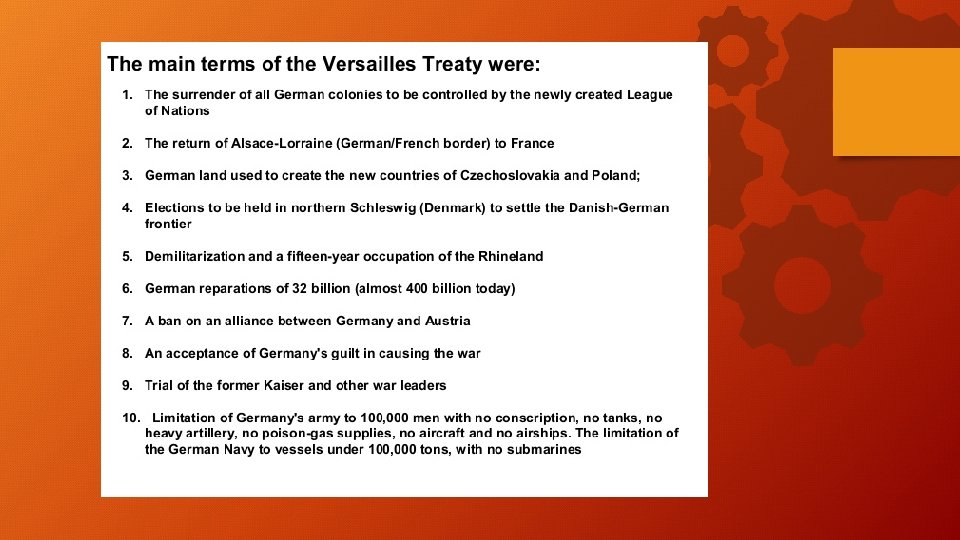
World War I: Treaty of Versailles • These provisions designed to punish Germany humiliated the German people & laid the foundation for the rise of Hitler in the 1930 s • They also aggravated the U. S. Senate who refused to ratify the Treaty of Versailles • Without ratification, the United States never joined the League of Nations • Without the United States as a member, the League of Nations was severely weakened & failed to maintain peace in the years leading to up to World War II
World War I Collapse of Empires
SSWH 17 - Demonstrate an understanding of longterm causes of World War I and its global impact. • d. Analyze the destabilization of Europe in the collapse of the great empires
World War I: Fall of Empires • After WWI, 4 great European empires came to an end • The German Reich under the Hohenzollern dynasty ended & was replaced by the Weimar Republic • The Weimar government was generally weak & ineffective because of a lack of public confidence as well as political infighting among the multitude of political parties • The Habsburg dynasty of Austria-Hungary fell as this empire was split into several successor states • Austria became a republic • Hungary went through a period of political instability during which it had succession of governments • In Russia, 300 years of Romanov rule ended with the Bolshevik Revolution, replacing the tsars with communist party rule
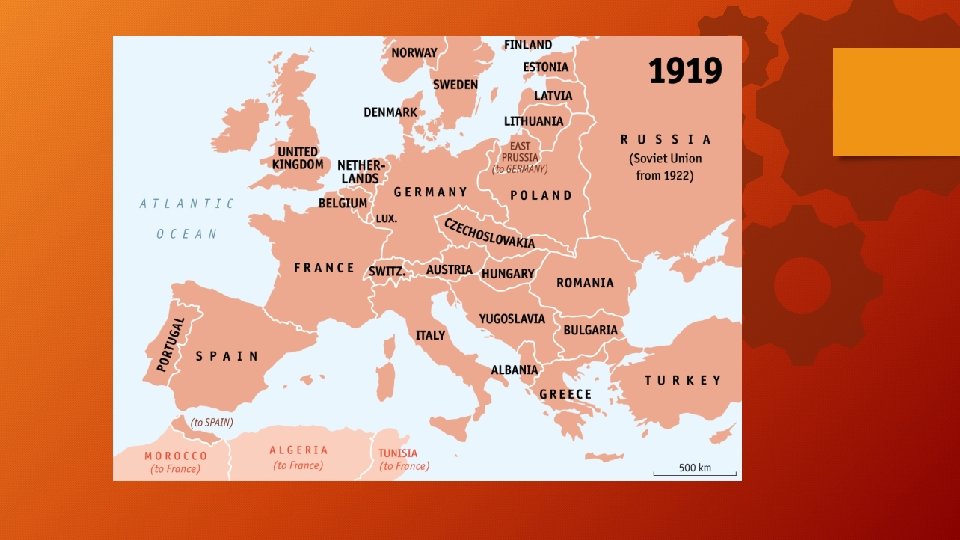
World War I: Fall of Empires • In the territory lost by these empires several new nation-states were created, including Poland, Yugoslavia, Czechoslovakia, Finland, Latvia, Lithuania, & Estonia. • Political, social & economic insecurity dominated in these new states in the years after the war. • To the south, the Ottoman Empire ended in 1922 when the Ottoman sultan was replaced by the Turkish Republic.