
World War I Breaks Out n n The
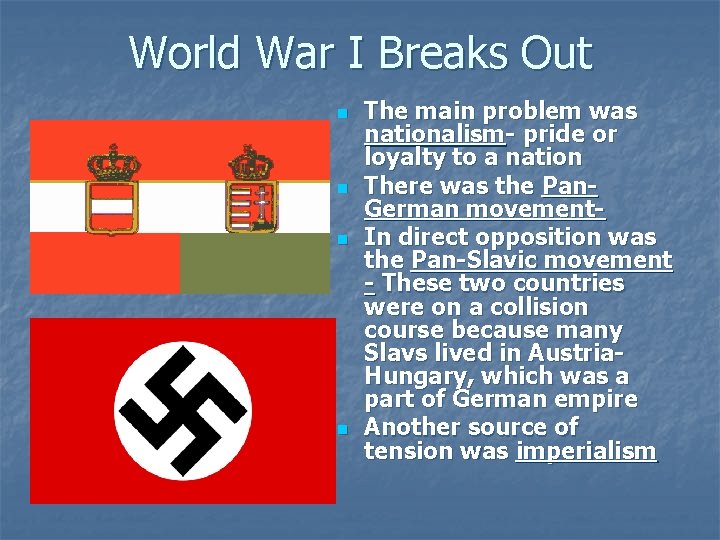
World War I Breaks Out n n The main problem was nationalism- pride or loyalty to a nation There was the Pan. German movement. In direct opposition was the Pan-Slavic movement - These two countries were on a collision course because many Slavs lived in Austria. Hungary, which was a part of German empire Another source of tension was imperialism
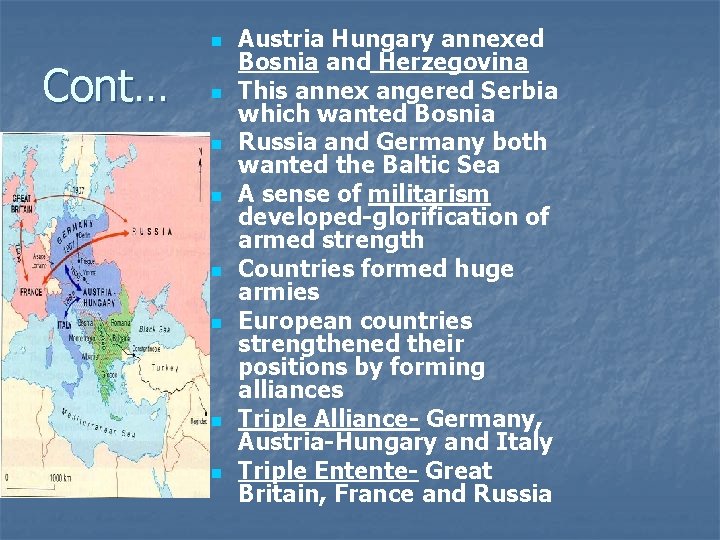
n Cont… n n n n Austria Hungary annexed Bosnia and Herzegovina This annex angered Serbia which wanted Bosnia Russia and Germany both wanted the Baltic Sea A sense of militarism developed-glorification of armed strength Countries formed huge armies European countries strengthened their positions by forming alliances Triple Alliance- Germany, Austria-Hungary and Italy Triple Entente- Great Britain, France and Russia
The spark that led to war n n n n Many people thought the incident would occur in the Balkans – the powder keg of Europe June 1914, Archduke Franz Ferdinand, the heir to the Austrian. Hungarian throne, went to visit Sarajevo the capital of Bosnia and Herzegovina He was assassinated by a Serbian named Gavrilo Princip Austria-Hungary declared war on Serbia Russia sided with Serbia Germany sided with Austria-Hungary France and Great Britain declared war on Austria-Hungary Italy joined in 1915 with France, Great Britain, Russia as the Allied Powers
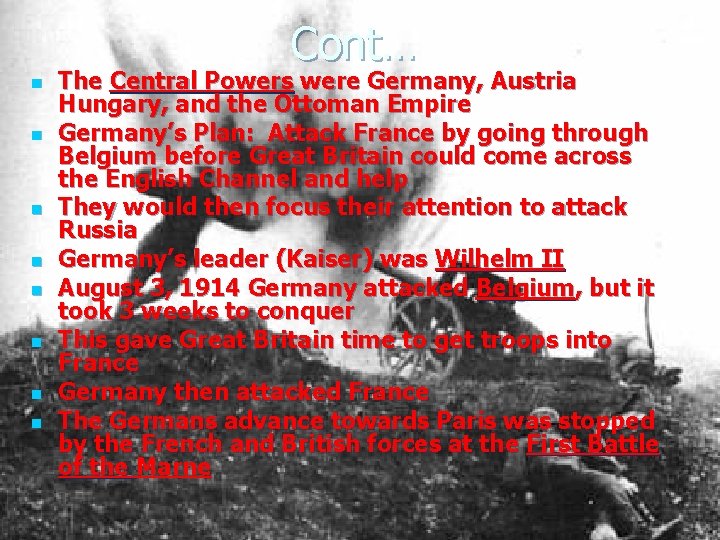
Cont… n n n n The Central Powers were Germany, Austria Hungary, and the Ottoman Empire Germany’s Plan: Attack France by going through Belgium before Great Britain could come across the English Channel and help They would then focus their attention to attack Russia Germany’s leader (Kaiser) was Wilhelm II August 3, 1914 Germany attacked Belgium, but it took 3 weeks to conquer This gave Great Britain time to get troops into France Germany then attacked France The Germans advance towards Paris was stopped by the French and British forces at the First Battle of the Marne
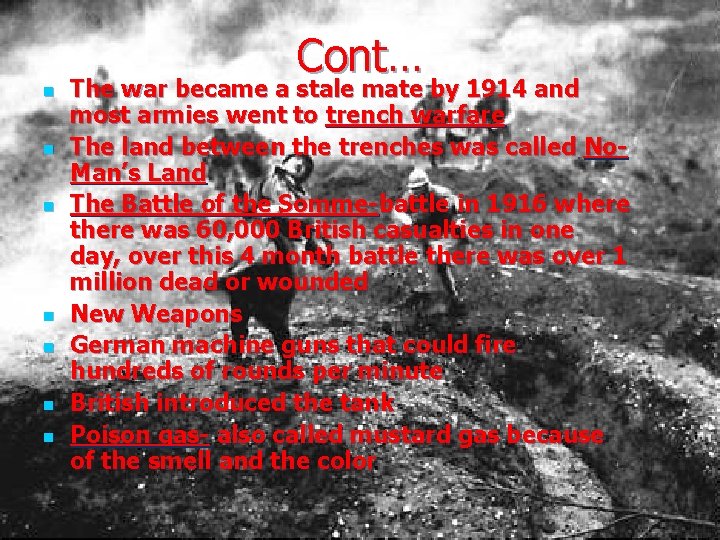
Cont… n n n n The war became a stale mate by 1914 and most armies went to trench warfare The land between the trenches was called No. Man’s Land The Battle of the Somme-battle in 1916 where there was 60, 000 British casualties in one day, over this 4 month battle there was over 1 million dead or wounded New Weapons German machine guns that could fire hundreds of rounds per minute British introduced the tank Poison gas- also called mustard gas because of the smell and the color
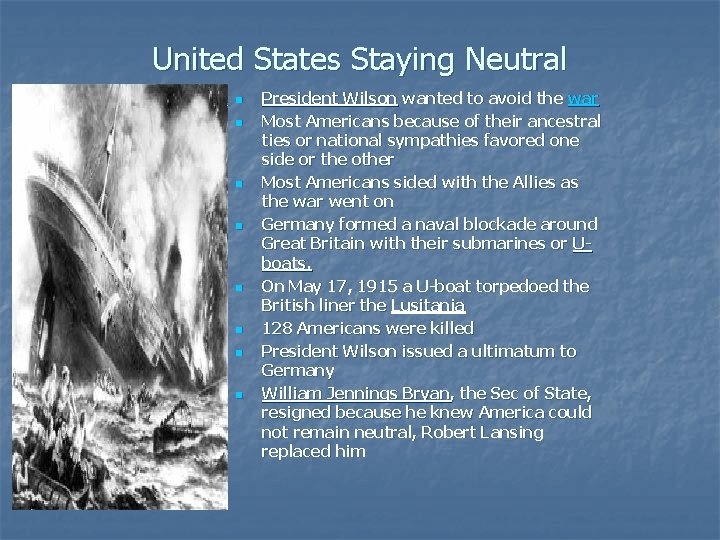
United States Staying Neutral n n n n President Wilson wanted to avoid the war Most Americans because of their ancestral ties or national sympathies favored one side or the other Most Americans sided with the Allies as the war went on Germany formed a naval blockade around Great Britain with their submarines or Uboats. On May 17, 1915 a U-boat torpedoed the British liner the Lusitania 128 Americans were killed President Wilson issued a ultimatum to Germany William Jennings Bryan, the Sec of State, resigned because he knew America could not remain neutral, Robert Lansing replaced him
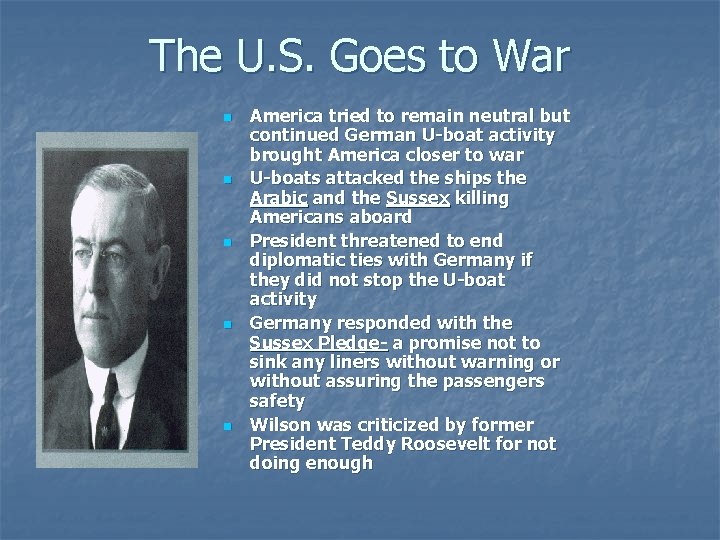
The U. S. Goes to War n n n America tried to remain neutral but continued German U-boat activity brought America closer to war U-boats attacked the ships the Arabic and the Sussex killing Americans aboard President threatened to end diplomatic ties with Germany if they did not stop the U-boat activity Germany responded with the Sussex Pledge- a promise not to sink any liners without warning or without assuring the passengers safety Wilson was criticized by former President Teddy Roosevelt for not doing enough
Cont… n n Robert Lansing, the new Sec. of State, encouraged trade with the Allies though President Wilson had Congress pass the National Defense Act- a military preparedness program that increased the size of the National Guard and Army Germany continued to break their Sussex Pledge by sinking 5 American ships The final straw was when Germany issued the Zimmerman Note to Mexico- a note that wanted Mexico to form an alliance with Germany and have Mexico attack the U. S. and Germany would help Mexico reconquer the lands of New Mexico, Texas, and Arizona
Congress Declares War n n n Congress declared war on Germany in April 1917 Not everyone supported the war Jeanette Rankin, a Congresswoman from Montana, opposed going to war She also opposed WWII in 1941 In May 1917, Congress passed the Selective Service Act- required men between the ages of 21 -30 to register for the draft Many Americans hoped the draft would end discrimination in the U. S. , but in reality all units were segregated by race
Over There n n n n American troops went to Europe as part of the American Expeditionary Force (AEF) under the leadership of John Pershing Americans made it to Europe using the convoy system- the use of armed vessels to accompany unarmed vessels transporting troops and supplies America arrived just in time as the Russians were getting out of war The Russian people were upset with the working and living conditions, overthrew Czar Nicolas The Bolsheviks, part of the Russian Communists party, took over Their leader was Vladimir Lenin The Bolsheviks signed the Brest-Litovsk Treaty with the Central Powers allowing them to concentrate all their forces on the western front
Germany’s Last Bid for Victory n n In March 1918, Germany launched their last offensive at the Allies They launched 6, 000 “Big Berthas” – huge guns capable of firing 300 lbs shells 74 miles. The arrival of American troops saved the city of Paris In Sept of 1918 the Allies went on the offensive and attacked the Germans in the Sedan and the Argonne Forest
Cont… n n n Germany’s soldiers started to leave at the end of the war Wilhelm II left the country Germany’s new governmental leaders agreed to an armistice- a cease fire November 11, 1918 at 11: 00 A. M. the cease fire went into effect. “Veteran’s Day”
The War at Home n n Sec. of Treasury, William Mc. Adoo, had to find a way to pay for the cost of the war, which was at $33 billion He had people buy Liberty Bonds and Victory Bonds This raised about $23 billion the government also raised taxes
Conserving Food and Fuel n n Herbert Hoover--Had Americans observe wheat less and meatless days Americans planted “Victory Gardens” to supplement their diet Fuel Administration- directed by Harry Garfield Wanted people to observe heatless Mondays
Mobilizing Labor n n n African Americans came North in pursuit of jobs This becomes known as the Great Migration They still faced racial violence in the North though
The League of Nations n n Wilson developed a program to bring peace to the world known as the Fourteen Points The heart of his program was the final point the establishment of the League of Nations Wilson went to France in Dec. 1918 to bring peace European leaders were not very receptive to letting Wilson run the peace talks because America entered the war late
The Paris Peace Conference n n Occurred in Jan 1919 with leaders of the other Allied countries Became known as the Big Four U. S. -Italy-Great Britain-France All wanted to make sure Germany was punished!!
Treaty of Versailles n n Treaty of Versailles- Signed June 28, 1919 All of Germany’s colonies were given to the Allies New countries were created. Czechoslovakia, Yugoslavia, Finland, Estonia, Latvia, Lithuania, and Poland The league would have 5 permanent members- France, Great Britain, U. S. , Italy, and Japan
Cont… n n Article 10 of the League of Nations was the most important part It required each member nation to “respect and preserve” the independence and territorial integrity of all other member nations
Cont. . n n n Germany and Russia suffered the greatest human loss during WWI Germany was completely destroyed economically as well This will potentially lead to WWII!!!
- Slides: 21