
World War I and the 1920 s 1914

- Slides: 22
World War I and the 1920 s (1914 -1929) Lesson 7 The Roaring Twenties
World War I and the 1920 s (1914 -1929) Lesson 7 The Roaring Twenties Learning Objectives • • • Describe how increased leisure time and technological innovations led to a widespread shared popular culture in the 1920 s. Analyze the changing role of women in the 1920 s. Describe how the concept of modernism shown in art and literature reflected postwar disillusionment.
World War I and the 1920 s (1914 -1929) Lesson 7 The Roaring Twenties Key Terms • • • Charlie Chaplin The Jazz Singer Babe Ruth Charles Lindbergh flapper Sigmund Freud “Lost Generation” F. Scott Fitzgerald Ernest Hemingway
Popular American Culture in the 1920 s The automobile reshaped American culture, creating new forms of recreation and making it easier for people to travel. Other factors also contributed to changing ways of daily life. Americans listened to the radio, went to the movies, and followed the exploits of sports heroes. In the process, a new mass culture emerged—one whose shape and character closely resemble our own.
Popular American Culture in the 1920 s • • Americans Enjoy More Leisure Time Innovation in the Motion Picture Industry The Radio Impacts American Society Americans Share Music With the Phonograph
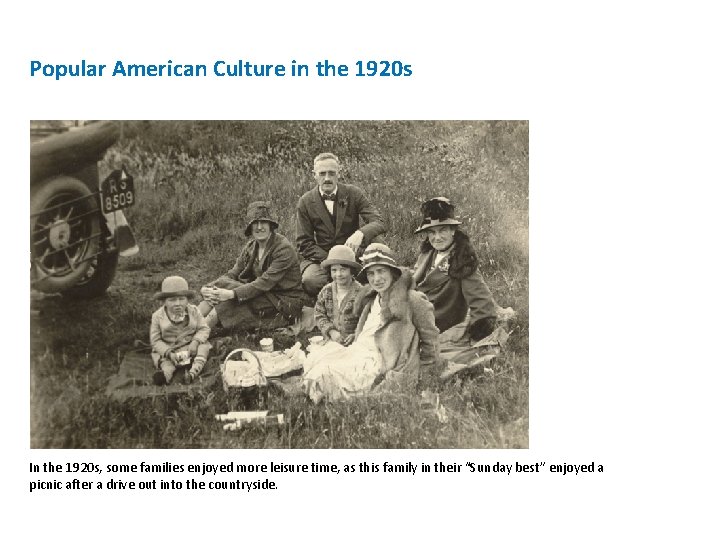
Popular American Culture in the 1920 s In the 1920 s, some families enjoyed more leisure time, as this family in their “Sunday best” enjoyed a picnic after a drive out into the countryside.
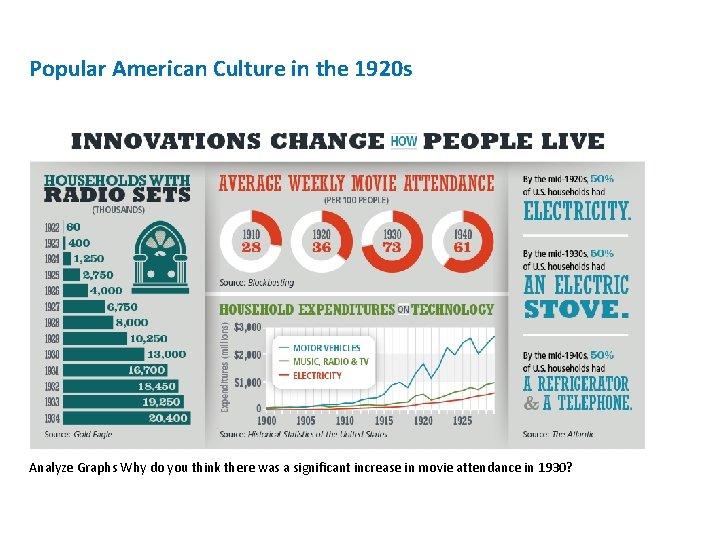
Popular American Culture in the 1920 s Analyze Graphs Why do you think there was a significant increase in movie attendance in 1930?
American Role Models Hollywood’s chief rivals for the creation of heroes were the nation’s baseball parks, football fields, and boxing rings. Before the 1920 s, there were relatively few nationally famous athletes, such as boxer John L. Sullivan and all-around athlete Jim Thorpe. Most sports stars were local heroes. This changed by the 1920 s, often called the Golden Age of Sports.
American Role Models • • Media Coverage Creates Sports Heroes A Transatlantic Flight
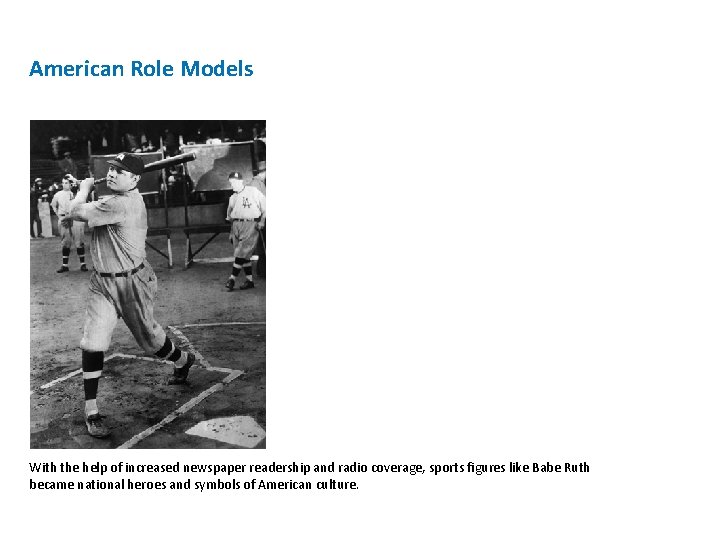
American Role Models With the help of increased newspaper readership and radio coverage, sports figures like Babe Ruth became national heroes and symbols of American culture.
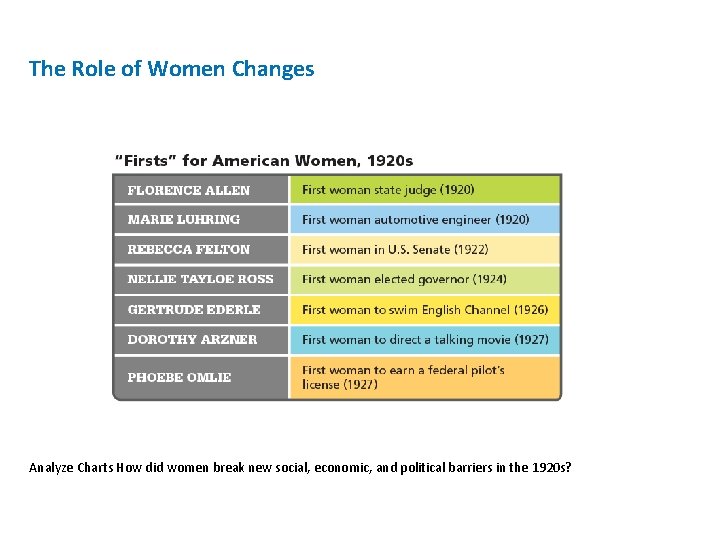
The Role of Women Changes In a 1931 book, Only Yesterday, journalist Frederick Lewis Allen attempted to make sense of the fads, heroes, and problems of the 1920 s. Featured prominently was the New Woman. During the decade, many women challenged political, economic, social, and educational boundaries to prove that their role was as vital outside the home as inside it. Women's roles began to change in many ways, caused by the overall changes that society was undergoing, as well as the passage of the Nineteeth Amendment in 1920. The effect of these changes was that women made more and more contributions to shape American culture.
The Role of Women Changes • • • Flappers Push Back Against Expectations Women’s Political Rights Life at Home Changes
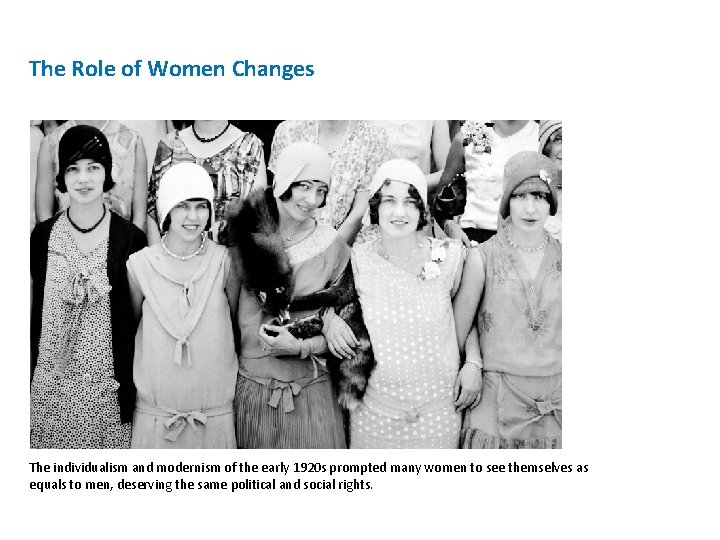
The Role of Women Changes The individualism and modernism of the early 1920 s prompted many women to see themselves as equals to men, deserving the same political and social rights.
The Role of Women Changes Analyze Charts How did women break new social, economic, and political barriers in the 1920 s?
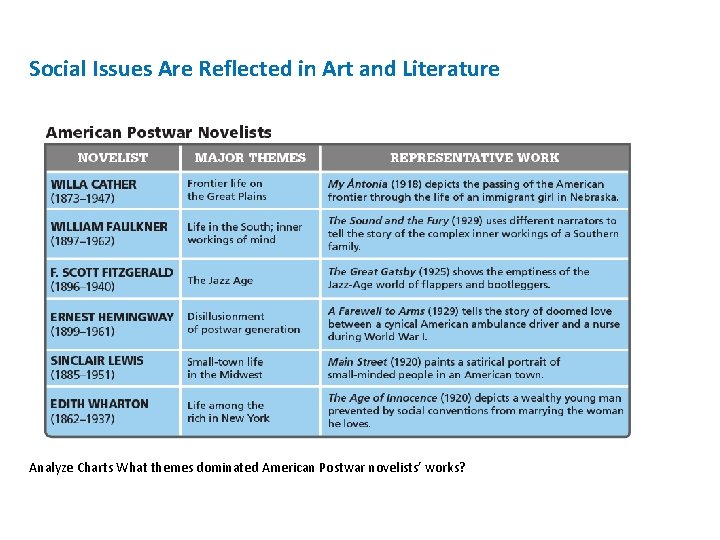
Social Issues Are Reflected in Art and Literature No area of American life, however, reflected the impact of World War I more than literature and the arts. The war altered the way writers and artists viewed the world, changed the way they approached their craft, and inspired them to experiment with new forms and fresh ideas.
Social Issues Are Reflected in Art and Literature • • • Postwar Uncertainty Modern Art Moves in New Directions Postwar American Literature Flowers
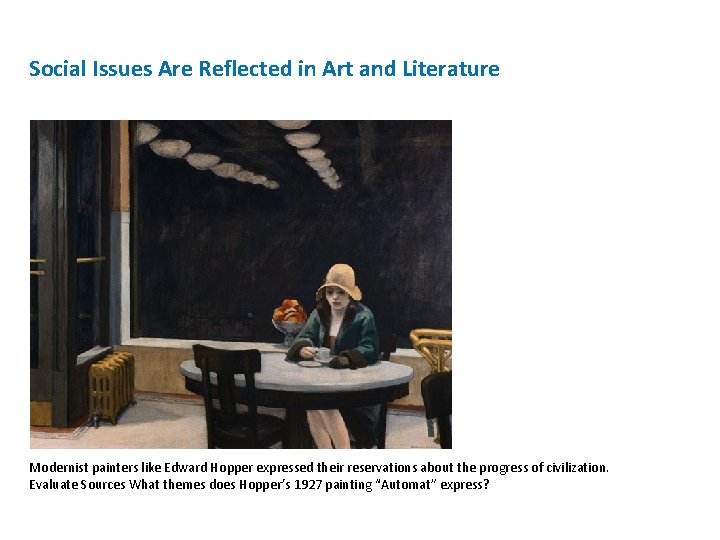
Social Issues Are Reflected in Art and Literature Modernist painters like Edward Hopper expressed their reservations about the progress of civilization. Evaluate Sources What themes does Hopper’s 1927 painting “Automat” express?
Social Issues Are Reflected in Art and Literature Analyze Charts What themes dominated American Postwar novelists’ works?
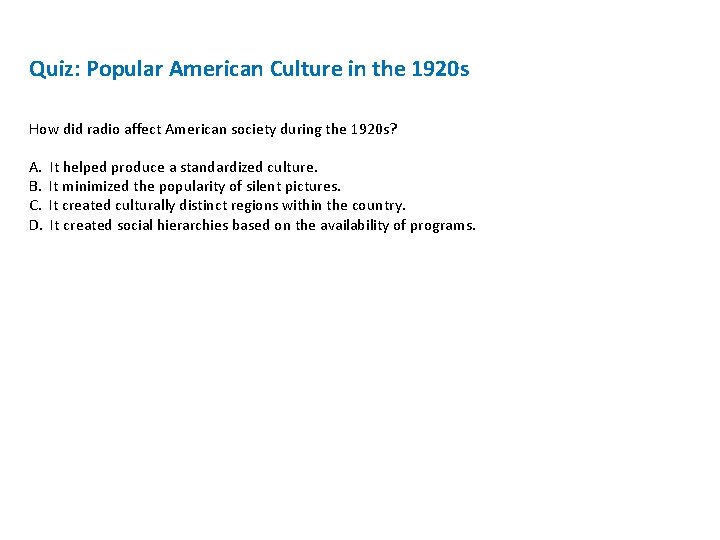
Quiz: Popular American Culture in the 1920 s How did radio affect American society during the 1920 s? A. B. C. D. It helped produce a standardized culture. It minimized the popularity of silent pictures. It created culturally distinct regions within the country. It created social hierarchies based on the availability of programs.
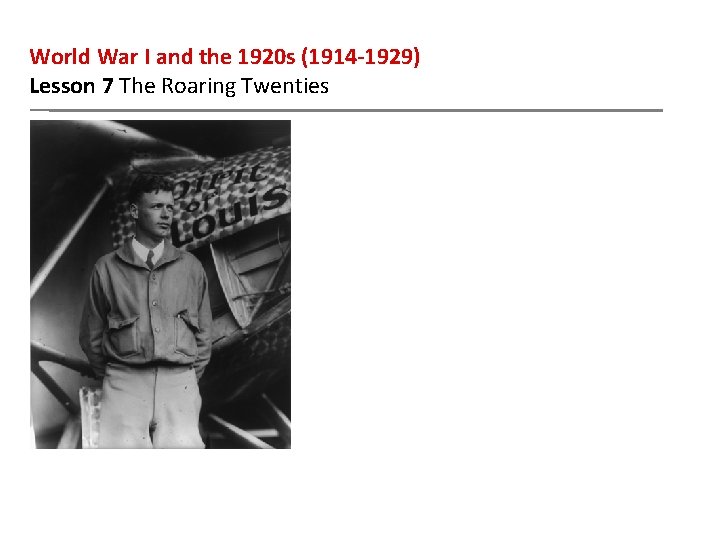
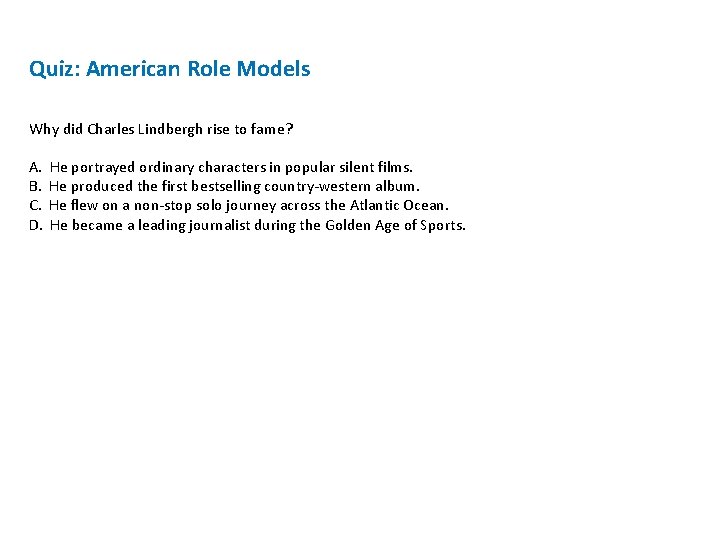
Quiz: American Role Models Why did Charles Lindbergh rise to fame? A. B. C. D. He portrayed ordinary characters in popular silent films. He produced the first bestselling country-western album. He flew on a non-stop solo journey across the Atlantic Ocean. He became a leading journalist during the Golden Age of Sports.
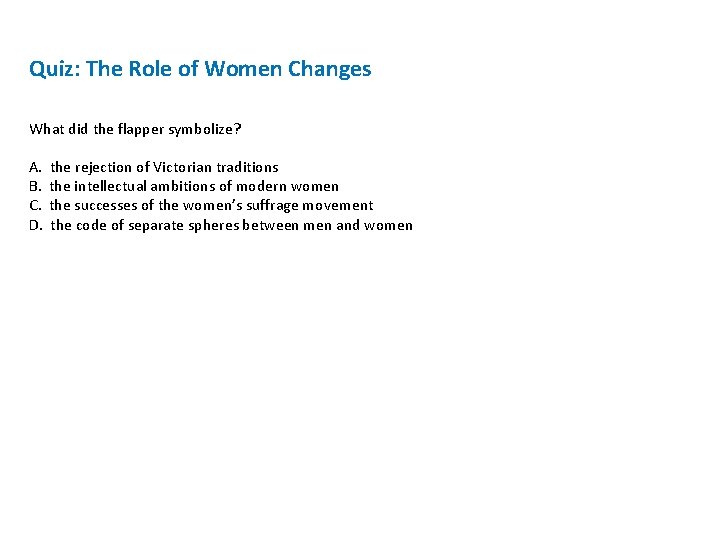
Quiz: The Role of Women Changes What did the flapper symbolize? A. B. C. D. the rejection of Victorian traditions the intellectual ambitions of modern women the successes of the women’s suffrage movement the code of separate spheres between men and women
Quiz: Social Issues Are Reflected in Art and Literature Who were the members of the “Lost Generation”? A. B. C. D. farmers that moved to the city after defaulting on their farms political radicals that opposed the U. S. government disillusioned American writers that sought new forms of expression U. S. citizens that left the United States to live in other countries