
World War I 1914 1919 War in Europe
- Slides: 92
World War I 1914 -1919
War in Europe Archduke Franz Ferdinand, the heir to the throne of the Austro-Hungarian Empire, visited Sarajevo, Bosnia and the streets were crowded with people anxious to see him All of a sudden, shots rang out and the archduke and his wife were hit and both died soon after The assassination crippled the balance of European stability and within weeks Europe was at war The tensions that led to WWI had roots that went back many years which all began when European nations dreamt of empires, built armies, and formed alliances
Nationalism – feeling of intense loyalty to one’s country or group This was the single cause which led to the war itself The two sides of nationalism: Side A: it encouraged new nations to unify and to establish their power in the world Side B: it inspired certain groups of people to break away from existing nations Ethnic groups – people who share a common language and traditions
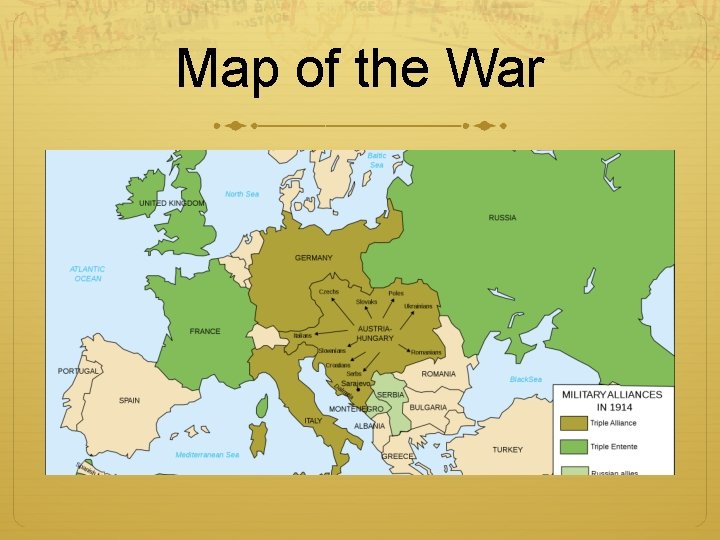
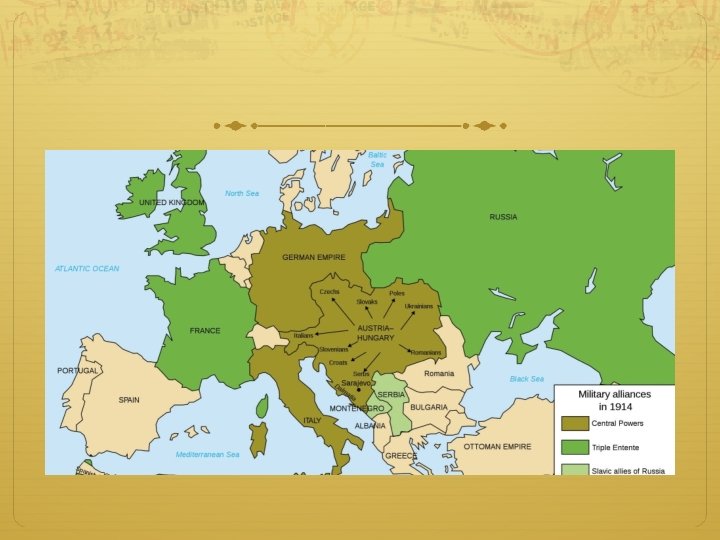
Map of the War
Imperial Expansion Nations desired to expand their empires and this caused tensions between neighboring countries They competed for colonies in Africa, Asia, and other parts of the world GB and France already possessed large overseas empires but they wanted to expand even more Germany, Italy, and Russia wanted to increase also and because few areas were left to colonize, this brought conflict when one nation began its expansion
Military Buildup Competing for colonies required a strong armies and navies If one nation increase its military strength its rivals felt threatened and built up their own military in response Germany, France, and Russia developed huge armies in the early 1900 s GB had the world’s largest and strongest navy because it was an island nation and when German’s began to challenge them, a bitter rivalry grew between them
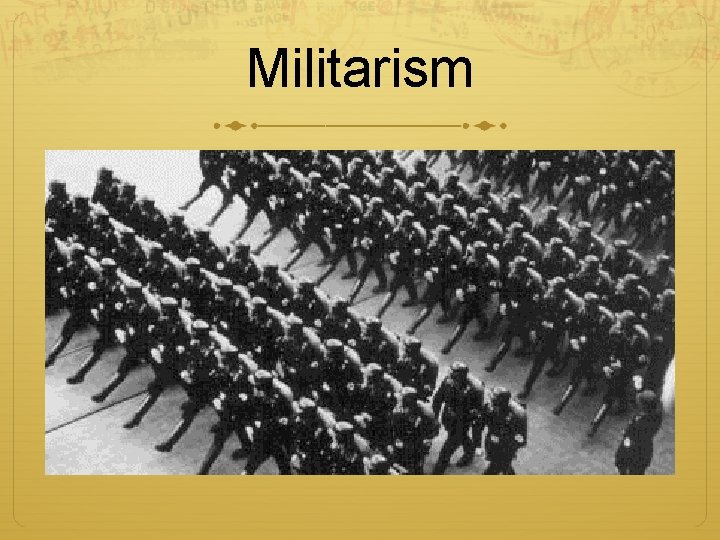
Militarism
Alliances Alliance System – the defense agreements among nations Militarism brought about alliance systems 1914 – two major alliances had been establish Triple Alliance – Germany, Austria-Hungary, and Italy Triple Entente – Great Britain, France, and Russia Entente – an understanding among nations
Alliances These alliances aimed to keep peace by creating a balance of power – a system that prevents any one country from domination the others An attack on one nation was all that was needed to trigger a war involving many countries Europe was like a powder keg which required “only a spark to set the whole thing off” The spark was in the Balkans
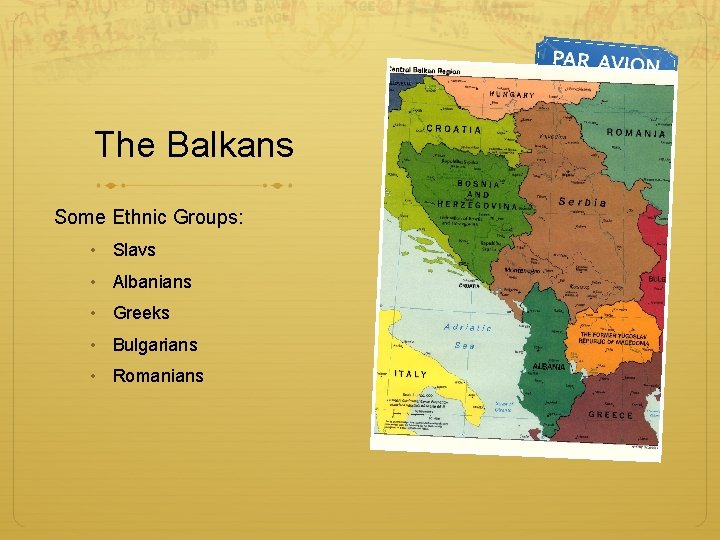
Crisis in the Balkans The Balkans are a peninsula which is located in southeastern Europe It was a hotbed of nationalist and ethnic rivalries Greece, Albania, Romania, and Bulgaria argued over territory, while Slavic nationalists hoped to unite all the Slavic peoples in the region There was a dispute between Austria-Hungary, whose Slavic people desired independence, and the neighboring nation of Serbia, which supported the Slavs and opposed the empire
The Balkans Some Ethnic Groups: • Slavs • Albanians • Greeks • Bulgarians • Romanians
Assassination Leads to War Gavrilo Princip, the assassin, was a member of a Serbian nationalist group and along with other terrorists they had plotted the murder to advance the cause of the unification of Slavic people Austria-Hungary blamed the Serbian government for the assassination and waited for Germany, its ally, for their support They sent a letter to Serbia listing harsh demand when Serbia refused, Austria-Hungary declared war on Serbia on July 28, 1914
Assassination Leads to War The system of alliances cause the war to spread Russia had agreed to protect Serbia and it was prepared for war This brought Germany to side with its ally, Austria. Hungary Germany declared war on Russia on August 1, 1914 and also declared war on France on August 3, 1914 because it knew France was an ally of Russia
Declarations of War August 4, 1914: Germany invades Belgium as part of a plan to sweep across eastern and northern France By doing this, Germany violates a treaty signed in 1839 which guaranteed Belgium its neutrality This invasion alarmed GB to honor its pledge to protect Belgium and they declared war on Germany
World War Begins The “Great War” had begun and there were two sides Allied Powers – Great Britain, France, Russia Japan joined the Allies because it was a rival of Germany Central Powers – Germany, Austria-Hungary, the Ottoman Empire Italy refused to honor its alliance with Germany and Austria-Hungary and instead joined the Allies after being promised territory in Austria after the war
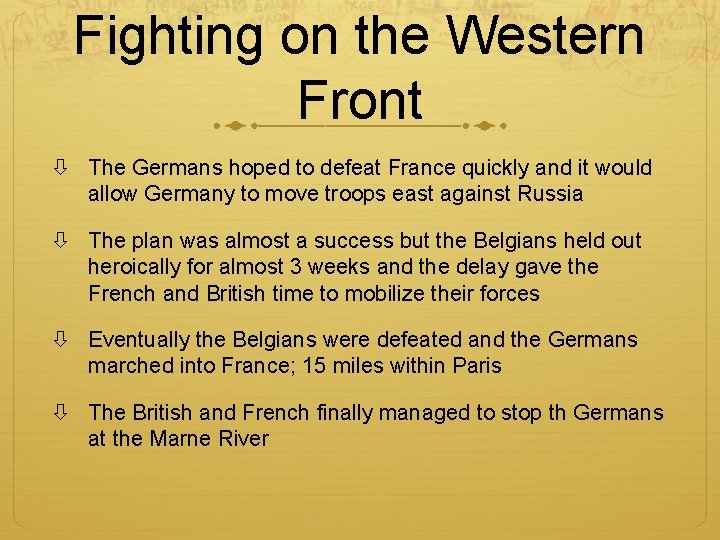
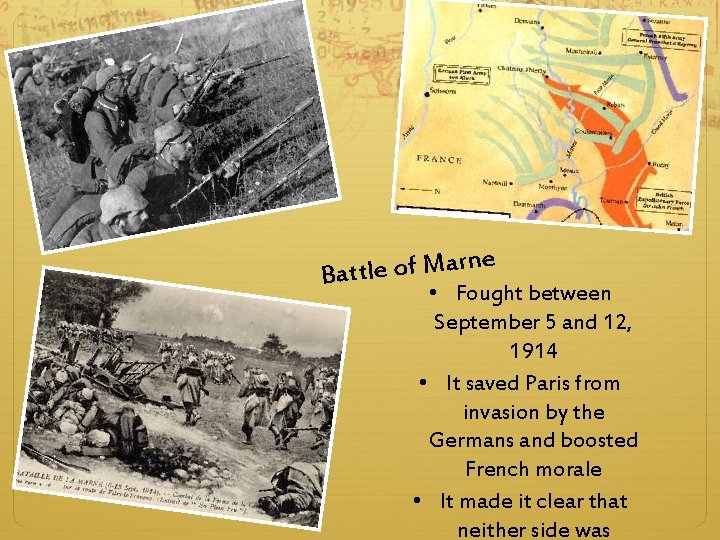
Fighting on the Western Front The Germans hoped to defeat France quickly and it would allow Germany to move troops east against Russia The plan was almost a success but the Belgians held out heroically for almost 3 weeks and the delay gave the French and British time to mobilize their forces Eventually the Belgians were defeated and the Germans marched into France; 15 miles within Paris The British and French finally managed to stop th Germans at the Marne River
e n r a M f o e l t Bat • Fought between September 5 and 12, 1914 • It saved Paris from invasion by the Germans and boosted French morale • It made it clear that neither side was
After the Battle of the Marne there was a stalemate and for the next three years, the opposing armies face each other across a network of deep trenches 1916: both sides attempted to break the deadlock by launching major offensives
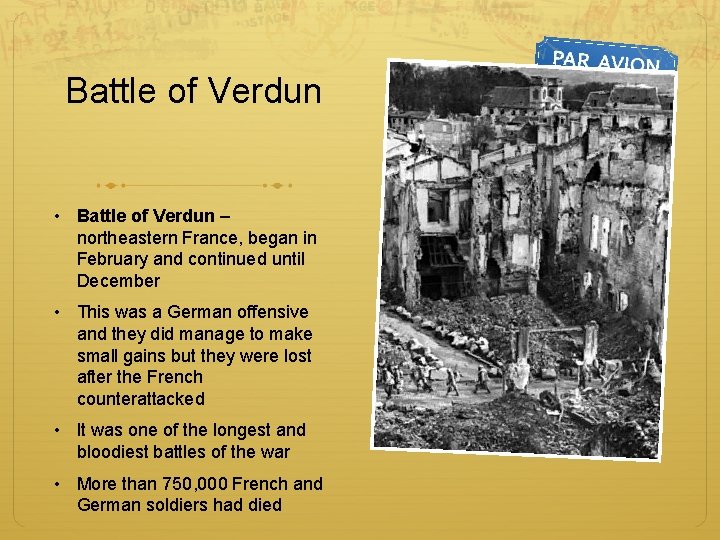
Battle of Verdun • Battle of Verdun – northeastern France, began in February and continued until December • This was a German offensive and they did manage to make small gains but they were lost after the French counterattacked • It was one of the longest and bloodiest battles of the war • More than 750, 000 French and German soldiers had died
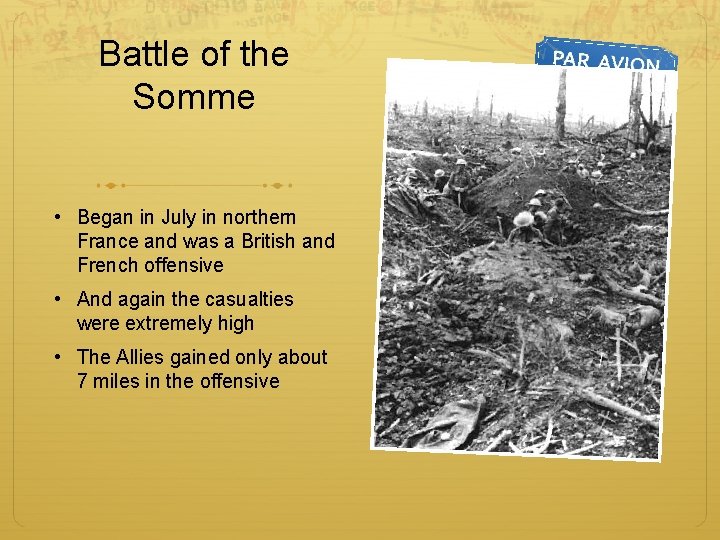
Battle of the Somme • Began in July in northern France and was a British and French offensive • And again the casualties were extremely high • The Allies gained only about 7 miles in the offensive
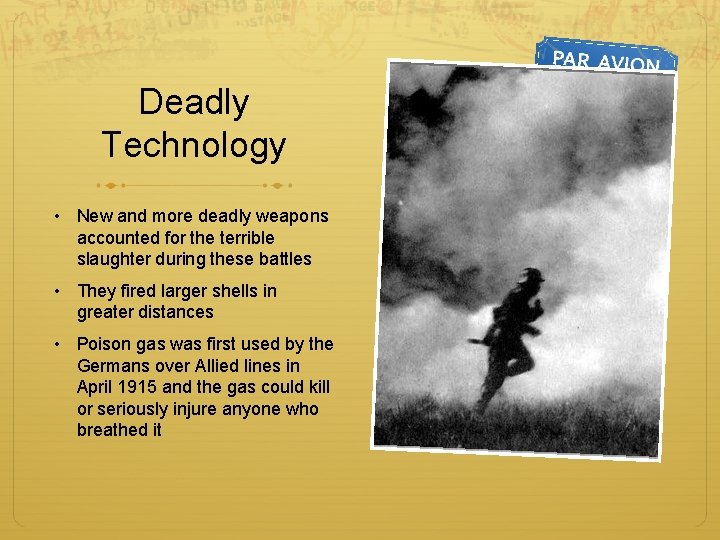
Deadly Technology • New and more deadly weapons accounted for the terrible slaughter during these battles • They fired larger shells in greater distances • Poison gas was first used by the Germans over Allied lines in April 1915 and the gas could kill or seriously injure anyone who breathed it
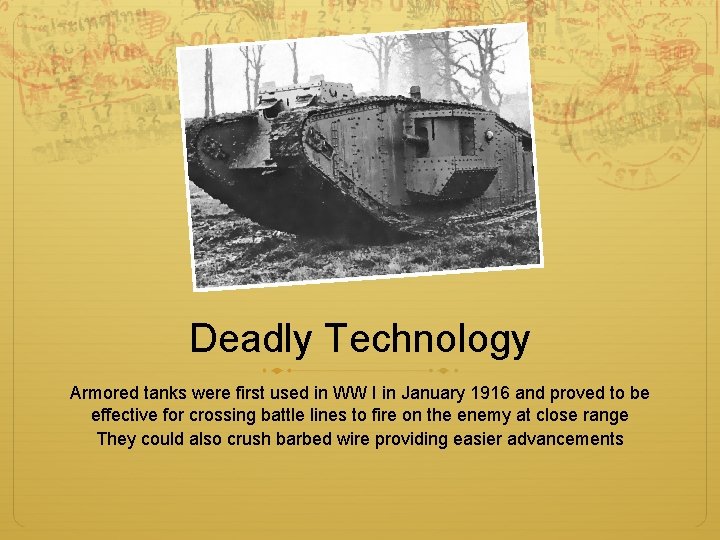
Deadly Technology Armored tanks were first used in WW I in January 1916 and proved to be effective for crossing battle lines to fire on the enemy at close range They could also crush barbed wire providing easier advancements
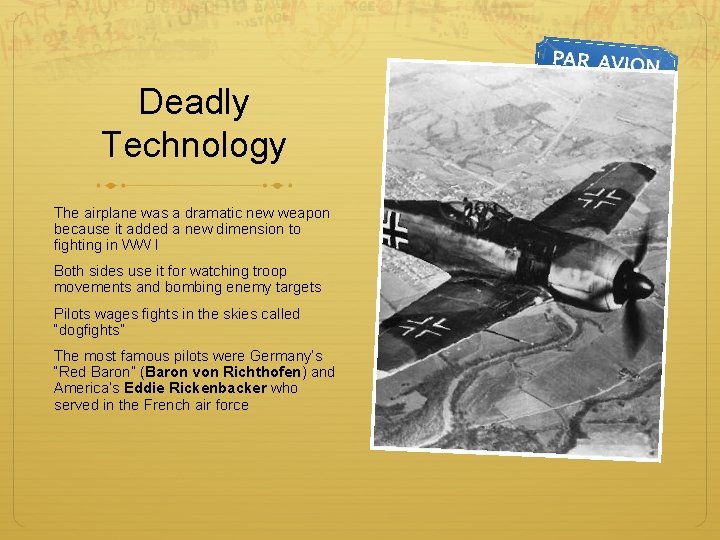
Deadly Technology The airplane was a dramatic new weapon because it added a new dimension to fighting in WW I Both sides use it for watching troop movements and bombing enemy targets Pilots wages fights in the skies called “dogfights” The most famous pilots were Germany’s “Red Baron” (Baron von Richthofen) and America’s Eddie Rickenbacker who served in the French air force
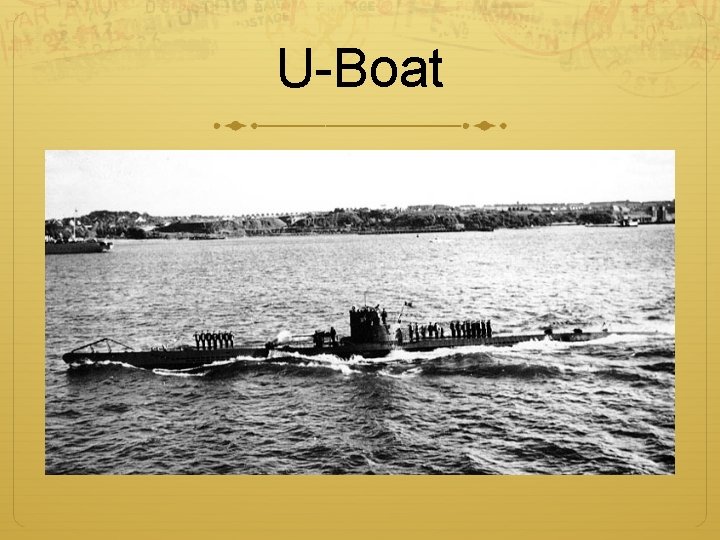
On the Seas Land armies were deadlocked and both sides looked to the sea to gain an advantage GB blockaded all orts under German control which caused major shortages Germans suffered from malnutrition and illness Germany had an effective naval weapon submarine called the U-boat (Unterseeboot) These U-boat attacks on ships eventually attacked the US and changed the course of the war
U-Boat
America’s Road to War World War I
American Neutrality President Wilson had to make very difficult decisions and declared that the US would remain neutral in the war Although many Americans believed the war did not concern them, still a good portion of Americans chose sides since more than 1/3 of the people were foreignborn or children of immigrants This made it a bit difficult for people to remain neutral; they still had families back in the warring European countries
American Neutrality 8 million Americans of German and Irish descent sided with the Central Powers because Preside Wilson and other Americans, sympathized with the Allied Powers because of links to Great Britain President Wilson: “Everything I love most in the world is at stake. A German victory would be fatal to our form of government and American ideals”
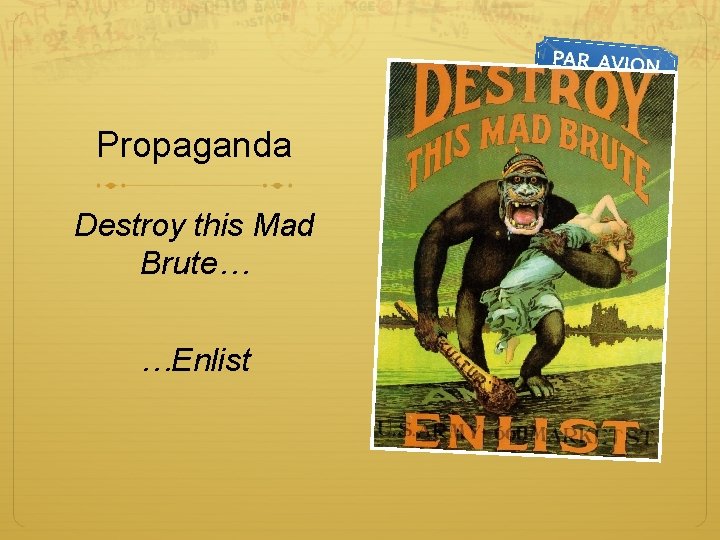
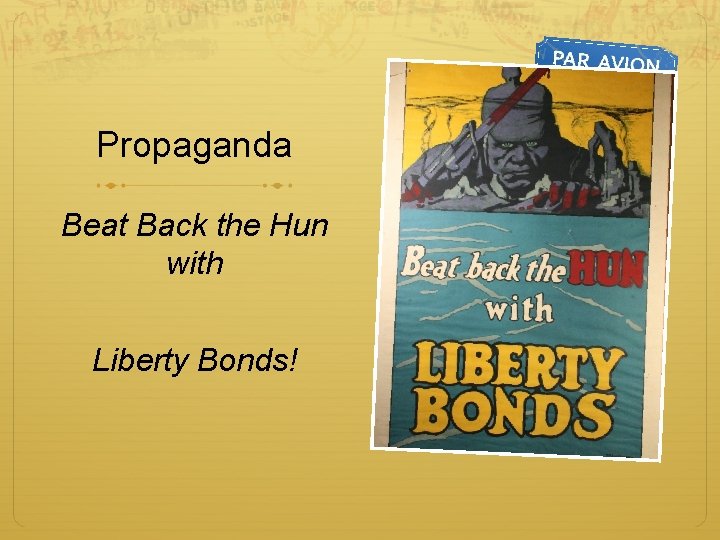
Using Propaganda – information designed to influence opinion Allied Propaganda Emphasized the German invasion of neutral Belgium and included horror stories of German atrocities They called the Germans, “Huns”, and pictured them as savage barbarians
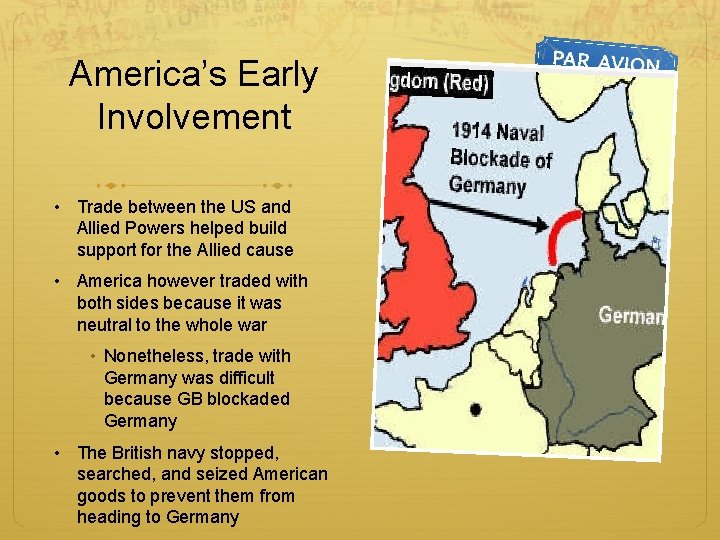
America’s Early Involvement • Trade between the US and Allied Powers helped build support for the Allied cause • America however traded with both sides because it was neutral to the whole war • Nonetheless, trade with Germany was difficult because GB blockaded Germany • The British navy stopped, searched, and seized American goods to prevent them from heading to Germany
America’s Early Involvement The US protested against the British claiming that they were neutral and were not choosing sides The British responded by stating, “If the American shipper grumbles, our reply is that this war is not being conducted for his pleasure or profit”. Therefore the US continued to trade with GB and not Germany, since it could not do anything about the blockade
America’s Early Involvement Trade between America and the Allied Powers soared The French and the British borrowed billions of dollars to help fund the war This all caused the American economy to boom However, this very much upset the Germans who watched the US help the Allies, while claiming to remain neutral
Submarine Warfare February 1915: In an effort to stop the American aid to GB, Germany announced that it would use its U-boats to sink any vessels that entered or left British ports President Wilson: warns Germany that they will be held responsible for any American lives lost May 7, 1915: a Germany U-boat torpedoed the British passenger liner Lusitania off the coast of Ireland
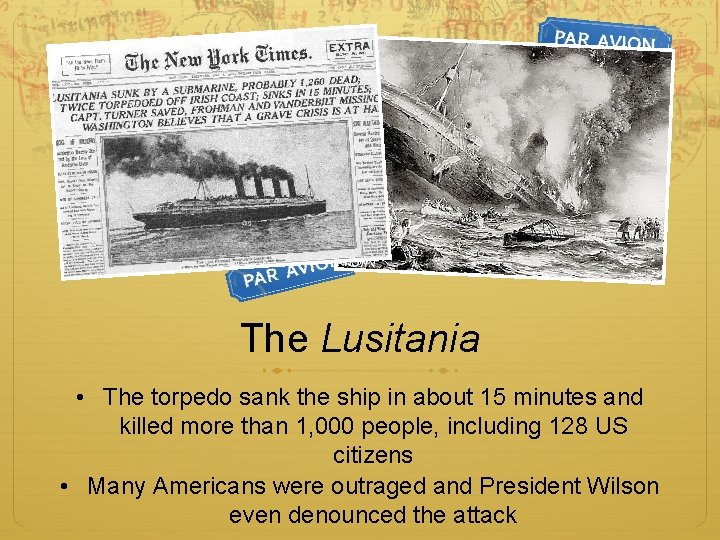
The Lusitania • The torpedo sank the ship in about 15 minutes and killed more than 1, 000 people, including 128 US citizens • Many Americans were outraged and President Wilson even denounced the attack
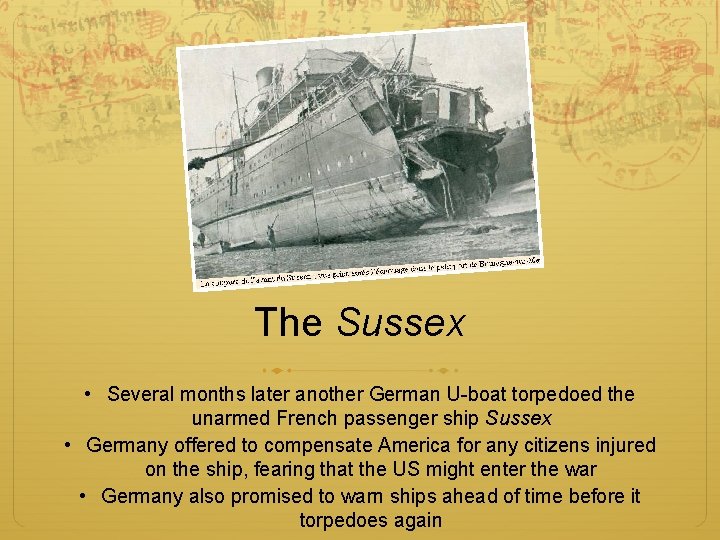
The Sussex • Several months later another German U-boat torpedoed the unarmed French passenger ship Sussex • Germany offered to compensate America for any citizens injured on the ship, fearing that the US might enter the war • Germany also promised to warn ships ahead of time before it torpedoes again
The End of Neutrality Submarine warfare led the US to take steps in strengthening its military Summer of 1916: Congress passed legislation that doubled the size of the army and provided funds to build new warships Antiwar sentiment, however, still remained strong
On the Brink of War January 1917: Germany reversed its policy on submarine warfare and announced that it would sink on sight all merchant vessels, armed or unarmed, sailing to Allied ports Germany’s plan was to attack and be victorious over the Allied nations before the US could get involved in the war President Wilson was outraged and broke off all diplomatic ties with Germany
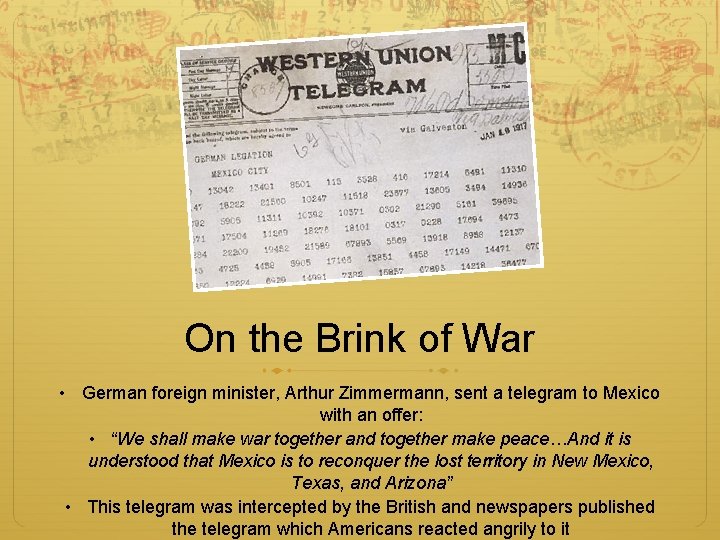
On the Brink of War • German foreign minister, Arthur Zimmermann, sent a telegram to Mexico with an offer: • “We shall make war together and together make peace…And it is understood that Mexico is to reconquer the lost territory in New Mexico, Texas, and Arizona” • This telegram was intercepted by the British and newspapers published the telegram which Americans reacted angrily to it
Revolution in Russia Dramatic events pushed the US to the brink of war 1 st: a revolution took place in Russia The Russian people overthrew the monarchy They established a temporary government that promised free election Americans felt that this new government would help the Allies because they promised to defeat Germany This change in Russia’s form of government (to a democracy) encouraged President Wilson to claim that the Allies were fighting a war of democracy against autocracy
Germans Sink More Ships March 1917: Germans attacked and sank four American ships The Algonquin The City of Memphis The Illinois The Vigilancia 36 people lost their lives
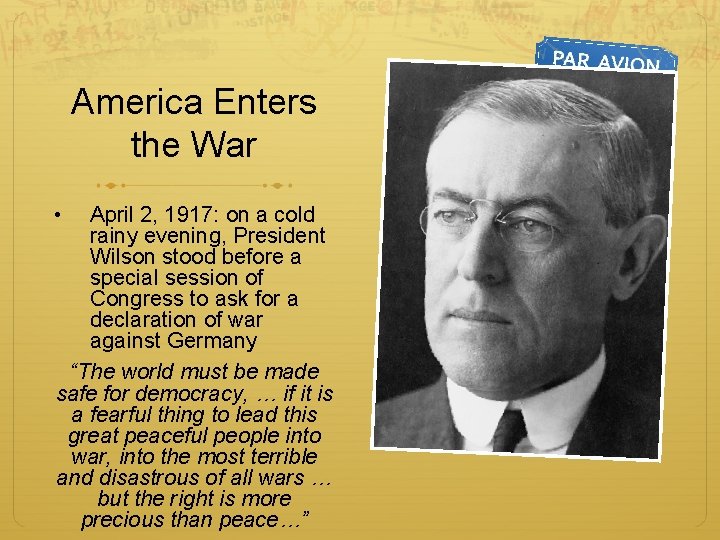
America Enters the War • April 2, 1917: on a cold rainy evening, President Wilson stood before a special session of Congress to ask for a declaration of war against Germany “The world must be made safe for democracy, … if it is a fearful thing to lead this great peaceful people into war, into the most terrible and disastrous of all wars … but the right is more precious than peace…”
America Enters the War Not everyone initially agreed with the decision to go to war Senator George Norris, of Nebraska, felt that America’s involvement in the war was the fault of American financiers and arms manufacturers who were determined to profit from the war no matter what it cost the rest of the country In the end: most members of Congress agreed that if the US wished to remain a superpower, it must enter the war
America Enters the War April 6: Congress passes the declaration of war and Wilson signed it on 56 members of the House and Senate voted against the war May 18: Congress passes the Selective Service Act – established a military draft, since the US needed to raise an army as fast as possible
America Enters the War Men aged 21 -30 registered by the millions and by the end of the war, about 24 million were called to serve while 2 million served voluntarily Thousands of women enlisted in the armed forces but did noncombat work: Radio Operators Clerks Nurses
America Enters the War Many African Americans also wanted to serve their country More than 300, 000 joined the army and navy The marines didn’t accept African Americans at the time They faced discrimination and racism in the army just like back home
Americans Join the Allies World War I
Supplying the Allies The British started to run out of war supplies and food, their people were starving German submarines were taking a deadly toll on Allied shipping America’s involvement in the war made an immediate difference
Supplying the Allies The US Navy took two steps 1 st: it helped the British find and destroy German submarines 2 nd: Convoys – teams – of navy destroyers escorted groups of merchant ships across the Atlantic In one year the convoy system reduced Allied shipping losses from 900, 000 to 300, 000 tons a month
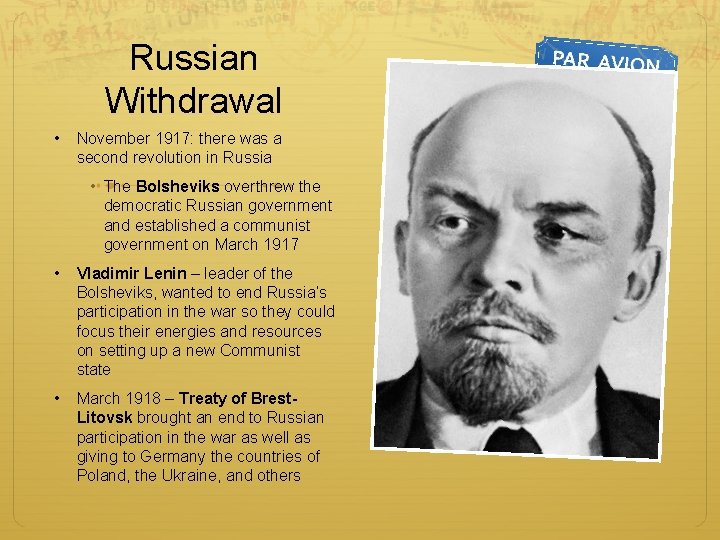
Russian Withdrawal • November 1917: there was a second revolution in Russia • The Bolsheviks overthrew the democratic Russian government and established a communist government on March 1917 • Vladimir Lenin – leader of the Bolsheviks, wanted to end Russia’s participation in the war so they could focus their energies and resources on setting up a new Communist state • March 1918 – Treaty of Brest. Litovsk brought an end to Russian participation in the war as well as giving to Germany the countries of Poland, the Ukraine, and others
New German Offensive Germans now launch a powerful offensive against the Allies Between March and June 1918, the Germans hammered at the Allied lines It suddenly looked as if the Germans might win the war after years of a stalemate
American Troops in the War American soldiers reached France in June 1917 but were not ready for battle General John J. Pershing led the Americans in Europe The American Expeditionary Force (AEF) were wanted to be used by the French and the British to build up their own troops But General Pershing refused and wanted to be a separate force
American Troops in the War The first fighting the Americans saw was in June 1918 They forced German forces return from the Marne River They then advanced to Belleau Wood For 24 hours a day/three weeks American forces fought their way through the forest against a wall of German machine-gun fire By mid July the Allies had stopped the German offensive
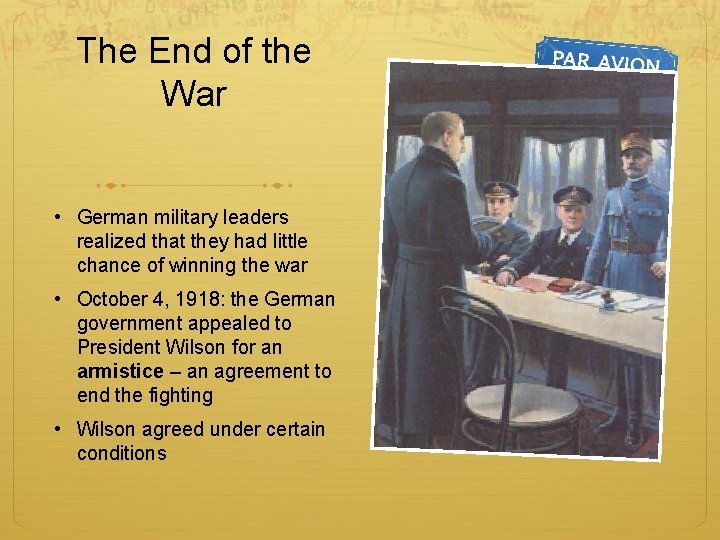
The End of the War • German military leaders realized that they had little chance of winning the war • October 4, 1918: the German government appealed to President Wilson for an armistice – an agreement to end the fighting • Wilson agreed under certain conditions
End of the War Conditions: Germany must accept this plan for peace and promise not to renew hostilities All German troops must leave Belgium and France Wilson would deal only with civilian leaders, not with the military The Germans agreed to these conditions, but political unrest was on the rise in Germany
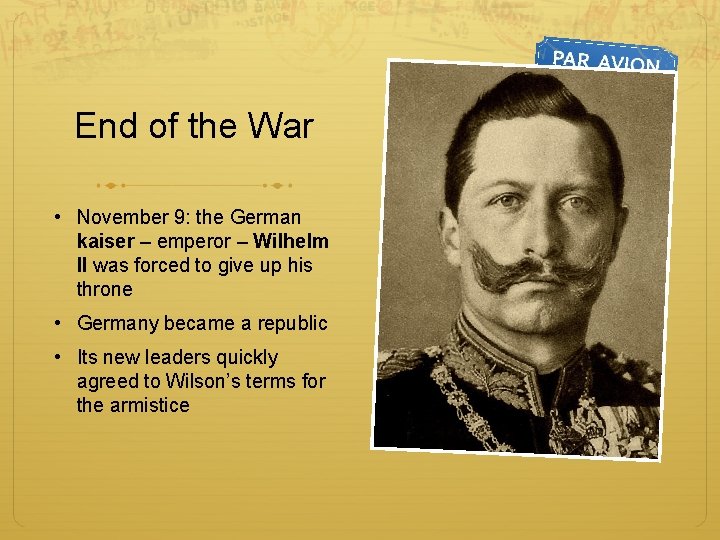
End of the War • November 9: the German kaiser – emperor – Wilhelm II was forced to give up his throne • Germany became a republic • Its new leaders quickly agreed to Wilson’s terms for the armistice
Peace Begins November 11, 1918: the day the armistice began and Germany agreed to withdraw all land forces west of the Rhine River Withdraw its fleet to the Baltic Sea Surrender huge amounts of equipment President Wilson announced: “Everything for which America fought has been accomplished. It will now be our duty to assist by example, by sober, friendly counsel, and by material aid in the establishment of just democracy throughout the world”
The War at Home World War I
Mobilizing the Nation After declaring war on Germany, Americans focused their attention on getting ready to fight Mobilization – the gathering of resources and the preparation for war This affected almost every part of American life
National War Labor Board This board was created to ensure production of vital war materials It pressured businesses to grant some of the workers’ demands It resulted in an 8 -hour work day for the workers Extra pay for overtime Equal pay for women The right to form unions
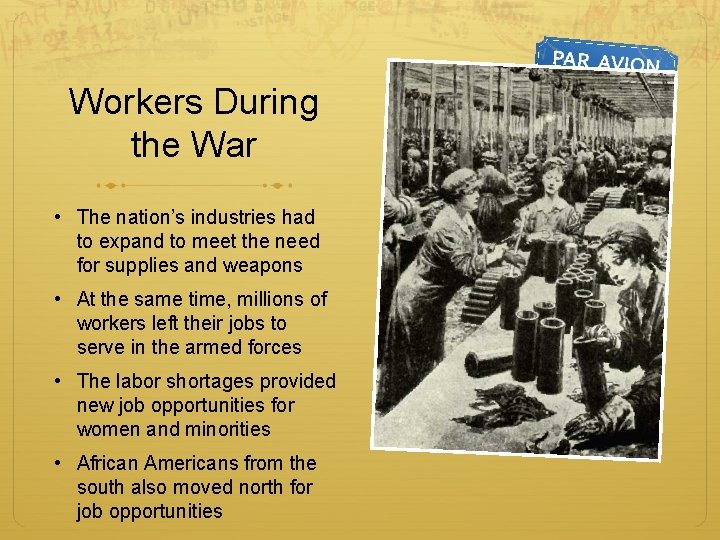
Workers During the War • The nation’s industries had to expand to meet the need for supplies and weapons • At the same time, millions of workers left their jobs to serve in the armed forces • The labor shortages provided new job opportunities for women and minorities • African Americans from the south also moved north for job opportunities
Paying for the War WW I cost the US about $32 million Liberty Bonds – these were sold to Americans in an effort to raise money for the war The government also raised taxes by raising the income tax, taxing wealthy Americans at high rates, and imposed steep taxes on business profits
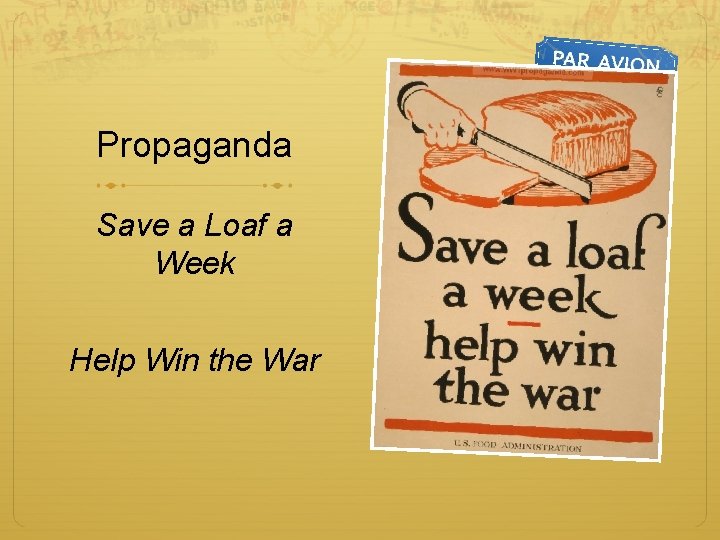
Producing Supplies Food Administration – launched a campaign to encourage American farmers to produce more and to persuade the public to eat less Wheatless Mondays Meatless Tuesdays Porkless Thursdays To try to convince Americans to conserve more food slogans included “Serve Just Enough” and “Use All Leftovers”
Producing Supplies Rationing – limitation of us; this was also imposed by the FA in order to persuade Americans to consume less food, expand food production, and increase food exports War Industries Board – this board supervised the nation’s industrial production Converting factories to the production of war-related goods Setting prices for key consumer products
Mobilizing Support Antiwar sentiment still remained strong so the government tried to rally up support for the war Committee on Public Information – its mission was to persuade Americans that the war represented a battle for democracy and freedom They distributed millions of pro-war pamphlets, posters, articles, and books Four-Minute Speeches – were presented before plays and movies Hired speakers, writers, artists, and actors built support for the war This was one of the greatest propaganda campaigns the nation had seen
Propaganda Save a Loaf a Week Help Win the War
Propaganda Destroy this Mad Brute… …Enlist
Propaganda Beat Back the Hun with Liberty Bonds!
Americans & the War The war provided a boost for the American economy However it created harmful effects on American society The government restrained voices of dissent – opposition Racial and other tensions remained Many Americans became intolerant of anyone they thought was “different”
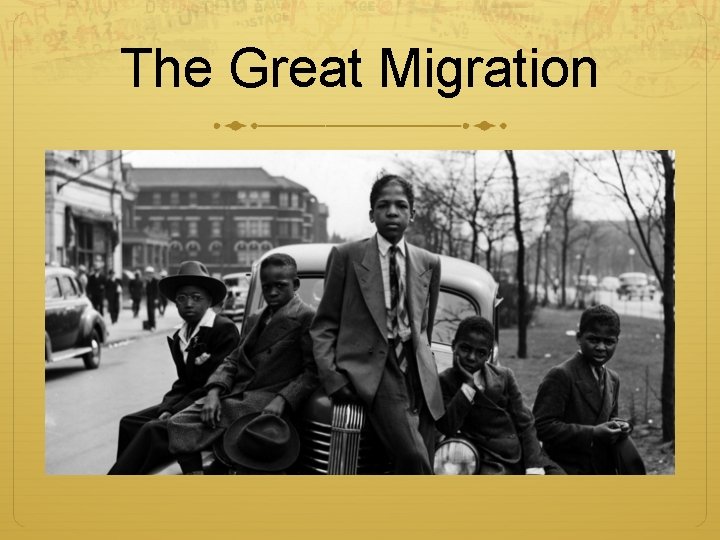
African American Migration From 1914 -1920 between 300, 000 to 500, 000 African Americans left their homes in the south to find jobs in the north Great Migration – the enormous population movement which continued since the 1800 s Many did not find jobs and their lives were not easy They lived in tiny, crowded apartments in segregated neighborhoods, and they still found racial prejudice which haunted them in the north
The Great Migration
African American Migrations During the war many riots took place in several northern town and cities East St. Louis, Illinois – July 1917, a white mob attacked an African American neighborhood, burned down the houses and fired on residents as they tried to escape As many as 40 African Americans died and thousands lost their homes
Opposition to War Opposition still remained strong even after America entered the war German Americans as well as Irish Americans sympathized with the Central Powers Socialists – people who believe industries should be publicly owned; they opposed the war Pacifists – people opposed to the use of violence; also opposed the war
Controlling Public Opinion The Committee on Public Information did everything possible to control the public’s opinion They portrayed anyone who opposed the war as unpatriotic The Espionage Act – passed by Congress in 1917; this gave the government a new weapon to combat dissent to the war It provided stiff penalties for espionage (spying), as well as helping the enemy or interfering with army recruiting
Controlling Public Opinion Sabotage Act – passed by Congress in 1918; secret action to damage the war effort Sedition Act – passed by Congress in 1918 Both laws made it a crime to say, print, or write almost anything perceived as negative about the government Thousands of people were convicted under these laws Socialists, immigrants, pacifists, labor activists
Controlling Public Opinion People became very suspicious of German Americans so much so that German Americans were forced to conceal their ancestry German foods were renamed: sauerkraut ~> liberty cabbage and frankfurter ~> liberty sausage German music and language was banned even in schools
Searching for Peace World War I
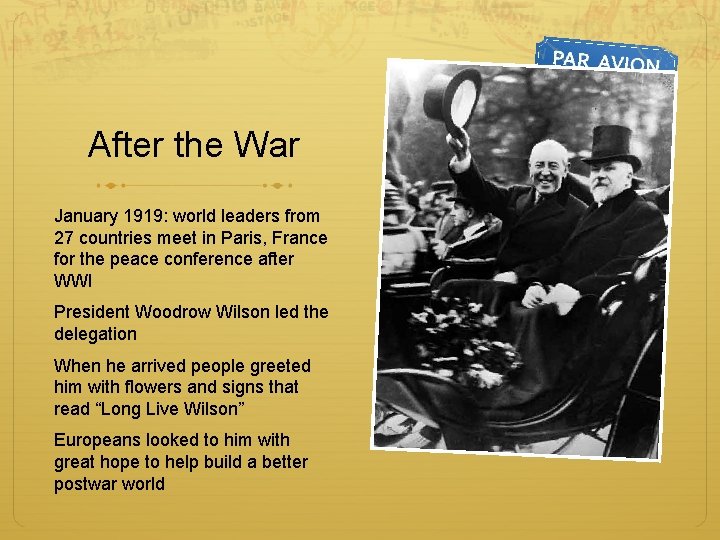
After the War January 1919: world leaders from 27 countries meet in Paris, France for the peace conference after WWI President Woodrow Wilson led the delegation When he arrived people greeted him with flowers and signs that read “Long Live Wilson” Europeans looked to him with great hope to help build a better postwar world
Europe After the War After the war, Europe was devastated with its farms and towns destroyed France, Russia, Germany, and Austria-Hungary each lost between 1 -2 million people More the 50, 000 Americans were killed in battle while 60, 000 died from disease It is estimated that nearly 9 million soldiers were killed worldwide
Europe After the War Millions of others found themselves homeless and hungry Civil war broke out in Russia Polish and Czech people struggled to form independent nations out of the collapsed empires of Turkey, Russia, and Austria-Hungary
Wilson’s 14 -Point Plan Several of the points concerned the adjustment of boundaries in Europe and the creation of new nations “national self-determination” – the right of the people to decide how they should be governed He also proposed principles for conducting international relations Calls for free trade Freedom of the seas An end to secret treaties or agreements Reductions and limits on arms The peaceful settlement of disputes over colonies
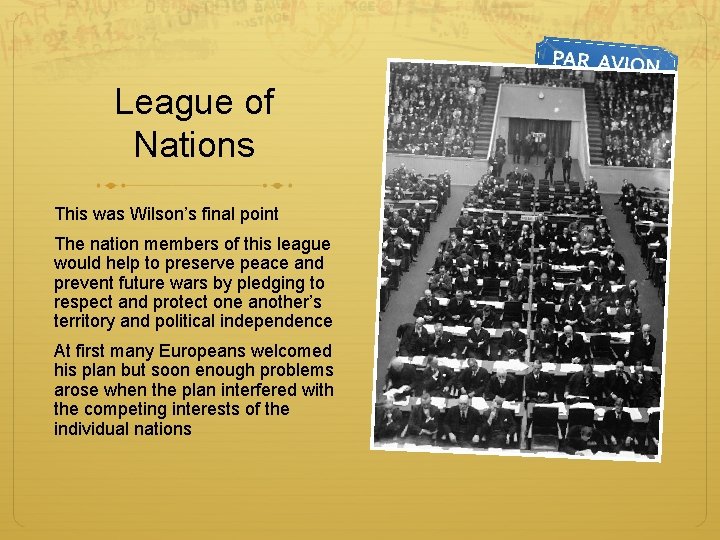
League of Nations This was Wilson’s final point The nation members of this league would help to preserve peace and prevent future wars by pledging to respect and protect one another’s territory and political independence At first many Europeans welcomed his plan but soon enough problems arose when the plan interfered with the competing interests of the individual nations
The Peace Conference Since the Allies won the war, they also dominated the Paris Peace Conference They did not invite Germany nor Russia (since it was now ruled by the Bolsheviks) The major speakers were the Big Four President Wilson of the United States Prime Minister David Lloyd George of Great Britain Premier Georges Clemenceau of France Prime Minister Vitorio Orland of Italy
The Allies Disagree Wilson opposed punishing the defeated nations while the victorious European nations wanted maximum revenge Clemenceau wanted to make sure the Germany could never invade France again and believed that Germany should be broken up into smaller countries Lloyd Georg of GB also supported this idea They demanded that Germany make reparations (payments) for the damage they caused in the war
The Allies Disagree Wilson was forced to again and again to compromise of give in to the demands of the other Allies had to decide how to deal with the new Bolshevik government of Russia They feared the spread of communism and therefore supported anti-Bolshevik forces fighting for control of Russia
Treaty of Versailles June 28, 1919: the Allies and Germany finally signed this treaty at the Palace of Versailles just outside of Paris The terms shocked the Germans but they had no choice but to sign since they lost the war Under this Treaty: Germany had to accept full responsibility for the war and to pay billions of dollars in reparations to the Allies Had to disarm completely and give up all its overseas colonies
Treaty of Versailles It also broke apart the Austro-Hungarian and Russian empires to create new nations Although Wilson had many of his 14 points dismissed by the European leaders, he still came back to the US with the creation of the League of Nations He believed that the League would correct any mistakes in the rest of the treaty
Opposition at Home July 1919: Wilson presented the Treaty of Versailles to the US Senate for approval/ratification Many Americans had doubts about the treaty and some thought the treaty dealt too harshly with Germany Many Americans worried about participation in the League of Nations which marked America’s commitment to international affairs
Opposition at Home 1919: the Republicans controlled the Senate Some Republicans in office saw this as an opportunity to embarrass Wilson (Democrat) before the upcoming elections of 1920 Others had sincere concerns about the treaty, especially the League of Nations
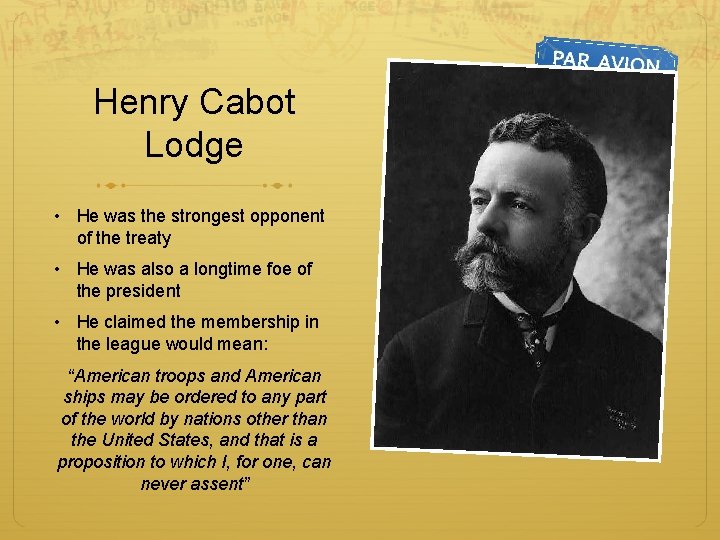
Henry Cabot Lodge • He was the strongest opponent of the treaty • He was also a longtime foe of the president • He claimed the membership in the league would mean: “American troops and American ships may be ordered to any part of the world by nations other than the United States, and that is a proposition to which I, for one, can never assent”
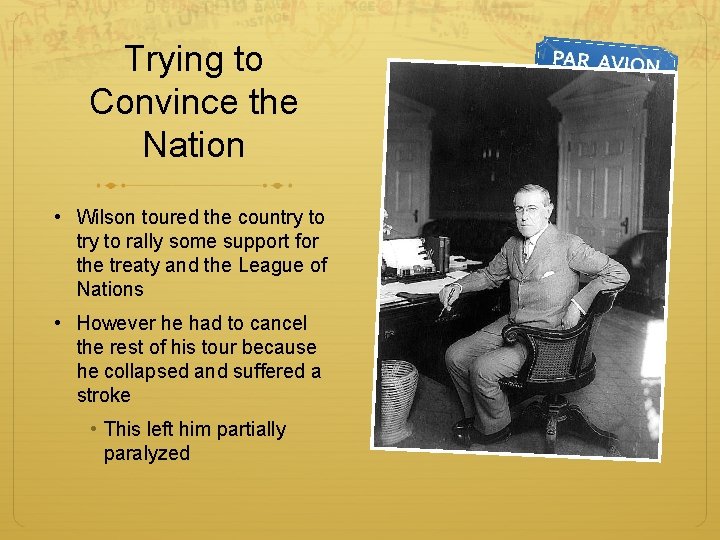
Trying to Convince the Nation • Wilson toured the country to rally some support for the treaty and the League of Nations • However he had to cancel the rest of his tour because he collapsed and suffered a stroke • This left him partially paralyzed
The Treaty is Rejected March 1920: after the Senate voted on the treaty with Lodge’s changes, Wilson ordered loyal Democrats to vote against it Nevertheless the treaty and the League was rejected 1921: the US signed a separate peace treaty with each of the Central Powers and it never joined the League of Nations