
World War 1 The image above is a
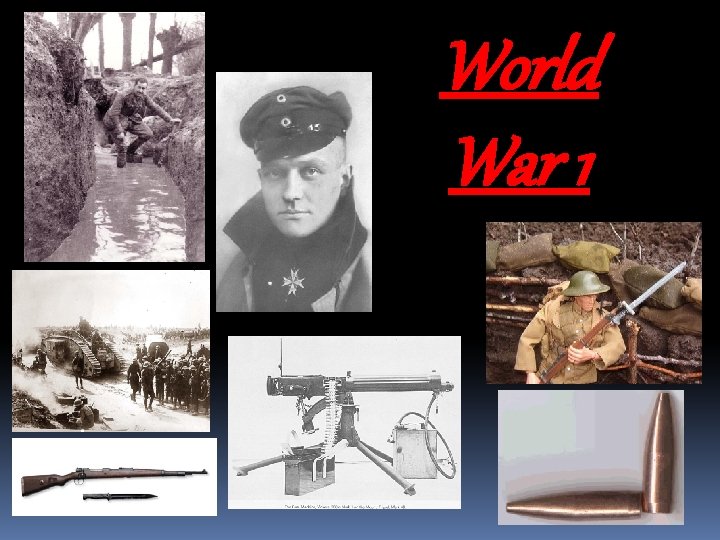
World War 1
The image above is a bottle of chlorine gas. Chlorine gas was first used by the Germans at the Second battle of Ypres in 1915. This gas effected a soldier’s vision, burned the skin and made it very difficult to breathe. Overall, it was not a effective as the Germans wanted. It could be easily beaten by a damp cloth over one’s face.
The war to end all wars World War 1 (WW 1) began on June 28, 1914. It was given the name “The war to end all wars” Young men were happy to join their countries’ military. Many believed that with new technology the war would be over in a few months. No one expected the war to turn out as it did.
An armistice (cease fire) was signed and scheduled for November 11, 1918 at 11: 00 am. The last soldier killed was Canadian G. L. Price. He was shot by a German sniper and died Nov. 11, 1918 at 10: 58 am. In total approximately 65 million men were deployed. Roughly 16 million were killed an additional 21 million were wounded. With a total cost in the hundreds of billions of dollars.
Causes of World War 1 After the colonization of Africa many European nations built up their armies and created new weapons. This boom in military was due to the tensions that were left in Europe after the division of Africa. Countries were preparing for war, all they needed was a reason. There were two main causes for the start of WW 1.
Cause #1: Alliances Due to the tensions after the division of Africa, European nations formed alliances. The goal of these alliances was to offer protection and ensure peace. Leaders felt that these alliances would keep all countries “in line, ” due to the alliances’ combined power. This idea failed. It was these alliances that brought the entire world into war.
There were two major alliances. 1. Triple Alliance (Central Powers): Germany, Austria-Hungary, and Italy 2. Triple Entente (Allied Powers): France, Russia, Great Britain By the start of the war 1914 Italy had left the Triple alliance and the Ottoman Empire took its place. Italy joined the Allied Powers Serbia a “break off nation” of Austria -Hungary had an alliance with Russia.
Cause #2: Assassination On June 28, 1914 Archduke Franz Ferdinand, heir to the Austrian throne, was assassinated in Sarajevo Ferdinand’s wife (Princess Sophie) was also assassinated. The killer was Gavrillo Princip a Serb and member of the Black Hand. The Black Hand was a terrorist group with a goal to unite all Slavs/ Serbs and claim their land from Austria.
Ferdinand his wife were on their way to see those injured by a grenade in an earlier assassination attempt. Most of Ferdinand’s motorcade had continued out of the city. Despite warnings Ferdinand continued towards the hospital. The assassins were trained in Serbia. It was later discovered by Austrian officials that the Serbian government had supplied the Black Hand with money and weapons.
The start of the Great War The death of Franz Ferdinand his wife deeply upset Austrian officials. Austria-Hungary declared war on Serbia on July 28, 1914. Due to it’s alliance Russia declared war on Austria one day later. On Aug. 1 Germany declares war on Russia and France declares war on Germany.
Aug. 3 Germany declares war on France. Aug. 4 Germany enters neutral Belgium. This forces Britain to declare war on Germany. It took 38 days from the assassination of Ferdinand for the world to go into total war. In total there were approximately 150 countries and colonies involved in WW 1.
Schlieffen Plan The Schlieffen Plan was a plan for war used by the Germans in WW 1. This plan called for a quick defeat of France, 6 weeks. This would be done by rushing all troops to France. Once victorious use the rail roads to ship all German soldiers into Russia. The purpose was not to separate German forces on two fronts.
The Germans relied on speed and surprise in order to insure victory over France. The Schlieffen Plan called for German forces to move through Belgium to get to France. This move brought Britain into the war. The Schlieffen Plan had major flaws; it assumed that there would be little fight from Belgium and France. Also that it would take 6 weeks for Russia to mobilize.
Early Resistance The Schlieffen Plan called for the quick defeat of Belgium and France. However, quick mobilization of Russian and French forces posed a problem. The Battle of the Frontiers (1914) in Russia and Battle of Tannenberg (1914) in Belgium slowed down Germany. Numerous small battles in Belgium also slowed down Germany. German did not expect this type of resistance from Belgium.
The first battle of the Marne (Sept. 7, 1914) German army advanced through northern France and were closing in on Paris. French launched a counterattack along the Marne River east of Paris. 2 million men fought on a battle-front that stretched over 100 km. The French managed to push back Germany. 250, 000 French lives were lost.
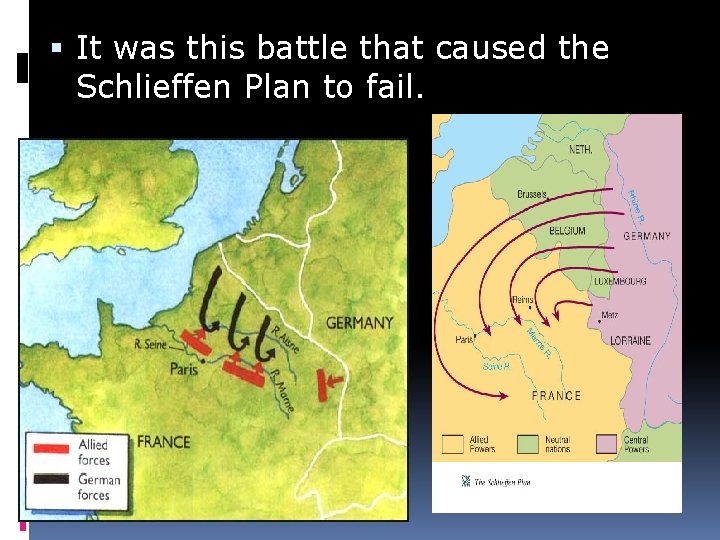
It was this battle that caused the Schlieffen Plan to fail.
A New kind of Warfare Word of Germany’s invasion of Belgium quickly spread to France and other European nations. French troops mobilized to meet approaching German divisions. French wore bright red coats and heavy brass helmets. Many soldiers carried flags and played instruments. German troops wore gray uniforms as camouflage on the battlefield.
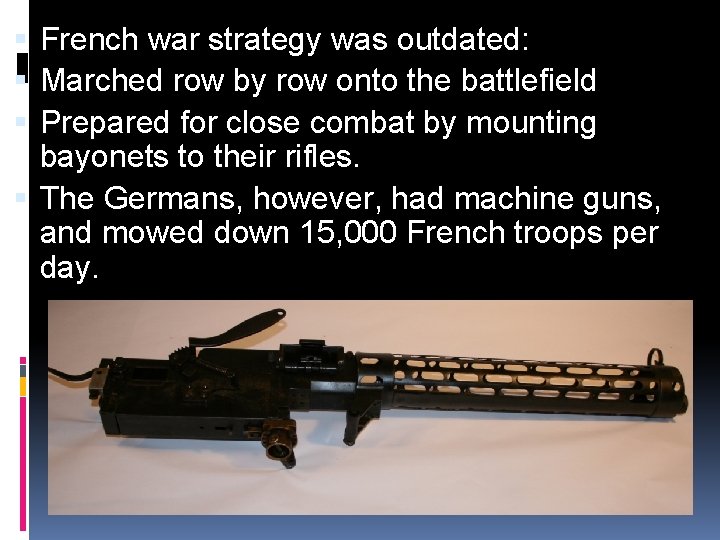
French war strategy was outdated: Marched row by row onto the battlefield Prepared for close combat by mounting bayonets to their rifles. The Germans, however, had machine guns, and mowed down 15, 000 French troops per day.
The war reaches a stalemate The First Battle of the Marne ended in a stalemate. Both French and German soldiers dug trenches to defend their positions and seek protection. By late 1914, massive systems of trenches stretched across Western and Eastern Europe. The battle lines known as the Western Front extended from Switzerland to the North Sea. In the east the stretched from Riga, Latvia to Northern Romania.
Trench Life Soldiers lived in the trenches. They ate, slept, and went to the bathroom in the same position all the time. The sounds of gunfire, explosions, and screams of pain were constant. Soldiers had to stay with their heads down at all times. A soldier’s weapon was always at their side.
The smell in the trenches was a mixture of human waste, rotting bodies, ammunition, and mildew. Along with this the trenches were usually filled with water (between the soldiers ankle and knee). This water caused a very common problem “trench foot”. Trench foot was the result of a soldier’s foot constantly being under cold, dirty water. Amputation was the only solution in severe cases
Soldiers had to share the trench with millions of insects and bacteria. Frogs and snakes were common as well. Lice became a huge problem. It was responsible for “trench fever. ” Rats were very common. They fed on the flesh of dead bodies. Moreover, it was not uncommon for rats to bite or begin to feed on living soldiers as well.
Trench Warfare Both Allied and German created a system of trenches. Constant bombardment and rifle fire hit the walls of the trenches. Machine guns were always standing guard to prevent enemy attacks. Territory was gained by opposing soldiers taking over enemy trenches. Soldiers went “over the top” into an area called “no man’s land. ”
No man’s land was the area between two systems of trenches. It was usually filled with barbed wire, bodies, and bomb craters. Attacking soldiers were usually shot down by enemy machine guns and artillery. These attacks did not gain much territory for either side. Both sides lost and gained territory throughout the war. For this reason WW 1 ended in a stalemate.
New weapons of war Poisonous Gas German military scientists experimented with gas as a weapon. Gas in battle was risky: Soldiers didn’t know how much to use, and wind changes could backfire the gas. The first gas attack was in 1915 at Second battle of Ypres. Chlorine gas was used. This gas affected a soldier’s lungs and vision.
Eventually Phosgene and Mustard gas began being used. Both of these gases affected the lungs and other internal organs. However, with these gases little could be done to save soldiers once the gas entered their bodies. Unlike chlorine gas, phosgene and mustard gas were colorless. Mustard gas had severe external symptoms such as blisters and burnt skin.
Tanks British forces developed armored tanks to move into no-man’s-land. Tanks were able to move over barbed wire and bomb craters with ease. They could also withstand machine gun fire. These tanks had limited success because many got stuck in the mud. Germans soon found ways to destroy the tanks with artillery fire.
Airplanes Planes were used to map and to attack trenches. Planes first dropped heavy objects on the enemy. Soon guns and bombs were mounted on planes. Skilled pilots fought in air battles called dogfights. The most famous fighter pilot of all time was the Red Baron.
U-Boats (undersea boats) Germany developed small submarines called U-boats to strike to attack allied ships. In February 1915 the German government declared the waters around Great Britain a war zone, threatening to destroy all enemy ships. This was in response to a British blockade near the German coast. Many nations were angry that the Germans used u-boats. They felt it violated the “rules of war”
Germany specifically warned the U. S. that neutral ships will be attacked. This angered the Americans, and President Wilson believed it violated the laws of neutrality. On May 7, 1915 the Germans sank the RMS Lusitania. Although this was a British ship it had nearly 200 Americans on board President Woodrow Wilson held Germany accountable for American losses. This was one of the main reasons why the United States entered WW 1.
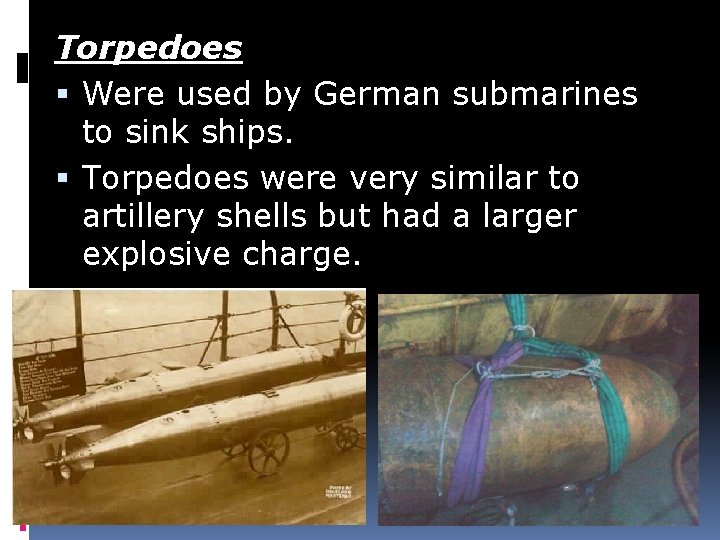
Torpedoes Were used by German submarines to sink ships. Torpedoes were very similar to artillery shells but had a larger explosive charge.
Zeppelins These were large balloons otherwise known as blimps. They were primarily used for surveillance. They were eventually fitted with bombs and machine guns. These were very slow and could be shot out of the sky very easily. They were also filled with a highly flammable gas.
Machine guns and Rifles Machine guns and rifles were much more powerful then earlier guns. Machine guns had the ability to fire up to 500 bullets per minute. These guns had enough power to cut down full sized trees and go through cement walls. Furthermore, these weapons were very easy to reload, which ultimately meant more casualties.
The US Enters the War Wilson kept the US neutral as long as possible. However, after the Lusitania and other German atrocities the US declared war on April 6, 1917. With the participation of the United States, it gave the allies a much needed boost in manpower and resources. This was a key event in ending the war
The End of the Great War The involvement of the Americans proved too much for Germany and its allies. The Germans made one last major offensive on July 15, 1918. The battle has been dubbed the Second Battle of the Marne. The Germans were defeated, suffering nearly 150 000 casualties.
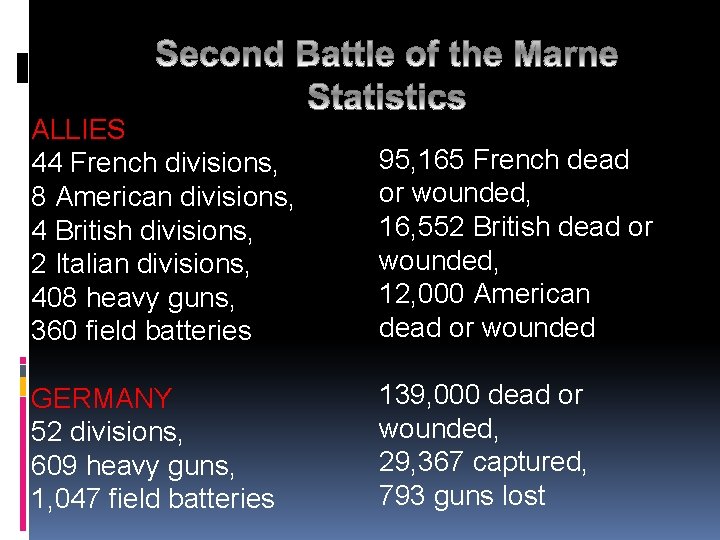
ALLIES 44 French divisions, 8 American divisions, 4 British divisions, 2 Italian divisions, 408 heavy guns, 360 field batteries 95, 165 French dead or wounded, 16, 552 British dead or wounded, 12, 000 American dead or wounded GERMANY 52 divisions, 609 heavy guns, 1, 047 field batteries 139, 000 dead or wounded, 29, 367 captured, 793 guns lost
The allies continued their advance and pushed the Germans to Sedan. A small town on the Belgian border. The German army would not recover from the 2 nd Battle of the Marne. With major military loses, failing economy, and food shortages, Germany asks for an armistice. Armistice: Not a surrender but a cease fire.
The Paris Peace Conference Woodrow Wilson (USA), David Lloyd George (Brit), Georges Clemenceau (Fra), and Vittorio Orlando (Ita), wanted peace. These men (leaders of the allies) came to be known as the “Big Four” They invited 32 nations to this meeting. Germany and its allies were not invited.
The Treaty of Versailles Shortly after the Paris Conference a treaty was signed between the Allies and Germany and its allies had to: 1. Disarm 2. Pay 33 billion dollars in war reparations to the Allies 3. Take sole responsibility for the start of the war 4. Lost all colonies
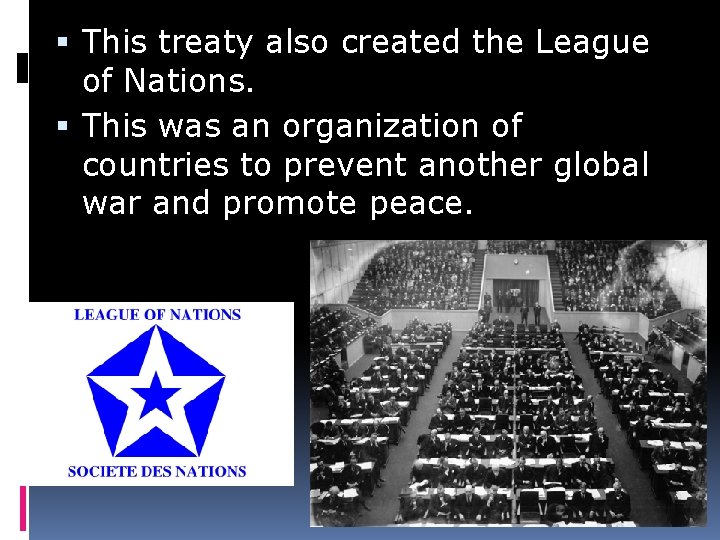
This treaty also created the League of Nations. This was an organization of countries to prevent another global war and promote peace.
- Slides: 40