
World Trade Organization Presented By Ancy Nadar 1
World Trade Organization Presented By : Ancy Nadar – 1 Michael George – 10 Jatin Jain – 15 Ashish Mulani - 25 Radhika Pote - 31 Priyal Karkera - 57
INTRODUCTION v The World Trade Organization (WTO) is the only international organization dealing with the global rules of trade between nations. v The WTO ensures that trade flows as smoothly, predictably and freely as possible. v So almost all the country in the world are a member of WTO. There are different types of countries like rich or poor countries, very industrialized, developing countries, etc.
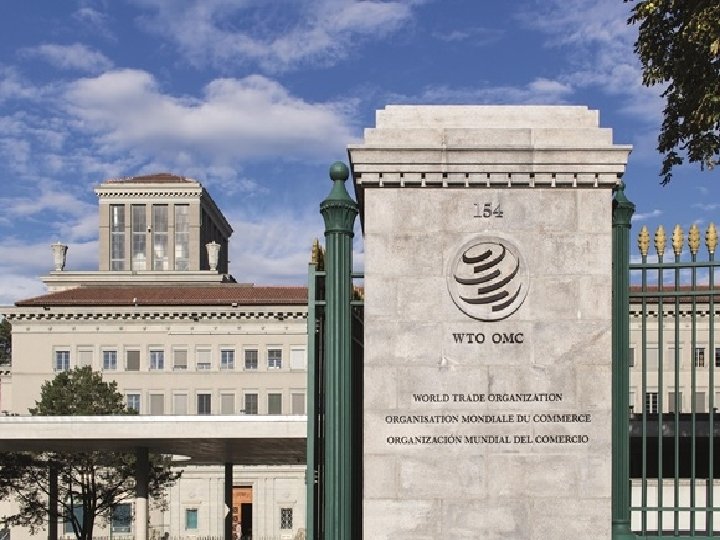
FORMATION OF WTO v The conversion of GATT in WTO in 1995 is a important event in the field of global trade. v The World Trade Organization started functioning from 1 st January, 1995. v The formation of WTO is the result of the Uruguay round of negotiations. v WTO is based in Geneva, Switzerland.
v WTO has larger membership than GATT. v GATT ceased to exist as a separate institution and has become a part of the WTO. v WTO has the membership of 147 countries. v In present, WTO acts as the governing body of world trade.
OBJECTIVES OF WTO v Free trade i. e. trade without discrimination. v Growth of less developed countries (LDC). v Protection and preservation of environment.
v Ensure optimal utilization of available world’s resources, expanding production and trading. v Raising living standard of citizen of member nations and ensure full employment. v Settlement of trades disputes among member countries through consultation and dispute settlement procedures.
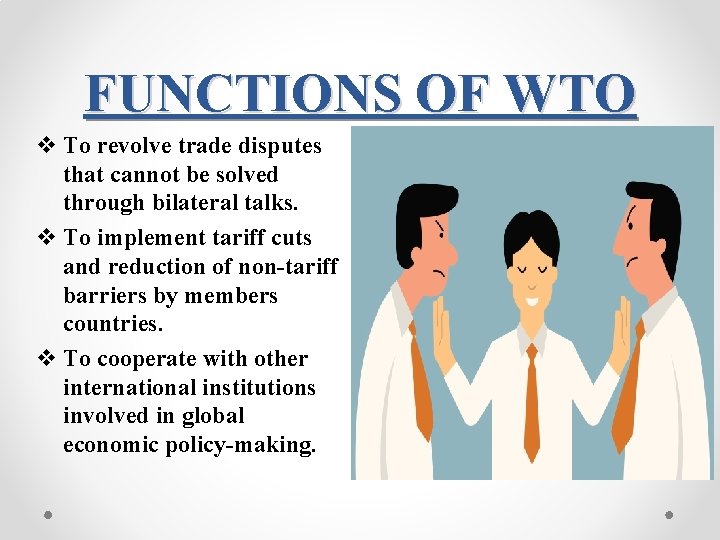
FUNCTIONS OF WTO v To revolve trade disputes that cannot be solved through bilateral talks. v To implement tariff cuts and reduction of non-tariff barriers by members countries. v To cooperate with other international institutions involved in global economic policy-making.
v To promote international trade without discrimination of any type. v To administer and implement the trade agreements signed under Uruguay Round Negotiations. v To act as a forum for multilateral trade negotiations
ACHIEVEMENTS OF WTO v Greater market orientation has become the general rule. v Use of restrictive measures for BOP problems has declined markedly. v Tariff-based protection has become the norm rather than the expectation.
v Services trade has been brought into the multilateral system and many countries. v Many UDCs have undertaken radical trade, exchange and domestic reforms. v It has been agreed to reduce import tariffs on industrial goods, based on Swiss Formula.
WTO NEGOTIATIONS v WTO provides a framework of negotiation between participating countries. v Most issues dealt are from previous negotiations, especially from the Uruguay Round (1986– 1994). v The Doha Development Round or is the latest tradenegotiation round of the World Trade Organization.
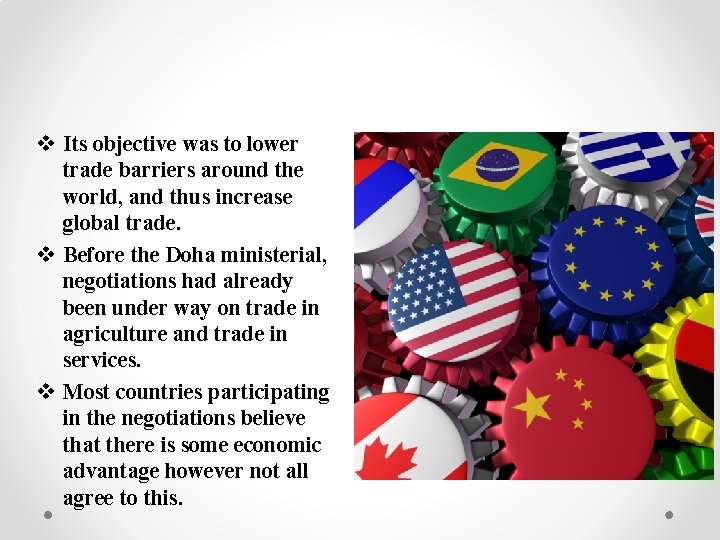
v Its objective was to lower trade barriers around the world, and thus increase global trade. v Before the Doha ministerial, negotiations had already been under way on trade in agriculture and trade in services. v Most countries participating in the negotiations believe that there is some economic advantage however not all agree to this.
CONCLUSION v IT IS THE PLACE WHERE THE MEMBER COUNTRIES COME TOGETHER TO SOLVE THEIR PROBLEMS RELATED TO INTERNATIONAL TRADE. v THIS SYSTEM HELPS PROMOTE PEACE BY HANDLEING DESPUTES OF MEMBER COUNTRIES. v IT PROVIDES FREE TRADE WHICH CUTS THE COST OF LIVING AND PROVIDES MORE CHOICE OF PRODUCTS AND QULAITIES AND STIMULATES ECONOMIC GROWTH.

- Slides: 16