
World Trade Center New Employee Orientation Site Safety
- Slides: 64
World Trade Center New Employee Orientation • • • Site Safety Structure Site Layout Map Site-wide Work Rules Contractor/Service-Specific Work Rules Specific Site Safety Issues & Controls Field Orientation WTC Emergency Project Orientation Program 1
Joint Safety & Health Activities • • Instructor Introductions Joint Safety & Health Committee Joint Site Inspections Working Together for a Safer Job WTC Emergency Project Orientation Program 2
Joint Labor/Management Environmental Safety and Health Committee • Purpose: To advise on ES&H issues • Membership: – Tri-chairs: NYC BCTD, BTEA, NYC DDC – Prime Contractor representatives – 4 – General Contractors Association – 1 – Site Union representatives – 6 WTC Emergency Project Orientation Program 3
WTC Site Map • • • Badges & Security – Entry & Exit Traffic Lanes – 10 mph Maximum Speed! First Aid Stations Site Evacuation Routes PPE zones Eyewash & Showers WTC Emergency Project Orientation Program 4
Emergency Telephone Number 212 -747 -9193 WTC Emergency Project Orientation Program 5
Contractor/Agency Zone Map • • • Site Description & Project Expectations Location of written safety programs Compressed gas storage areas Subcontractor activities PPE use zones Fuel depot and equipment refueling WTC Emergency Project Orientation Program 6
General Site Policies • • • Site ES&H program Labor-Management Partnership for Safety Disciplinary Warning Policy for Safety Drug & Alcohol Policy Non-Discrimination Policy Roles of Firefighters, Police & Construction WTC Emergency Project Orientation Program 7
Safety Rules • • Dust Control & Fire Suppression Traffic Rules 100% Fall Protection Above 6 feet 100% PPE Compliance on Site Injury & Incident Reporting Exit the site CLEAN Crime Scene Activities & Human Remains WTC Emergency Project Orientation Program 8
Traffic • • Project SPEED LIMIT 10 MPH ! Stay clear of traffic lanes Stay clear of areas where you don’t belong Be alert for backup alarms and vehicles Watch for overhead debris& collapse hazards Use covered and marked walkways Do not walk under live loads WTC Emergency Project Orientation Program 9
Mandatory Personal Protective Equipment at Ground Zero • • Respirators (in defined zones) Hard hats Safety glasses with side shields or goggles Long pants, long sleeve work shirts, and coveralls • High Visibility Clothing/Reflective Vests • Steel-toed, heavy duty work shoes WTC Emergency Project Orientation Program 10
Respiratory Protection Requirements • Debris Area or Where Debris is Moved – Half-face respirator with combination P 100 filter/acid gas/organic vapor cartridge • Dusty areas within restricted zone/marina – Half face respirator with HEPA filter (P 100, N 95 or equivalent) • Other areas with dust or smoke – Dust mask (P 100 or N 95 or equivalent) WTC Emergency Project Orientation Program 11
PPE Program • Hazard assessment to determine need for PPE • Medical Clearance for PPE Use • PPE selection and fitting • Training – When PPE is needed – What PPE is needed – Use and limitations of PPE – Care and maintenance of PPE WTC Emergency Project Orientation Program 12
Reporting Incidents or Hazardous Conditions • Report work-related injuries and illnesses, imminent danger situations, or other incidents to your supervisor & steward • New or expanding fires should be immediately reported to fire department EMERGENCY Phone: 212 -747 -9193 WTC Emergency Project Orientation Program 13
Reportable Incidents Involving Workers • Work-related injuries or illnesses • Exposures to hazardous substances above allowable exposure limits • Electrical shocks or arc flashes • Near misses WTC Emergency Project Orientation Program 14
Reportable Incidents (Continued) • • • Crane, rigging, or material handling accidents Property/vehicle/equipment damage Unplanned fires or explosions Spills or releases to the environment Unexpected contact or damage to utilities Discovery of unknown or potentially hazardous debris, containers or other materials WTC Emergency Project Orientation Program 15
Stop Work If … • You face unsafe conditions not previously addressed • You face an imminent danger situation • The scope of work changes from the safety briefing • You find bodies or body parts • You find unknown or potentially hazardous objects or materials WTC Emergency Project Orientation Program 16
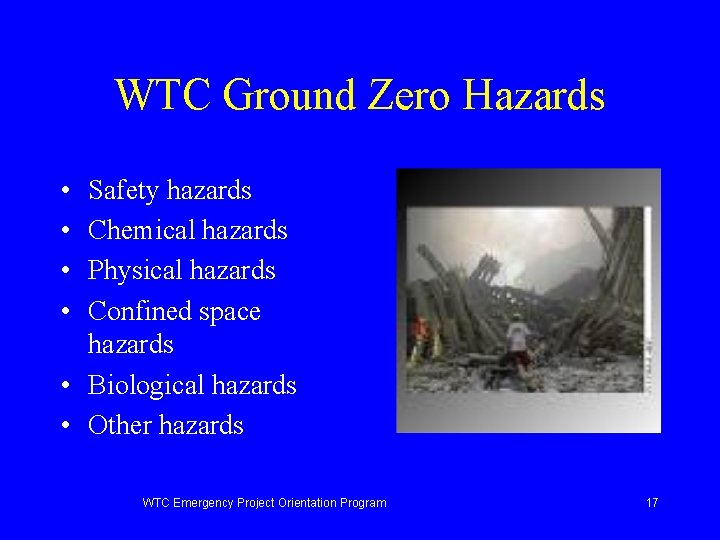
WTC Ground Zero Hazards • • Safety hazards Chemical hazards Physical hazards Confined space hazards • Biological hazards • Other hazards WTC Emergency Project Orientation Program 17
Safety Hazards • Falls from heights • Collapses • Struck by/against and caught in/between • Fires and Burn Hazards WTC Emergency Project Orientation Program 18
Fall Protection 100% fall protection when working more than 6 feet above a lower surface WTC Emergency Project Orientation Program 19
Types of Fall Protection • Guardrails – Around excavations, holes, building edges, and wherever else possible. – On aerial lifts, crane manbaskets, scaffolds • Personal fall protection systems – Fall arrest – stops falls – Fall restraint – prevents falls WTC Emergency Project Orientation Program 20
Personal fall protection systems – Harness – Lanyard – Vertical or horizontal lifeline – Adequate anchorage point – Always inspect before use WTC Emergency Project Orientation Program 21
Aerial Lifts/Crane Baskets • Aerial lifts (JLG, Genie, etc. ) – Must wear harness/lanyard as fall restraint – Secure lanyard ONLY to approved lift anchor – Make sure railings, doors, chains are in place – Do not climb on rails or use ladders, boxes, etc. • Crane manbaskets – Must wear harness/lanyard as fall restraint – Secure lanyard to independent anchor on crane, NOT crane basket WTC Emergency Project Orientation Program 22
Surface and Trench Collapses • Competent person must check excavation sites at start of each shift and as needed • Surface collapses – Comply with approved demolition plan before removing girders, large chunks of concrete, etc. • Trench collapses (cave-ins) – Have proper access and way to escape – Use proper protective devices (benching, shoring, sloping, trench boxes) WTC Emergency Project Orientation Program 23
Aerial Lift and Crane Collapses/Tipovers • Make sure you are trained in use of model of equipment you will be working on • Inspect equipment at start of shift • Make surface is stable • Don’t exceed rated load limits • Don’t exceed boom extension limits • Watch for struck by/against accidents • Follow all manufacturers directions WTC Emergency Project Orientation Program 24
Struck By and Caught In/Between Working Near Heavy Machinery • Stand clear of operating equipment and vehicles • Wear high visibility/reflective clothing! • Be alert for backup alarms on vehicles • Avoid entering crane swing radius • Use tag lines when lifting loads • Use spotters during lifting operations WTC Emergency Project Orientation Program 25
Struck By/Against Hazards • Falling debris – Barricade off falling object hazard areas – Wear hard hats at all times • Sharp objects in debris – Work gloves – Protective clothing WTC Emergency Project Orientation Program 26
Fires & Burns • Be alert for hot steel, hot debris and smoke • Fires should be immediately reported to fire department • Hot Work Procedures • Fuel & compressed gas cylinders Fire or Emergency CALL: 212 -747 -9193 WTC Emergency Project Orientation Program 27
Storage of Compressed Gas Cylinders • Separate oxygen cylinders from fuel cylinders by at least 20 feet, unless protected by fire wall • Store acetylene cylinders upright • Protect against falling and high temperature • Protect against falling objects • Do not store in unvented areas • Cap & secure cylinders WTC Emergency Project Orientation Program 28
Refueling Area Setup • Refuel vehicles ONLY in designated area • Refueling areas must be at least 50 feet from other operations and storm drains • Fuel storage and filling areas are marked “No Smoking or Open Flames” • Locate disconnect switches for refueling equipment away from refueling areas • Spill control and cleanup materials available • An ABC fire extinguisher shall be located 25 -75 feet from refueling operations WTC Emergency Project Orientation Program 29
Refueling Area Operations • Allow portable equipment time to cool down before refueling • Shut down spark-producing equipment • Dispensing nozzles must have automatic shutoff and not have “latch open” device WTC Emergency Project Orientation Program 30
Portable Fuel Cans • NO plastic containers! Use only properly labeled and approved containers • Do not store in direct sunlight • Relieve pressure buildup away from ignition sources (hot surfaces, sparks) WTC Emergency Project Orientation Program 31
Chemical Hazards • Chemicals brought on site • Chemicals possibly present in WTC debris and air WTC Emergency Project Orientation Program 32
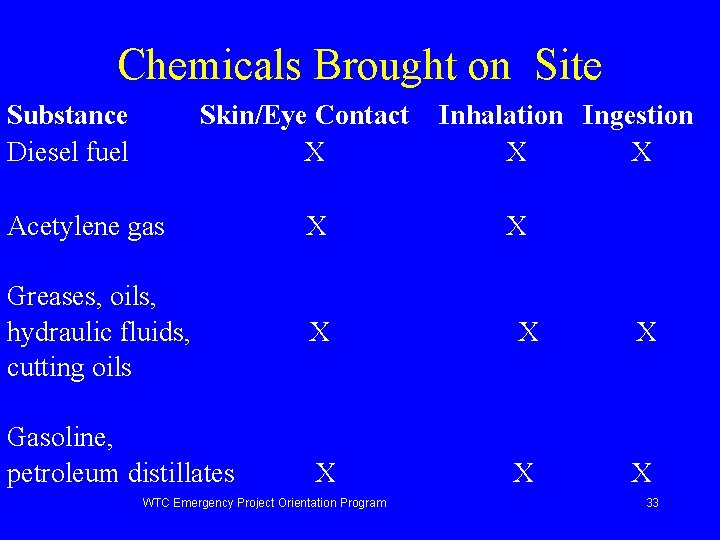
Chemicals Brought on Site Substance Diesel fuel Skin/Eye Contact X Inhalation Ingestion X X Acetylene gas X Greases, oils, hydraulic fluids, cutting oils X X X Gasoline, petroleum distillates WTC Emergency Project Orientation Program X 33
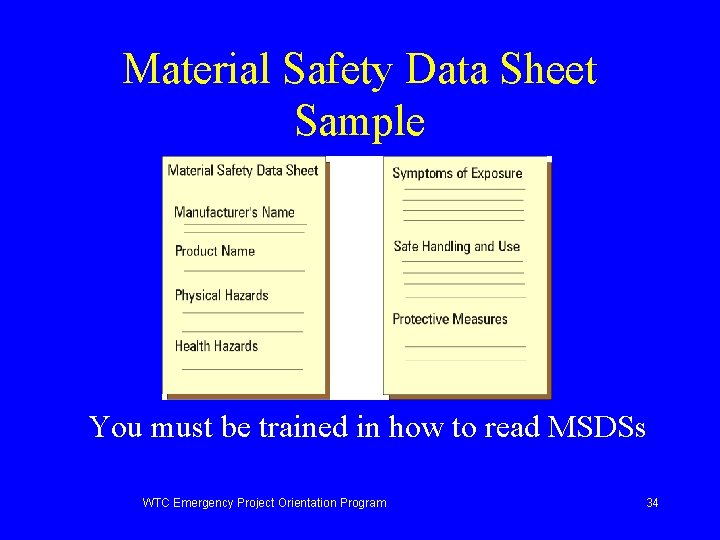
Material Safety Data Sheet Sample You must be trained in how to read MSDSs WTC Emergency Project Orientation Program 34
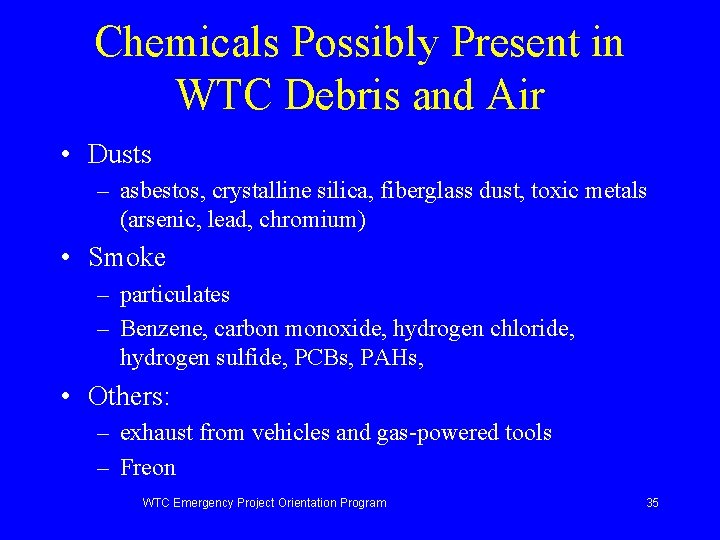
Chemicals Possibly Present in WTC Debris and Air • Dusts – asbestos, crystalline silica, fiberglass dust, toxic metals (arsenic, lead, chromium) • Smoke – particulates – Benzene, carbon monoxide, hydrogen chloride, hydrogen sulfide, PCBs, PAHs, • Others: – exhaust from vehicles and gas-powered tools – Freon WTC Emergency Project Orientation Program 35
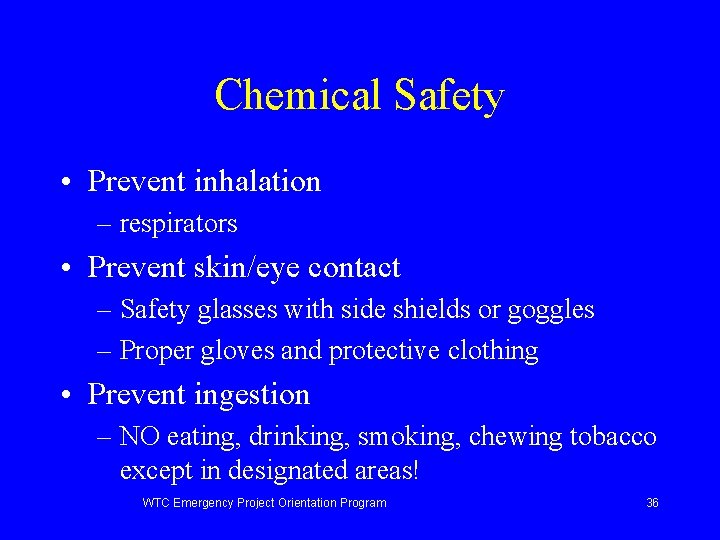
Chemical Safety • Prevent inhalation – respirators • Prevent skin/eye contact – Safety glasses with side shields or goggles – Proper gloves and protective clothing • Prevent ingestion – NO eating, drinking, smoking, chewing tobacco except in designated areas! WTC Emergency Project Orientation Program 36
Avoid Taking Home Contaminants • • • Wash Hands & Face Shower After Work Where Available Change into Street Clothes After Work Store Street Clothes in Clean Area Wash Work Clothes Separate from Family’s WTC Emergency Project Orientation Program 37
Physical Hazards • • • Cold Heat Noise Electrical hazards Manual lifting WTC Emergency Project Orientation Program 38
Cold • Can cause frostbite, hypothermia • Contributing factors: – Damp, windy, or wet weather • Prevention: – Warm, dry clothing – Work breaks in warm shelters WTC Emergency Project Orientation Program 39
Heat • Can cause heat stress, heat exhaustion, heat stroke • Contributing factors: – Temperature, humidity, heavy work, continuous work, – Fires, hot surfaces • Prevention: – Proper type of clothing – Work breaks in cool area WTC Emergency Project Orientation Program 40
Noise • Can cause hearing loss • Action level of 85 decibels triggers hearing conservation program – Noise monitoring – Worker protection • Engineering controls (quieter equipment) • Administrative controls (job rotation) • Hearing protection (ear plugs, ear muffs) – Hearing tests – Training WTC Emergency Project Orientation Program 41
Electrical Hazards • • Electrical shock and electrocution Electrical burns Arc flash burns Arc blast effects – hearing loss, pressure wave • Falls • Fire WTC Emergency Project Orientation Program 42
Electrical Safety • Watch for buried power lines. Don’t assume they are de-energized. • Keep all metal ladders and other conductive objects away from live circuits/power lines • Make sure all electrical outlets have GFCIs • Use only hard or extra-hard usage extension cords with 3 prongs • Properly maintain electrical cords & equip. WTC Emergency Project Orientation Program 43
Power Tools and Equipment • Use only tools and equipment labeled for wet or damp areas • Make sure plugs have 3 prongs or are double-insulated • Inspect cords for exposed wires, frayed, spliced or taped cords or other damage • Tag defective equipment and remove from service WTC Emergency Project Orientation Program 44
Equipment Maintenance Lockout/Tagout • Lock and tag all energy sources of equipment you will work on – Each person working should install own lock • Released stored energy • Before removing locks after working on equipment, notify others in area and check area • Make sure you are trained and know written Lockout/Tagout Program WTC Emergency Project Orientation Program 45
Manual Lifting • Can causes back pain and injury • Use proper lifting techniques – – Use lifting devices or get help for heavy loads Avoid bending or twisting while lifting Hold loads centered and close to the body Arrange lifting tasks to keep load between knuckle height and shoulder height – Avoid repeated one-handed lifting – Rotate continuous lifting tasks WTC Emergency Project Orientation Program 46
Confined Spaces Site ES&H Plan calls for each contractor to comply with 29 CFR 1910. 146 (OSHA Permit-Required Confined Space Standard) and have a plan reviewed by DDC. WTC Emergency Project Orientation Program 47
Confined Space Definition Confined Space – Large enough for human entry – Limited or restricted entry or exit – Not meant for human occupancy Permit-Required Confined Space WTC Emergency Project Orientation Program 48
Confined Space Hazards • Oxygen deficiency – Other gases crowd out oxygen • Toxic gases – carbon monoxide from fires & engines • Collapses – trench cave-ins, underground collapses WTC Emergency Project Orientation Program 49
Confined Space Safety • Permits required for all confined space entry • Confined Space Entry Program – Measures to prevent unauthorized entry – Identification of hazards and testing – Safe entry and rescue procedures – Proper PPE, equipment for testing, rescue, etc. – Outside attendant(s) – Additional specific training of all involved personnel WTC Emergency Project Orientation Program 50
Biological Hazards • Animal bites and insect stings – Report animal bites and stings to first aid station for evaluation and treatment – Use mosquito repellent during mosquito season – Report bee/wasp allergies to employer safety officer prior to working at WTC site • Bird droppings – May cause illnesses if inhaled or accidentally eaten – Respirators and protective clothing may be needed in nearby buildings if significant amounts are present WTC Emergency Project Orientation Program 51
Other Hazards • Post-Traumatic Stress Disorders • Night work – Poor lighting – Body rhythms • Extended hours – Fatigue • Exhaust/Carbon Monoxide WTC Emergency Project Orientation Program 52
Information on Additional Training • Contractor & Trade Specific Training • Specialty Training is Available and Training Needs Should be Communicated through Union Stewards to the Joint S&H Committee • New hazards may arise requiring additional training for all site workers. WTC Emergency Project Orientation Program 53
Respiratory Protection WTC Emergency Project Orientation Program 54
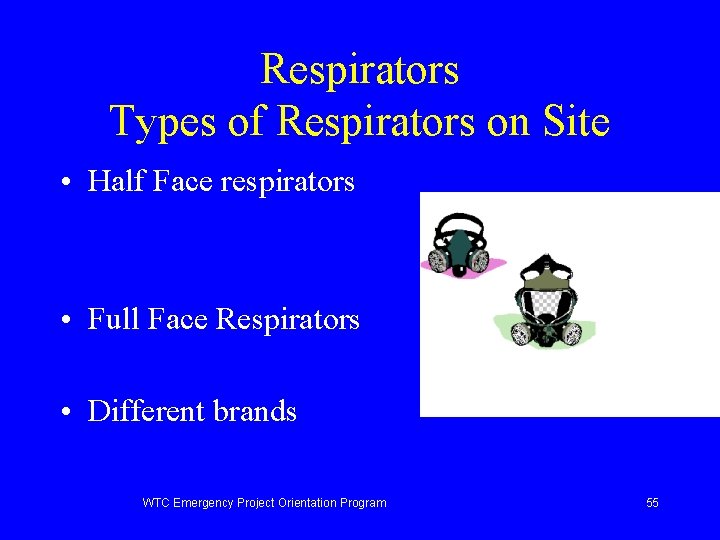
Respirators Types of Respirators on Site • Half Face respirators • Full Face Respirators • Different brands WTC Emergency Project Orientation Program 55
Respirators Types of Cartridges • P 100 – filters out toxic and nuisance particles – Color: Purple/Magenta • Acid Gas and Organic Vapor Combination Cartridge – Filters out vapors like benzene and solvents – Filters out sulfuric acid gas – Color: Yellow WTC Emergency Project Orientation Program 56
Respirators Requirements to wear • Facial Hair • Medical evaluation/examination – Workers must be evaluated and obtain medical clearance to make sure that wearing a respirator will not present health risks for them individually – Fit Testing on brand, model, and size you will wear – Qualitative – Quantitative • Training WTC Emergency Project Orientation Program 57
Respirators Daily Procedures • Inspection – Clean – Filters/Cartridges – Valves • Fit Checks – Positive and Negative fit checks • Cleaning and Storage WTC Emergency Project Orientation Program 58
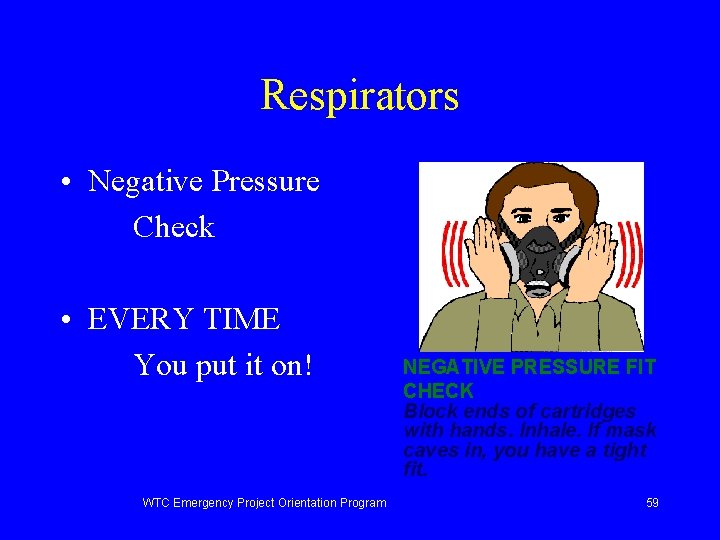
Respirators • Negative Pressure Check • EVERY TIME You put it on! WTC Emergency Project Orientation Program NEGATIVE PRESSURE FIT CHECK Block ends of cartridges with hands. Inhale. If mask caves in, you have a tight fit. 59
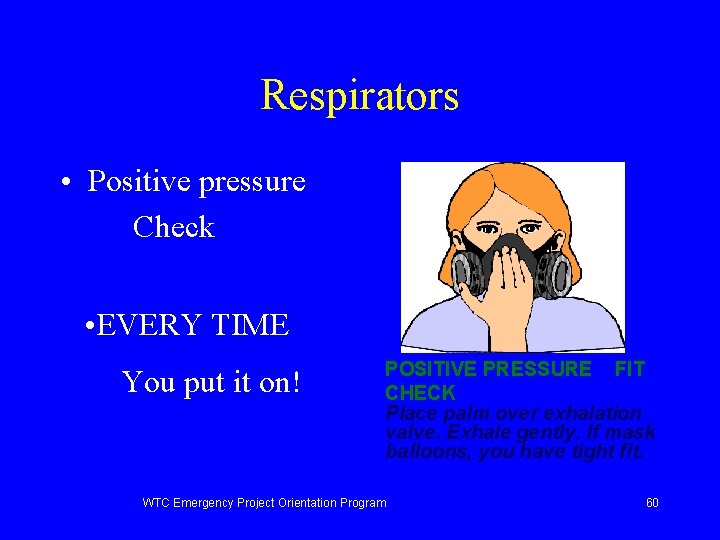
Respirators • Positive pressure Check • EVERY TIME You put it on! POSITIVE PRESSURE FIT CHECK Place palm over exhalation valve. Exhale gently. If mask balloons, you have tight fit. WTC Emergency Project Orientation Program 60
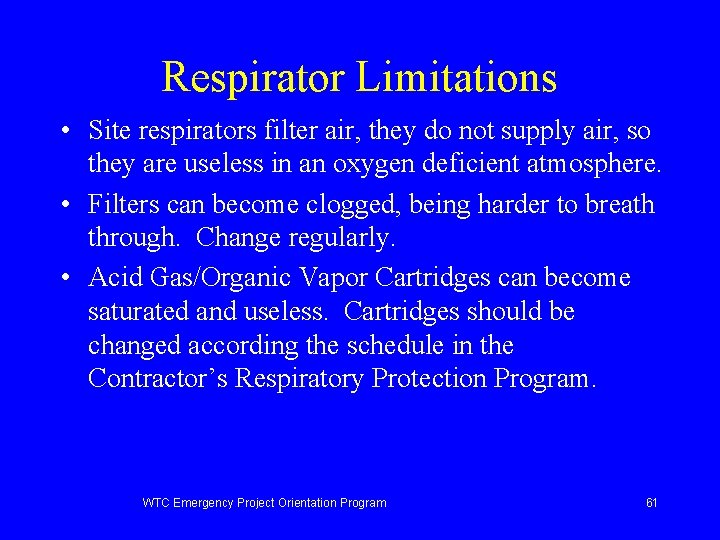
Respirator Limitations • Site respirators filter air, they do not supply air, so they are useless in an oxygen deficient atmosphere. • Filters can become clogged, being harder to breath through. Change regularly. • Acid Gas/Organic Vapor Cartridges can become saturated and useless. Cartridges should be changed according the schedule in the Contractor’s Respiratory Protection Program. WTC Emergency Project Orientation Program 61
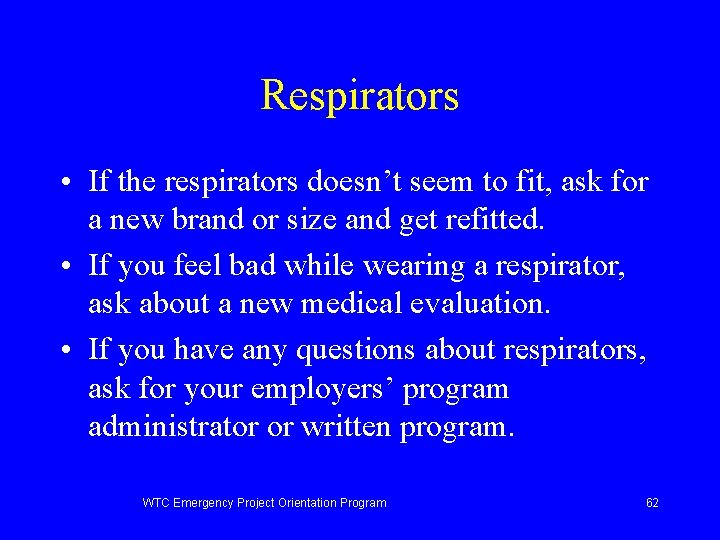
Respirators • If the respirators doesn’t seem to fit, ask for a new brand or size and get refitted. • If you feel bad while wearing a respirator, ask about a new medical evaluation. • If you have any questions about respirators, ask for your employers’ program administrator or written program. WTC Emergency Project Orientation Program 62
Trade/Contractor Specific Hazards and Work Rules WTC Emergency Project Orientation Program 63
Field Orientation Follow the instructor back to the site for a visual review of key locations WTC Emergency Project Orientation Program 64