
World Religions Five Major World Religions Christianity Buddhism
World Religions

Five Major World Religions • • • Christianity Buddhism Islam Hinduism Judaism

Five Main Questions 1. 2. 3. 4. When or How did this religion start? What is their philosophy/ beliefs? Who is their god or gods? What is their sacred texts or holy book? 5. How many followers and where in the world?
Christianity • Christianity started about 2, 000 years ago, mid 1 st century CE (1) • Jesus, or the Messiah, was a Jewish boy who disagreed with some of the Jewish principles of his day began to profess a new way of thinking. (1) • This eventually led to the beginning of the Christian religion. (1)
Christianity • Jesus was the son of God. (2) • Faith in Jesus Christ will save you from sin. (2) • God is the Creator of the universe. There is one God, Who is Three Persons Father, Son and Holy Spirit. (3) •
Christianity • The Bible is the Holy Book that records God's revelation. (4) • All believers are promised life everlasting. (2) • The leader of Christianity was Jesus, and the followers was his 12 disciples. • Approximately 2. 2 billion Christians in the world. (5)
Buddhism • 6 -4 th Cent. BCE (1) • Founding person of Buddhism is Siddhartha Guatama, in NE India (1) • He became the Buddha (3) • One Buddha, many images (3) • Buddhism is a major religion in China, Japan, India, and Tibet. (5)
The Major Philosophy of Buddhism • Buddhism states that existence is a continuing cycle of death and rebirth called reincarnation. (2) • Each person's position in life is determined by his or her behavior in the previous life. This is known as their "karma" (also a Hindu belief). (2)
The Major Philosophy of Buddhism (2) • Believe in 4 Noble Truth 1. Life is suffering 2. Suffering is caused because of cravings and aversions 3. True happiness is possible 4. Follow 8 Fold Path to happiness
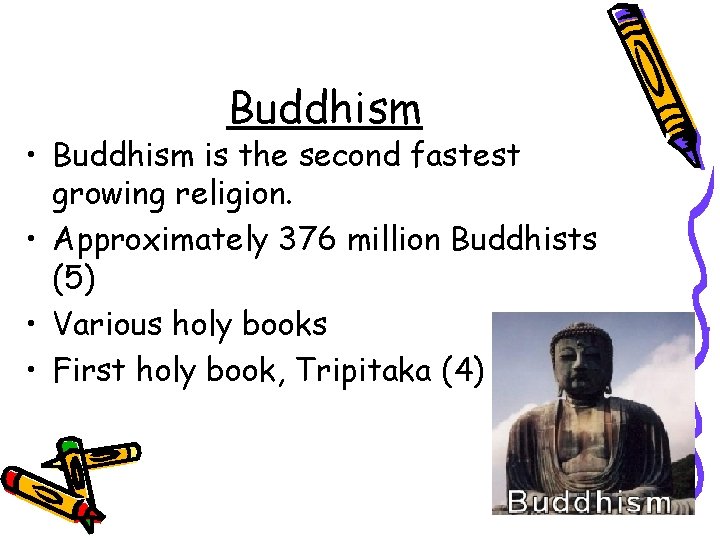
Buddhism • Buddhism is the second fastest growing religion. • Approximately 376 million Buddhists (5) • Various holy books • First holy book, Tripitaka (4)
Islam • ISLAM is the name given to the religion preached by the prophet Muhammad in the 7 th Century CE. (1) • The Islamic religion started in the area known as Palestine. (1) • most Muslims are in the Middle East, South Asia, Indonesia, and parts of Africa. (5)
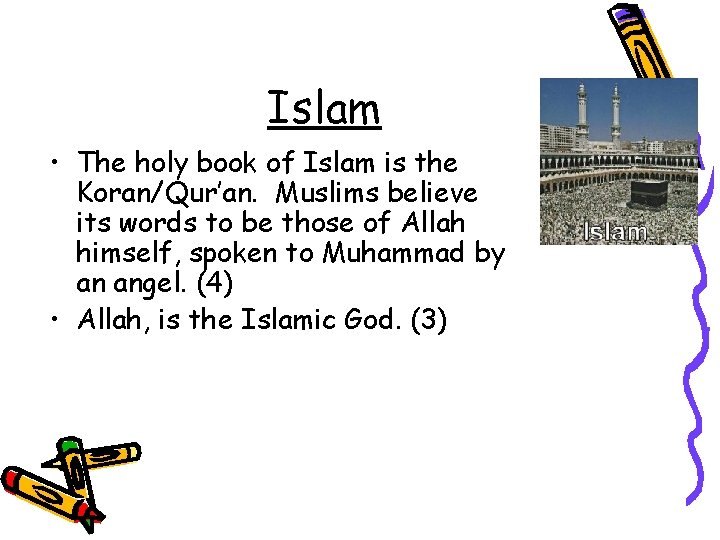
Islam • The holy book of Islam is the Koran/Qur’an. Muslims believe its words to be those of Allah himself, spoken to Muhammad by an angel. (4) • Allah, is the Islamic God. (3)
Islamic Philosophy • 5 Pillars of Islam (2) 1. 2. 3. 4. 5. No God but God Pray 5 times a day Alms Fasting (Ramadan) Pilgrimage to Mecca
Islam • Muslims learn that life on earth is a period of testing and preparation for the life to come. • People should behave themselves and help others, trusting in Allah's justice and mercy for their reward. • Approximately 1. 5 billion Muslims (5)
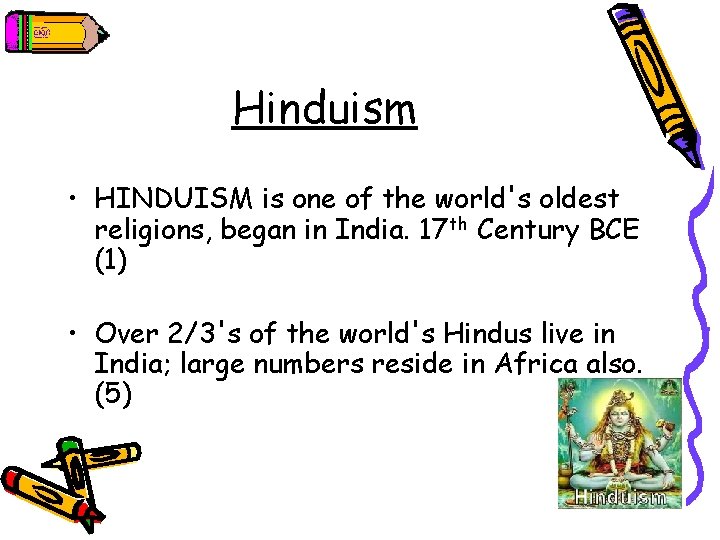
Hinduism • HINDUISM is one of the world's oldest religions, began in India. 17 th Century BCE (1) • Over 2/3's of the world's Hindus live in India; large numbers reside in Africa also. (5)
Hindu Philosophy • Hindus believe in many gods, numbering into the thousands. • They recognize one supreme spirit called Brahman (the Absolute). (3) • The Goal of Hindus is moksha. • Until that union takes place, believers are in a continuous process of rebirth called "reincarnation. “ (2)
Hinduism • At death, the Hindu's deeds (karma) determine what the next life will be. • Hinduism has many sacred books, the oldest being a series called the "Vedas. “ (4) • Traditional Hindu society was divided into groups of four classes (or varnas). This was known as the "caste system. " (2) • Approximately 900 million Hindus (5)
Judaism • About 18 th Century BCE. • JUDAISM was the first to teach belief in only one God. Two other important religions developed from Judaism: Christianity and Islam. (1)
Judaism • Jews think that God will send a Messiah (a deliverer) to unite them and lead them in His way. (2) • Christians believe that Jesus was the Messiah. The Jewish people do not agree; they anticipate His arrival in the future. (3) • Judaism teaches that death is not the end and that there is a world to come. (2)
Judaism • The "Torah, " the first five books of the Hebrew Bible, is the most important Jewish scripture. (4) • It contains the basic laws of Judaism. • Another important book is the "Talmud, " serving primarily as a guide to the civil and religious laws of Judaism. (4)
• • Jewish Philosophy We have the obligation to worship The Torah is God's law God is judge The Messiah will come. (2)
Judaism • The Jewish house of worship is called a synagogue. • Rabbis (spiritual leaders) conduct services, act as interpreters of Jewish laws, and deliver sermons. • Today there are over 18 million followers of Judaism scattered throughout the world. A large number live in the Jewish nation of Israel. Over six million live in the United States. (5)
- Slides: 22