
WORLD MUSIC Y 9 Lesson 1 Learning objectives
WORLD MUSIC Y 9 – Lesson 1
Learning objectives ◦ I will learn how to clap/play different rhythms from Samba music. ◦ I will understand the background of Brazilian Samba music. ◦ I will be able to identify features of Samba music.
Starter Activity ◦ You are going to listen to four different pieces of music, each of them in a different style. For each of the pieces try to work out which country the music might be from and write your answers in your booklet. ◦ Piece 1 - https: //www. youtube. com/watch? v=i. W 71 -s. Vy. Mz. M ◦ Piece 2 - https: //www. youtube. com/watch? v=DRfb-An. Do 7 g ◦ Piece 3 – https: //www. youtube. com/watch? v=TXSb_OIMNQg ◦ Piece 4 - https: //www. youtube. com/watch? v=A 6 VV 7__La. HU
Which country does the music come from? ◦ Piece 1 – Spain ◦ Piece 2 – Caribbean ◦ Piece 3 – India ◦ Piece 4 – Slavic (Russia, Czech Republic, Montenegro, Bulgaria etc. )
What is Samba music? ◦ Samba music is a combination of many different cultures. The Portuguese colonised Brazil in the 1500 s, and many cities along the coast were used as shipping routes. ◦ This created a melting pot of many different nationalities, and today Brazil’s population is the fifth largest in the world, with influences from Africa, Asia, France, the Netherlands, and other Native American cultures. ◦ The music became a combination of many different instruments and traditions. Today Brazil is famous for its carnival culture.
What is Syncopation? • A musical rhythm accenting a normally weak beat • Makes you want to dance and moves the music forward • Music (especially dance music) that has a syncopated rhythm
Listening Task ØHow would you describe the tempo? Ø What is the overall dynamic level? ØWhat is the name where a leader plays something and then everyone copies it and plays together? http: //www. youtube. com/watch? v=4 Wc_wb 5 Ek. U 8
Samba Instruments ◦ Samba bands are mostly percussive. Some of the instruments used may be familiar to you, and some may not. ◦ A samba band is designed to be portable, so musicians can walk along a parade route during carnivals. ◦ The band is led by a conductor with a whistle, which can be heard even over the pounding of the drums. ◦ Samba music uses drums and other percussion, some of which are shown below.
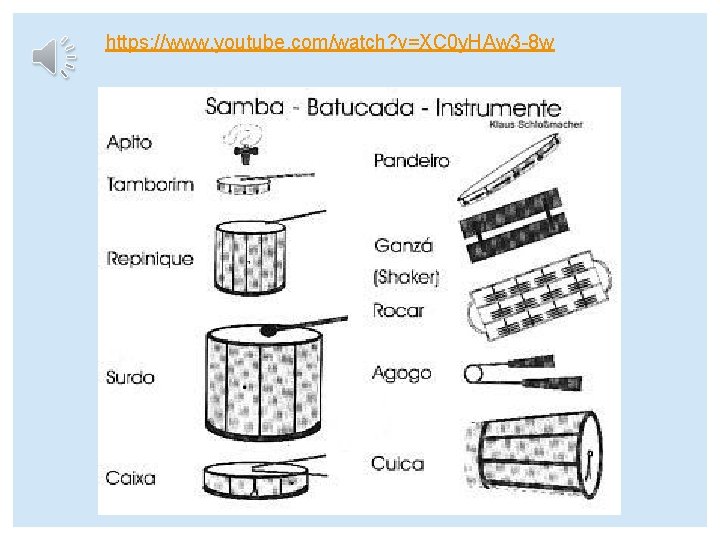
https: //www. youtube. com/watch? v=XC 0 y. HAw 3 -8 w
Practical Task 1) Try clapping through each of the different rhythms. 2) Once you have mastered the rhythm try playing it at the same time as someone else plays a different rhythm. If there’s nobody else around you to help then try layering the sounds on an app on your phone such as ‘a cappella’. 3) Create your own rhythmic pattern by putting the patterns that you have just clapped into a new order. Try drawing out your new pattern and upload this to Class. Charts so that your teacher can see how you have got on.
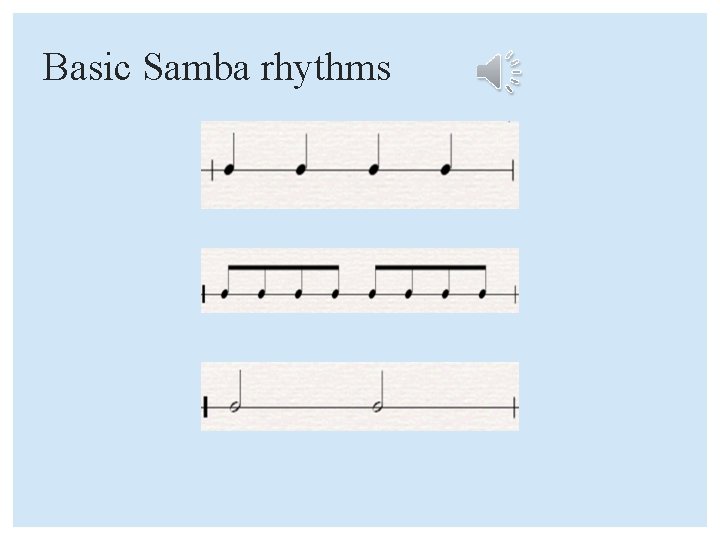
Basic Samba rhythms
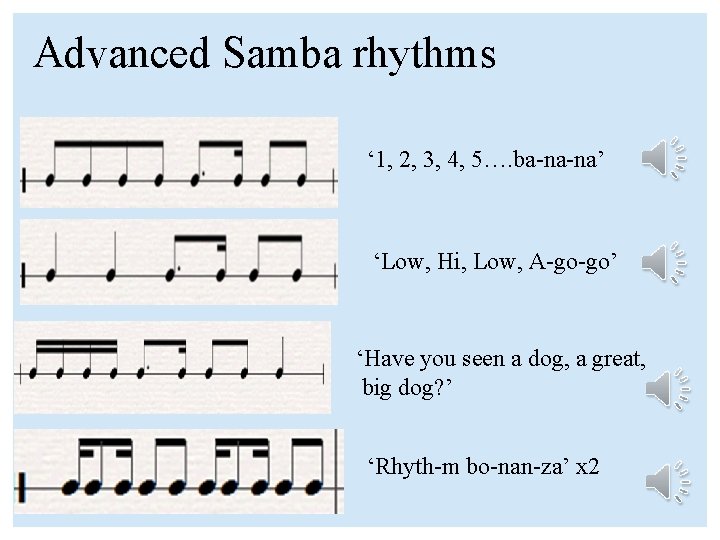
Advanced Samba rhythms ‘ 1, 2, 3, 4, 5…. ba-na-na’ ‘Low, Hi, Low, A-go-go’ ‘Have you seen a dog, a great, big dog? ’ ‘Rhyth-m bo-nan-za’ x 2
Samba facts quiz ◦ Q. What country is Samba music from?
Samba facts quiz ◦ Q. What country is Samba music from? ◦ A. Brazil
Samba facts quiz ◦ Q. What year was it ‘invented’?
Samba facts quiz ◦ Q. What year was it ‘invented’? ◦ A. 1930 – a group of musicians led by Ismael Silva founded first Samba school; Deixa (‘day-shar’) Falcar
Samba facts quiz ◦ Q. What 2 continents are involved in creating Samba music?
Samba facts quiz ◦ Q. What 2 continents are involved in creating Samba music? ◦ A. Africa and South America – similar to Blues, slaves taken from Africa in 19 th Century to Brazil
Samba facts quiz ◦ Q. At which time of the year is Samba usually performed at carnivals and street parties?
Samba facts quiz ◦ Q. At which time of the year is Samba usually performed at carnivals and street parties? ◦ A. Just before Lent (January/February)
Samba facts quiz ◦ Q. What word beginning with ‘P’ means ‘lots of different rhythms playing altogether’?
Samba facts quiz ◦ Q. What word beginning with ‘P’ means ‘lots of different rhythms playing altogether’? ◦ A. ‘Polyrhythms’
Samba facts quiz ◦ Q. What term, which is also used in African music, describes the act of one person performing and other people performing afterwards?
Samba facts quiz ◦ Q. What term, which is also used in African music, describes the act of one person performing and other people performing afterwards? ◦ A. Call and response
Samba facts quiz ◦ Q. What term beginning with ‘C’ describes the mixture of rhythms in 3 and rhythms of 4? ◦ A. C_ _ - r _ y _ _
Samba facts quiz ◦ Q. What term beginning with ‘C’ describes the mixture of rhythms in 3 and rhythms of 4? ◦ A. Cross - rhythms
Samba facts quiz ◦ Q. What key term beginning with ‘O’ means a repeating pattern or rhythm? ◦ A. O s _ _ t o
Samba facts quiz ◦ Q. What key term beginning with ‘O’ means a repeating pattern or rhythm? ◦ A. Ostinato
- Slides: 28