
World Meteorological Organization WMO is the United Nations
- Slides: 17
World Meteorological Organization WMO is the United Nations' authoritative voice on weather, climate and water Montréal The way forward
World Meteorological Organization (WMO) • United Nations Specialized Agency for meteorology, climate, operational hydrology and related geophysical sciences • United Nations system’s authoritative voice on the state and behaviour of the Earth’s atmosphere and its interaction with the oceans, as well as on climate and the distribution of water resources • Established on 23 March 1950; direct successor to the International Meteorological Organization founded in 1873 • Comprises 188 Members: 182 States and six territories 9/15/2020 Montréal The way forward 2
Aviation and the Environment • Global Climate Change: a reality, but more research will be needed to fully understand all the consequences for individual areas • Local Air Quality: All apects of NOx, PM 10, PM 2, aerosols, ozone, CO need addressing - Aircraft only part of the problem, but some cities approaching limits 9/15/2020 Montréal The way forward 3
Climate Change – what next? • Climate change is more than « Global Warming » • Public perception has changed dramatically • Aviation contributing more than CO • NOx, Cirrus effect different time scale • Operational measures need to include optimized use of meteorological information 2 – Upper winds and temperatures – Terminal aerodrome optimization (holdings, corner posts, runway changes) 9/15/2020 Montréal The way forward 4
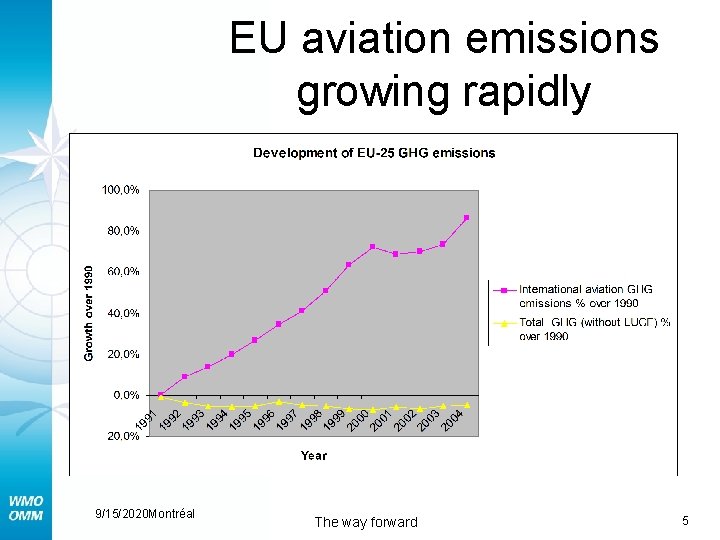
EU aviation emissions growing rapidly 9/15/2020 Montréal The way forward 5
Contrails and Cirrus • Moderate effect during daytime, larger warming during the night (no compensating reflection of short wave radiation) • + Layers of high humidity are normally thin and could potentially be avoided • + Less air traffic at night would allow avoidance without compromising RVSM • Need for more environmental monitoring by aircraft (AMDAR, IAGOS, MOZAIC) 9/15/2020 Montréal The way forward 6
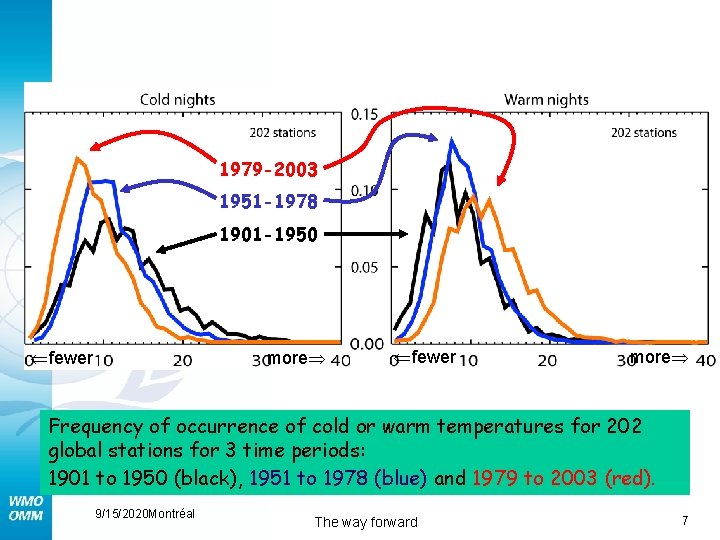
1979 -2003 1951 -1978 1901 -1950 fewer more Frequency of occurrence of cold or warm temperatures for 202 global stations for 3 time periods: 1901 to 1950 (black), 1951 to 1978 (blue) and 1979 to 2003 (red). 9/15/2020 Montréal The way forward 7
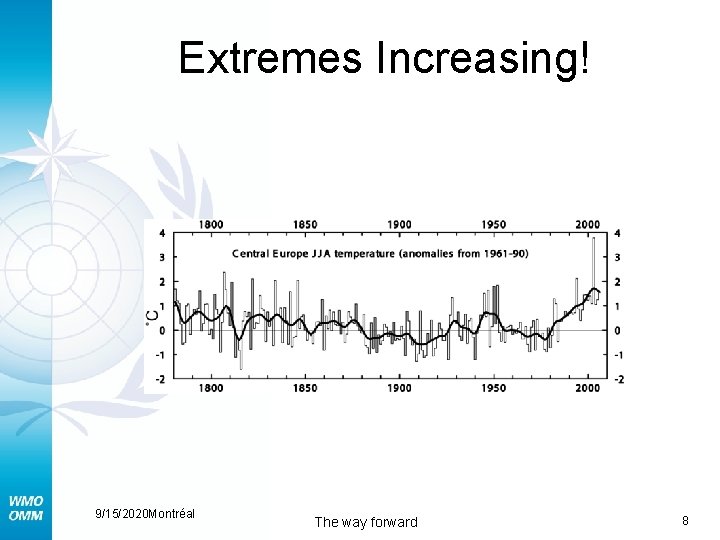
Extremes Increasing! 9/15/2020 Montréal The way forward 8
Effects on Cryosphere 9/15/2020 Montréal The way forward 9
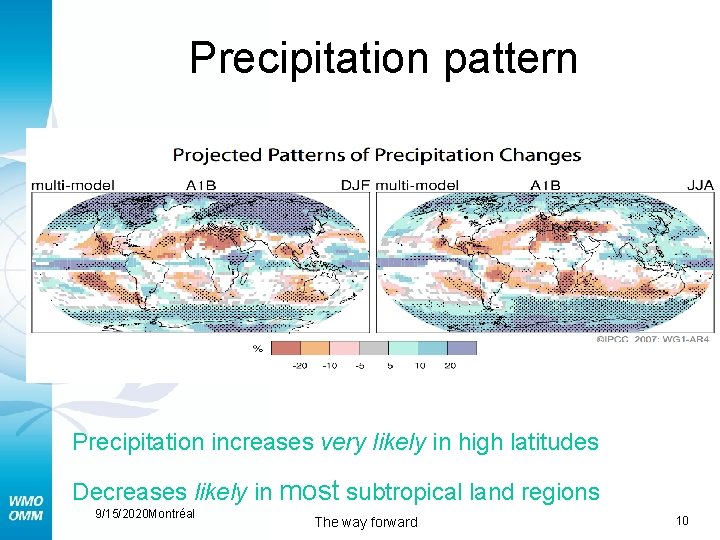
Precipitation pattern Precipitation increases very likely in high latitudes Decreases likely in most subtropical land regions 9/15/2020 Montréal The way forward 10
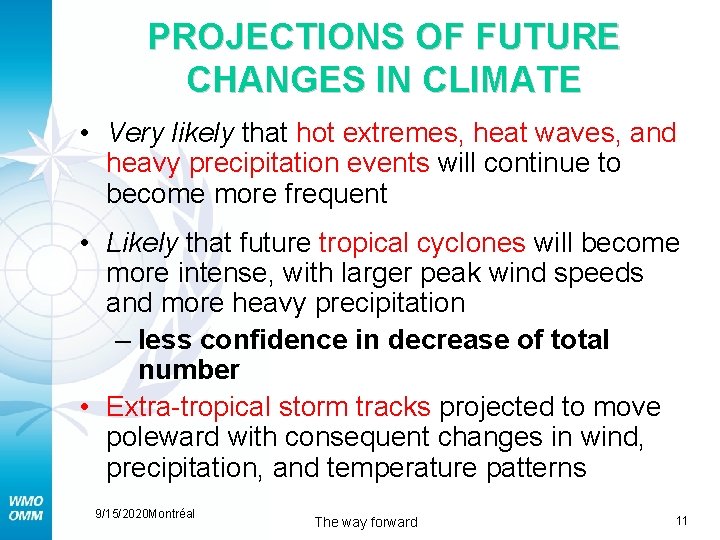
PROJECTIONS OF FUTURE CHANGES IN CLIMATE • Very likely that hot extremes, heat waves, and heavy precipitation events will continue to become more frequent • Likely that future tropical cyclones will become more intense, with larger peak wind speeds and more heavy precipitation – less confidence in decrease of total number • Extra-tropical storm tracks projected to move poleward with consequent changes in wind, precipitation, and temperature patterns 9/15/2020 Montréal The way forward 11
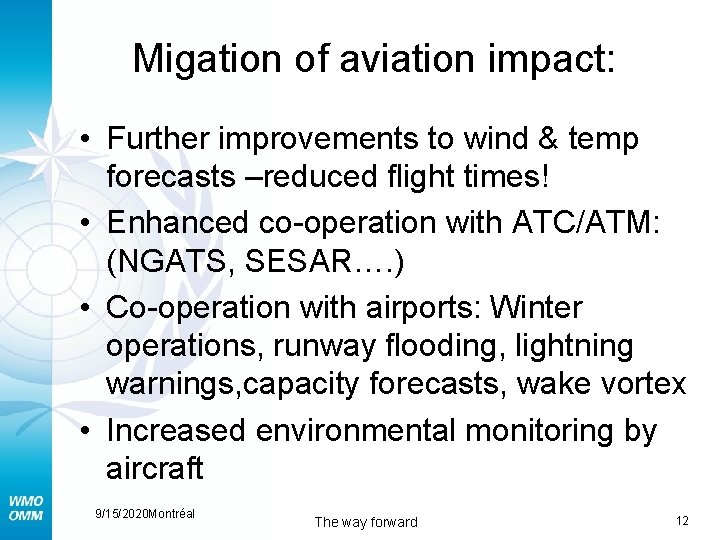
Migation of aviation impact: • Further improvements to wind & temp forecasts –reduced flight times! • Enhanced co-operation with ATC/ATM: (NGATS, SESAR…. ) • Co-operation with airports: Winter operations, runway flooding, lightning warnings, capacity forecasts, wake vortex • Increased environmental monitoring by aircraft 9/15/2020 Montréal The way forward 12
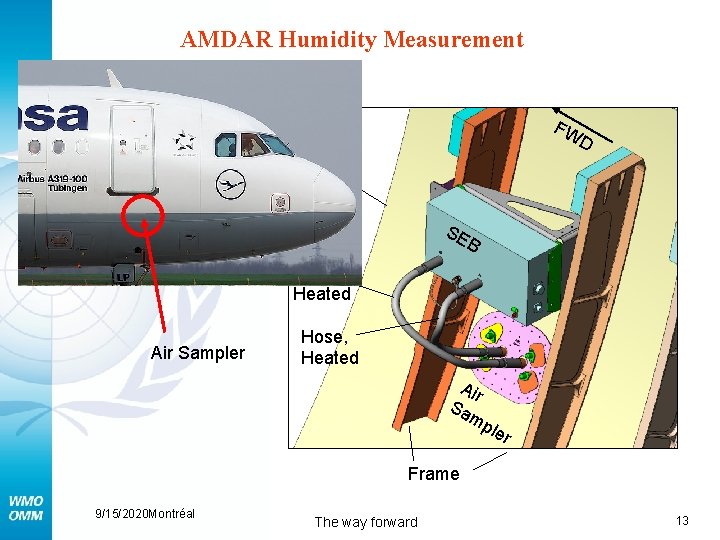
AMDAR Humidity Measurement FW D Skin SE B Hose, Non. Heated Air Sampler Hose, Heated Air Sa mp le r Frame 9/15/2020 Montréal The way forward 13
Anticipated effects on Aviation (Demand side) • Tourism: Popular Destinations in Subtropics will suffer from droughts, sand-and duststorms • Winter tourism (skiing) will suffer from lack of reliable snow cover • Tropical Island destinations suffer from stronger cyclones, sea level rise • Cost to national economies of mitigating and compensating for climate change may affext free disposable income 9/15/2020 Montréal The way forward 14
Effects on Aviation Operations • Hot extremes: performance limitations on flights near max endurance • Tropical Cyclones: Damages to infrastructure, disruption of schedules, evacuation? • Intensity of storms and convection: severe disruption of apch/dept , blocking of flight levels, runway flooding, , sandand dust storms 9/15/2020 Montréal The way forward 15
Thanks for material: • Working Group I Contribution to the IPCC Fourth Assessment Report Presented by R. K. Pachauri, IPCC Chair and Bubu Jallow, WG 1 Vice Chair • Europe & Emission Trading 9/15/2020 Montréal The way forward 16
Note: Aviation induced Cirrus! THANK YOUR FOR YOUR ATTENTION! 9/15/2020 Montréal The way forward 17