
WORLD HISTORY The Industrial Revolution Begins A New
WORLD HISTORY The Industrial Revolution Begins
A New Way of Life Before Industrial Revolution – most lived in rural villages § Hand tools § Human/animal power Industrial Revolution changed the way people lived and worked § § New inventions, innovations More efficient methods of production New sources of power Development of cities, towns A chain of events, causes led to the Industrial Revolution
The “Agricultural Revolution” British farmers adopted Dutch agricultural methods § Reclamation of farm land (dikes, consolidation) § Use of fertilizers Farmers developed new ways to improve crop yields § Lord Charles Townshend advocated crop rotation § Jethro Tull’s Tull seed drill made planting more efficient Wealthy landowners took over smaller fields through enclosure § § Peasants pushed out! Fewer workers needed Farm output, profits rose
A Population Explosion! Britain’s population increased 80% from 1700 - 1800 No real change in birthrate! So… what was going on? Better access to food § Less susceptible to disease due to malnourishment § Mothers were healthier – and so were babies § Fewer people dying early! Improved hygiene, sanitation Advancements in medical care
Technological Advancements New energy sources § Windmills and water mills § Coal was a critical resource Steam powered new industrial machinery § Thomas Newcomen’s Newcomen steam engine (1712) § James Watt improved it in 1769 – a key innovation! Abraham Darby used coal to smelt iron (to separate it from its ore) § § Result: cheaper, higher-quality iron Easy availability of iron encouraged building, infrastructure development
It Began In Britain A unique combination of conditions and events enabled Britain to lead the Industrial Revolution An abundance of natural and human resources § Large coal, iron ore reserves § Plenty of workers displaced by agricultural advances § An island – many natural ports and navigable rivers Demand, and funding, for innovation Overall health of the British economy, empire Political stability and strong work ethic
Textiles Spur Industrial Growth Textiles were the largest industry in Britain Cotton “put out” to peasants – cottage industry § All spinning, weaving, finishing, dyeing done by hand § Very slow process – couldn’t keep up with demand! New inventions helped speed production § John Kay’s flying shuttle made weaving faster § James Hargreaves’ spinning jenny helped spinners keep up with weavers § Richard Arkwright’s water frame used water power Factories built to accommodate machinery, replaced putting-out system
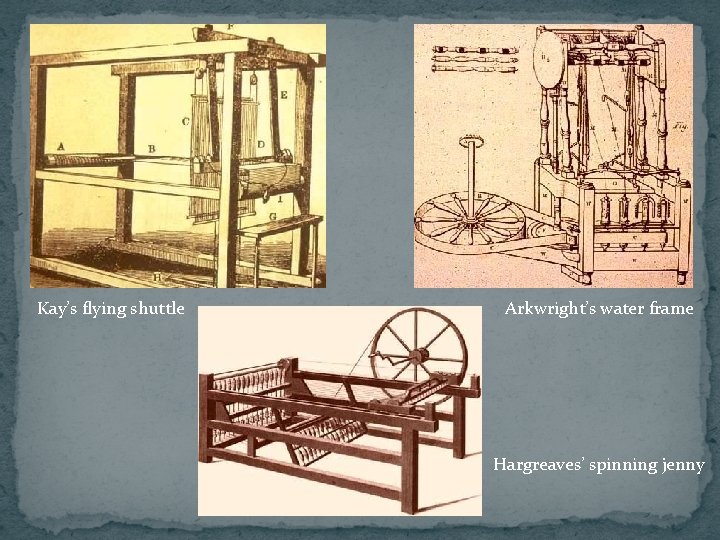
Kay’s flying shuttle Arkwright’s water frame Hargreaves’ spinning jenny
Transportation Developments Entrepreneurs needed to move all these goods to market! § § Turnpikes (private toll roads) Canals Railroads got shipping – and travel – on track § Railroads not dependent on water current § Liverpool-Manchester line completed in 1830 § Drive to construct new rail lines fueled demand for iron Development of the steamboat made shipping of goods – and travel – easier over water routes

A Chain Reaction… More efficient machines, technology More goods produced More consumers Improved timeto-market Greater demand Lower prices
Factory Life Urbanization as people moved to cities to live, work § Population growth, fewer farm jobs § Cities offered regular wages at factory jobs Factory work difficult… and dangerous § Long shifts, and monotonous work § Occupational hazards § § § Coal dust, cotton lint No safety devices or precautions to prevent injury No job security if sick or injured Workers primarily women, and children
Class Challenges Economic disparity grew between rich and poor New “working class” formed in urban centers § Tenement housing – small, cheaply built, and overcrowded § No running water, sewer, or public sanitation “Luddites” protested industrialization by burning, vandalizing factories and machinery Collective bargaining, strikes outlawed John Wesley’s Methodism movement tried to re-direct anger, energy toward social reform
The “Middle Class” Prospered New bourgeoisie (middle class) formed as investors, merchants, entrepreneurs became wealthy Proud of “rags to riches” accomplishments – even though not the social equals of the upper class Lived comfortably, with household servants Sons were educated; daughters taught to be “ladies” Ambitious – thought poverty was the fault of the poor
The Evolution of the Revolution Social problems, conflicts arose with industrialization § Workers in poverty grew frustrated at their inability to improve their situation § Factory owners unwilling to give concessions that might hurt profitability § Laws protected business interests at the expense of workers Ultimately, calls for reform led to formation of labor unions, better working conditions Most working men had the right to vote by mid-1800 s Growing demand for manufactured goods generally raised standard of living
Economic Theory Evolves, Too Enlightenment-era beliefs: men and government should not interfere with natural laws § § Extended to business, economics Analysis of socio-economic changes in context of natural laws “Hands-off” approach known as laissez-faire economics Key advocates were economists Adam Smith, Smith Thomas Malthus and David Ricardo
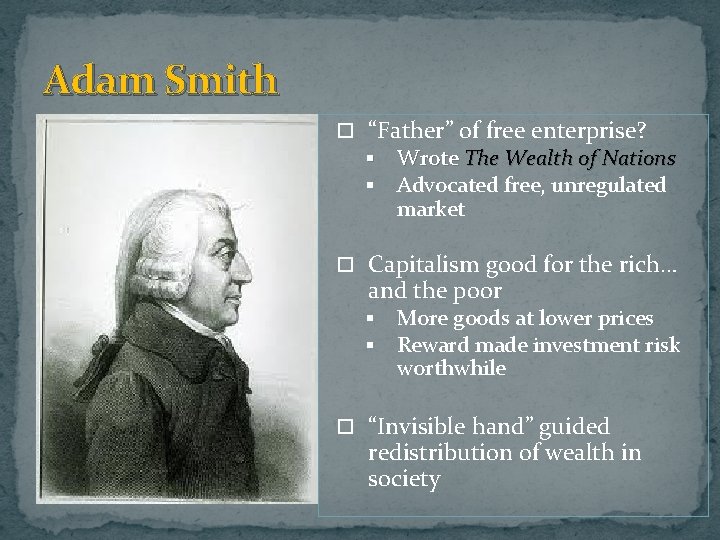
Adam Smith “Father” of free enterprise? § Wrote The Wealth of Nations § Advocated free, unregulated market Capitalism good for the rich… and the poor § § More goods at lower prices Reward made investment risk worthwhile “Invisible hand” guided redistribution of wealth in society
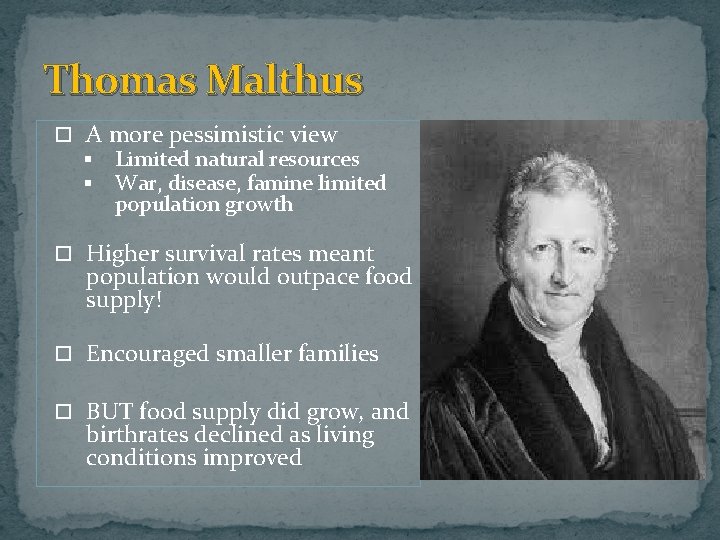
Thomas Malthus A more pessimistic view § Limited natural resources § War, disease, famine limited population growth Higher survival rates meant population would outpace food supply! Encouraged smaller families BUT food supply did grow, and birthrates declined as living conditions improved
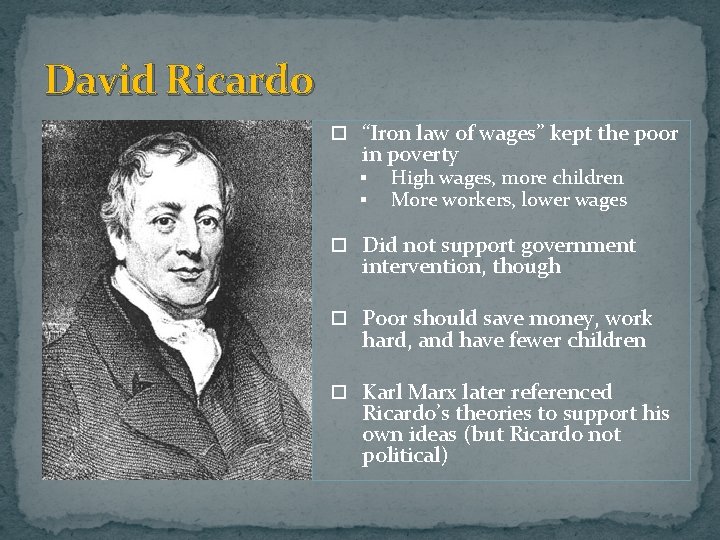
David Ricardo “Iron law of wages” kept the poor in poverty § § High wages, more children More workers, lower wages Did not support government intervention, though Poor should save money, work hard, and have fewer children Karl Marx later referenced Ricardo’s theories to support his own ideas (but Ricardo not political)
Utilitarianism Jeremy Bentham (a Ricardo contemporary) advocated idea of utilitarianism § § Utility = that which provides greatest good to greatest number of citizens Limited government intervention necessary to ensure laws, regulations focus on greater good John Stuart Mill expanded on Bentham’s ideas § Government should step in “to prevent harm” § Business should not improve at the expense of workers § Workers – and women – should have the vote! Middle class resisted these ideas – as might be expected
Socialism – A New Society? Capitalism without regulation created increasing divisions between rich and poor Socialism a radical alternative to laissez-faire policies § § § Means of production owned by “the people” Wealth in society not concentrated in hands of a few Economic equality would eliminate poverty, injustice How could it succeed? § Enlightenment view: people basically good and just § Class struggles, resentments would go away § Utopians (like Robert Owen) established model communities
Karl Marx and “Scientific Socialism” Marx believed capitalism was divisive and destructive He, with Friedrich Engels, advocated communism in The Communist Manifesto (1848) § § § Historical struggles between “haves” (bourgeoisie) and “have -nots” (the proletariat) proletariat “Haves” control wealth, society at expense of workers Marx predicted workers would rise up, take control Marx’s ideas resonated with workers – but other reforms equalized inequities National loyalties took precedence over international workers’ uprising – but Marxism often a revolutionary objective (Latin America, Cuba, Asia, Africa)
- Slides: 21