
WORLD HISTORY SEMESTER EXAM REVIEW 2014 2015 RENAISSANCE











- Slides: 52
WORLD HISTORY SEMESTER EXAM REVIEW 2014 -2015
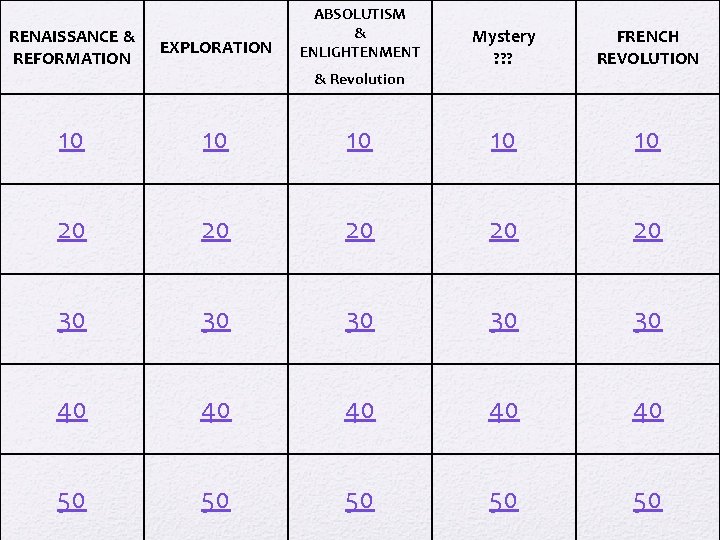
RENAISSANCE & REFORMATION EXPLORATION 10 10 20 ABSOLUTISM & ENLIGHTENMENT Mystery ? ? ? FRENCH REVOLUTION 10 10 10 20 20 30 30 30 40 40 40 50 50 50 & Revolution
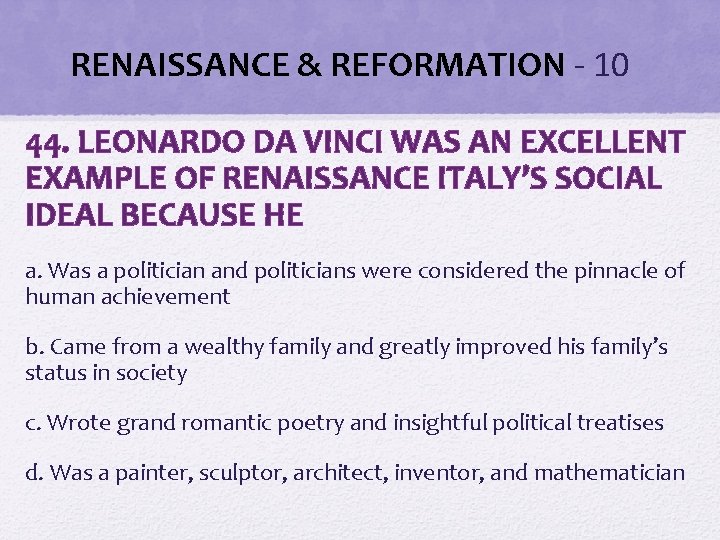
RENAISSANCE & REFORMATION - 10 44. LEONARDO DA VINCI WAS AN EXCELLENT EXAMPLE OF RENAISSANCE ITALY’S SOCIAL IDEAL BECAUSE HE a. Was a politician and politicians were considered the pinnacle of human achievement b. Came from a wealthy family and greatly improved his family’s status in society c. Wrote grand romantic poetry and insightful political treatises d. Was a painter, sculptor, architect, inventor, and mathematician
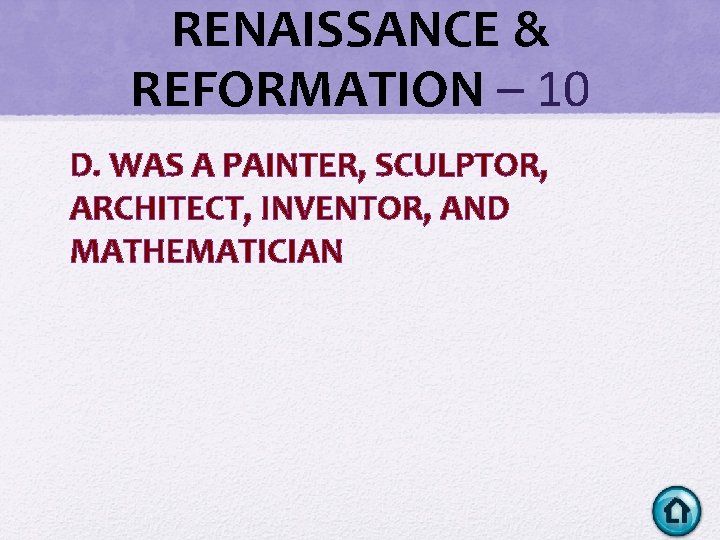
RENAISSANCE & REFORMATION – 10 D. WAS A PAINTER, SCULPTOR, ARCHITECT, INVENTOR, AND MATHEMATICIAN
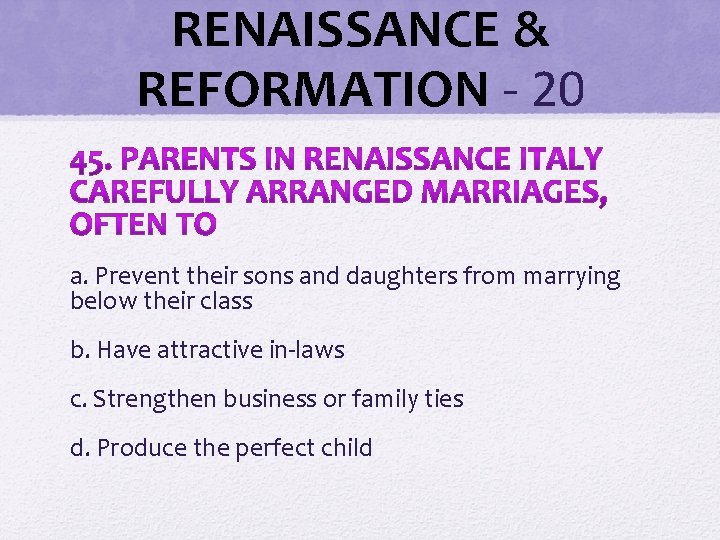
RENAISSANCE & REFORMATION - 20 a. Prevent their sons and daughters from marrying below their class b. Have attractive in-laws c. Strengthen business or family ties d. Produce the perfect child
RENAISSANCE & REFORMATION – 20 C. STRENGTHEN BUSINESS OR FAMILY TIES
RENAISSANCE & REFORMATION - 30 a. Was immediately seen as a threat by local businesses b. Attacked the abuses in the sale of indulgences, beginning the Protestant Reformation c. Was largely ignored until decades after Luther’s death d. Became the central text for Anglicanism
RENAISSANCE & REFORMATION – 30 B. ATTACKED THE ABUSES IN THE SALE OF INDULGENCES, BEGINNING THE PROTESTANT REFORMATION
RENAISSANCE & REFORMATION - 40 a. Latin American revolutionary leaders b. Reformation leaders c. Impressionist painters d. divine right monarchs
RENAISSANCE & REFORMATION – 40 B. REFORMATION LEADERS
RENAISSANCE & REFORMATION - 50 a. the quantities of gold and silver brought back to Italy by Italian explorers b. the concentration of riches in the hands of a king and his court c. through the use of merchants in trade between Europe and the East d. the location of the Vatican in Italy
RENAISSANCE & REFORMATION – 50
EXPLORATION- 10 a. Amerigo Vespucci b. John Cabot c. Christopher Columbus d. Alfonso de Albuquerque
EXPLORATION– 10 • C. CHRISTOPHER COLUMBUS
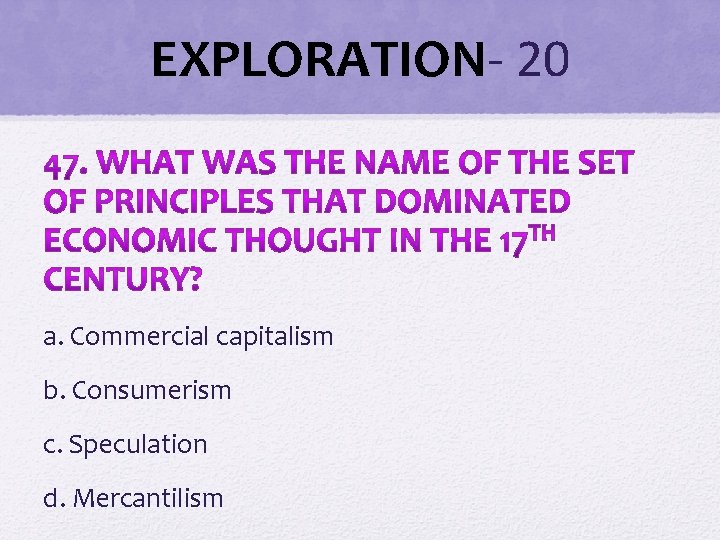
EXPLORATION- 20 a. Commercial capitalism b. Consumerism c. Speculation d. Mercantilism
EXPLORATION – 20
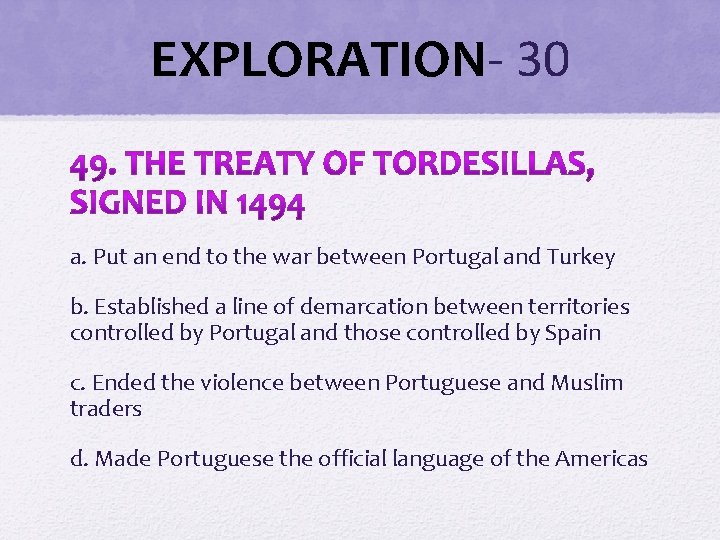
EXPLORATION- 30 a. Put an end to the war between Portugal and Turkey b. Established a line of demarcation between territories controlled by Portugal and those controlled by Spain c. Ended the violence between Portuguese and Muslim traders d. Made Portuguese the official language of the Americas
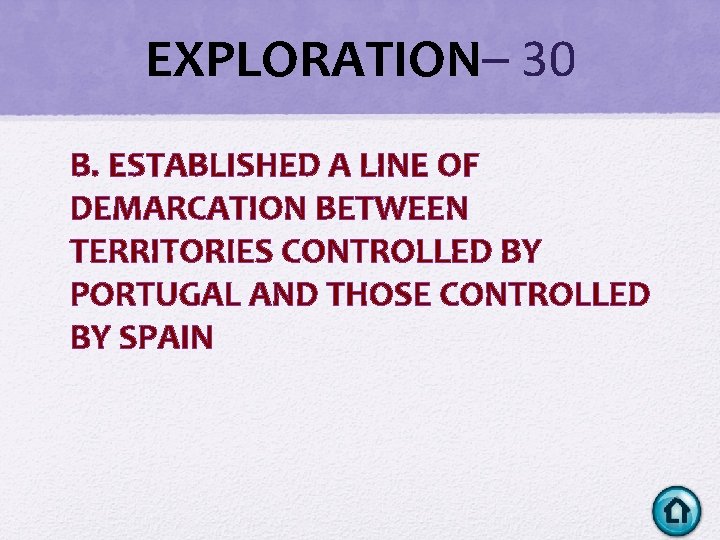
EXPLORATION– 30 B. ESTABLISHED A LINE OF DEMARCATION BETWEEN TERRITORIES CONTROLLED BY PORTUGAL AND THOSE CONTROLLED BY SPAIN
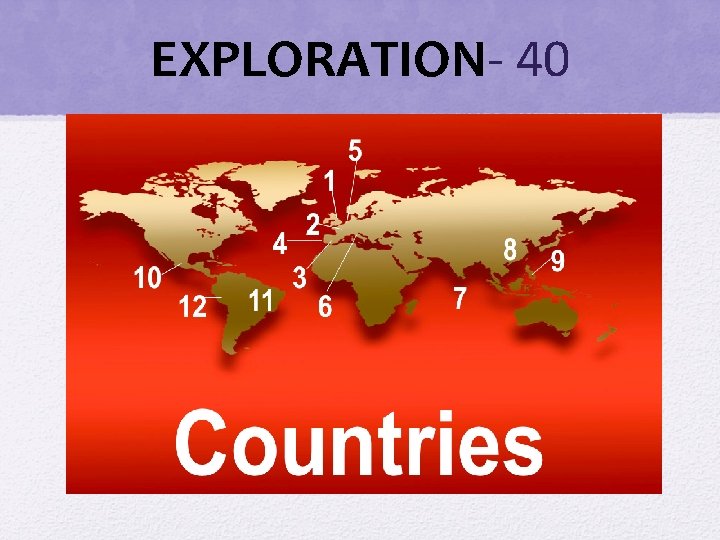
EXPLORATION- 40
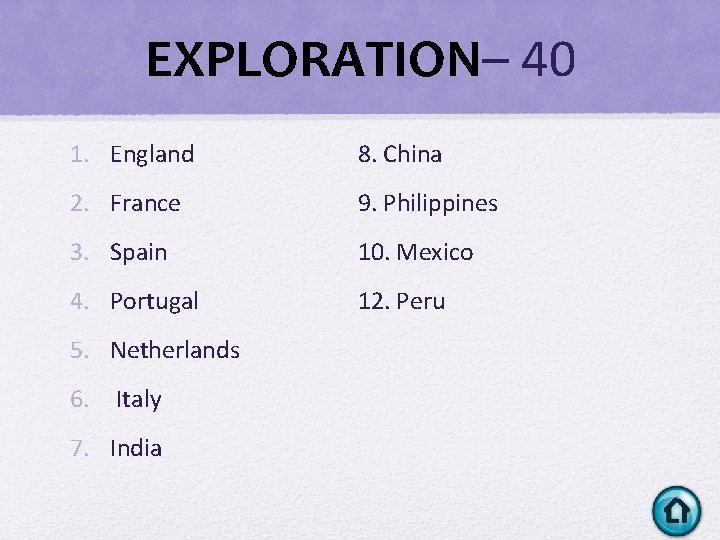
EXPLORATION– 40 1. England 8. China 2. France 9. Philippines 3. Spain 10. Mexico 4. Portugal 12. Peru 5. Netherlands 6. Italy 7. India
EXPLORATION- 50
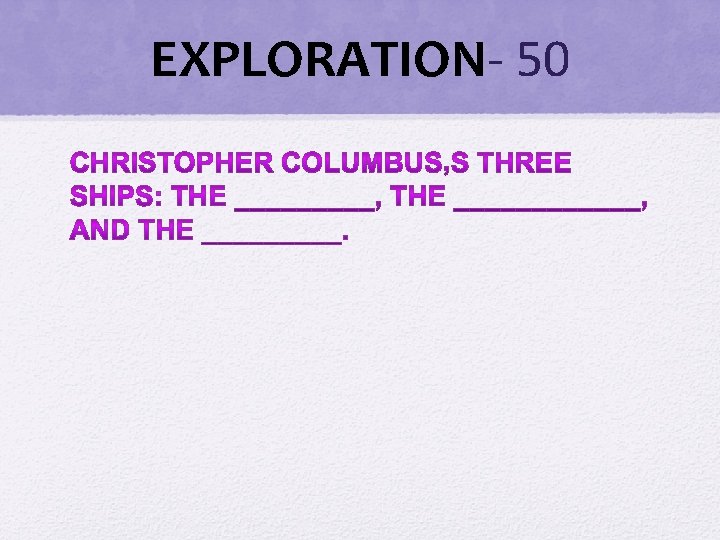
EXPLORATION– 50
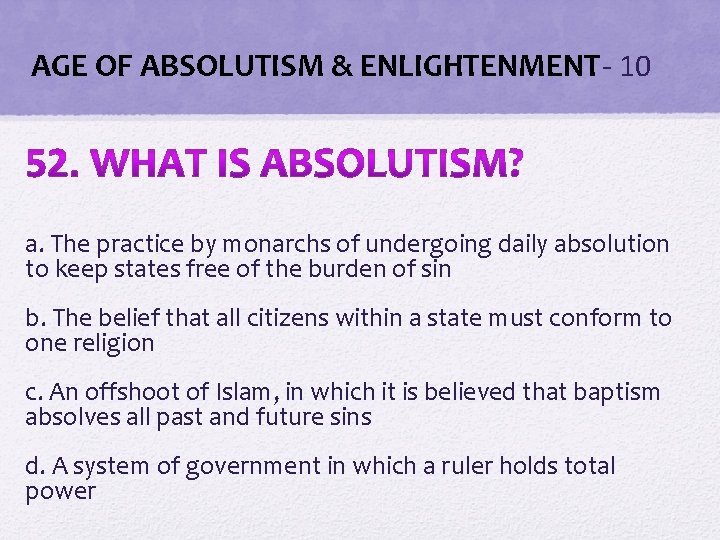
AGE OF ABSOLUTISM & ENLIGHTENMENT- 10 a. The practice by monarchs of undergoing daily absolution to keep states free of the burden of sin b. The belief that all citizens within a state must conform to one religion c. An offshoot of Islam, in which it is believed that baptism absolves all past and future sins d. A system of government in which a ruler holds total power
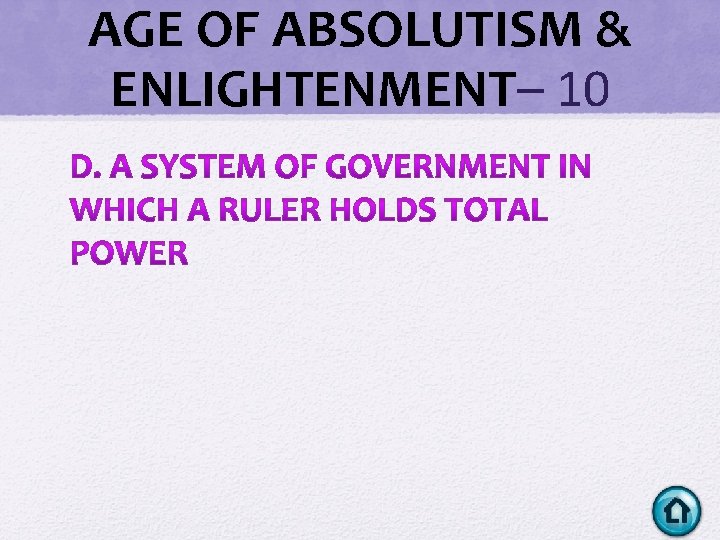
AGE OF ABSOLUTISM & ENLIGHTENMENT– 10
AGE OF ABSOLUTISM & ENLIGHTENMENT & Revolution - a. Thomas Wilson b. John Calvin c. Miguel de Cervantes d. John Locke 20
AGE OF ABSOLUTISM & ENLIGHTENMENT & Revolution – D. JOHN LOCKE 20
AGE OF ABSOLUTISM & ENLIGHTENMENT- 30 a. Was denounced by the Anglican Church as the work of the Devil b. Refuted Galileo’s theory of universal movement c. Was laughed at by Galileo, Kepler and Copernicus d. Showed how one law could explain all motion in the universe
AGE OF ABSOLUTISM & ENLIGHTENMENT– 30 D. SHOWED HOW ONE LAW COULD EXPLAIN ALL MOTION IN THE UNIVERSE
AGE OF ABSOLUTISM & ENLIGHTENMENT- 40 a. An entire society agrees to be governed by its general will b. Punishments are not exercises in brutality and capital punishment is discarded c. The government should not interfere in economic matters d. Women should be granted rights nearly equal to those of men
AGE OF ABSOLUTISM & ENLIGHTENMENT– 40
AGE OF ABSOLUTISM & ENLIGHTENMENT- 50 a. Copernicus and Kepler were wrong in their beliefs about the moon goddess b. The Catholic Church’s beliefs about the heavens were correct c. Plato was correct about the way the planets were arranged d. The heavenly bodies were composed of material substance just like Earth not pure orbs of light
AGE OF ABSOLUTISM & ENLIGHTENMENT– 50
Mystery- 10 a. Napoleon’s greed and laziness within his bureaucracy b. The survival of Great Britain and the force of nationalism c. The resentment of the clergy and the plotting of the accountants d. France’s weak economy and the drain of Napoleon’s many wars
Mystery – 10
Mystery - 20 a. The son of Allah, similar to Jesus b. An angel c. The prophet of Allah d. The reincarnation of Moses
Mystery – 20 C. THE PROPHET OF ALLAH
Mystery - 30 a. Brainwashing b. Gauntlet c. Quartering d. Ordeal
Mystery – 30 D. ORDEAL
Mystery - 40 a. The collapse of the caste system b. A severe famine c. The collapse of the Catholic Church d. Severe economic consequences
Mystery – 40 D. SEVERE ECONOMIC CONSEQUENCES
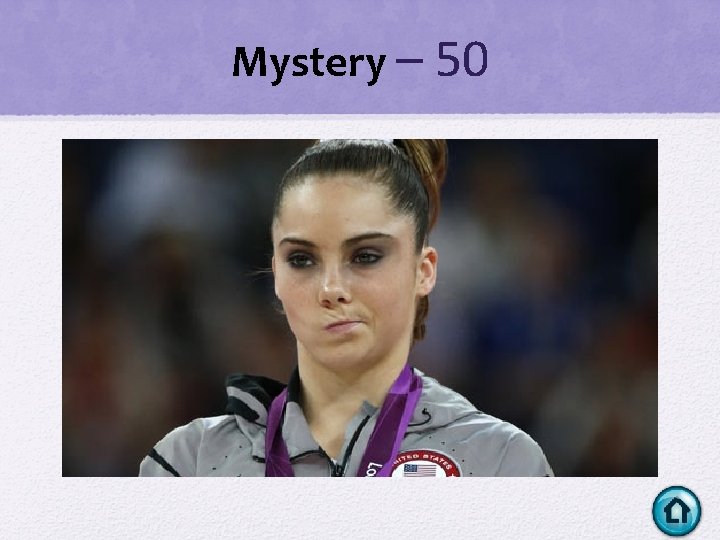
Mystery - 50 How does Ms. Cabrera feel about women’s rights, during the The Global Age, The Reformation, the Renaissance, the Scientific Revolution… Well, all of history, really?
Mystery – 50
FRENCH REVOLUTION - 10 a. The Storming of Bastille b. The Declaration of the Rights of Man c. The riots of 1791 d. War with Austria/Prussia
FRENCH REVOLUTION – 10 A. THE STORMING OF BASTILLE
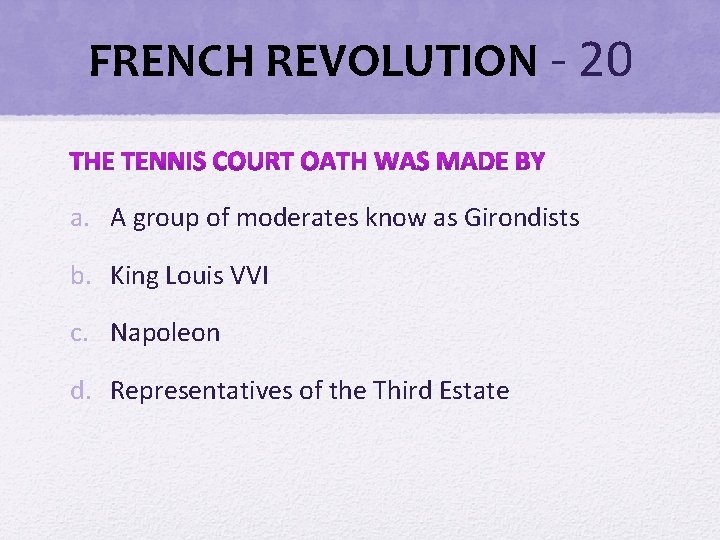
FRENCH REVOLUTION - 20 a. A group of moderates know as Girondists b. King Louis VVI c. Napoleon d. Representatives of the Third Estate
FRENCH REVOLUTION – 20
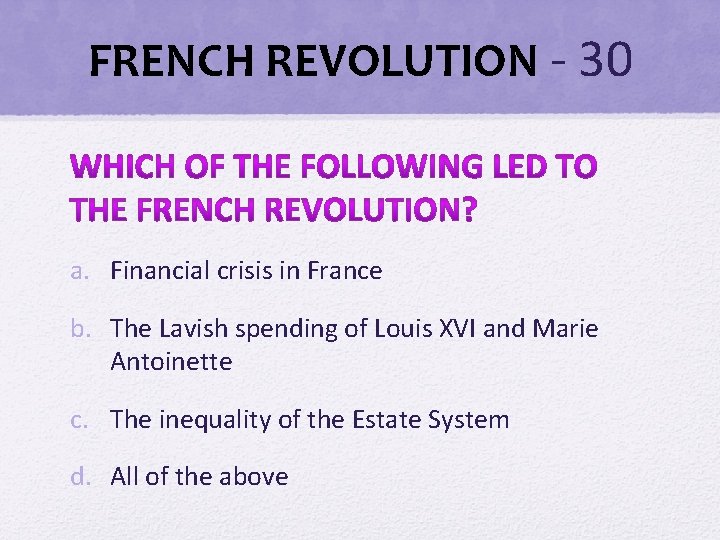
FRENCH REVOLUTION - 30 a. Financial crisis in France b. The Lavish spending of Louis XVI and Marie Antoinette c. The inequality of the Estate System d. All of the above
FRENCH REVOLUTION – 30 ALL OF THE ABOVE
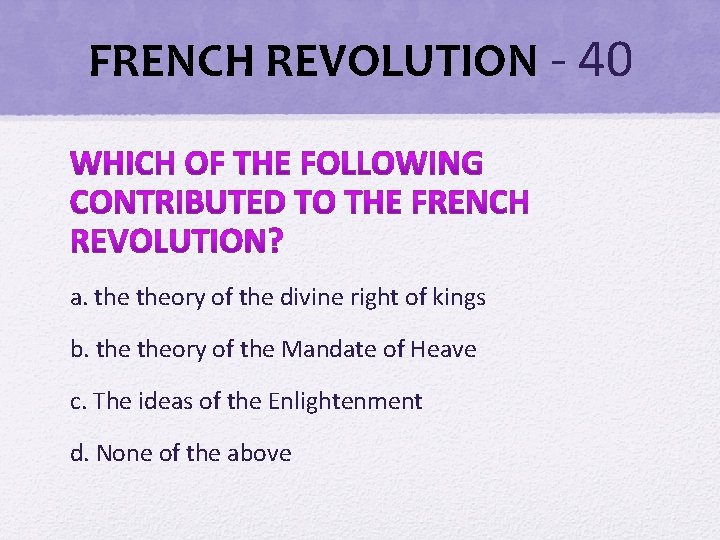
FRENCH REVOLUTION - 40 a. theory of the divine right of kings b. theory of the Mandate of Heave c. The ideas of the Enlightenment d. None of the above
FRENCH REVOLUTION – 40
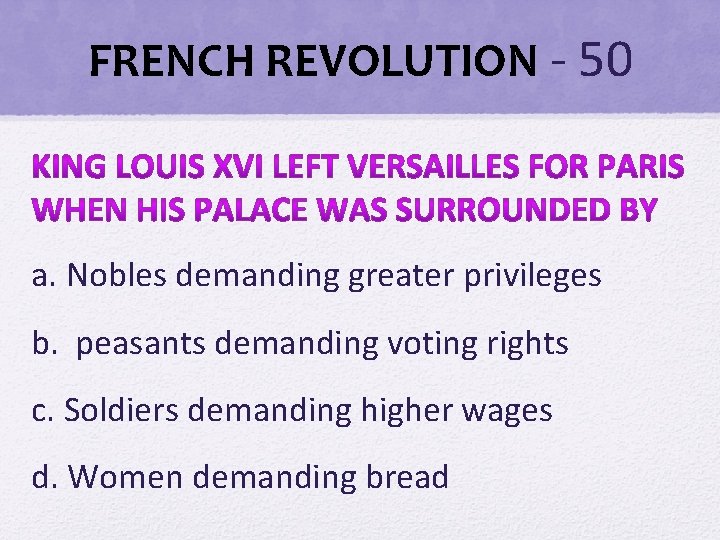
FRENCH REVOLUTION - 50 a. Nobles demanding greater privileges b. peasants demanding voting rights c. Soldiers demanding higher wages d. Women demanding bread
FRENCH REVOLUTION – 50 D. WOMEN DEMANDING BREAD