
World History Patterns of Interaction Chapter 2 Early

- Slides: 38
World History: Patterns of Interaction Chapter 2 Early River Valley Civilizations, 3500 B. C. – 450 B. C. Civilizations emerge and develop on fertile river plains in Mesopotamia, Egypt, the Indus Valley, and China. Next Copyright © by Houghton Mifflin Harcourt Publishing Company
World History: Patterns of Interaction Chapter 2 Early River Valley Civilizations, 3500 B. C. – 450 B. C. Section 1 City-States in Mesopotamia Section 2 Pyramids on the Nile Section 3 Planned Cities on the Indus Section 4 River Dynasties in China Previous Copyright © by Houghton Mifflin Harcourt Publishing Company Next
World History: Patterns of Interaction Chapter 2 Section-1 City-States in Mesopotamia The earliest civilization in Asia rises in Mesopotamia and organizes into city-states. Previous Copyright © by Houghton Mifflin Harcourt Publishing Company Next
World History: Patterns of Interaction Chapter 2 Section-1 City-States in Mesopotamia Geography of the Fertile Crescent The Fertile Crescent • Fertile Crescent—arc of land between Persian Gulf and Mediterranean • Includes Mesopotamia—“land between the rivers”—a fertile plain • Tigris and Euphrates rivers flood once a year, leaving rich soil. Previous Copyright © by Houghton Mifflin Harcourt Publishing Company Next
World History: Patterns of Interaction Chapter 2 Geography of the Fertile Crescent Environmental Challenges • Around 3300 B. C. Sumerians begin farming southern Mesopotamia • Environment poses three disadvantages: - floods are unpredictable; sometimes no rain - land offers no barriers to invasion - land has few natural resources; building materials scarce Previous Copyright © by Houghton Mifflin Harcourt Publishing Company Next
World History: Patterns of Interaction Chapter 2 Geography of the Fertile Crescent Solving Problems Through Organization • Sumerians worked together; find solutions to environmental challenges: -build irrigation ditches to control water, produce crops -build walled cities for defense -trade grain, cloth, and tools for raw materials—stone, wood metal • Organization, leadership, and laws are beginning of civilization Previous Copyright © by Houghton Mifflin Harcourt Publishing Company Next
World History: Patterns of Interaction Chapter 2 Sumerians Create City-States Sumerian City-States • By 3000 B. C. Sumerians build cities surrounded by fields of crops • Each is a city-state—an independent political unit • Sumer city-states Uruk, Kish, Lagash, Umma, and Ur • Each city has temple and ziggurat; priests appeal to gods Previous Copyright © by Houghton Mifflin Harcourt Publishing Company Next
World History: Patterns of Interaction Chapter 2 Sumerians Create City-States Priests and Rulers Share Control • Sumer’s early governments controlled by temple priests • Some military leaders become rulers; dynasties rule after 2500 B. C. • Dynasty—series of rulers from a single family The Spread of Cities • By 2500 B. C. many new cities in Fertile Crescent • Sumerians exchange products and ideas with other cultures • Cultural diffusion—process of one culture spreading to others Previous Copyright © by Houghton Mifflin Harcourt Publishing Company Next
World History: Patterns of Interaction Chapter 2 Sumerian Culture A Religion of Many Gods • Sumerians believe in many different gods polytheism • Gods are thought to control forces of nature • Gods behave as humans do, but people are gods’ servants • Life after death is bleak and gloomy Life in Sumerian Society • Sumerians have social classes—kings, landholders, priests at top • Wealthy merchants next; at lowest levels are slaves • Women have many rights; become priests, merchants, artisans Previous Copyright © by Houghton Mifflin Harcourt Publishing Company Next
World History: Patterns of Interaction Chapter 2 Sumerian Culture Sumerian Science and Technology • Sumerians invent wheel, sail, and plow; first to use bronze • Make advances in arithmetic and geometry • Develop arches, columns, ramps and pyramids for building • Have complex system of writing—cuneiform • Study astronomy, chemistry, medicine Previous Copyright © by Houghton Mifflin Harcourt Publishing Company Next
World History: Patterns of Interaction Chapter 2 The First Empire Builders Time of War • From 3000 to 2000 B. C. city-states at constant war Sargon of Akkad • Around 2350 B. C. , Sargon from Akkad defeats city-states of Sumer • Creates first empire—independent states under control of one leader • His dynasty lasts about 200 years Babylonian Empire • Amorites, nomadic warriors, take control of region around 2000 B. C. • Make Babylon, on Euphrates River, the capital • Babylonian Empire at peak during Hammurabi’s rule (1792 -1750 B. C. ) Previous Copyright © by Houghton Mifflin Harcourt Publishing Company Next
World History: Patterns of Interaction Chapter 2 The First Empire Builders Hammurabi’s Code • Hammurabi creates a code of laws for the Babylonian Empire • 282 laws on all aspects of life; engraved in stone and made public • Set different punishments depending on social class, gender • Goal for government to take responsibility for order, justice • Amorite rule for Fertile Crescent ends 200 years after Hammurabi Previous Copyright © by Houghton Mifflin Harcourt Publishing Company Next
World History: Patterns of Interaction Chapter 2 Section-2 Pyramids on the Nile Using mathematical knowledge and engineering skills, Egyptians build magnificent monuments to honor dead rulers. Previous Copyright © by Houghton Mifflin Harcourt Publishing Company Next
World History: Patterns of Interaction Chapter 2 Pyramids on the Nile The Geography of Egypt’s Settlements • Arise along the 4, 100 -mile Nile River on narrow strip of fertile land The Gift of the Nile • Yearly flooding brings water and fertile black mud—silt • Farmers build irrigation system for wheat and barley crops • Egyptian’s worship Nile as a god Previous Copyright © by Houghton Mifflin Harcourt Publishing Company Next
World History: Patterns of Interaction Chapter 2 The Geography of Egypt Environmental Challenges • Light floods reduce crops, cause starvation • Heavy floods destroy property; deserts isolate and protect Egyptians Upper Egypt and Lower Egypt • River area south of First Cataract is elevated, becomes Upper Egypt • Cataract—where boulders turn Nile River into churning rapids • River area north, including Nile delta, becomes Lower Egypt • Delta—land formed by silt deposits at mouth of river; triangular Previous Copyright © by Houghton Mifflin Harcourt Publishing Company Next
World History: Patterns of Interaction Chapter 2 Egypt Unites into a Kingdom King Narmer Creates Egyptian Dynasty • Villages of Egypt ruled by two kingdoms—Lower Egypt, Upper Egypt • King Narmer unites them around 3000 B. C. ; makes Memphis capital • Establishes first Egyptian dynasty Pharaohs Rule as Gods • To the Egyptians, kings are gods; Egyptian god kings called pharaohs • Pharaohs control religion, government, army, well-being of kingdom • Government based on religious authority—theocracy Previous Copyright © by Houghton Mifflin Harcourt Publishing Company Next
World History: Patterns of Interaction Chapter 2 Egypt Unites into a Kingdom Builders of the Pyramids • Kings believed to rule even after death; have eternal life force, ka • Build elaborate tombs, pyramids, to meet needs after death • Pyramids made with blocks of stone, 2 -15 tons each; 481 ft. high • Kingdom had leadership, government; economically strong Previous Copyright © by Houghton Mifflin Harcourt Publishing Company Next
World History: Patterns of Interaction Chapter 2 Egyptian Culture Religion and Life • Egyptians believe in 2, 000 gods and goddesses—polytheistic • Re is sun god, Osiris, god of the dead; goddess Isis is ideal woman • Believe in life after death; person judged by deeds at death • Develop mummification, process that prevents body from decaying • Book of the Dead contains prayers and spells, guides soul after death Previous Copyright © by Houghton Mifflin Harcourt Publishing Company Next
World History: Patterns of Interaction Chapter 2 Life in Egyptian Society Social Classes • Society shaped like pyramid, from Pharaoh down to farmers, laborers • Few people at top have great power; most people at bottom • People move into higher social classes through marriage or merit • Women have many of the same rights as men Egyptian Writing • In hieroglyphics writing system, pictures represent ideas • Paperlike sheets made from papyrus reeds used for writing Previous Copyright © by Houghton Mifflin Harcourt Publishing Company Next
World History: Patterns of Interaction Chapter 2 Life in Egyptian Society Egyptian Science and Technology • Egyptians invent calendar of 365 days and 12 months • Develop system of written numbers and a form of geometry • Skilled engineers and architects construct palaces, pyramids • Egyptian medicine famous in the ancient world Previous Copyright © by Houghton Mifflin Harcourt Publishing Company Next
World History: Patterns of Interaction Chapter 2 Invaders Control Egypt Changes to Egyptian Society • Power of Pharaohs declines about 2180 B. C. ; end of Old Kingdom • In Middle Kingdom (2040 to 1640 B. C. ), some pharaohs regain control • Improve trade, dig canal from Nile to Red Sea, drain swamps for farms • Hyksos move into Egypt from Palestine; rule from 1630 to 1523 B. C. Previous Copyright © by Houghton Mifflin Harcourt Publishing Company Next
World History: Patterns of Interaction Chapter 2 Section-3 Planned Cities on the Indus The first Indian civilization builds well-planned cities on the banks of the Indus River. Previous Copyright © by Houghton Mifflin Harcourt Publishing Company Next
World History: Patterns of Interaction Chapter 2 Section-3 Planned Cities on the Indus The Geography of the Indian Subcontinent • Subcontinent—landmass that includes India, Pakistan, and Bangladesh • World’s tallest mountain ranges separate it from rest of Asia Rivers, Mountains, and Plains • Mountains to north, desert to east, protect Indus Valley from invasion • Indus and Ganges rivers from flat, fertile plain—the Indo-Gangetic • Southern India, a dry plateau flanked by mountains • Narrow strip of tropical land along coast Previous Copyright © by Houghton Mifflin Harcourt Publishing Company Next
World History: Patterns of Interaction Chapter 2 The Geography of the Indian Subcontinent Monsoons • Seasonal winds—monsoons—dominate India’s climate • Winter winds are dry; summer winds bring rain cause flooding Environmental Challenges • Floods along the Indus unpredictable; river can change course • Rainfall unpredictable; could have droughts or floods Previous Copyright © by Houghton Mifflin Harcourt Publishing Company Next
World History: Patterns of Interaction Chapter 2 Civilization Emerges on the Indus Valley Civilization • Influenced an area larger than Mesopotamia or Egypt Earliest Arrivals • About 7000 B. C. , evidence of agriculture and domesticated animals • By about 3200 B. C. , people farming in villages along Indus River Planned Cities • By 2500 B. C. , people build cities of brick laid out on grid system • Engineers create plumbing and sewage systems • Indus Valley called Harappan civilization after Harappa, a city Previous Copyright © by Houghton Mifflin Harcourt Publishing Company Next
World History: Patterns of Interaction Chapter 2 Civilization Emerges on the Indus Harappan Planning • City built on mud-brick platform to protect against flood waters • Brick walls protect city and citadel—central buildings of the city • Streets in grid system are 30 feet wide • Lanes separate rows of house (which featured bathrooms) Previous Copyright © by Houghton Mifflin Harcourt Publishing Company Next
World History: Patterns of Interaction Chapter 2 Harappan Culture Language • Had writing systems of 400 symbols; but scientists can’t decipher it Culture • Harappan cities appear uniform in culture; no great social divisions • Animals important to the culture; toys suggest prosperity Previous Copyright © by Houghton Mifflin Harcourt Publishing Company Next
World History: Patterns of Interaction Chapter 2 Harappan Culture Role of Religion • Priests closely linked to rulers • Some religious artifacts reveals links to modern Hindu culture Trade • Had thriving trade with other peoples, including Mesopotamia Previous Copyright © by Houghton Mifflin Harcourt Publishing Company Next
World History: Patterns of Interaction Chapter 2 Indus Valley Culture Ends Harappan Decline • Signs of decline begin around 1750 B. C. • Earthquakes, floods, soil depletion may have caused decline • Around 1500 B. C. , Aryans enter area and become dominant Previous Copyright © by Houghton Mifflin Harcourt Publishing Company Next
World History: Patterns of Interaction Chapter 2 Section-4 River Dynasties in China Early rulers introduce ideas about government and society that shape Chinese civilization. Previous Copyright © by Houghton Mifflin Harcourt Publishing Company Next
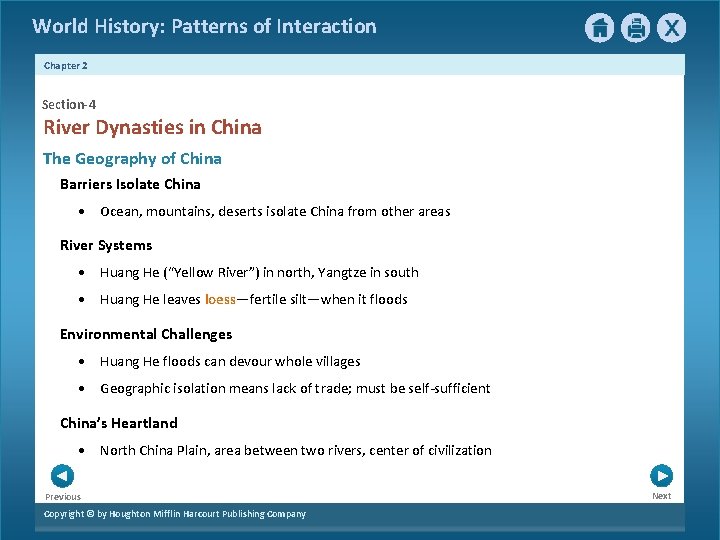
World History: Patterns of Interaction Chapter 2 Section-4 River Dynasties in China The Geography of China Barriers Isolate China • Ocean, mountains, deserts isolate China from other areas River Systems • Huang He (“Yellow River”) in north, Yangtze in south • Huang He leaves loess—fertile silt—when it floods Environmental Challenges • Huang He floods can devour whole villages • Geographic isolation means lack of trade; must be self-sufficient China’s Heartland • North China Plain, area between two rivers, center of civilization Previous Copyright © by Houghton Mifflin Harcourt Publishing Company Next
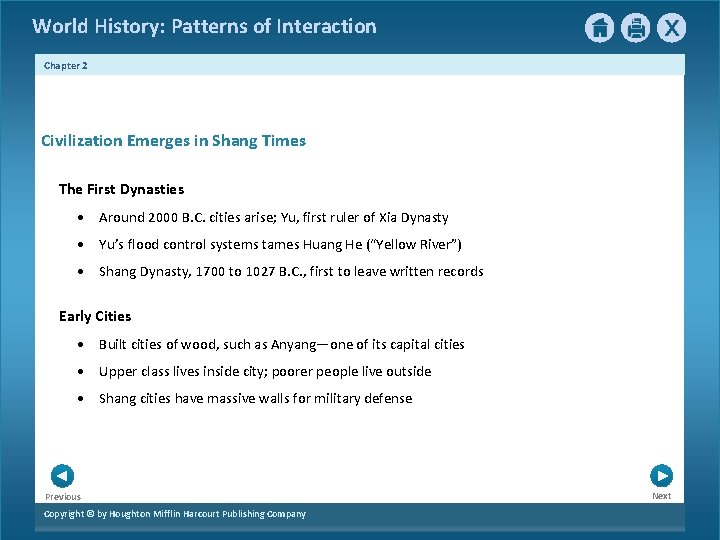
World History: Patterns of Interaction Chapter 2 Civilization Emerges in Shang Times The First Dynasties • Around 2000 B. C. cities arise; Yu, first ruler of Xia Dynasty • Yu’s flood control systems tames Huang He (“Yellow River”) • Shang Dynasty, 1700 to 1027 B. C. , first to leave written records Early Cities • Built cities of wood, such as Anyang—one of its capital cities • Upper class lives inside city; poorer people live outside • Shang cities have massive walls for military defense Previous Copyright © by Houghton Mifflin Harcourt Publishing Company Next
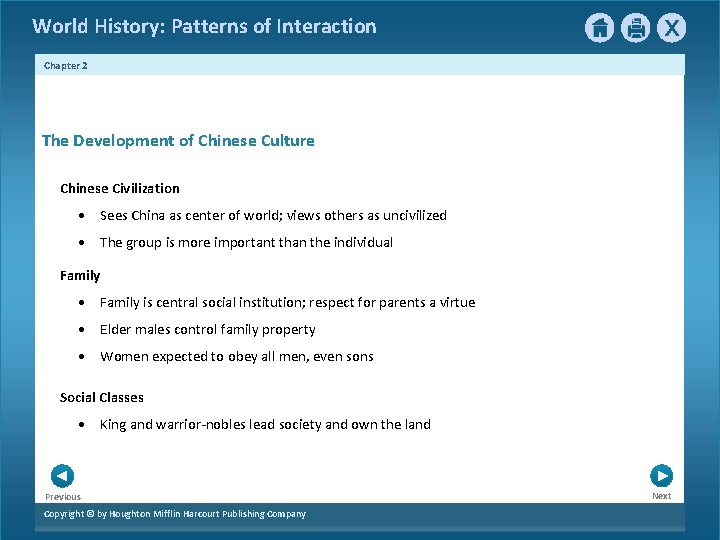
World History: Patterns of Interaction Chapter 2 The Development of Chinese Culture Chinese Civilization • Sees China as center of world; views others as uncivilized • The group is more important than the individual Family • Family is central social institution; respect for parents a virtue • Elder males control family property • Women expected to obey all men, even sons Social Classes • King and warrior-nobles lead society and own the land Previous Copyright © by Houghton Mifflin Harcourt Publishing Company Next
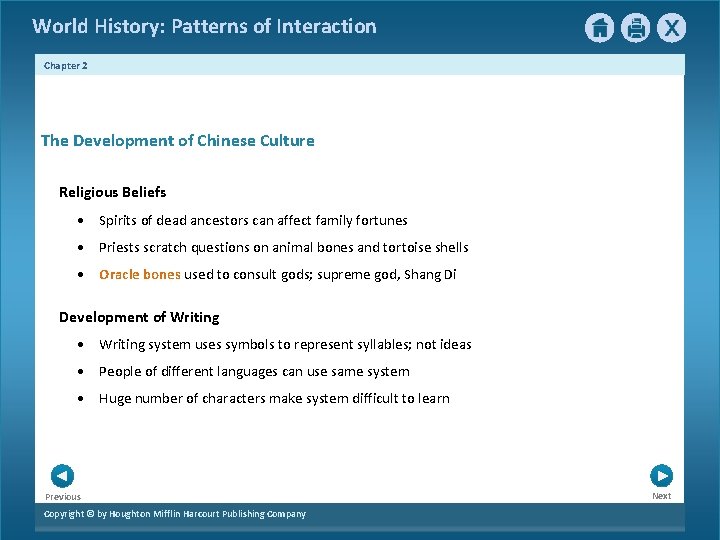
World History: Patterns of Interaction Chapter 2 The Development of Chinese Culture Religious Beliefs • Spirits of dead ancestors can affect family fortunes • Priests scratch questions on animal bones and tortoise shells • Oracle bones used to consult gods; supreme god, Shang Di Development of Writing • Writing system uses symbols to represent syllables; not ideas • People of different languages can use same system • Huge number of characters make system difficult to learn Previous Copyright © by Houghton Mifflin Harcourt Publishing Company Next
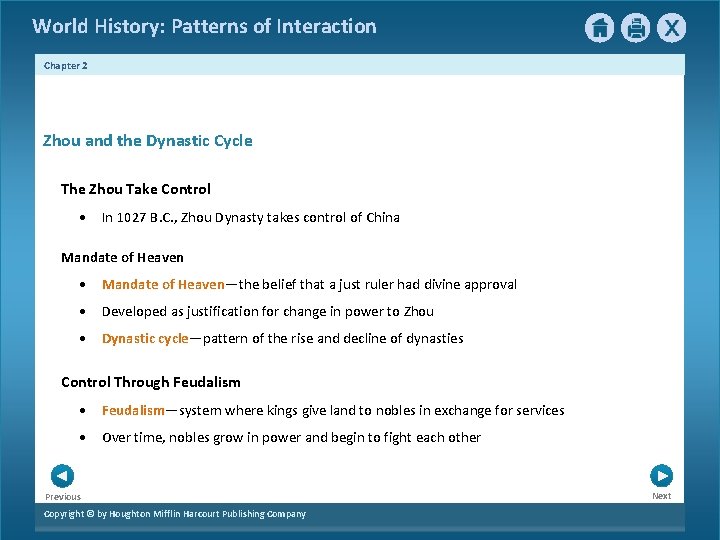
World History: Patterns of Interaction Chapter 2 Zhou and the Dynastic Cycle The Zhou Take Control • In 1027 B. C. , Zhou Dynasty takes control of China Mandate of Heaven • Mandate of Heaven—the belief that a just ruler had divine approval • Developed as justification for change in power to Zhou • Dynastic cycle—pattern of the rise and decline of dynasties Control Through Feudalism • Feudalism—system where kings give land to nobles in exchange for services • Over time, nobles grow in power and begin to fight each other Previous Copyright © by Houghton Mifflin Harcourt Publishing Company Next
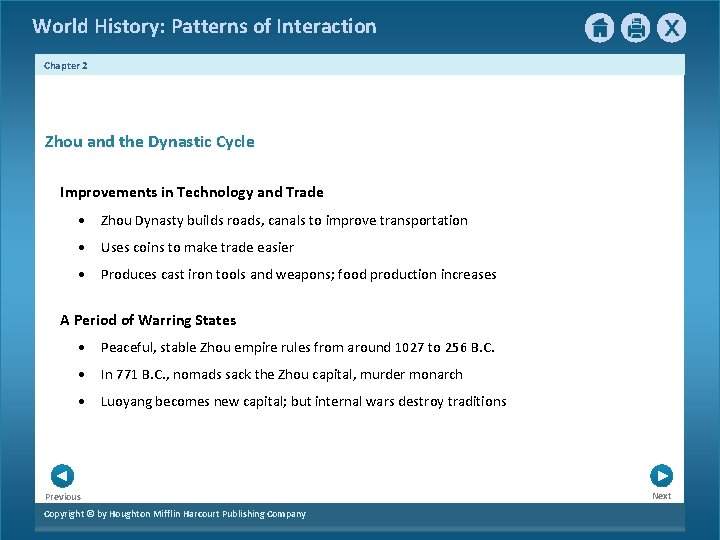
World History: Patterns of Interaction Chapter 2 Zhou and the Dynastic Cycle Improvements in Technology and Trade • Zhou Dynasty builds roads, canals to improve transportation • Uses coins to make trade easier • Produces cast iron tools and weapons; food production increases A Period of Warring States • Peaceful, stable Zhou empire rules from around 1027 to 256 B. C. • In 771 B. C. , nomads sack the Zhou capital, murder monarch • Luoyang becomes new capital; but internal wars destroy traditions Previous Copyright © by Houghton Mifflin Harcourt Publishing Company Next
World History: Patterns of Interaction Chapter 2 This is the end of the chapter presentation of lecture notes. Click the HOME or EXIT button. Previous Copyright © by Houghton Mifflin Harcourt Publishing Company Next
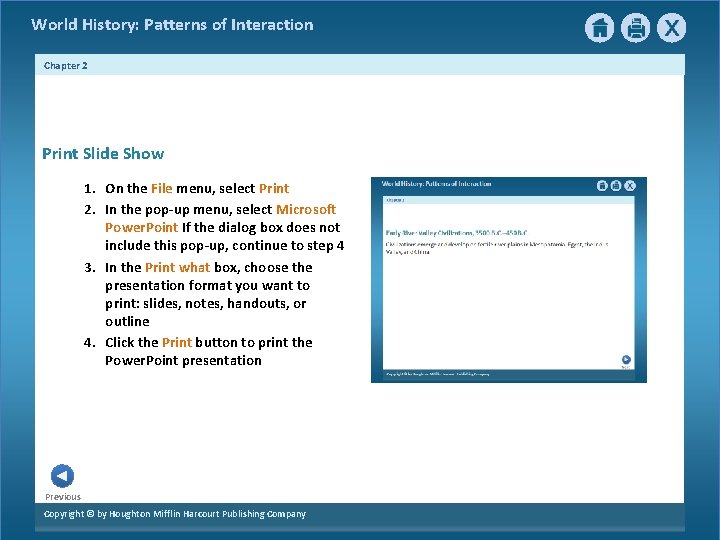
World History: Patterns of Interaction Chapter 2 Print Slide Show 1. On the File menu, select Print 2. In the pop-up menu, select Microsoft Power. Point If the dialog box does not include this pop-up, continue to step 4 3. In the Print what box, choose the presentation format you want to print: slides, notes, handouts, or outline 4. Click the Print button to print the Power. Point presentation Previous Copyright © by Houghton Mifflin Harcourt Publishing Company