
World History Patterns of Interaction Chapter 16 UNIT


- Slides: 29
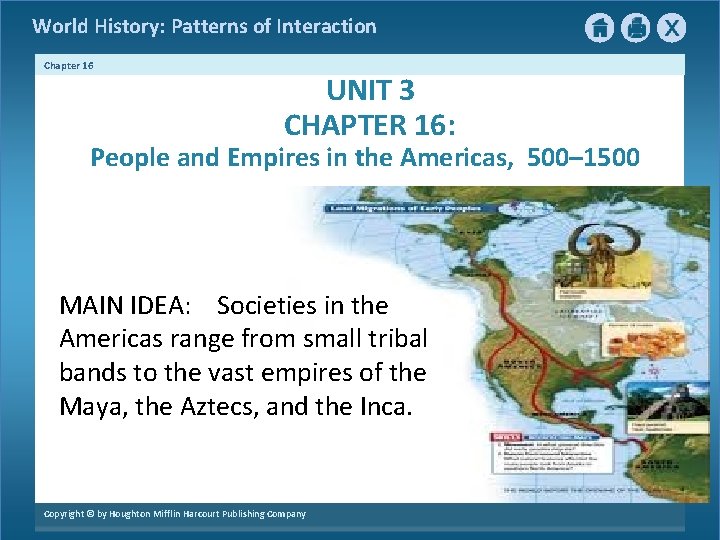
World History: Patterns of Interaction Chapter 16 UNIT 3 CHAPTER 16: People and Empires in the Americas, 500– 1500 MAIN IDEA: Societies in the Americas range from small tribal bands to the vast empires of the Maya, the Aztecs, and the Inca. Next Copyright © by Houghton Mifflin Harcourt Publishing Company
World History: Patterns of Interaction Chapter 16 People and Empires in the Americas, 500– 1500 SECTION 11 SECTION North American Societies SECTION 22 SECTION Maya Kings and Cities SECTION 33 SECTION The Aztecs Control Central Mexico SECTION 4 The Inca Create a Mountain Empire Previous Copyright © by Houghton Mifflin Harcourt Publishing Company Next
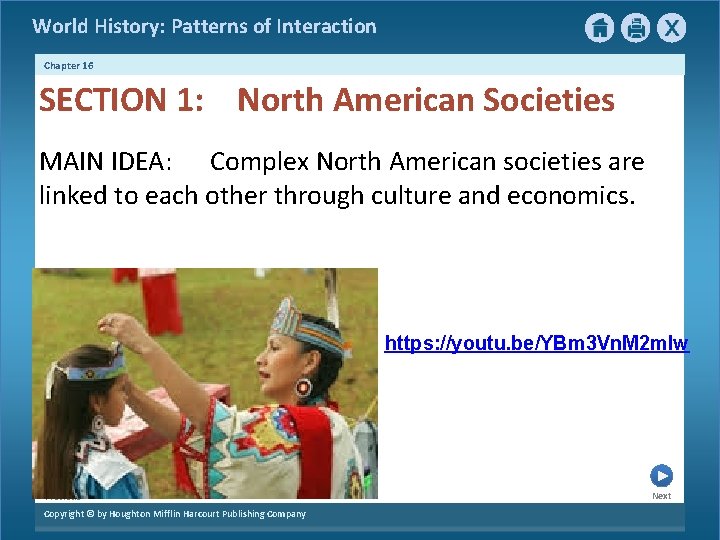
World History: Patterns of Interaction Chapter 16 SECTION 1: North American Societies MAIN IDEA: Complex North American societies are linked to each other through culture and economics. https: //youtu. be/YBm 3 Vn. M 2 m. Iw Previous Copyright © by Houghton Mifflin Harcourt Publishing Company Next
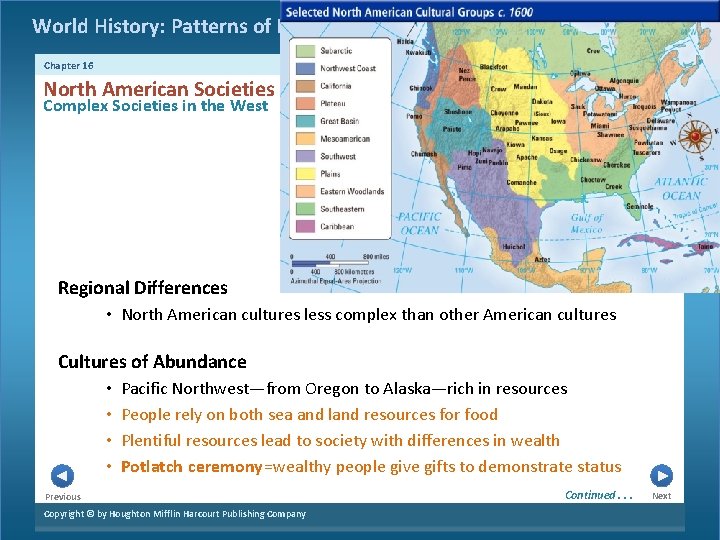
World History: Patterns of Interaction Chapter 16 North American Societies Complex Societies in the West Regional Differences • North American cultures less complex than other American cultures Cultures of Abundance • • Pacific Northwest—from Oregon to Alaska—rich in resources People rely on both sea and land resources for food Plentiful resources lead to society with differences in wealth Potlatch ceremony=wealthy people give gifts to demonstrate status Previous Copyright © by Houghton Mifflin Harcourt Publishing Company Continued. . . Next
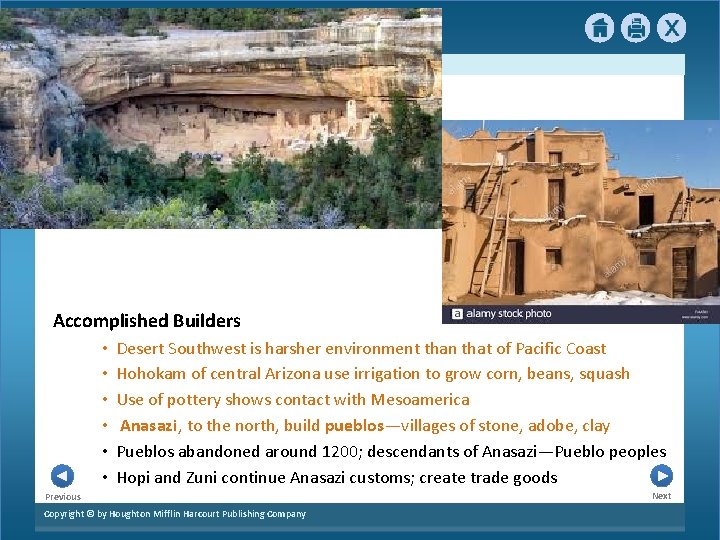
World History: Patterns of Interaction Chapter 16 Complex Societies in the West {continued} Accomplished Builders • • • Desert Southwest is harsher environment than that of Pacific Coast Hohokam of central Arizona use irrigation to grow corn, beans, squash Use of pottery shows contact with Mesoamerica Anasazi, to the north, build pueblos—villages of stone, adobe, clay Pueblos abandoned around 1200; descendants of Anasazi—Pueblo peoples Hopi and Zuni continue Anasazi customs; create trade goods Previous Copyright © by Houghton Mifflin Harcourt Publishing Company Next
World History: Patterns of Interaction Chapter 16 Mound Builders and Other Woodland Cultures The Mound Builders • • Mound Builders = Peoples who live east of Mississippi River in woodland areas Adena and Hopewell peoples build mounds for burials, ceremonies Mississippian —last Mound Builder culture, from 800 to 1500 s Cahokia, leading city, has many as 30, 000 people Northeastern Tribes Build Alliances • Iroquois—five allied tribes of eastern Great Lakes (military-like warriors) • Goals of Iroquois League: joint defense and cooperation Previous Copyright © by Houghton Mifflin Harcourt Publishing Company Next
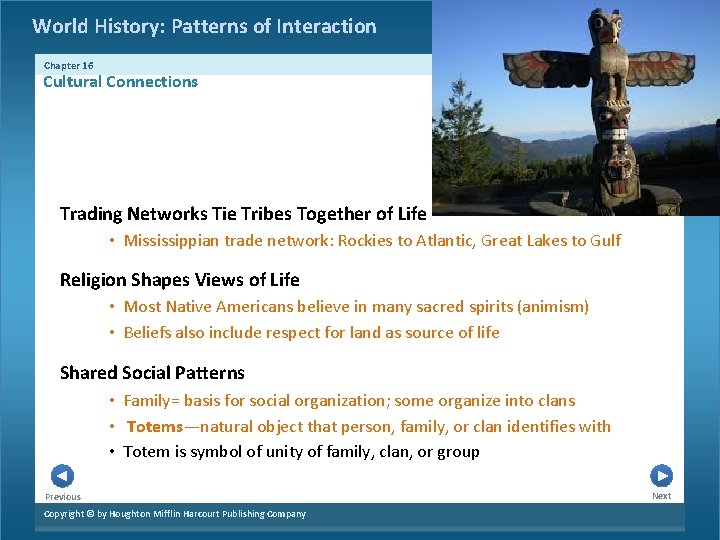
World History: Patterns of Interaction Chapter 16 Cultural Connections Trading Networks Tie Tribes Together of Life • Mississippian trade network: Rockies to Atlantic, Great Lakes to Gulf Religion Shapes Views of Life • Most Native Americans believe in many sacred spirits (animism) • Beliefs also include respect for land as source of life Shared Social Patterns • Family= basis for social organization; some organize into clans • Totems—natural object that person, family, or clan identifies with • Totem is symbol of unity of family, clan, or group Previous Copyright © by Houghton Mifflin Harcourt Publishing Company Next
World History: Patterns of Interaction Chapter 16 SECTION 2: Maya Kings and Cities MAIN IDEA: The Maya develop a highly complex civilization based on city-states elaborate religious practices. https: //www. youtube. com/watch? v=86 F 10 I rv. Vus Previous Copyright © by Houghton Mifflin Harcourt Publishing Company Next
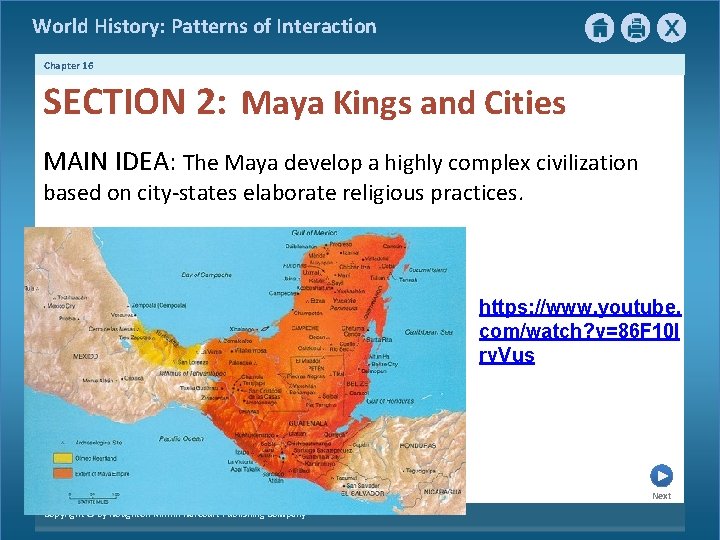
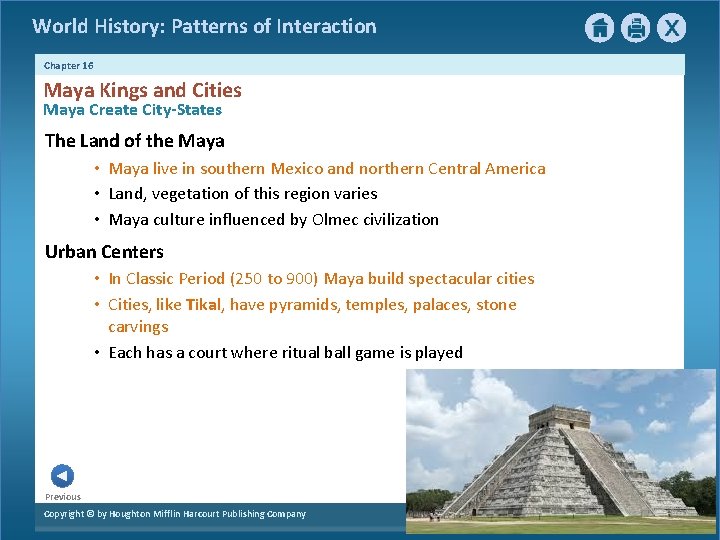
World History: Patterns of Interaction Chapter 16 Maya Kings and Cities Maya Create City-States The Land of the Maya • Maya live in southern Mexico and northern Central America • Land, vegetation of this region varies • Maya culture influenced by Olmec civilization Urban Centers • In Classic Period (250 to 900) Maya build spectacular cities • Cities, like Tikal, have pyramids, temples, palaces, stone carvings • Each has a court where ritual ball game is played Previous Copyright © by Houghton Mifflin Harcourt Publishing Company Continued. . . Next
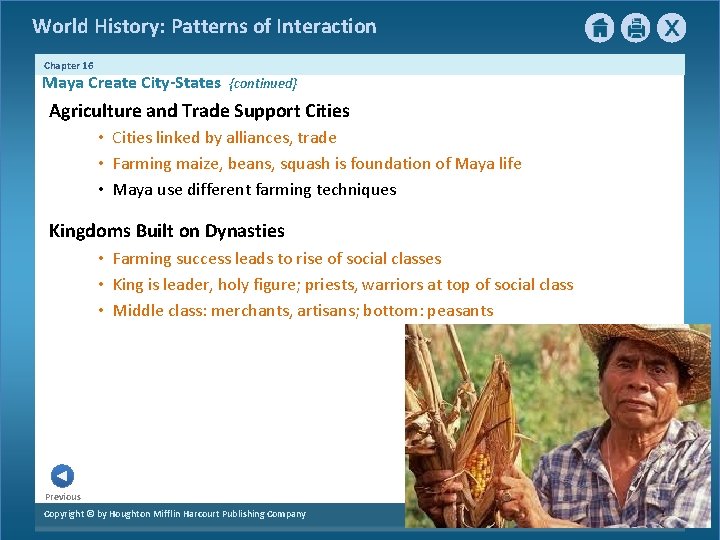
World History: Patterns of Interaction Chapter 16 Maya Create City-States {continued} Agriculture and Trade Support Cities • Cities linked by alliances, trade • Farming maize, beans, squash is foundation of Maya life • Maya use different farming techniques Kingdoms Built on Dynasties • Farming success leads to rise of social classes • King is leader, holy figure; priests, warriors at top of social class • Middle class: merchants, artisans; bottom: peasants Previous Copyright © by Houghton Mifflin Harcourt Publishing Company Next
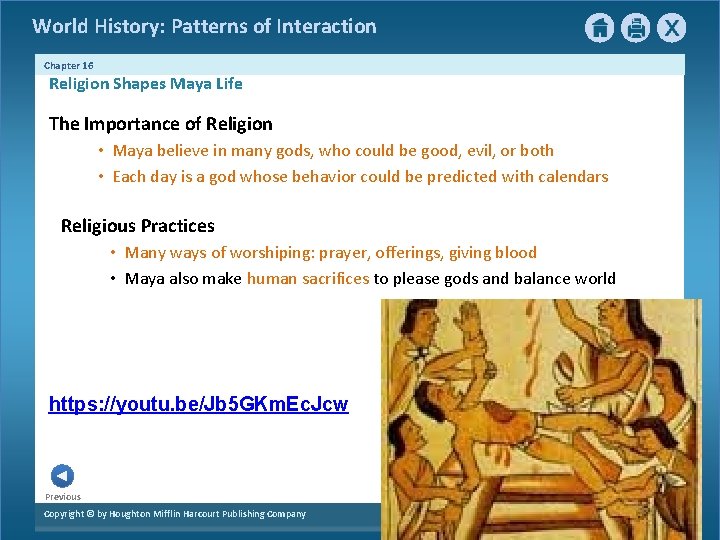
World History: Patterns of Interaction Chapter 16 Religion Shapes Maya Life The Importance of Religion • Maya believe in many gods, who could be good, evil, or both • Each day is a god whose behavior could be predicted with calendars Religious Practices • Many ways of worshiping: prayer, offerings, giving blood • Maya also make human sacrifices to please gods and balance world https: //youtu. be/Jb 5 GKm. Ec. Jcw Previous Copyright © by Houghton Mifflin Harcourt Publishing Company Continued. . . Next
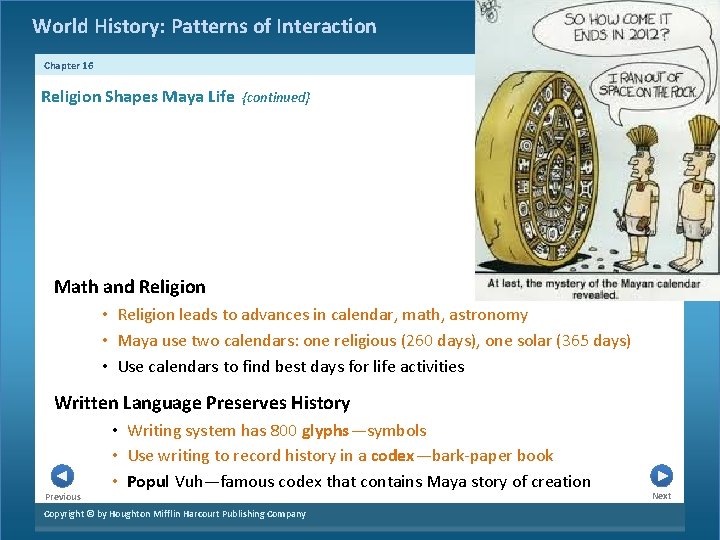
World History: Patterns of Interaction Chapter 16 Religion Shapes Maya Life {continued} Math and Religion • Religion leads to advances in calendar, math, astronomy • Maya use two calendars: one religious (260 days), one solar (365 days) • Use calendars to find best days for life activities Written Language Preserves History Previous • Writing system has 800 glyphs—symbols • Use writing to record history in a codex—bark-paper book • Popul Vuh—famous codex that contains Maya story of creation Copyright © by Houghton Mifflin Harcourt Publishing Company Next
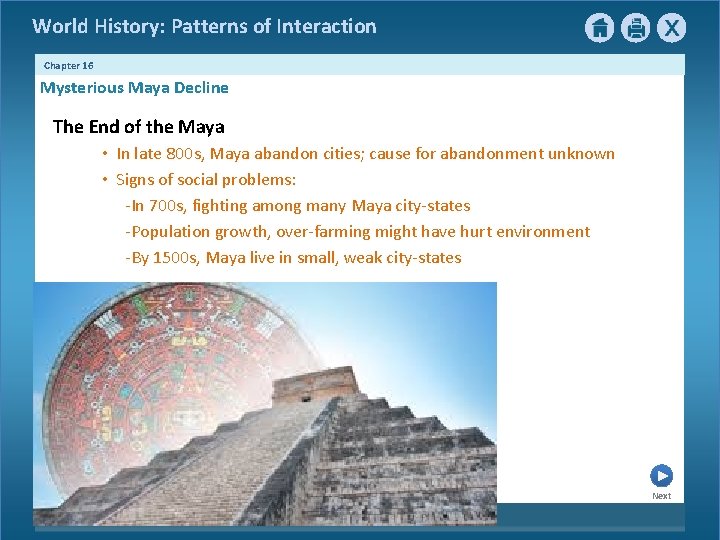
World History: Patterns of Interaction Chapter 16 Mysterious Maya Decline The End of the Maya • In late 800 s, Maya abandon cities; cause for abandonment unknown • Signs of social problems: -In 700 s, fighting among many Maya city-states -Population growth, over-farming might have hurt environment -By 1500 s, Maya live in small, weak city-states Previous Copyright © by Houghton Mifflin Harcourt Publishing Company Next
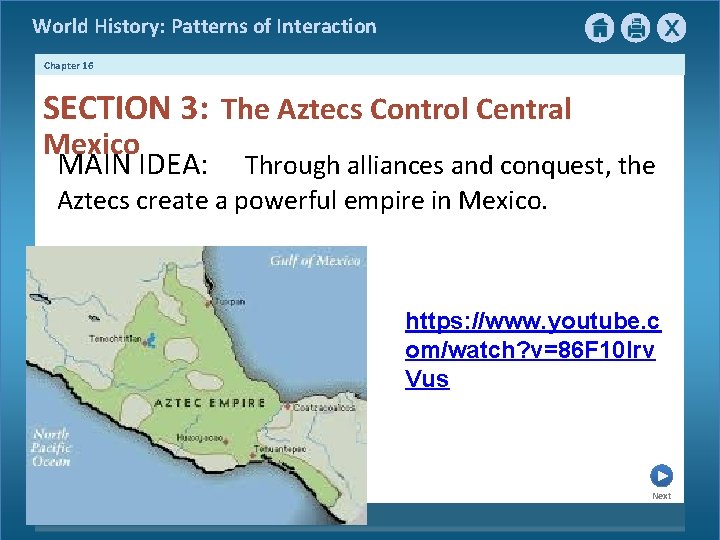
World History: Patterns of Interaction Chapter 16 SECTION 3: The Aztecs Control Central Mexico MAIN IDEA: Through alliances and conquest, the Aztecs create a powerful empire in Mexico. https: //www. youtube. c om/watch? v=86 F 10 Irv Vus Previous Copyright © by Houghton Mifflin Harcourt Publishing Company Next
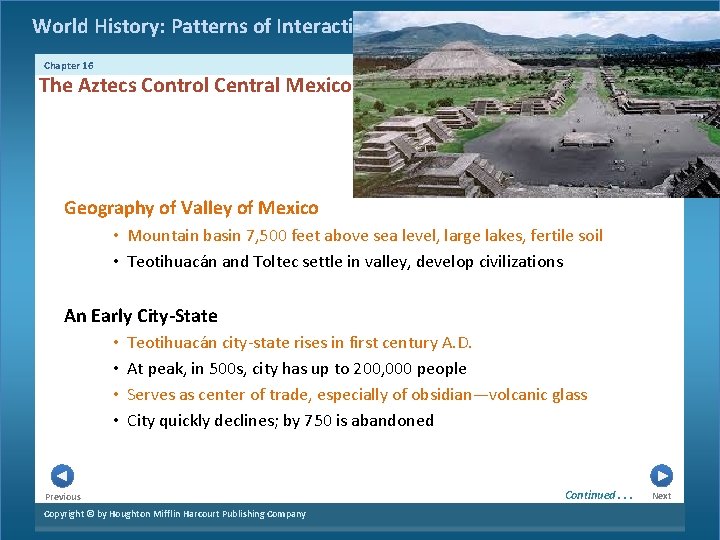
World History: Patterns of Interaction Chapter 16 The Aztecs Control Central Mexico Geography of Valley of Mexico • Mountain basin 7, 500 feet above sea level, large lakes, fertile soil • Teotihuacán and Toltec settle in valley, develop civilizations An Early City-State • • Teotihuacán city-state rises in first century A. D. At peak, in 500 s, city has up to 200, 000 people Serves as center of trade, especially of obsidian—volcanic glass City quickly declines; by 750 is abandoned Previous Copyright © by Houghton Mifflin Harcourt Publishing Company Continued. . . Next
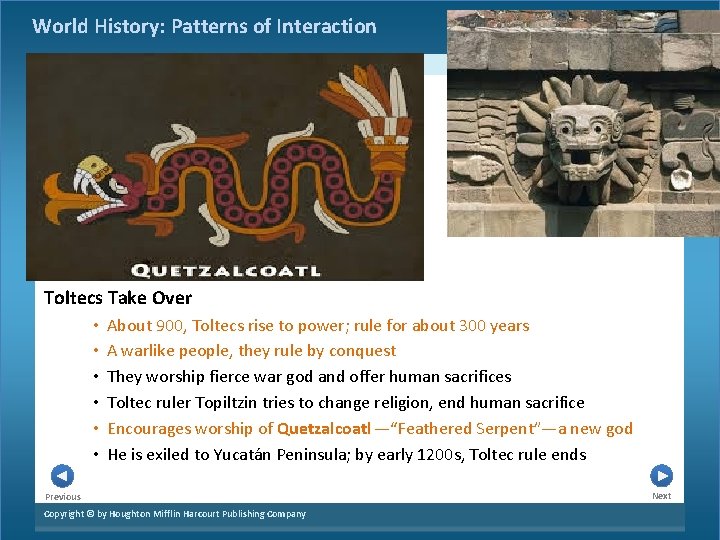
World History: Patterns of Interaction Chapter 16 The Valley of Mexico {continued} Toltecs Take Over • • • About 900, Toltecs rise to power; rule for about 300 years A warlike people, they rule by conquest They worship fierce war god and offer human sacrifices Toltec ruler Topiltzin tries to change religion, end human sacrifice Encourages worship of Quetzalcoatl —“Feathered Serpent”—a new god He is exiled to Yucatán Peninsula; by early 1200 s, Toltec rule ends Previous Copyright © by Houghton Mifflin Harcourt Publishing Company Next
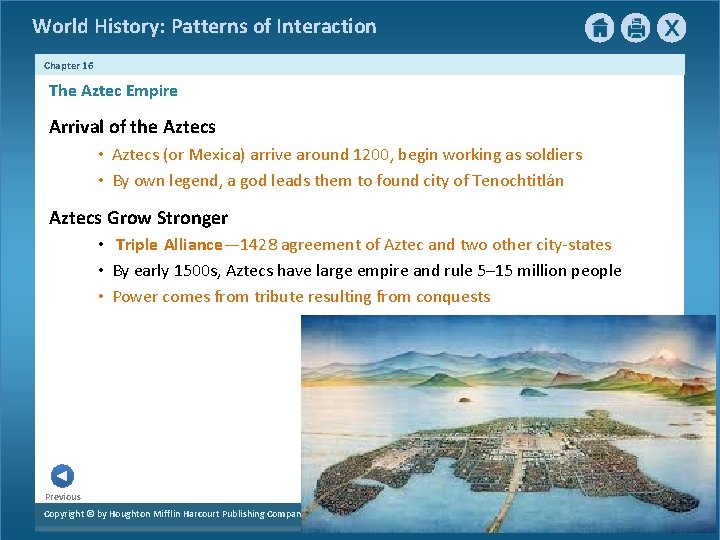
World History: Patterns of Interaction Chapter 16 The Aztec Empire Arrival of the Aztecs • Aztecs (or Mexica) arrive around 1200, begin working as soldiers • By own legend, a god leads them to found city of Tenochtitlán Aztecs Grow Stronger • Triple Alliance— 1428 agreement of Aztec and two other city-states • By early 1500 s, Aztecs have large empire and rule 5– 15 million people • Power comes from tribute resulting from conquests Previous Copyright © by Houghton Mifflin Harcourt Publishing Company Continued. . . Next
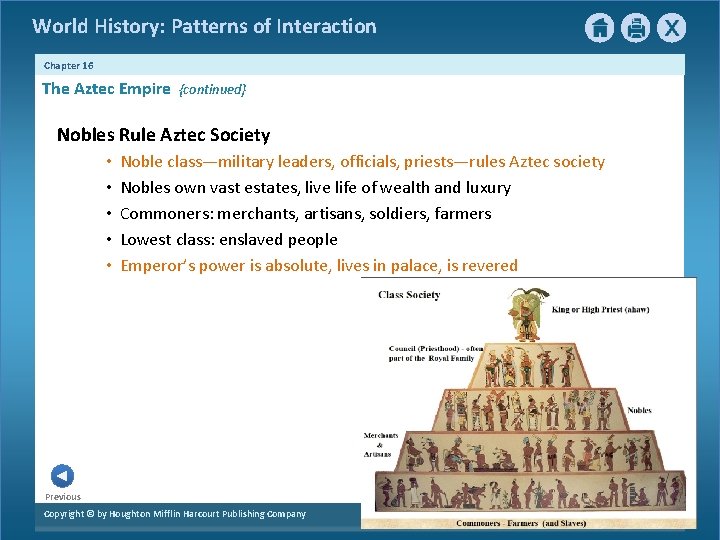
World History: Patterns of Interaction Chapter 16 The Aztec Empire {continued} Nobles Rule Aztec Society • • • Noble class—military leaders, officials, priests—rules Aztec society Nobles own vast estates, live life of wealth and luxury Commoners: merchants, artisans, soldiers, farmers Lowest class: enslaved people Emperor’s power is absolute, lives in palace, is revered Previous Copyright © by Houghton Mifflin Harcourt Publishing Company Next
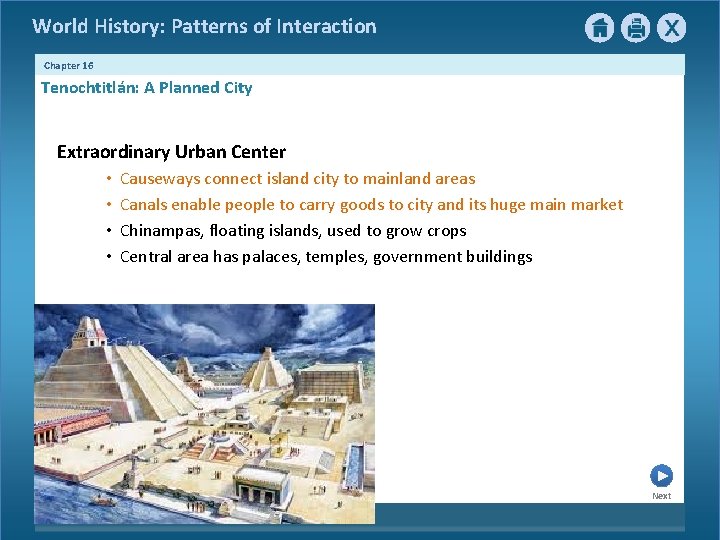
World History: Patterns of Interaction Chapter 16 Tenochtitlán: A Planned City Extraordinary Urban Center • • Causeways connect island city to mainland areas Canals enable people to carry goods to city and its huge main market Chinampas, floating islands, used to grow crops Central area has palaces, temples, government buildings Previous Copyright © by Houghton Mifflin Harcourt Publishing Company Next
World History: Patterns of Interaction Chapter 16 Religion Rules Aztec Life Many Gods • Religion includes 1, 000 gods, many adopted from other peoples Religious Practices • Center of religion is public ceremonies to win gods’ favor • Many religious festivals throughout year Sacrifices for the sun God • Most important rituals are for sun god, Huitzilopochtli • He needs human sacrifices to be strong • Aztecs engage in war to provide captives for these sacrifices Previous Copyright © by Houghton Mifflin Harcourt Publishing Company Next
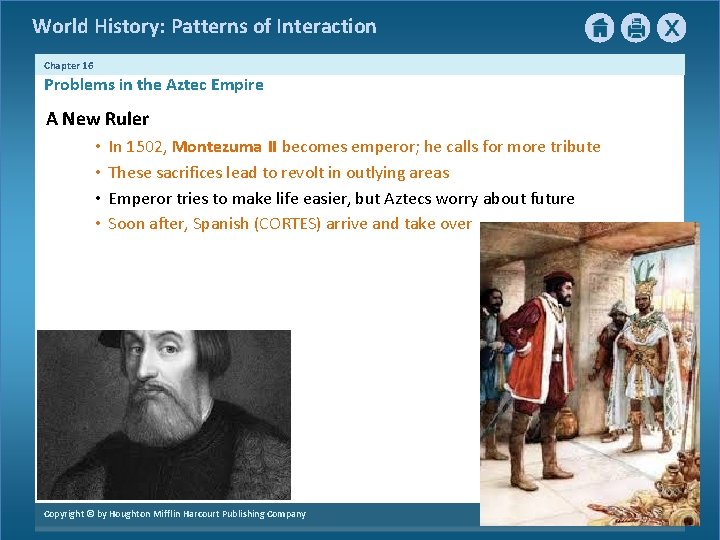
World History: Patterns of Interaction Chapter 16 Problems in the Aztec Empire A New Ruler • • In 1502, Montezuma II becomes emperor; he calls for more tribute These sacrifices lead to revolt in outlying areas Emperor tries to make life easier, but Aztecs worry about future Soon after, Spanish (CORTES) arrive and take over Previous Copyright © by Houghton Mifflin Harcourt Publishing Company Next
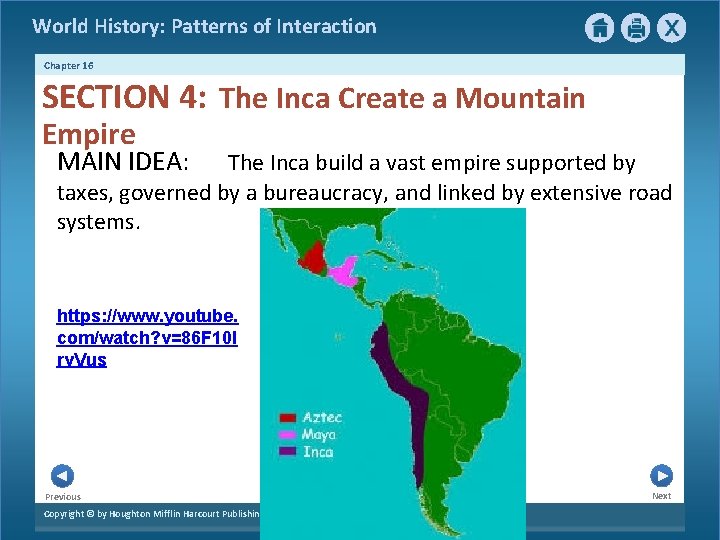
World History: Patterns of Interaction Chapter 16 SECTION 4: The Inca Create a Mountain Empire MAIN IDEA: The Inca build a vast empire supported by taxes, governed by a bureaucracy, and linked by extensive road systems. https: //www. youtube. com/watch? v=86 F 10 I rv. Vus Previous Copyright © by Houghton Mifflin Harcourt Publishing Company Next
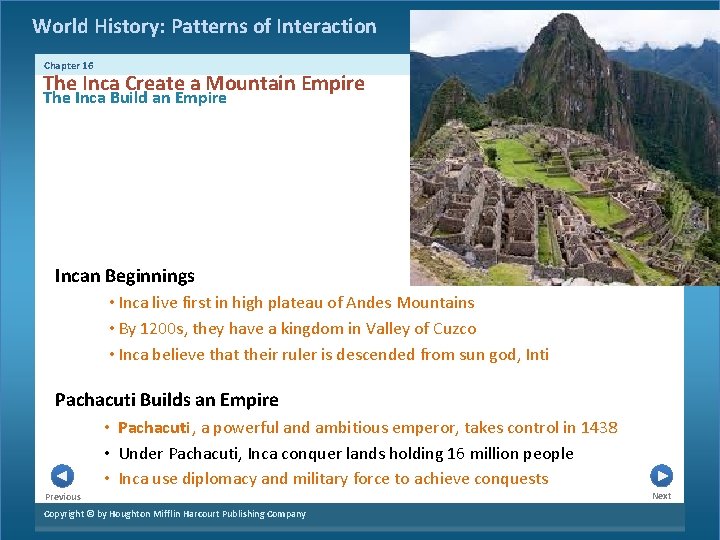
World History: Patterns of Interaction Chapter 16 The Inca Create a Mountain Empire The Inca Build an Empire Incan Beginnings • Inca live first in high plateau of Andes Mountains • By 1200 s, they have a kingdom in Valley of Cuzco • Inca believe that their ruler is descended from sun god, Inti Pachacuti Builds an Empire • Pachacuti, a powerful and ambitious emperor, takes control in 1438 • Under Pachacuti, Inca conquer lands holding 16 million people • Inca use diplomacy and military force to achieve conquests Previous Copyright © by Houghton Mifflin Harcourt Publishing Company Next
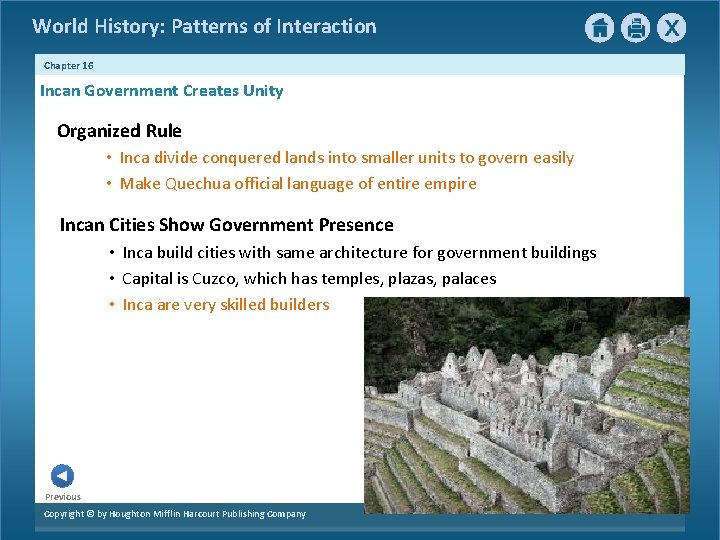
World History: Patterns of Interaction Chapter 16 Incan Government Creates Unity Organized Rule • Inca divide conquered lands into smaller units to govern easily • Make Quechua official language of entire empire Incan Cities Show Government Presence • Inca build cities with same architecture for government buildings • Capital is Cuzco, which has temples, plazas, palaces • Inca are very skilled builders Previous Copyright © by Houghton Mifflin Harcourt Publishing Company Continued. . . Next
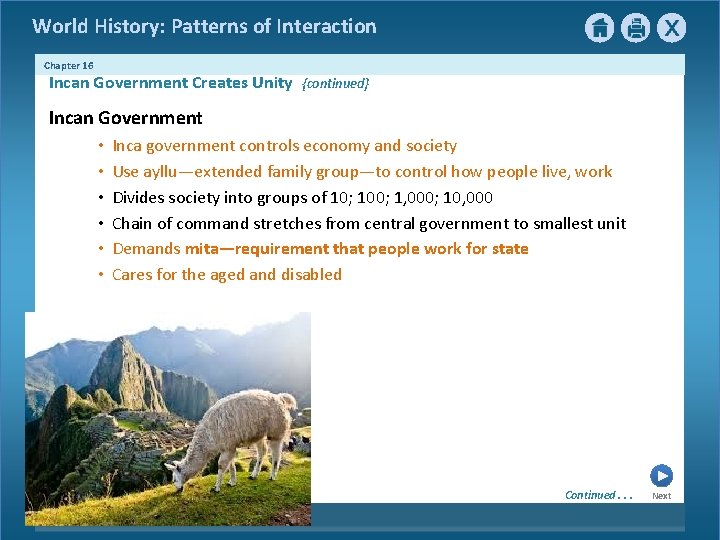
World History: Patterns of Interaction Chapter 16 Incan Government Creates Unity {continued} Incan Government • • • Inca government controls economy and society Use ayllu—extended family group—to control how people live, work Divides society into groups of 10; 100; 1, 000; 10, 000 Chain of command stretches from central government to smallest unit Demands mita—requirement that people work for state Cares for the aged and disabled Previous Copyright © by Houghton Mifflin Harcourt Publishing Company Continued. . . Next
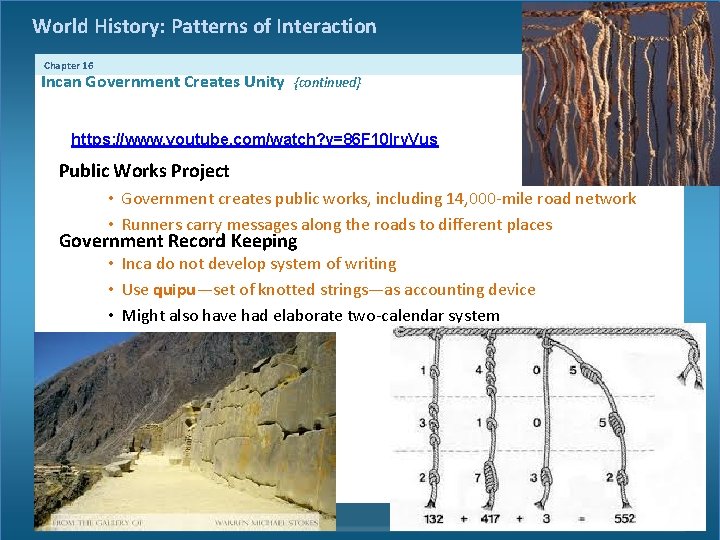
World History: Patterns of Interaction Chapter 16 Incan Government Creates Unity {continued} https: //www. youtube. com/watch? v=86 F 10 Irv. Vus Public Works Project • Government creates public works, including 14, 000 -mile road network • Runners carry messages along the roads to different places Government Record Keeping • Inca do not develop system of writing • Use quipu—set of knotted strings—as accounting device • Might also have had elaborate two-calendar system Previous Copyright © by Houghton Mifflin Harcourt Publishing Company Next
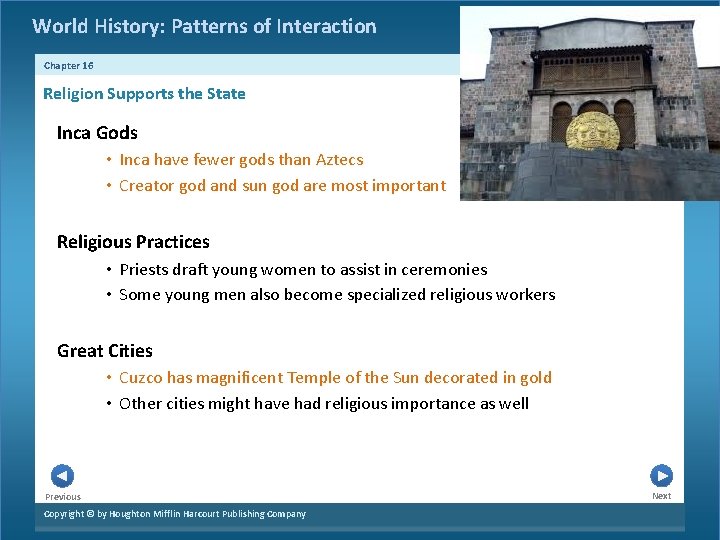
World History: Patterns of Interaction Chapter 16 Religion Supports the State Inca Gods • Inca have fewer gods than Aztecs • Creator god and sun god are most important Religious Practices • Priests draft young women to assist in ceremonies • Some young men also become specialized religious workers Great Cities • Cuzco has magnificent Temple of the Sun decorated in gold • Other cities might have had religious importance as well Previous Copyright © by Houghton Mifflin Harcourt Publishing Company Next
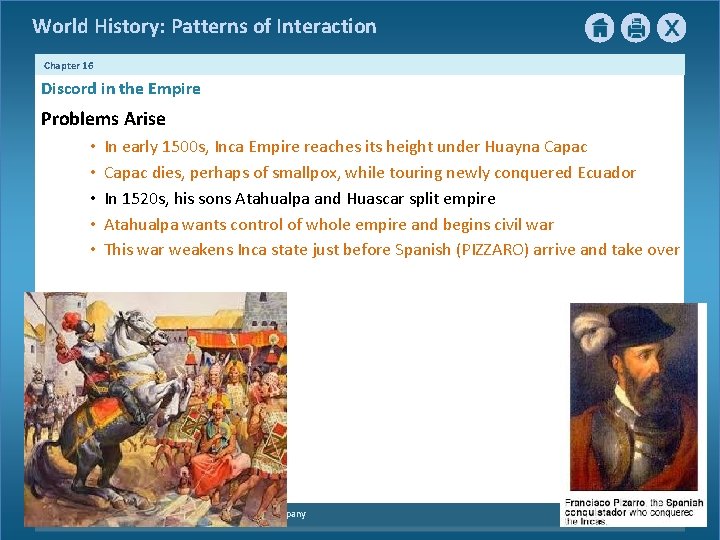
World History: Patterns of Interaction Chapter 16 Discord in the Empire Problems Arise • • • In early 1500 s, Inca Empire reaches its height under Huayna Capac dies, perhaps of smallpox, while touring newly conquered Ecuador In 1520 s, his sons Atahualpa and Huascar split empire Atahualpa wants control of whole empire and begins civil war This war weakens Inca state just before Spanish (PIZZARO) arrive and take over Previous Copyright © by Houghton Mifflin Harcourt Publishing Company Next
World History: Patterns of Interaction Chapter 16 This is the end of the chapter presentation of lecture notes. Click the HOME or EXIT button. Previous Copyright © by Houghton Mifflin Harcourt Publishing Company Next