
World History Patterns of Interaction Chapter 12 Empires
- Slides: 35
World History: Patterns of Interaction Chapter 12 Empires in East Asia, 600 -1350 Several kingdoms and empires arise in East Asia, helping to spread Hinduism and Buddhism, as well as trade, technology, and culture. Previous Copyright © by Houghton Mifflin Harcourt Publishing Company Next
World History: Patterns of Interaction Chapter 12 Empires in East Asia, 600 -1350 SECTION 1 Tang and Song China SECTION 2 The Mongol Quests. SECTION 3 The Mongol Empire SECTION 4 Feudal Powers in Japan SECTION 5 Kingdoms of Southeast Asia and Korea Previous Copyright © by Houghton Mifflin Harcourt Publishing Company Next
World History: Patterns of Interaction Chapter 12 Section-1 Tang and Song China During the Tang and Song dynasties, China experiences an era of prosperity and technological innovation. Previous Copyright © by Houghton Mifflin Harcourt Publishing Company Next
World History: Patterns of Interaction Chapter 12 Section-1 Tang and Song China The Tang Dynasty Expands China Brief Reign of the Sui Dynasty • Sui Dynasty, established by Wendi, lasts from 581 to 618 • Main accomplishment: completing Grand Canal, which expands trade • Forced labor, high taxes lead to revolt; Sui emperor assassinated, 618 Tang Rulers Create a Powerful Empire • Tang Dynasty (618 to 907) begun by brilliant emperor Tang Taizong • Wu Zhao—only woman in China to assume title of emperor • Tang rulers expand unify empire, strengthen government Previous Copyright © by Houghton Mifflin Harcourt Publishing Company Continued. . . Next
World History: Patterns of Interaction Chapter 12 The Tang Dynasty Expands China {continued} Scholar-Officials • Tang rulers revive civil service examination system • Theoretically, exams open to all men, even commoners • Practically, only rich can afford necessary education to take exam • Growth of bureaucracy cuts power of nobles The Tang Lose Power • Tang rulers increase taxes in mid-700 s, causing hardship • Attacks on empire increase; in 907, last Tang emperor killed Previous Copyright © by Houghton Mifflin Harcourt Publishing Company Next
World History: Patterns of Interaction Chapter 12 The Song Dynasty Restores China Turmoil Followed by Strong Rule • In 960, Taizu reunites China, proclaims Song Dynasty (960– 1279) • Song rulers unable to recapture lands lost in west and north • In 1100 s, Jurchen people arise in Manchuria, set up own empire • In 1127, Song rulers forced south; build new capital at Hangzhou • Southern Song empire lasts from 1127 to 1279 Previous Copyright © by Houghton Mifflin Harcourt Publishing Company Next
World History: Patterns of Interaction Chapter 12 An Era of Propensity and Innovation Growth • Population doubles during Tang and Song Dynasties to 100 million • China becomes most populous country in the world Science and Technology • Chinese invent gunpowder, porcelain, mechanical clock, paper money • Movable type—blocks of individual characters—makes printing easier • In mathematics, Chinese develop use of negative numbers Agriculture • Advances in farming contribute to population growth • Main advance: new strain of rice that produces two crops a year Previous Copyright © by Houghton Mifflin Harcourt Publishing Company Continued. . . Next
World History: Patterns of Interaction Chapter 12 An Era of Prosperity and Innovation {continued} Trade and Foreign Contacts • In early Tang, trade with west over Silk Road • During Tang decline, Chinese depend more on ocean trade routes • Trade stretches from Japan to Southeast Asia, India, Africa • Trade helps Buddhism spread A Golden Age of Poetry and Art • Tang period produces great poetry, including works of Li Bo and Tu Fu • Song period known for brilliant painting Previous Copyright © by Houghton Mifflin Harcourt Publishing Company Next
World History: Patterns of Interaction Chapter 12 Changes in Chinese Society Levels of Society • Power of noble families fades • Wealthy scholar-officials form new upper class, called the gentry • Urban middle class below gentry in social structure • Laborers, soldiers, peasants at bottom of social structure The Status of Women • Status of women always lower than men in China • That status falls even lower during Tang and Song periods • Foot binding of upper-class girls becomes new custom Previous Copyright © by Houghton Mifflin Harcourt Publishing Company Next
World History: Patterns of Interaction Chapter 12 Section-2 The Mongol Conquests The Mongols, a nomadic people from the steppe, conquer settled societies across much of Asia. Previous Copyright © by Houghton Mifflin Harcourt Publishing Company Next
World History: Patterns of Interaction Chapter 12 Section-2 The Mongol Conquests Nomads of Asian Steppe Geography of the Steppe • Steppe—dry grassland of Eurasia—provides home for nomads • Two main expanses: Central Asia to eastern Europe, and Mongolia • Steppe has little rain, dramatic seasonal temperature differences The Nomadic Way of Life • Steppe nomads are pastoralists —herd domesticated animals • Way of life teaches Asian nomads to be skilled horse riders • Nomads travel in clans—kin groups linked by common ancestor Previous Copyright © by Houghton Mifflin Harcourt Publishing Company Continued. . . Next
World History: Patterns of Interaction Chapter 12 Nomads of the Asian Steppe {continued} Steppe Nomads and Settled Societies • Nomads and people living in settled communities often interact • Some interactions peaceful, as in trade • Sometimes nomads raid towns and cities to seize wealth, goods • Strong state or empire could protect its lands from these invasions Previous Copyright © by Houghton Mifflin Harcourt Publishing Company Next
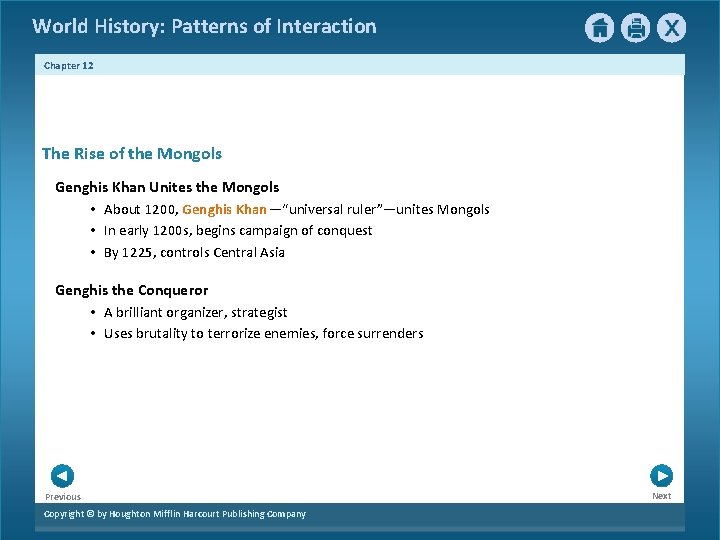
World History: Patterns of Interaction Chapter 12 The Rise of the Mongols Genghis Khan Unites the Mongols • About 1200, Genghis Khan —“universal ruler”—unites Mongols • In early 1200 s, begins campaign of conquest • By 1225, controls Central Asia Genghis the Conqueror • A brilliant organizer, strategist • Uses brutality to terrorize enemies, force surrenders Previous Copyright © by Houghton Mifflin Harcourt Publishing Company Next
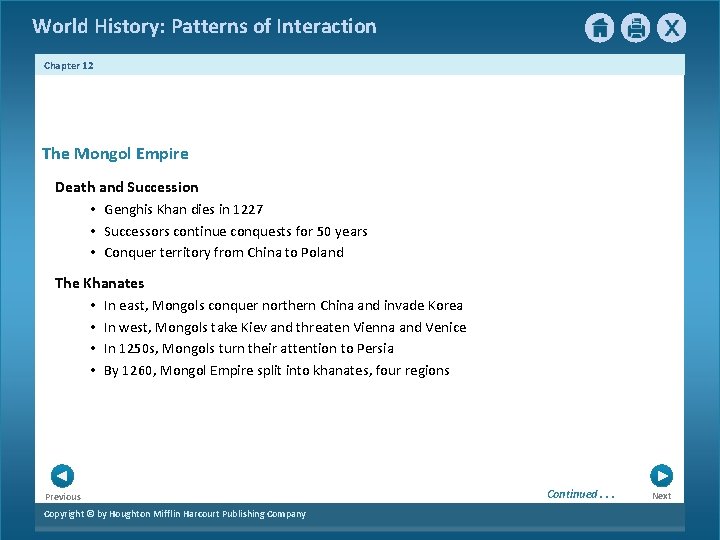
World History: Patterns of Interaction Chapter 12 The Mongol Empire Death and Succession • Genghis Khan dies in 1227 • Successors continue conquests for 50 years • Conquer territory from China to Poland The Khanates • In east, Mongols conquer northern China and invade Korea • In west, Mongols take Kiev and threaten Vienna and Venice • In 1250 s, Mongols turn their attention to Persia • By 1260, Mongol Empire split into khanates, four regions Previous Copyright © by Houghton Mifflin Harcourt Publishing Company Continued. . . Next
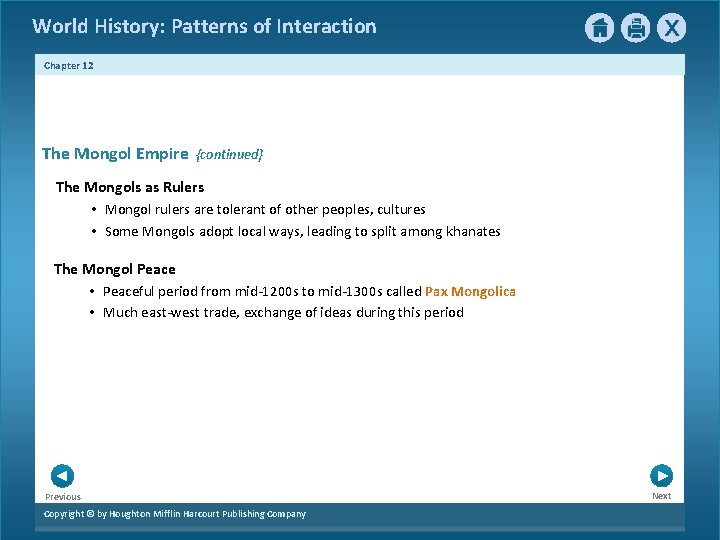
World History: Patterns of Interaction Chapter 12 The Mongol Empire {continued} The Mongols as Rulers • Mongol rulers are tolerant of other peoples, cultures • Some Mongols adopt local ways, leading to split among khanates The Mongol Peace • Peaceful period from mid-1200 s to mid-1300 s called Pax Mongolica • Much east-west trade, exchange of ideas during this period Previous Copyright © by Houghton Mifflin Harcourt Publishing Company Next
World History: Patterns of Interaction Chapter 12 Section-3 The Mongol Empire As Emperor of China, Kublai Khan encourages foreign trade. Previous Copyright © by Houghton Mifflin Harcourt Publishing Company Next
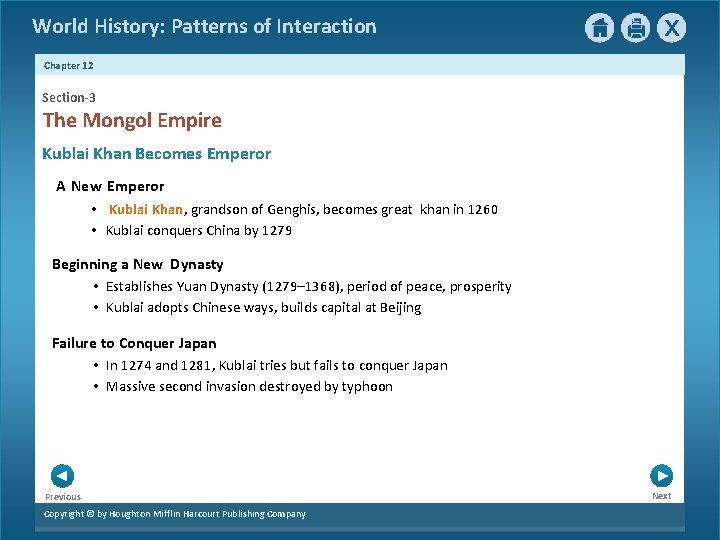
World History: Patterns of Interaction Chapter 12 Section-3 The Mongol Empire Kublai Khan Becomes Emperor A New Emperor • Kublai Khan, grandson of Genghis, becomes great khan in 1260 • Kublai conquers China by 1279 Beginning a New Dynasty • Establishes Yuan Dynasty (1279– 1368), period of peace, prosperity • Kublai adopts Chinese ways, builds capital at Beijing Failure to Conquer Japan • In 1274 and 1281, Kublai tries but fails to conquer Japan • Massive second invasion destroyed by typhoon Previous Copyright © by Houghton Mifflin Harcourt Publishing Company Next
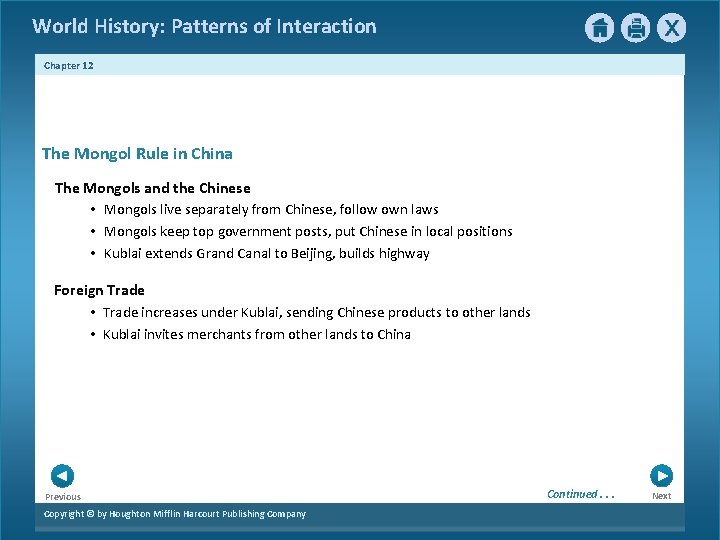
World History: Patterns of Interaction Chapter 12 The Mongol Rule in China The Mongols and the Chinese • Mongols live separately from Chinese, follow own laws • Mongols keep top government posts, put Chinese in local positions • Kublai extends Grand Canal to Beijing, builds highway Foreign Trade • Trade increases under Kublai, sending Chinese products to other lands • Kublai invites merchants from other lands to China Previous Copyright © by Houghton Mifflin Harcourt Publishing Company Continued. . . Next
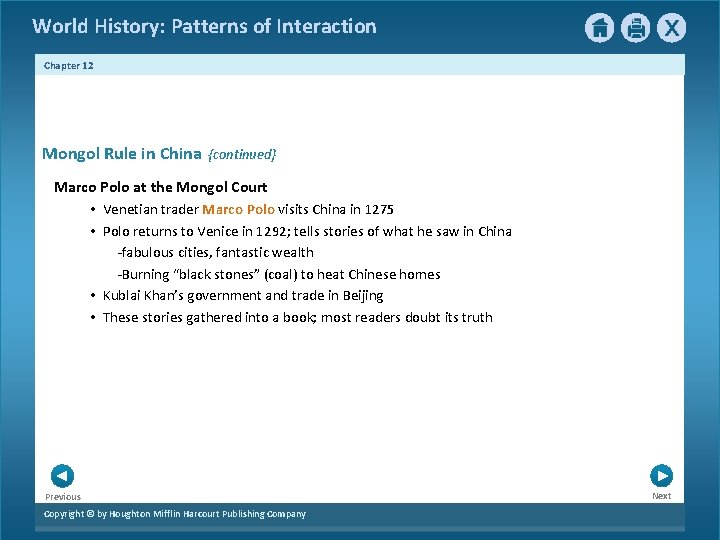
World History: Patterns of Interaction Chapter 12 Mongol Rule in China {continued} Marco Polo at the Mongol Court • Venetian trader Marco Polo visits China in 1275 • Polo returns to Venice in 1292; tells stories of what he saw in China -fabulous cities, fantastic wealth -Burning “black stones” (coal) to heat Chinese homes • Kublai Khan’s government and trade in Beijing • These stories gathered into a book; most readers doubt its truth Previous Copyright © by Houghton Mifflin Harcourt Publishing Company Next
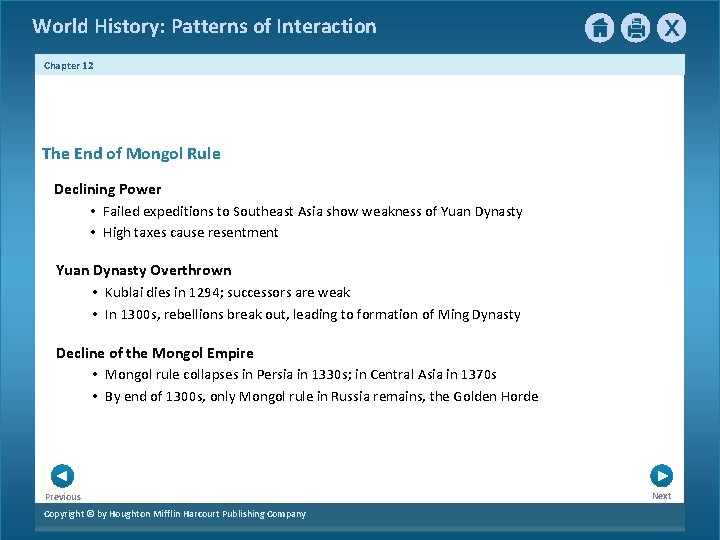
World History: Patterns of Interaction Chapter 12 The End of Mongol Rule Declining Power • Failed expeditions to Southeast Asia show weakness of Yuan Dynasty • High taxes cause resentment Yuan Dynasty Overthrown • Kublai dies in 1294; successors are weak • In 1300 s, rebellions break out, leading to formation of Ming Dynasty Decline of the Mongol Empire • Mongol rule collapses in Persia in 1330 s; in Central Asia in 1370 s • By end of 1300 s, only Mongol rule in Russia remains, the Golden Horde Previous Copyright © by Houghton Mifflin Harcourt Publishing Company Next
World History: Patterns of Interaction Chapter 12 Section-4 Feudal Powers in Japanese civilization is shaped by cultural borrowing from China and the rise of feudalism and military rulers. Previous Copyright © by Houghton Mifflin Harcourt Publishing Company Next
World History: Patterns of Interaction Chapter 12 Section-4 Feudal Powers in Japan The Growth of Japanese Civilization Japan’s Location • Japan lies east of China; name means “land of the rising sun” • Closest neighbor is 120 miles over water, Korea • 500 miles of water separate it from China The Geography of Japan • Consists of about 4, 000 islands in a 12, 000 -mile archipelago • Varied climate, but little land for farming Previous Copyright © by Houghton Mifflin Harcourt Publishing Company Continued. . . Next
World History: Patterns of Interaction Chapter 12 The Growth of Japanese Civilization {continued} Early Japan • Many different clans worshipped own gods • This early religion later called Shinto—“the way of the gods” • Shinto worshipers respect forces of nature, ancestors, and kami • Kami—divine spirits dwelling in nature: tree, rock, waterfall The Yamato Emperors • By 400 s, Yamato clan takes control, names emperor • For many centuries, Yamato emperors rule; sometimes in name only Previous Copyright © by Houghton Mifflin Harcourt Publishing Company Next
World History: Patterns of Interaction Chapter 12 Japanese Culture Buddhism in Japan • Japanese learn Chinese ideas, customs from contact with Korea • Buddhism spreads widely in Japan, mixes with Shinto practices Cultural Borrowing from China • Prince Shotoku rules as regent; sponsors missions to Tang China • Chinese ideas, practices gain wide currency in Japan as result • Japanese adopt Chinese writing, art, and ways of everyday living • Japan does not copy China’s civil-service system Previous Copyright © by Houghton Mifflin Harcourt Publishing Company Next
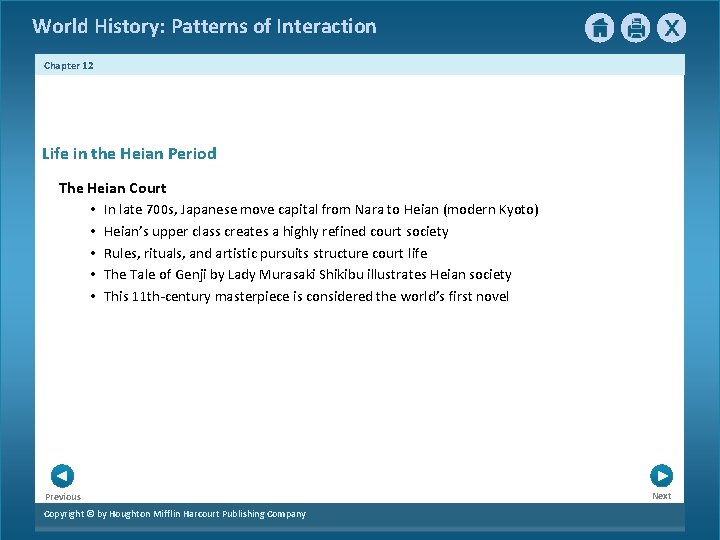
World History: Patterns of Interaction Chapter 12 Life in the Heian Period The Heian Court • In late 700 s, Japanese move capital from Nara to Heian (modern Kyoto) • Heian’s upper class creates a highly refined court society • Rules, rituals, and artistic pursuits structure court life • The Tale of Genji by Lady Murasaki Shikibu illustrates Heian society • This 11 th-century masterpiece is considered the world’s first novel Previous Copyright © by Houghton Mifflin Harcourt Publishing Company Next
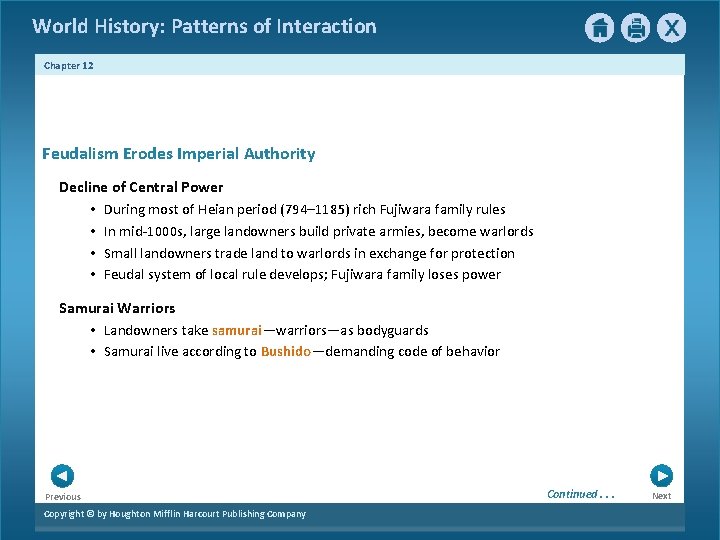
World History: Patterns of Interaction Chapter 12 Feudalism Erodes Imperial Authority Decline of Central Power • During most of Heian period (794– 1185) rich Fujiwara family rules • In mid-1000 s, large landowners build private armies, become warlords • Small landowners trade land to warlords in exchange for protection • Feudal system of local rule develops; Fujiwara family loses power Samurai Warriors • Landowners take samurai—warriors—as bodyguards • Samurai live according to Bushido—demanding code of behavior Previous Copyright © by Houghton Mifflin Harcourt Publishing Company Continued. . . Next
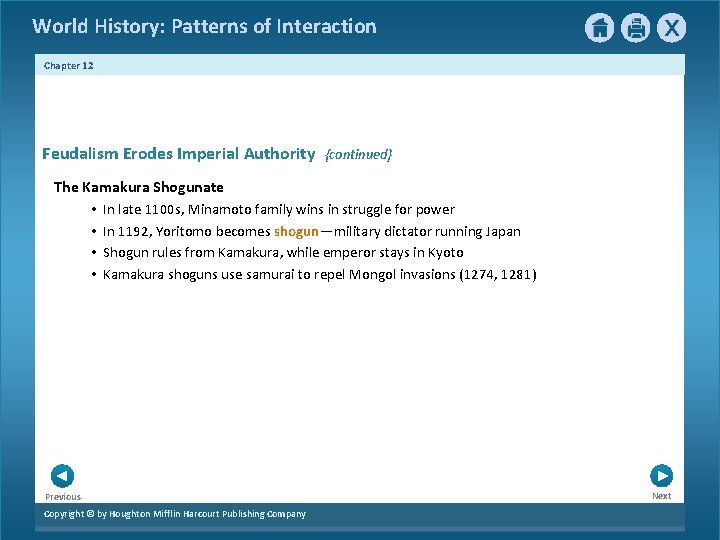
World History: Patterns of Interaction Chapter 12 Feudalism Erodes Imperial Authority {continued} The Kamakura Shogunate • In late 1100 s, Minamoto family wins in struggle for power • In 1192, Yoritomo becomes shogun—military dictator running Japan • Shogun rules from Kamakura, while emperor stays in Kyoto • Kamakura shoguns use samurai to repel Mongol invasions (1274, 1281) Previous Copyright © by Houghton Mifflin Harcourt Publishing Company Next
World History: Patterns of Interaction Chapter 12 Section-5 Kingdoms of Southeast Asia and Korea Several smaller kingdoms prosper in East and Southeast Asia, a region culturally influenced by China and India. Previous Copyright © by Houghton Mifflin Harcourt Publishing Company Next
World History: Patterns of Interaction Chapter 12 Section-5 Kingdoms of Southeast Asia and Korea Kingdoms of Southeast Asia Geography of Southeast Asia • Area between Indian and Pacific Oceans, includes mainland islands • Five major rivers on mainland, but mountains make travel difficult • Key to power in region is control of trade routes and harbors Influence of India and China • Indian traders arrive in first century A. D. ; bring Buddhism, Hinduism • Indian influence remains today • Chinese migrants and traders bring Chinese influence Previous Copyright © by Houghton Mifflin Harcourt Publishing Company Continued. . . Next
World History: Patterns of Interaction Chapter 12 Kingdoms of Southeast Asia {continued} The Khmer Empire • By 800 s the Khmer conquers kingdoms, creates an empire • Khmer Empire (now Cambodia) controls Southeast Asian mainland • Rulers build temple complexes in capital, Angkor • Angkor Wat—square mile complex dedicated to Hindu god Vishnu Island Trading Kingdoms • Sailendra dynasty rules on Java; its culture shows Indian influence • Island empire Srivijaya dominated area from 600 s to 1200 s Previous Copyright © by Houghton Mifflin Harcourt Publishing Company Continued. . . Next
World History: Patterns of Interaction Chapter 12 Kingdoms of Southeast Asia Dai Viet • During Han Dynasty, China controls Southeast Asia • Vietnam becomes an independent kingdom, Dai Viet, in 939 • Influenced by Chinese culture: Buddhism, government • Keep own cultural identity; women have some independence • Ly Dynasty (1009– 1225) establishes capital at Hanoi Previous Copyright © by Houghton Mifflin Harcourt Publishing Company Next
World History: Patterns of Interaction Chapter 12 Korean Dynasties Korean Culture • Combines Chinese culture with native traditions Geography of Korea • Peninsula with little arable land; mountains and seas isolate it Early History • Different clans control areas; in 108 B. C. , Han China conquers Korea • Chinese introduce governing method, religions, system of writing • Regional powers arise; the Silla defeats others, drives out Chinese • Silla rule: Buddhist monasteries, bronze sculptures, writing system Previous Copyright © by Houghton Mifflin Harcourt Publishing Company Continued. . . Next
World History: Patterns of Interaction Chapter 12 Korean Dynasties {continued} The Koryu Dynasty • In 935, Wang Kon takes control, forms Koryu Dynasty, rules to 1392 • Models government on China’s civil service system, with differences • Mongols dominate Korea from 1231 to 1360 s • In 1392, scholar-officials overthrow Koryu Dynasty Koryu Culture • Inspired by Song artists; Korean artists produce celadon pottery • Korean artisans produce wood blocks for printing Buddhist scriptures Previous Copyright © by Houghton Mifflin Harcourt Publishing Company Next
World History: Patterns of Interaction Chapter 12 This is the end of the chapter presentation of lecture notes. Click the HOME or EXIT button. Previous Copyright © by Houghton Mifflin Harcourt Publishing Company Next
World History: Patterns of Interaction Chapter 12 Print Slide Show 1. On the File menu, select Print 2. In the pop-up menu, select Microsoft Power. Point If the dialog box does not include this pop-up, continue to step 4 3. In the Print what box, choose the presentation format you want to print: slides, notes, handouts, or outline 4. Click the Print button to print the Power. Point presentation Previous Copyright © by Houghton Mifflin Harcourt Publishing Company