
WORLD HISTORY Interwar Period Stalin Mussolini and Hitler
- Slides: 29
WORLD HISTORY Interwar Period Stalin, Mussolini and Hitler
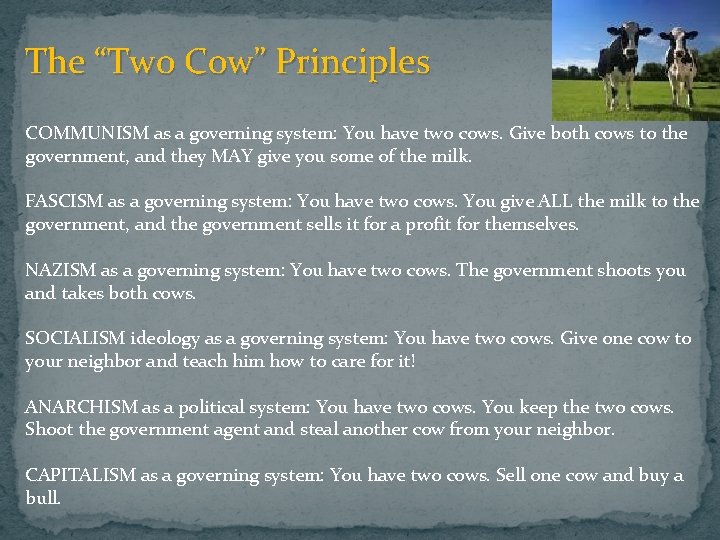
The “Two Cow” Principles COMMUNISM as a governing system: You have two cows. Give both cows to the government, and they MAY give you some of the milk. FASCISM as a governing system: You have two cows. You give ALL the milk to the government, and the government sells it for a profit for themselves. NAZISM as a governing system: You have two cows. The government shoots you and takes both cows. SOCIALISM ideology as a governing system: You have two cows. Give one cow to your neighbor and teach him how to care for it! ANARCHISM as a political system: You have two cows. You keep the two cows. Shoot the government agent and steal another cow from your neighbor. CAPITALISM as a governing system: You have two cows. Sell one cow and buy a bull.
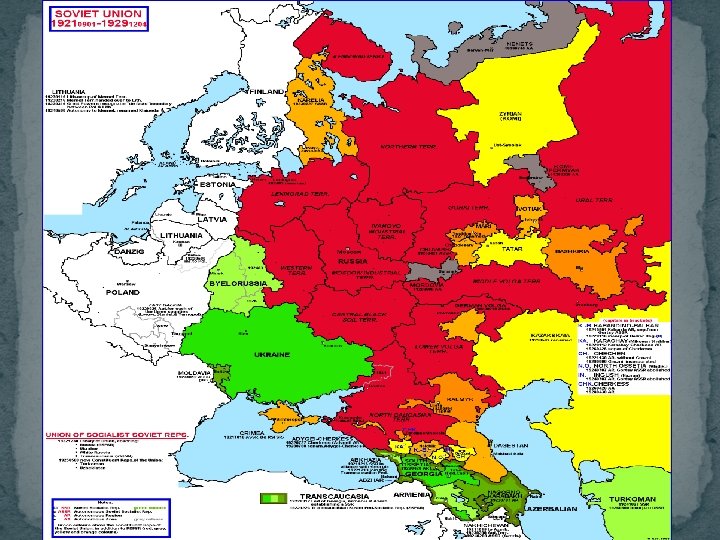
Building the “Soviet Union” Some achieved independence during Russia’s civil war (Poland, Estonia, Latvia, Lithuania) – but others not Western intervention in civil war built distrust After civil war, new focus on state, economy § Outward appearance of democratic socialism § Supreme Soviet “rubber stamped” party legislation § “Union of Soviet Socialist Republics” (USSR) Party authority, public order maintained by Red Army, secret police
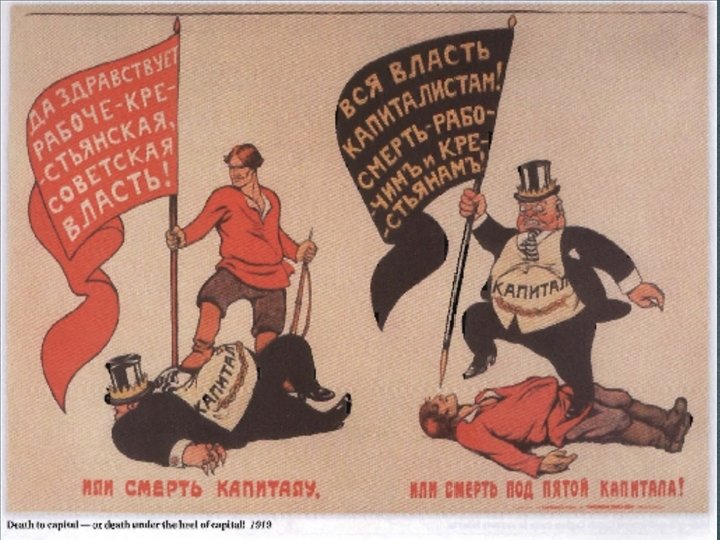
Lenin’s “New Economic Policy” “War communism” had devastated Soviet economy § Factory, mine output decreased § Peasants refused to produce food for government Lenin’s New Economic Policy (NEP) in 1921 § A (temporary) compromise to rebuild economy! § Some small businesses allowed to operate for profit § Peasants allowed small plots of land § Government controlled banks, trade, large industries § Tax on food to subsidize cost of food production Successful - famine largely eliminated by 1924 New wealthier peasant class – kulaks - emerged
The Rise of Stalin Lenin’s health compromised by effects of 1918 assassination attempt § § § Suffered first stroke in 1922 (and wrote Testament) Testament expressed concern about succession Did not trust Stalin, or think he had necessary leadership skills Lenin’s death in January, 1924 led to a power struggle § Party leaders ignored Lenin’s “testament” § Leon Trotsky (international focus) vs. Joseph Stalin (socialism at home) Stalin had a reputation as a shrewd, ruthless political operative § § Used his position as General Secretary to put his supporters in positions of power – isolating Trotsky After Stalin gained power in 1928 – Trotsky fled (later assassinated)
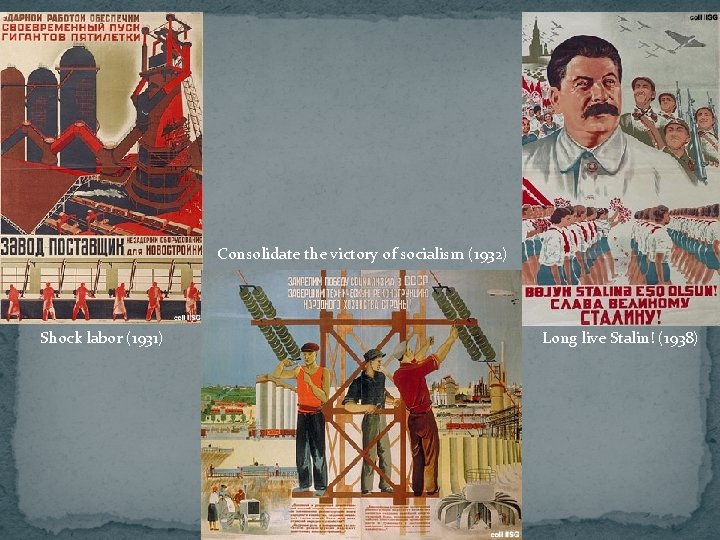
The “Five-Year Plans” Stalin wanted to build a modern, industrial power First of his “Five-Year Plans” launched in 1928 § Specific goals, timeframes for industry, agriculture § Command economy put all economic activity under government control Incentives for success in meeting goals, quotas – and harsh punishment for failure Progress in construction of factories, power plants, railroads (but quality questionable!) § § § Consumer goods scarce, expensive Government kept farm prices low, and strikes forbidden “Shock labor” efforts
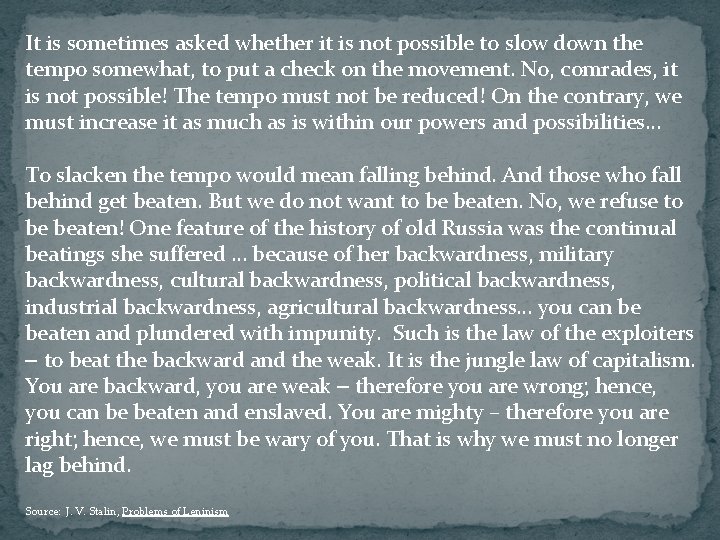
It is sometimes asked whether it is not possible to slow down the tempo somewhat, to put a check on the movement. No, comrades, it is not possible! The tempo must not be reduced! On the contrary, we must increase it as much as is within our powers and possibilities… To slacken the tempo would mean falling behind. And those who fall behind get beaten. But we do not want to be beaten. No, we refuse to be beaten! One feature of the history of old Russia was the continual beatings she suffered … because of her backwardness, military backwardness, cultural backwardness, political backwardness, industrial backwardness, agricultural backwardness… you can be beaten and plundered with impunity. Such is the law of the exploiters – to beat the backward and the weak. It is the jungle law of capitalism. You are backward, you are weak – therefore you are wrong; hence, you can be beaten and enslaved. You are mighty – therefore you are right; hence, we must be wary of you. That is why we must no longer lag behind. Source: J. V. Stalin, Problems of Leninism
Consolidate the victory of socialism (1932) Shock labor (1931) Long live Stalin! (1938)
Agricultural Collectivization Stalin saw private land ownership as inefficient – and threat to the state Peasants forced to give up land, form collectives § Stalin wanted to produce more food to feed urban workers – and a surplus to sell abroad to invest in industry § State-owned; all equipment, tools, livestock shared § Government provided machinery, seed, fertilizer – and taught new farming methods Peasants resisted (destroying property, killing livestock) § Stalin sent troops to crush resistance! § Vowed to crush kulak class – took land, sent them to labor camps Terror Famine in 1932 -1933 killed millions (esp. in Ukraine)
Stalin Crushed His Rivals Stalin insisted on absolute obedience! § Terror used as a weapon (secret police, surveillance) § Censorship of the press – only favorable reports § No freedom of assembly or speech § Critics sent to the Gulag (forced labor camps) – even for minor offenses Great Purge began in 1934 to oust party rivals and replace them with those loyal to Stalin § § § “Old Bolsheviks” – early revolutionaries, party elites, military leaders Ordinary citizens accused of plots against Stalin, or failure to meet production quotas Demonstrated consequences of disloyalty! “Show trials” from 1936 -1938 purged over 4 million – former Communist leaders, intellectuals, scientists
Soviet Foreign Policy Two goals – expansion of communism, but also national security Unable to reconcile the two – so foreign policy confusing Soviet Union wanted membership in the League of Nations and better relationships with the West … but Lenin had formed Communist International (Comintern) to help revolutionaries defeat imperialists § § § Anti-capitalist propaganda made West suspicious of intentions Fear of Bolshevik infiltration led to “Red Scare” in the U. S. Stalin’s Great Purge activities further alienated the West
Life in a Totalitarian State A totalitarian state tries to control all aspects of its citizens’ lives Leader’s image carefully controlled, cultivated to win “hearts and minds” § § Positive images, posters – everywhere! Propaganda promoted “cult of personality” Leader uses various methods to ensure compliance § Terror/fear to prevent public protest, disloyalty § Censorship restricts publication of anything critical § Arts also followed prescribed form (“socialist realism”) § Religious faith replaced with atheism • • New religious texts: writings of Lenin, Marx New religious icon: Stalin
A New Social Order Promise of full equality never realized New elites became new ruling class, and enjoyed special privileges of status (housing, consumer goods) § § § Communist Party leaders Military, industrial leaders Scientists, writers and artists supporting the regime Women did have the vote, and many worked in technical fields (engineering, medicine) Children attended free schools which taught Communist values, loyalty to Party and Stalin, and atheism Low-cost housing, free medical care and day-care
The Rise of Mussolini Italians thought they got a bad deal after the war – disappointment fueled nationalist protests Italy was a constitutional monarchy – and the government was unable to end the crisis Nationalist Benito Mussolini embraced a political ideology he called fascism § § § Organized the Fascist Party in 1919 Wanted to revive the glory of ancient Rome Promised to end government corruption, social disorder
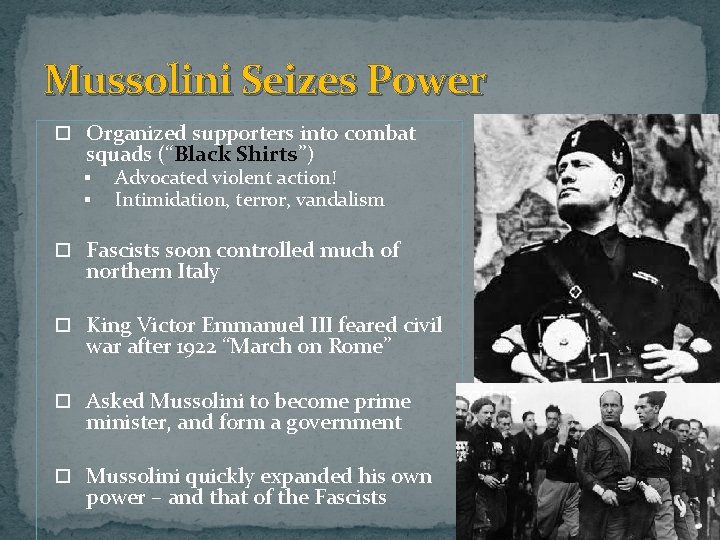
Mussolini Seizes Power Organized supporters into combat squads (“Black Shirts”) § § Advocated violent action! Intimidation, terror, vandalism Fascists soon controlled much of northern Italy King Victor Emmanuel III feared civil war after 1922 “March on Rome” Asked Mussolini to become prime minister, and form a government Mussolini quickly expanded his own power – and that of the Fascists
Fascists in Control “Il Duce” in full control of Italy’s government by 1925 Consolidated his power by § Imprisoning, exiling, executing critics and dissenters § Censoring the press § Rigging elections in favor of Fascist supporters § Recognizing Vatican City as independent (getting the pope, Pius XI, § to appear in agreement with him) Employing secret police, propaganda to boost image of, and support for, Fascists “Corporate state” kept economy under state control, but capitalism intact § § System favored upper-class elites Wages kept low, strikes outlawed (productivity!) Loyalty to state most important – not individual goals!
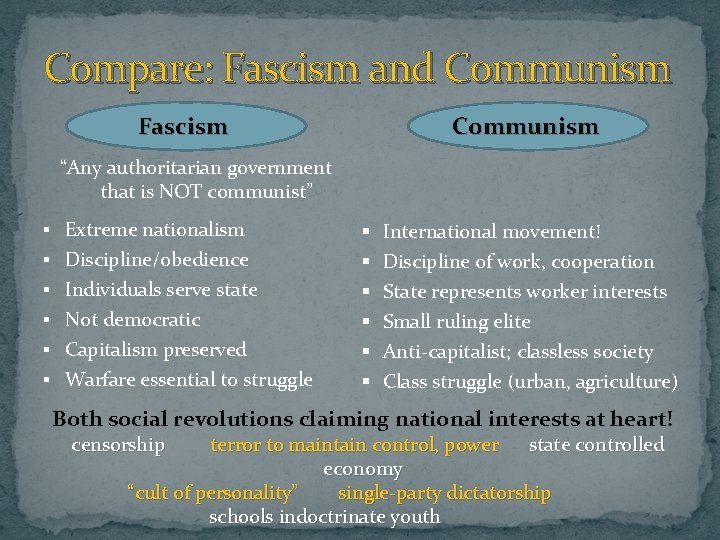
Compare: Fascism and Communism Fascism Communism “Any authoritarian government that is NOT communist” § Extreme nationalism § Discipline/obedience § Individuals serve state § Not democratic § Capitalism preserved § Warfare essential to struggle § § § International movement! Discipline of work, cooperation State represents worker interests Small ruling elite Anti-capitalist; classless society Class struggle (urban, agriculture) Both social revolutions claiming national interests at heart! censorship terror to maintain control, power state controlled economy “cult of personality” single-party dictatorship schools indoctrinate youth
The Weimar Republic Democratic government based on new 1919 constitution known as the Weimar Republic § § Parliamentary system, led by chancellor Included a “bill of rights” and gave women the vote Very weak government § Too many parties/factions meant coalitions not strong § Political pressure from communists, conservatives § Weimar leaders - and Jews - blamed for Versailles treaty terms Reparations obligations created economic disaster! § French seized coal-rich Ruhr Valley § Germans refused to work – but government still paid them § Too much printed currency led to rampant inflation § US-backed Dawes Plan helped, until Great Depression hit
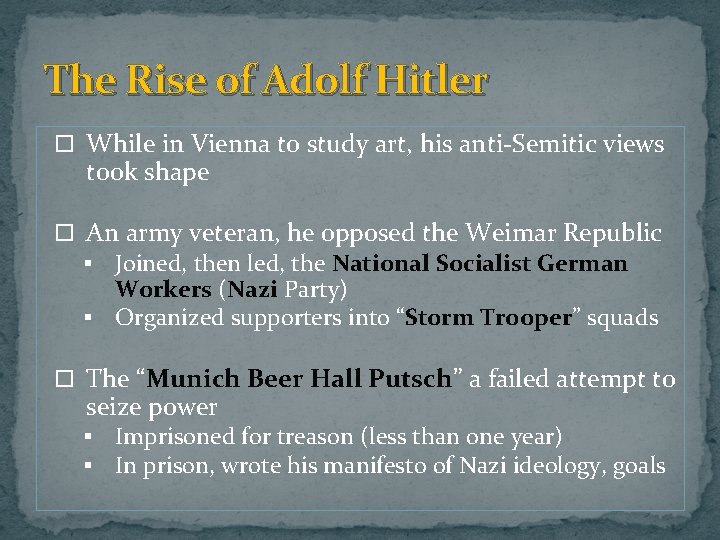
The Rise of Adolf Hitler While in Vienna to study art, his anti-Semitic views took shape An army veteran, he opposed the Weimar Republic § Joined, then led, the National Socialist German Workers (Nazi Party) § Organized supporters into “Storm Trooper” squads The “Munich Beer Hall Putsch” a failed attempt to seize power § § Imprisoned for treason (less than one year) In prison, wrote his manifesto of Nazi ideology, goals
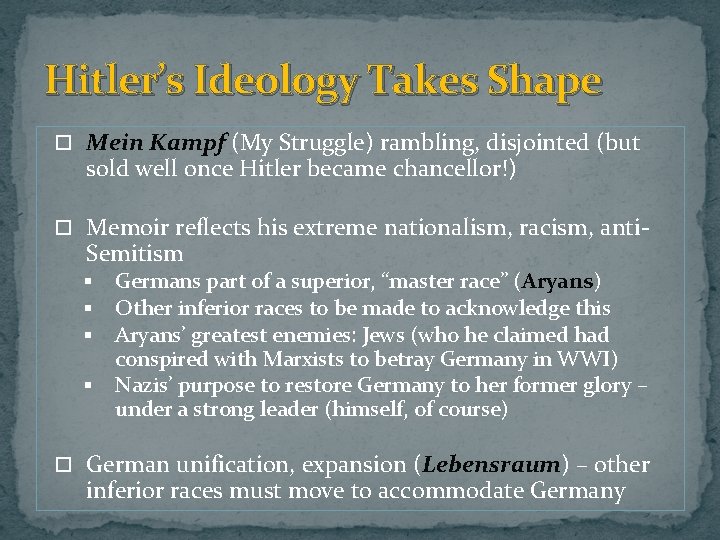
Hitler’s Ideology Takes Shape Mein Kampf (My Struggle) rambling, disjointed (but sold well once Hitler became chancellor!) Memoir reflects his extreme nationalism, racism, anti- Semitism § § Germans part of a superior, “master race” (Aryans) Other inferior races to be made to acknowledge this Aryans’ greatest enemies: Jews (who he claimed had conspired with Marxists to betray Germany in WWI) Nazis’ purpose to restore Germany to her former glory – under a strong leader (himself, of course) German unification, expansion (Lebensraum) – other inferior races must move to accommodate Germany
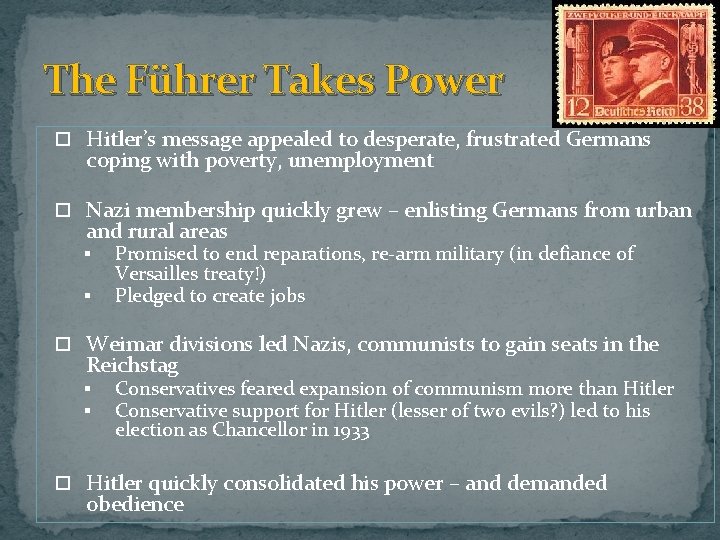
The Führer Takes Power Hitler’s message appealed to desperate, frustrated Germans coping with poverty, unemployment Nazi membership quickly grew – enlisting Germans from urban and rural areas § § Promised to end reparations, re-arm military (in defiance of Versailles treaty!) Pledged to create jobs Weimar divisions led Nazis, communists to gain seats in the Reichstag § § Conservatives feared expansion of communism more than Hitler Conservative support for Hitler (lesser of two evils? ) led to his election as Chancellor in 1933 Hitler quickly consolidated his power – and demanded obedience
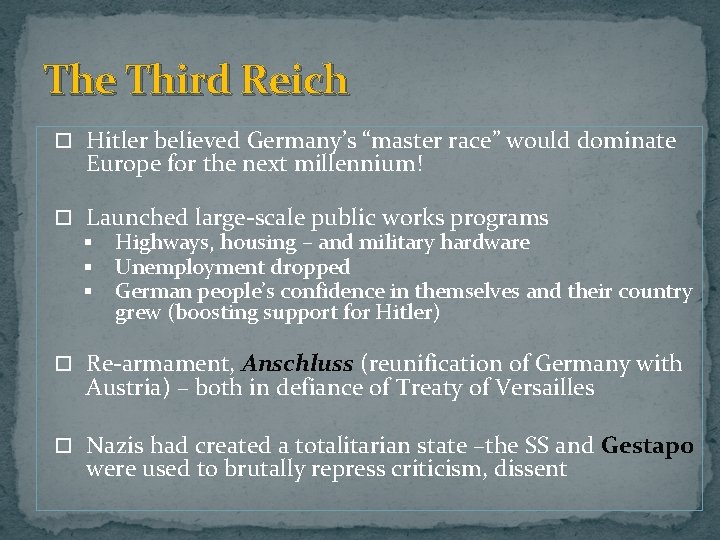
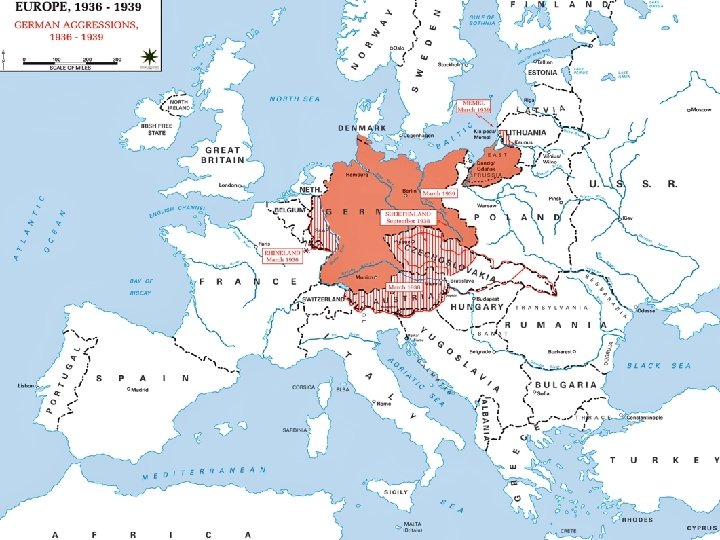
The Third Reich Hitler believed Germany’s “master race” would dominate Europe for the next millennium! Launched large-scale public works programs § Highways, housing – and military hardware § Unemployment dropped § German people’s confidence in themselves and their country grew (boosting support for Hitler) Re-armament, Anschluss (reunification of Germany with Austria) – both in defiance of Treaty of Versailles Nazis had created a totalitarian state –the SS and Gestapo were used to brutally repress criticism, dissent
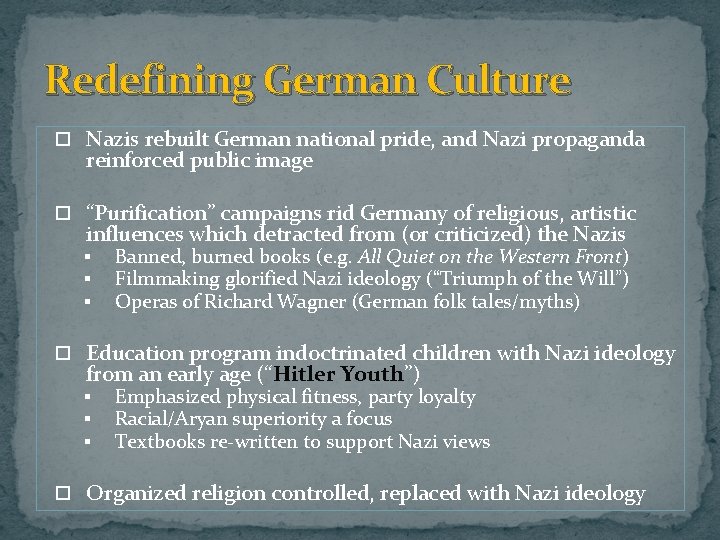
Redefining German Culture Nazis rebuilt German national pride, and Nazi propaganda reinforced public image “Purification” campaigns rid Germany of religious, artistic influences which detracted from (or criticized) the Nazis § § § Banned, burned books (e. g. All Quiet on the Western Front) Filmmaking glorified Nazi ideology (“Triumph of the Will”) Operas of Richard Wagner (German folk tales/myths) Education program indoctrinated children with Nazi ideology from an early age (“Hitler Youth”) § § § Emphasized physical fitness, party loyalty Racial/Aryan superiority a focus Textbooks re-written to support Nazi views Organized religion controlled, replaced with Nazi ideology
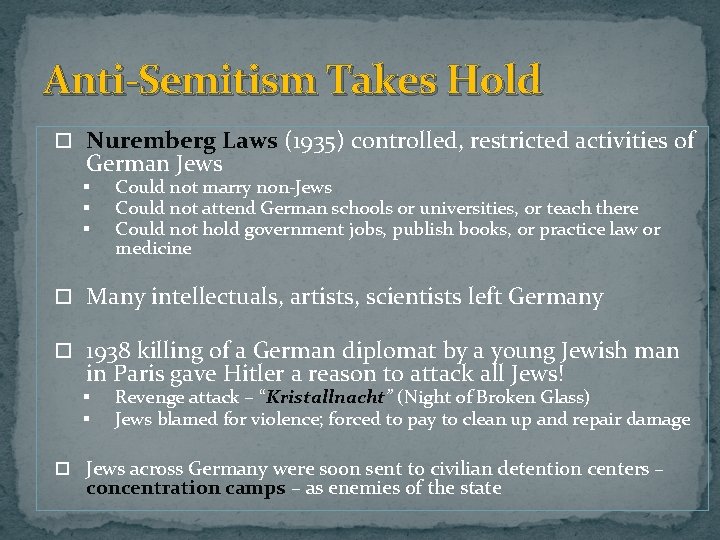
Anti-Semitism Takes Hold Nuremberg Laws (1935) controlled, restricted activities of German Jews § § § Could not marry non-Jews Could not attend German schools or universities, or teach there Could not hold government jobs, publish books, or practice law or medicine Many intellectuals, artists, scientists left Germany 1938 killing of a German diplomat by a young Jewish man in Paris gave Hitler a reason to attack all Jews! § § Revenge attack – “Kristallnacht” (Night of Broken Glass) Jews blamed for violence; forced to pay to clean up and repair damage Jews across Germany were soon sent to civilian detention centers – concentration camps – as enemies of the state
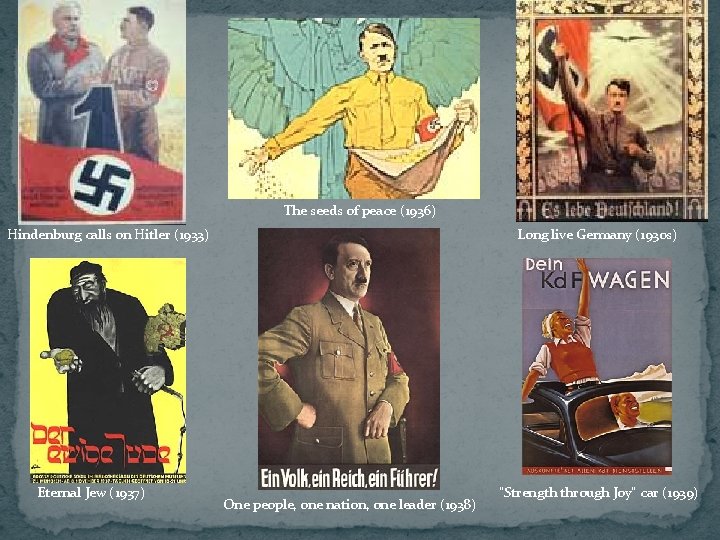
The seeds of peace (1936) Hindenburg calls on Hitler (1933) Eternal Jew (1937) Long live Germany (1930 s) One people, one nation, one leader (1938) “Strength through Joy” car (1939)