
World History Grade 9 Unit 3 4 Lesson

- Slides: 13
World History Grade 9 Unit 3. 4 Lesson 1 – 3 Migrations and Militarism Across Afroeurasia 2000 – 1000 B. C. E.
Unit 3. 4 Lesson 1 -3 Objectives: 1. Compare the key differences between the way of life and values of pastoral nomads and settled peoples. 2. Examine the reasons for and consequences of the interactions between these groups. 3. Infer characteristics of kingdoms that developed in the 2 nd millennium B. C. E. 4. Describe the effects of migration and settlement on the development of languages. Main Teaching Points: • Historical Context • Defining Terms • Pastoralists Values • Farmers vs. Nomads • Online Texts
Lesson 1 Define • What do you think this term means? • Pastoral o idealizing rural life • Nomad o Wanderer, someone who moves from place to place • Steppe o an extensive plain, especially one without trees • Pastoralist o a person who herds livestock, often as a nomadic wanderer without a set farm area. • Pastoralism o branch of agriculture concerned with the raising of livestock • Nomadic/Nomadism o roaming about from place to place
What’s the Difference In Groups: • Make a list of 5 -6 similarities and differences between settled farmers/Urban Dwellers and Pastoral Nomads • Does the lifestyle of the Nomads remind you of another group of early humans? • Let’s Read
DISCUSS • In what ways might geography or population density have influenced these two ways of life • What special challenges did life on the steppe present? • What did pastoral nomads do to compensate for the poor land sparse rainfall on the steppe? • Why were their herds so important? • Why did they usually become excellent warriors?
DISCUSS • Where are towns and cities likely to be established? • What various ways of life were possible for people settled in towns? • In what ways were towns vulnerable to attack by pastoral nomads? • What measures might the people in the town take to defend themselves? • What benefits might both nomadic groups and farmers have gained from towns and cities? • Why and when might nomads have interacted peacefully or conflicted with people in towns and cities? • Do you think fighting and warfare were important in the lives of pastoral nomads? Do you think settled people or nomads would have been more concerned with warfare? Why or why not?
Lesson 2 • Why do so many groups of pastoral nomads migrate into or invade settled areas during the 2 nd millennium B. C. E. ? o Nomads were desperate for food because of overpopulation or because disease killed their herds o Changes in the climate, dry conditions, less grass. o Refusal to trade by settled peoples o Other nomadic groups pushing them out of their grazing areas o The development of new weapons • Population growth, disease, climatic change, weakness of settled areas, surplus wealth of settled areas, need for goods such as grain, desire for glory, leadership of skilled warriors, new technology
• Lesson 2 cont… What could settled people do to prevent some of these problems from the pastoral nomads? o o Why might they choose to attack the nomads? Why might they want to expand their frontiers? • Why do you think that one reading depicts settled and nomadic individuals fighting and the other shows them battling but then becoming equals and friends? • What is the reason for the jealousy between Cain and Abel in the story from Genesis? • How are the two ways of life (shepherd and farmer) contrasted? • How does this comparison align with the typical views of nomads versus sedentary folk? • Compare the characters of Gilgamesh and Enkidu in appearance, in personal qualities and in the way the are seen by the people of the city.
What’s missing? What are the feelings towards sedentary people and pastoral nomads in regards to their interactions with each other and people within their own society? (Divide into 2 groups) Make a list of problems you have with each other and possible solutions • Nomads views towards sedentary people: • Sedentary People views towards nomads: • Nomad view towards each other: • Sedentary views towards each other:
Lesson 3 Laws: Past vs. Present • What laws do we need in 2015? • Laws Mesopotamia
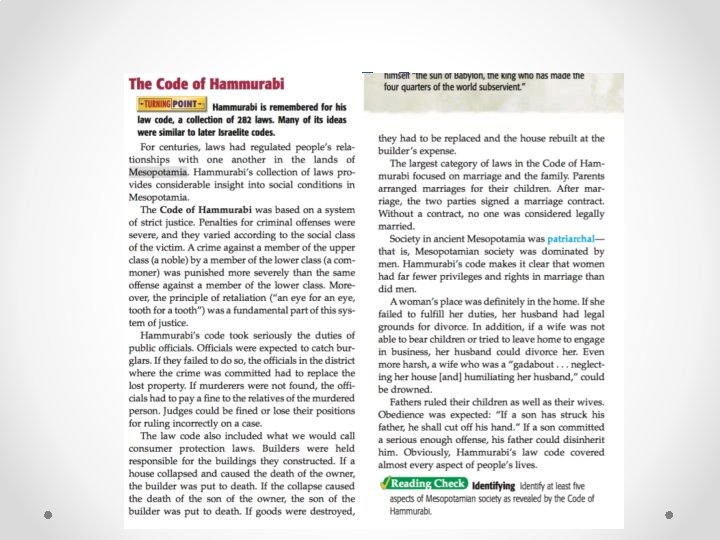
Hammurabi's • What areas of life does his laws cover? o o Economic Activity The Military Hierarchy and Justice Roles and Status of Women • Find 2 -3 laws from each section that you think are similar to laws in 2015 • What laws do you find disturbing?
THE CODE
Ancient Mesopotamia Crash Course • Read Chapter 2 Online • Homework Due: Chapter 2 Monday/Tuesday • Homework Due: Chapter 9 Wednesday