
World History Academic Language 100 Terms Development of


- Slides: 5
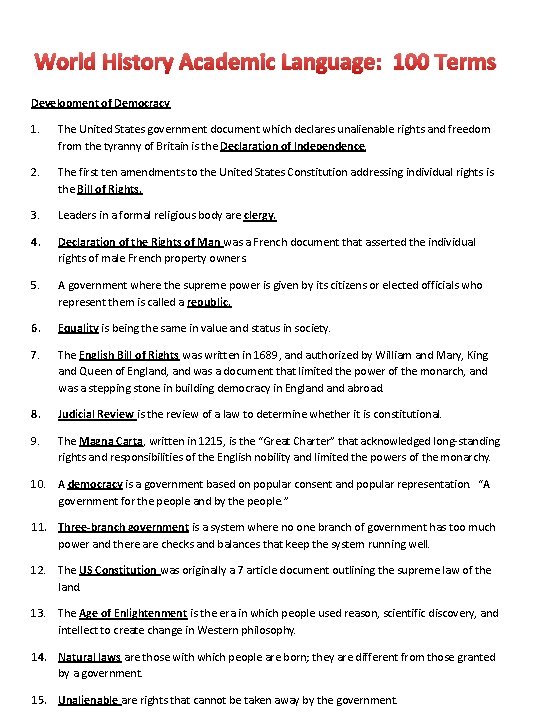
World History Academic Language: 100 Terms Development of Democracy 1. The United States government document which declares unalienable rights and freedom from the tyranny of Britain is the Declaration of Independence. 2. The first ten amendments to the United States Constitution addressing individual rights is the Bill of Rights. 3. Leaders in a formal religious body are clergy. 4. Declaration of the Rights of Man was a French document that asserted the individual rights of male French property owners. 5. A government where the supreme power is given by its citizens or elected officials who represent them is called a republic. 6. Equality is being the same in value and status in society. 7. The English Bill of Rights was written in 1689, and authorized by William and Mary, King and Queen of England, and was a document that limited the power of the monarch, and was a stepping stone in building democracy in England abroad. 8. Judicial Review is the review of a law to determine whether it is constitutional. 9. The Magna Carta, written in 1215, is the “Great Charter” that acknowledged long-standing rights and responsibilities of the English nobility and limited the powers of the monarchy. 10. A democracy is a government based on popular consent and popular representation. “A government for the people and by the people. ” 11. Three-branch government is a system where no one branch of government has too much power and there are checks and balances that keep the system running well. 12. The US Constitution was originally a 7 article document outlining the supreme law of the land. 13. The Age of Enlightenment is the era in which people used reason, scientific discovery, and intellect to create change in Western philosophy. 14. Natural laws are those with which people are born; they are different from those granted by a government. 15. Unalienable are rights that cannot be taken away by the government.
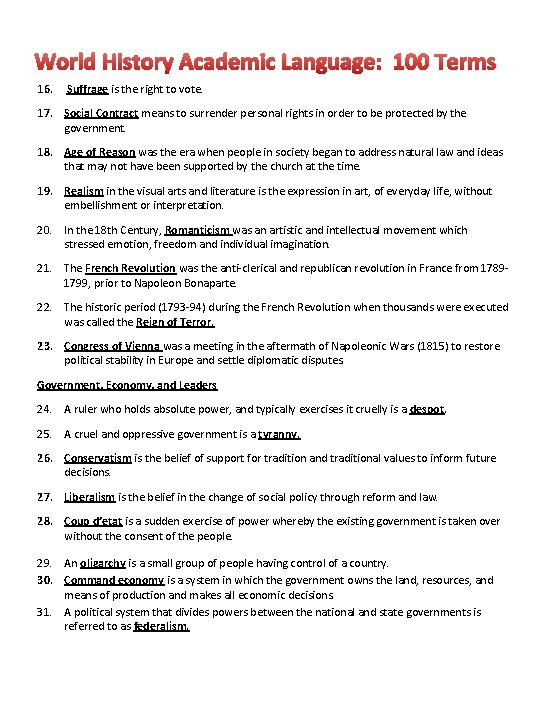
World History Academic Language: 100 Terms 16. Suffrage is the right to vote. 17. Social Contract means to surrender personal rights in order to be protected by the government. 18. Age of Reason was the era when people in society began to address natural law and ideas that may not have been supported by the church at the time. 19. Realism in the visual arts and literature is the expression in art, of everyday life, without embellishment or interpretation. 20. In the 18 th Century, Romanticism was an artistic and intellectual movement which stressed emotion, freedom and individual imagination. 21. The French Revolution was the anti-clerical and republican revolution in France from 17891799, prior to Napoleon Bonaparte. 22. The historic period (1793 -94) during the French Revolution when thousands were executed was called the Reign of Terror. 23. Congress of Vienna was a meeting in the aftermath of Napoleonic Wars (1815) to restore political stability in Europe and settle diplomatic disputes. Government, Economy, and Leaders 24. A ruler who holds absolute power, and typically exercises it cruelly is a despot. 25. A cruel and oppressive government is a tyranny. 26. Conservatism is the belief of support for tradition and traditional values to inform future decisions. 27. Liberalism is the belief in the change of social policy through reform and law. 28. Coup d’etat is a sudden exercise of power whereby the existing government is taken over without the consent of the people. 29. An oligarchy is a small group of people having control of a country. 30. Command economy is a system in which the government owns the land, resources, and means of production and makes all economic decisions. 31. A political system that divides powers between the national and state governments is referred to as federalism.
World History Academic Language: 100 Terms 32. Hegemony is the dominance of one group over other groups, with or without the threat of force. 33. Humanism was an emphasis on human culture during the Renaissance sparked by the rediscovery of classical Greek and Roman literature, culture, and language. 34. National security means to protect a nation-state through the use of economic, military and political power and the exercise of diplomacy. 35. Capitalism is a free enterprise system where individuals are allowed to own and operate private business for personal gain. 36. Collectivism is a political theory that the people should own the means of production. 37. Socialism is when the means of production and distribution of goods and services is controlled by the government. 38. Monarchy is when a nation is ruled by one ruler. 39. Nobility a privileged class holding hereditary titles. 40. Parliament is the legislative body within a nation who is also responsible to the ruling party. Imperialism and Industrialism 41. In 1900, an unsuccessful rebellion led by a nationalist Chinese secret society against foreigners was the Boxer Rebellion. 42. Nationalism is pride in ones nation. 43. When a nation takes over of another nation or territory for economic, social, or military purposes it is called imperialism. 44. Intervention is the political practice of intervening in a state's affairs. 45. Militarism is the belief that a nation must develop military to protect its people and worth. 46. Entrepreneurship is a process through which individuals identify opportunities, allocate resources, and create value. 47. Factors of Production are the resources used to produce goods and services. 48. A Labor Union is an organization of workers formed for the purpose of advancing its members' interests in respect to wages, benefits, and working conditions. 49. Rapid, massive growth, or migration to an urban area is urbanization. 50. Natural Resources are land or raw materials used to produce goods or services. 51. Assembly line is the means by which something is produced in mass quantity, usually using interchangeable parts. 52. A textile is a thread or yarn-like product used to weave cloth or fabric. 53. Social Darwinism is a theory that the laws of evolution by natural selection also apply to social structures. 54. The Great Depression was a global economic collapse, beginning in 1929, in which the production of goods exceeded the demand for them.
World History Academic Language: 100 Terms Totalitarianism 55. The Five-Year Plans consisted of Stalin’s plan to quickly industrialize the Soviet Union. 56. Gulags were forced labor camps in the former Union of Soviet Socialist Republic (U. S. S. R. ). 57. The Great Purge, was political repression and persecution directed by Joseph Stalin that brought about the death of millions of people in the Soviet Union, from 1934 -1939. 58. The practice of completely controlling a nation and not abiding by a constitution is totalitarianism. 59. Communism is Karl Marx’s political theory based on holding all property in common, where the people work for the good of the whole and personal rights are eliminated. 60. Fascism is an authoritarian political ideology that holds the state above all else and seeks to forge a type of national unity, usually based on ethnic, cultural, or racial attributes. 61. The Russian Revolution was a rebellion and coup de etat led by Vladmir Lenin in November, 1917, that led to a period of civil war in Russia. 62. Tsar or czar is a male monarch or emperor, especially in Russia prior to 1917. 63. A Bolshevik was a member of a radical majority of the Social Democratic Party (19031917), who advocated immediate seizure of power by force. 64. A Menshevik was a member of the liberal minority group that advocated gradual reform and opposed the Bolsheviks before and during the Russian Revolution. World War I 65. The Triple Alliance was the military alliance among Germany, Austria–Hungary, and Italy that lasted from 1882 until the start of World War I in 1914. 66. The Triple Entente was an alliance formed between the Britain, France, and Russia in 1907, which would lead to their partnership in the First World War. 67. Appeasement is the policy of establishing a state of peace, calm, and contentment. 68. Brinkmanship is when a nation is stressed militarily and almost to the point of going to war. 69. The Central Powers was the group of nations (Bulgaria, Austria-Hungary, Germany, Ottoman Empire), during WWI, who opposed the Allied Powers. 70. Isolationism means to keep out of foreign policy and war with other nations. 71. Mobilization means to ready troops for war. 72. Propaganda the use of biased information to hurt or help a specific cause. 73. Rearmament is the process of rebuilding the military of a nation. 74. The Schlieffen Plan was a plan for a lightening-quick attack during battle. 75. Trench Warfare was the system of dugout land used as shelter and protection, especially on the Western Front, during WWI. 76. The United Nations was an organization of independent states formed in 1945 to promote international peace and security. 77. The Lost Generation was an unfulfilled generation coming to maturity during a period of instability after WWI.
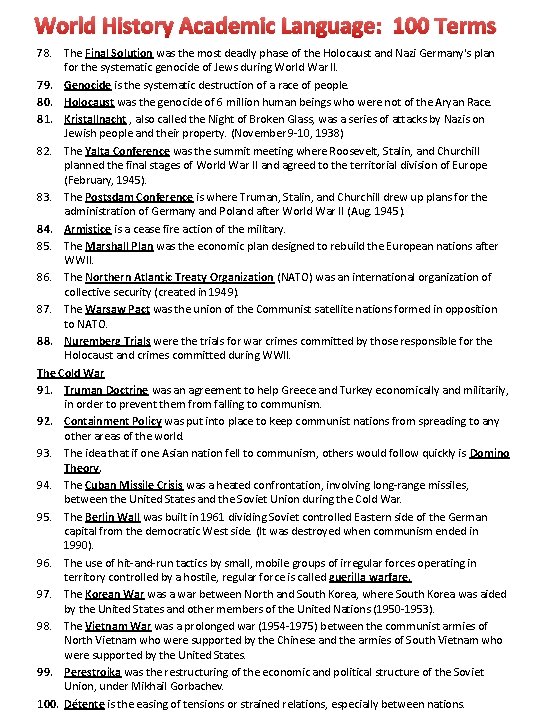
World History Academic Language: 100 Terms 78. The Final Solution was the most deadly phase of the Holocaust and Nazi Germany's plan for the systematic genocide of Jews during World War II. 79. Genocide is the systematic destruction of a race of people. 80. Holocaust was the genocide of 6 million human beings who were not of the Aryan Race. 81. Kristallnacht , also called the Night of Broken Glass, was a series of attacks by Nazis on Jewish people and their property. (November 9 -10, 1938) 82. The Yalta Conference was the summit meeting where Roosevelt, Stalin, and Churchill planned the final stages of World War II and agreed to the territorial division of Europe (February, 1945). 83. The Postsdam Conference is where Truman, Stalin, and Churchill drew up plans for the administration of Germany and Poland after World War II (Aug. 1945). 84. Armistice is a cease fire action of the military. 85. The Marshall Plan was the economic plan designed to rebuild the European nations after WWII. 86. The Northern Atlantic Treaty Organization (NATO) was an international organization of collective security (created in 1949). 87. The Warsaw Pact was the union of the Communist satellite nations formed in opposition to NATO. 88. Nuremberg Trials were the trials for war crimes committed by those responsible for the Holocaust and crimes committed during WWII. The Cold War 91. Truman Doctrine was an agreement to help Greece and Turkey economically and militarily, in order to prevent them from falling to communism. 92. Containment Policy was put into place to keep communist nations from spreading to any other areas of the world. 93. The idea that if one Asian nation fell to communism, others would follow quickly is Domino Theory. 94. The Cuban Missile Crisis was a heated confrontation, involving long-range missiles, between the United States and the Soviet Union during the Cold War. 95. The Berlin Wall was built in 1961 dividing Soviet controlled Eastern side of the German capital from the democratic West side. (It was destroyed when communism ended in 1990). 96. The use of hit-and-run tactics by small, mobile groups of irregular forces operating in territory controlled by a hostile, regular force is called guerilla warfare. 97. The Korean War was a war between North and South Korea, where South Korea was aided by the United States and other members of the United Nations (1950 -1953). 98. The Vietnam War was a prolonged war (1954 -1975) between the communist armies of North Vietnam who were supported by the Chinese and the armies of South Vietnam who were supported by the United States. 99. Perestroika was the restructuring of the economic and political structure of the Soviet Union, under Mikhail Gorbachev. 100. Détente is the easing of tensions or strained relations, especially between nations.