
World Geography Unit 4 Lesson 1 Regions of






- Slides: 55
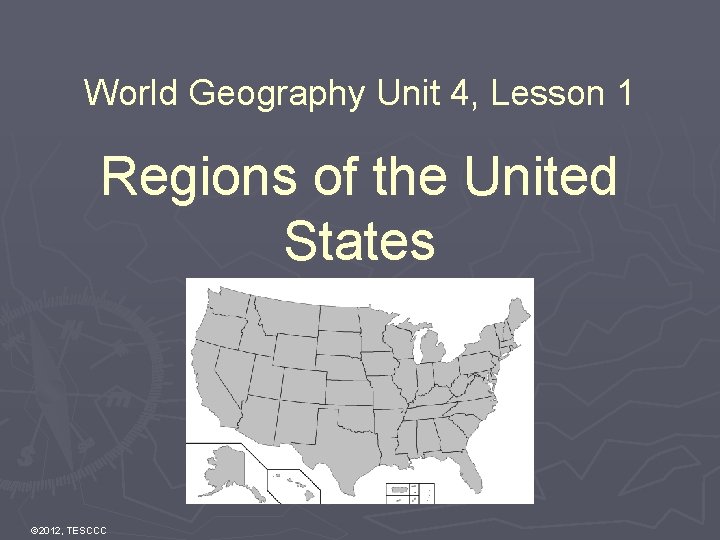
World Geography Unit 4, Lesson 1 Regions of the United States © 2012, TESCCC
Class Outline Ø Northeast Ø South Ø Midwest &Great Plains Ø Rocky Mountains/Basin States, including Southwest Ø Pacific Coast © 2012, TESCCC
Topics discussed for each Region Ø Physical Geography Ø Historical Geography Ø Population Geography Ø Economic Geography Ø Cultural Geography © 2012, TESCCC
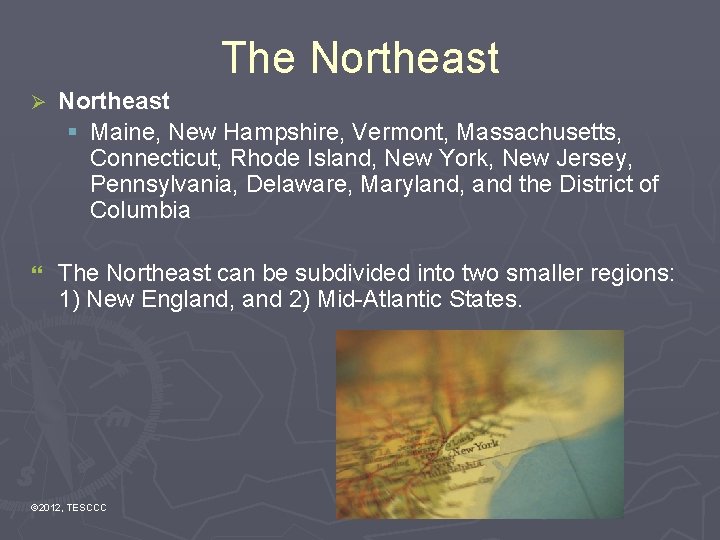
The Northeast Ø Northeast § Maine, New Hampshire, Vermont, Massachusetts, Connecticut, Rhode Island, New York, New Jersey, Pennsylvania, Delaware, Maryland, and the District of Columbia } The Northeast can be subdivided into two smaller regions: 1) New England, and 2) Mid-Atlantic States. © 2012, TESCCC
Physical Geography of Northeast } Northern Appalachian mountains run through most of the northeastern states, causing little farmland, except in valley areas. } Coastal plain is narrow, with an area between the mountains and coast called the fall line. } Deep bays exist, allowing for port towns. } Jagged, rocky coastline in northern areas. © 2012, TESCCC
Climate and Vegetation of Northeast: Humid Continental } No Dry Season- this area receives precipitation throughout the year. } Cold, snowy winters and hot summers. } Moderate growing season that decreases as you go north. } Vegetation is mixed forests with deciduous and coniferous trees. © 2012, TESCCC
Historical Geography of the Northeast } The Northeast has the longest history of European settlement. } Historically, the Northeast has been the gateway to immigrants. } Established itself as the financial and manufacturing hub early in the industrial revolution. © 2012, TESCCC
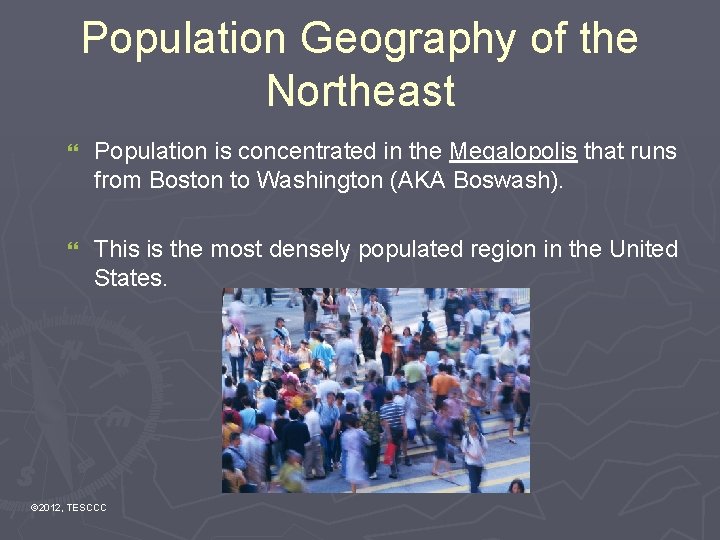
Population Geography of the Northeast } Population is concentrated in the Megalopolis that runs from Boston to Washington (AKA Boswash). } This is the most densely populated region in the United States. © 2012, TESCCC
Economic Geography of the Northeast } The New England states have a long history of maritime industry, although forestry exists inland with little farming. } The Mid-Atlantic states dominate the financial sector of the U. S. , advertising, manufacturing. } This region is the home to most major corporations in the United States. © 2012, TESCCC
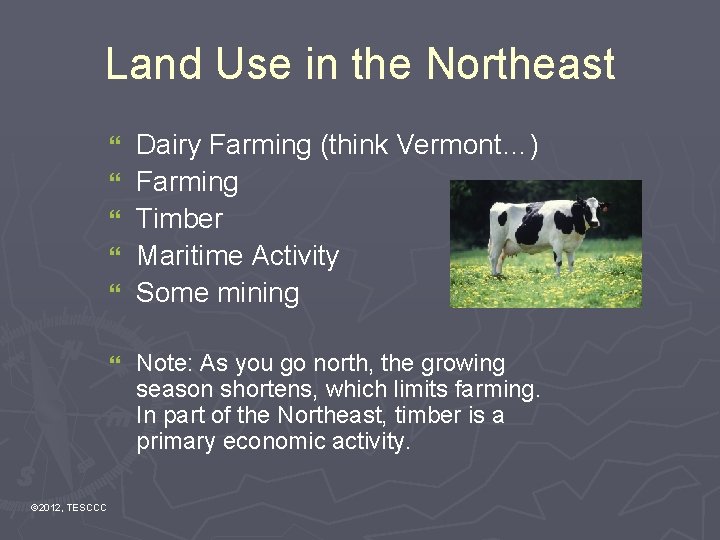
Land Use in the Northeast } } } © 2012, TESCCC Dairy Farming (think Vermont…) Farming Timber Maritime Activity Some mining Note: As you go north, the growing season shortens, which limits farming. In part of the Northeast, timber is a primary economic activity.
Economic Geography } Northeast is the heart of the manufacturing core, but lately has been termed the RUST BELT. This extends into the Midwest. } Why do you think it’s called the Rust belt? Where have industries relocated? Why? © 2012, TESCCC
Cultural Geography of Northeast: Mid-Atlantic } South of New England, the Mid-Atlantic states enjoy warmer weather and a longer growing season. } The economy has more farming activity and has less maritime activity, although major shipping waterways are present. } Major cities are located on these major waterways: New York is on the Hudson R. , Philly is on the Delaware, and Baltimore is located on Chesapeake Bay. © 2012, TESCCC
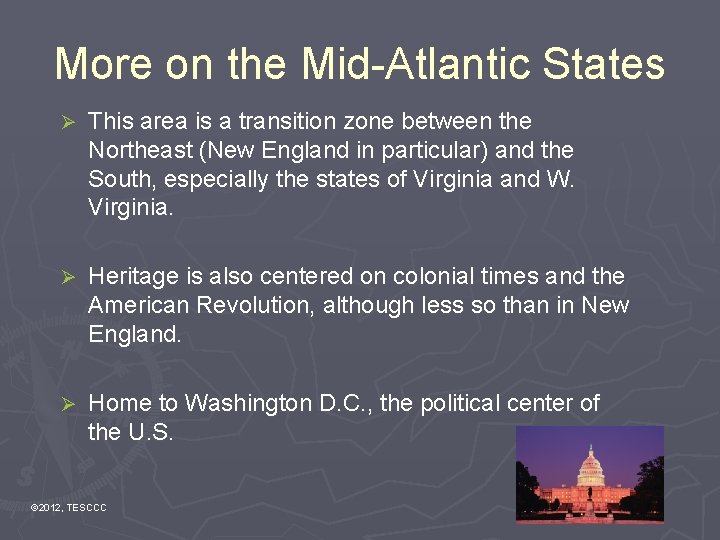
More on the Mid-Atlantic States Ø This area is a transition zone between the Northeast (New England in particular) and the South, especially the states of Virginia and W. Virginia. Ø Heritage is also centered on colonial times and the American Revolution, although less so than in New England. Ø Home to Washington D. C. , the political center of the U. S. © 2012, TESCCC
The South } States included: North Carolina, South Carolina, Florida, Georgia, Alabama, Mississippi, Tennessee, Arkansas, and Louisiana } Transition States: Virginia, W. Virginia, Kentucky, Missouri, Oklahoma, and Texas © 2012, TESCCC
Variations on the South } Deep South- consists of the six founding members of the Confederacy: S. Carolina, Mississippi, Georgia, Alabama, Florida, and Louisiana } Appalachia Region: Virginia, W. Virginia, Tennessee, Kentucky, and parts of N. Carolina, Georgia and Alabama } Cajun South: Louisiana and East Texas } Gulf Coast States: Florida, Alabama, Mississippi, Louisiana, Texas © 2012, TESCCC
Notes about Transition States } Southern Louisiana is influenced by French, Caribbean, Latin American history. } Texas is divided into the South, Great Plains and Southwest regions. } Oklahoma is also included in the Great Plains region for two reasons: Climate and “Indian territory”. © 2012, TESCCC
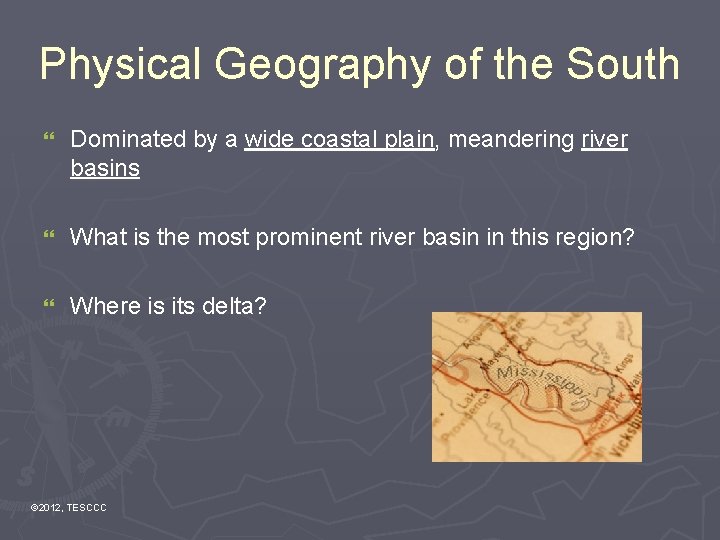
Physical Geography of the South } Dominated by a wide coastal plain, meandering river basins } What is the most prominent river basin in this region? } Where is its delta? © 2012, TESCCC
Climate and Vegetation of the South } Humid subtropical, with hot, humid summers and long growing season. Winters are mild, seldom with snow. There is no dry season. } Vegetation: Mixed forests. The South is known for plants such as live oaks, magnolia trees, flowering dogwoods. © 2012, TESCCC
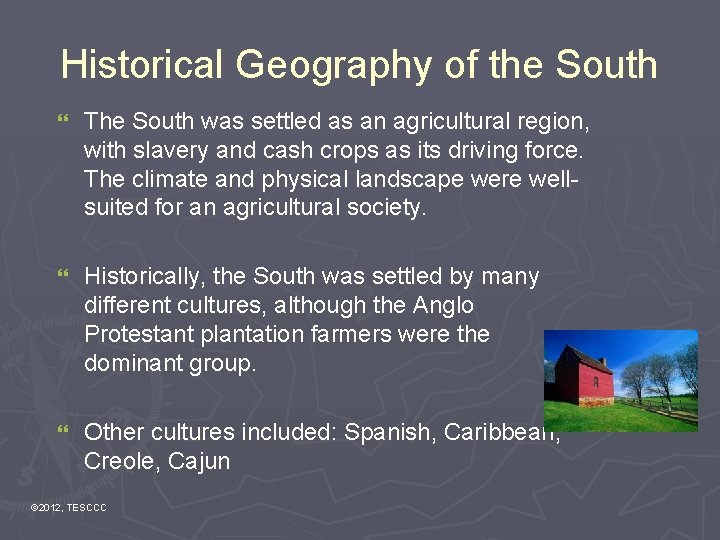
Historical Geography of the South } The South was settled as an agricultural region, with slavery and cash crops as its driving force. The climate and physical landscape were wellsuited for an agricultural society. } Historically, the South was settled by many different cultures, although the Anglo Protestant plantation farmers were the dominant group. } Other cultures included: Spanish, Caribbean, Creole, Cajun © 2012, TESCCC
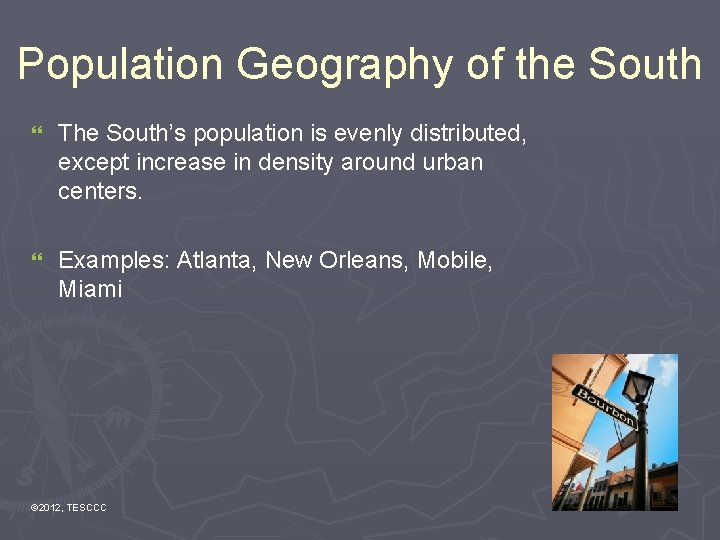
Population Geography of the South } The South’s population is evenly distributed, except increase in density around urban centers. } Examples: Atlanta, New Orleans, Mobile, Miami © 2012, TESCCC
Economic Geography of the South } Historically based on agriculture, with tobacco and cotton being the first cash crops. } Although agriculture has dominated the economy, service industry, manufacturing, and high tech industries are also located in the South. } Fishing is a common activity in Gulf Coast States. } Tourism along the Gulf Coast, especially Florida. Oil Industry is located in the Gulf and in cities like Houston and Beaumont, close to continental shelf drilling. © 2012, TESCCC }
Cultural Geography of the South } } } Deep South Appalachians Gulf Coast region Florida Cajun South and East Texas © 2012, TESCCC
Music of the South } The South is the origin all types of music: § Rhythm and Blues § Jazz § Bluegrass § Appalachian Folk Music § Gospel § Country music § Rock n Roll (Elvis/Memphis) © 2012, TESCCC
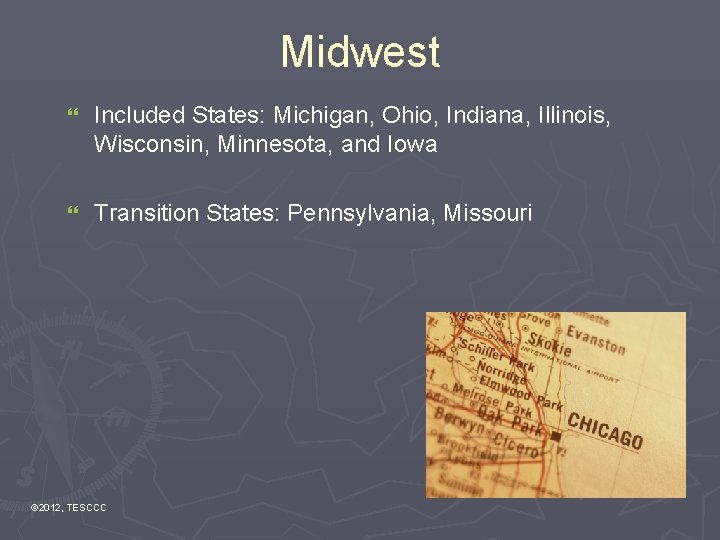
Midwest } Included States: Michigan, Ohio, Indiana, Illinois, Wisconsin, Minnesota, and Iowa } Transition States: Pennsylvania, Missouri © 2012, TESCCC
Physical Geography of Midwest § Flat landscape, with river basins. § Distinctive Great Lakes, which provide for shipping. © 2012, © 2010, TESCCC
Climate of the Midwest: Humid Continental } No Dry Season- this area receives precipitation throughout the year. } Cold, snowy winters and hot summers. } Moderate growing season that decreases as you go north. } Vegetation is mixed forests with deciduous and coniferous trees. © 2012, TESCCC
Historical Geography of the Midwest The Mid-west was considered the “Western Frontier”, hence the name. } Historically known as the breadbasket of the U. S. , as this is also an agricultural region. } Also known as a manufacturing, blue-collar hub of the U. S. } © 2012, TESCCC
The Midwest as a Cultural Crossroads } Immigrant groups: § Scots Presbyterians settled in Pennsylvania. § Dutch Amish and Quakers settled in Ohio and Indiana. § German Lutherans settled in Ohio, Wisconsin, Illinois and Eastern Missouri. § Swedes and Norwegians settled in Wisconsin and Minnesota. § Polish, Hungarians, German Catholics, and Jews settled in Midwestern cities. © 2012, TESCCC
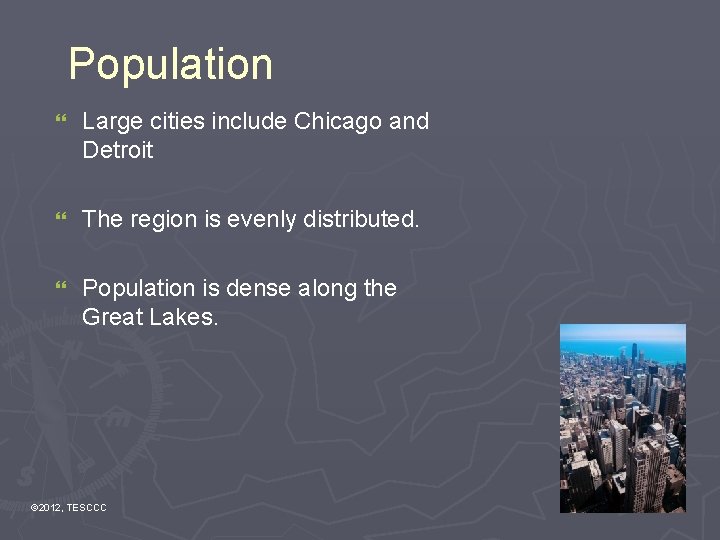
Population } Large cities include Chicago and Detroit } The region is evenly distributed. } Population is dense along the Great Lakes. © 2012, TESCCC
Economic Geography } Dairy Farming in Wisconsin and Minnesota } Fruit Orchards in Michigan } Corn in Indiana, Illinois, and Iowa } Manufacturing in urban cities along Great Lakes, like Pittsburgh, Cleveland, Detroit and Chicago (Steel Towns). © 2012, TESCCC
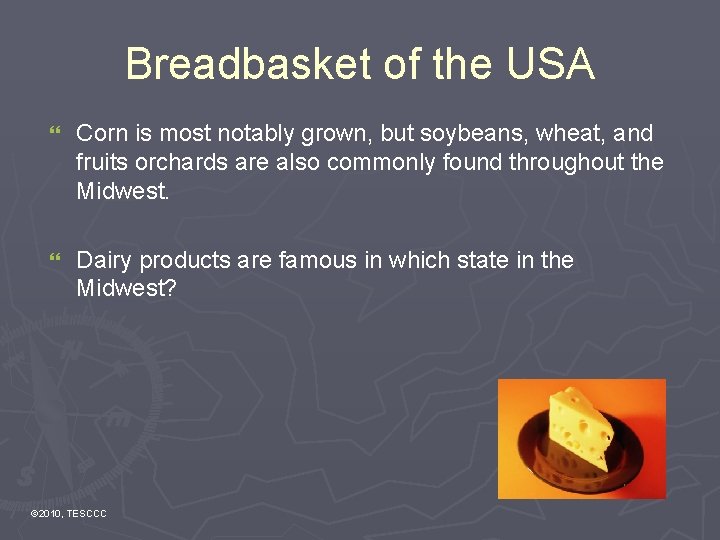
Breadbasket of the USA } Corn is most notably grown, but soybeans, wheat, and fruits orchards are also commonly found throughout the Midwest. } Dairy products are famous in which state in the Midwest? © 2010, TESCCC
Cultural Geography } Home to various immigrant groups, which causes ethnic, racial, and religious diversity in the cities. } Cuisine reflects the cultural and physical diversity: Chicago style pizza, Polish bakeries, Wisconsin cheese, and Michigan’s apple cider mills and fruit orchards. © 2012, TESCCC
Great Plains Region } Strip of States through the center of the country } Includes: Kansas, Nebraska, South Dakota, and North Dakota } Transition States: Oklahoma, Panhandle of Texas, Eastern Colorado, Wyoming and Montana © 2012, TESCCC
Physical Geography of the Great Plains Ø The Great Plains are also called the High Plains, as the elevation increases gradually as you go west. Ø Generally flat with some rolling hills Ø Major River Basins: Red R. , Arkansas River, Platte River, and the Missouri River © 2012, TESCCC
Climate of the Great Plains } Generally the Great Plains is Steppe climate (Grasslands). Some of the eastern areas have Humid Continental climate. } This area receives little rainfall (less than 18 in. a year on average). } Cold winters, especially in the northern areas. © 2012, TESCCC
Historical Geography of the Great Plains Before Americans settled the frontier, the Great Plains was home to several indigenous cultures, most notably the Sioux, the Cheyenne, and the Arapaho. } During the 19 th century, the Great Plains became the staging point of war between the native people and the American settlers. } © 2012, TESCCC
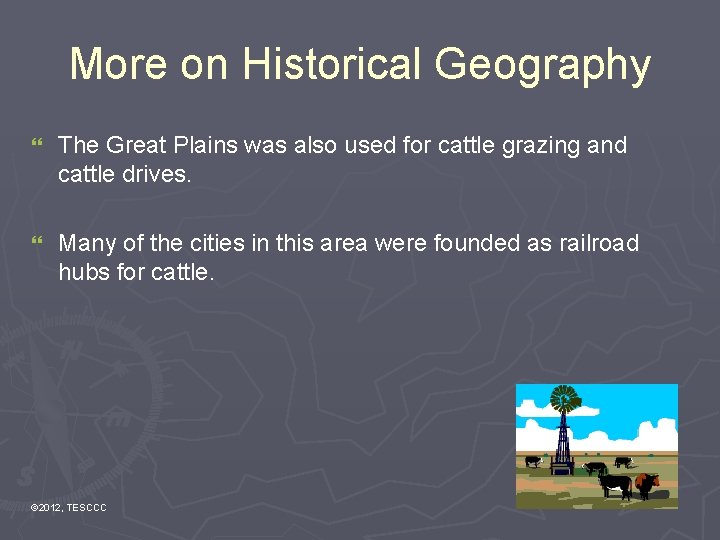
More on Historical Geography } The Great Plains was also used for cattle grazing and cattle drives. } Many of the cities in this area were founded as railroad hubs for cattle. © 2012, TESCCC
Homestead Act of 1862 } This act provided each settler with 160 acres of land, as long as he cultivated the land. } This caused a rush of settlers to the Great Plains region in the 1800 s. } Ironically, the Great Plains has lost a third of its population since 1920. Kansas has 6, 000 ghost towns. © 2012, TESCCC
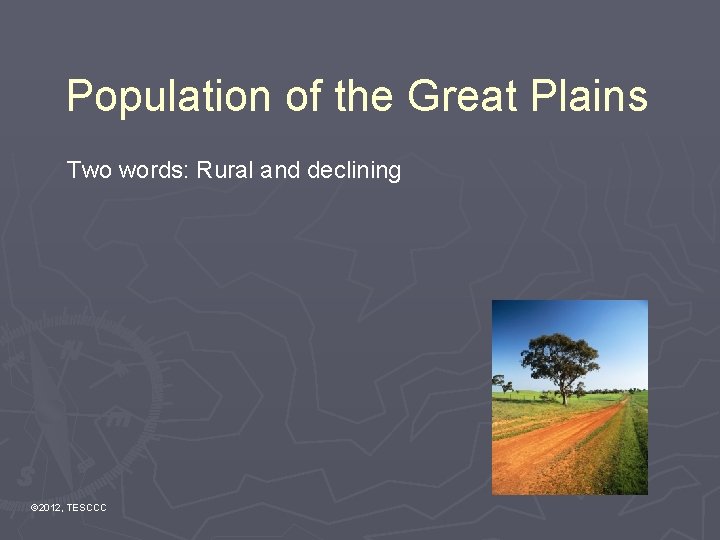
Population of the Great Plains Two words: Rural and declining © 2012, TESCCC
Economic Activity } Wheat – another important crop (the Dakotas) § spring wheat major crop in the north § winter wheat (Kansas) § Associated with wheat are sorghums, barley, and livestock production } Cattle are also a primary economic activity in the Great Plains. © 2012, TESCCC
Ogallala (High Plains) Aquifer } Because there is little rainfall, farmers use the aquifers to irrigate crops. The Ogallala is one of the largest in the U. S. , but it is being depleted at a high rate. } The Aquifer runs from the Texas Panhandle to Nebraska. Almost the entire state of Nebraska lies on top of the Aquifer. © 2012, TESCCC
Mountain and Basin States } States included: New Mexico, Colorado, Wyoming, Montana, Idaho, Utah, Nevada, Arizona } Transitions: Colorado, Wyoming and Montana are also Great Plains States. } Southwest: Texas, New Mexico, Arizona, Southern Utah/Nevada © 2012, TESCCC
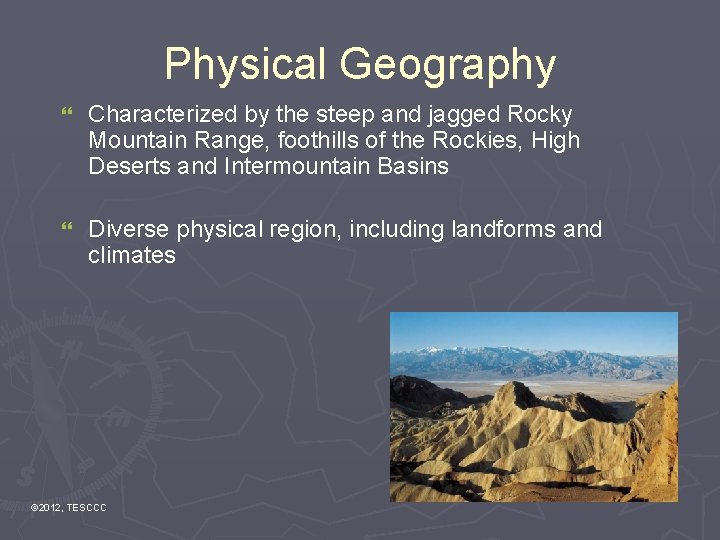
Physical Geography } Characterized by the steep and jagged Rocky Mountain Range, foothills of the Rockies, High Deserts and Intermountain Basins } Diverse physical region, including landforms and climates © 2012, TESCCC
Climates } Highland climate is found throughout the Rockies. } Desert and Steppe are found in the Southwest and Basin area. } In general, the area is arid. Farming is done with irrigation. © 2012, TESCCC
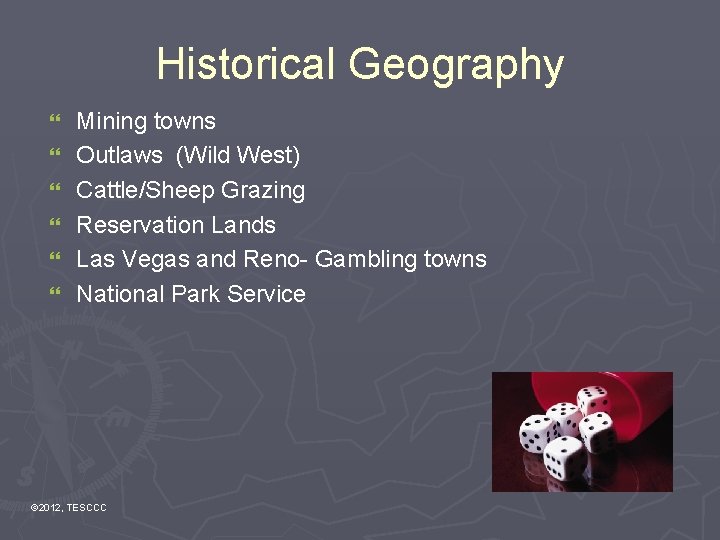
Historical Geography } } } Mining towns Outlaws (Wild West) Cattle/Sheep Grazing Reservation Lands Las Vegas and Reno- Gambling towns National Park Service © 2012, TESCCC
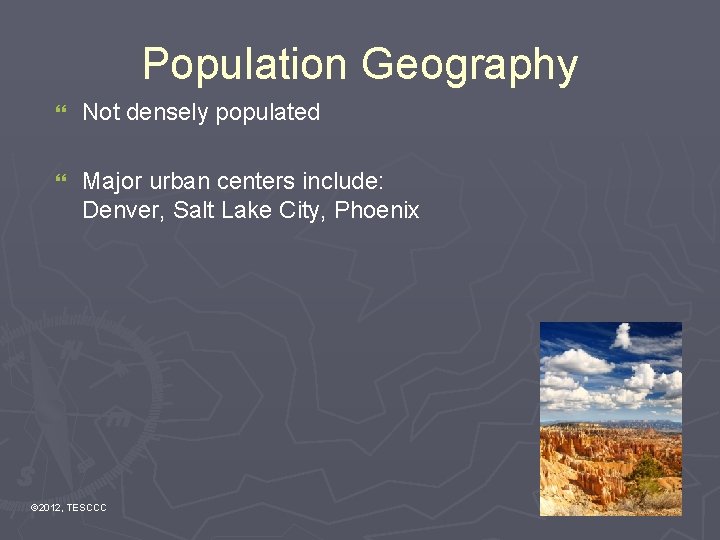
Population Geography } Not densely populated } Major urban centers include: Denver, Salt Lake City, Phoenix © 2012, TESCCC
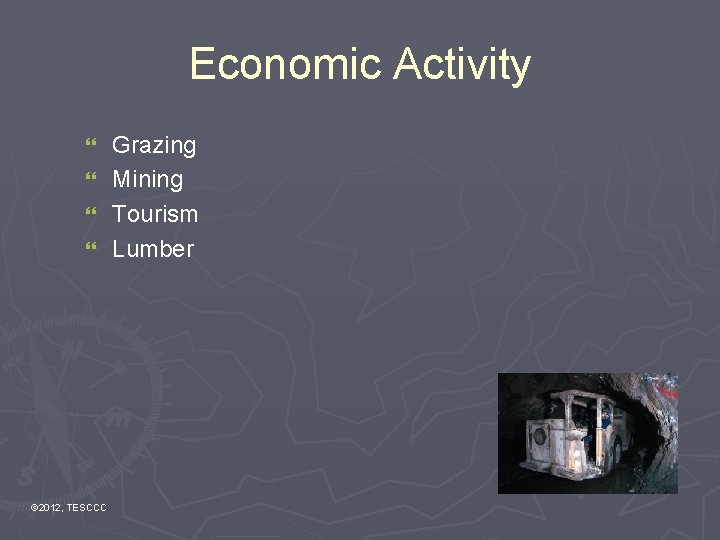
Economic Activity } } © 2012, TESCCC Grazing Mining Tourism Lumber
Cultural Heritage of the West } Old Mining ghost towns exemplify the culture of the mountain states. When mining diminished, tourism took over. } Mountain towns are known for their transient population, seasonal employment, and influx of tourists. } Likewise, the Basin states are home to the largest number of National Parks. © 2012, TESCCC
Pacific Coast States } California, Oregon and Washington } Alaska and Hawaii will be covered separately. © 2012, TESCCC
Physical Geography of West Coast } Mountain Ranges (Sierra Nevada and the Cascades) and Rocky coastlines due to Subduction forces } Fertile valleys (San Joaquin) and forests in northern areas that receive more rainfall } Physical hazard exist across the region due to tectonic forces. © 2012, TESCCC
Southern California } The continual presence of natural hazards, including fire, flood, earthquakes, and intense drought, has done little to reduce the growth of this area. } San Andreas Fault } Los Angeles is the 2 nd largest city in the U. S. © 2012, TESCCC
Climates of the West Coast } Mediterranean in Southern California } Deserts and Steppe in California } Highland Climate in Sierra Nevadas and Cascades } Marine West Coast in North California, Oregon and Washington } Windward and leeward slopes of mountains are crucial in this area: populations tend to settle on windward (moisture laden) side of mountains and become less dense on leeward side. © 2012, TESCCC
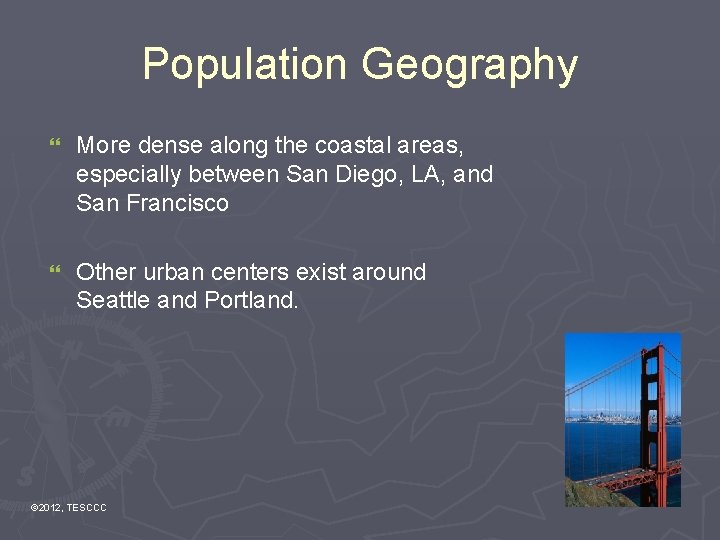
Population Geography } More dense along the coastal areas, especially between San Diego, LA, and San Francisco } Other urban centers exist around Seattle and Portland. © 2012, TESCCC
Development in Southern California } Began to grow significantly when water was brought from the distant Owens Valley to Los Angeles early in the 20 th century } As water from the Colorado River Project was also made available to cities in the southwest & in southern California, growth accelerated } Presently, about one-seventh of the United States population lives in southern California. © 2012, TESCCC
Economic Activity } } } Hi-tech Industry Movie Industry Farming in the San Joaquin Valley Wine (Napa and Sonoma) Tourism Fishing on the coast © 2012, TESCCC