
World Geography Today Chapter 26 The Indian Perimeter

- Slides: 20
World Geography Today Chapter 26 The Indian Perimeter Preview Section 1: Natural Environments Section 2: History and Culture Section 3: The Region Today Chapter Wrap-Up
World Geography Today Chapter 26 Section 1: Natural Environments Read to Discover • What are the main physical features of the Indian Perimeter? • What types of climates, plants, and animals are found there? • What natural resources do countries in the region have?
World Geography Today Chapter 26 Section 1: Natural Environments Physical Features • Pakistan—Northern mountains (Himalayas, Karakoram, Hindu Kush), hills and plateaus, Indus Valley, Thar Desert • Nepal and Bhutan—Himalayas, Tarai (Gangetic Plain in Nepal) • Bangladesh—Alluvial plain and delta • Sri Lanka—Coastal plain and mountainous center • Maldives—Low coral islands
World Geography Today Chapter 26 Section 1: Natural Environments Question What climates, plants, and animals exist around the Indian Perimeter?
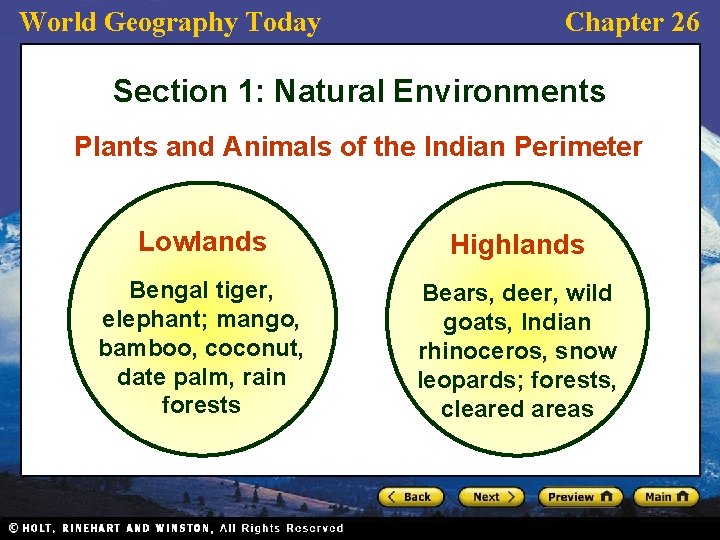
World Geography Today Chapter 26 Section 1: Natural Environments Plants and Animals of the Indian Perimeter Lowlands Highlands Bengal tiger, elephant; mango, bamboo, coconut, date palm, rain forests Bears, deer, wild goats, Indian rhinoceros, snow leopards; forests, cleared areas
World Geography Today Chapter 26 Section 1: Natural Environments Climates • From arid and semiarid to tropical humid and highland • Monsoon—Wet season affects all countries; promotes lush forests and varied wildlife (tigers, elephants) in Bangladesh and lowland Bhutan and Nepal • Tropical cyclones in Bay of Bengal • Pakistan—Mainly arid and semiarid, with humid subtropical in mountain foothills • Highland areas of Pakistan, Nepal, and Bhutan—Highland climates, with some forests and wildlife (bears, deer, snow leopards, wild goats)
World Geography Today Chapter 26 Section 1: Natural Environments Natural Resources • Generally not rich in resources; Pakistan and Sri Lanka have the most minerals • Pakistan—Iron, copper, limestone, natural gas • Sri Lanka—Gemstones, iron, salt • Bangladesh—Some oil, coal, natural gas; rivers and soil • Nepal and Bhutan—Forests, hydroelectric potential
World Geography Today Chapter 26 Section 2: History and Culture Read to Discover • What is the history of the countries of the Indian Perimeter? • What are some characteristics of the region’s cultures?
World Geography Today Chapter 26 Section 2: History and Culture History • Harappan civilization emerged in Indus Valley. • By 1500 B. C. Aryans had arrived. • Persians, Greeks, and Indians (Maurya, Gupta) occupied parts of the region. • Turkic Muslims brought Islam around A. D. 1000. • Mughals ruled from 1500 s to 1700 s. • Europeans colonized the region after 1500.
World Geography Today Chapter 26 Section 2: History and Culture History (continued) • Partition at independence (1947) divided India from East and West Pakistan; East Pakistan became Bangladesh (1971). • Other independence dates: Sri Lanka (1948), Maldives (1965), Bhutan (1949) • Nepal set up constitutional monarchy in 1950 s.
World Geography Today Chapter 26 Section 2: History and Culture Question What ethnic groups, languages, and religions are prevalent in the countries of the Indian Perimeter?
World Geography Today Chapter 26 Section 2: History and Cultures • Pakistan—Regions are culturally distinct, but all are Muslim; Urdu the official language • Nepal—Indian ancestry and cultural ties in the south; Tibetan in the north • Bhutan—Three groups (Bhote, Nepalese, tribal peoples); English widely used in schools • Bangladesh—Mainly Bengalis, some southwest Asians
World Geography Today Chapter 26 Section 2: History and Cultures (continued) • Sri Lanka—Majority Sinhalese and minority Tamils in conflict • Three major religions—Buddhism and Hinduism in Nepal, Bhutan, and Sri Lanka; Islam in Pakistan, Bangladesh, and Maldives • Religious practice very important—Muslim prayers in Pakistan, Buddhist festivals in Sri Lanka
World Geography Today Chapter 26 Section 3: The Region Today Read to Discover • What is the basis of the economies of the Indian Perimeter? • What are settlement patterns like in the region? • What challenges will these countries face in the future?
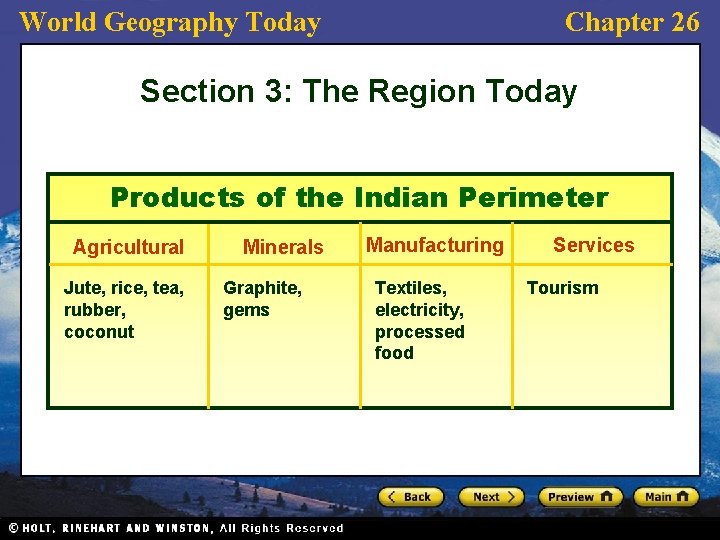
World Geography Today Chapter 26 Section 3: The Region Today Question What products do the countries of the Indian Perimeter produce?
World Geography Today Chapter 26 Section 3: The Region Today Products of the Indian Perimeter Agricultural Jute, rice, tea, rubber, coconut Minerals Graphite, gems Manufacturing Textiles, electricity, processed food Services Tourism
World Geography Today Chapter 26 Section 3: The Region Today Economic Foundations • Heavy reliance on agriculture; industrialization limited by scarce resources • Pakistan—Some manufacturing; nearly half of labor force works in agriculture • Bangladesh—Farming, textiles and clothing, fishing, logging, construction • Sri Lanka—Export crops (tea, rubber, coconut), mining (gemstones, graphite), manufacturing (food products, textiles) • Nepal and Bhutan—Farming, timber, tourism, some hydroelectric generation
World Geography Today Chapter 26 Section 3: The Region Today Settlement Patterns • Mainly rural, though some growing cities • Pakistan—One-third urban, concentrated in Indus Valley • Nepal and Bhutan—Low population density, but higher in lowlands and valleys • Bangladesh and Sri Lanka—Mostly rural and densely populated • Villages in fertile farming areas close together
World Geography Today Chapter 26 Section 3: The Region Today Challenges • Typical developing country issues—Poverty, health conditions, population growth • Environment—Deforestation, effects of tourism, flooding, and concerns about global warming • Political problems—Kashmir issue, military coups in Pakistan, Sri Lanka conflict • Establishing democratic government and sharing wealth more equally in society
World Geography Today Chapter 26 Chapter Wrap-Up Understanding the Main Ideas 1. Which countries of the Indian Perimeter include parts of the Himalayas? Which include parts of the plain of the Ganges River? 2. Where did Bhutan’s largest ethnic group, the Bhote, come from? 3. On what basis did the British divide their colony of India upon independence in 1947? 4. What are the major industries of Bangladesh? 5. What is the greatest potential energy resource of Nepal and Bhutan?