
World Geography 3202 Unit 1 Major Landforms and

- Slides: 46
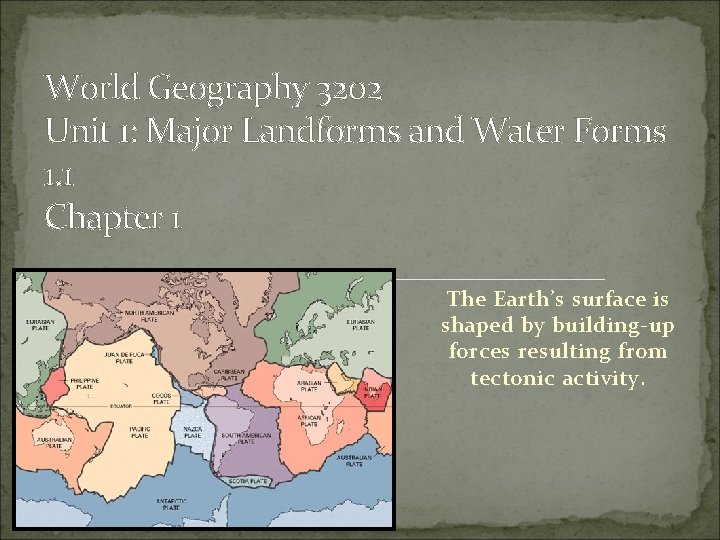
World Geography 3202 Unit 1: Major Landforms and Water Forms 1. 1 Chapter 1 The Earth’s surface is shaped by building-up forces resulting from tectonic activity.
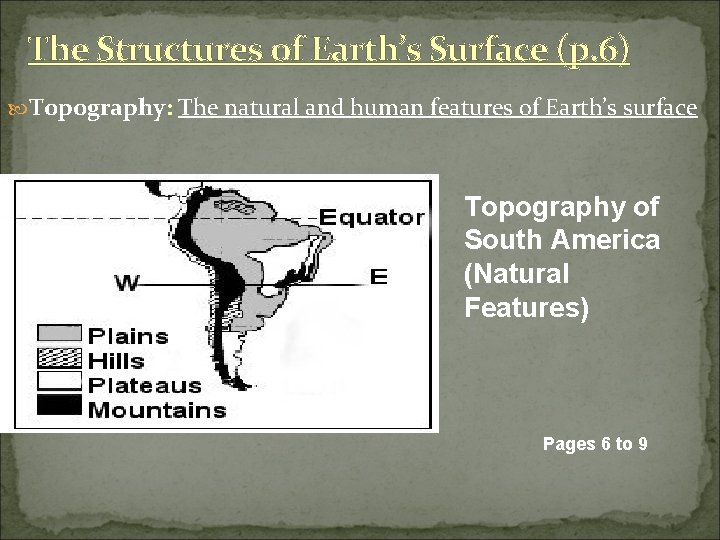
The Structures of Earth’s Surface (p. 6) Topography: The natural and human features of Earth’s surface Topography of South America (Natural Features) Pages 6 to 9
NATURAL FEATURES Elevation = Height above sea level. Relief = Areas where the elevation changes (i. e. valleys versus hills). Hills areas of upward relief less than 600 meters. Mountains areas of upward relief greater than 600 meters. Plains areas of flat land with very little relief. Found at low elevations (e. g. , along coasts, center of continents). Plateaus areas of flat land with very little relief. Found at high elevations and are associated with mountains.
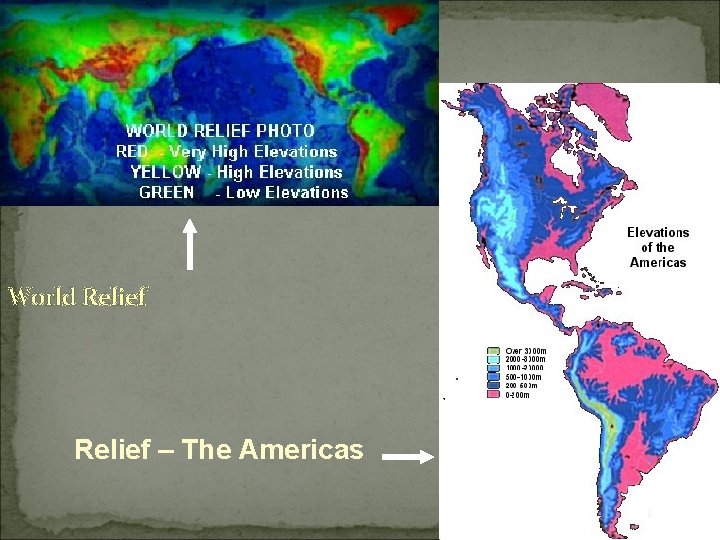
World Relief – The Americas
Landform Patterns 1. Most mountains (high elevations) are located on the coasts of continents. 2. Large mountain ranges exist on the west coasts of N. A. and S. A. 3. Major mountain ranges coincide with plate tectonic boundaries.
http: //ees. as. uky. edu/sites/default/files/elearning/module 04 swf. swf
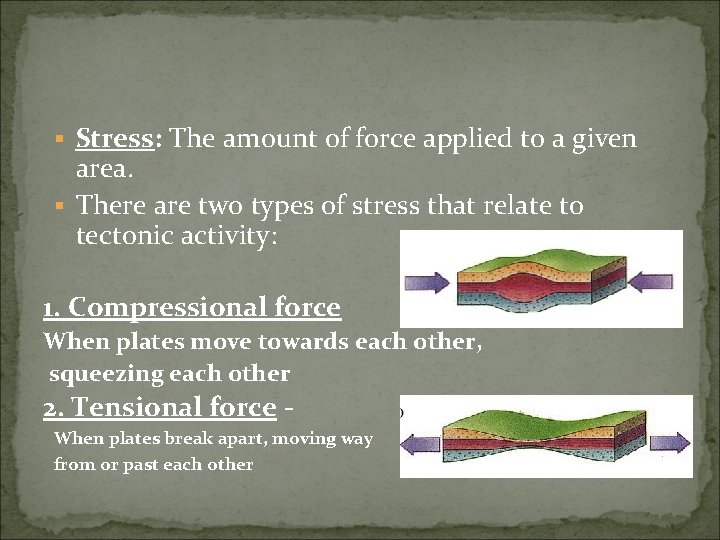
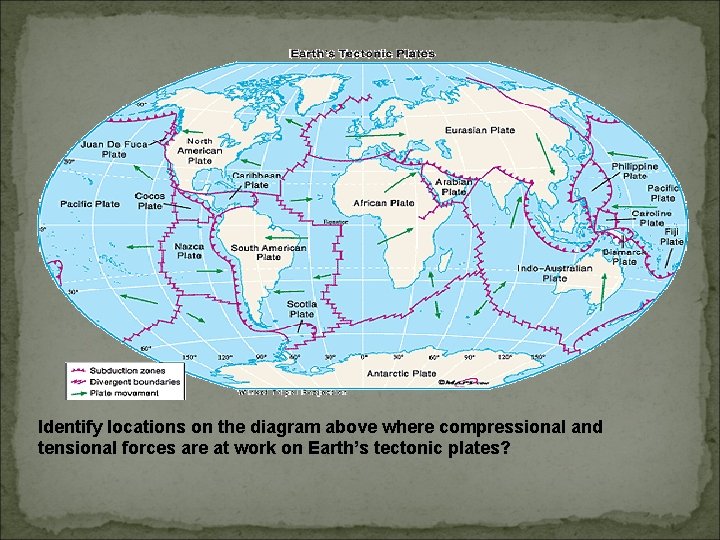
Stress: The amount of force applied to a given area. There are two types of stress that relate to tectonic activity: 1. Compressional force When plates move towards each other, squeezing each other 2. Tensional force When plates break apart, moving way from or past each other
Identify locations on the diagram above where compressional and tensional forces are at work on Earth’s tectonic plates?
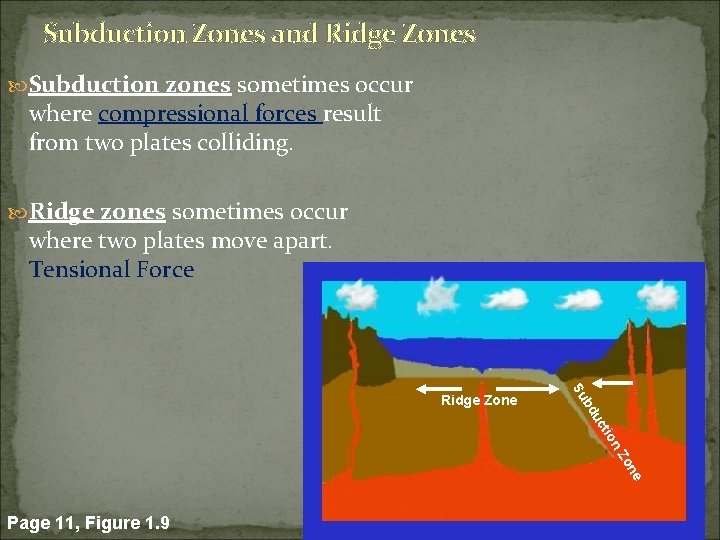
Subduction Zones and Ridge Zones Subduction zones sometimes occur where compressional forces result from two plates colliding. Ridge zones sometimes occur where two plates move apart. Tensional Force tio uc bd Su Ridge Zone n. Z e on Page 11, Figure 1. 9
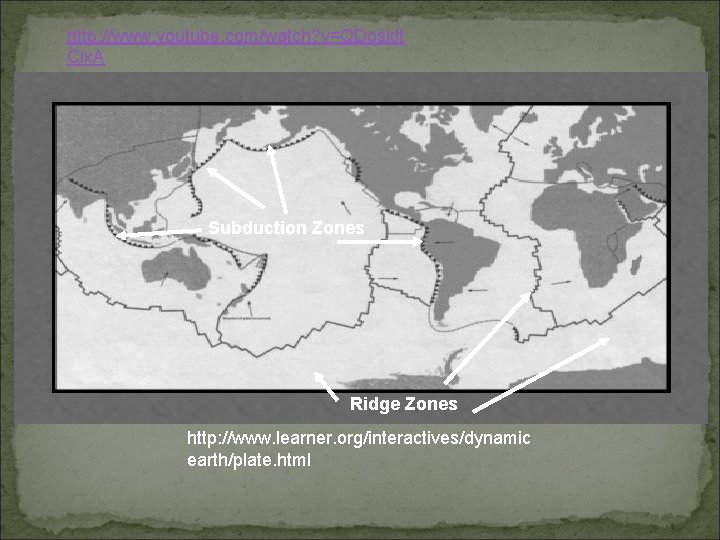
http: //www. youtube. com/watch? v=QDqsklt Cix. A Subduction Zones Ridge Zones http: //www. learner. org/interactives/dynamic earth/plate. html
Mountain Building Three types of Mountains Fold Mountains Fault Mountains Volcanic Mountains http: //ees. as. uky. edu/sites/default/files/elearning/module 04 swf. swf
Fold Mountains
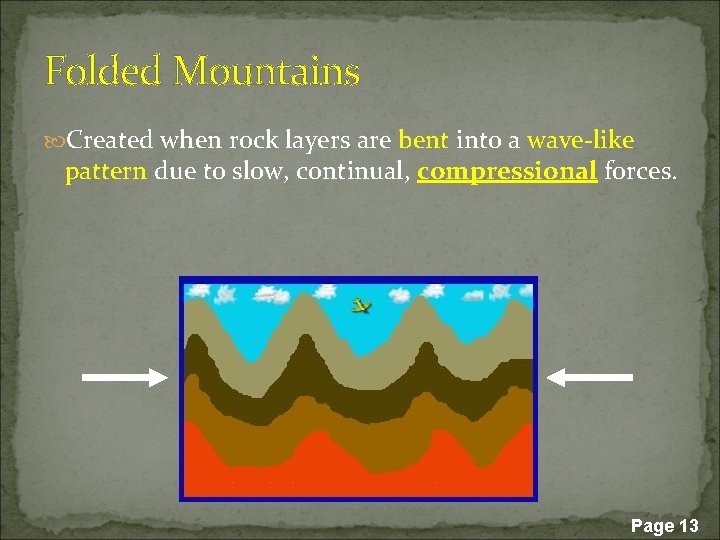
Folded Mountains Created when rock layers are bent into a wave-like pattern due to slow, continual, compressional forces. Page 13
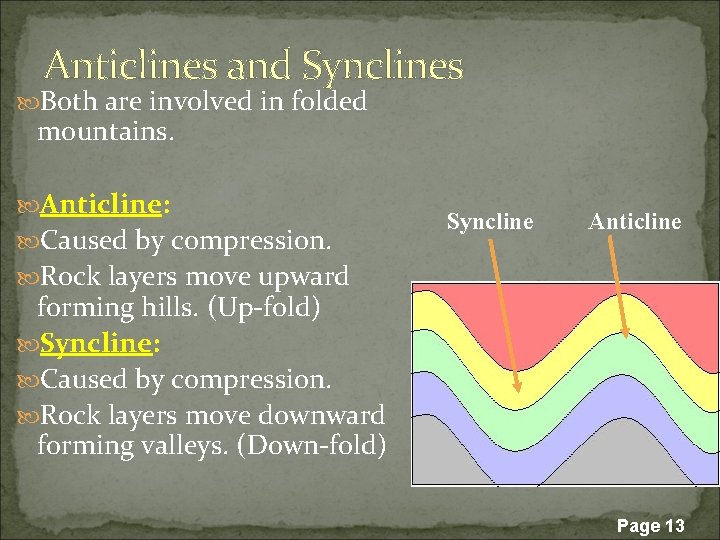
Anticlines and Synclines Both are involved in folded mountains. Anticline: Caused by compression. Rock layers move upward Syncline Anticline forming hills. (Up-fold) Syncline: Caused by compression. Rock layers move downward forming valleys. (Down-fold) Page 13
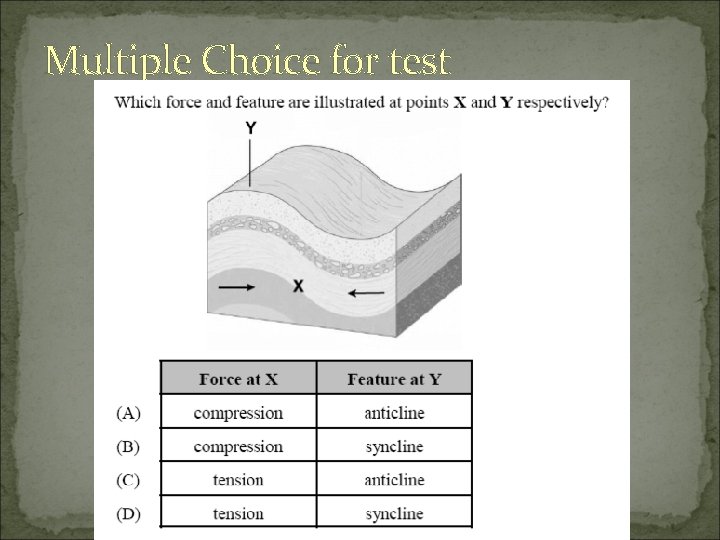
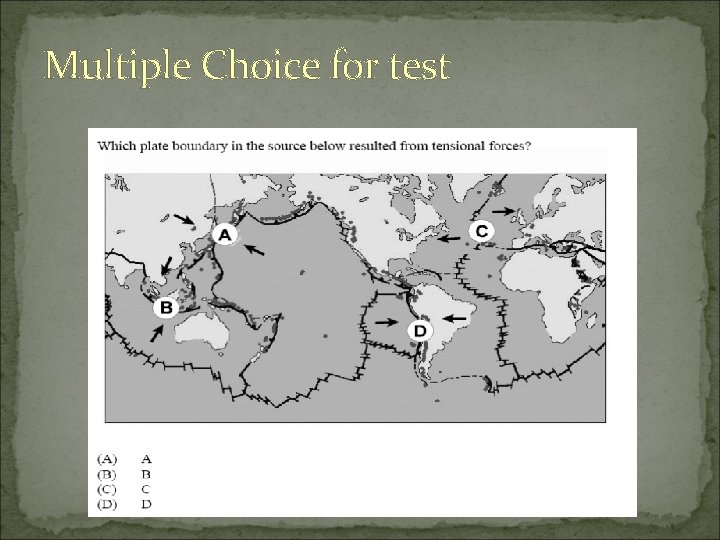
Multiple Choice for test
Multiple Choice for test
Fault Mountains
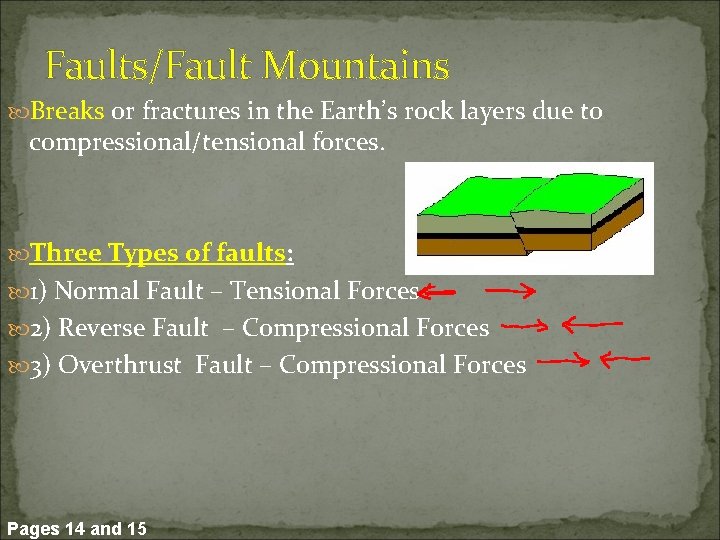
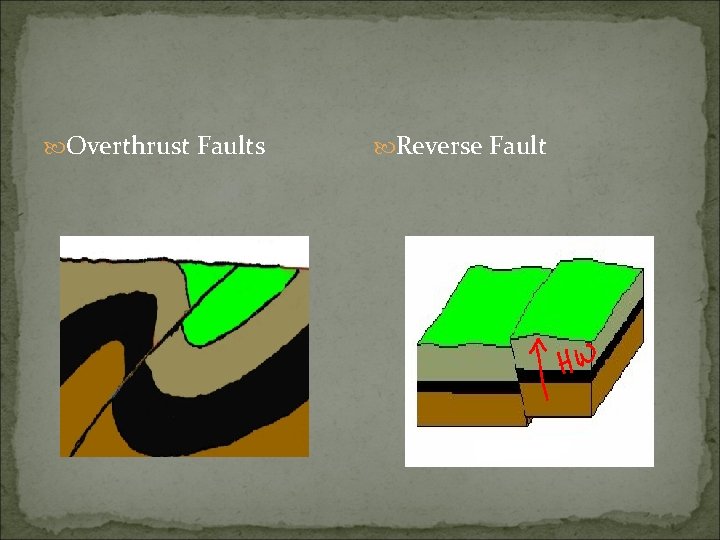
Faults/Fault Mountains Breaks or fractures in the Earth’s rock layers due to compressional/tensional forces. Three Types of faults: 1) Normal Fault – Tensional Forces 2) Reverse Fault – Compressional Forces 3) Overthrust Fault – Compressional Forces Pages 14 and 15
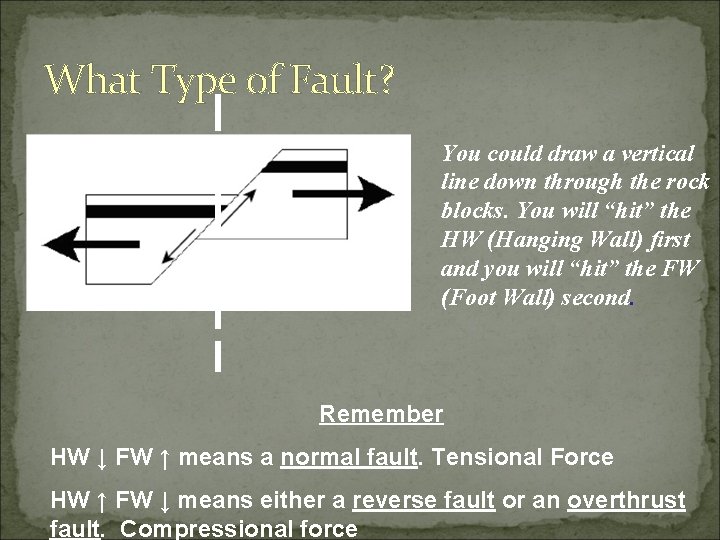
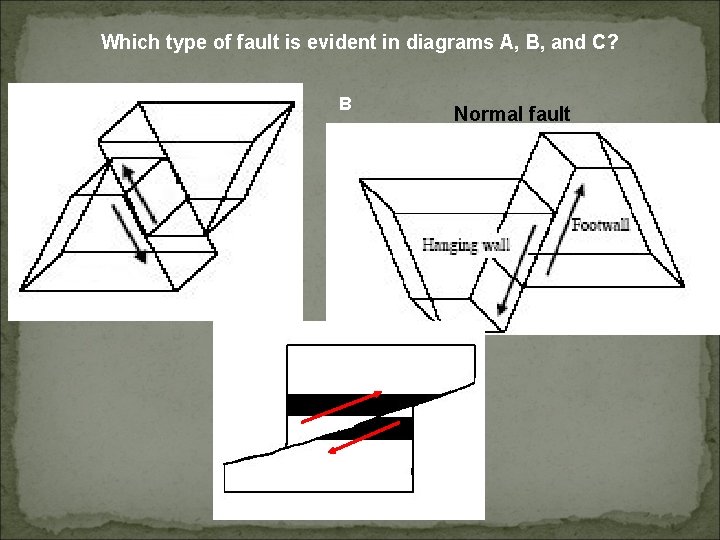
What Type of Fault? FW HW You could draw a vertical line down through the rock blocks. You will “hit” the HW (Hanging Wall) first and you will “hit” the FW (Foot Wall) second. Remember HW ↓ FW ↑ means a normal fault. Tensional Force HW ↑ FW ↓ means either a reverse fault or an overthrust fault. Compressional force
Which type of fault is evident in diagrams A, B, and C? A Hanging Wall B Foot Wall C Hanging Wall Foot Wall Normal fault
Overthrust Faults Reverse Fault
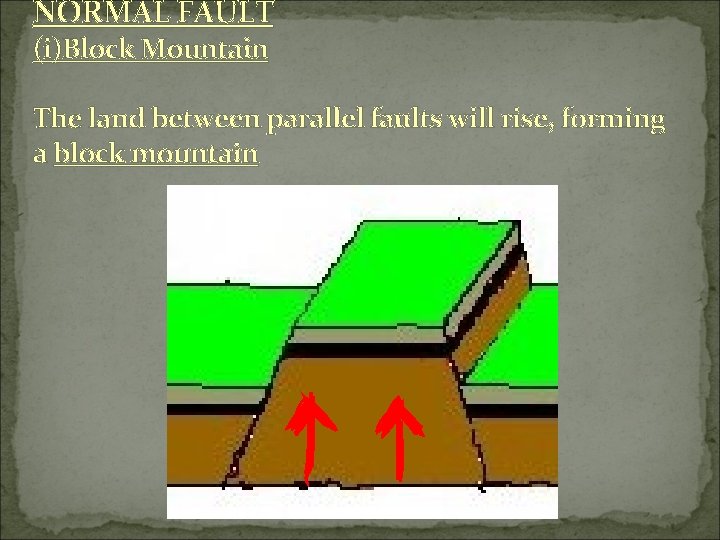
NORMAL FAULT (i)Block Mountain The land between parallel faults will rise, forming a block mountain
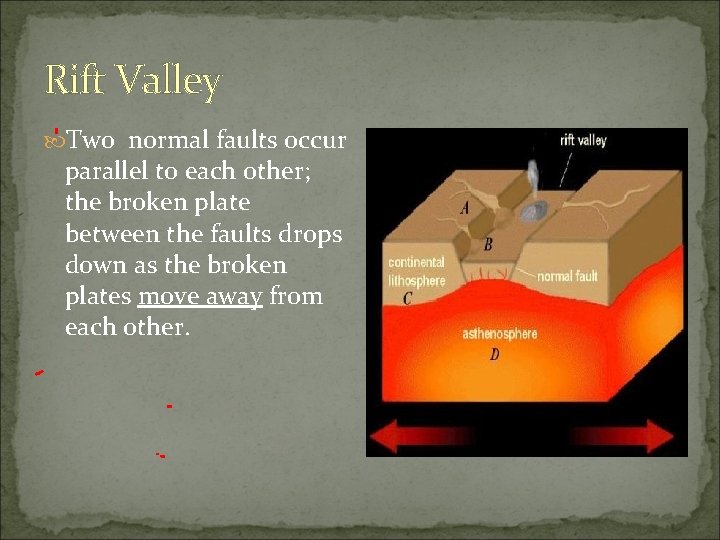
Rift Valley Two normal faults occur parallel to each other; the broken plate between the faults drops down as the broken plates move away from each other.
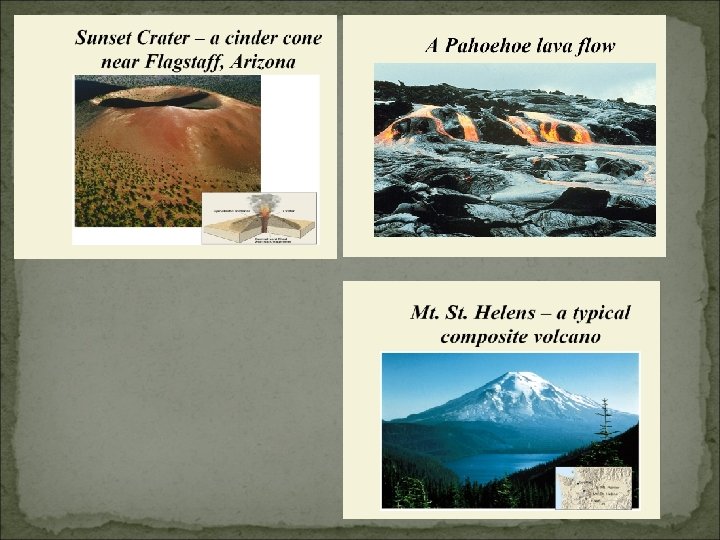
Volcanic Mountains Mt. St. Helen’s http: //www. youtube. com/watch? v=Fn. DT_6 V 4 q. Vw&safety_mode=true&safe=active&persist_safety_mode=1
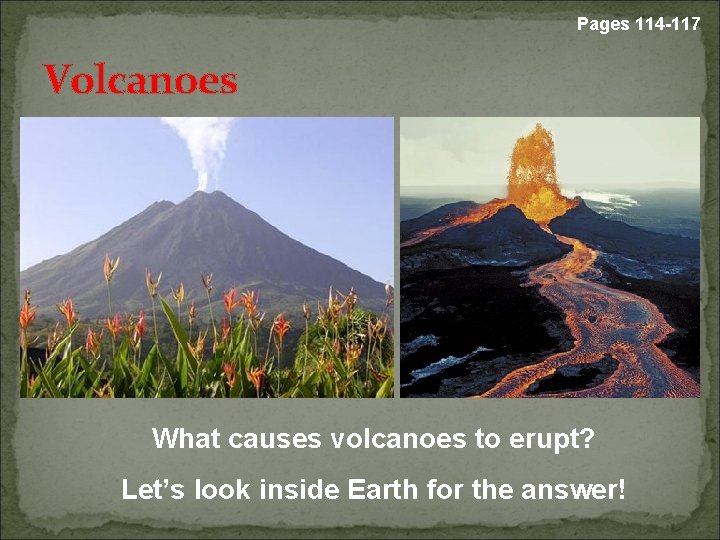
Pages 114 -117 Volcanoes What causes volcanoes to erupt? Let’s look inside Earth for the answer!
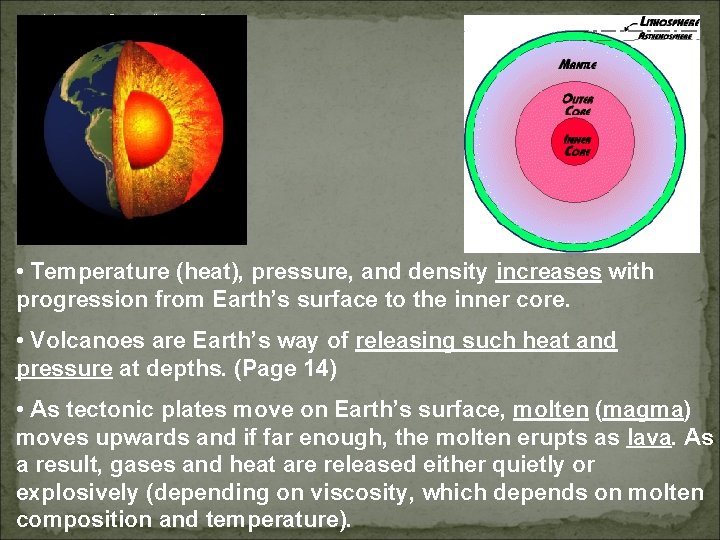
Inside Earth • Temperature (heat), pressure, and density increases with progression from Earth’s surface to the inner core. • Volcanoes are Earth’s way of releasing such heat and pressure at depths. (Page 14) • As tectonic plates move on Earth’s surface, molten (magma) moves upwards and if far enough, the molten erupts as lava. As a result, gases and heat are released either quietly or explosively (depending on viscosity, which depends on molten composition and temperature).
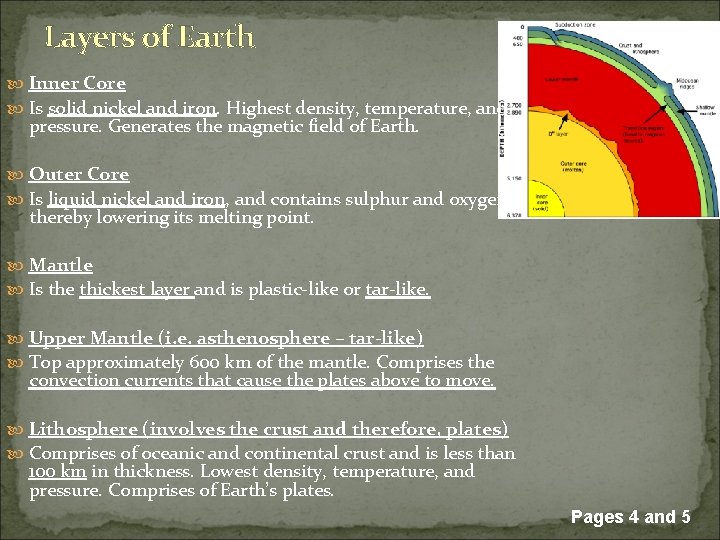
Layers of Earth Inner Core Is solid nickel and iron. Highest density, temperature, and pressure. Generates the magnetic field of Earth. Outer Core Is liquid nickel and iron, and contains sulphur and oxygen, thereby lowering its melting point. Mantle Is the thickest layer and is plastic-like or tar-like. Upper Mantle (i. e. asthenosphere – tar-like) Top approximately 600 km of the mantle. Comprises the convection currents that cause the plates above to move. Lithosphere (involves the crust and therefore, plates) Comprises of oceanic and continental crust and is less than 100 km in thickness. Lowest density, temperature, and pressure. Comprises of Earth’s plates. Pages 4 and 5
Terminology Volcano: An opening in the Earth’s crust through which magma, gases, and ash erupt. Magma: Molten or melted rock found below Earth’s crust. When magma cools to a solid it forms igneous rocks. Lava: magma that flows at the Earth’s surface. Ash : Small pieces of lava that are blasted into the air during volcanic eruptions. Vent: The opening through which the volcanic material flows.
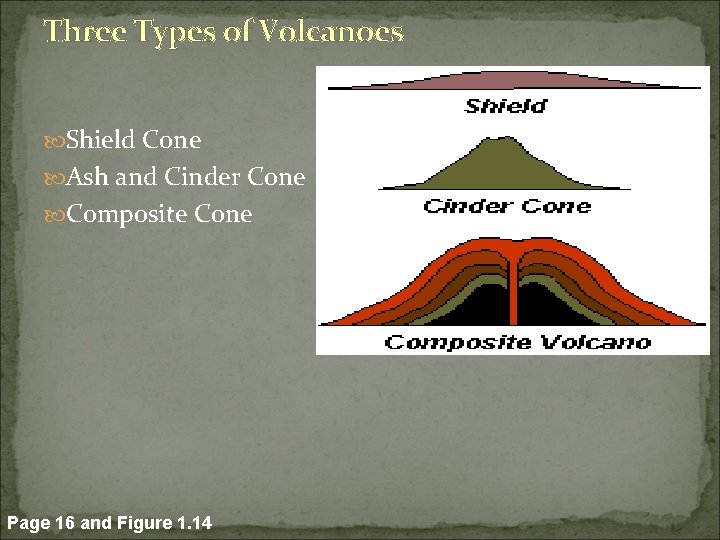
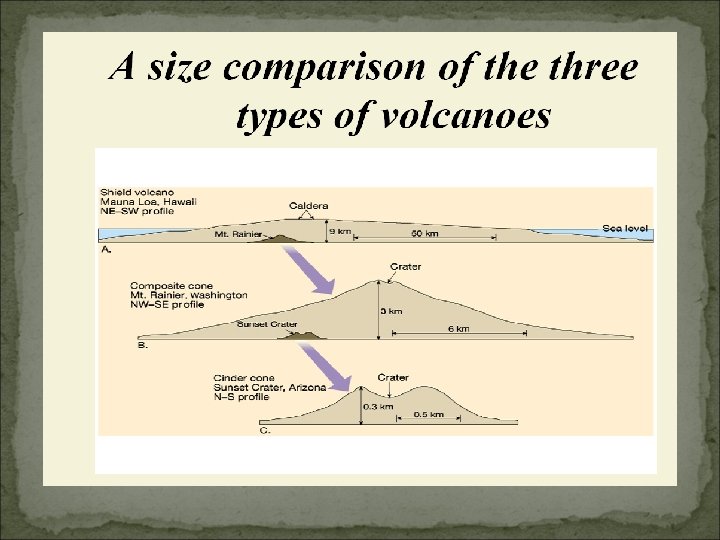
Three Types of Volcanoes Shield Cone Ash and Cinder Cone Composite Cone Page 16 and Figure 1. 14
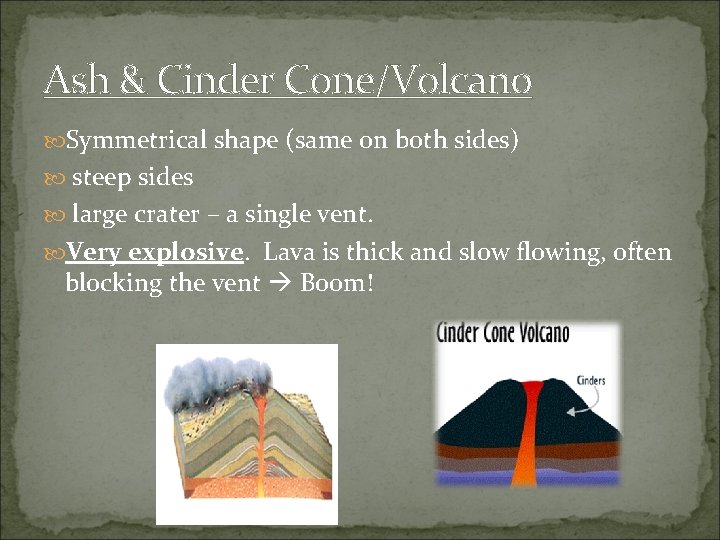
Ash & Cinder Cone/Volcano Symmetrical shape (same on both sides) steep sides large crater – a single vent. Very explosive. Lava is thick and slow flowing, often blocking the vent Boom!
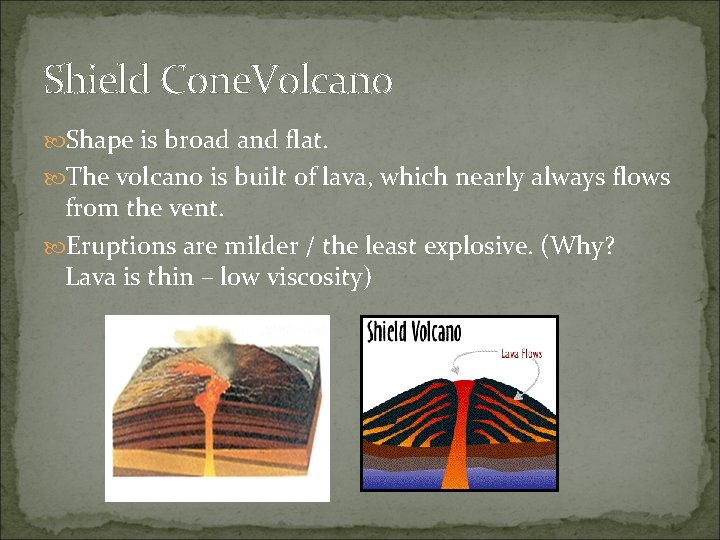
Shield Cone. Volcano Shape is broad and flat. The volcano is built of lava, which nearly always flows from the vent. Eruptions are milder / the least explosive. (Why? Lava is thin – low viscosity)
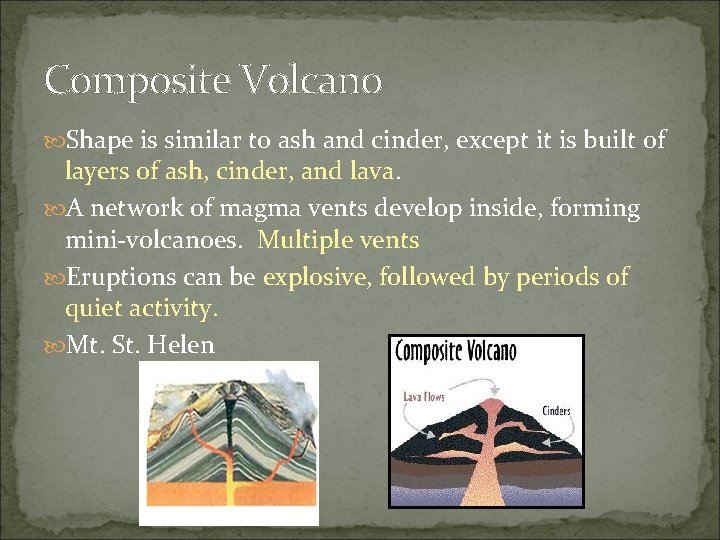
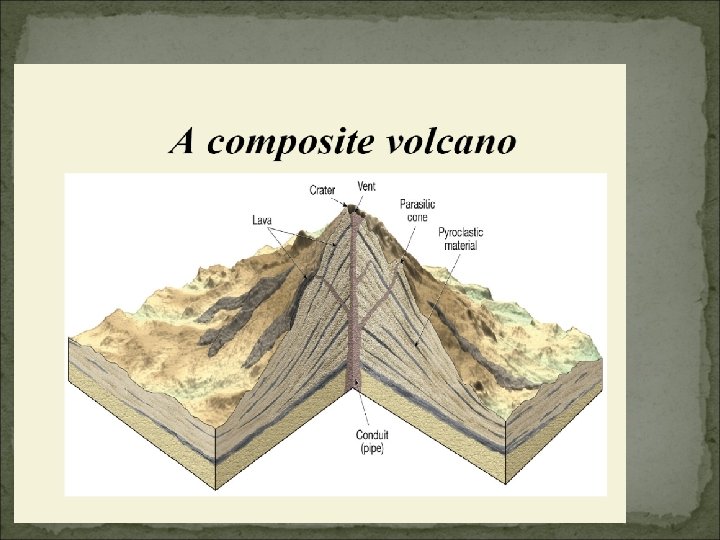
Composite Volcano Shape is similar to ash and cinder, except it is built of layers of ash, cinder, and lava. A network of magma vents develop inside, forming mini-volcanoes. Multiple vents Eruptions can be explosive, followed by periods of quiet activity. Mt. St. Helen
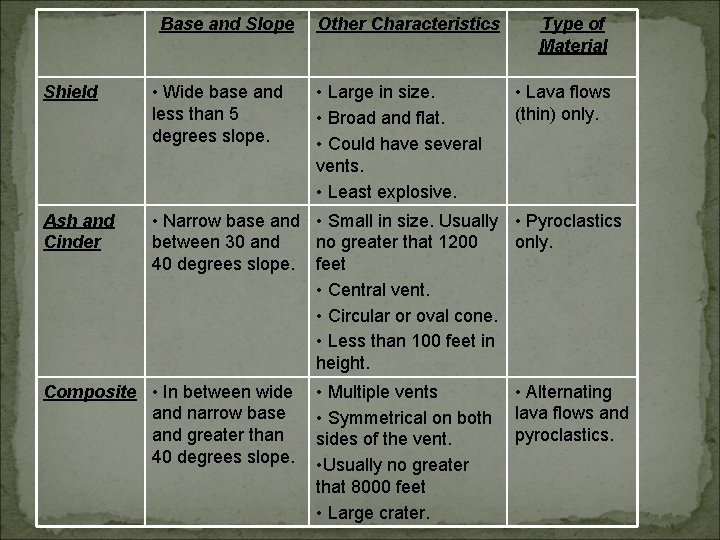
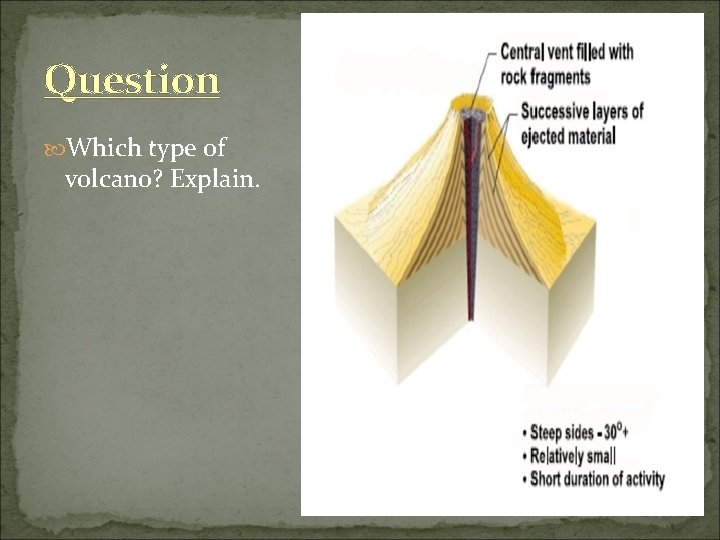
Base and Slope Other Characteristics Shield • Wide base and less than 5 degrees slope. Ash and Cinder • Narrow base and • Small in size. Usually • Pyroclastics between 30 and no greater that 1200 only. 40 degrees slope. feet • Central vent. • Circular or oval cone. • Less than 100 feet in height. Composite • In between wide and narrow base and greater than 40 degrees slope. • Large in size. • Broad and flat. • Could have several vents. • Least explosive. Type of Material • Multiple vents • Symmetrical on both sides of the vent. • Usually no greater that 8000 feet • Large crater. • Lava flows (thin) only. • Alternating lava flows and pyroclastics.
Question Which type of volcano? Explain.
Volcanoes: Review Which type of volcano is most explosive? Ash & Cinder Which type of volcano is least explosive? Shield Which type of volcano is explosive at times and slow flowing lava at times? Composite
Volcanoes: Review Which type of volcano has the thickest lava? Ash & Cinder Which type of volcano has the thinnest, most liquid lava? Shield Which type of volcano often has side vents? Composite Which type of volcano has the gentlest slope? Shield
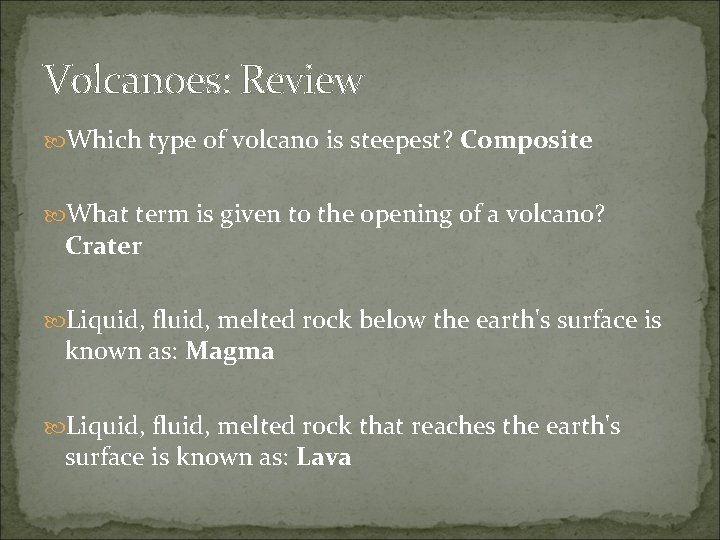
Volcanoes: Review Which type of volcano is steepest? Composite What term is given to the opening of a volcano? Crater Liquid, fluid, melted rock below the earth's surface is known as: Magma Liquid, fluid, melted rock that reaches the earth's surface is known as: Lava
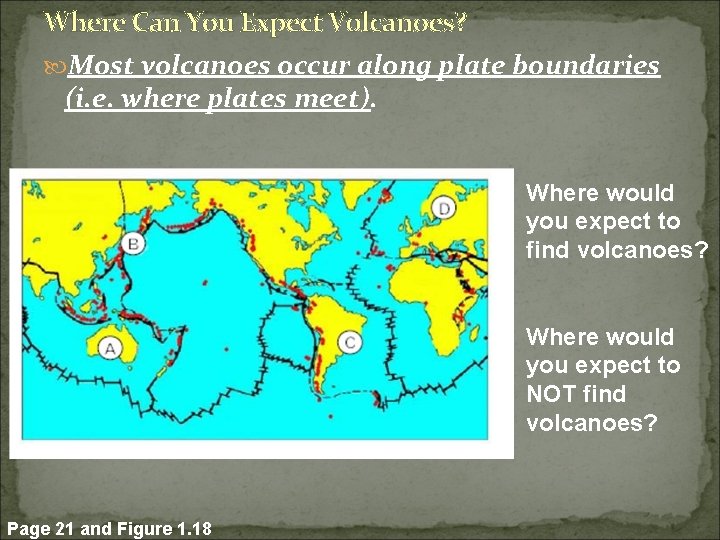
Where Can You Expect Volcanoes? Most volcanoes occur along plate boundaries (i. e. where plates meet). Where would you expect to find volcanoes? Where would you expect to NOT find volcanoes? Page 21 and Figure 1. 18
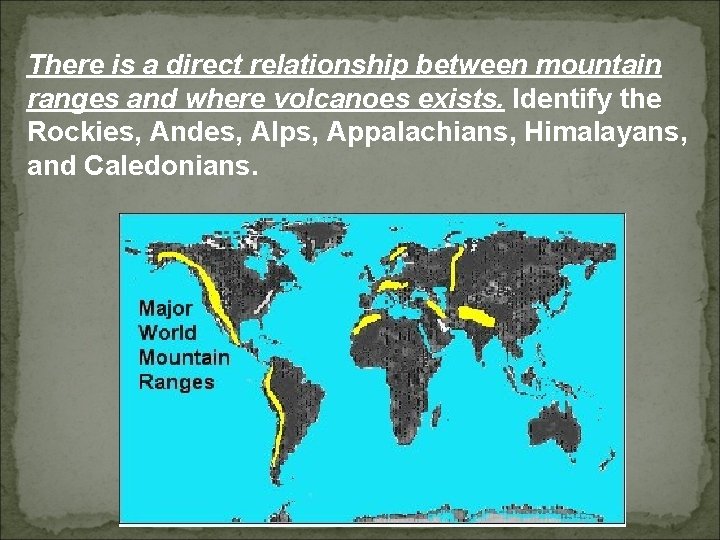
There is a direct relationship between mountain ranges and where volcanoes exists. Identify the Rockies, Andes, Alps, Appalachians, Himalayans, and Caledonians.
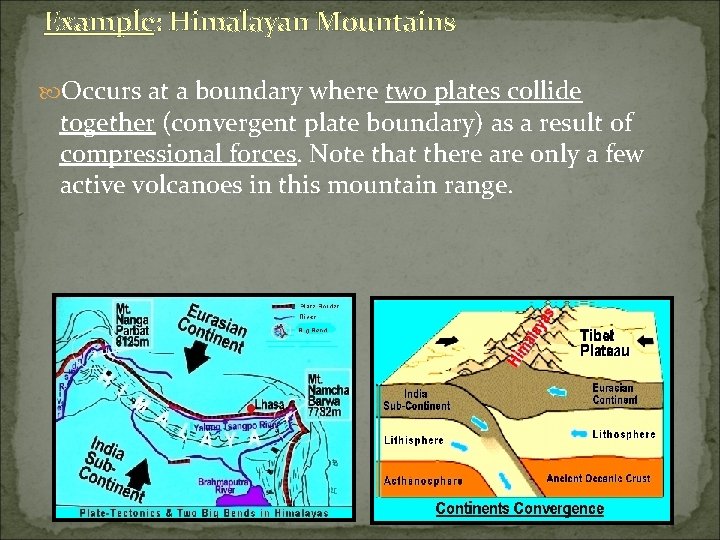
Example: Himalayan Mountains Occurs at a boundary where two plates collide together (convergent plate boundary) as a result of compressional forces. Note that there are only a few active volcanoes in this mountain range.
Homework On a blank map of the world and using an Internet Search Engine, locate the mountain ranges listed in Question 16 (a on Pages 16 and 17. Answer Question 16 (b as well. Also, locate the volcanic eruptions listed in Question 17 (a on Page 17.
Mt. St. Helen’s http: //www. youtube. com/watch? v=Fn. DT_6 V 4 q. Vw&safety_mode=true&safe=active&persist_safety_mod e=1