
WORLD CONTINUOUS AUDITING REPORTING SYMPOSIUM Update on the
- Slides: 13
WORLD CONTINUOUS AUDITING & REPORTING SYMPOSIUM Update on the Rutgers AICPA Data Analytics Research Initiative BRIAN MILLER, CPA, CFE NATIONAL PARTNER – AUDIT TRANSFORMATION & INNOVATION
AUDIT DATA ANALYTICS & THE PROFESSION Audit Data Analytics: ". . . the science and art of discovering and analyzing patterns, identifying anomalies, and extracting other useful information in data underlying or related to the subject matter of an audit through analysis, modeling, and visualization for the purpose of planning or performing the audit. ” – AICPA Guide to Audit Data Analytics, December 2017
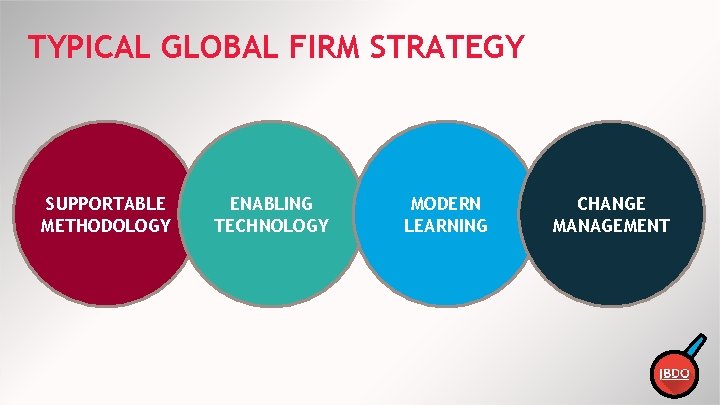
TYPICAL GLOBAL FIRM STRATEGY SUPPORTABLE METHODOLOGY ENABLING TECHNOLOGY MODERN LEARNING CHANGE MANAGEMENT
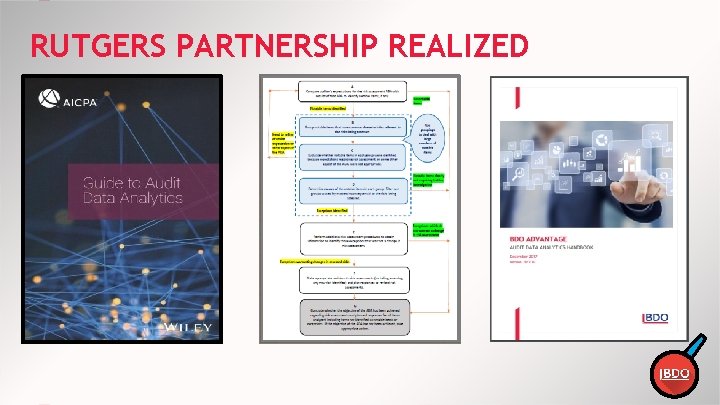
RUTGERS PARTNERSHIP REALIZED
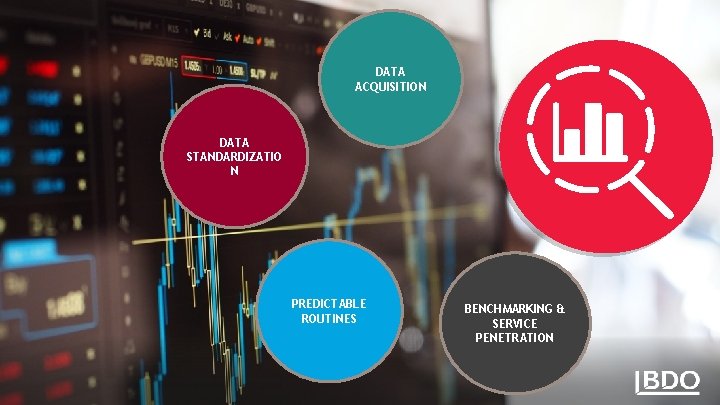
DATA ACQUISITION DATA STANDARDIZATIO N PREDICTABLE ROUTINES 5 INNOVATING THE AUDIT EXPERIENCE BENCHMARKING & SERVICE PENETRATION
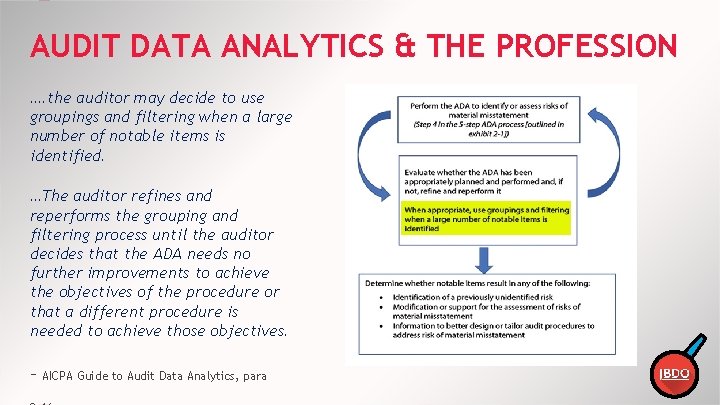
AUDIT DATA ANALYTICS & THE PROFESSION …. the auditor may decide to use groupings and filtering when a large number of notable items is identified. …The auditor refines and reperforms the grouping and filtering process until the auditor decides that the ADA needs no further improvements to achieve the objectives of the procedure or that a different procedure is needed to achieve those objectives. – AICPA Guide to Audit Data Analytics, para
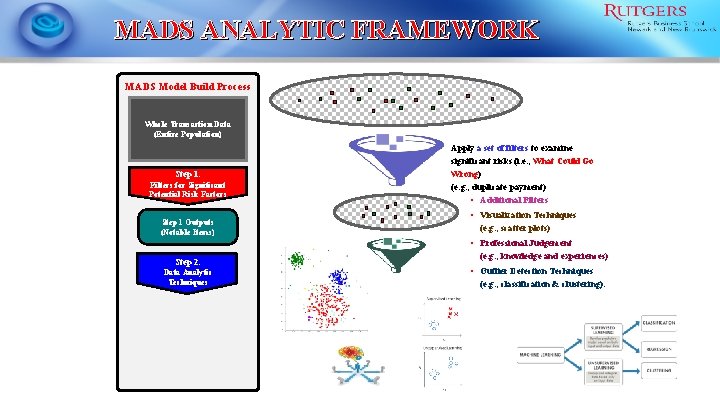
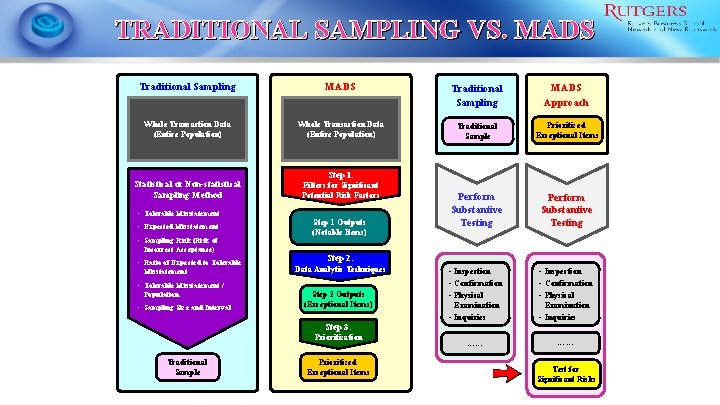
MADS ANALYTIC FRAMEWORK MADS Model Build Process Whole Transaction Data (Entire Population) Step 1: Filters for Significant Potential Risk Factors Step 1 Outputs (Notable Items) Apply a set of filters to examine significant risks (i. e. , What Could Go Wrong) (e. g. , duplicate payment) • Additional Filters • Visualization Techniques (e. g. , scatter plots) • Professional Judgement Step 2: Data Analytic Techniques (e. g. , knowledge and experiences) • Outlier Detection Techniques (e. g. , classification & clustering).
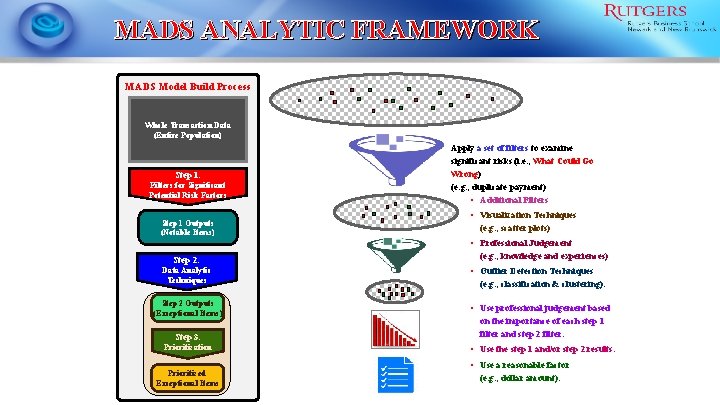
MADS ANALYTIC FRAMEWORK MADS Model Build Process Whole Transaction Data (Entire Population) Step 1: Filters for Significant Potential Risk Factors Step 1 Outputs (Notable Items) Apply a set of filters to examine significant risks (i. e. , What Could Go Wrong) (e. g. , duplicate payment) • Additional Filters • Visualization Techniques (e. g. , scatter plots) • Professional Judgement Step 2: Data Analytic Techniques Step 2 Outputs (Exceptional Items) (e. g. , knowledge and experiences) • Outlier Detection Techniques (e. g. , classification & clustering). • Use professional judgement based Step 3: on the importance of each step 1 filter and step 2 filter. Prioritization • Use the step 1 and/or step 2 results. Prioritized Exceptional Items • Use a reasonable factor (e. g. , dollar amount).
TRADITIONAL SAMPLING VS. MADS Traditional Sampling MADS Approach Whole Transaction Data (Entire Population) Traditional Sample Prioritized Exceptional Items Statistical or Non-statistical Sampling Method Filters for Significant Potential Risk Factors Perform Substantive Testing • Inspection • Confirmation • Physical Step 1: • Tolerable Misstatement • Expected Misstatement • Sampling Risk (Risk of Incorrect Acceptance) • Ratio of Expected to Tolerable Misstatement Step 1 Outputs (Notable Items) Step 2: Data Analytic Techniques • Tolerable Misstatement / Population • Sampling Size and Interval Step 2 Outputs (Exceptional Items) Examination • Inquiries Step 3: Prioritization Traditional Sample Prioritized Exceptional Items …… …… Test for Significant Risks
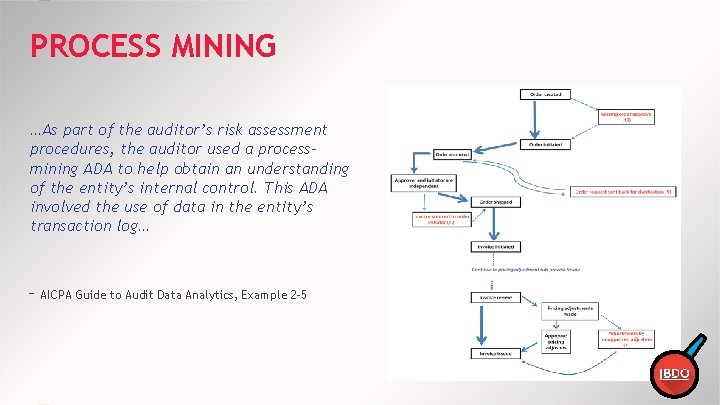
PROCESS MINING …As part of the auditor’s risk assessment procedures, the auditor used a processmining ADA to help obtain an understanding of the entity’s internal control. This ADA involved the use of data in the entity’s transaction log… – AICPA Guide to Audit Data Analytics, Example 2 -5
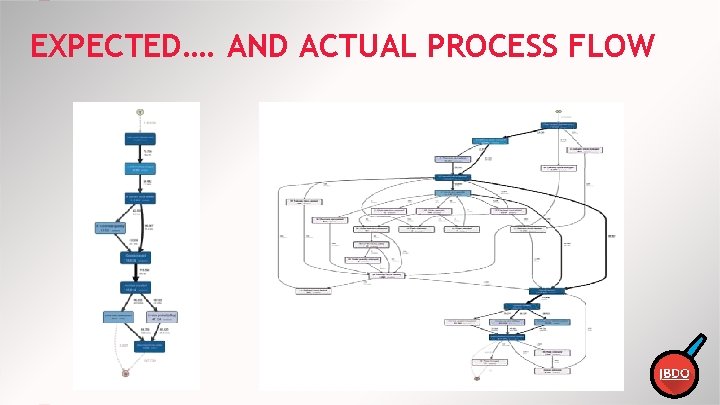
EXPECTED…. AND ACTUAL PROCESS FLOW
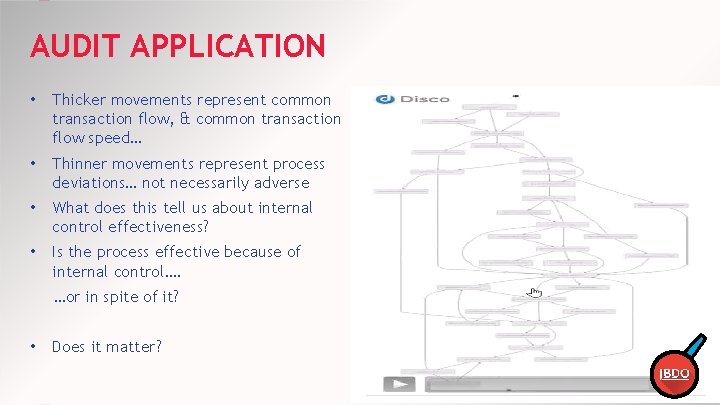
AUDIT APPLICATION • Thicker movements represent common transaction flow, & common transaction flow speed… • Thinner movements represent process deviations… not necessarily adverse • What does this tell us about internal control effectiveness? • Is the process effective because of internal control…. …or in spite of it? • Does it matter?
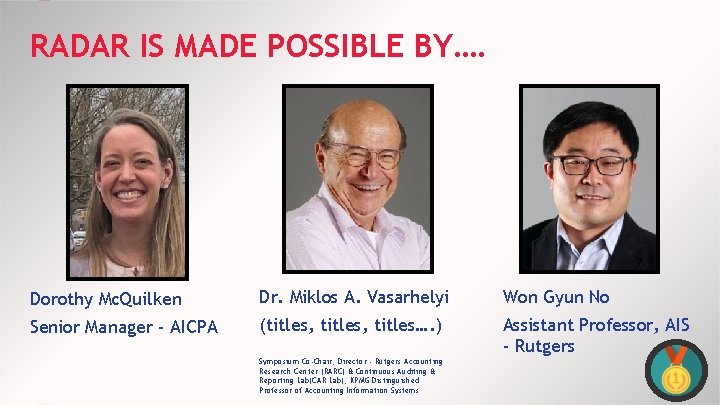
RADAR IS MADE POSSIBLE BY…. Dorothy Mc. Quilken Dr. Miklos A. Vasarhelyi Won Gyun No Senior Manager - AICPA (titles, titles…. ) Assistant Professor, AIS - Rutgers Symposium Co-Chair, Director - Rutgers Accounting Research Center (RARC) & Continuous Auditing & Reporting Lab(CAR Lab), KPMG Distinguished Professor of Accounting Information Systems