
World Biomes Biomes Biomes regions of the world
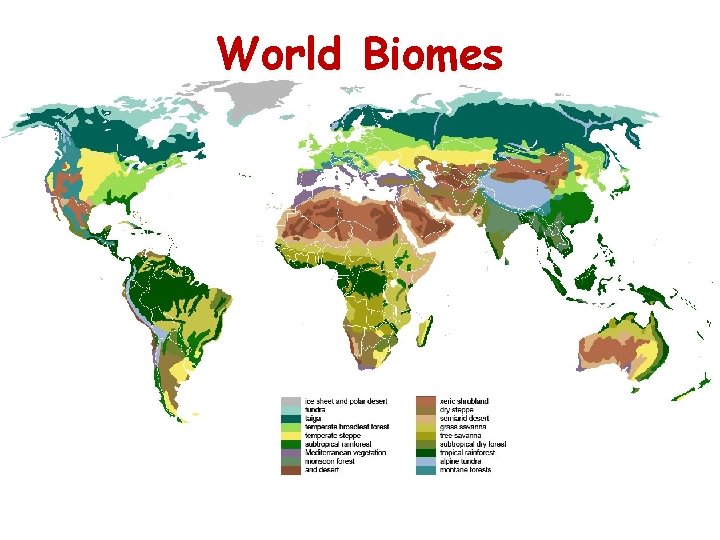
World Biomes
Biomes • Biomes – regions of the world with similar climate, animals and plants • Climate factors ØPrecipitation ØTemperature ØAltitude ØLatitude • Contain both biotic and abiotic components • Boundaries are not well-defined
Biotic and Abiotic factors • The biotic factors in an ecosystem are the living elements within that system. • The abiotic factors are nonliving things in the ecosystem. • Consider the ecosystem we live in (North Alabama). What abiotic and biotic factors can we list?
• Scientists debate on the exact number or different types of biomes in the world. • Most agree to the following types: aquatic, desert, forest, grasslands, tundra.
Six Major Biomes • Tropical Rain Forest • Grassland – Tropical Grassland – Temperate Grassland • Desert • Temperate Forest – Temperate Deciduous Forest – Temperate Rain Forest • Tundra • Taiga
Classification According to Climate Zones • Tropical: – Rainforests – Savannas (Grasslands) – Deserts • Temperate: – – Forests Grasslands Chaparrals Deserts • Polar: – Tundra – Taiga
Biomes of the Tropical Zone • Warm/Hot temperatures that stay virtually the same all year-round • 23. 5 north latitude to 23. 5 south latitude • Differ in: – Amounts of precipitation – Soil characteristics – Vegetation/plantlife – Types of animals
Tropical Rain Forests • Located near the equator; direct sunlight • Abundant rainfall year long • Greatest diversity of life; 50% of all known species on Earth • Many arboreal animals (tree dwellers) • Few terrestrial animals (on the ground) • Plenty of light at the canopy level, but little light reaches the forest floor • Above-ground roots provide extra support for trees in thin nutrient-poor soil
Tropical Savannas or Grassland • Found in tropical regions • Warm temperatures throughout the year • Well-defined dry season and rainy season • Tall grasses and a few scattered trees and shrubs • Large herbivores as well as carnivores • Grass fires are common
Tropical Deserts Identified by lack of precipitation Tropical deserts are hot Nocturnal animal life in hot deserts Desert organisms have many ways to conserve water • Succulent plants are well-adapted to the short water supply • • succulent – plants that store water
Biomes of the Temperate Zone • Deciduous Forests, Grasslands, Deserts, Chaparrals, Rainforests • Located between the Tropics and the Polar Zone • These biomes all have 4 distinct seasons • Differ in: – Temperature – Amounts of precipitation – Types of plants and animals
Temperate Deciduous Forests • Deciduous forests of mid‑latitude regions • Cold winters and hot summers • Abundant rain and snowfall • Wide variety of animal life Trees that are deciduous shed their leaves every year.
Temperate Grassland • Warm summers and cold winters • Little precipitation; falls as winter snow and spring/summer rain • Short and tall grasses; trees found only near streams • Most fertile soil of all biomes; cropland • Wide variety of animal life – Large herbivores – Smaller animals that build burrows
Chaparrals • • Temperate coastal biome Dominated by dense evergreen shrubs Rocky, nutrient-poor soil Mild, rainy winters and hot, dry summers Evergreen – a tree or shrub that has leaves year-round
Temperate Deserts • Identified by lack of precipitation; dry • Plants are well-adapted to short water supply. • Deserts can be hot or cold. – Antarctica is a cold desert • Temperate deserts tend to be hot in the daytime and cold at night. • Often receive light snow during the winter
Temperate Rain Forests • Cold winters and hot summers • Abundant rain and snowfall • Conifers (redwood, firs, pines, spruce) retain their needles. – Needles conserve water in dry summer and shed snow in cold winter • Wide variety of animal life • Animals live on the forest floor in a temperate rain forest.
Biomes of the Polar Zone • Located at or near the North and South Pole • Coldest average temperatures of all climate zones
Tundra • Vast treeless plain found near polar regions • Areas with continuously frozen ground (permafrost) • Large plants are rare since roots cannot penetrate the permafrost or absorb water/nutrients from it • Short growing season • Animals adapted to extreme cold; birds often migrate
Taiga (Boreal Forest) • Coniferous (Evergreen) Forests • Found at far northern latitudes and/or high elevations • Long and cold winters • Snow accounts for most of the precipitation • Soil poor in nutrients and very acidic • Short growing season • Animals are adapted to long, cold winters
- Slides: 19