
Workstream Initiative Summary 5 Workers Skills and Transition
- Slides: 3
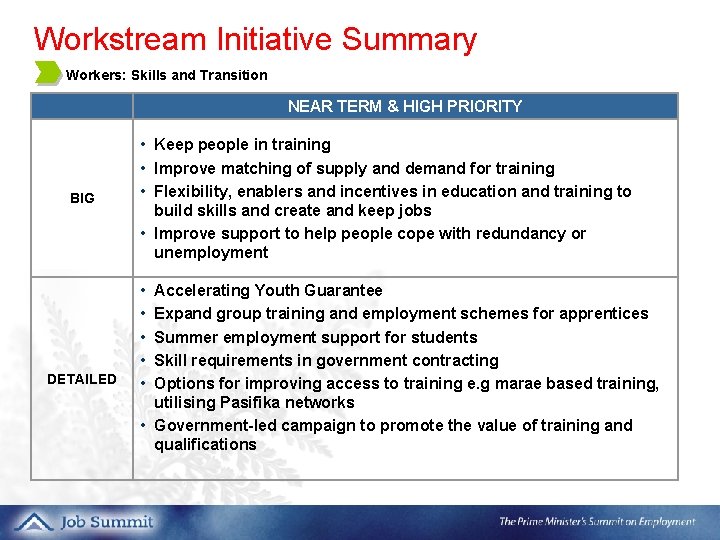
Workstream Initiative Summary 5. Workers: Skills and Transition NEAR TERM & HIGH PRIORITY BIG DETAILED • Keep people in training • Improve matching of supply and demand for training • Flexibility, enablers and incentives in education and training to build skills and create and keep jobs • Improve support to help people cope with redundancy or unemployment • • • Accelerating Youth Guarantee Expand group training and employment schemes for apprentices Summer employment support for students Skill requirements in government contracting Options for improving access to training e. g marae based training, utilising Pasifika networks • Government-led campaign to promote the value of training and qualifications
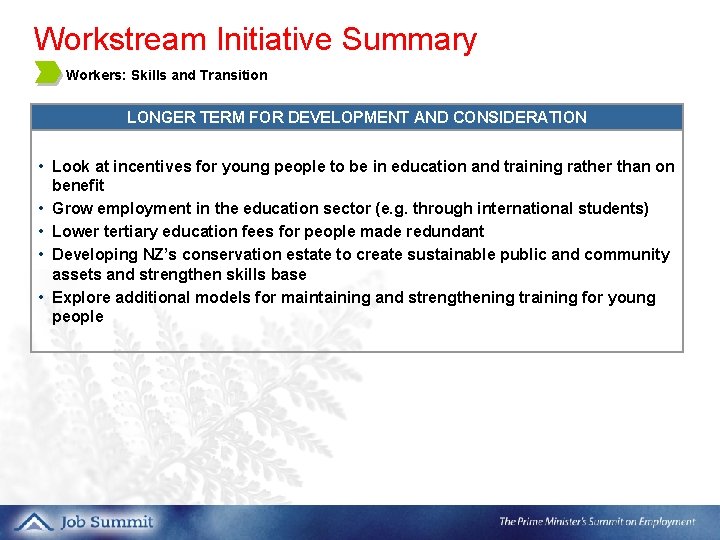
Workstream Initiative Summary 5. Workers: Skills and Transition LONGER TERM FOR DEVELOPMENT AND CONSIDERATION • Look at incentives for young people to be in education and training rather than on benefit • Grow employment in the education sector (e. g. through international students) • Lower tertiary education fees for people made redundant • Developing NZ’s conservation estate to create sustainable public and community assets and strengthen skills base • Explore additional models for maintaining and strengthening training for young people
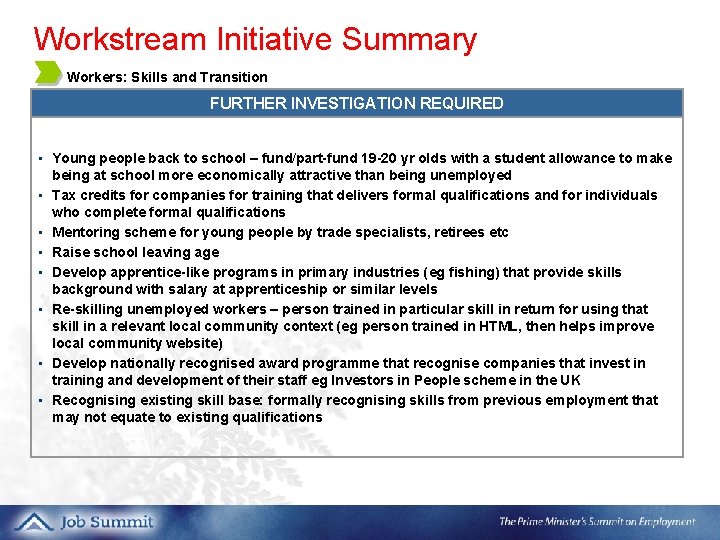
Workstream Initiative Summary 5. Workers: Skills and Transition FURTHER INVESTIGATION REQUIRED • Young people back to school – fund/part-fund 19 -20 yr olds with a student allowance to make being at school more economically attractive than being unemployed • Tax credits for companies for training that delivers formal qualifications and for individuals who complete formal qualifications • Mentoring scheme for young people by trade specialists, retirees etc • Raise school leaving age • Develop apprentice-like programs in primary industries (eg fishing) that provide skills background with salary at apprenticeship or similar levels • Re-skilling unemployed workers – person trained in particular skill in return for using that skill in a relevant local community context (eg person trained in HTML, then helps improve local community website) • Develop nationally recognised award programme that recognise companies that invest in training and development of their staff eg Investors in People scheme in the UK • Recognising existing skill base: formally recognising skills from previous employment that may not equate to existing qualifications