
Workstream 2 Data Quality The Data Quality Puzzle
- Slides: 19
Workstream 2: Data Quality The Data Quality Puzzle Piece: Hands-on session and lessons learned from bringing IATI data into country systems 10 July 2018 1
Agenda 1. Presentation on IATI data use in country systems (20 mins) a. UNICEF experience in Senegal and Madagascar b. USAID experience in Bangladesh 1. Hands-on session using IATI data in country (40 mins) 2. Feedback from group exercise (15 mins)
Using IATI Data In-country: UNICEF Experience in Senegal and Madagascar International Aid Transparency Initiative 2018 Members’ Assembly 10. 07. 2018 3
UNICEF Experience in Senegal and Madagascar Who: UNICEF HQ and country offices + Governments of Madagascar and Senegal + Development Gateway and Development Initiatives + two fellows based in each governments for 3 months Goals: ● reduce the burden of data collection and reporting ● increase the timeliness of data reporting ● improve UNICEF IATI data so that it can be useful for country systems and planning Progress since last Members Assembly: Sharing what we’ve learned: summary report with Q&A, full report, country-specific reports, training guides, blogs. See them at developmentgateway. org/iatiaims International Aid Transparency Initiative 2018 Members’ Assembly 10. 07. 2018 4
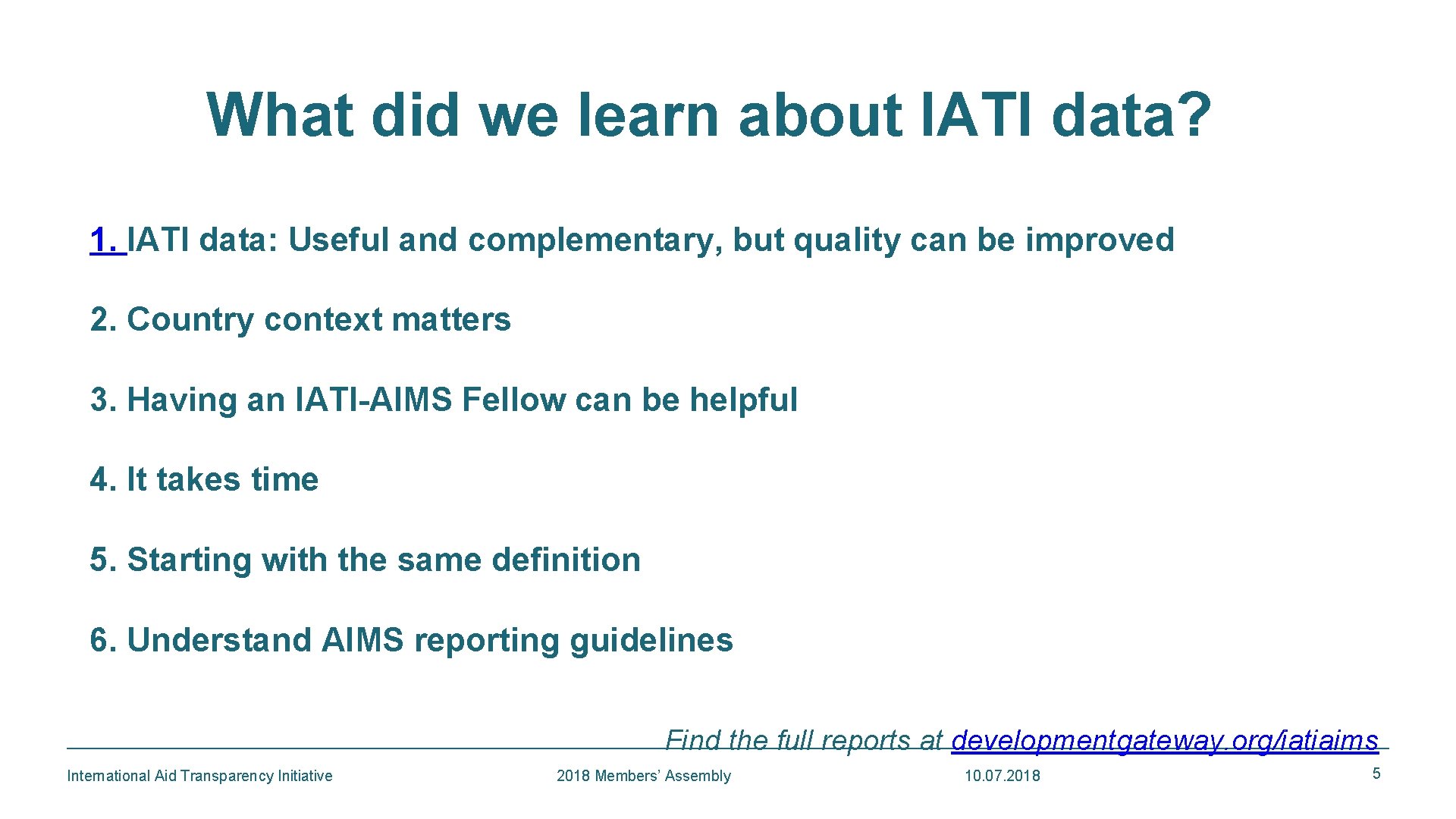
What did we learn about IATI data? 1. IATI data: Useful and complementary, but quality can be improved 2. Country context matters 3. Having an IATI-AIMS Fellow can be helpful 4. It takes time 5. Starting with the same definition 6. Understand AIMS reporting guidelines Find the full reports at developmentgateway. org/iatiaims International Aid Transparency Initiative 2018 Members’ Assembly 10. 07. 2018 5
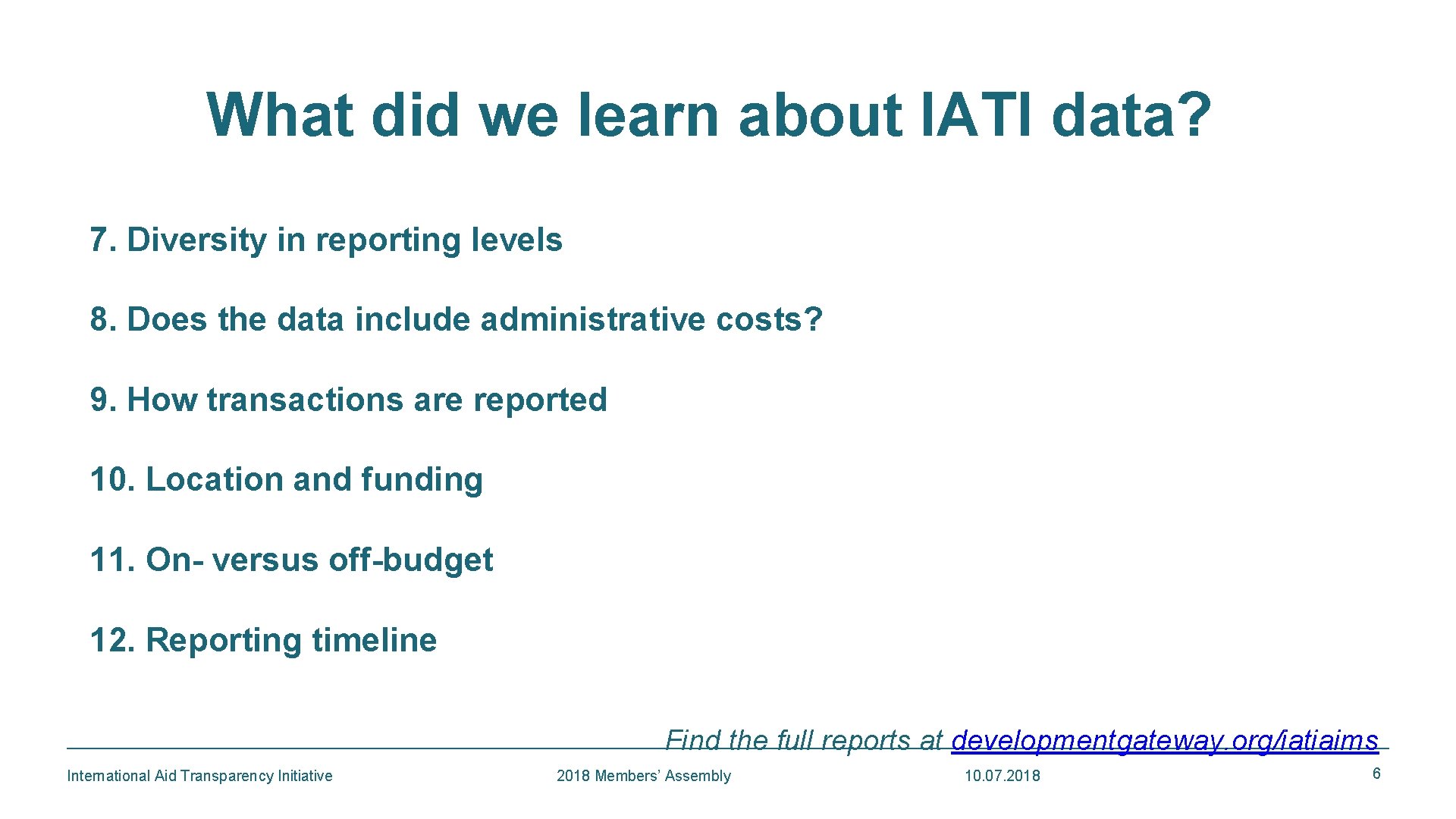
What did we learn about IATI data? 7. Diversity in reporting levels 8. Does the data include administrative costs? 9. How transactions are reported 10. Location and funding 11. On- versus off-budget 12. Reporting timeline Find the full reports at developmentgateway. org/iatiaims International Aid Transparency Initiative 2018 Members’ Assembly 10. 07. 2018 6
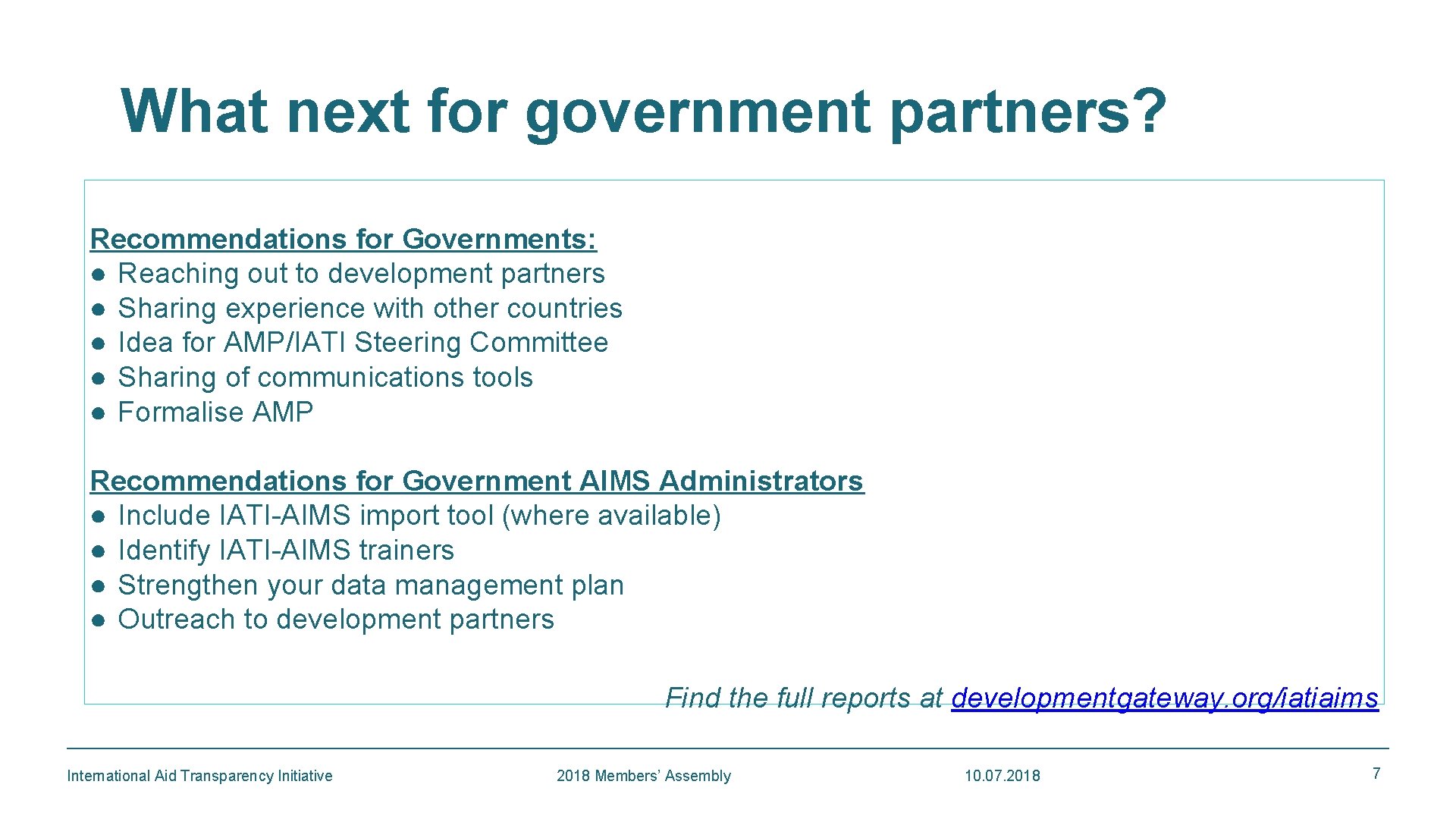
What next for government partners? Recommendations for Governments: ● Reaching out to development partners ● Sharing experience with other countries ● Idea for AMP/IATI Steering Committee ● Sharing of communications tools ● Formalise AMP Recommendations for Government AIMS Administrators ● Include IATI-AIMS import tool (where available) ● Identify IATI-AIMS trainers ● Strengthen your data management plan ● Outreach to development partners Find the full reports at developmentgateway. org/iatiaims International Aid Transparency Initiative 2018 Members’ Assembly 10. 07. 2018 7
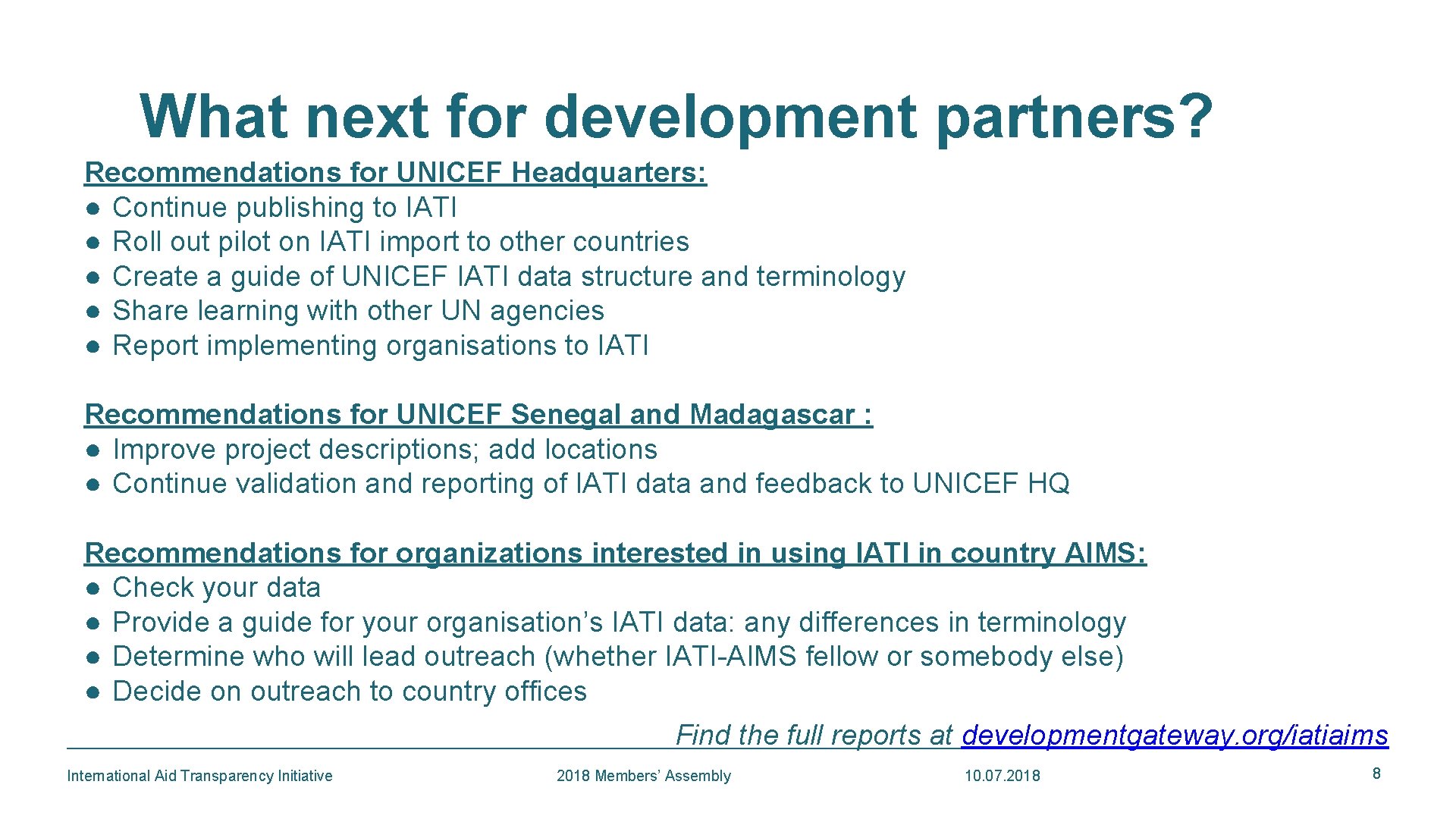
What next for development partners? Recommendations for UNICEF Headquarters: ● Continue publishing to IATI ● Roll out pilot on IATI import to other countries ● Create a guide of UNICEF IATI data structure and terminology ● Share learning with other UN agencies ● Report implementing organisations to IATI Recommendations for UNICEF Senegal and Madagascar : ● Improve project descriptions; add locations ● Continue validation and reporting of IATI data and feedback to UNICEF HQ Recommendations for organizations interested in using IATI in country AIMS: ● Check your data ● Provide a guide for your organisation’s IATI data: any differences in terminology ● Determine who will lead outreach (whether IATI-AIMS fellow or somebody else) ● Decide on outreach to country offices Find the full reports at developmentgateway. org/iatiaims International Aid Transparency Initiative 2018 Members’ Assembly 10. 07. 2018 8
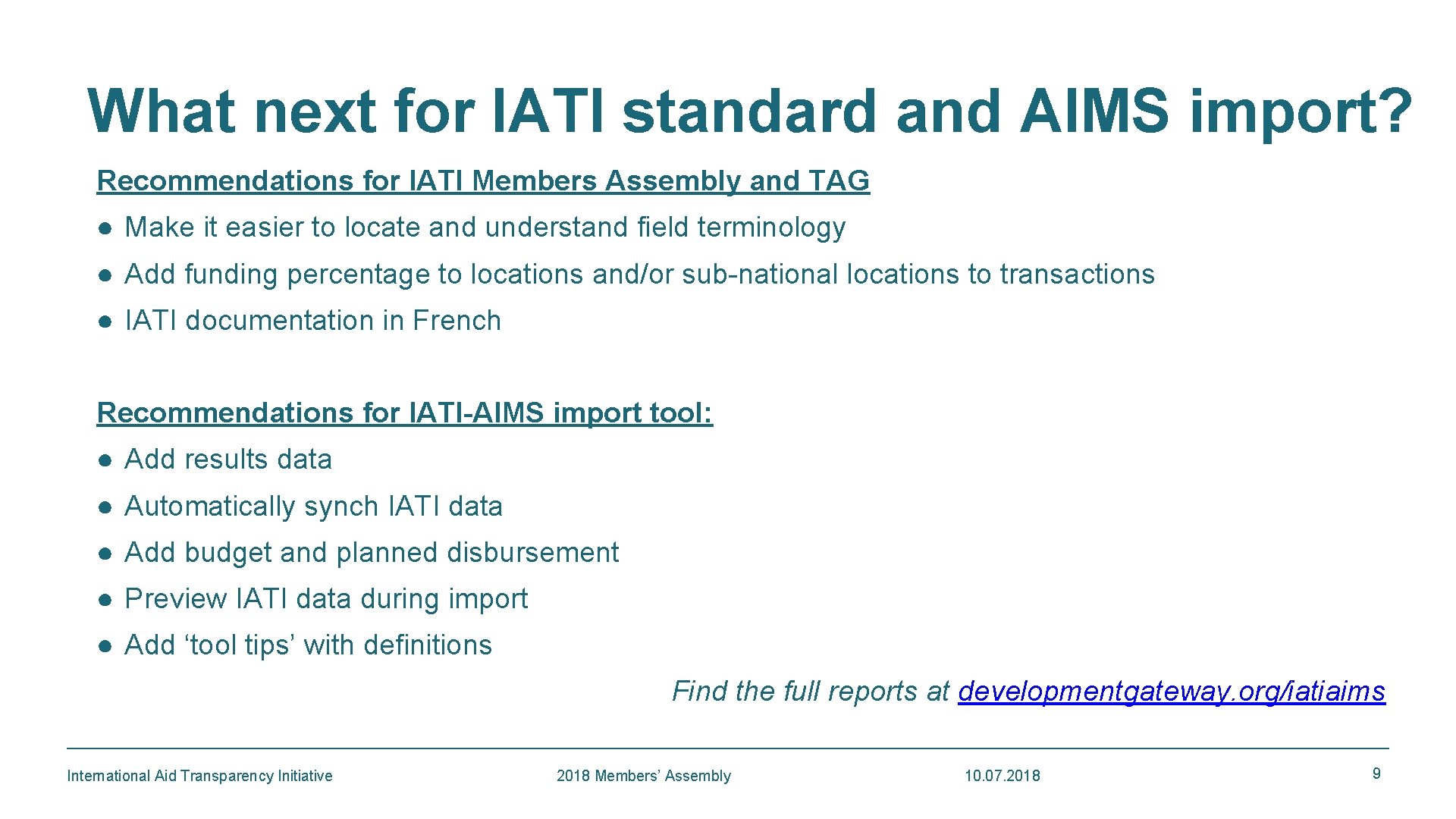
What next for IATI standard and AIMS import? Recommendations for IATI Members Assembly and TAG ● Make it easier to locate and understand field terminology ● Add funding percentage to locations and/or sub-national locations to transactions ● IATI documentation in French Recommendations for IATI-AIMS import tool: ● Add results data ● Automatically synch IATI data ● Add budget and planned disbursement ● Preview IATI data during import ● Add ‘tool tips’ with definitions Find the full reports at developmentgateway. org/iatiaims International Aid Transparency Initiative 2018 Members’ Assembly 10. 07. 2018 9
Using IATI Data In-country: USAID Experience in Bangladesh International Aid Transparency Initiative 2018 Members’ Assembly 10. 07. 2018 10
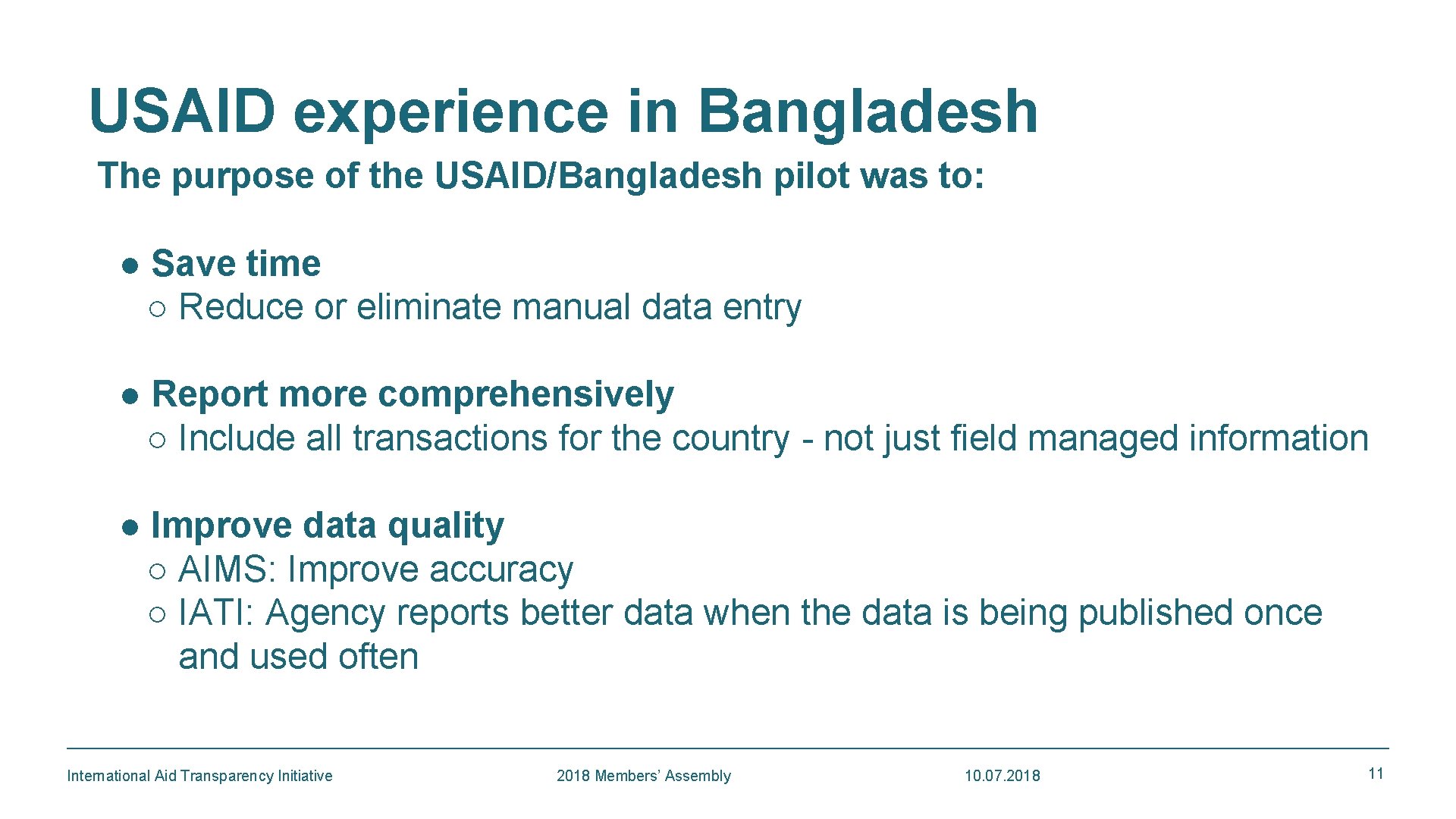
USAID experience in Bangladesh The purpose of the USAID/Bangladesh pilot was to: ● Save time ○ Reduce or eliminate manual data entry ● Report more comprehensively ○ Include all transactions for the country - not just field managed information ● Improve data quality ○ AIMS: Improve accuracy ○ IATI: Agency reports better data when the data is being published once and used often International Aid Transparency Initiative 2018 Members’ Assembly 10. 07. 2018 11
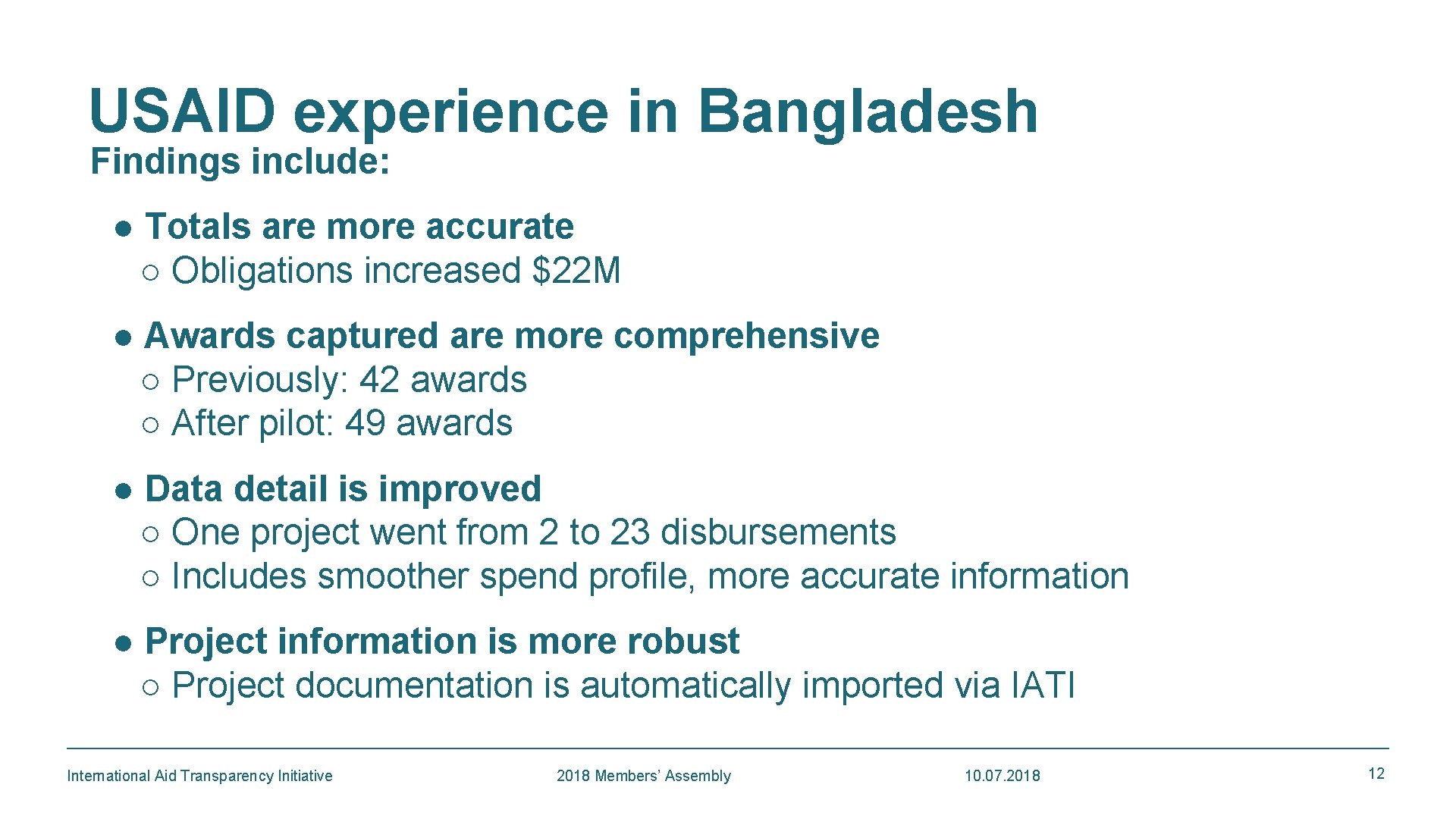
USAID experience in Bangladesh Findings include: ● Totals are more accurate ○ Obligations increased $22 M ● Awards captured are more comprehensive ○ Previously: 42 awards ○ After pilot: 49 awards ● Data detail is improved ○ One project went from 2 to 23 disbursements ○ Includes smoother spend profile, more accurate information ● Project information is more robust ○ Project documentation is automatically imported via IATI International Aid Transparency Initiative 2018 Members’ Assembly 10. 07. 2018 12
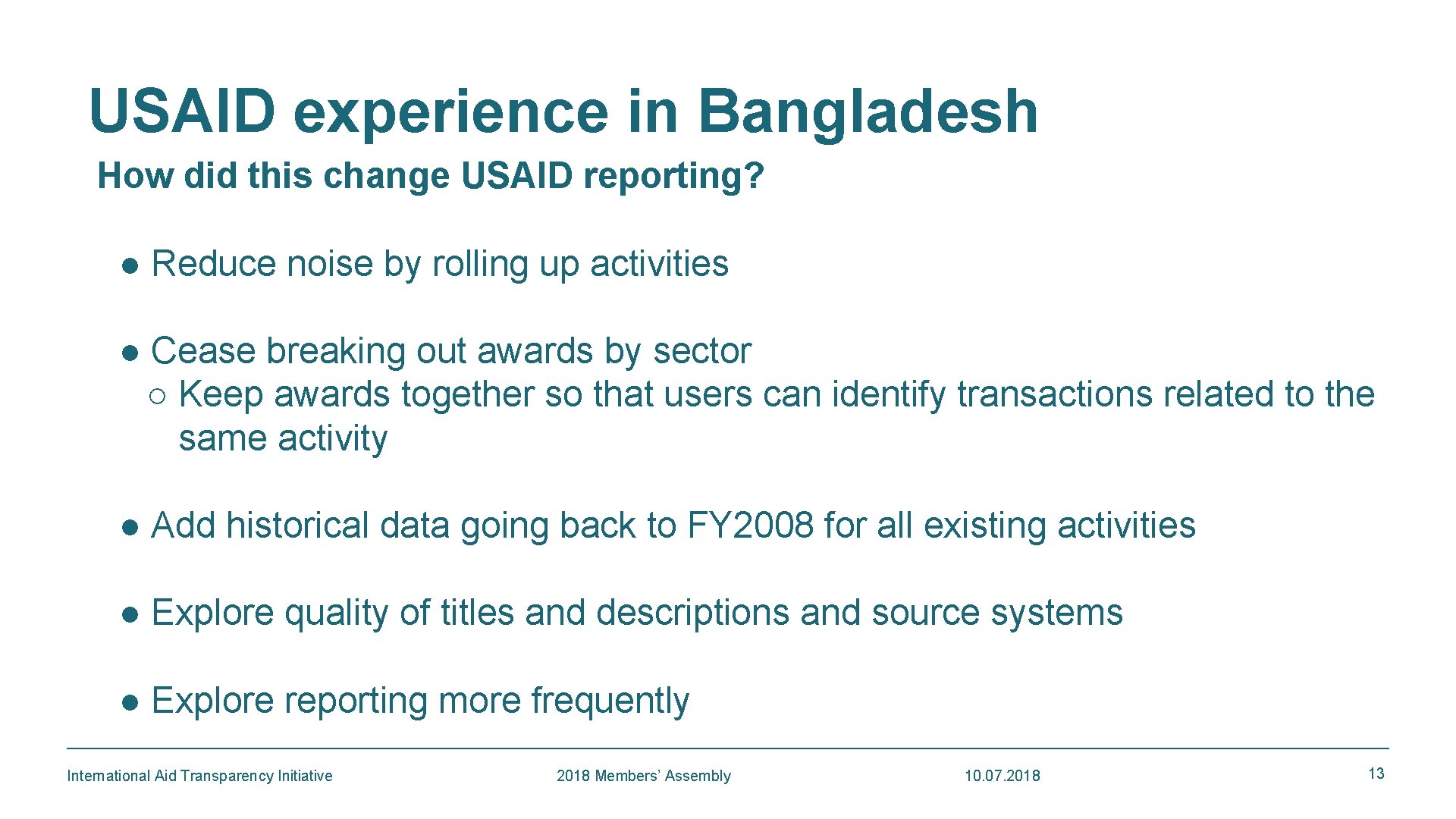
USAID experience in Bangladesh How did this change USAID reporting? ● Reduce noise by rolling up activities ● Cease breaking out awards by sector ○ Keep awards together so that users can identify transactions related to the same activity ● Add historical data going back to FY 2008 for all existing activities ● Explore quality of titles and descriptions and source systems ● Explore reporting more frequently International Aid Transparency Initiative 2018 Members’ Assembly 10. 07. 2018 13
Hands-on Session The Data Quality Puzzle Piece: Using IATI Data In-country International Aid Transparency Initiative 2018 Members’ Assembly 10. 07. 2018 14
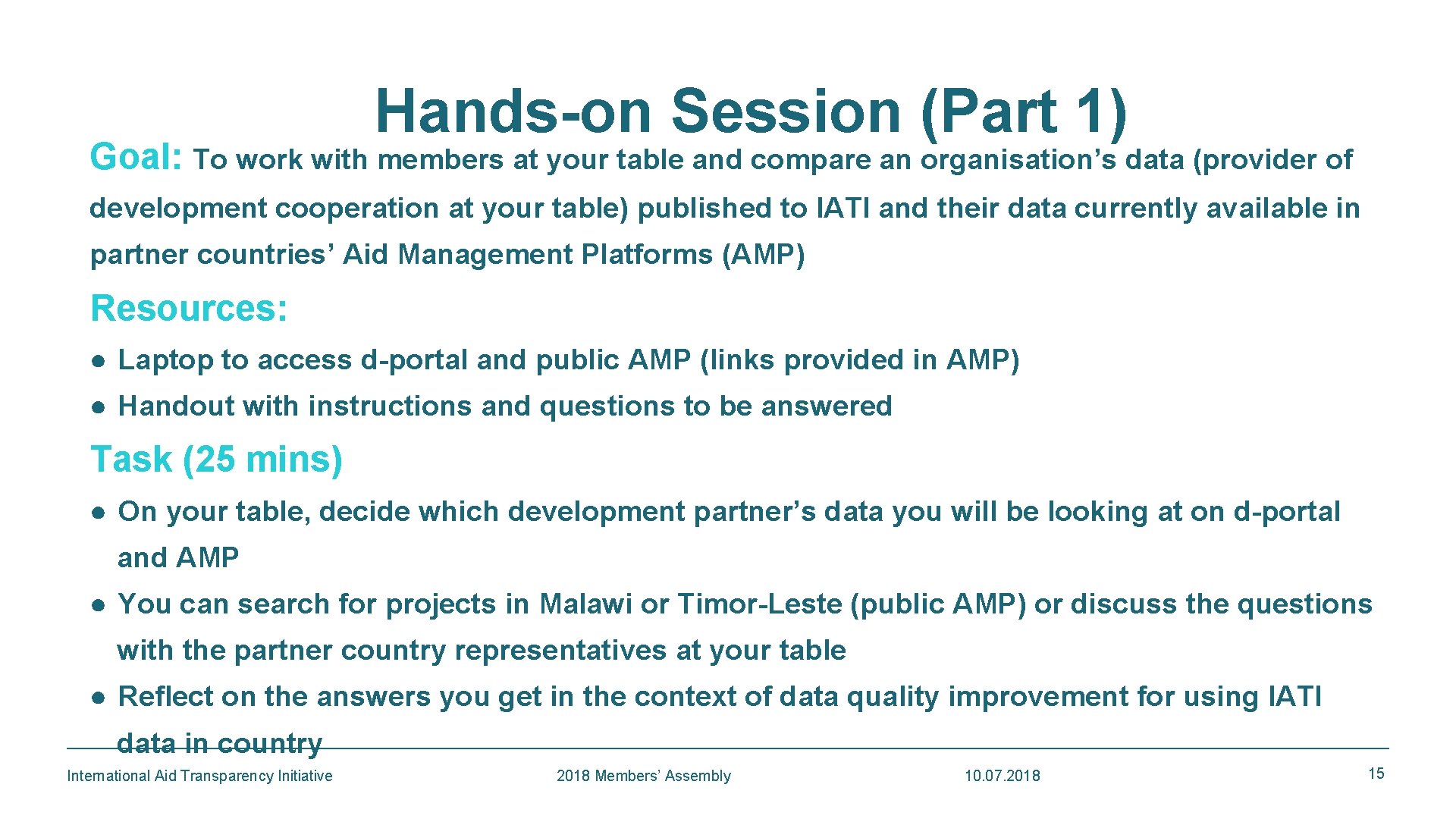
Hands-on Session (Part 1) Goal: To work with members at your table and compare an organisation’s data (provider of development cooperation at your table) published to IATI and their data currently available in partner countries’ Aid Management Platforms (AMP) Resources: ● Laptop to access d-portal and public AMP (links provided in AMP) ● Handout with instructions and questions to be answered Task (25 mins) ● On your table, decide which development partner’s data you will be looking at on d-portal and AMP ● You can search for projects in Malawi or Timor-Leste (public AMP) or discuss the questions with the partner country representatives at your table ● Reflect on the answers you get in the context of data quality improvement for using IATI data in country International Aid Transparency Initiative 2018 Members’ Assembly 10. 07. 2018 15
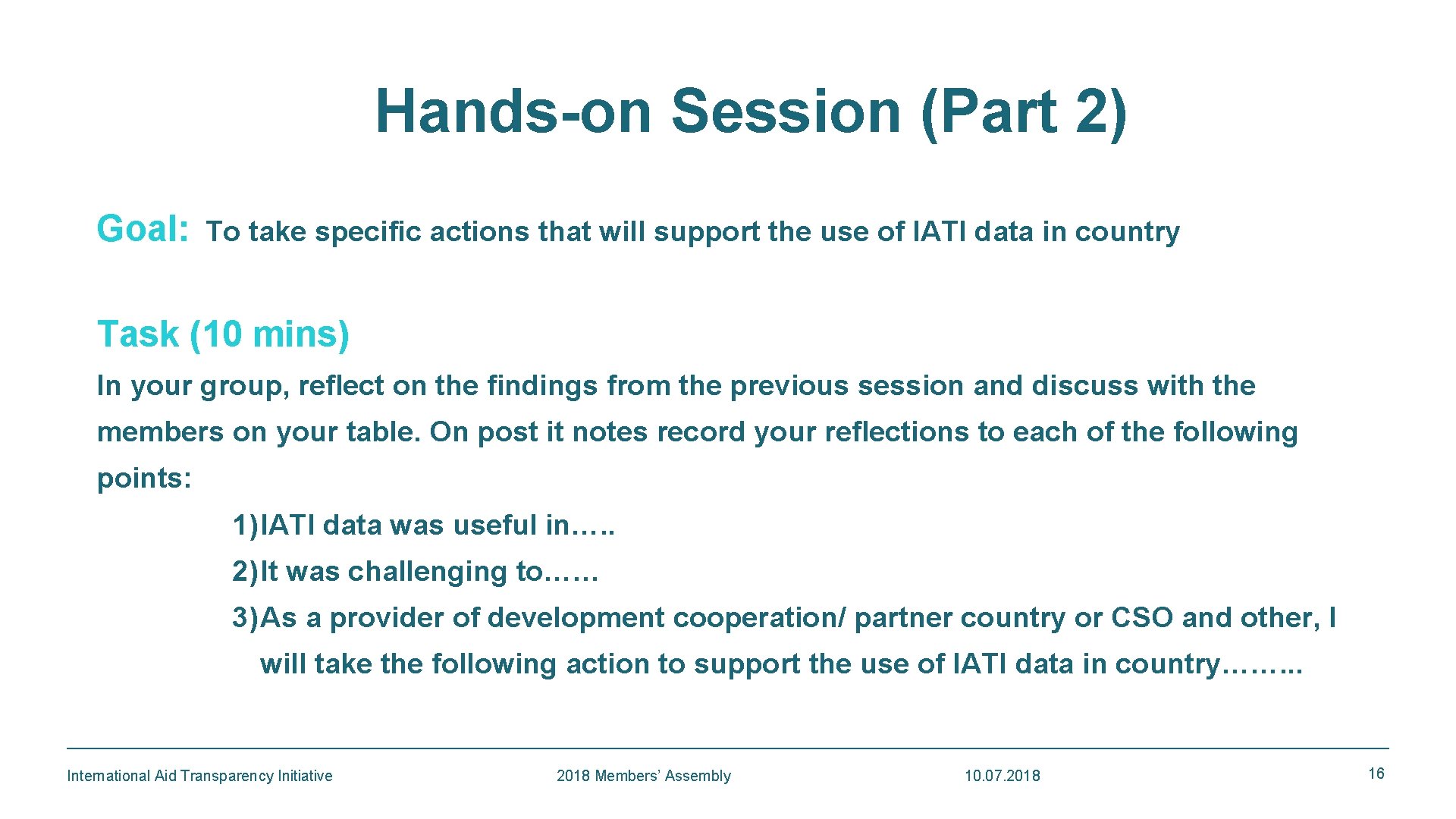
Hands-on Session (Part 2) Goal: To take specific actions that will support the use of IATI data in country Task (10 mins) In your group, reflect on the findings from the previous session and discuss with the members on your table. On post it notes record your reflections to each of the following points: 1)IATI data was useful in…. . 2)It was challenging to…… 3)As a provider of development cooperation/ partner country or CSO and other, I will take the following action to support the use of IATI data in country……. . . International Aid Transparency Initiative 2018 Members’ Assembly 10. 07. 2018 16
FEEDBACK AND ACTIONS FROM THE SESSION THANK YOU!
Annex / Additional Information International Aid Transparency Initiative 2018 Members’ Assembly 10. 07. 2018 18
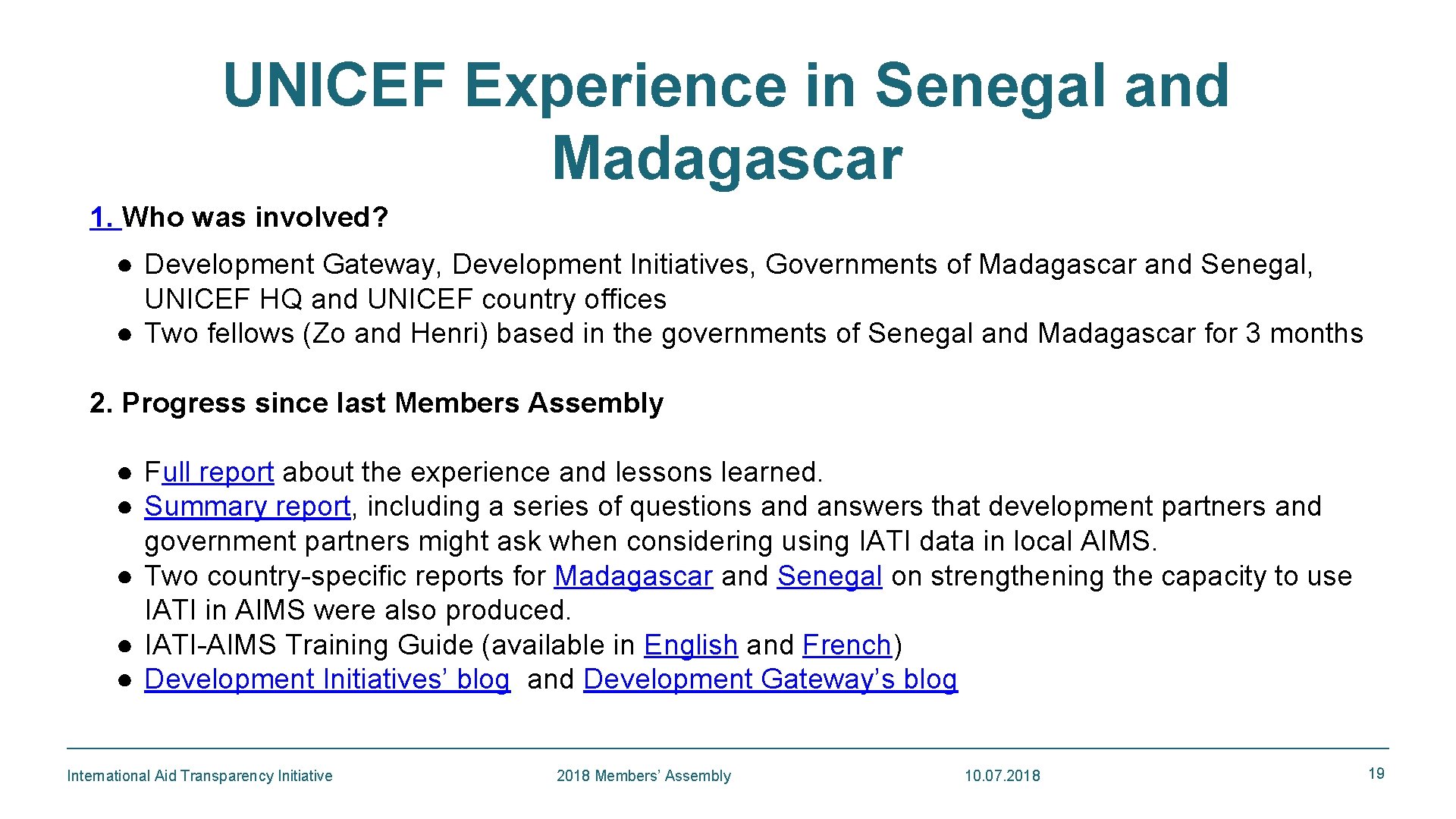
UNICEF Experience in Senegal and Madagascar 1. Who was involved? ● Development Gateway, Development Initiatives, Governments of Madagascar and Senegal, UNICEF HQ and UNICEF country offices ● Two fellows (Zo and Henri) based in the governments of Senegal and Madagascar for 3 months 2. Progress since last Members Assembly ● Full report about the experience and lessons learned. ● Summary report, including a series of questions and answers that development partners and government partners might ask when considering using IATI data in local AIMS. ● Two country-specific reports for Madagascar and Senegal on strengthening the capacity to use IATI in AIMS were also produced. ● IATI-AIMS Training Guide (available in English and French) ● Development Initiatives’ blog and Development Gateway’s blog International Aid Transparency Initiative 2018 Members’ Assembly 10. 07. 2018 19