
Workshop on the Teaching of Software Testing The
- Slides: 40
Workshop on the Teaching of Software Testing The Challenge of Teaching Software Testing Earlier into Design Courses Ellen Francine Barbosa 1 Richard Le. Blanc 2 Mark Guzdial 2 José Carlos Maldonado 1 1 University of São Paulo (Brazil) 2 College of Computing, Georgia Institute of Technology (USA)
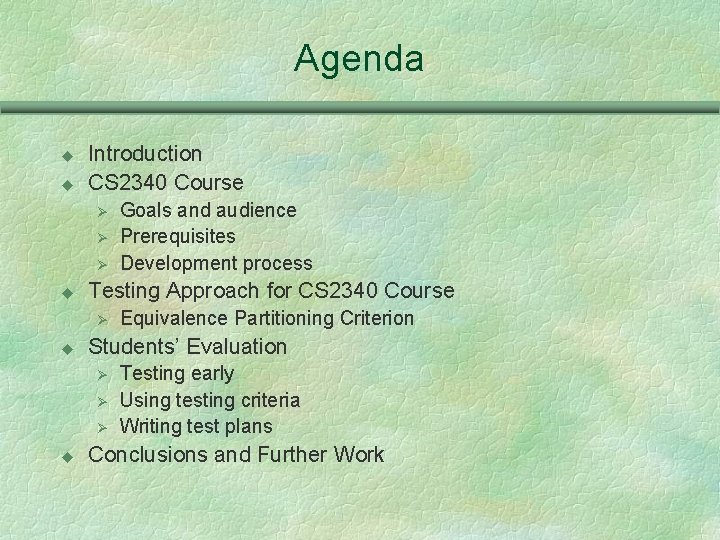
Agenda u u Introduction CS 2340 Course Ø Ø Ø u Testing Approach for CS 2340 Course Ø u Equivalence Partitioning Criterion Students’ Evaluation Ø Ø Ø u Goals and audience Prerequisites Development process Testing early Using testing criteria Writing test plans Conclusions and Further Work
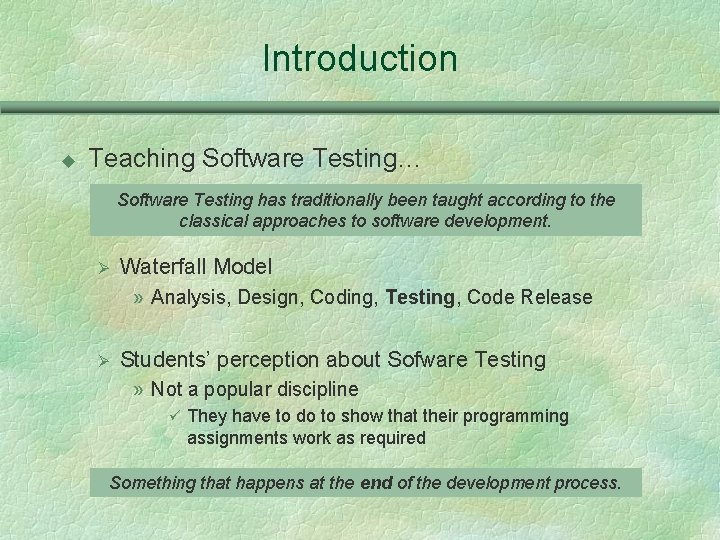
Introduction u Teaching Software Testing… Software Testing has traditionally been taught according to the classical approaches to software development. Ø Waterfall Model » Analysis, Design, Coding, Testing, Code Release Ø Students’ perception about Sofware Testing » Not a popular discipline ü They have to do to show that their programming assignments work as required Something that happens at the end of the development process.
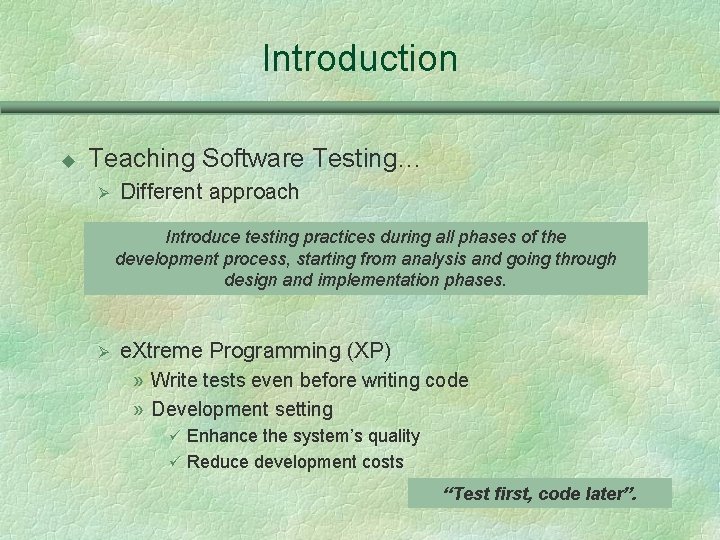
Introduction u Teaching Software Testing… Ø Different approach Introduce testing practices during all phases of the development process, starting from analysis and going through design and implementation phases. Ø e. Xtreme Programming (XP) » Write tests even before writing code » Development setting Enhance the system’s quality ü Reduce development costs ü “Test first, code later”.
Introduction u Objective Explore the impact of introducing testing practices as early as possible, throughout all phases of the development process. Ø Ø Investigate different learning opportunities Provide extra motivation » Ideas for modern methodologies (like XP) Ø CS 2340 Course » Encourage the students on thinking about Software Testing earlier in their projects ü Provide a more pragmatic view of testing » Evaluate the students’ attitude
CS 2340 – Objects and Design u Main Goal Explore higher-level issues of analysis and design, with some emphasis on user interface development. Ø u Object-oriented paradigm Audience Ø Second-year undergraduate students » Fall 2002: 160 students u Structure Ø One semester » 2 lecture classes per week » 2 exams, 1 development project
CS 2340 – Objects and Design u Pre-requisites Ø Introduction to Computing » Design, construction and analysis of algorithms Ø Object-Oriented Programming » Java Ø Languages and Translation » Issues of language implementation, tokenizing and parsing Ø Software Practicum (sometimes concurrently) » Basics of Software Engineering ü General view on Software Testing
CS 2340 – Objects and Design u Projects Ø Ø Ø Team-oriented Development of a small-to-medium sized OO system Fall 2002: Genealogy Information » Create a system to. . . Collect genealogical information ü Note inconsistencies and flaws in the database ü Provide some graphical representations ü Support a standard genealogical information format ü
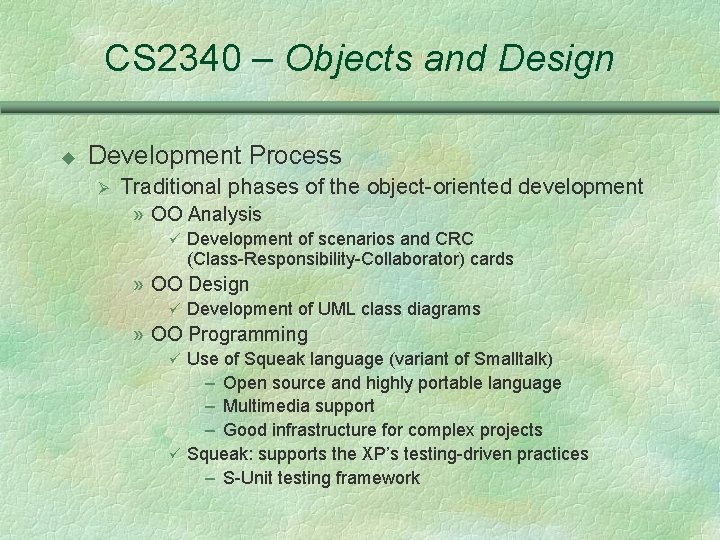
CS 2340 – Objects and Design u Development Process Ø Traditional phases of the object-oriented development » OO Analysis ü Development of scenarios and CRC (Class-Responsibility-Collaborator) cards » OO Design ü Development of UML class diagrams » OO Programming Use of Squeak language (variant of Smalltalk) – Open source and highly portable language – Multimedia support – Good infrastructure for complex projects ü Squeak: supports the XP’s testing-driven practices – S-Unit testing framework ü
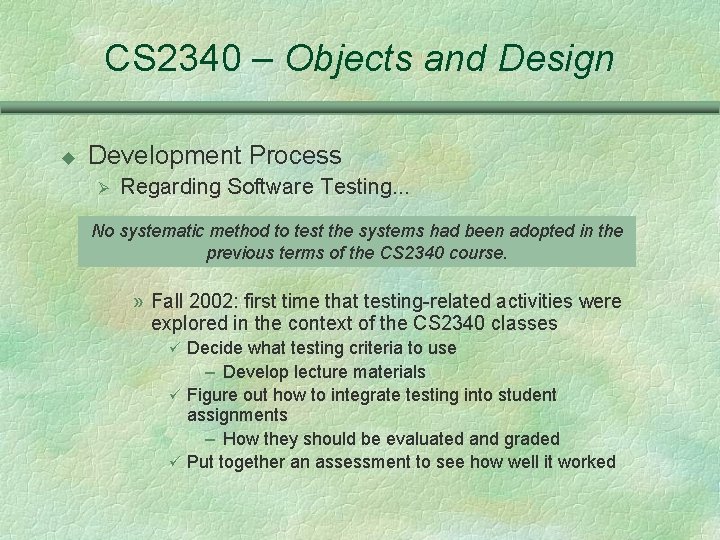
CS 2340 – Objects and Design u Development Process Ø Regarding Software Testing. . . No systematic method to test the systems had been adopted in the previous terms of the CS 2340 course. » Fall 2002: first time that testing-related activities were explored in the context of the CS 2340 classes Decide what testing criteria to use – Develop lecture materials ü Figure out how to integrate testing into student assignments – How they should be evaluated and graded ü Put together an assessment to see how well it worked ü
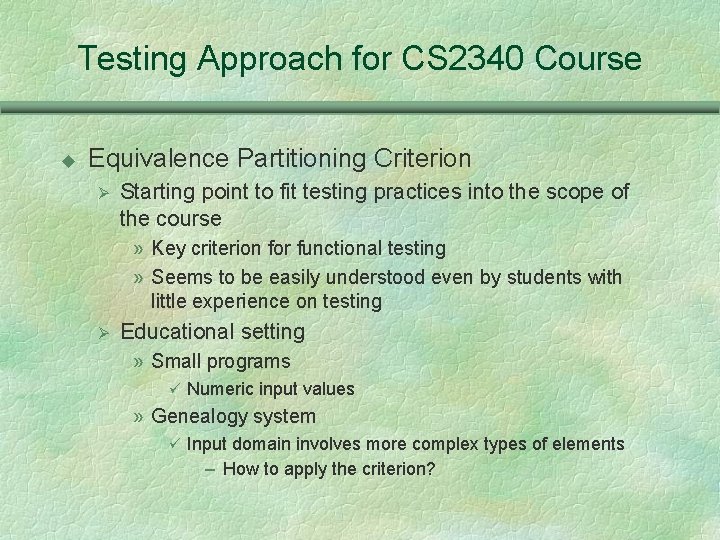
Testing Approach for CS 2340 Course u Equivalence Partitioning Criterion Ø Starting point to fit testing practices into the scope of the course » Key criterion for functional testing » Seems to be easily understood even by students with little experience on testing Ø Educational setting » Small programs ü Numeric input values » Genealogy system ü Input domain involves more complex types of elements – How to apply the criterion?
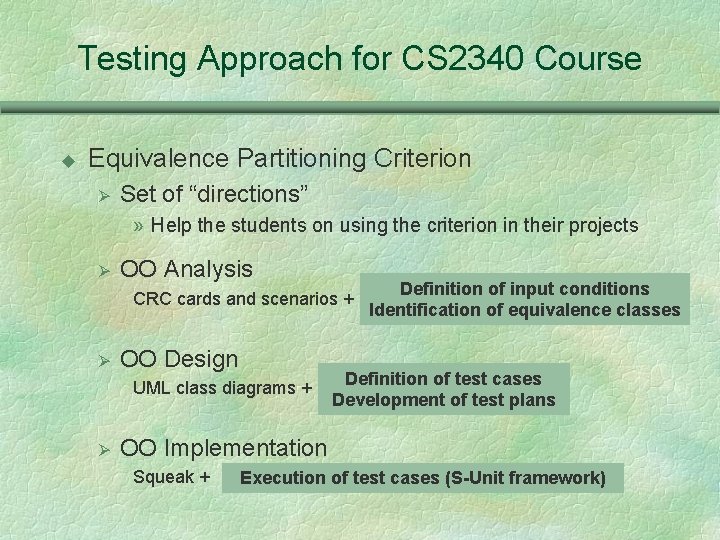
Testing Approach for CS 2340 Course u Equivalence Partitioning Criterion Ø Set of “directions” » Help the students on using the criterion in their projects Ø OO Analysis CRC cards and scenarios + Ø OO Design UML class diagrams + Ø Definition of input conditions Identification of equivalence classes Definition of test cases Development of test plans OO Implementation Squeak + Execution of test cases (S-Unit framework)
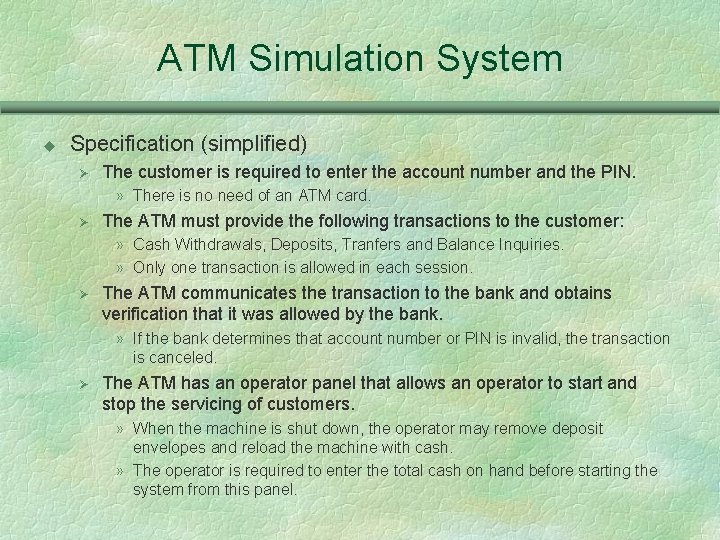
ATM Simulation System u Specification (simplified) Ø The customer is required to enter the account number and the PIN. » There is no need of an ATM card. Ø The ATM must provide the following transactions to the customer: » Cash Withdrawals, Deposits, Tranfers and Balance Inquiries. » Only one transaction is allowed in each session. Ø The ATM communicates the transaction to the bank and obtains verification that it was allowed by the bank. » If the bank determines that account number or PIN is invalid, the transaction is canceled. Ø The ATM has an operator panel that allows an operator to start and stop the servicing of customers. » When the machine is shut down, the operator may remove deposit envelopes and reload the machine with cash. » The operator is required to enter the total cash on hand before starting the system from this panel.
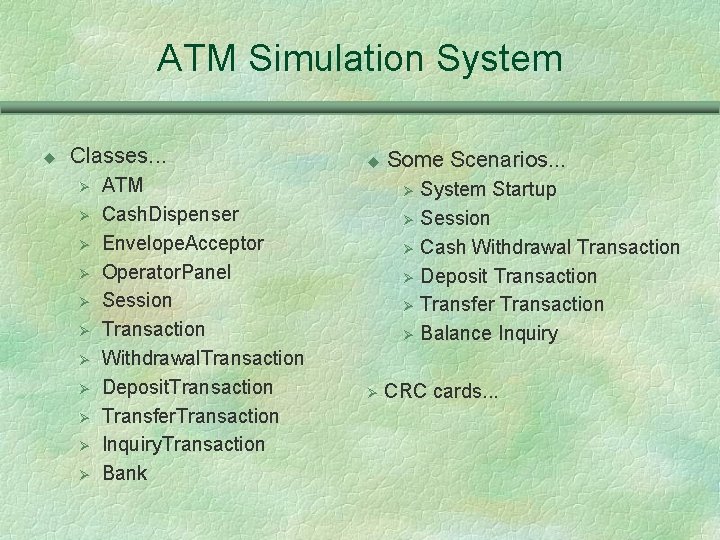
ATM Simulation System u Classes. . . Ø Ø Ø ATM Cash. Dispenser Envelope. Acceptor Operator. Panel Session Transaction Withdrawal. Transaction Deposit. Transaction Transfer. Transaction Inquiry. Transaction Bank u Some Scenarios. . . System Startup Ø Session Ø Cash Withdrawal Transaction Ø Deposit Transaction Ø Transfer Transaction Ø Balance Inquiry Ø Ø CRC cards. . .
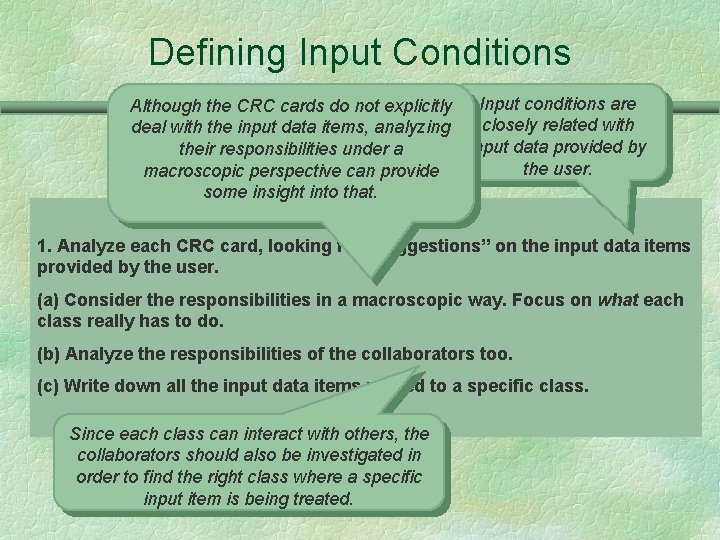
Defining Input Conditions Input conditions are Although the CRC cards do not explicitly closely related with deal with the input data items, analyzing input data provided by their responsibilities under a the user. macroscopic perspective can provide some insight into that. 1. Analyze each CRC card, looking for “suggestions” on the input data items provided by the user. (a) Consider the responsibilities in a macroscopic way. Focus on what each class really has to do. (b) Analyze the responsibilities of the collaborators too. (c) Write down all the input data items related to a specific class. Since each class can interact with others, the collaborators should also be investigated in order to find the right class where a specific input item is being treated.
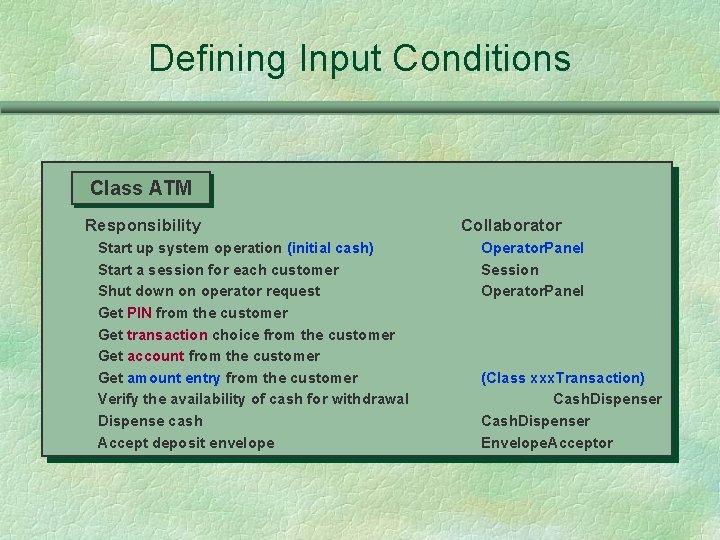
Defining Input Conditions Class ATM Responsibility Start up system operation (initial cash) Start a session for each customer Shut down on operator request Get PIN from the customer Get transaction choice from the customer Get account from the customer Get amount entry from the customer Verify the availability of cash for withdrawal Dispense cash Accept deposit envelope Collaborator Operator. Panel Session Operator. Panel (Class xxx. Transaction) Cash. Dispenser Envelope. Acceptor
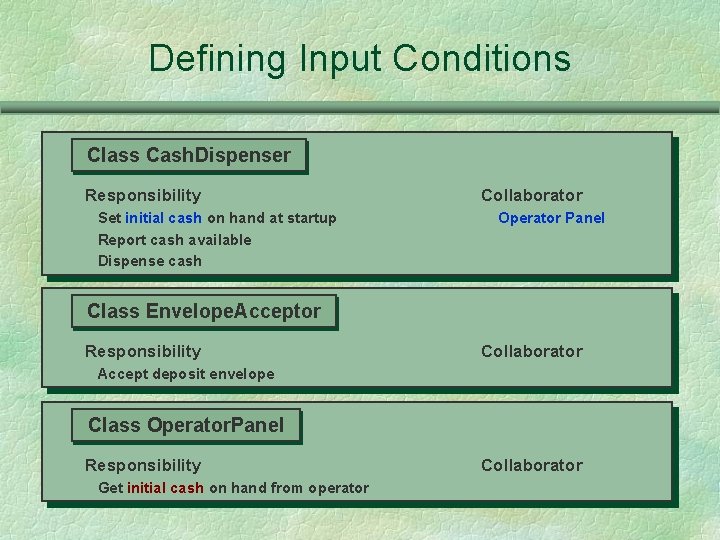
Defining Input Conditions Class Cash. Dispenser Responsibility Set initial cash on hand at startup Report cash available Dispense cash Collaborator Operator Panel Class Envelope. Acceptor Responsibility Collaborator Accept deposit envelope Class Operator. Panel Responsibility Get initial cash on hand from operator Collaborator
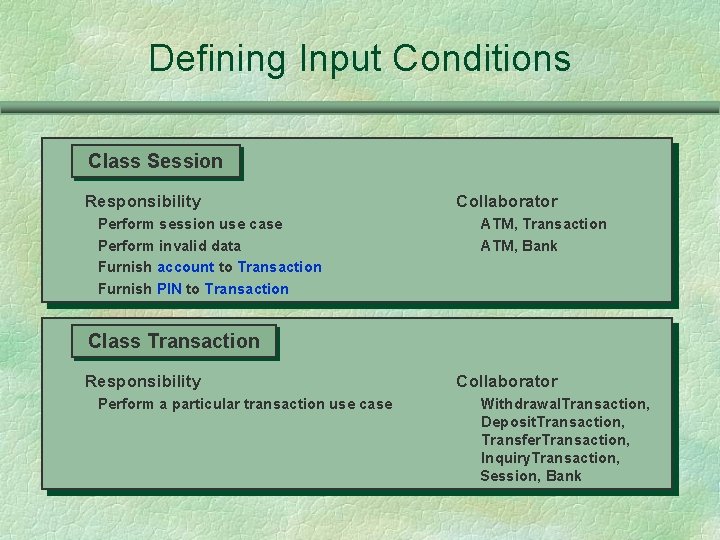
Defining Input Conditions Class Session Responsibility Perform session use case Perform invalid data Furnish account to Transaction Furnish PIN to Transaction Collaborator ATM, Transaction ATM, Bank Class Transaction Responsibility Perform a particular transaction use case Collaborator Withdrawal. Transaction, Deposit. Transaction, Transfer. Transaction, Inquiry. Transaction, Session, Bank
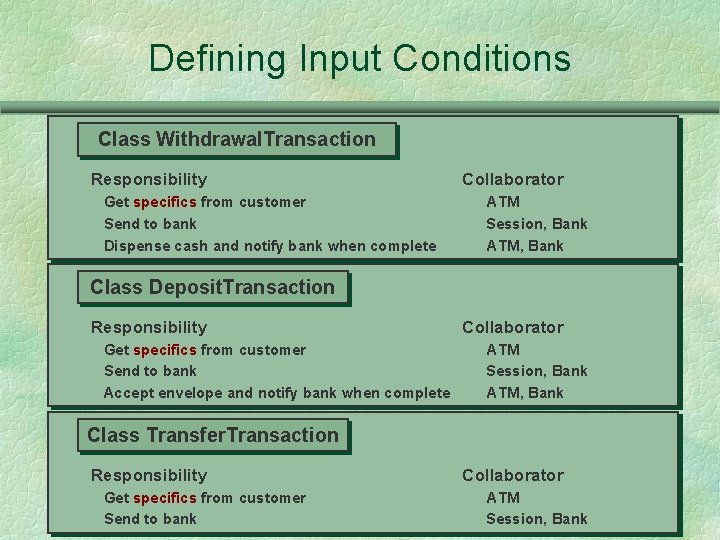
Defining Input Conditions Class Withdrawal. Transaction Responsibility Get specifics from customer Send to bank Dispense cash and notify bank when complete Collaborator ATM Session, Bank ATM, Bank Class Deposit. Transaction Responsibility Get specifics from customer Send to bank Accept envelope and notify bank when complete Collaborator ATM Session, Bank ATM, Bank Class Transfer. Transaction Responsibility Get specifics from customer Send to bank Collaborator ATM Session, Bank
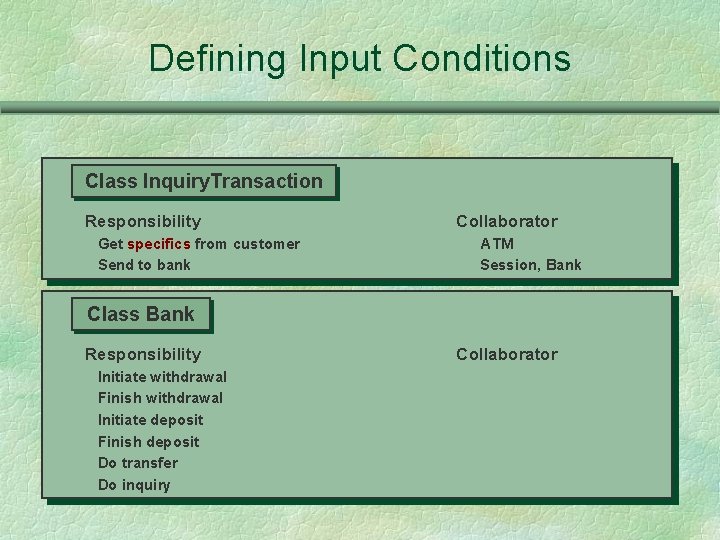
Defining Input Conditions Class Inquiry. Transaction Responsibility Get specifics from customer Send to bank Collaborator ATM Session, Bank Class Bank Responsibility Initiate withdrawal Finish withdrawal Initiate deposit Finish deposit Do transfer Do inquiry Collaborator
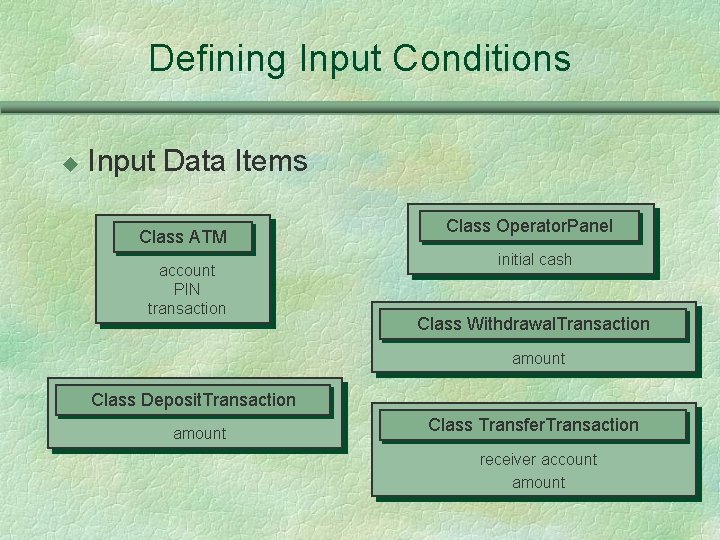
Defining Input Conditions u Input Data Items Class ATM account PIN transaction Class Operator. Panel initial cash Class Withdrawal. Transaction amount Class Deposit. Transaction amount Class Transfer. Transaction receiver account amount
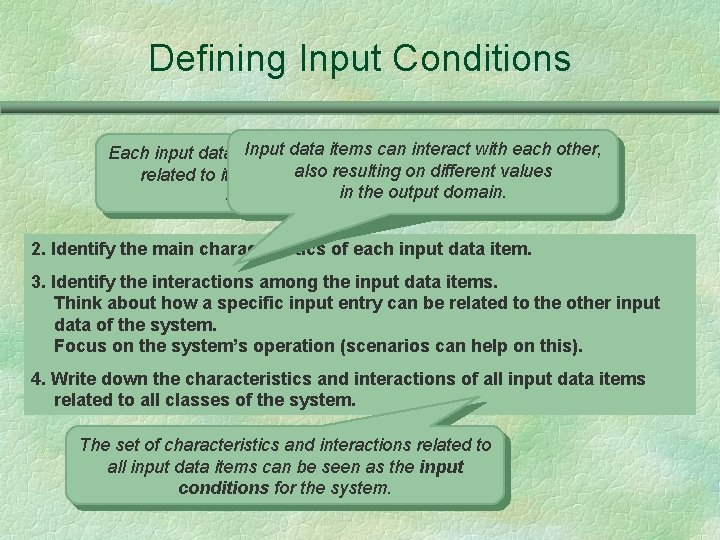
Defining Input Conditions Inputhas data items characteristics can interact with each other, Each input data item specific alsodirectly resulting on different values related to it, which can affect the in the output domain. system’s behavior. 2. Identify the main characteristics of each input data item. 3. Identify the interactions among the input data items. Think about how a specific input entry can be related to the other input data of the system. Focus on the system’s operation (scenarios can help on this). 4. Write down the characteristics and interactions of all input data items related to all classes of the system. The set of characteristics and interactions related to all input data items can be seen as the input conditions for the system.
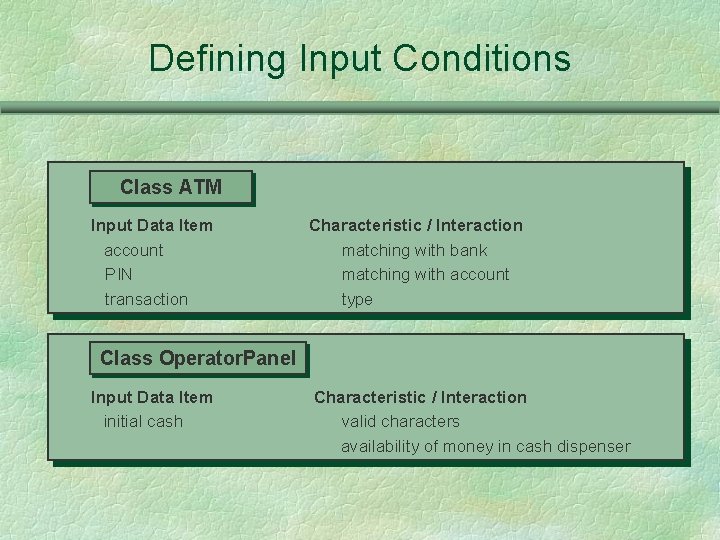
Defining Input Conditions Class ATM Input Data Item account PIN transaction Characteristic / Interaction matching with bank matching with account type Class Operator. Panel Input Data Item initial cash Characteristic / Interaction valid characters availability of money in cash dispenser
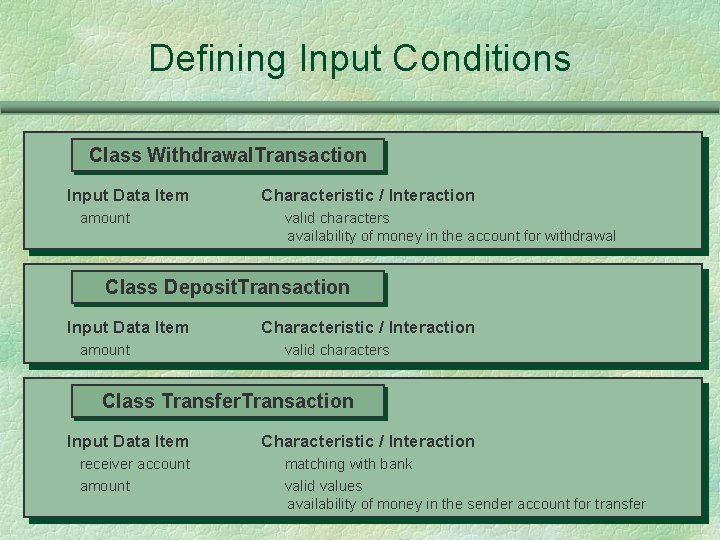
Defining Input Conditions Class Withdrawal. Transaction Input Data Item amount Characteristic / Interaction valid characters availability of money in the account for withdrawal Class Deposit. Transaction Input Data Item amount Characteristic / Interaction valid characters Class Transfer. Transaction Input Data Item receiver account amount Characteristic / Interaction matching with bank valid values availability of money in the sender account for transfer
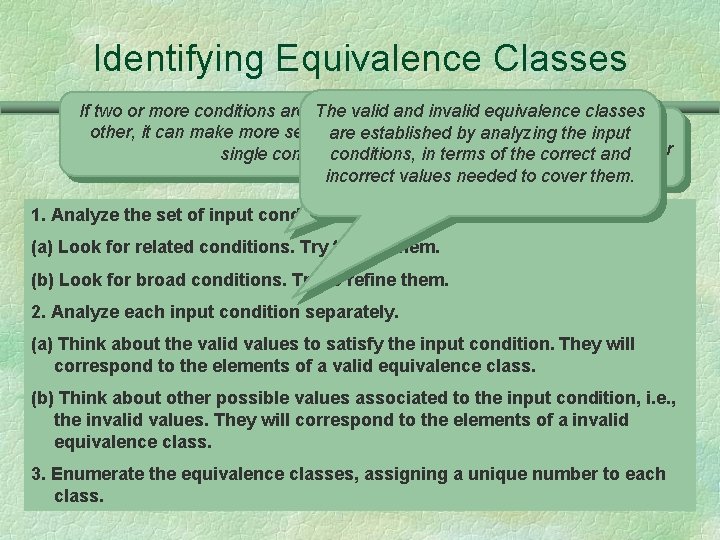
Identifying Equivalence Classes If two or more conditions are closely related to eachequivalence classes The valid and invalid If them a condition is too broad, can be other, it can make more senseare to join intobya analyzing established the itinput necessary to refine it by creating single conditions, in terms of the correct andtwo or more specific ones. them. incorrect values needed to cover 1. Analyze the set of input conditions for the system. (a) Look for related conditions. Try to join them. (b) Look for broad conditions. Try to refine them. 2. Analyze each input condition separately. (a) Think about the valid values to satisfy the input condition. They will correspond to the elements of a valid equivalence class. (b) Think about other possible values associated to the input condition, i. e. , the invalid values. They will correspond to the elements of a invalid equivalence class. 3. Enumerate the equivalence classes, assigning a unique number to each class.
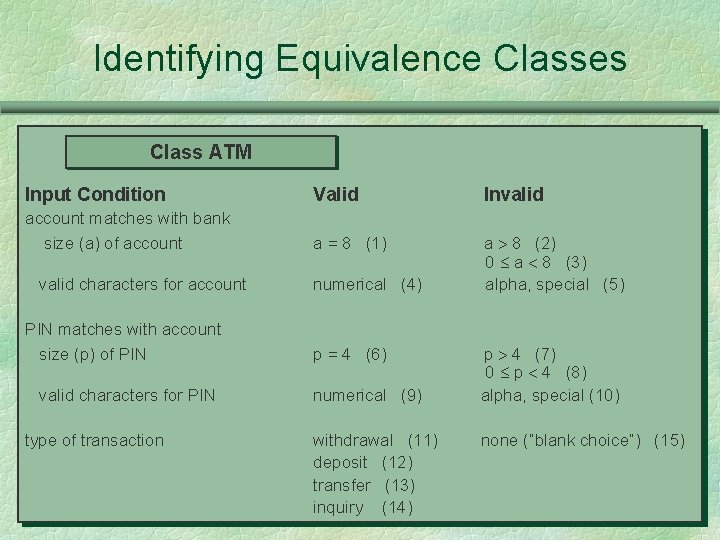
Identifying Equivalence Classes Class ATM Input Condition Valid Invalid account matches with bank size (a) of account a = 8 (1) a > 8 (2) 0 a < 8 (3) alpha, special (5) valid characters for account PIN matches with account size (p) of PIN valid characters for PIN type of transaction numerical (4) p = 4 (6) numerical (9) withdrawal (11) deposit (12) transfer (13) inquiry (14) p > 4 (7) 0 p < 4 (8) alpha, special (10) none (“blank choice”) (15)
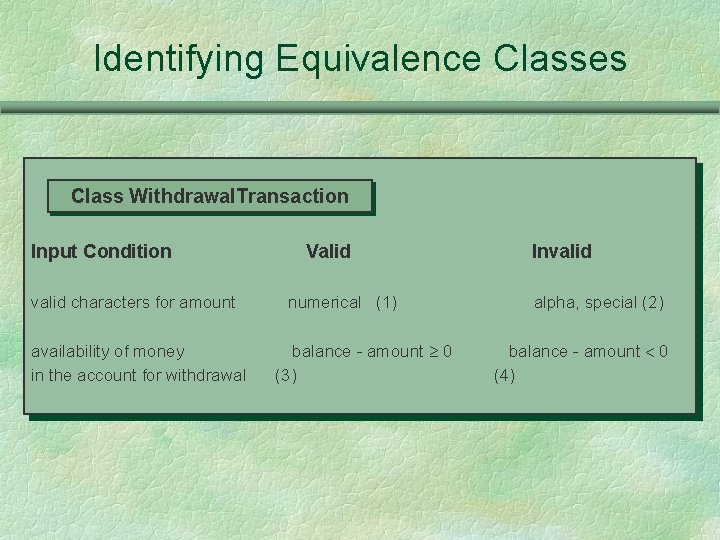
Identifying Equivalence Classes Class Withdrawal. Transaction Input Condition valid characters for amount availability of money in the account for withdrawal Valid numerical (1) balance - amount 0 (3) Invalid alpha, special (2) balance - amount < 0 (4)
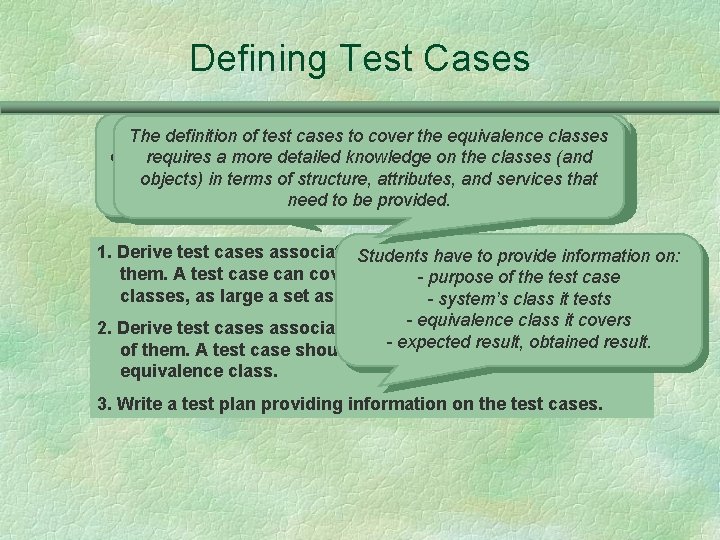
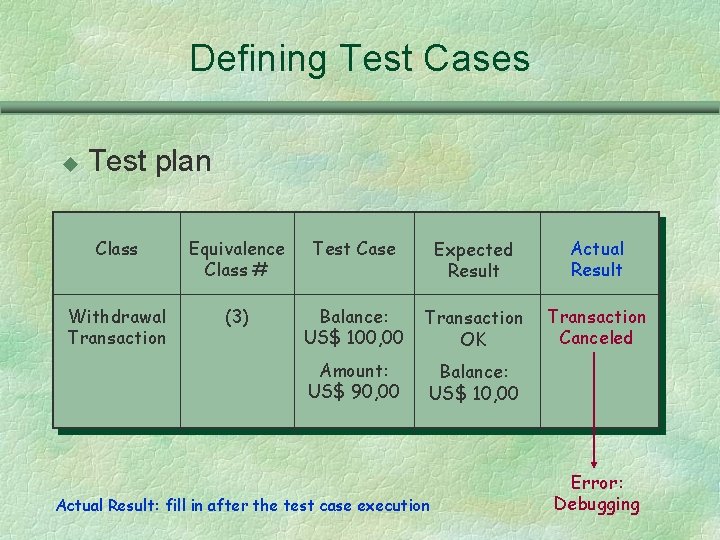
Defining Test Cases defined atathe same time as the The definition testare cases to cover the equivalence classes At. The test endcases ofofthe OOD phase, number of development UML detailed class diagrams, when the have to requires aofmore knowledge thestudents classes (and test cases have already been written, oneven deal with more detailed issues ofattributes, the design (such as instance objects) in terms of structure, and services that before the students have started coding. variables and for the classes). needmethods to be provided. 1. Derive test cases associated. Students with valid classes to cover all of on: have to provide information them. A test case can cover a number of valid - purpose of equivalence the test case classes, as large a set as possible. - system’s class it tests equivalence class it covers 2. Derive test cases associated with -invalid classes to cover all expected result, obtained result. of them. A test case should be written for each invalid equivalence class. 3. Write a test plan providing information on the test cases.
Defining Test Cases u Test plan Class Equivalence Class # Test Case Expected Result Actual Result Withdrawal Transaction (3) Balance: US$ 100, 00 Transaction OK Transaction Canceled Amount: US$ 90, 00 Balance: US$ 10, 00 Actual Result: fill in after the test case execution Error: Debugging
Executing Test Cases u S-Unit Ø Unit testing framework » Squeak’s environment Structure, describe the context of test cases and run them automatically Ø Development of a well-documented test suite Ø Mechanism to motivate regression tests Ø
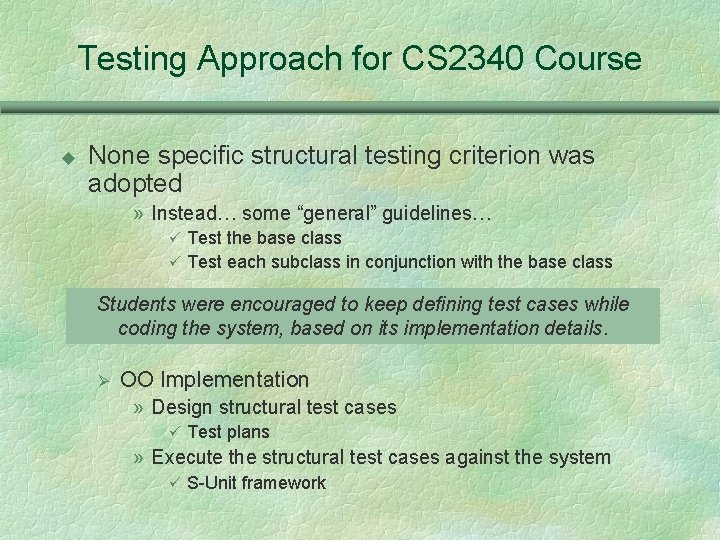
Testing Approach for CS 2340 Course u None specific structural testing criterion was adopted » Instead… some “general” guidelines… Test the base class ü Test each subclass in conjunction with the base class ü Students were encouraged to keep defining test cases while coding the system, based on its implementation details. Ø OO Implementation » Design structural test cases ü Test plans » Execute the structural test cases against the system ü S-Unit framework
Testing Approach for CS 2340 Course u Relevant Points Ø Ø CRC cards can be helpful to define input conditions and… Input conditions can be useful in checking the consistency of CRC cards » Responsibilities and interactions among classes Ø Defining input conditions and equivalence classes during the OOA phase can provide a better understanding of the system’s requirements Ø Writing test cases even before writing code (OOD phase) » Encourage the students to think about the functionality they are designing
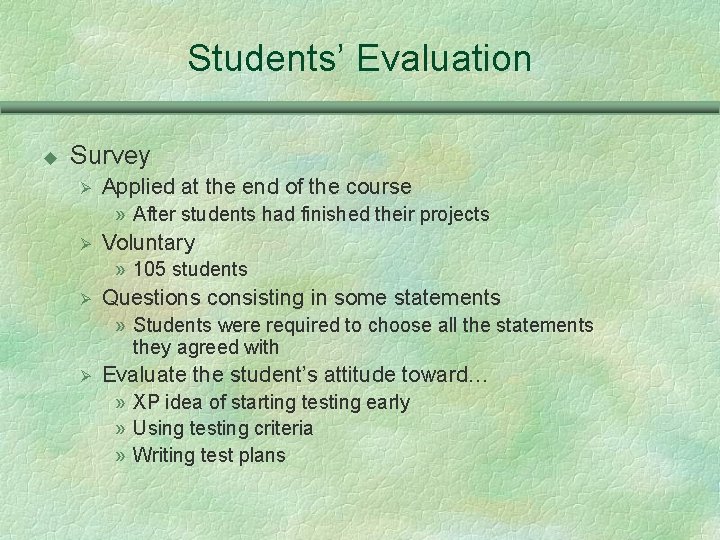
Students’ Evaluation u Survey Ø Applied at the end of the course » After students had finished their projects Ø Voluntary » 105 students Ø Questions consisting in some statements » Students were required to choose all the statements they agreed with Ø Evaluate the student’s attitude toward… » XP idea of starting testing early » Using testing criteria » Writing test plans
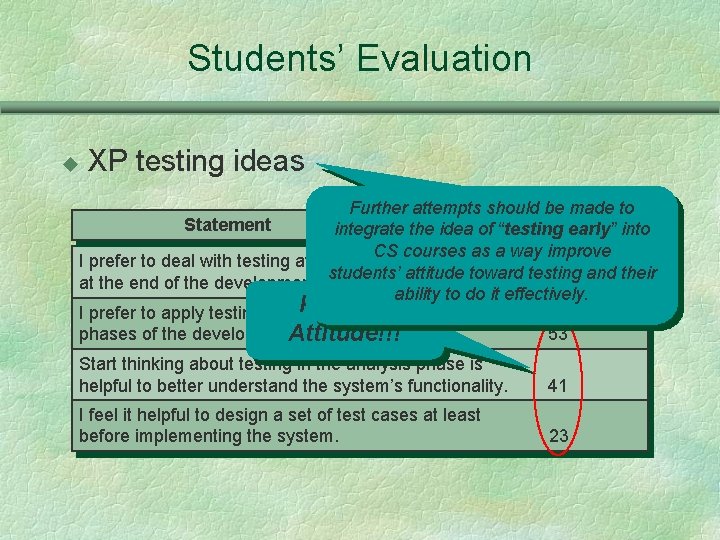
Students’ Evaluation u XP testing ideas Further attempts should be made to Statement Students integrate the idea of “testing early” into CS courses as a way improve I prefer to deal with testing after coding the system, students’ attitude toward testing and their at the end of the development process. 12 ability to do it effectively. Positive I prefer to apply testing practices through all the phases of the development. Attitude!!! process. 53 Start thinking about testing in the analysis phase is helpful to better understand the system’s functionality. 41 I feel it helpful to design a set of test cases at least before implementing the system. 23
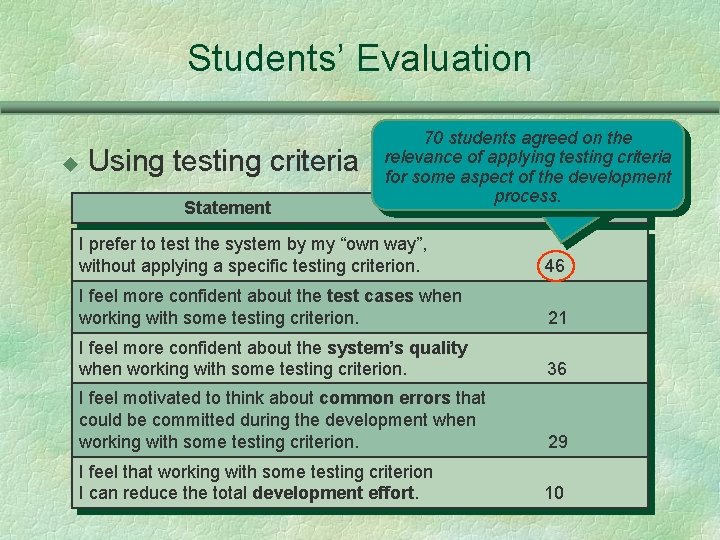
Students’ Evaluation u Using testing criteria Statement 70 students agreed on the 35 students were testing strictly criteria relevance of applying the idea of working for“against” some aspect of the development with testing criteria. process. Students I prefer to test the system by my “own way”, without applying a specific testing criterion. 46 I feel more confident about the test cases when working with some testing criterion. 21 I feel more confident about the system’s quality when working with some testing criterion. 36 I feel motivated to think about common errors that could be committed during the development when working with some testing criterion. 29 I feel that working with some testing criterion I can reduce the total development effort. 10
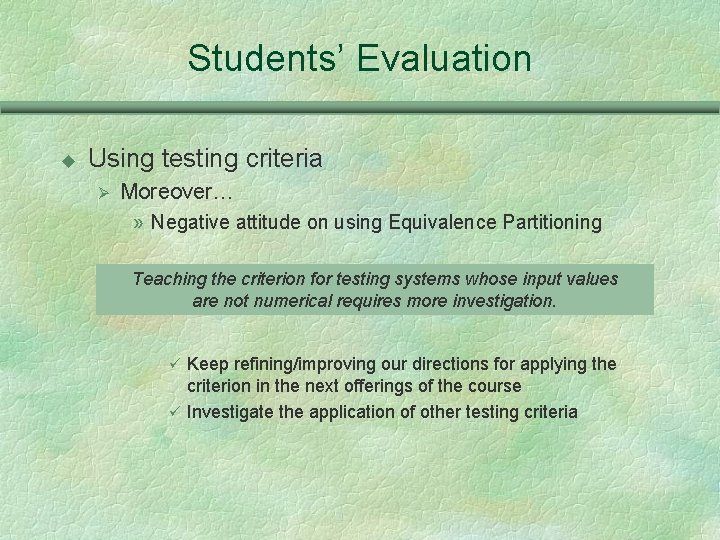
Students’ Evaluation u Using testing criteria Ø Moreover… » Negative attitude on using Equivalence Partitioning Teaching the criterion for testing systems whose input values are not numerical requires more investigation. Keep refining/improving our directions for applying the criterion in the next offerings of the course ü Investigate the application of other testing criteria ü
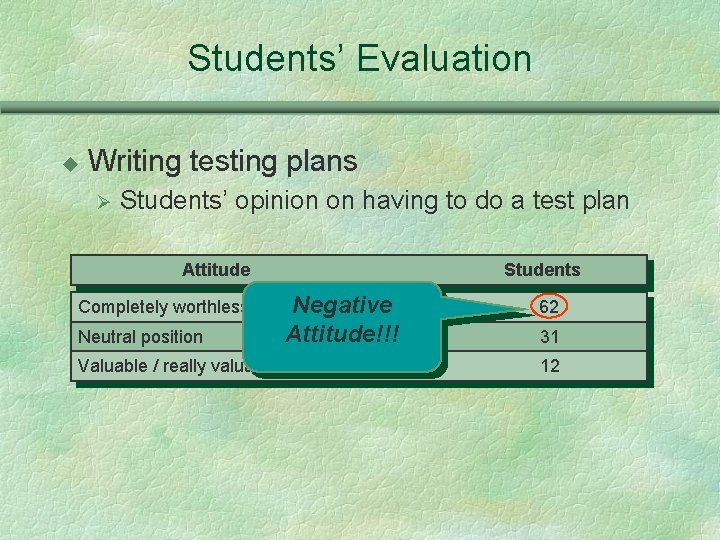
Students’ Evaluation u Writing testing plans Ø Students’ opinion on having to do a test plan Attitude Students Completely worthless / worthless Negative Neutral position Valuable / really valuable Attitude!!! 62 31 12
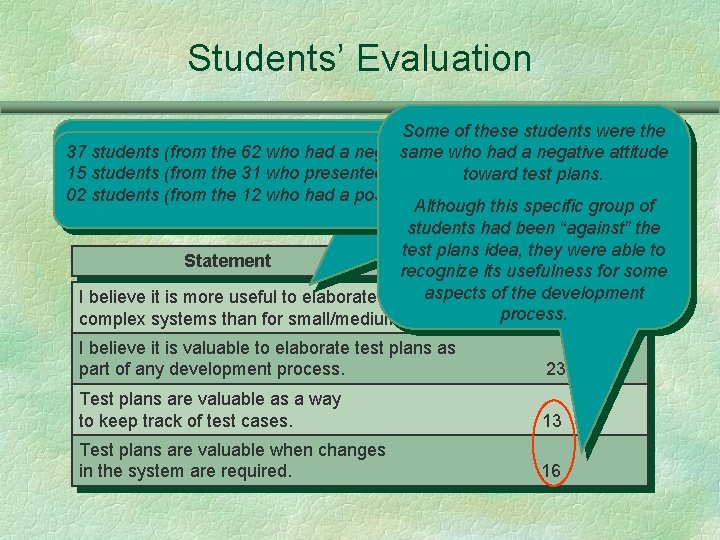
Students’ Evaluation Some of these students were the One reason for the “high rejection” of creating test plans 37 students (from the 62 who had a negative attitude toward test plans) same who had a negative attitude can be related to the kind of system u 15 students (from the 31 who presented a neutral toward position) test plans. (small-to-medium size) the students had to develop in the 02 students (from the 12 who hadabout a positive attitude) Ø Some statements test plans CS 2340 projects. Although this specific group of students had been “against” the test plans idea, they were able to Statement Students recognize its usefulness for some aspects I believe it is more useful to elaborate test plans for of the development complex systems than for small/medium systems. process. 54 Writing testing plans I believe it is valuable to elaborate test plans as part of any development process. 23 Test plans are valuable as a way to keep track of test cases. 13 Test plans are valuable when changes in the system are required. 16
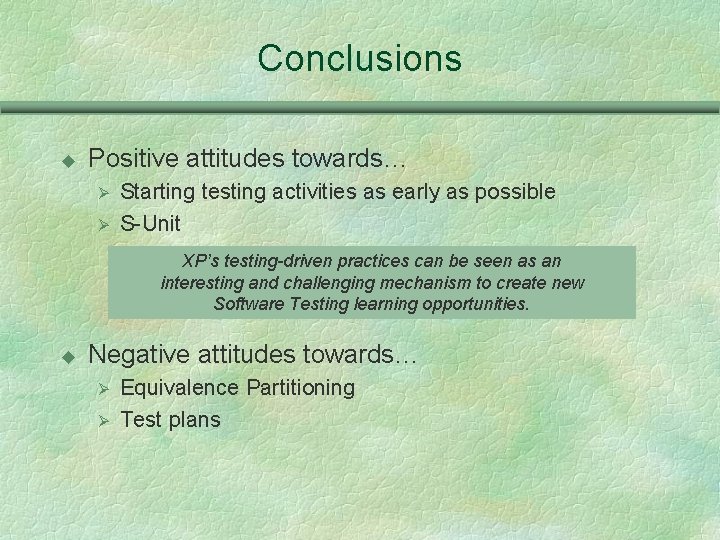
Conclusions u Positive attitudes towards… Ø Ø Starting testing activities as early as possible S-Unit XP’s testing-driven practices can be seen as an interesting and challenging mechanism to create new Software Testing learning opportunities. u Negative attitudes towards… Ø Ø Equivalence Partitioning Test plans
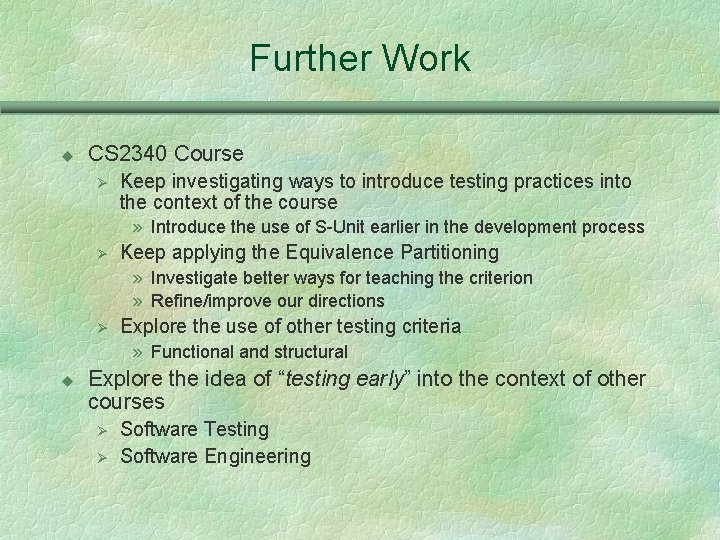
Further Work u CS 2340 Course Ø Keep investigating ways to introduce testing practices into the context of the course » Introduce the use of S-Unit earlier in the development process Ø Keep applying the Equivalence Partitioning » Investigate better ways for teaching the criterion » Refine/improve our directions Ø Explore the use of other testing criteria » Functional and structural u Explore the idea of “testing early” into the context of other courses Ø Ø Software Testing Software Engineering