
Workshop on Technology Pathways Forward for CCS on
- Slides: 16
Workshop on Technology Pathways Forward for CCS on Natural Gas Power Systems United States Energy Association Mark Ackiewicz Director, Division of CCS Research U. S. Department of Energy April 22, 2014
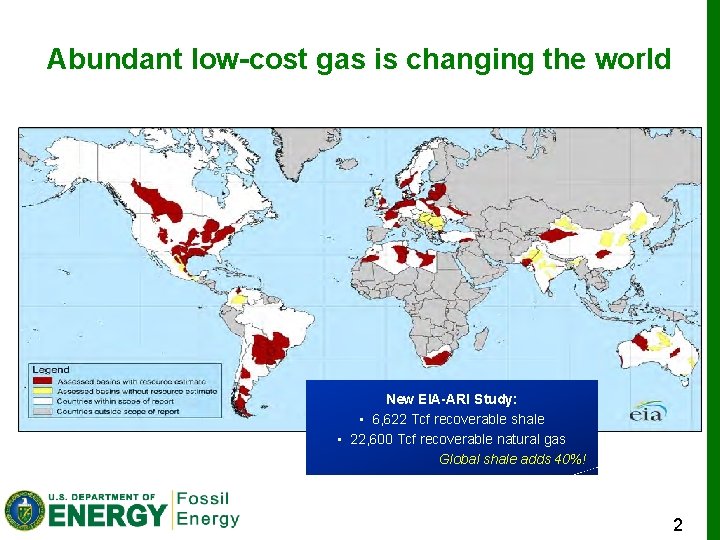
Abundant low-cost gas is changing the world New EIA-ARI Study: • 6, 622 Tcf recoverable shale • 22, 600 Tcf recoverable natural gas Global shale adds 40%! 2
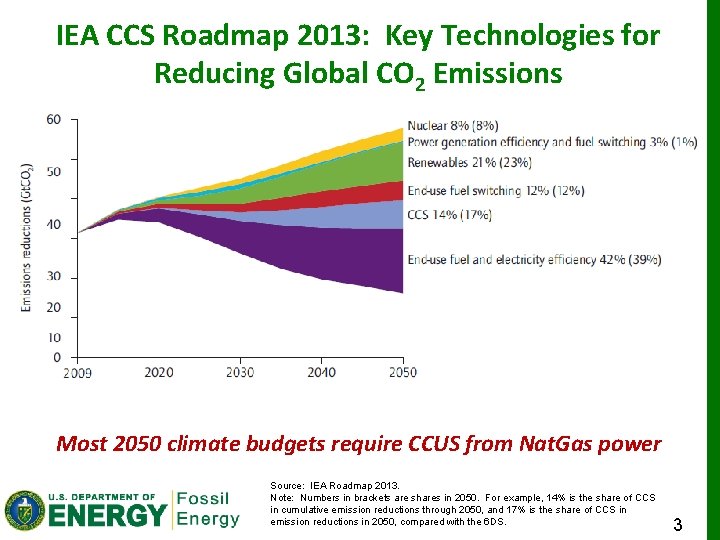
IEA CCS Roadmap 2013: Key Technologies for Reducing Global CO 2 Emissions Most 2050 climate budgets require CCUS from Nat. Gas power Source: IEA Roadmap 2013. Note: Numbers in brackets are shares in 2050. For example, 14% is the share of CCS in cumulative emission reductions through 2050, and 17% is the share of CCS in emission reductions in 2050, compared with the 6 DS. 3
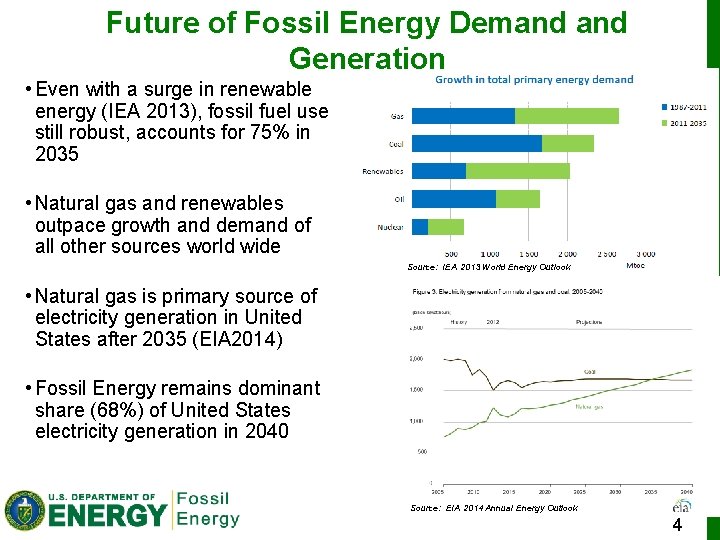
Future of Fossil Energy Demand Generation • Even with a surge in renewable energy (IEA 2013), fossil fuel use still robust, accounts for 75% in 2035 • Natural gas and renewables outpace growth and demand of all other sources world wide Source: IEA 2013 World Energy Outlook • Natural gas is primary source of electricity generation in United States after 2035 (EIA 2014) • Fossil Energy remains dominant share (68%) of United States electricity generation in 2040 Source: EIA 2014 Annual Energy Outlook 4
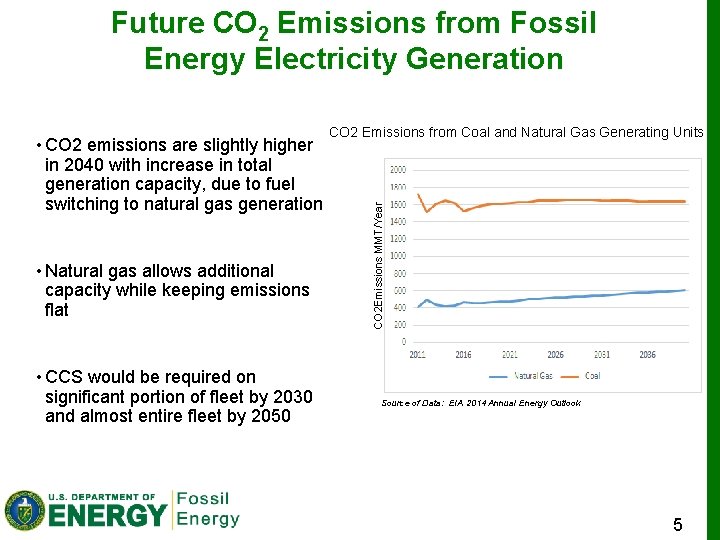
Future CO 2 Emissions from Fossil Energy Electricity Generation • Natural gas allows additional capacity while keeping emissions flat • CCS would be required on significant portion of fleet by 2030 and almost entire fleet by 2050 CO 2 Emissions from Coal and Natural Gas Generating Units CO 2 Emissions MMT/Year • CO 2 emissions are slightly higher in 2040 with increase in total generation capacity, due to fuel switching to natural gas generation Source: IEA 2013 World Energy Outlook Source of Data: EIA 2014 Annual Energy Outlook 5
Fossil Energy FY 14 Budget Activities • FY 14 Key Activities – Support to existing portfolio and 18 new capture projects awarded in early FY 2014 • 2 nd generation small-scale pilot, bench, and laboratory projects – Several projects have/plan to test solvents, sorbents and membranes under natural gas conditions. • Funded outside of project scope to satisfy industrial partners interests – Negotiation and Award of Carbon Capture R&D Test Facility • CCS for Natural Gas – Congressional appropriations provided guidance that research and development could consider natural gas as long as it does not negatively impact efforts to develop technologies for coal. 6
FY 15 Fossil Energy Budget Request • FY 15 Key Activities for Carbon Capture – Large-scale carbon capture pilot facility(ies) 10 MW+ – Begin identifying transformational technologies for carbon capture – Continue support to small-scale pilot projects • Natural Gas CCS Demo – $25 million requested would be competed to fund work that directly demonstrates technology to capture and store more than 75 percent of the carbon from treated emissions from a natural gas power system. 7
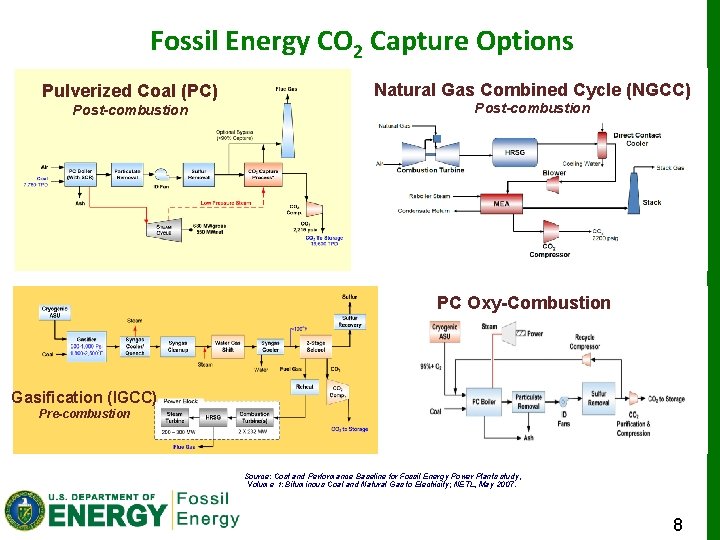
Fossil Energy CO 2 Capture Options Pulverized Coal (PC) Post-combustion Natural Gas Combined Cycle (NGCC) Post-combustion PC Oxy-Combustion Gasification (IGCC) Pre-combustion Source: Cost and Performance Baseline for Fossil Energy Power Plants study, Volume 1: Bituminous Coal and Natural Gas to Electricity; NETL, May 2007. 8
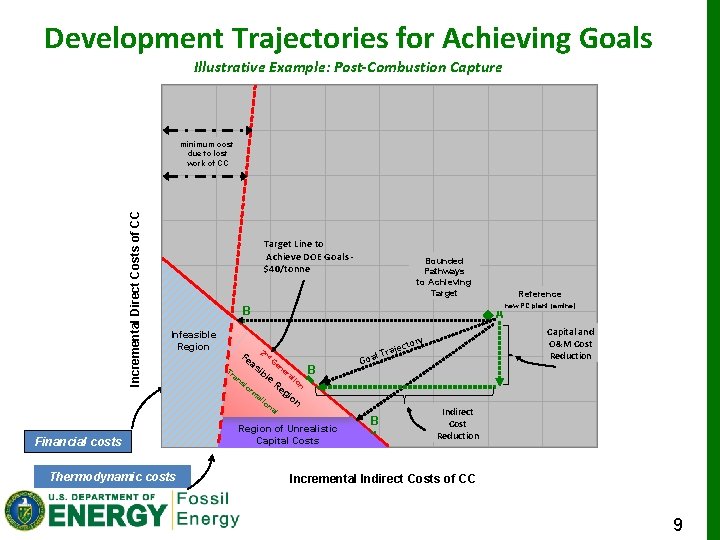
Development Trajectories for Achieving Goals Illustrative Example: Post-Combustion Capture Incremental Direct Costs of CC minimum cost due to lost work of CC Target Line to Achieve DOE Goals $40/tonne A 2 nd Fe Tr as ib an sf or m l Tr G le at io en er Re at gi io n na B Goa on l Thermodynamic costs Reference new PC plant (amine) B ' Infeasible Region Financial costs Bounded Pathways to Achieving Target Region of Unrealistic Capital Costs B '' Capital and O&M Cost Reduction tory ajec Indirect Cost Reduction Incremental Indirect Costs of CC 9
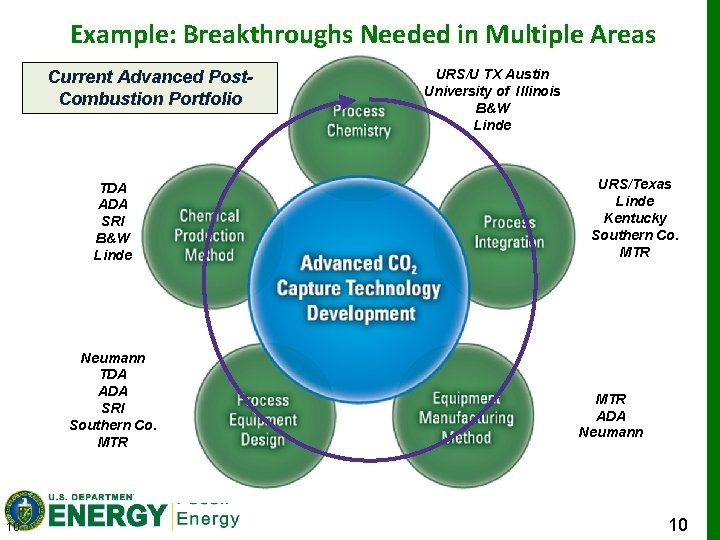
Example: Breakthroughs Needed in Multiple Areas Current Advanced Post. Combustion Portfolio TDA ADA SRI B&W Linde Neumann TDA ADA SRI Southern Co. MTR 10 URS/U TX Austin University of Illinois B&W Linde URS/Texas Linde Kentucky Southern Co. MTR ADA Neumann 10
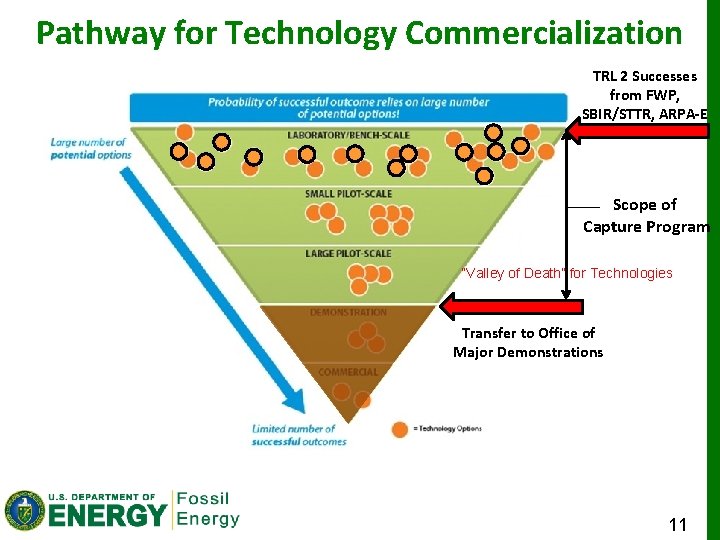
Pathway for Technology Commercialization TRL 2 Successes from FWP, SBIR/STTR, ARPA-E Scope of Capture Program “Valley of Death” for Technologies Transfer to Office of Major Demonstrations 11
Questions? 12
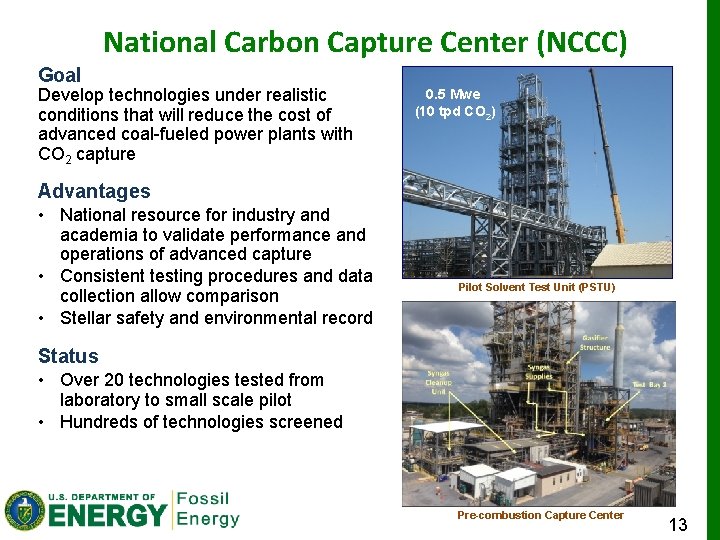
National Carbon Capture Center (NCCC) Goal Develop technologies under realistic conditions that will reduce the cost of advanced coal-fueled power plants with CO 2 capture 0. 5 Mwe (10 tpd CO 2) Advantages • National resource for industry and academia to validate performance and operations of advanced capture • Consistent testing procedures and data collection allow comparison • Stellar safety and environmental record Pilot Solvent Test Unit (PSTU) Status • Over 20 technologies tested from laboratory to small scale pilot • Hundreds of technologies screened Pre-combustion Capture Center 13
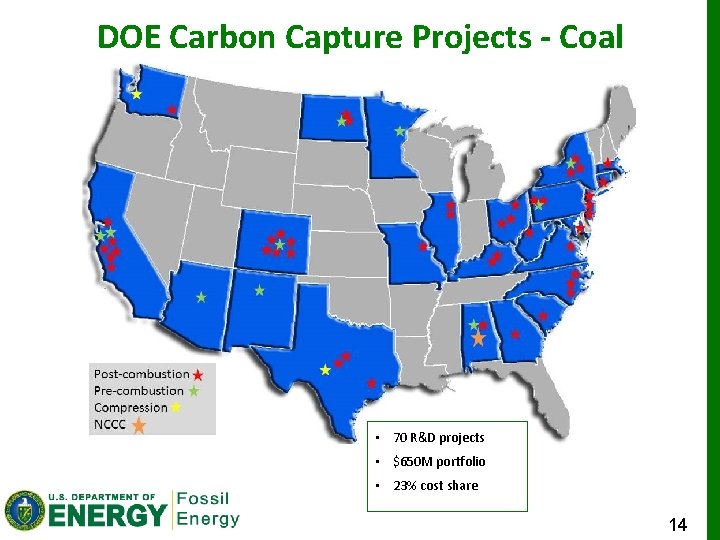
DOE Carbon Capture Projects - Coal • 70 R&D projects • $650 M portfolio • 23% cost share 14
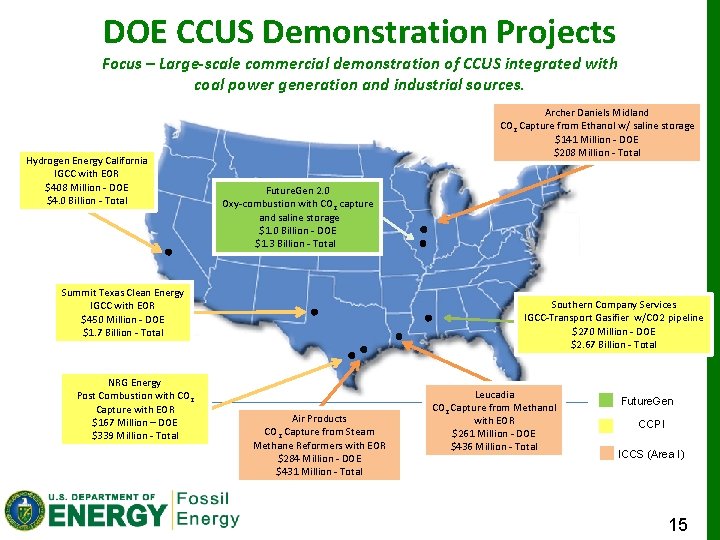
DOE CCUS Demonstration Projects Focus – Large-scale commercial demonstration of CCUS integrated with coal power generation and industrial sources. Hydrogen Energy California IGCC with EOR $408 Million - DOE $4. 0 Billion - Total Archer Daniels Midland CO 2 Capture from Ethanol w/ saline storage $141 Million - DOE $208 Million - Total Future. Gen 2. 0 Oxy-combustion with CO 2 capture and saline storage $1. 0 Billion - DOE $1. 3 Billion - Total Summit Texas Clean Energy IGCC with EOR $450 Million - DOE $1. 7 Billion - Total NRG Energy Post Combustion with CO 2 Capture with EOR $167 Million – DOE $339 Million - Total Southern Company Services IGCC-Transport Gasifier w/CO 2 pipeline $270 Million - DOE $2. 67 Billion - Total Air Products CO 2 Capture from Steam Methane Reformers with EOR $284 Million - DOE $431 Million - Total Leucadia CO 2 Capture from Methanol with EOR $261 Million - DOE $436 Million - Total Future. Gen CCPI ICCS (Area I) 15
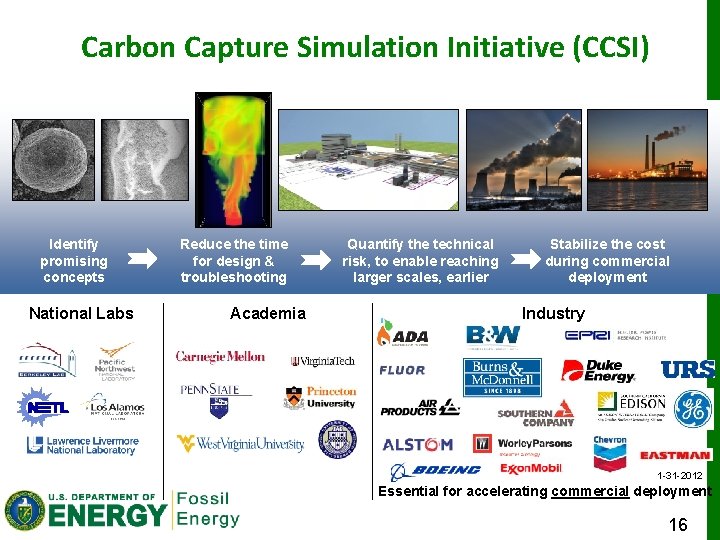
Carbon Capture Simulation Initiative (CCSI) Identify promising concepts National Labs Reduce the time for design & troubleshooting Academia Quantify the technical risk, to enable reaching larger scales, earlier Stabilize the cost during commercial deployment Industry 1 -31 -2012 Essential for accelerating commercial deployment 16